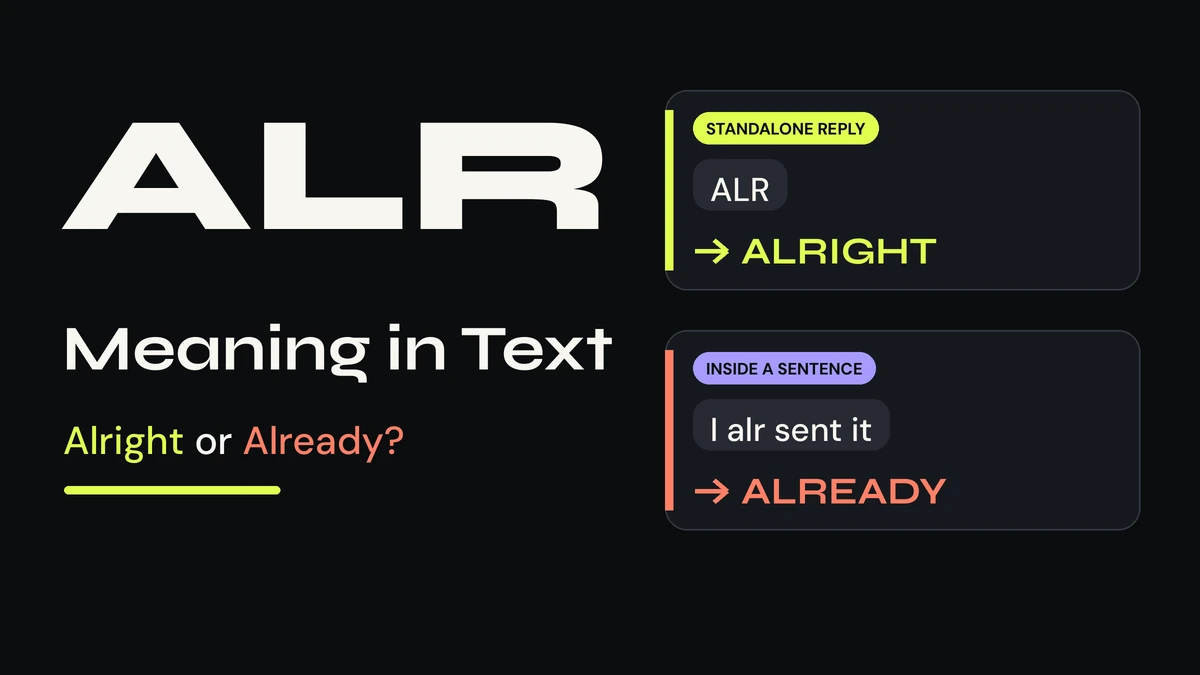
In texting, ALR can shorten either “alright” or “already.” When it stands alone as a reply, it usually reads as “alright” or “okay”; inside a sentence such as “I alr sent it,” it means “already.”
Where the word sits in the message tells you which one you are looking at. Below: both readings, a three-step test for telling them apart, what an “alr” reply usually feels like, and how to answer it — without guessing at someone’s mood from three letters.
What ALR Means in a Text
“Alr” is a shortened spelling, known as a clipping, of two ordinary English words. It is not an acronym assembled from the initials of a phrase; it is a faster way to type “alright” or, in the right sentence, “already.”
The dictionary record for the abbreviation itself lists both source words. Wiktionary’s entry for “alr” records it, in Internet slang and text messaging, as a clipping of “already” and of “alright” — including “alright” used as a small standalone word of agreement. Because one short form serves two words, readers can pick the wrong one; the sentence around it is what settles the question.
There is no measured count of how often “alr” means one word rather than the other, so this guide crowns no winner. It teaches the test instead.
Alright or Already? The Grammar-and-Position Test
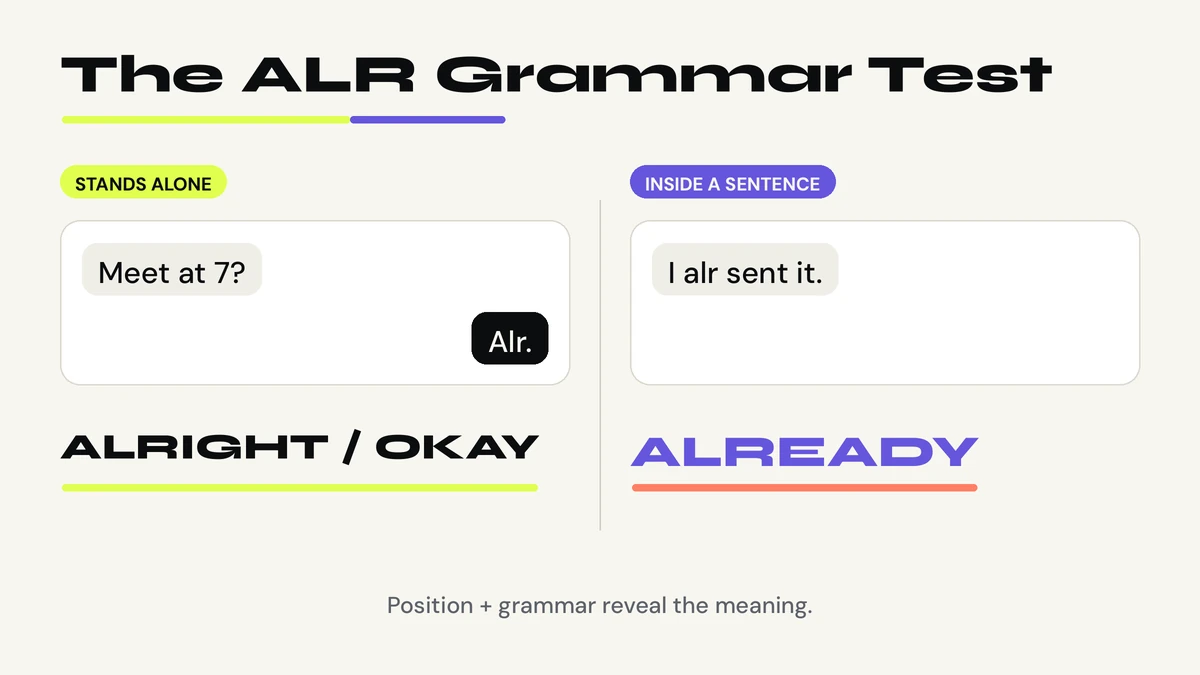
When an “alr” lands in your chat, run these three checks in order.
1. Is it standing alone, or opening the message?
If “alr” is the entire reply, or opens the message before a new thought, read “alright.” In that position it does the work of “okay”: agreeing, accepting, or acknowledging. “Bus leaves at six.” “Alr.” No timing is being claimed — the sender is simply saying the plan is fine.
2. Is it inside a sentence, just before an action or a state?
If “alr” sits inside a sentence where an adverb belongs, typically right before a verb, read “already.” “I alr sent it” only makes sense as “I already sent it.” Try the swap test: replace “alr” with “alright,” and the sentence collapses. That collapse is your confirmation.
3. Let the surrounding words settle close calls
Plans, requests, and talk about the future pull toward “alright.” Reports about something finished pull toward “already.” If both swaps still seem possible, read the messages before and after; the wider conversation resolves it.
Two things will not resolve it. Capitalization will not: “ALR” and “alr” are the same word, and capital letters add emphasis at most, never a different expansion. Punctuation and emojis will not, either — they shade how a message feels, not which word the letters stand for. Position and grammar decide the meaning; everything else is tone.
ALR in Chat: Illustrative Examples
The conversations below are illustrative examples written for this guide, not recorded messages. Each note explains the reading.
Maya: The train is at 6:40, so don’t be late
Dev: alr
A standalone reply, so “alright.” Dev is acknowledging the plan: “okay, got it.”
Priya: Did you send the form to Ms. Carter?
Tom: I alr sent it this morning
Inside the sentence, directly before the action “sent,” so “already.” The swap test confirms it: “I alright sent it” makes no sense.
Sam: Tickets are booked for Saturday!
Ana: alr!! 🎉 can’t wait
Still “alright” — the exclamation marks and emoji add the excitement, not the word.
Leo: Sorry, only window seats are left
Nina: alr, that works
Neutral acceptance. Nina is agreeing to the alternative, neither thrilled nor upset.
Chris: You missed the meeting again
Jordan: alr.
After a criticism, a bare “alr.” can feel reluctant or dismissive. The word has not changed — the context has. Treat that as a possibility, not a verdict on Jordan’s mood.
Emma: Running ten minutes behind, sorry!
Liam: alr, no rush at all 😊
The same three letters, warmed up: the extra words and emoji make it reassuring — “alright” as “it’s fine, don’t worry.”
What Tone Does ALR Carry?
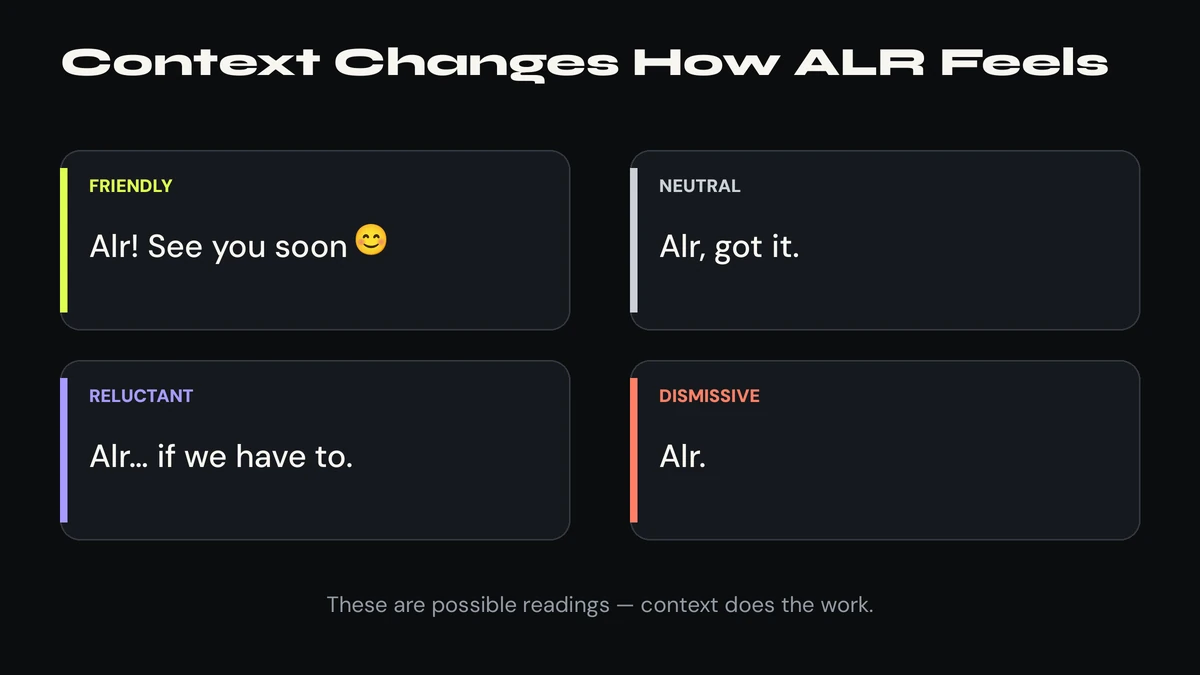
On its own, “alr” has no fixed emotion. It is a small, neutral tool, and its feeling is built by the conversation it lands in. Depending on that context, it can come across as:
- Friendly — when it arrives with warmth around it, in an easy, upbeat exchange.
- Neutral — its default setting: a plain acknowledgment that something was heard or agreed.
- Reassuring — when it opens a message that settles the other person: “alr, I’ve got it from here.”
- Reluctant — when it accepts something the sender would rather refuse.
- Impatient — when it lands after repeated reminders; any one-word reply would sound clipped there.
- Dismissive — when it closes down a topic, especially mid-argument.
- Conversation-closing — “alr, talk tomorrow” works as a friendly sign-off.
Notice what does the work in every case: the messages before it, the relationship, and what follows. Read the whole exchange before reading a mood into it.
Is ALR Rude?
Not by itself. The letters themselves do not encode rudeness, and a standalone “alr” says nothing about the sender’s attitude on its own. A bare “alr” can feel abrupt when it lands under a long, emotional, or detailed message, not because the word is hostile, but because the reply is so much shorter than what came before it. Relationship, timing, the sender’s normal texting style, and the surrounding words all shape how it reads. Treat brevity as neutral information rather than proof of hostility, and judge the whole exchange.
Does ALR Mean Something Different on TikTok or Snapchat?
The evidence reviewed for this guide does not establish a separate TikTok, Snapchat, Instagram, or general texting meaning for “alr.” The same two supported readings remain relevant on every platform, and the specific sentence still determines whether “alr” means “alright” or “already.” Platform alone is never enough to decide the meaning. A particular community could use the letters in its own way, which is one more reason the surrounding context remains necessary.
How to Reply When Someone Sends ALR
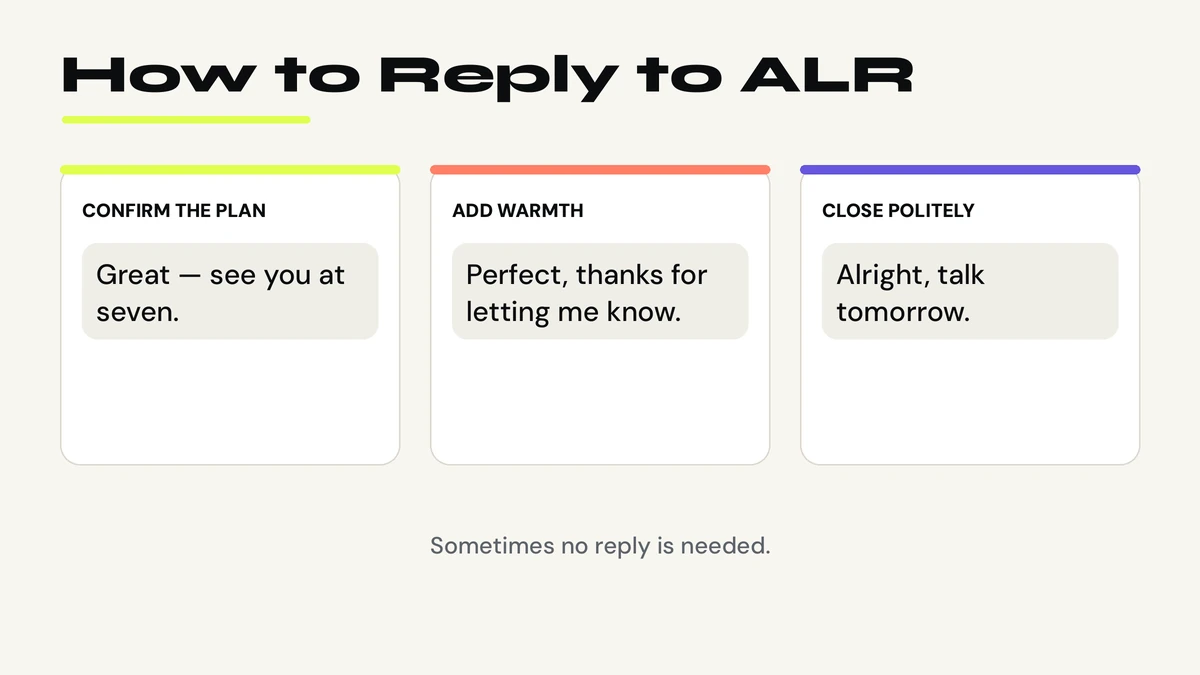
When ALR appears as a standalone reply, the sender is using the “alright” reading to acknowledge or accept the message. A reply is often unnecessary, because that “alr” can complete the exchange on its own. When a reply is needed, match it to what you want to do.
To confirm and move on
Keep it short and clear: “See you at seven, then.” Or: “Great, that’s settled.”
To add warmth
A full short sentence feels friendlier than another abbreviation: “Perfect, thanks for sorting that.”
To keep planning
Build on the agreement: “Great — I’ll book the table for eight.”
If their “alr” felt reluctant
Give them an easy way out instead of pushing: “No pressure if you’d rather skip it.” It acknowledges the hesitation without arguing about tone.
To close the chat politely
Mirror the sign-off: “Alright, talk tomorrow.”
ALR vs OK, K, Aight, and Bet
OK — broader than “alr” and generally clearer across casual and semi-formal contexts. Where “alr” is pure chat shorthand, “OK” travels more easily into careful messages.
K — the shortest reply of all. Because it is extremely brief, some readers may feel it as colder, but that reaction is not guaranteed. The surrounding conversation still controls how it lands.
Aight — an informal spelling and pronunciation form related to “alright,” with a spoken flavour. It belongs to the same family as “alr,” but the two are not interchangeable in every setting.
Bet — in some conversations, “bet” communicates agreement or acceptance with a more energetic feel. Like every term in this list, it carries no guaranteed tone. Context decides.
When Not to Use ALR
Save “alr” for people and places where shorthand is welcome. In professional or formal communication, “okay,” “understood,” or a complete sentence is usually clearer than ALR. That applies to work emails, school assignments, and applications, where the full form also avoids any impression of carelessness. The same care belongs in serious or emotional conversations. An apology, bad news, or a friend having a hard week deserves complete sentences rather than abbreviations.
Frequently Asked Questions
What does ALR mean in texting?
It shortens either “alright” or “already.” Standing alone as a reply, it reads as “alright”; inside a sentence, it can mean “already.”
Can ALR mean “already”?
Yes. When “alr” sits inside a sentence, just before an action — “I alr sent it” — it means “already.”
How can I tell whether ALR means “alright” or “already”?
Check its position. A standalone “alr” is “alright.” An “alr” inside a sentence, where an adverb belongs, is “already.” Unsure? Swap in each word and keep the one that survives.
Is ALR rude?
Not on its own. The letters do not encode rudeness. A bare “alr” under a long or emotional message can feel abrupt, but brevity alone is not proof of hostility. Check the conversation and the sender’s usual style.
What does ALR mean on TikTok or Snapchat?
The evidence reviewed for this guide does not establish a separate TikTok or Snapchat meaning. The sentence still decides: “alright” as a standalone reply, “already” inside a sentence.
Can I use ALR in a work message?
It is better not to. With managers, teachers, or clients, write “alright” or “okay” in full — it is clearer and reads as more careful.
The Takeaway
“Alr” is one small form doing two jobs. Standing alone, it is “alright” — a quick okay. Inside a sentence, it can be “already.” Position and surrounding words, not capital letters, tell you which job it is doing, and its tone comes from the same place as its meaning: the conversation it lands in.