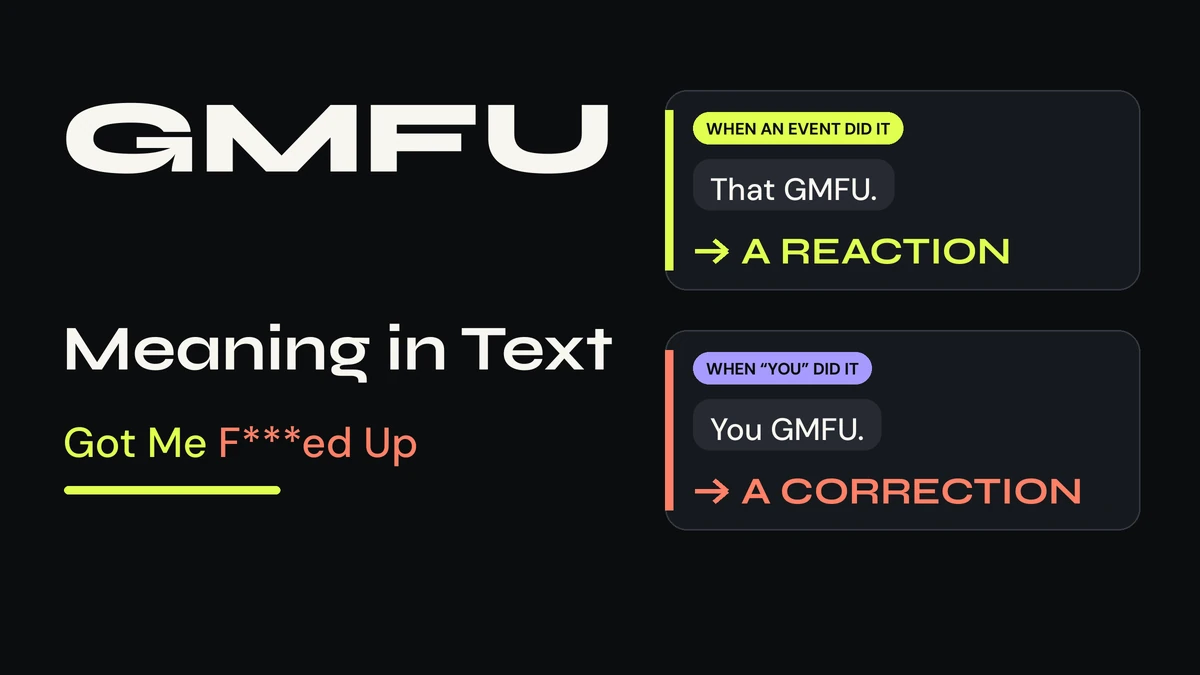
GMFU stands for “got me f***ed up.” In a text it is a strong reaction: something has shocked, annoyed or thrown the sender off balance. Aimed at a person – “you GMFU” – it means something sharper: you have got me wrong. The subject of the sentence tells you which one you are reading.
This guide separates the two readings with a simple who test, shows how the tone shifts, explains the one place GMFU means something entirely different, and gives you a reply for each case.
What GMFU Means in a Text
Read the phrase word by word. “Got me” means something has put the sender in a state. “F***ed up” names the state: rattled, offended, thrown off. So the acronym reports a condition, not an action – it is the sender saying “the state I am in right now is not okay, and something caused it.”
A note on sources, because this term is newer than most: the classic dictionaries have not caught up with it yet. Neither Wiktionary nor Merriam-Webster lists GMFU (checked in October 2026), so there is no dictionary definition to quote. What exists instead is a unanimous reading across slang references – all of them give the same expansion – plus a well-documented life in music and social media, covered in the origin section below. The expansion itself is not in doubt; it just has not been stamped by a dictionary yet.
Reaction or Correction? The Who Test
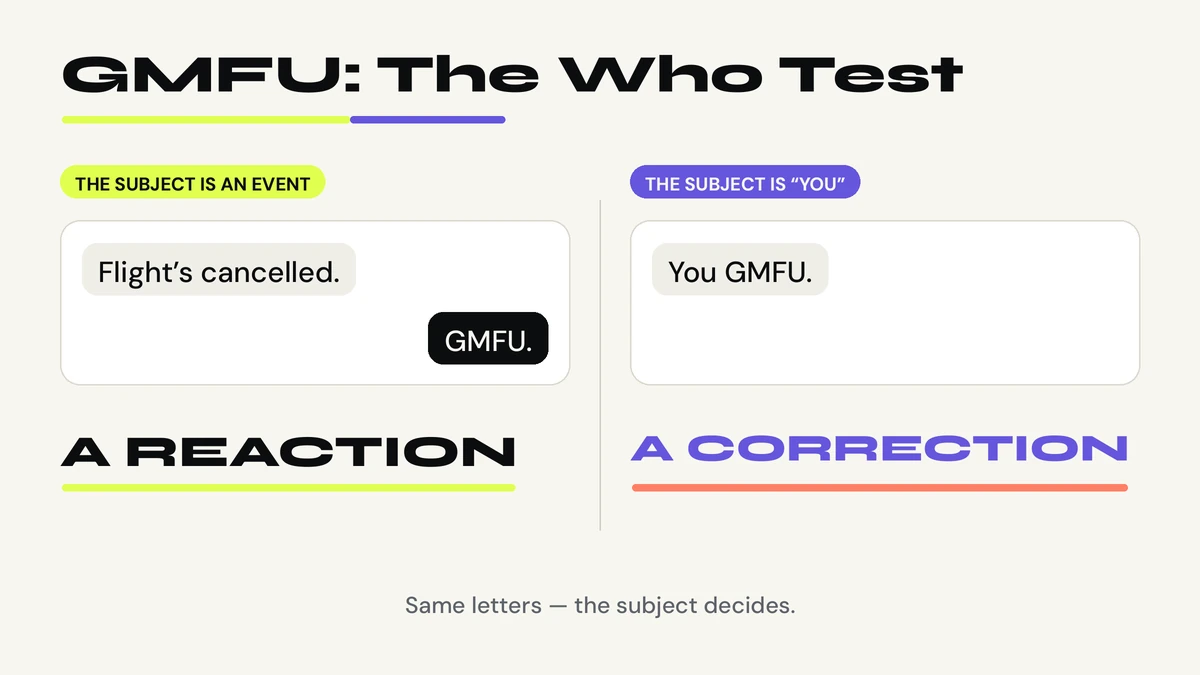
GMFU points in one of two directions, and one question separates them: who or what did the “getting”?
1. An event did it: a reaction
If the subject is a thing – “that GMFU,” “this GMFU,” or a piece of news standing behind it – the sender is reporting their own state. They are shocked, annoyed or in disbelief, and the message accuses nobody in the chat. It works the way “that’s messed up” or “I can’t believe this” does, at higher volume.
2. “You” did it: a correction
If the subject is “you,” the direction reverses. “You got me fucked up” means “you have the wrong idea about me” – the sender feels misjudged, misunderstood or disrespected, and is correcting the record. It usually follows an assumption or an accusation, and it is the reading a recipient should take seriously: a boundary is being restated.
3. No subject at all: pure reaction
A standalone “GMFU.” under a video or after a headline is a reaction by default – the event is whatever you are both looking at. When the subject is missing, read the message just before it; that is where the event lives.
GMFU in Chat: Illustrative Examples
The conversations below are illustrative examples written for this guide, not recorded messages. Each note explains the reading.
Nadia: Flight got cancelled. We are stuck here till morning.
Theo: GMFU 😭
A reaction. The event – the cancellation – did the “getting.” The emoji keeps it at shocked and annoyed, not furious.
Zoe: Did you see the goalkeeper score from his own box?
Ram: GMFU. That’s unreal.
Disbelief, the friendly end of the reaction reading. Nothing has gone wrong; something has gone unbelievably right.
Kofi: Be honest, you told Sara the plan, right?
Dan: You GMFU. I didn’t say a word.
A correction. The subject is “you,” and Dan feels misjudged – he is defending himself, not reacting to news. Laughing this off would miss the point.
Priya: You ate the last slice, didn’t you.
Jay: …maybe.
Priya: GMFU 😂
Playful. The offense is performed rather than felt – the emoji and the friendship give it away.
Mia: He really thought I’d just cover his shift again.
Leo: Yeah, he GMFU.
The correction reading in the third person: he misjudged her. Mia is reporting it, not sending it.
What Tone Does GMFU Carry?
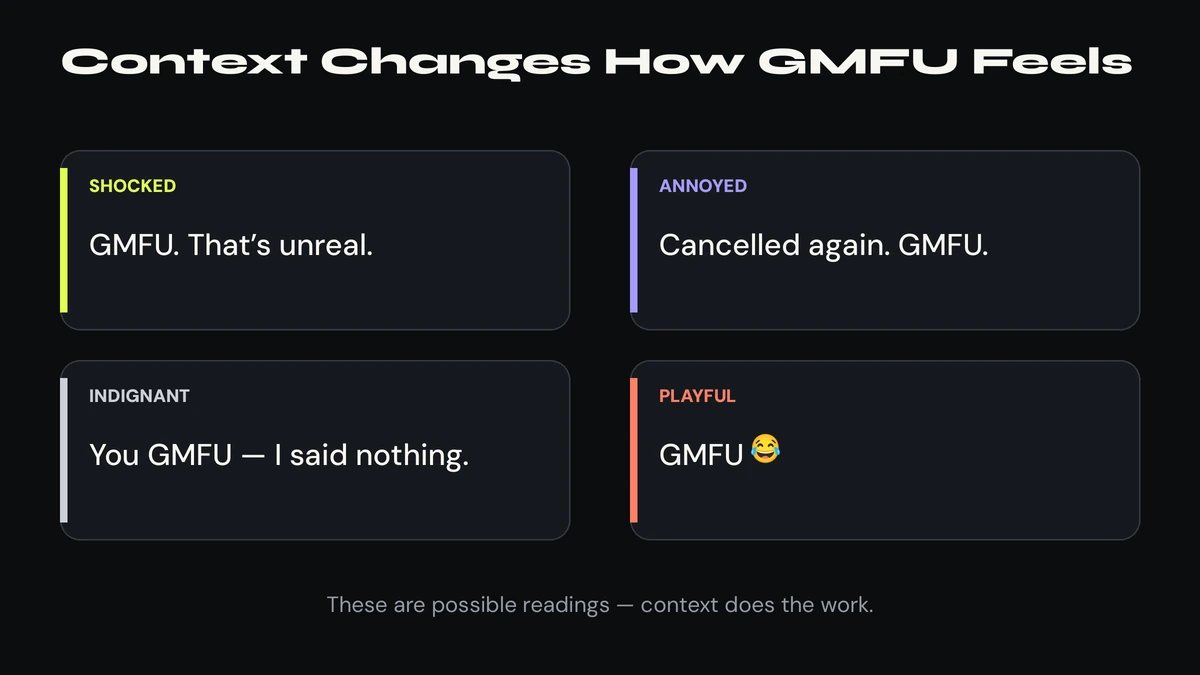
Short reaction terms work this way generally – ALR can land warm or cold depending on the chat around it – and GMFU sits at the blunt end of that family. Depending on the moment, it can sound:
- Shocked – for the message that makes you re-read it.
- Annoyed – for the cancellation, the delay, the repeat offense.
- Indignant – the correction setting: a boundary being restated.
- Playful – performed outrage between friends, usually with a laughing emoji attached.
Weigh the same three signals each time: the subject (an event or a “you”), the emoji, and what the sender just received – news, or an accusation. Those three settle most readings before you reply.
Is GMFU Rude?
It is blunt by construction: the phrase contains a profanity, so GMFU never reads as polite, whatever the intent. Within that, intent still matters. Among friends, with humor signals, it lands as exaggeration. The correction reading is the confrontational one by design – it tells the other person they misread you – so if a GMFU follows something you said about the sender, do not laugh it off. That one is asking to be heard, and answering the misunderstanding works better than answering the tone.
A Different GMFU in Crypto Chats
One community uses the same four letters for something unrelated. In crypto social circles, GMFU is a joking twist on “GM” – the daily “good morning” greeting those communities exchange – and it stands for “Good Morning F*** U”: a self-mocking counter-greeting for a bad market morning, as Gate’s crypto glossary documents.
So if a GMFU appears in a trading chat early in the day, next to price talk and red charts, it is probably this greeting, not the reaction – the sender is mocking the morning, not you.
Where GMFU Comes From
Slang references trace the phrase “got me fucked up” to African American Vernacular English, spread widely through hip-hop lyrics and social media. Precise dates are harder to pin down than most explainers admit – as noted above, the dictionaries that would normally settle the record have not listed the term yet, so this guide attributes the origin rather than certifying it. What is firmly documented is the acronym’s mainstream arrival: in October 2026, The Source reported that the rapper Offset had titled his solo album GMFU (Got Me Fucked Up), explaining that the title came from feeling thrown off by distractions that did not matter. An album title needs no translation for its audience – by 2026, neither did GMFU.
How to Reply When Someone Sends GMFU
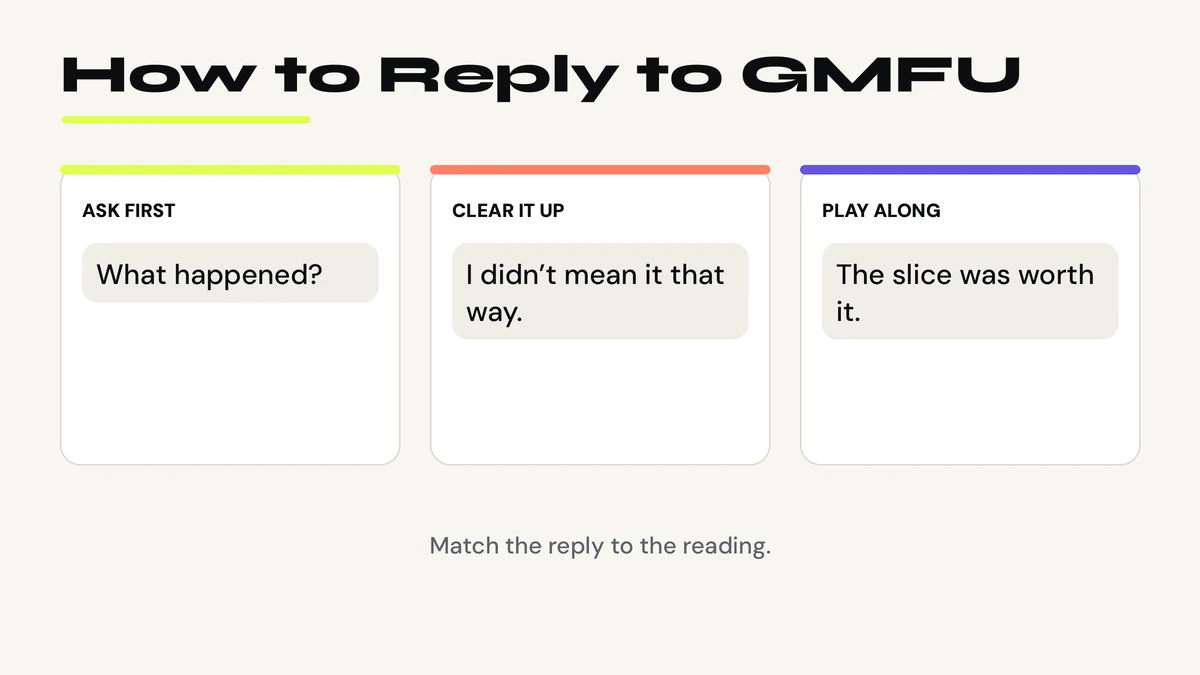
Run the who test first – an event or a “you”? Your reply depends entirely on which GMFU arrived.
If it was a reaction
Ask before you match the energy: “What happened?” If you already know the story, a small acknowledgement – “that’s rough” – beats a joke while the sender is still rattled.
If it was a correction aimed at you
They feel misjudged, so answer the misunderstanding, not the acronym: “I didn’t mean it that way – here’s what I meant.” And if you did misjudge them, a plain apology ends it faster than any defense. Doubling down is how a correction becomes an argument.
If it was playful
Play back at the same size: own the crime lightly – “the slice was worth it” – and let the emoji do the rest.
Cleaner Alternatives and When Not to Use GMFU
The idea translates cleanly when the word does not fit. For the reaction: “that’s messed up,” “I can’t believe this,” or “that threw me.” For the correction: “you’ve got me wrong” says the same thing with no profanity at all. Keep GMFU out of work chats, school and client emails, conversations with anyone who would read the profanity literally, and arguments you want to end rather than extend.
Frequently Asked Questions
What does GMFU stand for?
“Got me f***ed up” – the unanimous expansion across slang references. The classic dictionaries have not listed the acronym yet.
What does GMFU mean in texting?
A strong reaction to something shocking, annoying or unfair – or, aimed at a person, a correction: “you have the wrong idea about me.” The subject tells you which.
Does GMFU mean someone is angry at me?
Only in the correction reading, when the subject is “you”: then the sender feels misjudged by you. After news or an event, it is a reaction aimed at the situation, not at you.
What does GMFU mean in crypto chats?
Something different: a joking twist on the “GM” (good morning) greeting that stands for “Good Morning F*** U,” used self-mockingly on bad market mornings, per Gate’s glossary.
Is GMFU a bad word?
It stands for a phrase containing a profanity, so treat it as one: fine between friends who talk that way, out of place at work, school or with anyone formal.
How do you reply to GMFU?
By reading: ask what happened after a reaction, clarify or apologize after a correction aimed at you, and play back lightly when it is clearly a joke.
The Takeaway
GMFU is a state report: something knocked the sender off balance. Find the subject and you have the meaning – an event means a reaction you can simply answer, a “you” means a correction you should answer carefully. In a trading chat at breakfast time, check for the greeting instead.