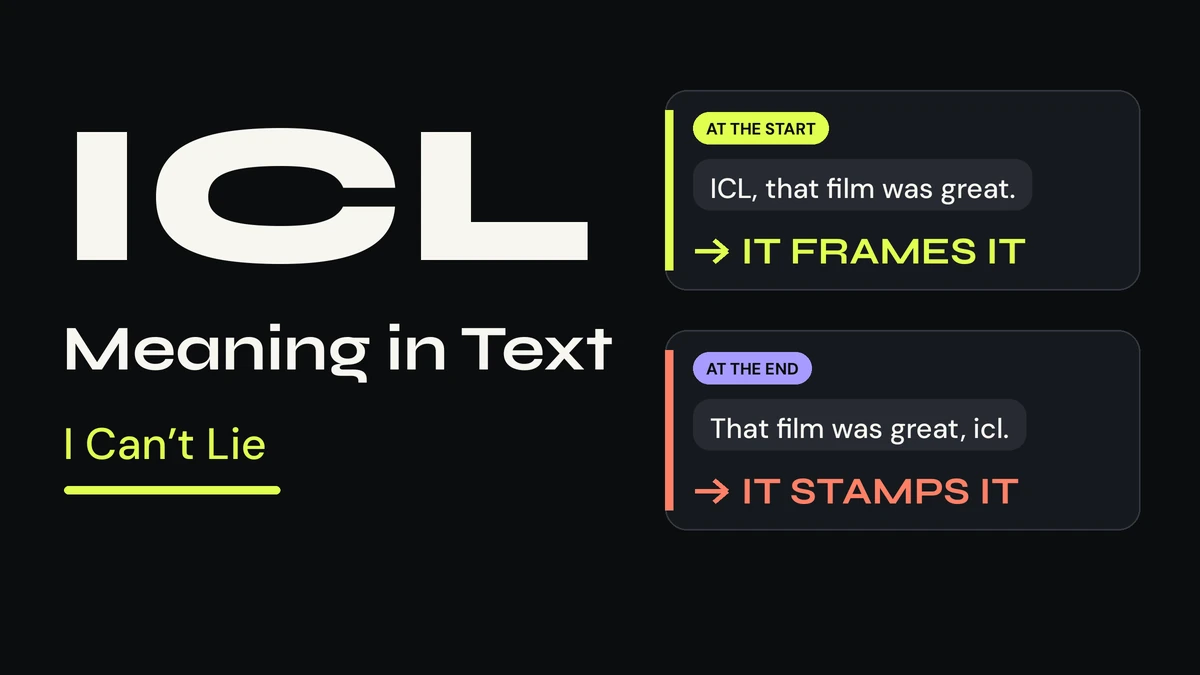
ICL means “I can’t lie.” In a text it adds no information of its own – it adds a promise: whatever sits next to it is the sender’s honest version. At the start of a sentence it frames an opinion or confession that is about to land; at the end it stamps the sentence as sincerely meant.
Where the three letters sit changes what they do, so this guide is built around position: the test, chat examples for each spot, how ICL compares with its honesty-marker cousins, and one popular claim about ICL that the evidence does not support.
What ICL Means in a Text
ICL is an initialism of the phrase “I can’t lie,” recorded by Wiktionary as an Internet-slang and text-messaging phrase. It belongs to a small family of honesty markers – short flags a sender plants next to a statement to say: read this one as candid. The statement itself carries the content; ICL carries the warranty.
The warranty matters because so much chat is performance – jokes, hype, polite filler. ICL tells the reader to switch modes: this opinion is real, this admission is genuine, this compliment is not flattery. Parade notes that the big general dictionaries have not given ICL its own entry yet, though they do recognize its close sibling NGL (“not gonna lie”) – which is roughly where ICL stands in the language: established in use, still being cataloged.
Start, End, or Standalone? The Position Test
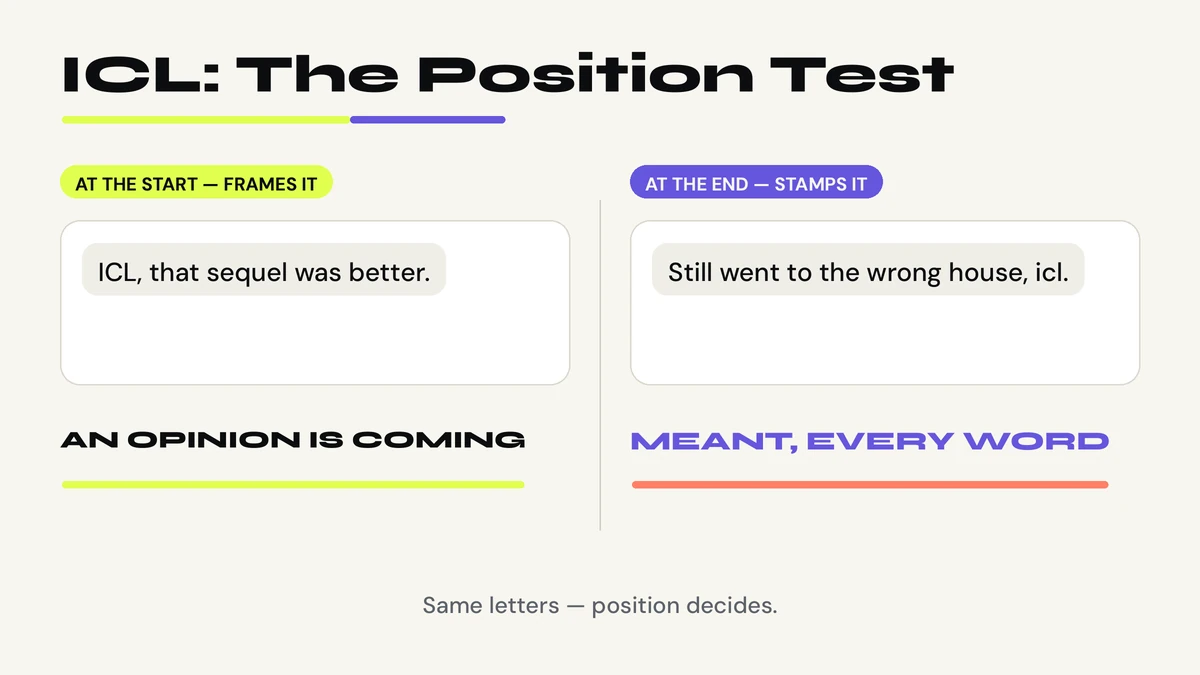
One term, three positions, three slightly different jobs. Checking where ICL sits is the fastest way to read the sender’s intent.
1. At the start: it frames what is coming
“ICL, that sequel was better than the first.” Up front, ICL is a frame and a small alert: an honest thing is on its way. It typically introduces an opinion the sender expects to surprise you, a confession, or a compliment that could otherwise sound like empty flattery.
2. At the end: it stamps what was said
“I double-checked the address and still went to the wrong house, icl.” At the end, the sentence is already complete, and ICL underlines it – a rueful or emphatic stamp that says the sender means every word, including the embarrassing parts.
3. Standing alone: an agreeing admission
As a whole reply, “icl” cosigns the previous message: same here, honestly. It admits agreement rather than just nodding along, which is why a bare “icl” under someone’s take reads warmer than it looks.
ICL in Chat: Illustrative Examples
The conversations below are illustrative examples written for this guide, not recorded messages. Each note names the position and the job it is doing.
Tara: Be honest, sequel or original?
Ben: ICL the sequel was better. Fight me.
Start position, framing an opinion Ben knows is contested – the marker is why “fight me” reads as confidence, not confusion.
Ana: You seem quiet about tomorrow.
Ravi: ICL I was nervous about the interview.
Start position again, but confessional: the honesty flag is doing heavier work here, because the admission costs Ravi something.
Kim: Did the parcel arrive?
Leo: It went to the wrong building again, icl.
End position. Leo’s report is complete without the marker; “icl” stamps it as exasperated fact, not a joke.
Zoe: This lecturer makes 8 a.m. feel illegal.
Sam: icl
Standalone. Sam’s whole reply is the cosign – an admission that he agrees completely.
Mia: New haircut. Be kind.
Tom: ICL it really suits you.
Start position in front of a compliment – exactly where the warranty matters, because the compliment could otherwise be read as politeness.
What Tone Does ICL Carry?
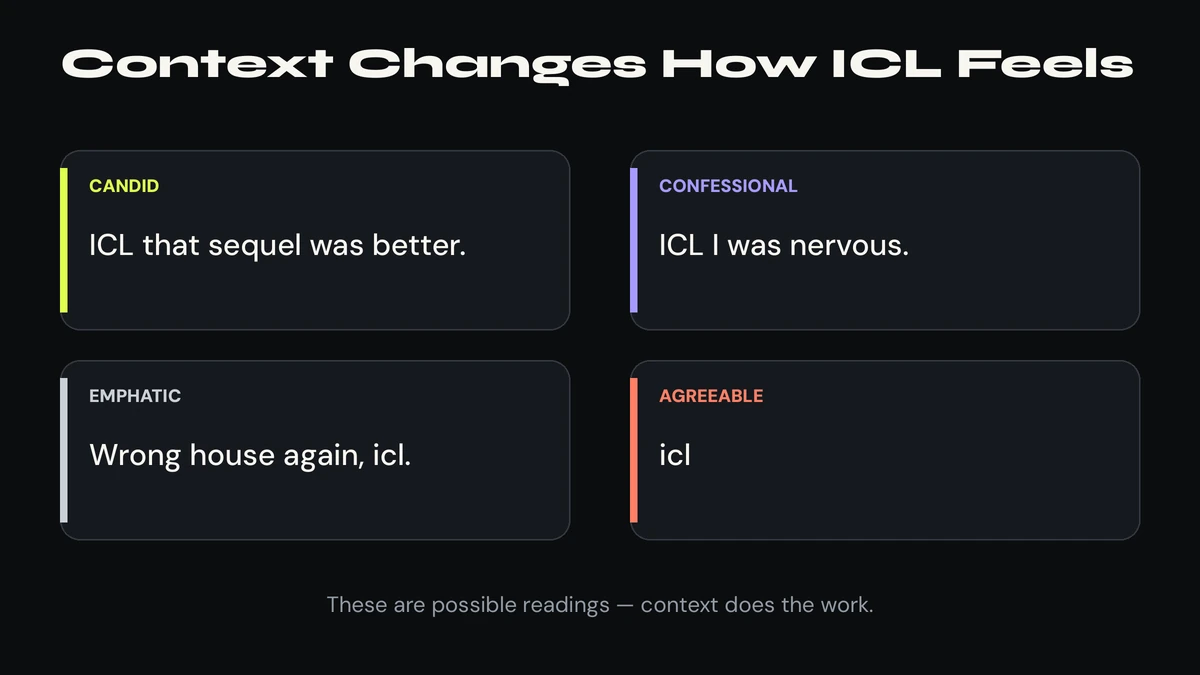
Most short chat markers bend with their surroundings – ALR can land warm or cold on the same three letters – and ICL is no exception, though its range is narrower because the honesty claim is built in. It tends to sound:
- Candid – a straight opinion, padding removed.
- Confessional – before something the sender finds hard to say.
- Emphatic – the end-position stamp on a statement already made.
- Agreeable – the standalone cosign, warmer than a bare “same.”
What it almost never does is joke about the honesty itself: a sender who writes ICL is asking to be believed, whatever else is funny in the message.
Is ICL Rude?
The letters contain no profanity and no insult, so ICL itself is not rude – Parade reaches the same conclusion. The risk sits in what the marker delivers: it announces that a blunt statement is deliberate rather than accidental, which can sharpen criticism. And a common misuse is worth avoiding yourself: ICL is not a license. “ICL, no offense, but…” does not cancel the offense – it confirms you knew.
The “I Care Less” Claim, Checked
Some explainer sites list a second expansion for ICL: “I care less,” said to express indifference. This guide does not use it, and here is the check. The claim appears in no dictionary record – both of Wiktionary’s ICL entries give only “I can’t lie” – and it is absent from the strongest mainstream coverage. It also has the fingerprints of a backronym invented to pad a list. Indifference already has a standard acronym, IDC (“I don’t care”). If a message seems to use ICL coldly, the honest reading is still “I can’t lie” – probably attached to a blunt statement – not a secret second meaning.
ICL vs NGL, TBH and FR
NGL (“not gonna lie”) is ICL’s closest cousin – so close that the two often swap freely. The wording hints at a weight difference readers can feel: “I can’t lie” claims something about the speaker’s character, while “not gonna lie” describes this one occasion, which is why NGL tends to ride along with lighter admissions and ICL with statements the sender wants believed. NGL is also the family member the general dictionaries have cataloged so far.
TBH (“to be honest”) is the classic the whole family descends from: neutral, slightly more formal, and the safest choice with mixed audiences. FR (“for real”) does the opposite job to ICL – it usually responds to someone else’s statement, agreeing or marveling, rather than framing your own. The four overlap, and context forgives most swaps; position and weight are what separate them.
Other ICLs Outside Texting
The same three letters hold formal jobs elsewhere, all recorded on Wiktionary’s ICL page: in eye care, an implantable collamer lens, a corrective lens placed inside the eye; in medicine, idiopathic CD4+ lymphocytopenia, a rare immune condition; and Imperial College London, the university. None of these travels into chat. In a text conversation, ICL is “I can’t lie” unless the conversation is literally about eyes, immune cells or universities.
Where ICL Comes From
The abbreviation is documented earlier than its recent fame suggests. Wiktionary’s citations include a Twitter post from 23 December 2019 – “Christmas really fell off icl” – which already uses it casually, in the end position, as if readers needed no explanation. Beyond that floor, the honest position is the one Parade takes: the exact origin cannot be pinpointed. Slang references attribute the spoken phrase “I can’t lie” to African American Vernacular English, and the shortening follows the usual texting pattern. One modern chapter is documented, though: Dexerto reported a 2024 TikTok trend that stacked ICL into copy-paste “slang walls” (“TS PMO ICL”), where the term was sprayed as decoration and its honesty job largely washed out – a reminder that a marker only works when a real statement stands next to it.
How to Reply to an ICL Message
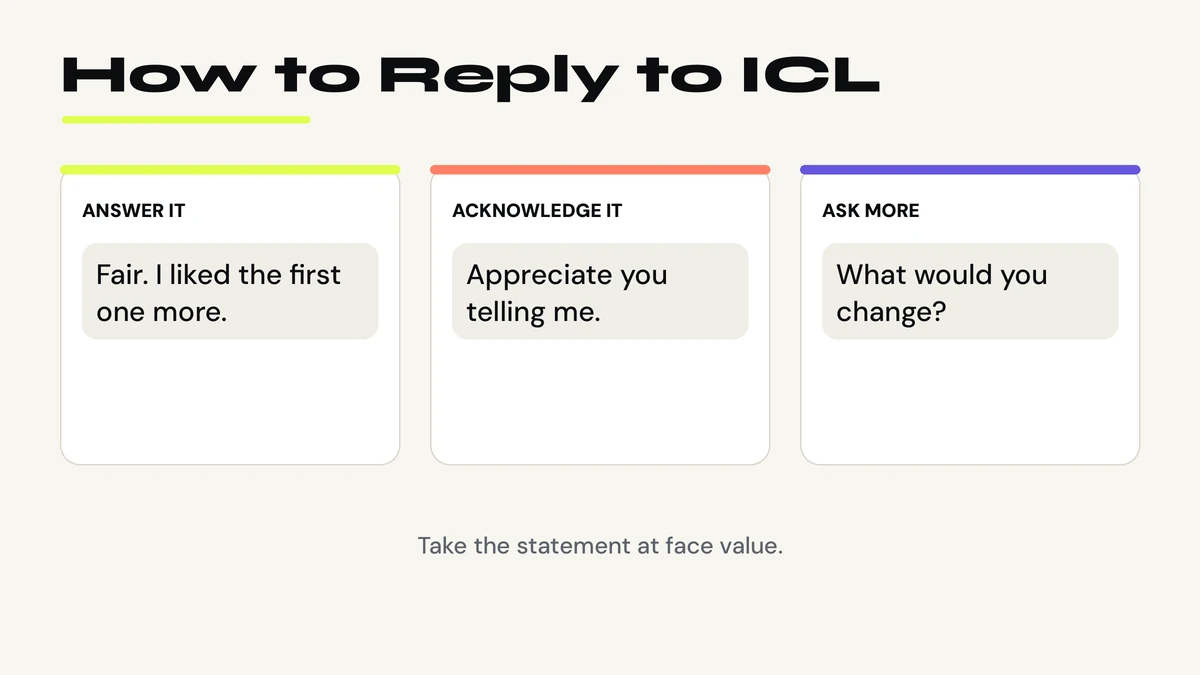
ICL messages ask for one thing above all: take the statement at face value. Beyond that, the right reply depends on what the marker is framing.
If it frames an opinion
Answer the opinion itself, with the same candor if you can: agree, disagree, ask why. Correcting the slang (“you mean ‘to be honest’?”) answers a message nobody sent.
If it frames a confession
Acknowledge the honesty before the content: “appreciate you telling me.” The sender spent something to say it; a reply that skips the acknowledgment and grabs the content can feel like a dismissal.
If it stamps blunt feedback about you
Treat it as considered, not careless – the marker says the sender meant it kindly enough to be sincere, or at least deliberately. Ask a follow-up (“what would you change?”) and the bluntness usually turns into useful detail.
Frequently Asked Questions
What does ICL stand for?
“I can’t lie.” Wiktionary records ICL as an Internet-slang and text-messaging initialism of that phrase.
What does ICL mean in texting?
It flags the words next to it as candid – an honest opinion, admission or reaction. At the start of a sentence it frames one; at the end it stamps one.
Is ICL the same as NGL?
Nearly. NGL is “not gonna lie”; the two introduce the same kinds of statements. ICL’s wording claims a habit of honesty, NGL’s a single occasion, so ICL often reads a touch weightier.
Does ICL mean “I care less”?
No reliable source says so. The claim circulates on explainer sites but appears in no dictionary record; indifference is IDC, “I don’t care.”
Is ICL rude or a bad word?
Neither. There is no profanity in it. What follows it can be blunt – the marker announces honesty, which is exactly why people use it.
Can I use ICL at work?
In casual team chat, probably; in anything formal, write the thought out. “To be honest” is the same signal in a suit.
The Takeaway
ICL is a warranty stamp in three letters: what it touches is meant sincerely. Read its position – framing at the start, stamping at the end, cosigning on its own – and you will hear not just what the sender said, but how hard they wanted you to believe it.