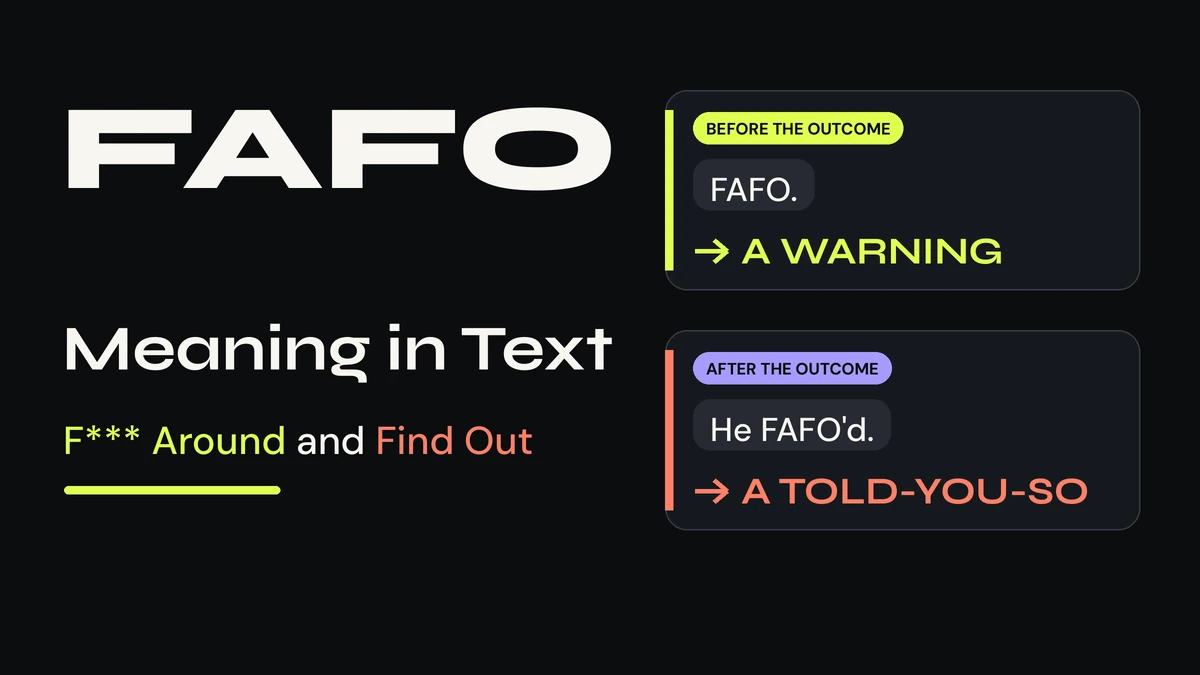
FAFO stands for “f*** around and find out.” In a text, it is a compact warning: keep pushing your luck and you will face the consequences. Sent after something has already gone wrong, the same four letters read as a told-you-so: you were warned, and it happened.
Which of the two you are looking at depends on timing – whether the bad outcome is still ahead of you or already behind you. Below: what each half of the phrase does, a timing test for telling the warning from the told-you-so, how FAFO’s tone shifts, and what to send back.
What FAFO Means in a Text
FAFO is an acronym – a word built from the first letters of a phrase. The phrase is “fuck around and find out,” and the idea it carries is older than the acronym: actions have consequences, and some lessons are only learned by living them.
The term is recorded directly by two authorities. Wiktionary’s entry for “FAFO” lists it as an acronym of “fuck around and find out,” and Merriam-Webster’s slang dictionary gives the same expansion, along with a politer respelling: “Fool Around and Find Out.”
The Two Halves: The Action and the Result
Read the phrase as two beats. The first half, “f*** around,” names the action: careless, provocative or rule-testing behavior – poking at something that was fine left alone. The second half, “find out,” names the result: the consequence arriving, usually unpleasant and usually predictable.
That is why FAFO points at a specific choice. It is rarely about bad luck. It is about a decision someone was warned about – or should have seen coming – and what that decision costs.
Before or After? The Timing Test
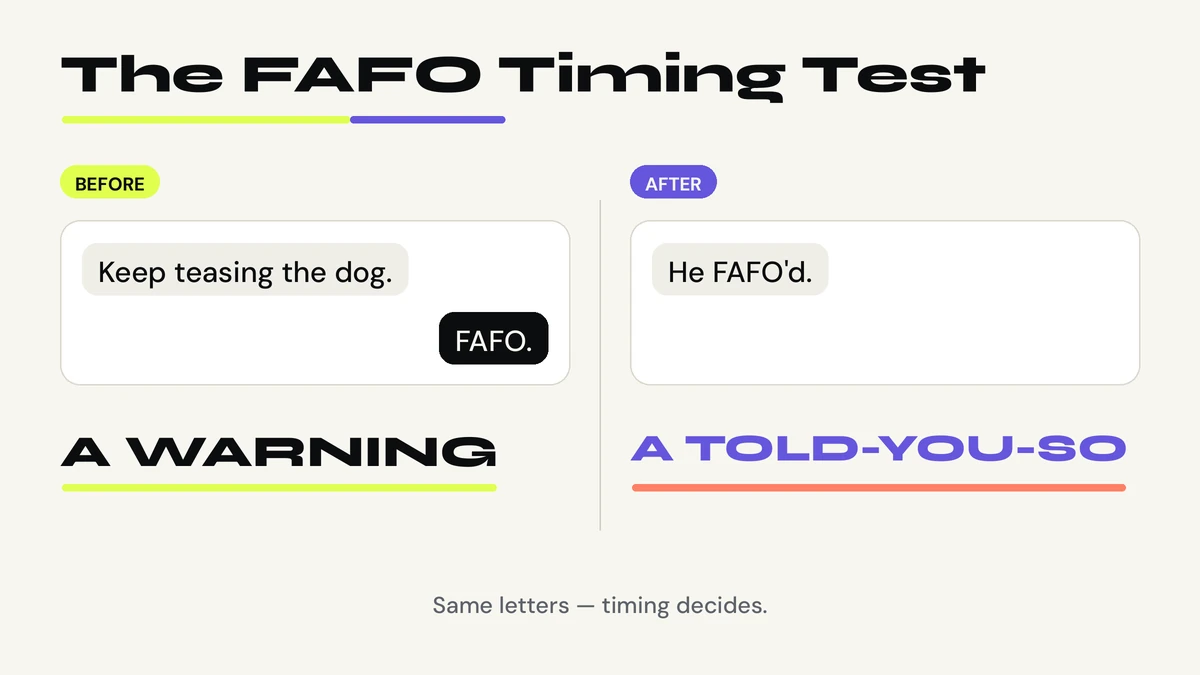
When FAFO lands in your chat, one question sorts out most of its meaning: has the consequence already happened?
1. Before the outcome: a warning
If the risky act is still in progress, or has not happened yet, FAFO looks forward. It means: stop, or you will find out. “Keep teasing the dog and FAFO” is advice wearing a threat’s clothing – the speaker is predicting the ending and offering a chance to change it.
2. After the outcome: a told-you-so
If the consequence has already landed, FAFO looks backward. It means: that is exactly what was going to happen. “He drove on the bald tire and FAFO’d” reports a finished story. Nothing is being warned about any more; the speaker is naming the lesson.
3. Aimed at you, or aimed past you?
Finally, check the direction. FAFO aimed at you carries a demand: back off, or accept what comes. FAFO about a third party – a video, a headline, a friend’s story – is commentary, and it asks nothing of you. The same letters, very different obligations.
FAFO in Chat: Illustrative Examples
The conversations below are illustrative examples written for this guide, not recorded messages. Each note explains the reading.
Ravi: I’m taking one of your fries.
June: Touch one and FAFO.
A warning before anything has happened – playful between friends, but the rule is real: the fries are not shared.
Marta: Stop answering his texts. He only calls when he wants something.
Ivy: I know, I know.
Marta: Keep going back and you’ll FAFO.
Still before the outcome, but nobody is joking. The warning is the message: the consequence is predictable, and Marta is naming it in advance.
Ben: I winged the whole quiz without studying.
Sofia: And?
Ben: 52. Total FAFO moment.
After the outcome. Ben is labeling his own result – the consequence arrived exactly as advertised.
Arun: Ignored the check-engine light for three months.
Arun: FAFO, I guess. The repair bill is huge.
Aimed at himself. The tone is rueful, not hostile – FAFO as a shrug at your own choices.
Lena: The guy who kept poking the wasp nest at the picnic?
Omar: He FAFO’d. Three stings.
The verb form in action – “FAFO’d” means he found out. Commentary about someone else; it asks nothing of the reader.
What Tone Does FAFO Carry?
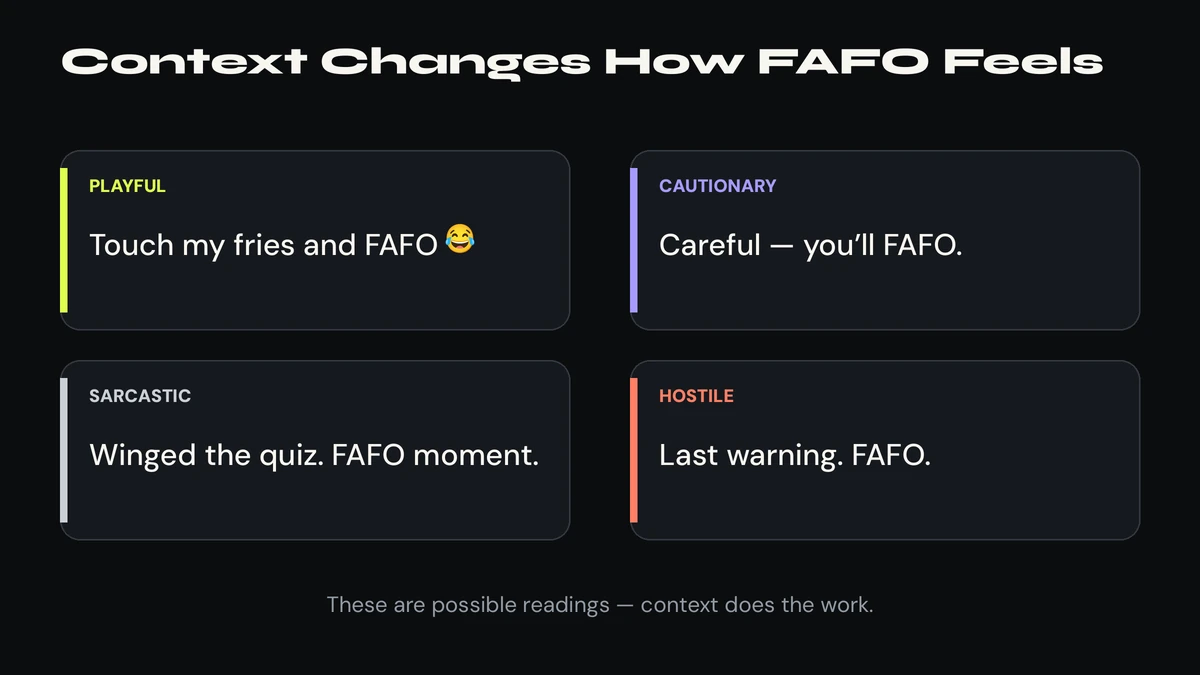
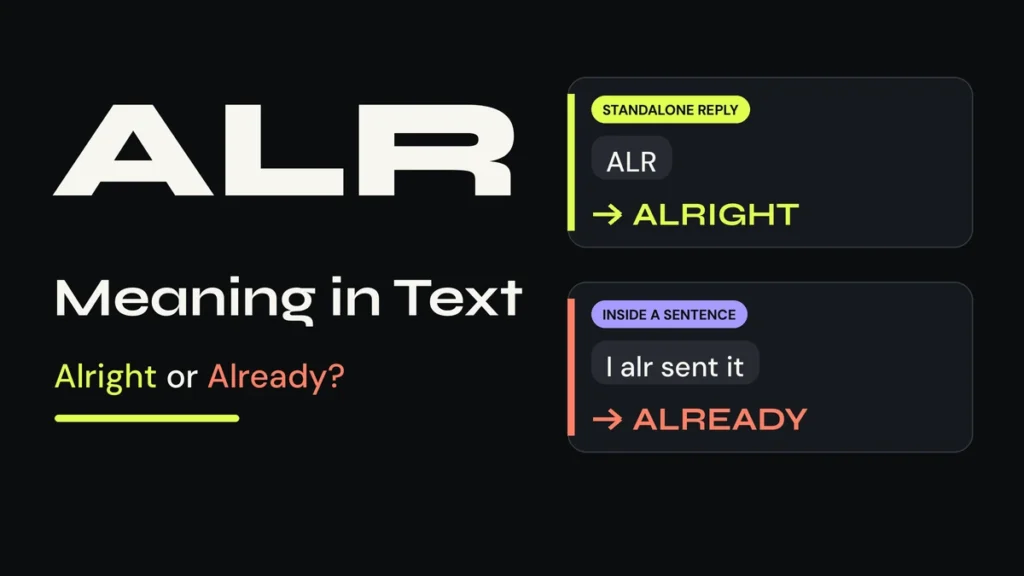
FAFO’s letters state a rule, but they do not set a temperature. Very short replies work this way in general: ALR can read as friendly or dismissive with the same three letters, and FAFO likewise takes its feeling from the conversation around it. Depending on that context, it can come across as:
- Playful – between friends, over something harmless, often with a laughing emoji nearby.
- Cautionary – a genuine heads-up from someone who can see the ending.
- Sarcastic – the told-you-so setting, after a failure everyone predicted.
- Defiant – a dare: test me and see.
- Hostile – a bare FAFO after an argument, with no humor anywhere near it.
Weigh your history with the sender, what came just before, and whether anything in the message is laughing. Emojis and follow-up jokes point playful; silence after a fight points the other way.
Is FAFO Rude?
It can be, and two separate things decide it. First, the phrase itself contains a profanity, so FAFO is never fully polite – some people will find it offensive in any setting, and the asterisked spelling only softens it. Second, the intent matters: among friends it usually lands as teasing, while aimed at a stranger mid-argument it functions as a threat. Treat one specific case with care: a bare “FAFO” after a heated exchange, from someone who seems angry, is safest read as a serious warning. You do not have to answer it in kind – or at all.
FAFO as a Verb, a Noun and More
FAFO stretches further than most acronyms. Merriam-Webster records it as a verb (“he FAFO’d”), a noun, an adjective (“a FAFO moment”) and an interjection. Wiktionary’s verb entry gives the forms FAFOs, FAFOing and FAFOed. The adjective use is the one you will meet most: a “FAFO moment” is the instant the predictable consequence arrives. There is even “FAFO parenting” in Merriam-Webster’s examples – letting a child skip the jacket and learn from the cold.
Where FAFO Comes From
The phrase is older than the acronym. Merriam-Webster traces “fuck around and find out” to African American English and notes that it has appeared in print since at least the 2000s. The short form spread online, and by January 2025 it had reached national political discourse: TIME’s guide to the acronyms of that period documents a Truth Social post showing the letters FAFO on a sign. You may also see the phrase credited to biker slang; that version rests on anecdote rather than documentation, so this guide records it as folklore, not origin.
How to Reply When Someone Says FAFO
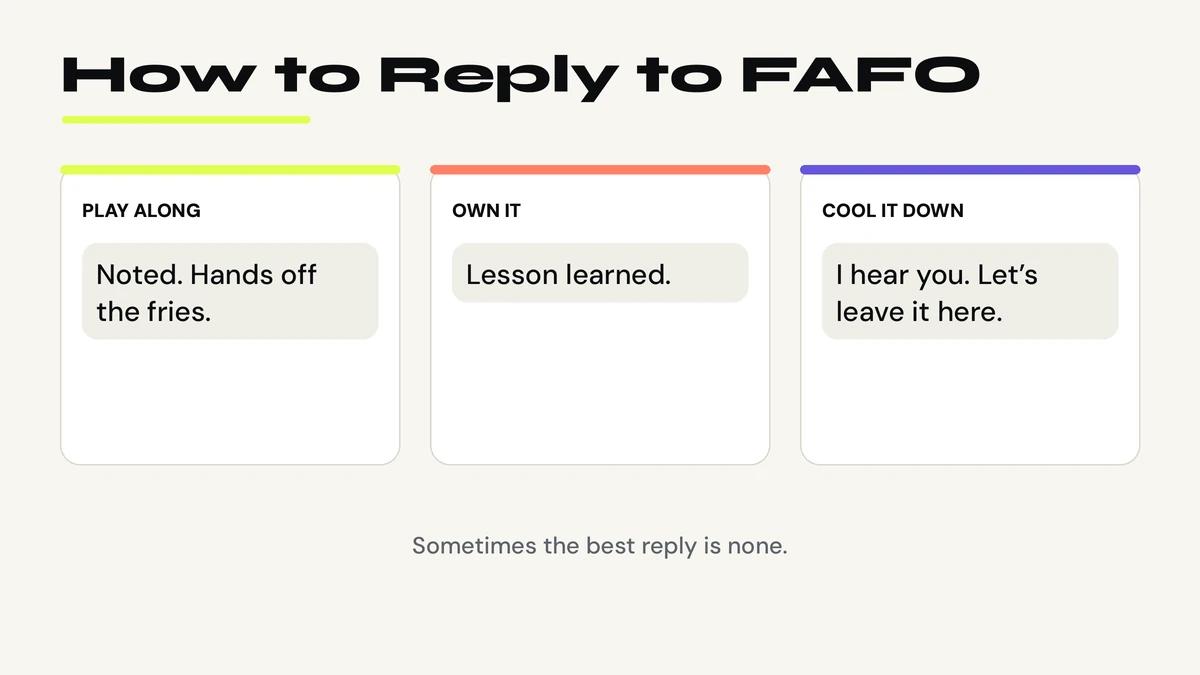
Start by running the timing test: warning or told-you-so, aimed at you or past you? Once you know which FAFO you received, the reply mostly chooses itself.
If it was playful
Match the energy and keep it small: “Noted. Hands off the fries.” A laughing emoji does most of the work.
If it was a warning aimed at you
Decide whether the warning has a point before you answer it. If it does, say so plainly: “Fair. I’ll stop.” If you think it is unfair, ask what they mean rather than daring them back – a dare is how the finding-out starts.
If it was a told-you-so about you
Own it lightly and the exchange stays friendly: “Lesson learned.” “Found out. Do not recommend.” Self-awareness is the cheapest exit from a FAFO moment.
If it felt hostile
Do not match the temperature. A short, calm line (“I hear you. Let’s leave it here”) ends most exchanges; if the messages feel threatening, stop replying. No acronym is owed an answer.
Polite Alternatives and When Not to Use FAFO
When the idea fits but the word does not, Merriam-Webster’s documented variant “Fool around and find out” keeps the meaning with less profanity. Plainer options cover most situations: “Actions have consequences,” “That may backfire,” and the older saying “Play stupid games, win stupid prizes.” Keep FAFO out of work messages, school and client emails, and any conversation where the profanity or the warning would land on the wrong person – a manager, a teacher, or someone already upset.
FAFO vs Similar Expressions
Mess around and find out – the same phrase with the profanity swapped out. Identical meaning, slightly lower voltage.
Play stupid games, win stupid prizes – an older saying with the same logic: the prize matches the game. Less of a warning, more of a verdict.
Reap what you sow – the formal, proverb version. It stresses the harvest, not the warning, and suits writing better than chat.
Actions have consequences – the neutral summary of the whole idea, safe in any setting, with none of FAFO’s edge.
Frequently Asked Questions
What does FAFO stand for?
“F*** around and find out.” Merriam-Webster also records the politer respelling “Fool Around and Find Out.”
What does FAFO mean in texting?
A compact warning that actions bring consequences – said before a bad outcome as a warning, or after one as a told-you-so.
Is FAFO a warning or a joke?
Either, and timing separates them: before the outcome it warns; after it, it comments. Emojis, your relationship and the messages before it set the temperature.
Is FAFO a threat?
Usually it is a warning or a joke, not a literal threat. A bare FAFO after an argument, from an angry sender, is the case to take seriously – you can simply stop replying.
How do you reply to FAFO?
Match what you received: play along with a joke, accept a fair warning, own a told-you-so lightly, and answer a hostile one calmly or not at all.
Can I use FAFO at work?
Better not. The phrase contains a profanity and a warning, and both travel badly in professional messages. “Actions have consequences” says it safely.
The Takeaway
FAFO compresses a whole story into four letters: someone tests a limit, and the limit answers. Read it by timing – warning before, told-you-so after – and by aim, and the tone will usually explain itself. Use it where bluntness is welcome; everywhere else, the idea survives translation into plainer words.