If you searched for “brb meaning in text,” here is the answer: BRB means “be right back” — three letters that form a social promise, not a goodbye. One of the oldest abbreviations in texting, it commits the sender to exactly one thing: coming back.
Most guides stop at the expansion. That misses the interesting part: BRB is the oldest promise in texting — a three-letter contract that sets an expectation, shapes your reply, and, when broken, quietly turns into a goodbye. Below: the test that decodes every BRB, the protocol for the ones that go unanswered, and the scorecard for sending your own.
The BRB Promise Test
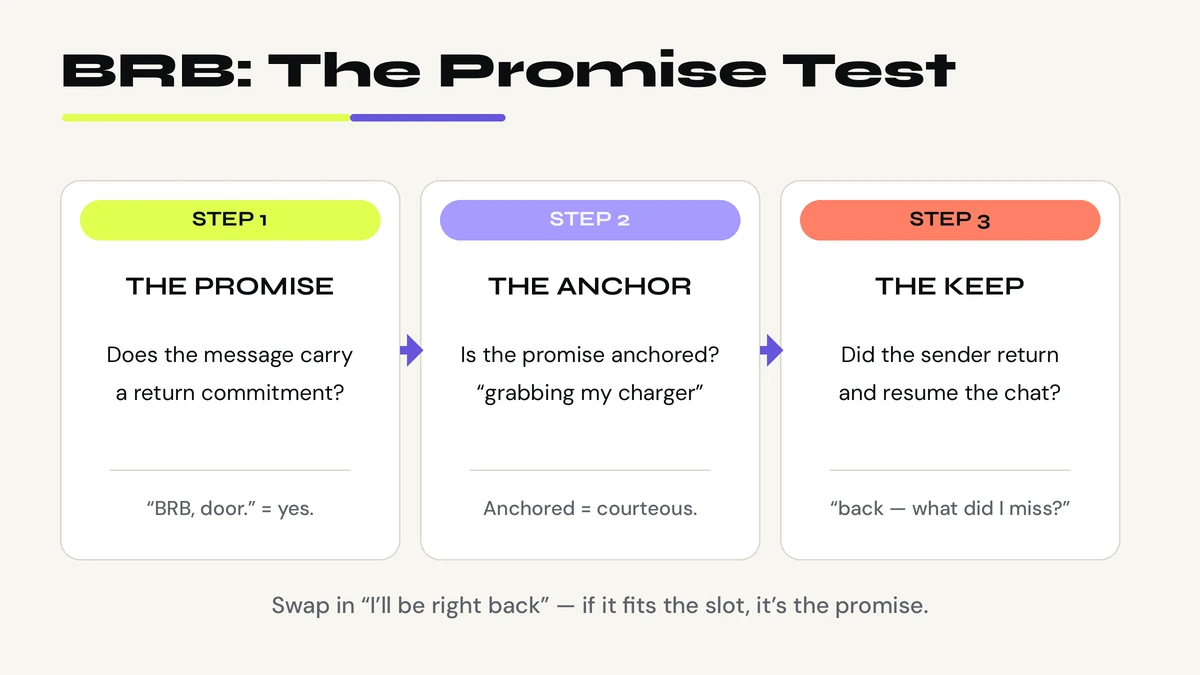
Here is the tool flat definitions never give you. Wiktionary’s BRB entry carries a noun sense: “the state of being away from one’s device while meaning to come back soon.” That “meaning to come back” clause is the insight: BRB is not a status announcement — it is a social promise. Three checks.
THE PROMISE — does the message carry a return commitment? A standalone “BRB” or “BRB, door” says yes: the sender commits to returning. The structural difference from its closest cousin — AFK announces a status; BRB makes a promise — our AFK guide covers the status half of the pair. From GTG: BRB pauses the conversation, GTG ends it.
THE ANCHOR — is the promise anchored? “BRB, grabbing my charger” hands you a reason and an expectation; a bare “brb” asks you to accept the default reading of a few minutes. Like ALR’s grammar-and-position test, one check decides the reading: anchored BRBs read as courteous, bare BRBs as abrupt but perfectly normal.
THE KEEP — did the sender return and resume? “Back — what did I miss?” means the promise was kept. Silence past every reasonable window means it broke — that failure mode gets its own protocol below.
The test also rules things out: BRB is never a greeting, never a question, never a farewell. And it is falsifiable — swap in “I’ll be right back.” If the sentence still works, you are holding the promise; “goodbye, keep talking” collapses.
What BRB Means: The Pause, Not the Goodbye
The verdict is single and strongly supported: BRB expands to exactly one phrase — “be right back.” Wiktionary reads it directly as an initialism in internet slang and text messaging, with a 2012 dated citation; Merriam-Webster reads it the same way. No second texting expansion exists, so this guide manufactures no ambiguity.
The position note: like PMO’s position test, where BRB sits changes the read. A standalone “BRB” is the promise itself; an embedded “I’ll brb” is an aside in a longer thought. Lowercase vs uppercase is settled too: Wiktionary treats “brb” as a letter-case variant of one entry — capitalization does not decide meaning.
The most common misread deserves one line of burial: BRB is not goodbye. Every source agrees it is a pause — the conversation is suspended, not ended. GTG and TTYL are the closers.
The Claims This Guide Rejects
Simple terms collect myths. These got the same evidence bar this guide gave GMFU’s invented meanings. What did not survive:
- “BRB means goodbye.” Rejected. A pause with a return commitment; GTG and TTYL handle exits.
- “BRB means something different on TikTok.” Rejected. The meaning is constant across platforms; only context shifts. No source documents a split, and this guide does not invent one.
- “Case or fixed-duration claims.” Rejected. Lowercase is a letter-case variant of one entry; “right back” has no measured length. Explainers that publish minute-by-minute BRB tables are selling opinion as data.
- “BRB is rude / always unprofessional.” Rejected as oversimplified. Casual chat: polite. Formal email: out of place. The rudeness people complain about lives in the broken promise — saying BRB and never returning.
- “BRB is a digital red flag.” Rejected. Some parental-safety content frames BRB as secretive behavior — marketing wrapped as guidance, with zero evidence. The real misuse, the ghosted BRB, is handled plainly in the protocol below.
BRB in Action: Illustrative Examples
The conversations below are illustrative examples written for this guide — not recorded messages.
THE PROMISE — “BRB, door.” Anchored, the promise explicit: the sender committed to a return.
THE KEEP — “back — what did I miss?” Loop closed, promise kept: the conversation resumes where it paused.
THE GHOST — BRB sent at 9:12 PM; silence by morning. The promise broke. One nudge — “still there?” — then release, per the protocol below.
GROUP CHAT / DISCORD — “brb bio” / “hurry, we’re queuing.” Gaming’s fastest BRB: the promise is measured in minutes, because the queue is.
CRUSH, ANCHORED — “brb, my roommate needs me — don’t go anywhere” / “i won’t.” The anchor carries the warmth the moment needs.
BRB on TikTok
The meaning does not change on TikTok — the evidence requires that stated plainly. What changes is the staging: comment replies (“brb checking the comments”), creator captions, and stacked takes where a quick pause is part of the performance. The venue is public, so anchored BRBs read friendlier here than a bare “brb” in a stranger’s thread. Same expansion, same promise, livelier stage.
BRB on Snapchat
On Snapchat the usage is private and quick: DMs and story replies between people who know each other. A BRB here often carries a streak attached — “brb, streaks safe” extends the promise to the streak. The register skews casual and warm; a bare “brb” mid-conversation is the normal texture.
BRB on Instagram
Instagram hosts both slots. In DMs, BRB is the standard one-to-one pause — “brb, someone’s at the door” works exactly like a text. In comments, a quick reply before a creator answers, or a pause between back-and-forths. The public venue raises the stakes slightly: an anchored BRB keeps the tone light where a bare one can read as dismissive.
BRB in Text Messages
Plain texting is BRB’s home turf: one-to-one, no audience, no performance. The standalone form rules here — “BRB” or “brb, one sec” dropped straight into the flow. It has ridden every messaging platform since the 1990s unchanged, and SMS-era texting is where most people first met it.
What It Means Depending on Who Sends It
The sender does not change the definition — but it changes everything about how you read it. The promise is constant; the stakes are not.
- A close friend — the safest sender. A bare “brb” is the normal texture of pausing; an anchor is a courtesy, not a requirement. Default to trusting the promise.
- A crush — a bare “brb” mid-flirtation reads colder than intended, so go anchored and warm. Receiving one? Reply light — “ok” — not an interrogation.
- A partner — anchors carry more weight, and a ghosted BRB stings because the contract is bigger. If the pattern repeats, address the pattern.
- A group chat — the promise dilutes across members: “keep going without me.” Return, skim back, rejoin — nobody owes you a recap.
- A coworker — casual chat yes, formal email no. An anchored BRB (“joining the standup in 2”) reads as professional courtesy.
BRB’s Tone: Polite Utility
BRB is the flattest, most functional term in this guide’s series so far — a tone grade of neutral-courteous. The politeness is procedural: BRB acknowledges the other person’s time, which is why every serious explainer calls it respectful and safe. The spectrum:
- Anchored + warm — “BRB, grabbing my charger, keep talking” — courteous, engaged. The anchor does the social work.
- Bare neutral — “brb” — functional, slightly abrupt, fully normal among friends.
- Workplace casual — “BRB, joining the standup in 2” — professional enough for Slack, never for email.
- The broken promise — BRB sent, never returned — the only reading that is rude, and the rudeness attaches to the behavior, not the word.
Two contrasts worth naming. First, the anchor is the tone control: adding a reason softens every reading, and — unlike some slang — there is no ironic or sarcastic BRB hiding underneath. Second, BRB is tonally flat where LWK is deliberately understated — two different kinds of quiet. BRB says nothing about how you feel; LWK says everything by saying little.
The Return Ladder
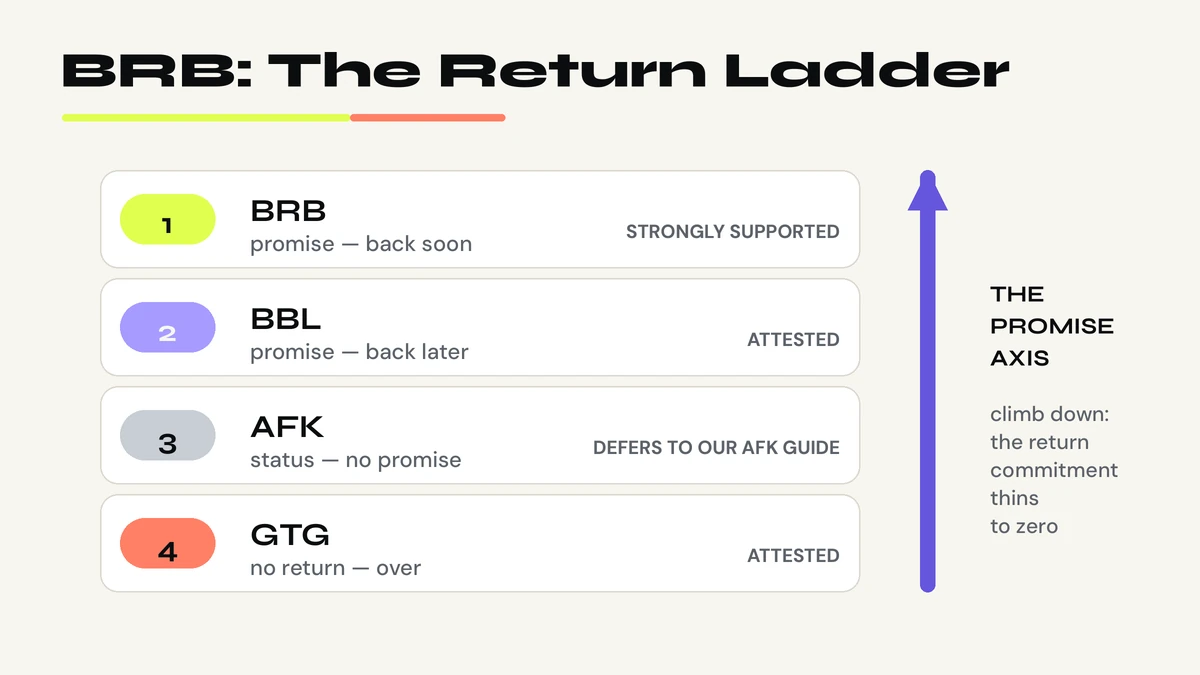
When the promise varies, it varies along one axis: how much return you are owed, and how soon. Four rungs with evidence grades; the rail is the promise axis — climb down and the return commitment thins until it disappears.
Rung 1 — BRB: promise, back soon. The commitment is explicit; the window is short. Grade: STRONGLY SUPPORTED — two primary dictionary references agree.
Rung 2 — BBL (“be back later”): promise, back later. Same contract, longer window — use it when “soon” would be a lie. Grade: ATTESTED — paired with BRB since the chatroom era.
Rung 3 — AFK: status, no promise. The sender is away; no return is owed. This rung deliberately defers to the published guide rather than re-teaching it — the status half of the pair lives there.
Rung 4 — GTG (“got to go”): no return. The conversation is over. Grade: ATTESTED as the exit of the pair — in the IRC days, BRB was the pause and G2G the exit.
BRB vs Its Closest Cousins
BBL is the longer sibling — same promise, stretched window. G2G is the faded exit — once BRB’s partner in crime (“the pause and the exit”), now rare; if someone types it, read it as GTG. TTYL (“talk to you later”) is the soft goodbye — a vague future with no return window, ending the exchange politely. And AFK is the status sibling — “away,” no commitment — covered in depth in our AFK guide, not re-taught here.
The Unanswered-BRB Protocol
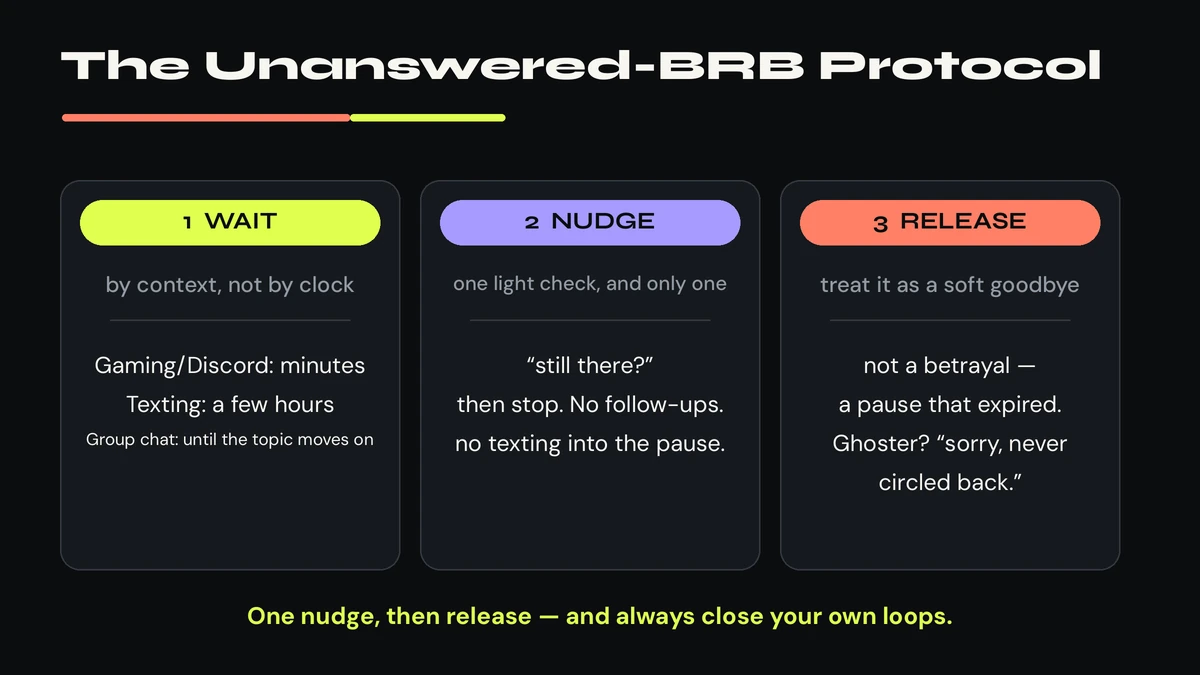
A BRB is a promise, and promises break. When the return never comes, here is the protocol, in order. Read it with empathy: you may be the ghosted, or the ghoster.
Step 1 — wait, by context. The window is not fixed; the venue sets it. Gaming and Discord: minutes. Texting a friend: a few hours before you read anything into it. Group chat: until the topic moves on. Crush or partner: the window feels shorter than it is — give it the evening before the nudge.
Step 2 — one nudge, and only one. A single light check — “still there?” — is the limit. Do not stack follow-ups, and do not keep texting into the pause. Each unread message raises the cost of their return.
Step 3 — release it. If the nudge goes unanswered, treat the BRB as a soft goodbye — not a betrayal, just a pause that expired. And if you are the ghoster, the repair is one message: “sorry, never circled back.”
Where BRB Came From
The 1990s, attestation-grade and undisputed: IRC chatrooms, the earliest text-chat culture. No away-status feature existed, so users typed BRB as a manual flag to tell the room they were stepping away. The early 2000s carried it into one-to-one chat on AIM and MSN Messenger; then came SMS, WhatsApp, Discord, and Slack — every new platform, the same three letters, the meaning never changing.
Two details worth keeping. First, the pairing: BRB was often typed alongside G2G — BRB the pause, G2G the exit — the promise ladder above in its original form. Second, unusually for an initialism, people say “BRB” in speech — “BRB, gotta go to the restroom” at the dinner table. The term’s longevity, made audible.
The Sender Scorecard
This article coaches both sides of the exchange. The four-point scorecard for sending a good BRB:
- Anchor it. “BRB, grabbing my charger” beats a bare “brb” every time. The reason sets the expectation.
- Keep it short. The promise is the message; do not bury it in explanation. Three letters plus a reason is the entire format.
- Actually return. The promise is the whole product. If the pause will stretch past the window, say so in a second message instead of expiring in silence.
- Close the loop. “Back — what did I miss?” resumes the conversation where it paused and proves the promise was kept. The highest-value habit on the list.
How to Reply to a BRB
The agreed reply family — every serious explainer concurs: “ok,” “no problem,” “take your time,” “kk,” “see you in a bit.” Match the anchor’s warmth: a bare “brb” mid-flirtation gets a light “ok,” not an interrogation. Gaming: “hurry, we’re queuing” is acceptable. Video call: “sure, we’ll wait.” Work: “understood” or a thumbs-up — never demand the reason.
What NOT to do: no triple follow-ups while they are gone, and do not text into the pause — they are away, and the messages pile up unread. If the window passes with no word, the single-nudge rule applies: one “still there?”, then release.
Frequently Asked Questions
What does BRB mean in text?
BRB means “be right back” — a promise to return soon, not a goodbye. Two primary dictionary references agree, and the Promise Test above shows you how to read the commitment behind it.
Is BRB rude?
The letters are never rude; the broken promise is. A bare “brb” is normal among friends, an anchored BRB reads as courteous, and only the ghosted BRB — sent, never returned — earns the rudeness label.
What is the difference between BRB and AFK?
AFK announces a status — “away,” no return owed; BRB makes a promise — a return is expected. That promise-vs-status line is the whole of the Promise Test, and our AFK guide covers the status half in full.
How long is “right back” supposed to be?
Context-dependent and unmeasured: minutes in gaming, hours in texting, until-the-topic-moves-on in group chats. Exact minute tables for BRB are opinion sold as data.
Can I use BRB at work?
In casual chat — Slack, Teams — yes, anchored and brief: “BRB, joining the standup in 2.” In formal email or with senior leadership, no. The anchor is what makes it work-safe.
What should I reply when someone says BRB?
“ok,” “take your time,” “kk,” or “see you in a bit.” If they never return, one light nudge — “still there?” — then release. The Unanswered-BRB Protocol above has the full procedure.
The Takeaway
Three letters, one contract. BRB means “be right back” — a promise, an anchor, and a keep. Run the Promise Test on every BRB you receive, follow the protocol when one goes unanswered, and send your own with the scorecard’s four habits.