If you searched for “bffr meaning in text,” here is the answer in one line: BFFR means “be f*cking for real” — a blunt call-out used when something sounds like a lie, an exaggeration, or pure nonsense. This guide teaches the two-question test that decodes the force behind every BFFR you will ever receive.
The meaning itself is settled. What trips people up is the force: the same four letters can be a friendly roast between best friends, a genuine demand for honesty, or a conversation-ending escalation. The force comes from tone, casing, who sent it, and where it landed — and this guide maps all of it, so you never misread a BFFR again.
What BFFR Means
The verdict is single and strongly supported: BFFR stands for be fucking for real — the one time this article prints the expansion in full, because the term cannot be explained honestly without it. Dictionary.com defines it as an abbreviation used “to accuse someone of lying or exaggerating” in texting, and Wikipedia’s Glossary of 2020s slang lists bffr as the acronym for the same phrase. Every competitor this guide surveyed agrees. There is no second meaning hiding underneath.
In plain terms, BFFR is a reality check in four letters. It says: what you just said does not sound true, and I am not going along with it. It gets aimed at exaggeration (“I bench 300 pounds”), at obvious lies (“I never said that” — when there are screenshots), and at takes so absurd they demand a response (“BFFR, pineapple does not belong on pizza”).
One honest note on register: some people read BFFR as a softer “be for real,” with the middle word barely stressed. That is the same meaning in a lighter voice — not a separate definition. And if you are wondering about best friends forever, that confusion gets its own warning box later in this guide. It is not what BFFR means.
The Belief-and-Bite Test

Meaning is one thing; force is another. The Belief-and-Bite Test is the two-question check this guide gives you for any BFFR you receive. Run it in seconds, right in the moment.
BELIEF: does the sender actually disbelieve you, or are they playing along? Earnest disbelief means they think you are lying or wrong — treat it as a real challenge and answer it. Playful ribbing means a close friend is teasing you in a joking context — laugh it off. The difference is everything: same letters, opposite stakes. If you are not sure which it is, default to earnest. Laughing off a serious challenge starts fights.
BITE: how hard does it land? Read the casing and punctuation — all-caps “BFFR!” hits harder than lowercase “bffr.” Read who sent it — a close friend’s BFFR and a stranger’s BFFR are different animals. Read the venue — a private chat absorbs a BFFR that a public comment section turns into a spectacle. The harder the bite, the less you should joke back.
Built into the test is the position rule, and it changes your reply strategy. A standalone BFFR is a reaction to YOUR words — “I ran a marathon this weekend” / “bffr.” The sender is challenging something you just said; you are being called out. A stacked BFFR is attached to a claim the sender is making — “BFFR, the new album is mid.” That is the speaker firing a hot take at the world; they are performing for an audience, not accusing you. Standalone means defend or defuse yourself. Stacked means you can agree, disagree, or scroll past — the BFFR is not aimed at you.
Two questions, one position check: belief, bite, and slot. That is the whole test, and it beats guessing by feel every time.
BFFR in Action: Illustrative Examples
The conversations below are illustrative examples written for this guide, not recorded messages.
STANDALONE CALL-OUT — Sam: i deadlift 400 pounds / Jay: bffr, you skipped leg day twice this week. Read: standalone, aimed at Sam’s claim. Jay is not performing; he is challenging.
STACKED HOT TAKE — Post: bffr, nobody is actually busy, they just don’t want to talk to you. Read: stacked, aimed at the world. The BFFR launches the take; it is not calling anyone out.
PLAYFUL LOWERCASE — Maya: you ate pizza yesterday and you’re ordering pizza again / Zoe: bffr let me live. Read: lowercase, close friends, joking context. The belief check says playful ribbing — nobody is actually angry.
HEATED ALL-CAPS — Thread: BFFR!!! you have NO idea what you’re talking about. Read: all-caps, triple exclamation, public venue. Maximum bite. The correct response is not a comeback — it is de-escalation or disengagement, covered in the reply section below.
THE CONFUSION CORRECTION — Aunt: Happy birthday!! BFFR!! love you / Niece: …auntie no. BFFR doesn’t mean what you think it means. Read: the BFF confusion is real and documented. One extra letter turns an endearment into an accusation.
The Profanity Register Map
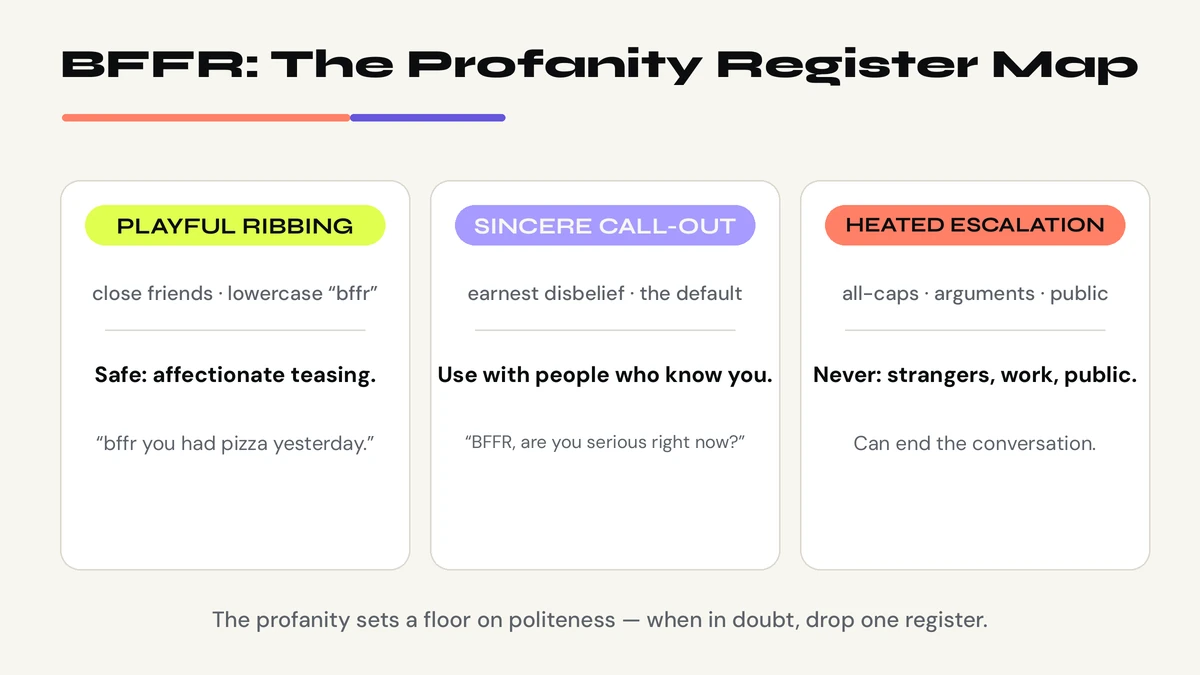
BFFR carries real profanity force, which is why tone is this article’s load-bearing section. The three registers, with explicit audience cues:
- Playful ribbing — close friends, lowercase “bffr,” joking context. Reads as affectionate teasing. Safe to use and receive here. Example pattern: “bffr you had pizza yesterday.”
- Sincere call-out — earnest disbelief at an exaggeration or a lie. This is the default register and the term’s native habitat. Use it with people who know you and expect directness. Example pattern: “BFFR, are you serious right now?”
- Heated escalation — arguments, all-caps BFFR with exclamation points, public call-outs. Reads as aggressive and can end the conversation. Do not use this with non-friends, and never at work.
The rule that governs all three: the profanity sets a floor on politeness. BFFR is never appropriate at work, never appropriate in a first message to a stranger, and always a risk with someone whose sense of humor you have not mapped yet. When in doubt, drop one register — say “be for real” instead, or go softer still.
The series parallel: FAFO is the other profanity call-out in this guide’s series, and it works the same way — the letters are fixed, the force slides with context. Once you can read one profanity term’s register, you can read them all.
BFFR on TikTok
The meaning does not change on TikTok — the evidence requires that stated plainly. What changes is the staging. TikTok is where BFFR went mainstream in 2022, and it still lives there as a reaction instrument: comment sections full of standalone BFFRs answering exaggerated claims, captions using a stacked BFFR to launch a hot take, and the viral soundbite that carried it — “BFFR, what did I spell? Be f*cking for real” — still echoing through stitches and duets. Expect the stacked form and the playful register here more than anywhere else.
BFFR on Snapchat
On Snapchat the usage is private and quick: DMs and story replies, where BFFR lands as a one-word reaction to a friend’s snap — a flex that needs checking, a story that sounds too wild to be true. The meaning holds; the register skews playful, because Snapchat’s audience is mostly people you actually know. A heated all-caps BFFR is rare here, and when it appears, the private venue usually means it is a real argument, not a performance.
BFFR on Instagram
Instagram hosts both slots. In comments, BFFR shows up as a standalone challenge to influencer claims — the authenticity-policing that the platform’s comment culture runs on. In captions and stories, creators use the stacked form for hot takes and memes, sometimes hashtagged. The public venue raises the bite: a BFFR under a stranger’s post reads colder than the same letters in a DM, so the Belief-and-Bite Test matters most here.
BFFR in Text Messages
In plain texting, BFFR is almost always the standalone form: a direct reply to something someone just said. No audience, no performance — just the challenge. This is the term’s home turf and its sharpest context, because there is no comment section to hide behind. Texts are also where the playful lowercase register thrives: between friends who text all day, “bffr” is punctuation, not provocation.
What It Means Depending on Who Sends It
The sender does not change the definition — but it changes everything about how you should read it. The audience-sensitivity ladder:
- A close friend — the safest sender. Default to playful ribbing unless the context is clearly serious. You can use BFFR back at them, lowercase, guilt-free.
- A crush — high-risk. A BFFR from a crush reads as mocking far more easily than the sender intends, and a BFFR to a crush can land as disrespect. Keep it out of early flirting entirely.
- A partner — can trigger real fights. Calling out your partner’s exaggeration with a profanity acronym skips past the conversation you actually need to have. The bite multiplies in relationships.
- A stranger or a public commenter — reads as rude, almost by default. There is no shared history to soften it, and the venue adds spectators. Treat any stranger’s BFFR as heated until proven otherwise.
- A work contact — never appropriate. Full stop. There is no professional register of BFFR, and using it at work signals judgment problems, not directness.
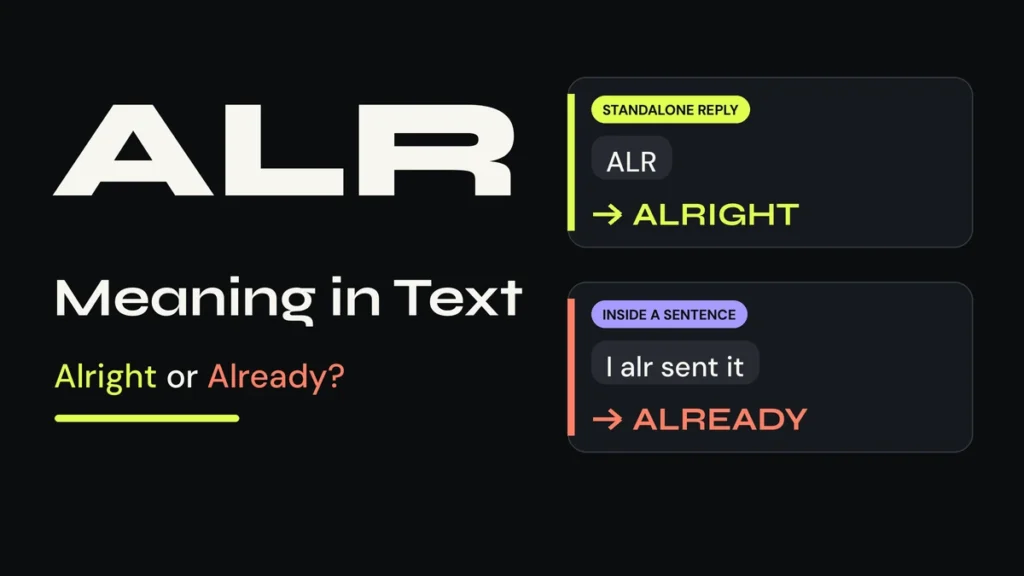
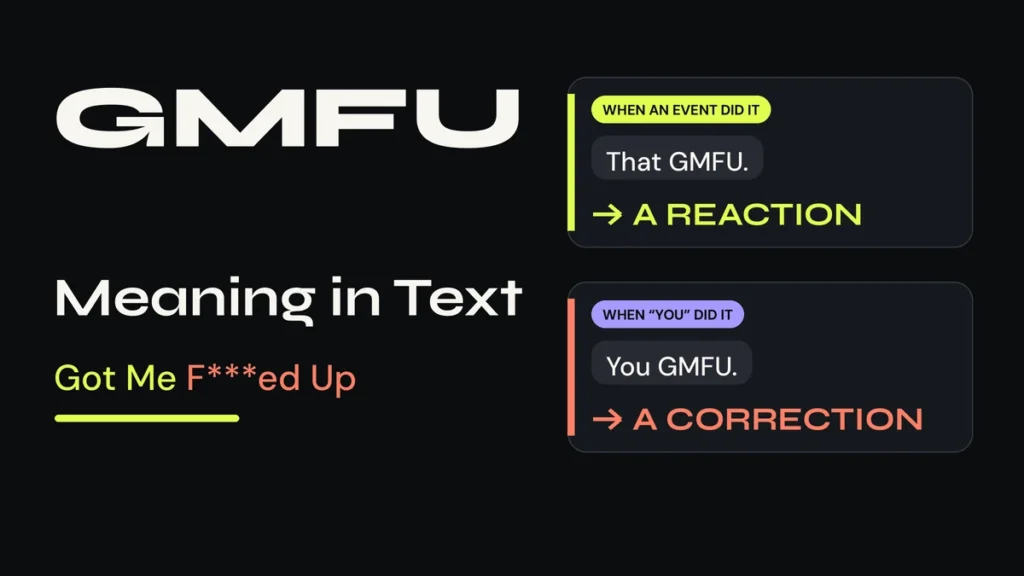
The series parallel: GMFU is another profanity term in this guide whose reading shifts with the sender and the setting — the same lesson, a different acronym. The rule generalizes: with profanity slang, who says it is half the meaning.
The BFF-vs-BFFR Warning Box
⚠ WARNING: BFFR is not BFF. The two share three letters and nothing else. BFF means best friends forever — affection. BFFR means “be f*cking for real” — a call-out. The confusion is documented across multiple explainers, and the fix is one letter of attention: if you mean friendship, type BFF. If you type BFFR on a birthday card, you have not sent love — you have sent an accusation.
BFFR vs Its Closest Cousins
BFR and “be for real” are the softer siblings — same challenge, profanity removed. Use BFR with your mom; save BFFR for people who expect the full register. “Fr fr” is the mirror image: affirmation instead of challenge (“for real, for real” — I agree), where BFFR says “I don’t believe you.” “Are you serious?” is the clean, work-safe equivalent of a standalone BFFR — same question, zero profanity. And the softer lane this guide already mapped — “lwk, that’s a stretch” — sits one full register below BFFR for days when the call-out needs to land gently.
How to Reply to BFFR

The reply playbook, in order of honesty:
- If you were joking: admit it fast and playfully. “Okay, you got me.” A BFFR means the other person has stopped believing you — doubling down after one signals you would rather perform than be honest, and it escalates everything. This is the single most important rule in the playbook.
- If you were serious: back the claim. Evidence or a simpler explanation. ICL, you might be right to doubt me — here’s the screenshot” turns a challenge into a conversation.
- Defuse with something softer. Humor works; so does a softer term like LWK — “lwk, that’s a stretch” lands the same point one full register down, useful when you want the call-out without the bite.
- If the BFFR is heated: do not match the register. De-escalate or disengage. Ask what exactly they are reacting to — a WYO-style “wait, what part?” re-opens the conversation instead of trading blows. Never answer all-caps profanity with more of it.
The golden rule, one more time: never double down after a BFFR. The letters mean the belief is already gone; arguing the claim harder does not bring it back.
Where BFFR Came From
The roots are African American Vernacular English, and this guide credits that openly: the spoken phrase “be for real” circulated as a way to call someone’s bluff long before the acronym existed, and the intensified “be f*cking for real” was documented on social media in the early 2010s. Mainstream popularization came via TikTok in 2022, when a viral soundbite — a remix of a Slump6s clip — turned the acronym into a comment-section staple. One source claims “around 2019” for the acronym itself; that claim is single-sourced and unsourced, so this guide uses the multiply-attested 2022 dating and labels the 2019 figure as unverified.
Frequently Asked Questions
What does BFFR stand for?
BFFR stands for “be f*cking for real” — a blunt call-out of exaggeration, lies, or absurdity, demanding honesty. The verdict is strongly supported across dictionary references and full competitor consensus.
Is BFFR a bad word?
It contains profanity, so treat it as one. It is fine between close friends in a joking context, but it reads as rude from strangers and is never appropriate at work. The Profanity Register Map above shows exactly where each register lands.
Is BFFR the same as BFF?
No — and confusing them is the most common mistake with this term. BFF means best friends forever; BFFR is a call-out. See the warning box above before you type it on anything sentimental.
Does BFFR mean something different on TikTok?
No. The meaning is the same everywhere — a demand to be real. TikTok changes the staging (more stacked hot takes, more playful register, comment-section pile-ons), not the definition. No source supports a platform-specific meaning, and this guide does not invent one.
How do you reply to a BFFR?
Admit it if you were joking, back it up if you were serious, defuse with humor or a softer term, and never double down — a BFFR means the belief is already gone. The full playbook is in the reply section above.
What is a softer alternative to BFFR?
BFR (“be for real”) drops the profanity while keeping the challenge. One register softer still: “lwk, that’s a stretch.” Both work where BFFR would land too hard.
The Takeaway
BFFR is one meaning with a sliding force: “be f*cking for real,” aimed at nonsense, graded by belief, bite, and position. Run the two-question test, read the register, match the sender — and never double down after one. Do that, and four blunt letters will never catch you off guard again.