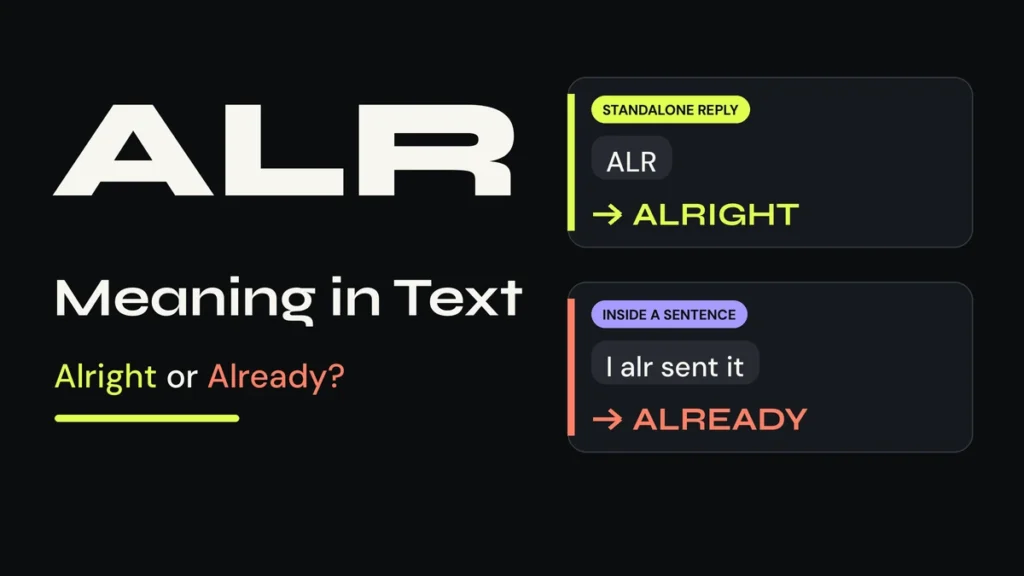
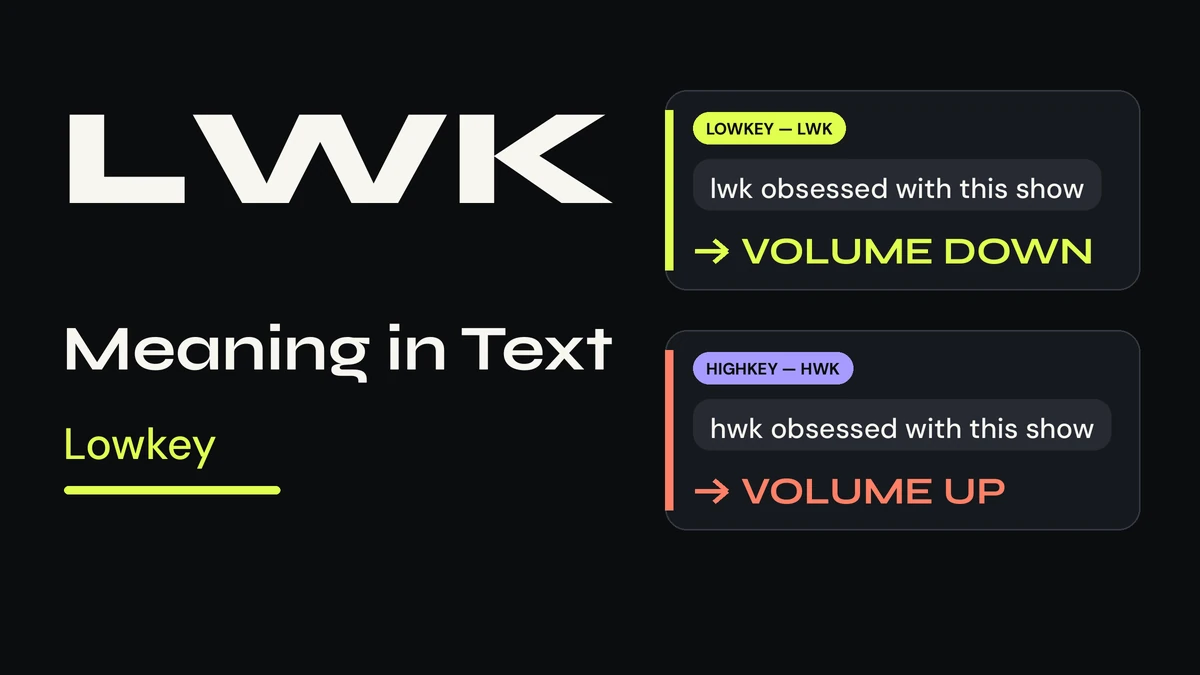
LWK means “lowkey.” In a text it works like a volume knob: whatever it touches is real, but turned down – said somewhat, secretly, or without making an announcement of it. “Lwk I’m nervous” means the nerves are genuine; they are just not being broadcast.
Because LWK changes how loud a statement is rather than what it says, this guide is built around volume: the scale from LWK to its opposite, highkey, chat examples at each setting, two extra meanings doing the rounds that do not check out, and how to reply at the right volume.
What LWK Means in a Text
LWK is the written abbreviation of “low-key,” used as an adverb. Wiktionary gives “lwk” its own entry – Internet slang, text messaging – as an abbreviation of low-key, and the parent word’s standard senses in Merriam-Webster run along the same line: restrained, understated, not showy. In a sentence, LWK does the job of “somewhat,” “kind of” or “quietly”: it shrinks how big the claim sounds without shrinking what the claim is.
That last part is the whole trick. LWK edits the presentation, not the content. “I lwk failed the quiz” is not a small confession of a small failure – the failure is full size. Only the telling of it is small.
The Volume Test: LWK, Plain and Highkey
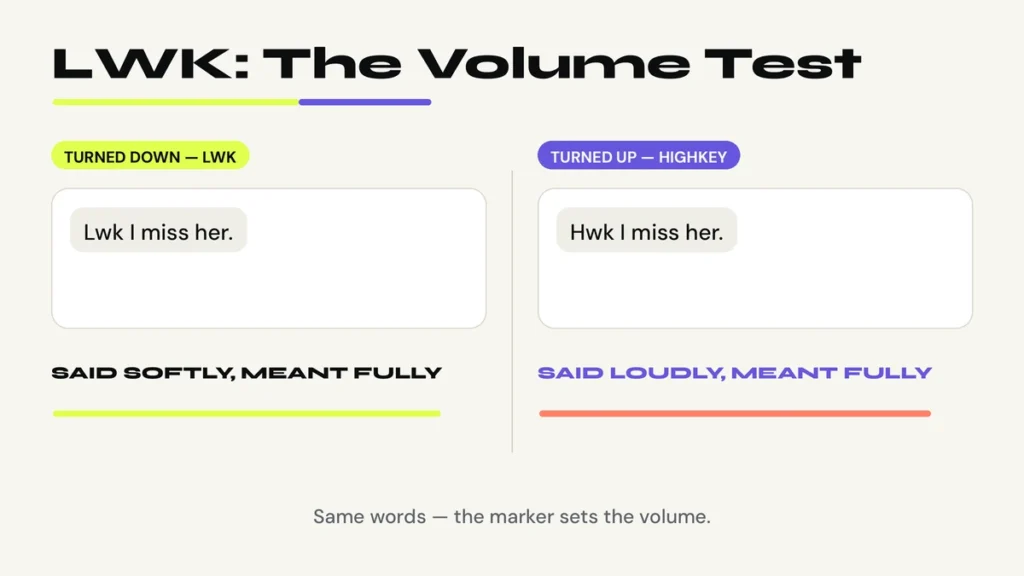
Every statement LWK touches sits somewhere on one scale. Reading where it sits is the fastest way to know how much of a message is packaging and how much is content.
1. Turned down: LWK
“Lwk I miss her.” The marker turns the sentence down: the feeling is admitted, but softly, with room to retreat. Senders reach for LWK when they want the truth on record without making it the headline of the conversation.
2. Turned up: highkey
The scale has an opposite end. “Highkey” – often shortened to hwk – means openly, strongly, at full volume: “hwk I miss her” is the same fact with the packaging removed and the volume up. If swapping LWK for highkey changes how a sentence feels but not what it says, you have found the adverb at work.
3. The packaging paradox
Here is the part most explainers miss: LWK is often chosen because the content is big. Wiktionary’s own example for the entry is a fan asking for another voice message “cuz im lwk obsessed with ur voice.” Obsessed is not a small feeling. The quiet packaging is what makes a big feeling safe to send – if it lands badly, it was only lwk. So never convert LWK into a small feeling automatically: measure the content words, not the volume knob.
LWK in Chat: Illustrative Examples
The conversations below are illustrative examples written for this guide, not recorded messages. Each note names the volume job LWK is doing.
Nia: Interview tomorrow. How are you feeling?
Jay: Lwk nervous. Prepared, but nervous.
Degree setting. The nerves are real; LWK keeps them at a size Jay can admit to.
Ana: You two still talk?
Leo: Lwk I still think about that day.
Confession setting. The sentence is heavy; the marker is what lets Leo send it at all.
Zoe: New episode tonight?
Max: Lwk obsessed with this show already.
The paradox setting – “obsessed” is full-volume content wearing a quiet label.
Kim: Any thoughts on the group project theme?
Tom: Lwk don’t care, pick whatever.
Shrink setting. Here LWK shrinks importance rather than a feeling – Tom is opting out, quietly.
Sam: Results are out!
Rae: Lwk passed!!
Sam: Hwk proud of you!!
Both settings in one chat: Rae turns her own news down, Sam turns his reaction up. Same scale, opposite ends.
What Tone Does LWK Carry?
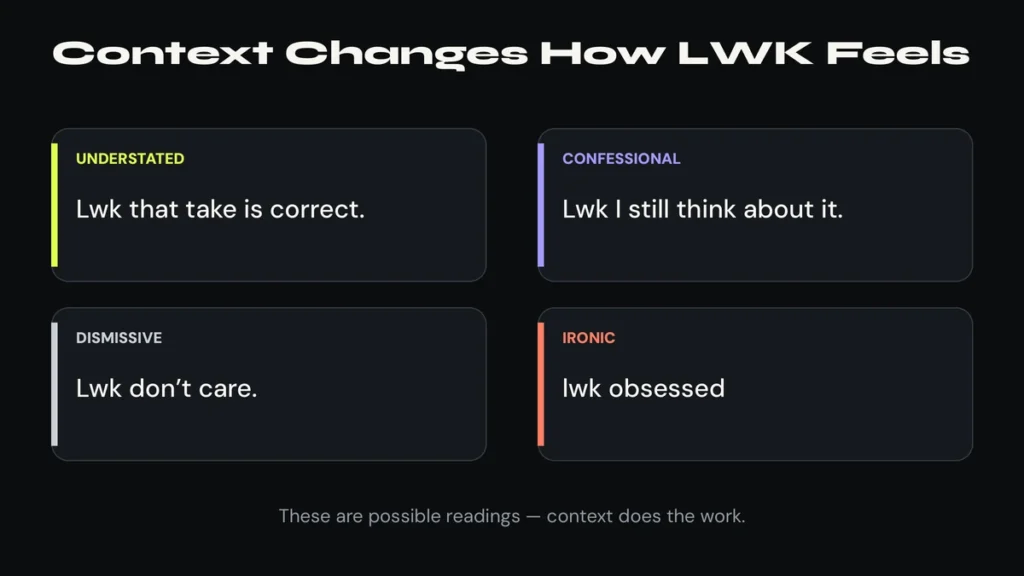
Like most short markers, LWK bends with context – ALR can sound warm or dismissive on the same three letters – but its range stays inside one family: things said quietly. It usually sounds:
- Understated – a straight opinion with the drama removed.
- Confessional – a feeling admitted softly, often one that costs something to say.
- Dismissive – shrinking something’s importance rather than engaging with it.
- Ironic – when the content is huge and both sides know the “lwk” label is a joke.
The tone nearly always softens the delivery; it never softens the underlying fact. Misreading that – treating an LWK confession as a small one – is the main way people get LWK wrong.
Is LWK Rude?
No. LWK contains no profanity and aims at the sender’s own volume, not at the reader. The one rough edge is the dismissive setting: “lwk don’t care” can land cold, because it shrinks something the other person may care about. Even then, the coldness sits in what is being shrunk, not in the letters themselves.
Two More Claims, Checked
Search LWK and you will meet two extra expansions, presented by several explainer sites as genuine second and third meanings. Both fail the same check, so they are handled together here.
The first claims LWK is an affectionate sign-off: “love with kisses.” It appears in no dictionary record – Wiktionary’s dedicated lwk entry lists exactly one sense, the abbreviation of low-key. Affectionate sign-offs are a crowded, well-documented family (XOXO, ILY), and LWK is not in it.
The second claims LWK means “laughing without kidding” – laughing genuinely, as opposed to a polite lol. Same problem: no dictionary record, and the shape of a backronym built to fill a list. If LWK ever turns up next to something funny, the working reading is still low-key – usually attached to a reaction the sender is understating.
Neither claim is a scandal; listicles pad. But a meaning with no dictionary record and no life outside the sites copying each other is not a meaning – it is a rumor with a table.
LWK vs Kind Of, Sort Of and ICL
“Kind of” and “sort of” are LWK’s everyday cousins: they soften a claim the same way (“kind of nervous”), in words any audience understands. LWK is the compressed, in-the-know version of the same move – which is why it lives in chats and captions rather than emails.
ICL, from the honesty family, is the instructive contrast. ICL stamps a statement as sincerely meant; LWK turns a statement’s volume down. They can even stack – “icl lwk miss her” would be a sincere stamp on a quiet admission – but they do different jobs: one guarantees the truth, the other controls the loudness.
Where LWK Comes From
The parent word is old. “Low-key” has described restrained, muted things in standard English for well over a century – Merriam-Webster records it in general use – with earlier technical lives in photography and music, where low-key meant dark, muted tones. The slang adverb grew out of that idea: to keep something low-key was to keep it quiet and unannounced. Secondary explainers attribute the spoken softener to African American Vernacular English before it spread through social media; the written compression to LWK is the usual texting shortcut, now cataloged by Wiktionary with a present-day example.
How to Reply to an LWK Message
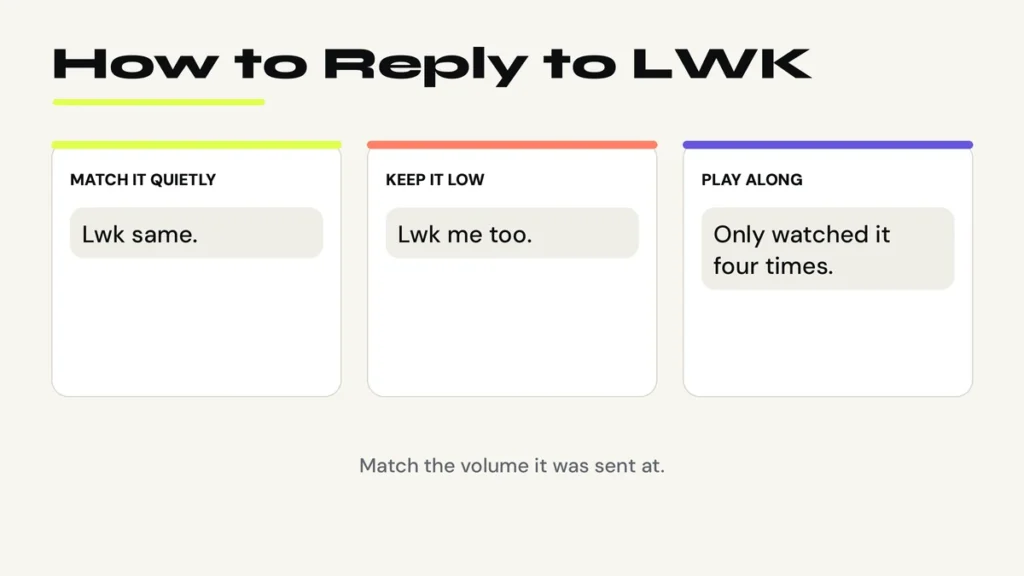
One rule covers most cases: match the volume. An LWK message is a statement deliberately sent at a certain loudness, and the reply lands best at the same setting.
If it softens an opinion
Answer the opinion at the same level: agree quietly, disagree quietly. “Lwk same” is a complete reply. Correcting the intensity (“you don’t sound nervous”) argues with the packaging instead of the content.
If it packages a confession
Keep it low. A confession sent quietly trusts you with its volume as well as its content: acknowledge it in kind – “lwk me too,” or a plain “I get it” – and never amplify it, in the chat or anywhere else.
If it’s ironic
Play along at the same exaggeration level. “Lwk obsessed” answered with “lwk same, only watched it four times” keeps the joke’s terms: huge content, quiet labels, both sides in on it.
Frequently Asked Questions
What does LWK stand for?
“Low-key.” Wiktionary catalogs lwk as an Internet-slang and text-messaging abbreviation of low-key, used as an adverb.
What does LWK mean in texting?
It turns the volume down on what follows: the feeling or opinion is real but understated – somewhat, secretly, or without a big announcement.
What is the difference between LWK and HWK?
They are opposite ends of one scale. LWK (lowkey) downplays a statement; HWK (highkey) amplifies it – openly, strongly, nothing held back.
Does LWK mean “love with kisses”?
No reliable source says so. The claim circulates on explainer sites but appears in no dictionary record; Wiktionary lists only the low-key sense.
Is LWK the same as lowkey?
Yes – it is the same word, compressed for typing. The full forms “lowkey” and “low-key” also appear in texts; the spelling does not change the job.
How do you reply to LWK?
Match the volume: answer an understated message at the same level. Quiet agreement for an opinion, quiet acknowledgment for a confession, and never amplify what was sent softly.
The Takeaway
LWK is a volume knob in three letters: it never changes what a statement says, only how loud it is allowed to be. Read the content for the size of the feeling, read the marker for how softly the sender wanted it held – and reply at the same volume.