
What does asl mean in text? Two things – and the message itself tells you which. Standing alone – “asl?” – it is the old chatroom question: age, sex, location. After an adjective – “tired asl” – it means “as hell,” pure emphasis.
Here is the part no competitor tells properly: the same three letters mean opposite things to two generations. To a millennial they are a 1998 chatroom memory; to Gen Z they are a TikTok intensifier – and the two readings collided in public, on the record, in 2018. This guide teaches the position test that sorts them, the generational story behind the collision, and where each reading lands safely.
The Position + Punctuation Test
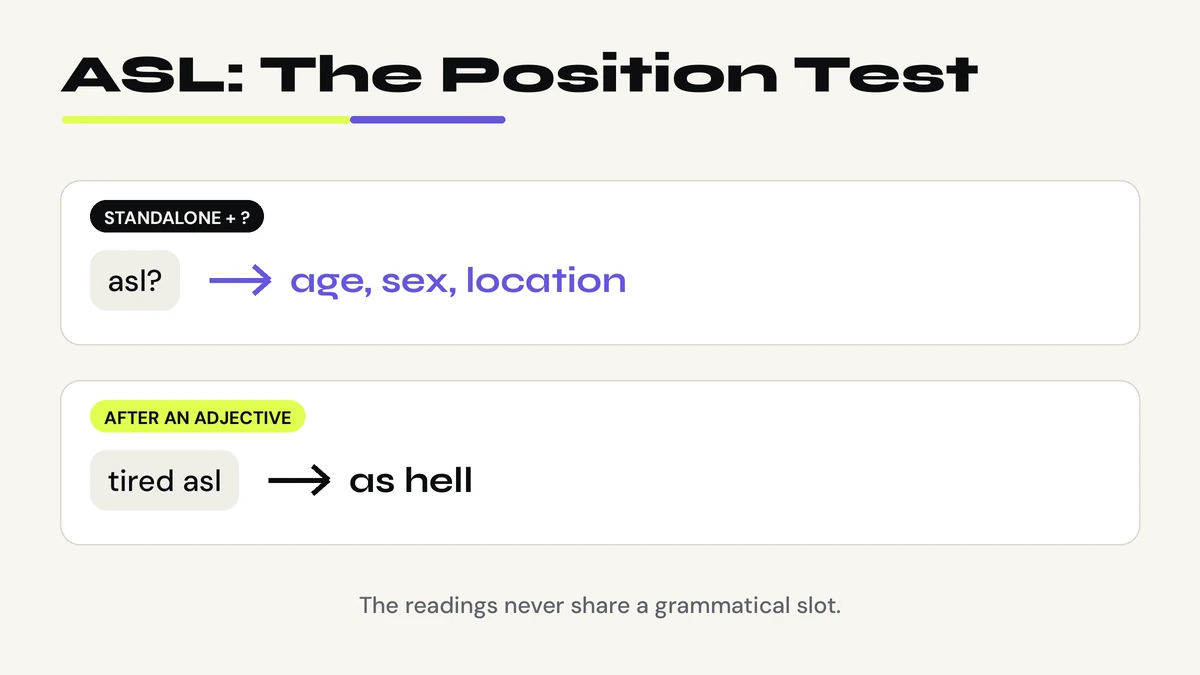
ASL’s two texting readings never share a grammatical slot, so you never have to guess. Three checks:
Does ASL stand alone, usually with a question mark? Then it is “age, sex, location.” Example: “asl?” It is functioning as a question.
Does ASL follow an adjective or exclamation, with no question mark and usually lowercase? Then it is “as hell.” Example: “tired asl,” “fun asl.” It is functioning as an intensifier – like “so” or “very.”
Does ASL sit next to class, interpreter, teacher, Deaf, or learning? Then it is American Sign Language. Not slang at all.
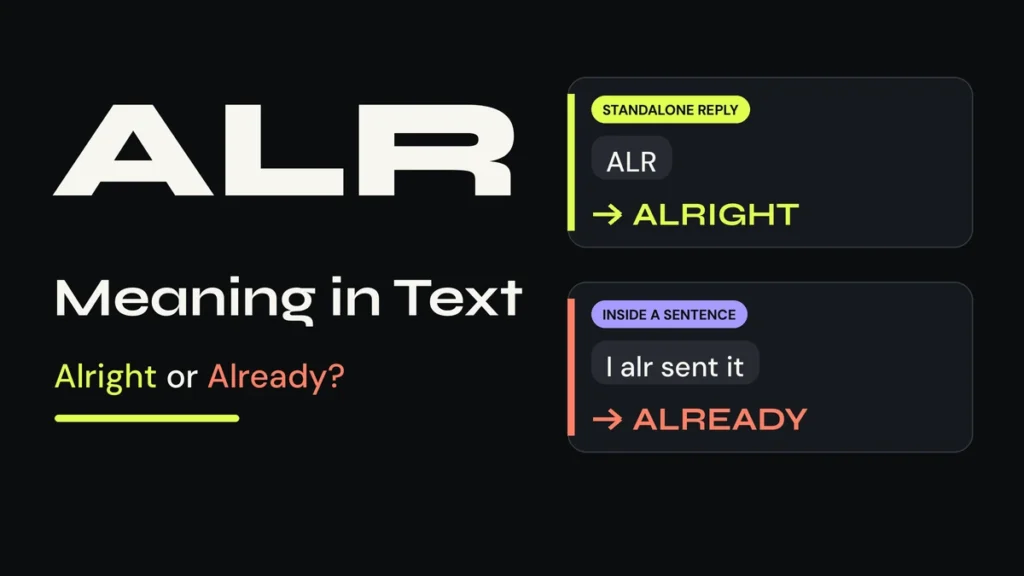
Now the part that makes this test stick: break it on purpose. “Tired asl?” with a question mark is nonsense – an intensifier cannot ask a question. “Asl!” as emphasis is impossible – a standalone question cannot intensify. The readings cannot swap slots, which proves position decides – the Swap Test. ASL joins ALR as one of the few slang terms where grammar alone decides the meaning, and ICL’s Position Test is another position-based differentiator in the same family.
What the test rules out: lowercase alone is not decisive (people type “asl?” lowercase too), and generation is not decisive (a millennial can use “as hell” ironically). Only position plus punctuation is.
Two Generations, Same Three Letters

In 1998, “asl” was the first question a stranger asked you in a chatroom – the icebreaker of the dial-up era, typed by millennials and Gen X on AIM, Yahoo Messenger, and IRC. By 2023, “asl” was something a Gen Z teen typed after an adjective on TikTok – “tired asl,” “fun asl” – and the old question had been dead for a decade. Like LWK, ASL belongs to two generations at once; unlike LWK, the generations use it for opposite jobs.
The collision is documented. On June 20, 2018, a Twitter user complained he had been confused by “asl” meaning “as hell” “for a while now” – proof the new reading was already circulating. By September 2018 it had its first Urban Dictionary definition; by July 2020 its first known TikTok instance; by 2021 the mainstream explainers arrived. A millennial acronym was repurposed into a Gen Z intensifier, and the confusion became contentious enough to earn its own Know Your Meme entry.
Why the old one faded: profiles started displaying age and location, and privacy norms shifted – asking a stranger for personal details went from normal to intrusive. Why the new one stuck: it sounds like spoken emphasis. “As hell” is how people already talked; the letters just caught up.
“Age, Sex, Location” – The Chatroom Question
The original reading is exactly what it sounds like: a stranger’s request for three facts – your age, your sex/gender, your location. The classic exchange, preserved in Wiktionary’s own example: one user types “asl,” the other answers “18/m/California.” Variations grew around it – a/s/l with slashes, A/S/L/P adding a photo request, NASL and ASLR as regional riffs.
Two things to say plainly. First, in its era this was an icebreaker between strangers, not a request for explicit content – blunt and transactional, skipping small talk entirely, but informational. Second, it reads very differently now. Privacy norms moved on; “asl?” from a stranger today lands as intrusive, even creepy. When it appears now, it is almost always nostalgic or ironic – a millennial joking in the old register, not a real question.
The safety note, practical not alarmist: you are never obliged to answer a stranger’s “asl?” Ignore it, deflect with “why do you ask?,” or set the boundary – “I don’t share personal info online.” Parents: screenshot, block, report, tell a trusted adult. Never share real details with strangers; the question’s original function was exactly the thing you should not do anymore.
“As Hell” – The Modern Intensifier
The current reading is grammatical, not interrogative: “asl” works as an adverbial intensifier glued to an adjective. “Tired asl” = very tired. “That ride was fun asl” (Wiktionary’s example) = extremely fun. “Cold asl outside” = bitterly cold. It does the job of “super,” “hellla,” or “so” – comedic exaggeration is its native register.
A note on the language: “as hell” carries mild profanity – the unexpanded “hell.” It is casual-only, never for work or formal settings, handled with the same care the FAFO guide applies to stronger language. The expansion appears here because the dictionary sense requires it; the letters do the daily work on their own.
The conversations below are illustrative examples written for this guide, not recorded messages.
Dev: that test was hard asl
Maya: fr same, I blanked on question 3
Emphasis, not a question – no reply needed, and Maya’s mirror is the natural one.
Leo: woke up hungry asl this morning
Sam: same, ate everything in the fridge
The casual-thread pattern: an intensifier doing the job of an entire second sentence.
ASL Across Platforms
The meaning does not change per platform – the explicit line, because the evidence requires it. Only the frequency of each reading changes.
On TikTok, the “as hell” reading dominates: captions and comments, “tired asl” under a long day’s vlog, “fun asl” under a clip worth sharing. Documented across TikTok-slang guides and meme trackers – this is the reading’s home turf.
On Snapchat and in plain texting, the same reading rides in casual threads – quick, lowercase, attached to adjectives, the way people actually talk. Instagram comments and captions follow the same pattern.
The “asl?” question lives where it was born: old chatrooms and gaming lobbies, plus the occasional ironic revival. If you see it there, the position test still applies – standalone with a question mark is the 1998 reading, wherever the screen is.
Who’s Sending It
The sender does not change the definition, but it changes the stakes.
A friend typing “tired asl”: pure emphasis. No reply needed; mirror it if you like.
A crush typing “fun asl” about your playlist: flirty exaggeration, audience-aware. The intensifier is doing compliment work.
A group chat: joke fuel. “Asl” intensifiers stack and escalate – “broke asl,” “hungry asl” – until someone breaks the chain.
A stranger’s “asl?”: the boundary rules from the chatroom section apply. Ignore, deflect, or decline – in that order of politeness.
A parent or grandparent typing “asl?”: they are reading it the 1990s way. They are not asking you for “as hell”; they are referencing the old question. Translate kindly instead of laughing – the confusion is documented, and it was everyone’s confusion in 2018.
The Tone Spectrum

The widest register gap in this guide’s series – one reading is a borderline-invasive question, the other is joking emphasis. Each reading, with where it lands:
- “Age, sex, location” – lands fine when: nobody, anymore, except as nostalgia or irony among people who remember the era. Lands badly when: sent to a stranger today, sent to anyone younger, sent in any professional context. Tone grade: curious but cold; often off-putting.
- “As hell” – lands fine when: friends, group chats, casual captions, comedic exaggeration among people who share the register. Lands badly when: at work (“busy asl” in a work channel reads as unprofessional), to a boss, to anyone who will read the literal profanity instead of the joke. Tone grade: playful exaggeration, mildly edgy.
Explicit rule for both readings: never in professional settings. “Asl?” to a colleague is inappropriate; “busy asl” to a manager is a self-own. The letters are casual in every sense.
Cousins and Checked Claims
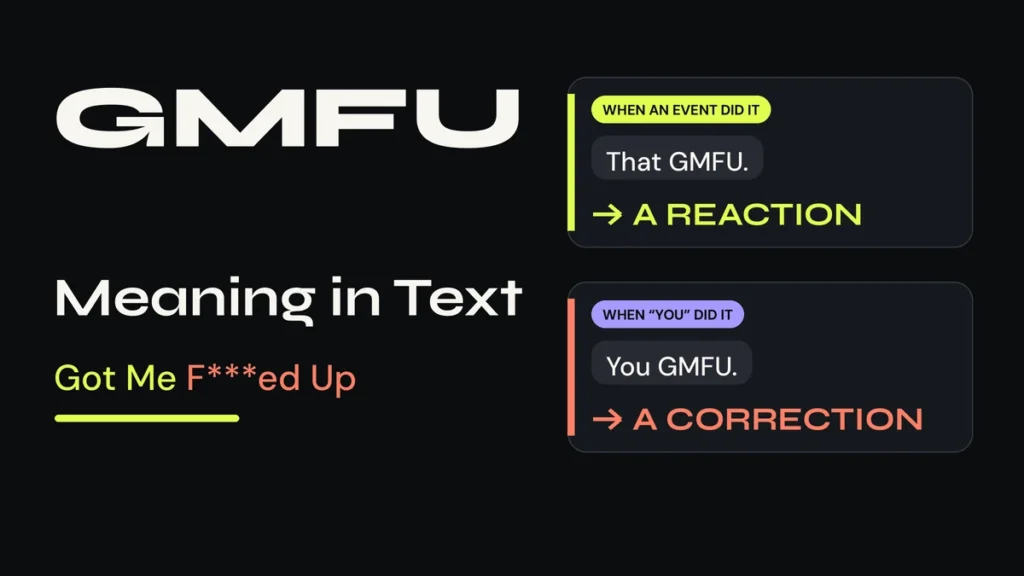
The intensifier has close relatives. ASF and AF (“as f***”) are the stronger siblings – same grammatical slot, heavier profanity. Why speakers pick “as hell” over them: it reads softer, funnier, safer – the exaggeration without the edge. “Hella” is the regional cousin, same job, West Coast accent. This is a real semantic comparison, not a glossary list: the choice between them is a choice about how much edge the sentence can carry.
The checked-claims box, graded in the open – the same evidence bar used for GMFU. Wiktionary: both senses confirmed, with usage examples – the backbone. Merriam-Webster: covers ASL only as American Sign Language – which cleanly proves the slang senses live exclusively in internet-slang references. The 2001 Pew claim (“most common chatroom question”): competitor-reported, NOT verified – this guide does not state it as fact. The early-2010s origin claim for “as hell”: one weak source, unverifiable – the dated record starts mid-2018, and the article says so.
And the single-meaning holdouts: two competitor pages cover only “age, sex, location,” as if the last decade did not happen. Wiktionary documents both. The position is not a judgment call; it is a dictionary fact.
One Respectful Note
If the conversation is about Deaf culture, classes, or interpreters, ASL is American Sign Language – a full, living language with its own grammar, used by millions. Not slang, not a joke, not this article’s subject. The letters coincide; the worlds do not. Never use the slang as a joke in those contexts – it reads as disrespectful, because it is.
How to Reply
Stranger’s “asl?”: ignore, deflect (“why do you ask?”), or boundary (“I don’t share personal info online”). Parents’ version: screenshot, block, report, tell a trusted adult.
Friend’s “tired asl”: no answer required – it is emphasis, not a question. “Fr same” if you want to play along.
The generational misread: if an older relative asks “asl?” and you answer with your location, everyone is confused for different reasons. Clarify kindly: “oh you mean the old chatroom thing – I’m good, how are you?”
At work: don’t. Neither reading belongs in a professional channel, and no reply is better than a casual one.
Frequently Asked Questions
Is asl rude?
“As hell” is casual with mild profanity – fine with friends, never professional. “Asl?” from a stranger reads as intrusive today. Neither is rude in the right context; both are wrong in the wrong one.
What does asl mean on TikTok?
“As hell” – the intensifier. “Tired asl,” “fun asl”: emphasis after an adjective, documented across TikTok-slang guides. The old chatroom question does not live on TikTok.
What does “asl?” with a question mark mean?
The 1990s reading: “age, sex, location” – a stranger’s request for three facts. Standalone with a question mark is the question slot; the position test decides.
Is “age, sex, location” still used?
Only nostalgically or ironically. Privacy norms moved on – profiles display age and location now, and asking a stranger reads as intrusive. The reading survives as a millennial memory and a joke, not a live question.
Is American Sign Language the same as the texting slang?
No. Same letters, different worlds. American Sign Language is a full language with its own grammar; the texting slang is two internet abbreviations. If the chat is about Deaf culture or classes, it is the language – full stop.
Is asl safe for kids to use?
“As hell” is mild profanity – parents decide. “Asl?” from strangers is the real concern: teach kids never to share personal details with strangers online, and the boundary replies in this guide.
The Takeaway
ASL is two meanings, one position test, and one generational story. “Age, sex, location” asked a stranger for three facts in 1998; “as hell” emphasizes an adjective in 2026 – and the sentence tells you which one, because the readings never share a grammatical slot. Check the slot, not the letters; respect the language that shares them; and never answer a stranger’s question with your real details.