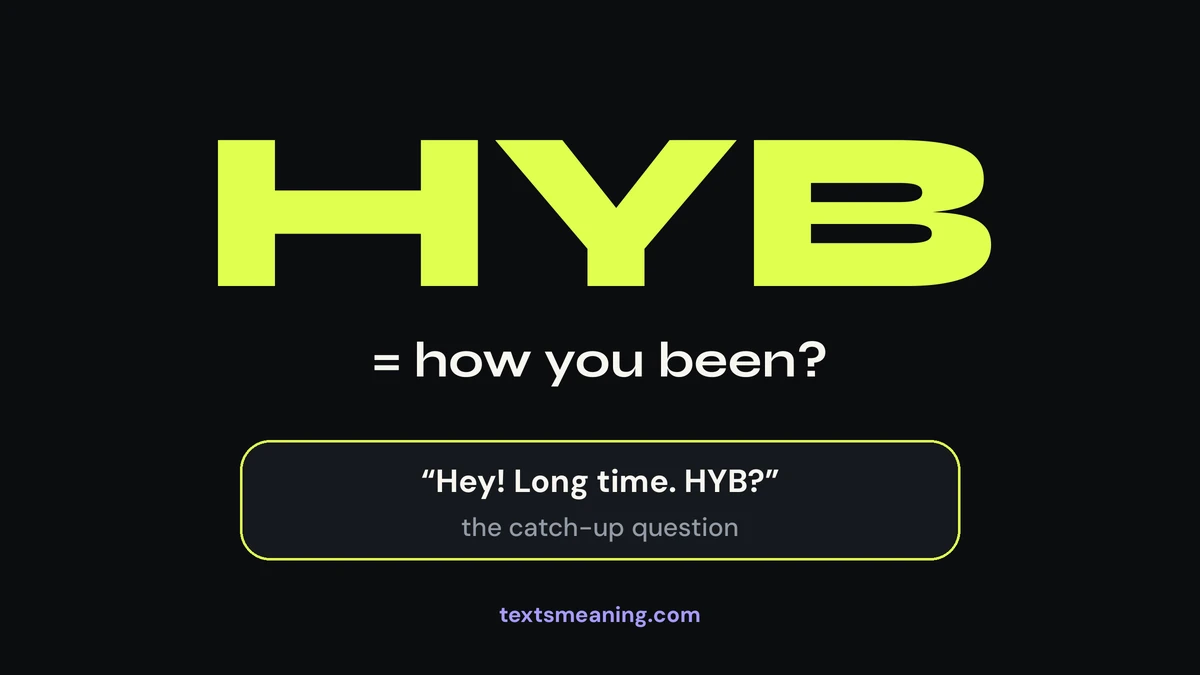
What does HYB mean in text? HYB means “how you been?” — a casual catch-up check-in, used when someone has not talked to you for a while and wants to know what has happened since. “Hey! Long time. HYB?” is the whole question, shortened to three letters. That sounds simple, until the same three letters show up as an order or a promise, and answering the wrong one makes you look like you misheard the whole conversation.
This guide covers the HYB Time Test, a seven-reading tone list, HYB on TikTok, Snapchat, Instagram, and in texts, senders, misreads, graded claims, cousins, history, and three reply tracks — one for each live reading.
What “HYB” Means in Text
“HYB” most often means “how you been?” It is a shortening of “how have you been?” with “have” dropped: H stands for how, Y for you, and B for been. The spoken form behind it is casual on purpose — nobody says “how you been?” in a formal email, and nobody should type HYB in one either.
Two further readings are genuinely live, and a good guide cannot pretend otherwise. “Handle your business” turns HYB into an order: get it done, take care of it, stop drifting. “Hit you back” turns HYB into a promise: the sender will contact you later. Same letters, three different jobs — and, crucially, three different people who act next. That is what makes HYB harder than a simple greeting, and it is why this guide opens with a test instead of a definition alone.
One honesty note up front. Unlike the previous guide in this series, no primary dictionary entry for the texting sense of HYB could be verified for this article: the direct dictionary check was blocked, and no dictionary entry surfaced in search. The verdict above therefore rests on unanimous agreement across every secondary guide read for this article, not on a dictionary quote. That is strong consensus, honestly graded — and it is exactly why the test below matters more than any single definition: when the dictionary cannot settle it, grammar and context have to.
The closest cousin is HRU (“how are you?”). HRU asks about right now. HYB asks about the time since you last spoke. “HRU?” works even if you talked yesterday; “HYB?” only makes sense after a gap. Remember that one line and half of HYB stops being confusing.
The HYB Time Test
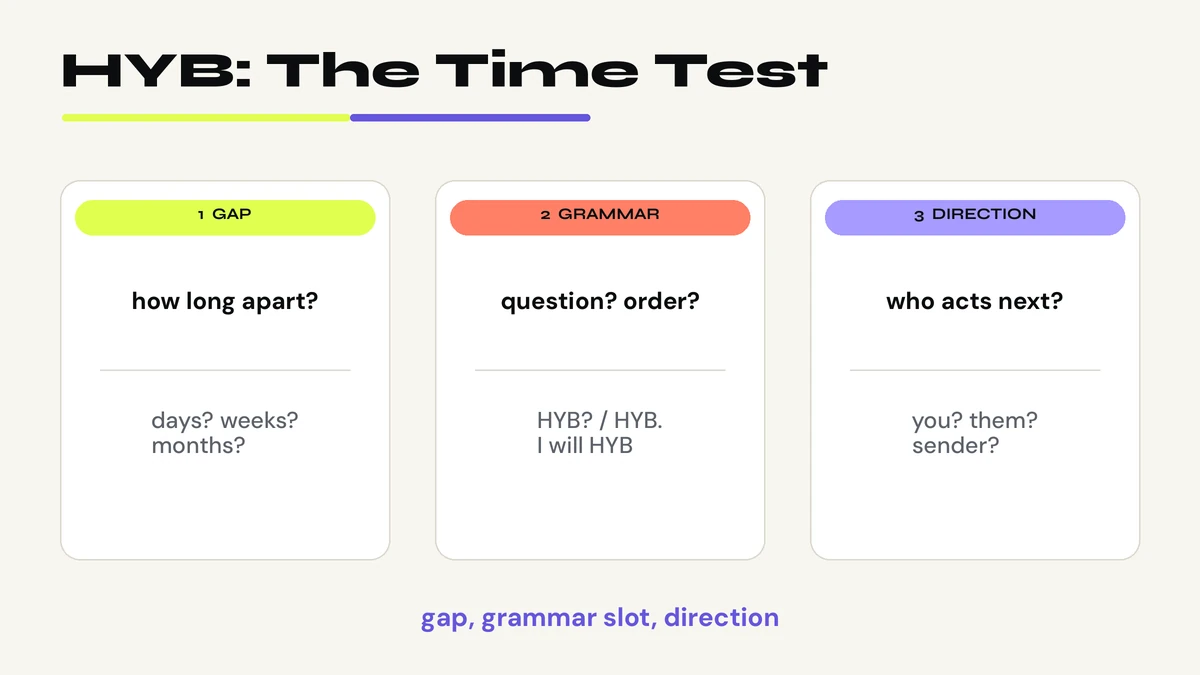
Three checks decide which HYB you just received — and who acts next:
- Check 1 — The Gap Check. How long since you last talked? Days, weeks, or months of silence plus a bare HYB points hard at the check-in reading, because “how you been?” asks about exactly that gap. Daily contact with no gap weakens the check-in reading and should make you look harder at the other two.
- Check 2 — The Grammar Slot Check. What job is HYB doing in the sentence? As a question (“Hey, HYB?”) it is a check-in. As an order (“HYB and finish strong.”) it is handle your business. As a promise (“I will HYB later.”) it is hit you back. Punctuation helps, but the sentence job decides.
- Check 3 — The Direction Check. Who acts next? Check-in: you answer, with an update about your life. Handle your business: they must act, on a task. Hit you back: the sender will act, later, by contacting you. If your planned reply has the wrong person acting, you have the wrong reading.
Worked trio. “Hey! Long time. HYB?” after three silent months — gap plus question plus you-act: a check-in; answer with one update and ask back. “You got deadlines this week. HYB and finish strong.” — no gap needed, order, they-act: handle your business; answer with what you will do. “Gotta run, I will HYB later.” — promise, sender-acts: hit you back; a short acknowledgement closes it, not a life update.
“HYB” in Real Chats
Illustrative examples written for this guide, not real transcripts:
- The warm reconnection. “Hey! Long time. HYB?” — the default HYB: a door reopening after months apart.
- The everyday catch-up. “HYB lately? Miss chatting with you.” — friendly, low-pressure, and clearly a question.
- The light re-entry. A bare “HYB?” after a short gap — a door opening with no weight attached.
- The tough-love order. “You got deadlines this week. HYB and finish strong.” — not a question at all; answer with action, not news.
- The callback promise. “Gotta run, I will HYB later.” — the sender is leaving, not asking; do not send a life update to a goodbye.
- The thin nudge. A bare “HYB” from an ex after distance, with no detail — a door cracked open, not a conversation.
The HYB Tone List
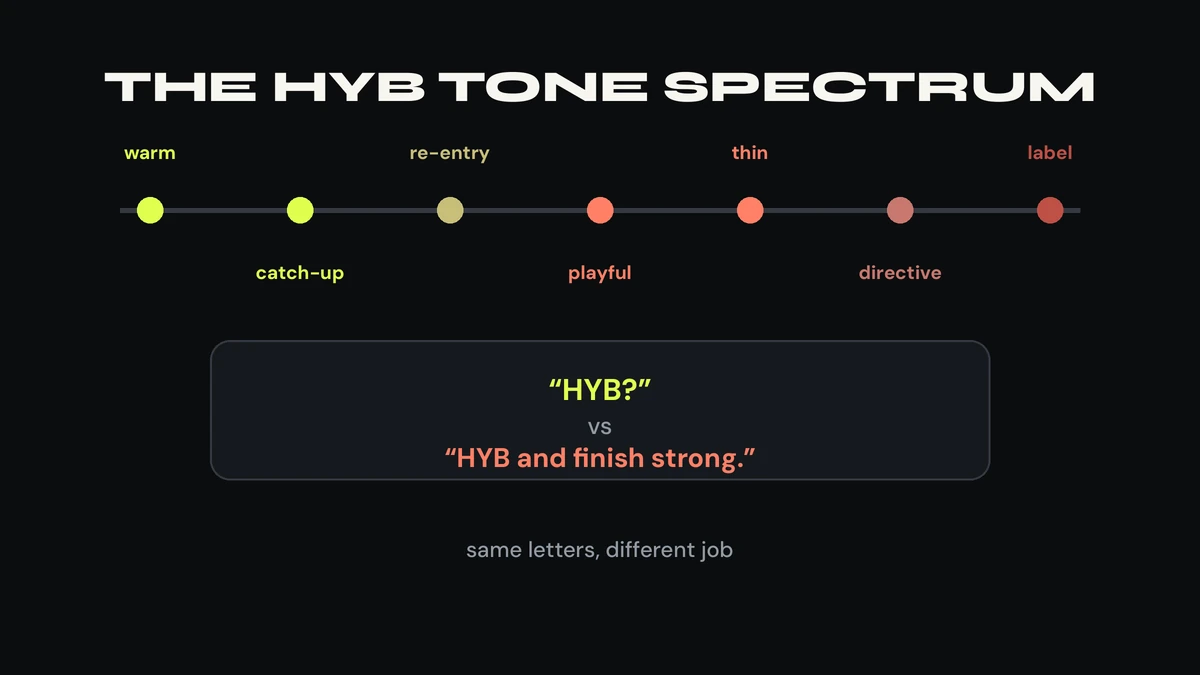
HYB’s tone slides from warm to bossy. Seven readings, warmest to bossiest:
- Warm reconnection: “Hey! Long time. HYB?” after months apart — genuine care; the sender means it.
- Friendly catch-up: “HYB lately? Miss chatting with you.” — the everyday default.
- Light re-entry: a bare “HYB?” after a short gap — a door opening, no weight.
- Playful nudge: “HYB??” with extra question marks or an emoji — eager or teasing, still a check-in.
- Thin or low-effort: a bare “HYB” from a stranger or an ex, with no detail and no warmth — reads as checked-out, not caring.
- Tough-love directive: “HYB and finish strong.” — motivational, but it is an order, not a question.
- Objectifying label: the slang-list reading that labels a person — fenced off in this guide: never the default, and using it about someone reads as objectifying rather than friendly. Do not use it that way.
Gap, grammar slot, and direction move a reading across this list. Punctuation alone never decides it: “HYB??” is still a question, and “HYB.” with a full stop is still an order if the sentence says so.
“HYB” on TikTok
On TikTok, HYB is a comment-section catch-up: “HYB everyone?” under a creator’s return video, or “long time no see, HYB?” as a reply to a familiar commenter. The public stage suits the check-in reading: a hello that asks about the gap since the creator last posted, without owing a private answer. The handle-your-business reading almost never appears here, because a public comment cannot order a stranger around and be taken seriously. If you see HYB on TikTok, start from the check-in and only leave it if the sentence is clearly an order.
“HYB” on Snapchat
On Snapchat, HYB fits the fast, disappearing DM: “HYB?” on a streak snap after a quiet week, or “hey, HYB lately?” as a story reply reopening a private chat. The disappearing format suits a light re-entry: a greeting that lands, asks about the gap, and vanishes. The thin reading is easiest to misjudge here, since the message vanishes before you can re-read it: if an HYB felt off, ask from memory what rode with it — a gap, or nothing at all.
“HYB” on Instagram
On Instagram, HYB shows up in story replies and DMs: “HYB? loved the trip photos” as a story reply, or “hey, HYB?” as a DM opener after months apart. Public replies lean light re-entry; DMs carry the full range, including the tough-love order between close friends. One warning: some guides claim Instagram has its own HYB meaning, different from everywhere else. It does not. The same guide that teaches the check-in in its main text claims the order reading for Instagram in its own FAQ — a self-contradiction, not evidence. Platforms stage the same readings differently; they do not invent new ones.
“HYB” in Text Messages
Plain texts are HYB’s home ground, and the gap is usually visible right there in the thread: scroll up, and the last message tells you how long the silence lasted. That visible gap is why texts are the easiest place to run the Gap Check. HYB pairs with the reassurance companion DW — “HYB? dw, I have been fine” answers the check-in and reassures in one breath — and with the side-note companion BTW: “HYB? btw, did you see the game?” catches up and pivots in the same message. Three abbreviations, three jobs, one fluent chat.
Texts are also HYB’s work habitat — and its limit: in a casual team chat, an “HYB?” to a teammate you know well is friendly small talk, but a formal email wants “how have you been?” spelled out. The test: if you would not say “hey” in the message, do not say “HYB.” And never send the order reading at work unless you are actually in a position to give that order; a tough-love “HYB” from the wrong person reads as bossy, not motivating.
Who Is Sending It: How “HYB” Lands by Sender
No source documents a different meaning of HYB per sender — the readings stay fixed; what changes is which reading is likely, and what the sender wants:
- Friend: the default. A friend’s “HYB?” after a gap is a check-in at face value; answer with one update and ask back.
- Crush: overread territory. A crush’s “HYB??” feels bigger than it is — a nudge, not a confession. Answer the question, not the fantasy.
- Partner: pattern rules. A partner’s “HYB?” is usually genuine; judge the pattern across days, not one message. A partner’s order reading is usually encouragement, not a command.
- Parent: common and usually warm. A parent’s “HYB, sweetie?” is care, plain and simple.
- Coworker: context decides. In a casual channel it is friendly small talk; in a deadline thread, an order reading means the work, so answer the work first.
- Group chat: the poll habitat. A group’s “HYB guys?” is an open catch-up; answer briefly in the group, not privately.
- Stranger or ex: the thin habitat. A bare “HYB” here is a door cracked open, not a conversation; a short answer, or silence, both end it without rudeness.
When “HYB” Is Not Just Friendly
Four misfires, graded. First, the cross-track misfire — the most consequential one in this guide: sending a life update to a promise (“I will HYB later” answered with a paragraph about your week) or a task report to a check-in. Match the track to the reading, or the conversation derails in one message. Second, the order misfire: taking “HYB and finish strong” as a friendly question, and answering “I have been good!” to someone who was telling you to work. Third, the flirting assumption: a simple catch-up is not a romantic signal. Check timing, emoji, and history first. Fourth, the thin reply after a real gap: a bare “HYB” where a real sentence was owed, after months apart or bad news, reads as checked-out. If you sent it, a follow-up with a detail repairs it.
The objectifying reading deserves its own warning. Some slang lists teach HYB as a label for a person. That reading is context-limited, it is never the reading to assume from a bare HYB, and using it about someone is objectifying rather than friendly. This guide names it once so you can recognise it, and advises against using it. A guide that lists it as a co-equal meaning without that warning is doing its readers no favours.
Checked Claims: Readings That Do Not Hold Up
Three letters attract folklore. The claims that fail evidence:
- “HYB has only one meaning” — rejected. Three readings are live, and collapsing them causes the cross-track misfire above.
- “HYB means something different on Instagram” — rejected. No source documents a platform-specific meaning; one leading guide contradicts itself on exactly this point, teaching the check-in in its body and the order reading for Instagram in its FAQ.
- “HYB means ‘hug you back’” — rejected as unevidenced. One secondary page asserts it while also teaching two other readings in the same breath, with no corroboration anywhere else.
- “HYB means ‘hell yeah, brother’ by default” — fenced as a rare community joke reading. It needs an excitement context to be plausible at all, and it is never the default.
- “HYB means ‘how you bout’ as a separate meaning” — graded as a regional variant, not a separate meaning. It asks what you are up to, which is a cousin question, not the standard HYB.
- “HYB means hybrid, high yield bond, or a youth bureau in a text” — rejected for chat. Real domain acronyms with zero chat relevance.
- “99% of HYB uses mean one thing” — rejected as evidence. Competitor percentages with no method, sample, or dataset; none repeated here as fact.
- “HYB is flirty by itself” — rejected. The letters are neutral; flirtation comes from timing, emojis, and the relationship.
- “HYB works in formal writing” — rejected. Formal contexts want “how have you been?” spelled out; if you would not say “hey” in the message, do not say “HYB.”
What SURVIVES: “how you been?” as the default (strong secondary consensus), with “handle your business” and “hit you back” as live alternates decided by grammar slot and direction. No dictionary attestation is claimed for any of them.
“HYB” vs Its Closest Cousins
HYB belongs to the conversation-flow family — words that open, steer, or close a chat:
- HRU (“how are you?”) — the time cousin, and the most important one. HRU asks about right now; HYB asks about since last contact. HRU says “how are you today?”; HYB says “how have you been since we last spoke?”
- HBU (“how about you?”) — the return cousin. HBU asks second, after an answer; HYB asks first, after a gap. HBU says “now yours”; HYB says “tell me about the gap.”
- HMU (“hit me up”) — the contact cousin. HMU asks you to contact the sender; HYB as “hit you back” promises the sender will contact you. Same contact family, opposite direction — and direction is everything.
- WYO (“what you on?”) — the plans cousin. WYO asks about plans right now; HYB asks about life since last contact. WYO says “what are you doing?”; HYB says “how have you been?”
- BRB (“be right back”) — the promise cousin. BRB promises a return to this chat; HYB as “hit you back” promises a later contact. BRB says “hold on, I am coming back here”; HYB says “I will reach you later.”
HYB often travels with a bounce-back — “HYB? HBU?” — the cheapest way to turn a catch-up into a two-sided conversation.
Where “HYB” Came From
The phrase “how have you been?” is ordinary English, older than any abbreviation. The HYB shortening belongs to the SMS and instant-messaging era: secondary guides converge on texting culture shortening common questions to save typing, the same pressure that produced HRU, HBU, and BRB. HYB drops “have” and compresses “you” to “y” and “been” to “b”, keeping “how” whole — so the letters read as the casual spoken form “how you been?”, not the formal “how have you been?” A secondary theory traces the “how you be” variant through casual spoken English; it is a theory, not a dated first-use claim. No inventor, first-use date, or birthplace platform is claimed.
How to Reply When Someone Sends “HYB”
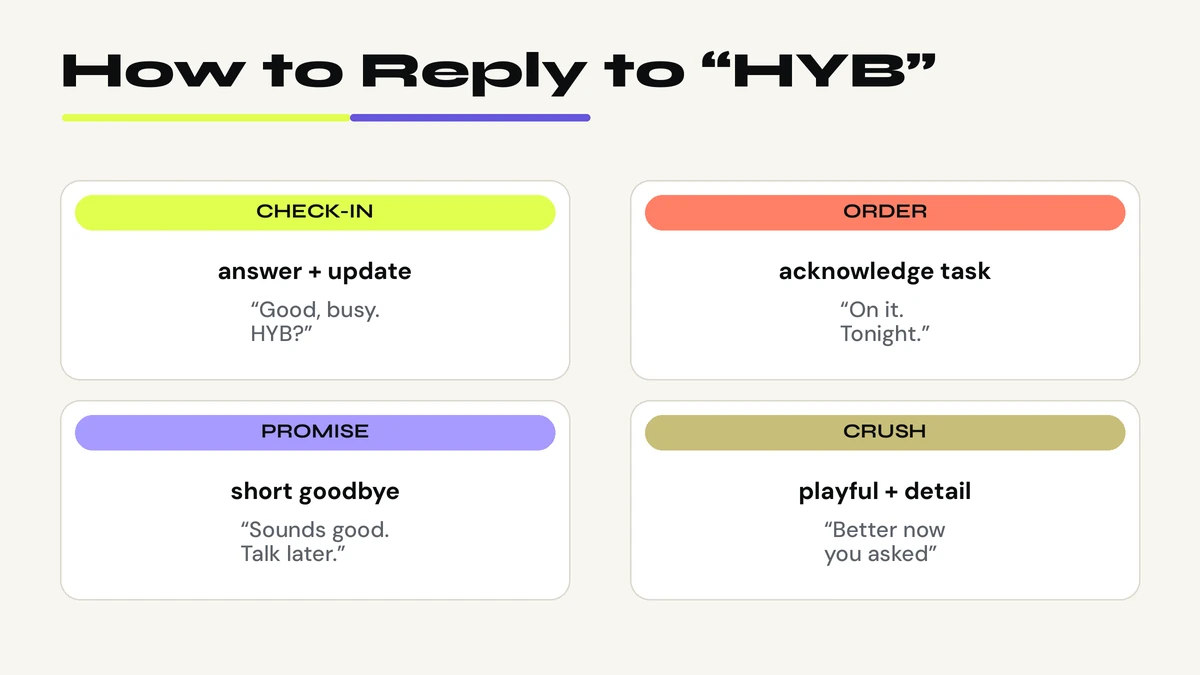
No single reply rule fits HYB, because HYB has three readings. Match the track to the test result:
- Check-in track — answer, update, ask back: “I have been good, just busy with work. HYB?” One update about the gap, then the question returned.
- Directive track — acknowledge the task: “On it. Will finish tonight.” Do not answer an order with a life update.
- Promise track — short acknowledgement: “Sounds good. Talk later.” Do not send a life update to a goodbye, and do not chase it tonight.
- Busy — short and warm: “Slammed but alive. HYB?” Friendly, without pretending you have time you do not.
- Crush — playful plus one detail: “Better now that you asked. HYB?” Playful, but still a real answer.
- Stranger or ex — short or silent: a short answer or silence ends it without rudeness.
Weak versus strong, and the cross-track warning. Weak: “good.” Strong: “good, just finished a long project. HYB?” Small change, big difference. And the misfire to avoid: answering “I will HYB later” with a paragraph about your week. Golden rule: match the track to the reading, never the letters alone.
Frequently Asked Questions
What does “HYB” mean in a text message?
“How you been?” — a casual catch-up check-in after a gap. “Hey! Long time. HYB?” asks what has happened since you last spoke.
What does “HYB” mean on TikTok, Snapchat, and Instagram?
The same check-in everywhere — no platform-specific meaning exists. TikTok stages it as a comment catch-up, Snapchat as a DM re-entry, Instagram as a story reply or DM opener. Any guide claiming an Instagram-only meaning is contradicting its own main text.
Is “HYB” the same as “HRU”?
No. HRU asks about right now; HYB asks about the time since you last spoke. HRU works after a day apart; HYB only makes sense after a gap.
Can “HYB” mean “handle your business”?
Yes, as a live alternate — but only when the sentence is an order, not a question. “HYB and finish strong” is an order; “HYB?” with a question mark is a check-in. The grammar slot decides.
Can “HYB” mean “hit you back”?
Yes, as a promise: “I will HYB later” means the sender will contact you later. Answer with a short acknowledgement, not a life update.
Is “HYB” rude or objectifying?
The check-in reading is not rude; a bare HYB after a long gap can read thin, but that is about the missing detail, not the letters. The slang-list label reading for a person is objectifying, is never the default, and should not be used about someone.
Can I use “HYB” at work?
In a casual team chat, with people you know well, yes. In a formal email, spell out “how have you been?” instead. The test: if you would not say “hey” in the message, do not say “HYB.”
Someone just sent me “HYB”. What do I say?
Run the Time Test first. Check-in: answer with one update and ask back. Order: acknowledge the task. Promise: a short acknowledgement. Never answer all three readings the same way.
The Takeaway
“HYB” is a three-letter catch-up question — “how you been?” — that asks about the gap since you last spoke, with an order and a promise hiding in the same letters. When the letters arrive, run the Time Test: gap, grammar slot, direction. And when you send one, remember: a check-in with no gap is just a greeting, and a greeting mistaken for an order is a conversation derailed in one message.