
What does HMU mean in text? HMU means “hit me up” — contact me when you are ready. “Free Saturday, hmu if you want to grab food” is not a question or an order with a deadline. It is an open door.
This guide to hmu meaning in text covers the HMU Open-Door Test, how hmu changes tone, what it means on TikTok, Snapchat, and Instagram, how it lands by sender, claims that do not hold up, its cousins, its history, and smart replies.
What “HMU” Means in Text
The dictionary record is unusually clean. Wiktionary lists uppercase HMU, in Internet slang and text messaging, as an initialism of “hit me up”: contact me at a later time. Its lowercase entry, hmu, is the alternative letter-case form, so case changes nothing. Merriam-Webster agrees: HMU, hit me up.
“Hit” here is old slang for contact, not a physical blow — the same “hit” from pager days, when paging someone meant they would call back. “Me” is the sender. Together the phrase says: get in touch with me, however suits you, whenever you are ready.
That vagueness is the point. “Text me” names a channel. “Call me” names a channel and implies urgency. HMU names neither, which is why one short form can cover a weekend plan, a sale post, and a late-night message.
The HMU Open-Door Test
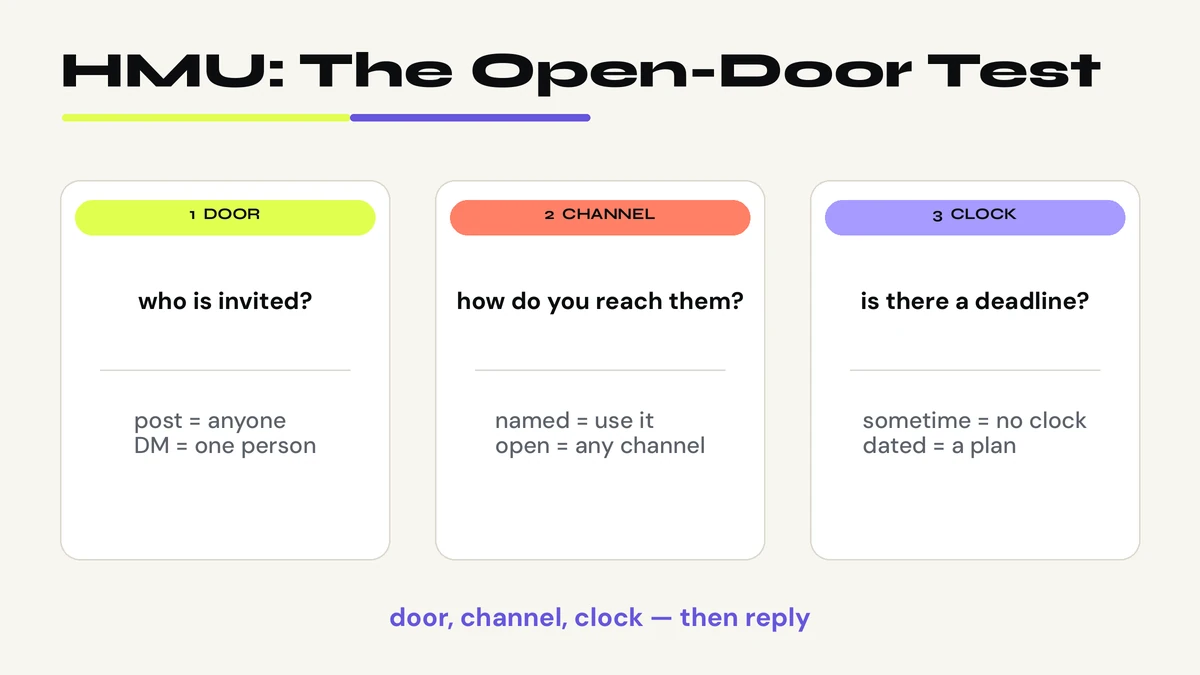
HMU has one real ambiguity: how open is this door, really? Three checks settle it before you reply.
- Check 1 — The Door Check: who is invited? A post, caption, story, or bio invites anyone reading. A direct message invites one person. A broadcast door (“2 tickets left, hmu”) means first come, first served. A private door (“hmu when you are free”) means you, specifically, so a slow reply is fine.
- Check 2 — The Channel Check: how should you reach them? If a channel is named, use it: “hmu on Snap” wants a snap, not an email. If none is named, any normal channel works, so pick the one you already use with that person.
- Check 3 — The Clock Check: is there a deadline? Open-ended hmu (“sometime,” “when you are free”) has no clock, so there is no late reply. Dated hmu (“hmu before 6 if you are coming”) is a plan with a deadline, and silence after it reads as a no. On stories, the platform adds its own clock: the invitation fades when the story does.
Worked trio. A sale caption, “hmu if interested,” is a broadcast door with no clock: ask fast. A friend’s “hmu when you are free” is a private door with an open clock: reply when free. A group-chat “hmu before 6” is a dated door: the deadline is the message.
“HMU” in Real Chats
Illustrative examples written for this guide:
- The weekend plan. “Free Saturday, hmu if you want to grab food” — a private door with a condition. The sender wants company, not a debate.
- The sale post. Caption: “cleaning out my closet, barely worn sneakers, hmu if interested.” — a broadcast door. The right reply is a specific question, not just “hi.”
- The soft reopening. “Haven’t talked in ages, hmu sometime” — a low-pressure way back into a friendship. No date is proposed, and none is expected yet.
- The offer of help. “I have done this before, hmu if you get stuck” — the door opens the other way: the sender is offering themselves, not asking for plans.
- The polite close. A bare “hmu” with no reason, ending a chat nobody picks up again — technically an invitation, practically a goodbye.
How “HMU” Changes Tone

HMU itself is neutral. Its tone comes from the door, the channel, the clock, and the relationship:
- Warm invitation: “hmu if you want to grab food” — a reason plus a condition, sent to someone you actually want to see.
- Low-pressure: “hmu sometime” or “hmu whenever” — the open clock removes the deadline, and with it the pressure.
- Flirty permission: from a crush, especially late at night or with a wink — permission to text first, without committing the sender to anything.
- Transactional: “hmu for rates” or “hmu for bookings” in a bio — a business call to action, not a friendship signal.
- Polite brush-off: a bare “hmu” closing a conversation — the door is left ajar so nobody has to say goodbye properly.
- Dry or blunt: a standalone all-caps “HMU” with nothing around it — the capitals and the emptiness do the cold work. One extra word softens it.
Unsure which tone you just received? Run the Open-Door Test, then read the last few messages.
“HMU” on TikTok
On TikTok, hmu moves a public thread into a private one. A comment like “new to the city, hmu with food spots” invites DM recommendations, and a creator’s “hmu for the link” turns viewers into messengers.
The caution is about the door, not the definition. A creator posting hmu expects stranger messages. A private user posting an open hmu publicly should expect the same strangers, so keep location and personal details out of it.
“HMU” on Snapchat
On Snapchat, hmu usually means snap or chat back. A story saying “bored, hmu” is an open call to viewers, while “hmu on snap” in a text names the channel outright.
Snapchat adds the one clock hmu does not carry itself. A story invitation lasts about as long as the story does, so hmu on yesterday’s story is already a closed door.
“HMU” on Instagram
On Instagram, hmu usually means DM me. It shows up in captions (“selling my old camera, hmu”), in stories (“bored, hmu”), and in bios, where it is a standing invitation, not a one-time offer: “hmu for collabs” stays open until the bio changes.
Instagram is also where hmu is most transactional. A seller or stylist posting hmu wants inquiries; the right reply is the practical question: still available, what is the price, what are the rates.
“HMU” in Text Messages
Plain texts are hmu’s home ground, and the one-to-one setting makes the private door the default. “Hmu when you land” asks for a message on arrival; “hmu, DW no rush” makes the open clock explicit.
Texts are also where hmu pairs with a side note: “hmu, BTW did you check the date?” And texts are where the polite brush-off lives: a bare “hmu” at the end of a long exchange usually means the conversation is over for now.
Who Is Sending It: How “HMU” Lands by Sender
No source documents a different meaning of hmu per sender — the invitation stays fixed; what changes is its weight:
- Friend: the default. A friend’s hmu is a plan or a chat at face value.
- Crush: permission territory. A crush’s hmu hands you the first move; a late-night one leans flirty, but it is not a confession.
- Partner: usually logistics or affection shorthand. Judge any odd one against your chat pattern, not alone.
- Parent: rare, and risky in reverse. Sending hmu to a parent who does not know the term invites confusion; spell it out.
- Boss or coworker: casual peers only. HMU fits a friendly team chat, never a first message to a client or manager.
- Seller or stranger: transactional by definition. Keep it on the deal, and meet in public if a sale turns into a meetup.
- Group chat: a broadcast door inside a smaller room. With no condition attached, a group hmu often goes nowhere.
When “HMU” Is Not Just an Invitation
HMU is informal, not rude. The problems start when the informality lands in the wrong room. Skip hmu in work emails, first messages to clients or recruiters, academic writing, and serious topics — health, money, or bad news deserve complete sentences.
Two more misfires. First, the empty invitation: saying hmu when you do not want to be contacted wastes the other person’s courage. Do not leave a door open you plan to keep shut. Second, the unanswered invitation: no reply to an open-ended hmu is not a rejection — an open door carries no RSVP requirement.
Checked Claims: Expansions That Do Not Hold Up
HMU attracts second readings. Graded, one by one:
- “Hook me up” — graded secondary, real but rarer. A request to be connected with something or someone, as in “hook me up with those tickets.” It needs a favor object; without one, the default is always “hit me up.” Note the gap: Wiktionary’s HMU entry lists only “hit me up.”
- “Hold my unicorn” — rejected as a serious meaning. A joke from around 2010–2011 about how many expansions three letters can carry. It survives in memes, never as a real message.
- “Hair and make-up” — graded domain homonym, real outside chat. In beauty and wedding work, HMU genuinely means hair and make-up: “book your HMU trial” is a salon appointment, not a text.
- “HMU means physical hitting” — rejected. “Hit” here has meant contact since pager days. Nobody sending hmu is threatening anyone.
- “HMUS, HMUT, HMUL” and past-tense “he hmu” — graded unverified or secondary-only. The extended forms appear in one secondary list and nowhere in a primary entry; write “hmu tomorrow” in full instead. The past-tense verb use has one secondary note only; prefer “he hit me up.”
- “HMU is always flirty” or “always means DM me” — both rejected. Flirt is a context, not a definition: a seller’s hmu is transactional, most hmu is friendly. And DM is one channel hmu can take, not the meaning.
What survives: “hit me up,” contact me at a later time, with “hook me up” as a genuine but secondary reading, and hair and make-up as a separate trade term. No competitor statistics are repeated here as fact.
“HMU” vs Its Closest Cousins
HMU is the widest invitation in the family. Its cousins each narrow it:
- DM me / text me / call me — the channel cousins. Each names exactly one way to reach the sender. HMU accepts any of them.
- HBU (“how ’bout you?”) — the question-back cousin. HBU asks a brand-new question back; HMU hands the next move over without asking anything.
- HM — the pause cousin. HM suspends a conversation while someone thinks; HMU invites someone to start one.
- BRB — the timed-pause cousin. BRB promises a return in minutes; HMU promises only an open door, with no clock unless one is named.
- GN — the closing cousin. GN ends a conversation for the night; HMU opens one for later.
- GTG — the leaving cousin. GTG says the sender is going now, and pairs naturally: “gtg, hmu later.”
Where “HMU” Came From
“Hit me up” is older than the abbreviation. “Hit” as contact comes from pager culture, when paging someone meant they would call back, and the phrase was already part of 1990s casual speech. As texting spread in the 2000s, it compressed to three letters; the earliest slang-dictionary entry is dated April 2009 — user-generated attestation, not a primary dictionary.
A widely shared 2011 prom-invite sign using hmu is credited by secondary explainers with a spike in searches that year. The term feels tied to the early 2010s even though it never left: every new app still needs a short way to say “contact me, whenever, however.”
How to Reply When Someone Sends “HMU”

Golden rule: answer an invitation with a next step, not a dead end:
- Friend, and you are free: “For sure — free after 6, want to grab food?”
- Friend, and you are busy: “Can’t today — tomorrow?” The door stays open.
- Public post or sale: “Still available? What’s the price?” Sellers answer specific questions first.
- Crush, and you are interested: “Hey, what are you getting into tonight?” Warm and open.
- Crush, and you are unsure: “About what — plans, or something else?” Clarifying prevents a misread.
- Not interested: “Thanks, not this time — take care.” A polite close beats silence.
- Bare hmu, unclear: “About what, exactly?” If no door, channel, or clock was named, asking is fairer than guessing.
Frequently Asked Questions
What does “HMU” mean in a text message?
“Hit me up” — contact me when you are ready, by text, call, or DM. An open invitation with no fixed channel or time, unless the message adds one.
What does “HMU” mean on Snapchat?
Send me a snap or a chat back. On a story it is an open call that fades when the story does; in a DM it is private, with the usual open clock.
What does “HMU” mean on Instagram?
Usually DM me. In captions and stories it invites a private message about a post or sale; in a bio it is a standing invitation until the bio changes.
What does “HMU” mean on TikTok?
The same invitation, moved into DMs or comment replies: “hmu with food spots” asks for private recommendations, and “hmu for the link” turns a public thread private.
Is “HMU” flirty?
Not by default. HMU is neutral; a crush’s late-night hmu leans flirty, a seller’s is transactional, and most hmu is friendly.
Is “HMU” rude, and can I use it at work?
It is informal, not rude, but keep it out of work emails, first messages to clients, and serious topics. In a casual team chat it is fine; anywhere formal, write “please contact me” instead.
Does “HMU” ever mean “hook me up”?
Yes, as a secondary reading: a request to be connected with something or someone, as in “hook me up with those tickets.” Without a favor object, the default is always “hit me up.”
The Takeaway
HMU is a three-letter open door: “hit me up,” contact me at a later time, by whatever channel suits you. Before you answer one, run the Open-Door Test — who is invited, how, and is there a clock? And never leave a door open you plan to keep shut.