
What does GN mean in text? GN means “good night” — a sign-off, not a statement. “Had a long day. GN!” closes the conversation the way a door closes a room: gently, finally, and without asking anything of the person left inside. But the same two letters can also be a plain log-off, a nightly ritual, or a cold brush-off. The expansion never changes; the ending does. And the Sign-Off Test below tells you which ending this GN is.
This guide to GN meaning in text covers the three-check Sign-Off Test, a six-reading tone spectrum, GN on TikTok, Snapchat, Instagram, and in plain texts, how it lands by sender, the cousins it gets confused with, its history from early-2000s messaging to the dating ritual, and the sender-timezone rule.
What “GN” Means in Text
“GN” means “good night.” It is the shortest way to end a conversation at night — a wish for rest, packed into two letters. The primary dictionary source attests it directly: Wiktionary lists GN as an interjection, “(Internet slang, text messaging) Initialism of good night,” with lowercase “gn” as the alternative form. That is the whole texting meaning; GN’s other dictionary senses — a graphic novel, a medical term, a country code — belong to other worlds, not to a chat thread.
GN does three headline jobs inside ordinary conversation. As a farewell: “GN, sweet dreams! Talk tomorrow.” As a log-off: “GG, GN everyone!” after a game, where nobody is going to sleep yet but everybody is leaving. As a ritual: the nightly “gn” closing a dating or friendship thread — expected, unremarkable, and missed more than noticed when absent.
GN is also the second half of texting’s only true day-pair: GM opens the day, GN closes it. A morning “GM” says “I’m here”; a night “GN” says “I’m done.” That pairing is why GN differs from an ordinary goodbye — it is time-bound. “Bye” works at any hour; a 2 PM GN is odd in a way “bye” never is.
The GN Sign-Off Test

GN has one real ambiguity, and it is not about the expansion: what kind of ending is this? Three checks settle it:
- Check 1 — The Time Check. Is it night for the sender? GN at 11 PM reads as a genuine good-night; GN at 3 PM reads as something else — a joke, a timezone difference, or a conversation-ender.
- Check 2 — The Warmth Check. What travels with the letters? “GN, sweet dreams, talk tomorrow” is warm. A bare “gn” alone is neutral shorthand, not coldness by itself.
- Check 3 — The Winding-Down Check. Was the conversation already slowing — short replies, yawns, “I’m tired” — or mid-topic? GN after a wind-down is natural; GN dropped mid-topic is an exit, and the reply should match the exit.
Worked trio. “I’m beat. GN, sweet dreams!” at midnight after a slowing chat — warm good-night. “GG, GN everyone!” after a game — plain log-off; nobody is owed more. “gn.” alone in reply to a long, personal message at 9 PM — brush-off; the chat was not winding down, so the GN does ending work the sender did not say out loud.
“GN” in Real Chats
Illustrative examples written for this guide — not presented as real transcripts:
- The tired close. “Had a long day. GN!” — the default GN: tired, neutral, no extra meaning.
- The warm close. “GN, sweet dreams! Talk tomorrow” — affection plus a promise of return.
- The game log-off. “GG, GN everyone!” — a collective exit. Warm, but nobody is singled out.
- The group exit. “GN y’all, I’m out” — a polite group departure.
- The brush-off. “gn.” alone, in reply to a long personal message — the period, timing, and cut-off topic do the cold work.
The GN Tone Spectrum
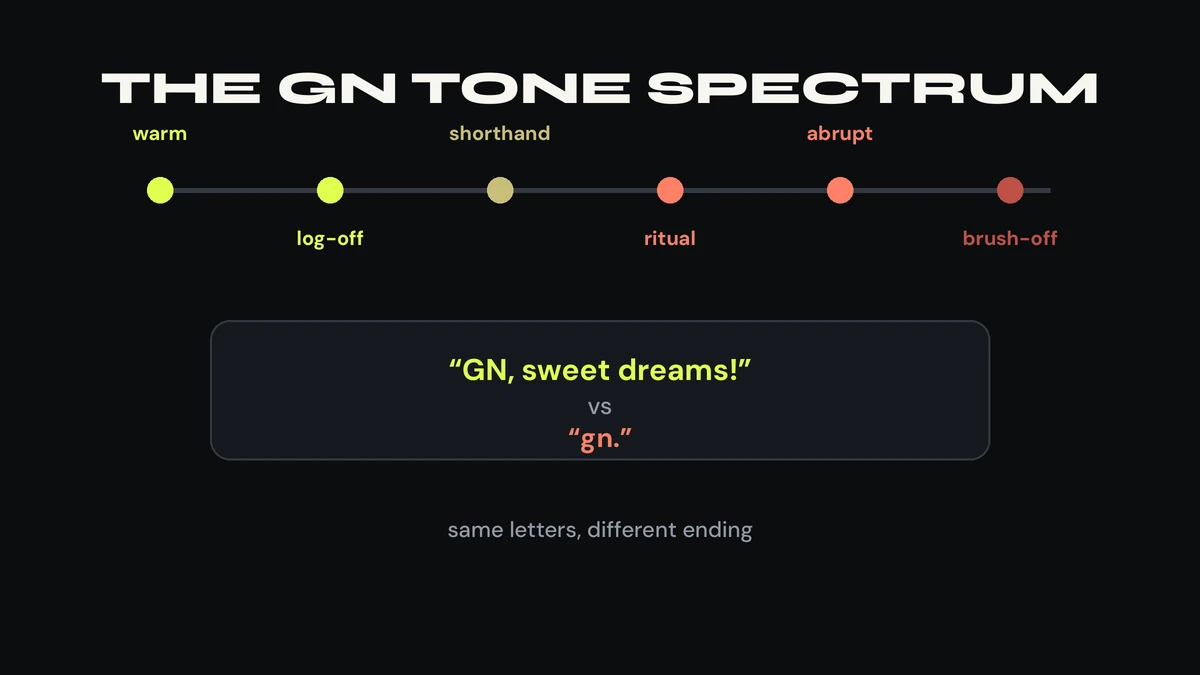
GN’s meaning stays “good night”; its tone slides. Six readings, lightest to heaviest:
- Warm good-night: “GN, sweet dreams! Talk tomorrow” — affection plus a promise of return; the classic close-friend close.
- Friendly log-off: “GG, GN everyone!” — a gaming or group sign-off; warm but collective.
- Plain shorthand close: “Had a long day. GN!” — tired, neutral, no extra meaning. The default reading.
- Ritual check-out: the nightly “gn” in a dating or friendship thread — a habit, not a message. Its absence matters more than its presence.
- Abrupt exit: a bare “gn” landing mid-topic — reads as “I’m done here” even when the sender only meant tiredness.
- Cold brush-off: “gn.” after a serious message — the period, timing, and cut-off topic do the cold work.
The tone lives in the time, the warmth, and the wind-down — not in GN alone. When in doubt, assume the plain close; coldness needs evidence, not just brevity.
“GN” on TikTok
On TikTok, GN is a caption closer and comment sign-off: “Had fun chatting! GN” under a late-night video, or “GN everyone, new video tomorrow” as a creator’s farewell. GN’s job here is pure exit — a two-letter close thousands of strangers can read without needing anything back.
The brush-off reading is rare here, since a caption cannot cut off a viewer; the ritual reading shows up in creator communities, where a nightly GN becomes part of the audience’s routine.
“GN” on Snapchat
On Snapchat, GN fits the disappearing message: “GN, see you tomorrow” on a snap, or a quick “gn” in a DM as the streak ends. The ephemeral format suits GN — an ending that lands lightly and vanishes.
On Snapchat the abrupt-exit reading is easiest to miss, because the message vanishes. If a GN felt off, ask from memory: was the chat slowing, or did it stop dead?
“GN” on Instagram
On Instagram, GN shows up in story captions and DMs: “GN everyone, big day tomorrow” as a story farewell, or “GN, sweet dreams” as a one-person DM close. The public version leans friendly log-off; in DMs, the full range appears.
Instagram is also where GN’s ritual life shows most: a nightly GN in DMs builds a pattern, and a missed night gets noticed in a way a missed comment never would.
“GN” in Text Messages
Plain texts are GN’s home ground. It pairs naturally with its conversation-opening cousin WYO — WYO (“what you on”) opens a conversation, GN closes it; one asks what you are doing, the other says the day is done — and with DW in the reassurance cluster: “GN, dw, we’ll sort it tomorrow” lets a worried friend sleep instead of spiraling. Three abbreviations, three jobs, one fluent night.
Texts are also where GN’s gaming life lives: a squad chat ending in “GG, GN everyone” is not people going to sleep — it is people logging off. That is the purest log-off reading, and the one where nobody expects a reply. In a work Slack, GN fits a casual team channel, but a formal email wants “good night” spelled out.
Who’s Sending It: How “GN” Lands by Sender
No source documents a different meaning of GN per sender — the meaning stays fixed; what changes is how the sign-off reads:
- Friend: the default. A friend’s “GN” is a tired or warm close at face value; read the warmth, not the letters.
- Crush: overread territory. A crush’s “GN, sweet dreams” feels bigger than it is — a warm close, not a confession. A bare “gn” is usually just tiredness, not rejection.
- Partner: ritual rules. A partner’s nightly “GN” is a habit; a missing one says more than a short one. Judge the pattern across nights, not one message.
- Parent: common and usually warm. A parent’s “GN, sleep well” is care, plain and simple — take it at face value.
- Group chat / gaming squad: the log-off habitat. A squad’s “GN everyone” is a collective exit, not a message to one person.
When “GN” Is Not Just a Good-Night
Three misfires, graded. First, the abrupt exit: a bare GN landing mid-topic, mid-question, or mid-argument ends a conversation the other person did not know was ending. If you sent it, a follow-up tomorrow (“Sorry, I crashed — what were you saying?”) repairs it. If you received it, do not chase it tonight; reopen it in daylight.
Second, the brush-off: “gn.” after a serious message uses a good-night as a door. If the chat was not slowing down, the GN does ending work the sender did not say out loud. Answer the topic tomorrow, or let it go; never answer the coldness itself. Third, the morning mistake: a morning GN confuses everyone — which is why the Time Check comes first. The closest cousin here is FWIW (“for what it’s worth”): FWIW softens an opinion before it is delivered, GN closes a conversation after it is over. FWIW says “take it or leave it”; GN says “we’re done for tonight.”
Checked Claims: Expansions That Don’t Hold Up
Two letters attract folklore. The claims that fail evidence:
- “GN means ‘good news’ in texting” — rejected for the texting sense. Wiktionary’s texting sense is “good night” only, and the dedicated GN guide explicitly rejects “good news” (usually “GNS”). A work-chat “good news” reading has no primary attestation and is held unverified here.
- “GN means ‘get naked’” — rejected as a standard meaning. No primary attestation exists; secondary explainers call it rare, outdated, or joking — a trap, never a meaning.
- “GN means ‘gender neutral’ in a text” — rejected as a sign-off reading. Wiktionary attests “gender-neutral” as a separate adjective sense, not a chat ending; a GN ending a message is “good night.”
- “GN always means the sender is going to sleep” — rejected. GN often means logging off, not sleeping — the sender may be done chatting while still awake.
- “A bare ‘GN’ is rude” — rejected as a blanket claim. Bare GN is usually just shorthand; coldness comes from cutting off a live topic.
- “GN is the same as ‘goodbye’” — rejected. GN is time-bound; a 2 PM “GN” is odd in a way “bye” is not.
- “GN is the same as GM” — rejected. GM opens the day, GN closes it; they are a pair, not synonyms.
What SURVIVES: “good night” (strong, universal, time-bound), with the warm close, log-off, ritual, abrupt exit, and brush-off as readings of the same sign-off — not as different meanings. Everything else failed evidence.
“GN” vs Its Closest Cousins
GN belongs to the endings family — the words that close conversations rather than fill them:
- CYA (“see you” / “cover your…”) — the goodbye cousin. CYA closes with a promise to return; GN closes with sleep. CYA says “until next time”; GN says “good night.”
- BRB (“be right back”) — the pause cousin. BRB promises a return in minutes; GN ends the night. BRB says “hold on”; GN says “we’re done.”
- BTW (“by the way”) — the side-note cousin. BTW adds something extra mid-conversation; GN ends it. BTW says “oh, also”; GN says “good night.”
- BFFR (“be for real”) — the reaction cousin. BFFR reacts to nonsense; GN ends the night. BFFR judges; GN closes.
GN often travels with a promise — “talk tomorrow” — the cheapest way to soften any ending, and the difference between a warm close and a final one.
Where “GN” Came From
GN rose with instant messaging in the early 2000s. The pair’s dictionary trail starts with GM in 2003 and GN in 2004 on Urban Dictionary, one year apart, and the pair “likely” existed in the 1990s but “took off with instant messaging apps like AOL Instant Messenger and Yahoo Messenger,” where teenagers needed fast ways to enter and exit chats.
From there GN traveled the dating route: as texting became the main way couples talked, a morning “GM” and a nightly “GN” became a start/end-of-day ritual — the cheapest proof someone was thinking of you at both ends of the day. Gaming added a second branch later: Discord servers and squads turned GN into a collective log-off (“GG, GN everyone”), the same sign-off with nobody going to sleep. No inventor or first-use date earlier than 2004 is claimed; the 1990s origin is likely, not attested.
How to Reply When Someone Sends “GN”

Five replies, matched to the reading:
- Warm good-night — return it: “GN! Sleep well”, “Sweet dreams, talk tomorrow”. A warm close deserves a warm close.
- Friendly log-off — mirror briefly: “GN everyone!” or silence. A collective exit needs no speech.
- Plain shorthand close — optional acknowledgment: a “GN!” back, or nothing. A tired close asks for nothing.
- Ritual check-out — keep the ritual: reply in kind. A missing reply breaks the pattern more than a short one keeps it.
- Abrupt exit or brush-off — don’t chase it tonight: if the topic matters, reopen it tomorrow in daylight. Never answer a GN with a new question tonight — a GN has already closed the shop.
What never works: answering a GN with a long message that restarts the conversation. The golden rule: match the sign-off, not the letters.
Frequently Asked Questions
What does “GN” mean in a text message?
“Good night” — a sign-off ending the conversation for the night. “Had a long day. GN!” is a farewell, not a question.
What does “GN” mean on TikTok, Snapchat, and Instagram?
The same sign-off everywhere — no platform-specific meaning exists. TikTok stages it as a caption closer, Snapchat as a disappearing DM, Instagram as a story farewell. Same letters, different stage.
Is a bare “GN” rude?
Usually not — bare GN is normally just shorthand. It reads cold only when it cuts off a live topic or follows a serious message.
What’s the difference between “GN” and “GM”?
GM opens the day and GN closes it. They are a pair, not synonyms: GM says “I’m here,” GN says “I’m done for tonight.”
What’s the difference between “GN” and “CYA”?
CYA closes with a promise to return; GN closes with sleep. CYA says “until next time”; GN says “good night.”
Can I use “GN” at work?
In a casual team chat, yes. In a formal email, spell out “good night” instead; GN is casual shorthand.
Someone just sent me “GN”. What do I say?
Match the sign-off: return a warm close, mirror a log-off, or say nothing to a plain close. If it cut off a live topic, reopen it tomorrow in daylight.
The Takeaway
“GN” is a two-letter good-night — a sign-off that ends the conversation, wishes rest, and asks for nothing back. When the letters arrive, run the Sign-Off Test: time, warmth, wind-down. And when you send one, remember the only rule that matters: a good-night that cuts off a live conversation is not a good-night.