
What does cya mean in text? It means “see ya” — a casual goodbye. But in work talk it can mean “cover your a**,” as in protect yourself with a paper trail. No study says which reading is more common, so context decides. Run the four-check test below and you will read it in seconds.
Most guides pick one meaning and declare it “the most common” without any frequency evidence. This guide does not. Below: both readings graded by evidence, a named reader test, a warmth spectrum, platform and sender breakdowns, and the workplace warning most guides skip.
What CYA Means in Text
CYA carries two dictionary-attested readings, and both are real. Your job is not to pick a favorite — it is to read the context and let it point you to the right one.
“See ya” — the casual goodbye. STRONGLY SUPPORTED. In everyday texting, CYA is simply “see ya”: a fast, friendly sign-off, the texting equivalent of waving as you walk out the door. Wiktionary reads “cya” directly as an alternative spelling of “see ya,” backed by a 2023 print citation. Merriam-Webster lists “CYA = see ya” in its texting-abbreviations reference, and Grammarly and Collins carry the same expansion. When a friend ends a chat with “Gotta run, cya tomorrow!” — that is this reading, no decoding required.
“Cover your a**” — the workplace guardrail. SUPPORTED. The second reading is an initialism for a vulgar workplace idiom. Expanded in full, the phrase is “cover your ass” — to protect yourself from blame, usually by documenting everything in writing. That is the one place this guide prints the plain form; everywhere else it is asterisked. Wiktionary lists CYA as the initialism directly, and Dictionary.com and WordReference carry the expansion (cited through competitor references). You will meet this reading in sentences like “save that email for CYA” — emails, records, blame. That is the guardrail, not the goodbye.
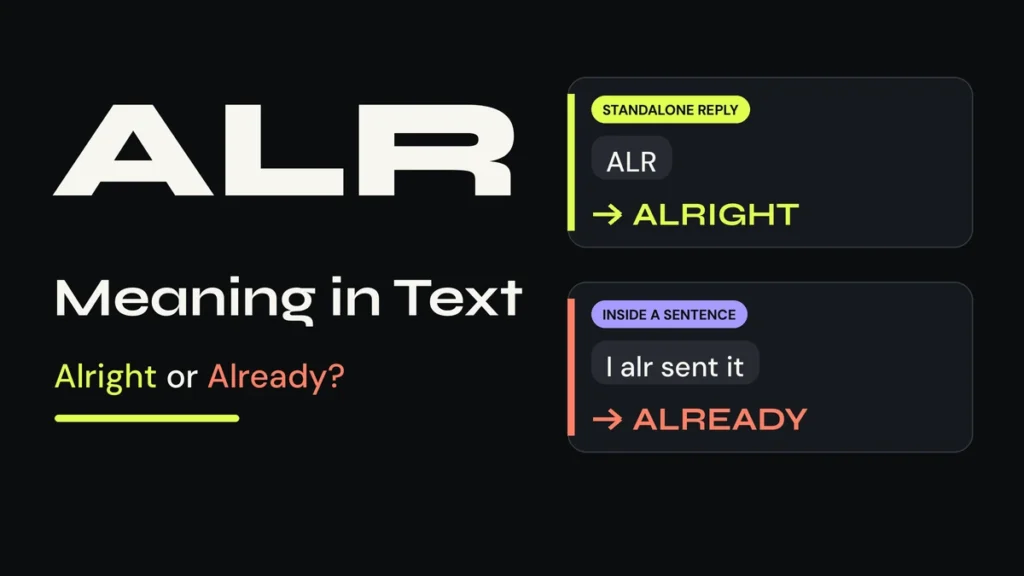
So which reading applies? Run the deciding rule: position + register + grammar, with case as a soft cue. A standalone end-of-chat sign-off in a casual register — “Cya!” — is the goodbye. A noun or verb slot about emails, records, or blame — “that’s a CYA email” — is the guardrail. Lowercase “cya” leans goodbye; ALL-CAPS “CYA” inside a work thread leans workplace. But as our ALR guide’s alright-vs-already verdict showed, a two-reading word needs a deciding rule, not a popularity contest — capitalization never decides alone.
The Goodbye-or-Guardrail Test

The Goodbye-or-Guardrail Test is the series’ first tool for resolving two dictionary-attested readings across different registers. Run any CYA through all four checks. If three or four point the same way, that reading wins. If the checks split 2–2, fail open and ask: “cya as in see ya?” A five-word question beats an awkward misread.
The example lines in this section are illustrative chats written for this guide, not quoted conversations.
1. Position — where does it sit? Standalone or the last line of a winding-down chat (“Gotta run, cya tomorrow!”) = goodbye. Embedded in a sentence about emails, records, reports, or blame (“save that email for CYA”) = guardrail.
2. Register — what is the chat about? Casual personal chat, gaming lobby, group thread = goodbye. Work, rules, deadlines, liability, proof = guardrail.
3. Grammar — what slot does it fill? Standalone interjection (“Cya!”) = goodbye. Noun or verb slot (“a CYA email,” “that’s just CYA,” “to CYA”) = guardrail.
4. Case — a soft cue only. Lowercase “cya” leans goodbye; ALL-CAPS “CYA” in a work thread leans guardrail. Never decisive alone — it only breaks ties.
Try the fail-open rule on a split: “CYA, I’m logging off.” Position says goodbye (end of chat), but the work Slack channel says guardrail. Do not guess. Ask: “cya as in see ya?” Compare “Put it in writing as CYA”: grammar, register, and position all point to the guardrail — no question needed.
The Goodbye-Warmth Spectrum

Not all goodbyes carry the same temperature. Here is where cya lands on the spectrum, from warmest to briskest — so you can feel the exact weight of the sign-off you send or receive.
1. “see you” — full words, warmest and most deliberate. You mean it.
2. “see ya” — warm and friendly, a touch more casual than the full form.
3. cya — breezier than “bye,” quicker to type, lighter in feeling. The friendly default of fast chats.
4. “bye” — the neutral standard. No temperature either way.
5. “ttyl” — softens the exit with a promise of return; warmer than it looks.
6. “gtg” — briskest of the bunch. The door is already closing.
The takeaway: cya sits in the warm-casual middle — friendlier than “bye,” cooler than “see you,” and far less abrupt than “gtg.” If someone wanted to sound cold, they would not have typed cya.
What CYA Means on Each Platform
The platform does not change the meaning: register and grammar decide, never the app. What changes is where each reading tends to show up.
On TikTok
The goodbye reading rules TikTok comments and captions — creators sign off videos with “cya in the next one,” and commenters drop “cyaa” under videos they liked. The guardrail reading appears in career-advice and office-life videos explaining “CYA culture” at work. Same two readings; the video’s topic picks the winner.
On Snapchat
Snapchat is goodbye territory: “cya” lands as a snap caption or a streak-chat sign-off between friends. Fast, visual, low-stakes — the guardrail reading has no natural home here, and you will rarely meet it.
On Instagram
Instagram DMs and comment threads use the casual reading — lowercase “cya” is the common spelling, often with no punctuation at all. The guardrail reading shows up mainly in work-adjacent meme pages joking about office documentation culture.
In Text Messages
Texting is the native habitat of both readings. Friends and family get the goodbye (“cya tomorrow!”); work threads get the guardrail (“CYA — get it in writing”). Because both live here, texts are where the Goodbye-or-Guardrail Test earns its keep — run the four checks before you assume.
What It Means Depending on Who Sends It
The sender does not change the dictionary meaning, but it changes the odds — and the stakes of misreading.
- Friend: the default warm goodbye. “cya tomorrow!” needs no decoding.
- Crush: a stretched “cyaa” with an emoji can flirt — read the warmth, not just the letters.
- Partner: a routine sign-off, neutral to warm; nothing to decode.
- Classmate: a neutral sign-off after coordinating plans. Logistics, not feelings.
- Group chat: one person’s exit, not a statement. Nobody is mad; they are just leaving.
- Coworker: the danger zone. In a work thread, treat CYA as the guardrail until the context proves otherwise — they may mean (or read) the other meaning.
- Manager or teacher: do not send it. Even a friendly “CYA” can read as flippant, hostile, or vulgar to someone grading you. Spell it out: “see you tomorrow.”
The sender does not change the dictionary meaning, but it changes the odds — and the stakes of misreading.
Tone: What CYA Feels Like
The letters never change, but the casing and punctuation rewrite the feeling. The same case-and-punctuation reading device our WYO guide uses for its punctuation tell works here:
- “cya!” — cheerful and breezy; the exclamation mark does the smiling.
- “cyaa” — the stretched spelling reads warmer and more playful.
- “cya.” — the period lands flat; abrupt, even annoyed.
- “cya” mid-argument — a cold sign-off. The conversation is over, and not happily.
- “CYA” in all caps, casual chat — louder and emphatic; in a work thread it reads defensive.
- “That’s a CYA move” — cynical and judgmental; it accuses someone of blame-shifting.
The “Cover Your A**” Reading: A Workplace Register, Handled Carefully
This section covers the second reading only, and it is register-gated on purpose: if you only ever text friends, skim it — but do not skip the warning at the end.
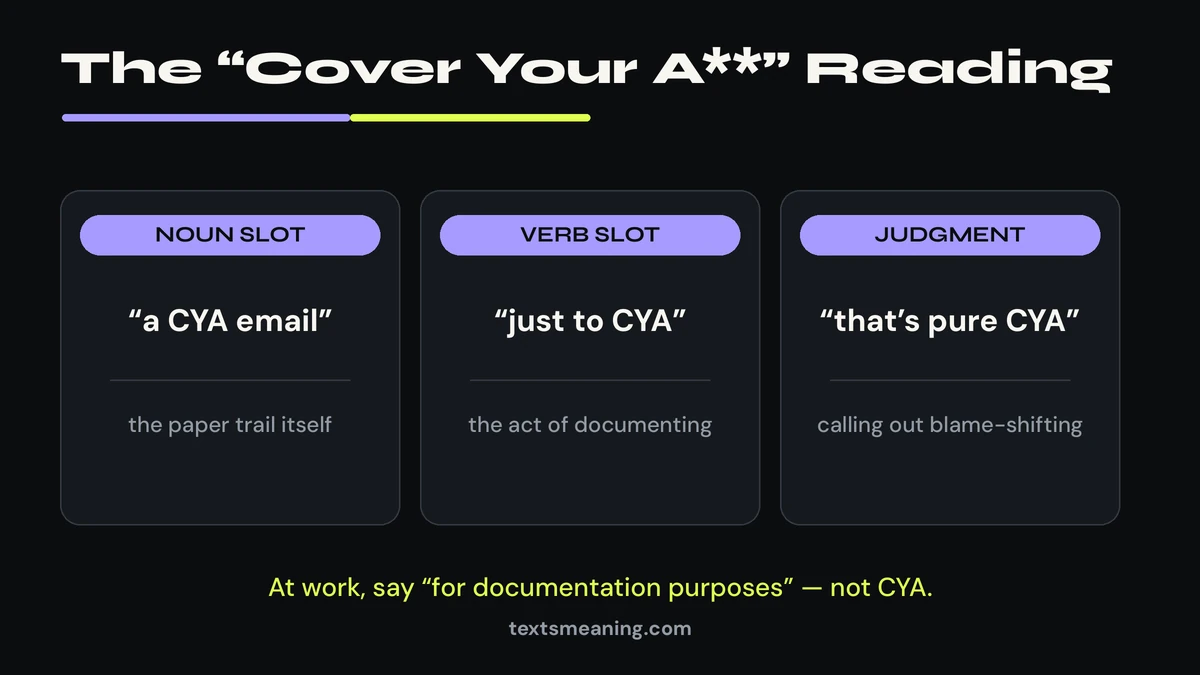
In workplace talk, CYA is a noun or verb for self-protection: “a CYA email,” “just to CYA,” “that’s pure CYA.” The move is always the same — build a paper trail so blame cannot land on you. The tone is cynical, cautious, strategic: the sound of people who have been burned before.
The blame game CYA is built to avoid is exactly what our FAFO guide warns about — consequences arrive whether or not you documented your way out of them. CYA is armor, not innocence.
Practical rule: at work, say “for documentation purposes” or “to keep a record” instead of typing CYA. The initialism saves three seconds and risks your reputation — especially with anyone who only knows the vulgar expansion.
Is CYA Rude?
It depends on which reading lands — and who is reading.
The goodbye reading is not rude by default; it only turns cold at the edges — “cya.” with a flat period, or “cya” dropped mid-argument, reads as a door slamming. And one hard rule: never text “CYA” to a manager, teacher, or client. Even when you mean “see ya,” they may read hostility — or the vulgar expansion. Spell it out instead.
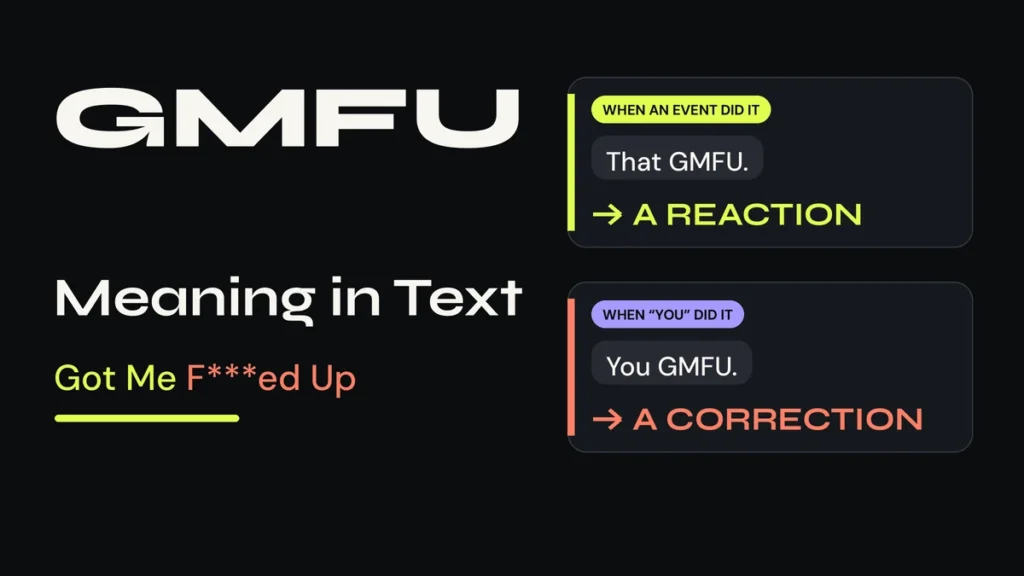
The guardrail reading is vulgar by construction — never use it in polite or professional company, and never let it slip into a message to someone who might take it at face value. We handle the expansion the same way our GMFU guide does: asterisked everywhere in display text, expanded in full exactly once where the meaning requires it.
How to Reply to CYA
Match the reading, not the letters.
- Goodbye reading: “bye!”, “see ya,” “cya!”, “talk later” — or a warm close like “goodnight!”
- Guardrail reading: acknowledge the documentation point — “Good idea, I’ll save the record,” or “Yes, I’ll keep everything documented.”
- Not sure which: use the fail-open line — “cya as in see ya?” Five words, zero awkwardness.
Where CYA Came From
The “see ya” reading rides the old C-for-see convention — CU, CYT, CUL — born in 1990s–2000s chatrooms and early mobile texting, when character limits and slow keypads rewarded short forms. Wiktionary’s “cya” entry carries a 2023 print citation. No source names a single inventor or a first-use date, so this guide will not invent one either.
The “cover your a**” reading comes from the older defensive idiom, which reference sources trace to mid-20th century workplace and military culture — reported by references rather than primary-documented, so take the date as tradition, not fact.
CYA vs Its Closest Cousins
Cya belongs to the goodbye family, but each cousin does a different job:
- CU (“see you”) — the fuller cousin; a touch warmer and more deliberate than cya.
- TTYL (“talk to you later”) — carries a return promise that cya never makes.
- BRB (“be right back”) — a pause, not an exit. The sender is coming back; cya means they are gone.
- GTG (“got to go”) — the abrupt exit, cooler and blunter than cya.
- AFK — stepping away from the keyboard mid-chat, not signing off. As our AFK guide covers the pause, this guide covers the exit: AFK is “hold on,” cya is “I’m out.”
Checked Claims: What CYA Does Not Mean
The internet attaches hopeful expansions to every acronym. Each of these was checked against the dictionaries and rejected openly:
- “Cover your assets” — reported by one site as a formal variant; no dictionary attests it. Looks invented. Rejected.
- “See you around” as a third meaning — the same goodbye wearing a different gloss, not an independent reading. Folded into “see ya.”
- Cyanuric Acid — a real pool-chemistry term, not a texting meaning. Mentioned here only so searchers land in the right place.
- “CYA almost always means see ya” — the dominance claim. No frequency study exists for either reading, so this guide makes no popularity claim. Rejected.
- “ALL-CAPS always means the workplace reading” — the absolute case rule. Counter-examples exist on both sides (all-caps goodbyes are all over gaming chats). Case is a soft cue, never a rule. Rejected.
Frequently Asked Questions
What does CYA mean in text from a guy?
The same two readings — the sender’s gender does not change the dictionary. Run the four checks: position, register, grammar, and case. A “cyaa” with an emoji leans warm and possibly flirty no matter who sends it.
Is CYA rude to say to someone?
The goodbye reading is not rude — it only reads cold with a flat period (“cya.”) or mid-argument. The “cover your a**” reading is vulgar, so keep it out of polite company.
Can I use CYA at work?
For the goodbye, spell it out: “see you tomorrow” beats “CYA” with a boss every time. For the guardrail reading, say “for documentation purposes” instead of typing the initialism. Typing CYA to a manager risks a misread you cannot take back.
What is the difference between CYA and TTYL?
CYA signs off; TTYL promises a return. “Cya!” ends the conversation, while “ttyl” says you will pick it back up later.
Does CYA mean “see you around”?
That is the same goodbye, not a separate meaning. “See you around” is just a warmer gloss on “see ya” — this guide folds it into the goodbye reading rather than counting it twice.
Is it CYA or cya?
Both spellings exist. Lowercase “cya” leans toward the casual goodbye; ALL-CAPS “CYA” in a work thread leans toward the guardrail reading. Treat case as a soft cue — it suggests, but it never decides alone.
The Takeaway
CYA means “see ya” in casual chats and “cover your a**” where blame and paperwork live — and the Goodbye-or-Guardrail Test tells you which. When the checks split 2–2, ask: “cya as in see ya?” Five words beat a misread every time.