
What does dm mean in text? DM means direct message — a private message inside a social app. When someone says “DM me,” they want you to move the conversation somewhere only the two of you can see. That is the whole trick: DMs don’t change what you’re saying — they change who’s allowed to hear it.
Most guides define DM in one line and stop. This one teaches the three jobs DM does (noun, verb, place), a three-check test for reading any “DM me,” what it looks like on TikTok, Snapchat, Instagram, and plain texts, how to read who is DMing you, and the safety half most guides skip.
What DM Means in Text
DM is an initialism of “direct message” — a private message, or the private conversation thread itself, inside a social media or messaging app. Four established dictionaries agree on this, word for word. Wiktionary reads the internet sense as “initialism of direct message (type of message on social media platforms).” Merriam-Webster defines it as “a private message sent on social media to a specific individual or group.” Collins says it plainly: “If you send someone a DM, you send them a private message via social media.” Cambridge agrees. No dictionary documents a second texting meaning — and that matters, because the internet invents them constantly.
Here is what makes DM special in this series: it is one of the few slang terms that is grammatically load-bearing. It does three jobs at once, and most guides only teach the first.
- Noun: “send me a DM” — the message itself, a thing you can receive, ignore, or screenshot.
- Verb: “DM me”, “she DM’d me,” “we’ve been DMing” — the act of messaging. Merriam-Webster lists the verb forms outright: DMed, DMing, DMs.
- Place: “in my DMs,” “my DMs are open” — the inbox as a location, somewhere you can be.
It can also be one-to-one or a small private group — Merriam-Webster’s “to a specific individual or group” covers both. What it is never is public: the moment everyone can see it, it stops being a DM.
The Inbox Shift Test
 When a “DM me” leaves you unsure what someone wants, three checks settle it in about five seconds:
- Check 1 — What’s moving? “DM me” never changes the topic; it changes the channel, from public to private. If the sentence makes sense as “let’s take this somewhere only we can see,” you are looking at the direct-message meaning.
- Check 2 — Who’s in the room? One person, or a small private group, means DM. Everyone watching means post, comment, or story — not a DM. If the audience is public, “DM” cannot be the meaning.
- Check 3 — Does it ride the app or the phone number? A DM lives inside the app’s inbox — Instagram, TikTok, X, Snapchat. If the message needs a phone number and travels through the SMS carrier, it is a text, not a DM, even when someone loosely calls it one.
Worked example. A comment under a creator’s post: “where did you get that jacket?” Reply: “DM me, I’ll send the link.” Check 1: the topic isn’t changing — the channel is, from public comments to a private thread. Check 2: the room shrinks to two people. Check 3: it rides the app’s inbox, not a phone number. Three checks, one answer: direct message.
Memory hook: DMs don’t change what you’re saying — they change who’s allowed to hear it.
DM in Real Chats
These examples are written for this guide to show the patterns — not presented as real transcripts:
- Friend logistics. A: “where’s the party at” / B: “DM me, I’ll send the address.” The public-to-private shift from Check 1, in the wild.
- Creator business. Comment: “how much for the preset pack?” / Reply: “DM me for details!” Professional register — DMs are a sales channel now.
- Warm-to-flirty. “your playlist is elite 👀” → “haha thanks — DM me.” The tone is flirty, but the word still means exactly one thing: take it private.
- Stranger, unanswered. “Hey I saw your profile, DM me back?” (no reply sent, none owed). This is the setup for the safety section below.
The Tone of “DM Me”
DM itself is neutral — it names a channel, not an attitude. The tone you feel comes from the request pattern and the sender, never from the letters:
- Neutral / practical: “DM me the link” — pure logistics, zero subtext.
- Warm / friendly: “just DM me whenever” — an open door, low pressure.
- Abrupt / transactional: a bare “DM me” from a brand or seller — efficient, slightly cold.
- Flirty / bold: “slide into my DMs” — a playful invitation with romantic overtones.
- Secretive / sensitive: “don’t post it here, DM me” — signals privacy; sometimes gossip, sometimes conflict.
- Spammy / suspicious: unsolicited sales or scam pitches from strangers — the dark side of the open inbox.
- Professional: “please DM your order number” — customer-support register, increasingly normal for brands.
That is the whole list — and its real lesson: DM has no single tone. Run the Inbox Shift Test for the meaning; run this list for the mood.
DM on TikTok
On TikTok, DMs live in the inbox tab, and creators use them constantly — “DM for collab,” “DM me the details.” Plan-making that starts in public moves into the inbox to get specific. One thing to state plainly, because listicles imply otherwise: DM does not mean anything different on TikTok. The dictionaries define one meaning; the app supplies one context. For what that opener means, see our WYO guide.
DM on Snapchat
Snapchat’s own interface calls them “Chats,” not DMs — and users say “DM me” anyway. That is how thoroughly the term has genericized: it now describes private messaging on any platform, whatever the button says. Snapchat’s disappearing-message culture adds one wrinkle — “DM me” there can imply a conversation that leaves no trail — but the meaning of the word itself does not change.
DM on Instagram
Instagram is DM’s natural habitat: message threads, link-sharing, and bios that read “my DMs are open.” The classic Instagram move is the recommendation handoff — that “put me on” request you see in comments is answered with “DM me the link.” Our PMO guide covers the term behind the pattern; the DM is just the delivery channel.
Instagram also shows the noun-verb-place trio on one screen: you get a DM (noun), someone DM’d you (verb), and it all lives in your DMs (place).
DM in Text Messages
Here is the distinction one competitor gets right and most guides blur: a DM is in-app; a text rides the phone number. When someone says “DM me” in a thread that is already a text conversation, they are usually speaking loosely — what they mean is “text me,” and the dictionaries back the strict reading (in-app inboxes, not carrier channels).
The confusion is understandable — both feel like private messaging — but the rails differ, and so do the rules. Texts go to whoever holds the number; DMs go to whoever holds the account. Run Check 3 of the Inbox Shift Test whenever the two get mixed up.
Who’s DMing You: Reading the Sender
No source assigns DM a different definition depending on who sends it — the meaning stays fixed, the sender changes the tone and the stakes:
- Friend: logistics and low stakes — addresses, links, plans. Reply like any text.
- Crush: can carry a flirtatious charge, especially with “slide into my DMs” energy — but the myth that DM always means flirting is rejected in the Checked Claims section. Context decides.
- Partner: the private channel for everything from grocery lists to the things you would never post.
- Stranger: could be networking, could be spam, could be a scam. You owe no reply — read the safety section before engaging.
- Brand or business: “please DM your order number” is legitimate support register. Unsolicited deals and prizes are not — that is the spammy end of the tone list.
Is “DM Me” Rude? Privacy and Safety
 Asking someone to DM you is not rude — demanding it repeatedly is. The etiquette is simple: never screenshot and share someone’s private DMs, don’t cold-DM a stranger three times because the first two went unanswered, and treat an unanswered DM as an answer.
The safety half is the part competitors reduce to one line. An open inbox is also an open door: unsolicited pitches, scams, and harassment all arrive as DMs. Cambridge’s dictionary entry carries the example “She received threats and abuse in her DMs” — the documented dark side of the channel, in a dictionary, not a think piece.
Three rules that cover most of it:
- You owe strangers nothing. Ignore, restrict, or block. Silence is a complete reply.
- Private ≠ secure. Never send passwords, financial details, or your address in a DM just because it feels private — “private from the public” is not the same as “secure.”
- Verify before you trust. Check the profile, the follower count, the history — especially when money, links, or personal details are involved.
Checked Claims: DM Expansions That Don’t Fit
The internet attaches hopeful expansions to every acronym. Each of these was checked against the dictionaries:
- Dungeon master — a real term, but only in roleplaying games. Wiktionary lists it under gaming, and no texting source carries it. Rejected.
- Dr. Martens boots — footwear slang (“check out my new DMs”). Never a texting sense. Rejected.
- “DM” = any text message — rejected by the dictionaries: DMs are in-app messages, not carrier texts. See the Text Messages section.
- “DM always means flirting” — the most common myth about the term, and the easiest to kill: most DMs are logistics, business, and friend chatter. The flirtatious charge exists only in specific patterns like “slide into DMs.” Rejected.
- Regional-usage claims — some competitors publish “regional and cultural usage” sections describing how different cultures DM. None of them cites a source. No source, no section. Rejected.
DM vs Its Closest Cousins
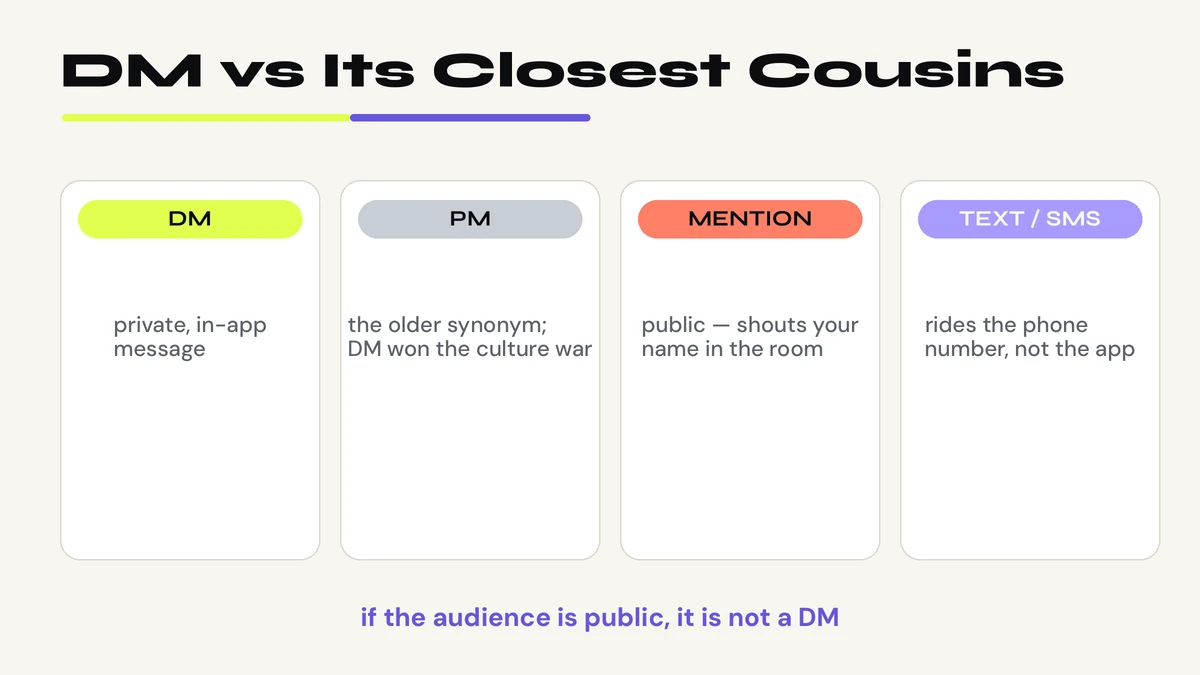 DM belongs to the private-messaging family, but each cousin does a different job:
- PM (“private message”) — the older synonym, from forum and IM culture. Same job, different era; DM won the culture war.
- Mention / tag (@name) — public. A mention shouts your name in the room; a DM whispers outside it.
- Reply (in-thread) — public conversation. A reply keeps the audience; a DM dismisses it.
- Text / SMS — rides the phone number and the carrier. A DM rides the app and the account.
One rule across the family: if the audience is public, it is not a DM — no matter what anyone calls it.
Where DM Came From
DM started as a Twitter feature name. Twitter’s private messages were officially called “direct messages,” and users shortened it to DM — partly because every character counted. Merriam-Webster dates the first known use to 2007, and the earliest messaging definitions surface in 2008.
Then it escaped. The term outgrew Twitter and genericized across every platform — Instagram, TikTok, Snapchat, Discord — displacing the older IM (instant message) and PM (private message) along the way. The phrase “slide into the DMs” is established enough that Wiktionary lists it as a derived term.
How to Reply When Someone Says “DM Me”
Match the purpose, not the letters:
- Clear ask (a link, details, an answer): answer in public if the info is public-safe — “posted it in the comments!” — or open the DM and send what they asked for.
- Stranger: no obligation. And if you are mid-thread and need to step away first, a quick “brb” keeps it courteous — our BRB guide covers the etiquette of the pause.
- Flirty: match the energy or deflect it explicitly — and remember that silence is also an answer.
- Business or support: treat it like any customer-service channel: include the reference, keep it factual, keep receipts.
Frequently Asked Questions
What does DM stand for?
Direct message. All four dictionaries consulted — Wiktionary, Merriam-Webster, Collins, and Cambridge — agree on this single expansion for texting and social media use.
Is a DM the same as a text message?
No. A DM lives inside a social app’s inbox; a text rides your phone number through the carrier. They feel similar because both are private, but they travel on different rails — see the Text Messages section for the full distinction.
What is the difference between DM and PM?
Almost nothing in meaning — PM (“private message”) is the older synonym from forum and instant-messenger culture. DM is simply the word that won. Use whichever your platform uses; everyone understands both.
What does “slide into DMs” mean?
To initiate a private message with someone, usually unsolicited — and often with flirtatious or romantic overtones. The phrase is established enough to appear as a derived term in Wiktionary’s DM entry.
Is it rude to say “DM me”?
Not by itself. Among friends and peers it is perfectly normal. It only reads cold when it is abrupt (a bare “DM me” from a seller) or repeated after being ignored. In formal or professional settings, spell it out — “please message me directly” — instead.
Are DMs private and safe?
Private from the public, yes — safe, not automatically. Never send passwords, financial details, or your address in a DM, and treat unsolicited DMs from strangers with the same caution as any message from someone you don’t know.
Can you DM someone who doesn’t follow you?
Usually yes, depending on the app’s settings — the message typically lands in a requests or spam folder first. Expect a lower reply rate, and never follow up an unanswered DM with another one.
The Takeaway
DM means direct message: a private message — or the private thread itself — inside a social app, working as noun, verb, and place. The meaning is the same on TikTok, Snapchat, Instagram, and in texts; only the tone and the stakes change with the sender. And when a “DM me” needs decoding, run the Inbox Shift Test: what’s moving, who’s in the room, app or phone number. DMs don’t change what you’re saying — they change who’s allowed to hear it.