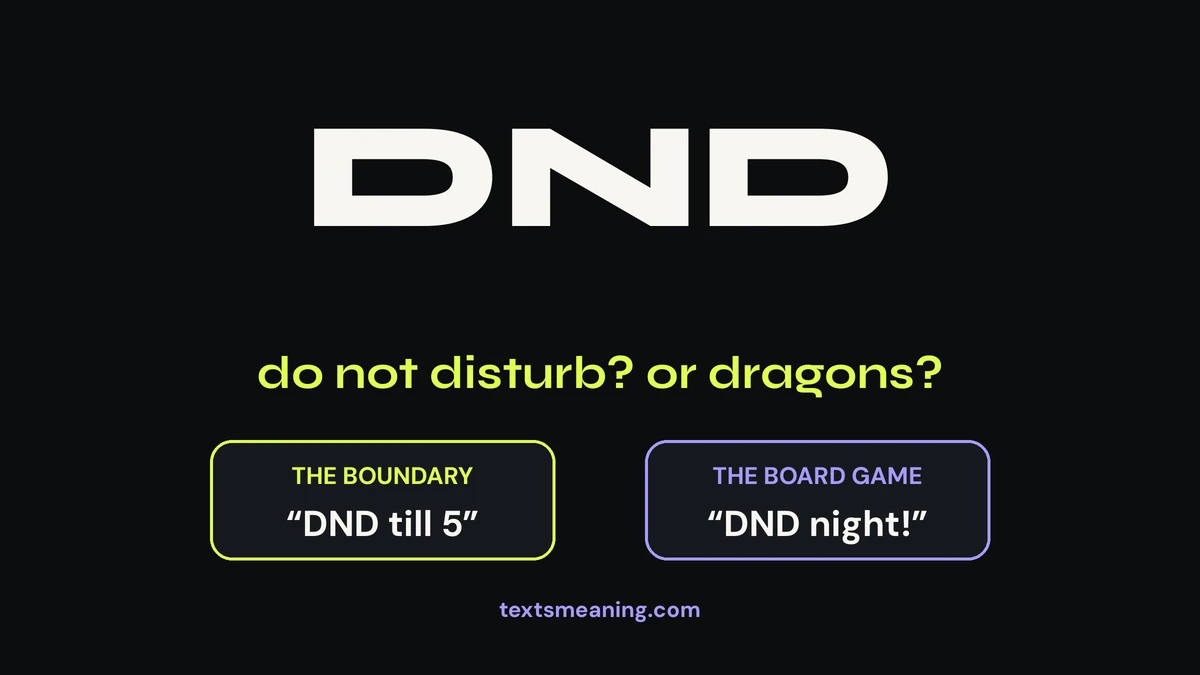
What does dnd mean in text? DND means “do not disturb” — a boundary, not a mood. When someone sends “DND,” they are asking for silence: no calls, no texts, no interruptions until they are back. There is one famous exception — the game Dungeons & Dragons — and the four-step test below tells the two apart in seconds.
Most guides define DND in one line and move on. This one does the harder job: a named test that separates the boundary from the board game, a tone guide for reading a terse “DND” without spiraling, what it looks like across platforms, reply scripts for every situation, and an honest debunk of the myths attached to these three letters.
What DND Means in Text
In texting, DND means “do not disturb.” It is a status and a request in one: I am unavailable, please do not interrupt me. The dictionaries agree. Dictionary.com defines it as “(originally used in digital communications) do not disturb: used as a privacy notification or function for many digital devices and applications.” Wiktionary lists it as an “initialism of do not disturb.” Two references, one reading — this is the strongly supported core of the term.
Notice what DND is not: it is not an apology, not a promise to return, and not a mood. It is an instruction — which is why a bare “DND” lands colder than a term like “brb,” which only announces what the sender is doing.
And then there is the collision: DND is also the abbreviation for Dungeons & Dragons, the tabletop roleplaying game, in gaming circles. Wiktionary carries both senses — the chat sense and the roleplaying-games sense — which is exactly why readers get confused, and exactly why the next section exists.
The Boundary-or-Boardgame Test

When you see DND and are not sure which three letters you are looking at, run four checks. No guide offers a tool for this — they list the two meanings and leave you to guess.
- Check 1 — The Surroundings Scan. Read the five words around DND. Gaming words — dice, DM, campaign, session, dragon, “tonight,” “Friday,” character names — flip it to the board game. Busy words — meeting, studying, nap, “rn,” “pls,” “for an hour” — lock it to the boundary.
- Check 2 — The Grammar Check. A standalone DND (“DND.” “Busy, DND”) is almost always the boundary. DND with an event shape (“DND night,” “up for DND,” “DND campaign”) is almost always the game.
- Check 3 — The Spelling Tell. “DnD” and “D&D” spellings lean toward the game; all-caps “DND” standing alone leans toward the boundary. A soft cue — suggestive, never decisive on its own.
- Check 4 — The Sender Check. Ask who sent it. A gaming-group regular talking weekend plans means the game; anyone going quiet mid-conversation means the boundary.
Worked examples. “Anyone up for DND tonight? 🐉” — surroundings (tonight, dragon emoji) plus event grammar says board game. “In a meeting, DND till 3” — surroundings (meeting, till 3) plus standalone grammar says boundary. When the checks disagree or the context is empty, default to “do not disturb” — it is the statistically dominant reading — and ask if it matters.
Boundary vs Boardgame: The Quick Matrix
The test above, compressed into one scannable card for the two readings:
- Grammar: standalone “DND” = boundary; event-shaped “DND night” = game.
- Spelling: all-caps DND leans boundary; DnD / D&D leans game.
- Surrounding words: busy words (meeting, studying, nap) = boundary; game words (dice, campaign, dragon) = game.
- Sender: anyone going quiet = boundary; the gaming group = game.
- Tone: terse and firm = boundary; excited and inviting = game.
- Default: when in doubt, read it as “do not disturb.”
DND in Real Chats
Illustrative examples written for this guide — not presented as real transcripts:
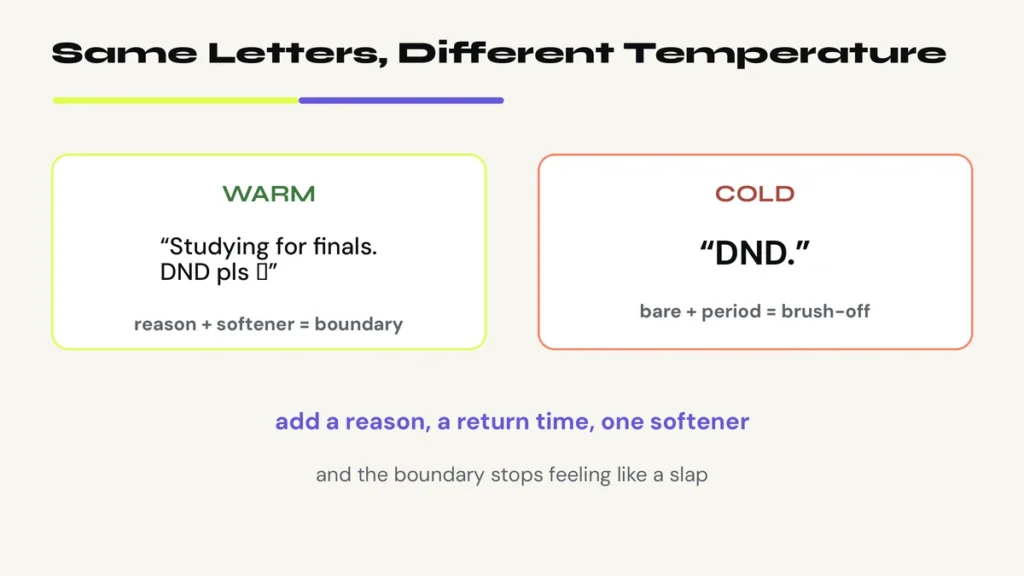
- The boundary, done right. “Studying for finals. DND pls 😴” — reason + emoji + politeness. Nobody is guessing what this means.
- The boundary, bare. “DND.” — one word, one period. Technically the same request; emotionally a different planet. See the Tone section.
- The game invite. “DND campaign starts Friday — who’s in?” — event grammar, gaming words: board game, no ambiguity.
- The game plan. “Anyone up for DND tonight? 🐉” — the classic dragon-emoji tell.
- The boss-appropriate version. “Heads down on the report — do not disturb until 4.” Spelled out, with a return time: DND’s meaning, office-safe packaging.
The Tone of “DND”
DND’s default tone is boundary-setting and terse — it is an imperative, and imperatives sound firm. But the same three letters land very differently depending on the packaging. Read the punctuation before you read the mood:
- Bare “DND.” — blunt. The period is a door closing. Can feel like a brush-off.
- “DND” + reason — “studying, DND till 5”. Polite; the reason softens the command.
- “DND” + emoji — “DND 😴”. Warm and playful; the emoji does the smiling the words don’t.
- Lowercase “dnd” — casual, less official than shouty all-caps.
- “DND pls” / “DND, sorry!” — explicitly polite framing; hard to misread.
The misread to avoid: receivers often hear a bare DND as anger or rejection. The fix runs both ways — when you set it, attach a reason or an emoji; when you receive it, read “busy” first, not “mad.” Terse acronyms can read cold no matter which letters they are — our GMFU guide covers the same cold-reading problem at the far end of the bluntness scale.
DND on TikTok
On TikTok, DND shows up in captions, comments, and bios — “in my DND era,” “DND, phone is going away for the weekend.” It is the boundary reading, styled as a lifestyle: unplugging framed as self-care. The meaning is identical to everywhere else; TikTok just dresses it up.
DND on Snapchat
Snapchat has something most platforms don’t: a literal Do Not Disturb toggle inside each chat. Tap the friend’s name, open More, switch it on — their messages stop buzzing your phone, and the muted friend is never notified. Typed “DND” in snaps and chats means the same thing as everywhere else — the toggle is just the feature version of the same boundary.
DND on Instagram
On Instagram, DND lives in bios and stories — “DND ☕ finals week” — and in the DMs as a quick status: “DND rn, will reply later.” Like other profile-shorthand terms (our ASL guide covers the same bio-line culture), it is self-description as much as request: this is who I am this week — unavailable.
DND in Text Messages
Plain texts are DND’s native habitat: “Busy rn, DND,” “Driving, DND.” No app features involved — just the three letters doing the work of a hotel door-hanger. Family group chats are the classic setting, where a parent’s “DND” can land like a verdict and usually just means “the oven timer is going.”
Who’s Sending It
The sender never changes what DND means — it changes the stakes. Same three letters, five different situations:
- Friend: low stakes. “DND, gaming” just means text them later. The one time you should not poke them is right now.
- Crush: easy to overread. A crush’s “DND” is almost never about you — it is about their schedule. Do not triple-text; do not write the breakup speech.
- Partner: context is everything. Routine “DND, in a meeting” is nothing; a sudden bare “DND.” mid-argument is something — but the something is the argument, not the acronym.
- Boss: read it as scheduling information, full stop. Respect the boundary the way you would a closed office door.
- Gaming buddy: run the Boundary-or-Boardgame Test. From this sender, “DND Friday?” is a game invitation until proven otherwise.
Notice the contrast with conversation-starters: where a term like WYO opens a chat, DND closes one for now. They are mirror images — the opener and the pause.
Is DND Rude?
It can be — but the rudeness is in the delivery, not the letters. A boundary is not an insult; a boundary delivered like a slap is.
The etiquette that keeps DND from burning bridges:
- Give a reason. “DND, studying” beats a bare “DND.” every time.
- Give a return time. “DND till 5” turns a wall into a door with a clock on it.
- Add one softener. An emoji, a “pls,” a “sorry” — one is enough.
- Keep it off the argument. A bare “DND.” mid-fight is a weapon no matter what the dictionaries say.
And the brush-off problem is real: DND is sometimes used as a cold shutdown, and that stings. If someone’s “DND” felt like a door slam, you are not imagining the cold — but assume “busy” once before you assume “ hostile.”
Checked Claims: What DND Does NOT Mean
Three letters attract folklore. Each of these was checked against the dictionaries and the evidence, and rejected or fenced:
- A secret sexual meaning — rejected. The only source is one joke dictionary entry; two independent guides explicitly debunk it. There is no hidden meaning.
- “They’re angry at you” — rejected. “Most of the time, it just means they’re busy.” A bare DND can feel cold, but cold is not angry.
- “Do not delete / do not disclose / do not duplicate” — weak for texting. These live in document and memo annotation, not chats. No texting evidence behind them.
- A special dating-app-bio meaning — rejected as asserted. A “DND” in a bio is the same “do not disturb” — a placement, not a new definition.
- Something different per platform — rejected. The meaning is constant; only the delivery changes (typed shorthand, phone setting, Snapchat toggle).
One legitimate footnote: in some countries, phone carriers run official “do not disturb” registries that block marketing texts — the same phrase, doing regulatory work. Same words, different job; worth one line so searchers land right.
DND vs Its Closest Cousins
DND belongs to the status-word family, but each cousin does a different job. Ranked by firmness:
- AFK — “away from keyboard.” A neutral absence: I am not here. No request attached. Our AFK guide covers the status half of the family.
- BRB — “be right back.” A promise: I am stepping away and I will return. Our BRB guide covers the promise half.
- DND — “do not disturb.” An instruction: I am here-ish, and I want silence. The firmest of the three — it asks something of you, where AFK and BRB only tell you something.
The ladder: AFK announces, BRB promises, DND instructs. If you remember nothing else, remember the verbs.
Where DND Came From
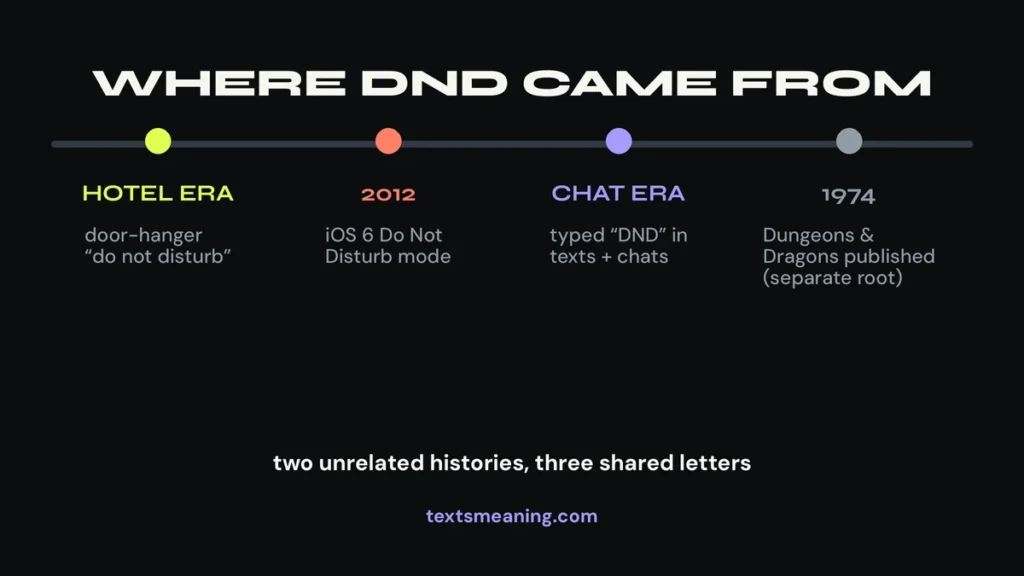
The boundary reading has a physical ancestor: the “Do Not Disturb” door-hanger in hotels. The phrase meant “please don’t interrupt me” long before it had an acronym.
The digital turn came in 2012, when Apple’s iOS 6 introduced a Do Not Disturb mode — widely reported at the time — and Android followed. The acronym became the setting’s name in phone menus, and from there it migrated into typed chat. Dictionary.com’s usage note confirms the digital-first life of the abbreviation: “originally used in digital communications.”
The board-game reading has a completely separate root: Dungeons & Dragons was first published in 1974, and roleplaying communities abbreviated it D&D / DnD / DND decades before the texting slang existed. Two unrelated histories, three shared letters — that is the whole collision.
How to Reply When Someone Sends DND
Match the situation, not the letters:
- Friend going quiet: “Got it, talk later 👍” — acknowledge and release. No follow-up, no “why?”
- Boss or coworker: “No worries, ping me when you’re free” — professional, zero pressure.
- Genuinely urgent: “Sorry — urgent, one quick thing” — say so plainly once, rather than ignoring the boundary.
- The game invite: “I’m in! What time?” — reply to the invitation normally.
What not to do: do not fire back a terse challenge the way our BFFR guide describes — a boundary is not an argument starter. And where CYA ends a chat warmly, DND only pauses one firmly; match your close to their pause, not the other way around.
Frequently Asked Questions
What does DND mean in a text message?
“Do not disturb.” The sender is asking for silence — no calls, no texts — until they are back. It is a boundary, not a mood: read “busy” before you read anything else into it.
Can DND mean Dungeons & Dragons?
Yes — in gaming contexts, with gaming cues: dice, campaigns, “DND night,” a dragon emoji. Outside gaming chats it is a rejected reading. Run the Boundary-or-Boardgame Test above whenever you are unsure.
Is it rude to send DND?
The letters aren’t rude; a bare “DND.” with no reason can feel like one. Attach a reason (“studying”), a return time (“till 5”), or one softener (an emoji, a “pls”) and it reads as a boundary, not a brush-off.
What does DND mean on Snapchat?
The same “do not disturb” — plus a real feature: Snapchat lets you switch on Do Not Disturb per chat, silently. The muted friend is never notified. Typed “DND” in chats means the same thing as everywhere else.
What’s the difference between DND, BRB, and AFK?
AFK announces an absence, BRB promises a return, DND instructs silence. DND is the firmest of the three — it is the only one that asks something of the reader.
Someone sent me “DND” — what should I reply?
“Got it, talk later 👍” covers almost everything. Don’t follow up, don’t ask why, don’t double-text. If it is genuinely urgent, say so plainly once. If it was a game invite, just answer the invite.
Does DND mean they’re mad at me?
Almost certainly not. “Most of the time, it just means they’re busy.” A bare DND can feel cold, but cold is not angry — and the fix is on the sender’s side (add a reason), not yours.
The Takeaway
DND means “do not disturb” — a boundary, in three letters. When the letters collide with the board game, the Boundary-or-Boardgame Test sorts them in four checks; when the tone feels cold, read the packaging before the mood; and when you send it yourself, give it a reason, a return time, and one softener. Announce like AFK, promise like BRB, instruct like DND — and never confuse the three.