
What does dtm mean in text? DTM means “doing too much” — a call-out for excessive, dramatic, or over-the-top behavior. “Bro, you’re DTM” is the digital way of saying “relax, you’re being extra.” A few rarer readings float around (“dead to me” is real but serious; “down to meet” is mostly listicle folklore), and this guide grades every one of them honestly.
Most guides hand you a flat menu of three or four meanings and leave you to guess. This one does the evidence work: a graded verdict on every circulating expansion, a four-step test that settles the meaning in seconds, a tone slider from playful banter to genuine beef, what DTM looks like on TikTok, Snapchat, Instagram, and plain texts, and reply scripts for each reading.
What DTM Means in Text
DTM’s default meaning — the one you should assume until proven otherwise — is “doing too much.” It judges behavior, not people: the outfit with seventeen accessories, the triple-text at 2 a.m., the 40-slide birthday slideshow. Dictionary.com — the strongest reference found — reads it directly: “DTM is an internet slang acronym meaning doing too much or do too much, in reference to the poster’s behavior.” Every major competitor agrees — and for once, the agreement is the evidence.
The full verdict, graded — because the internet lists expansions like a menu, and menus lie:
- “Doing too much” — STRONGLY SUPPORTED. The primary, default meaning.
- “Dead to me” — SUPPORTED, rare and serious. A cold goodbye after a betrayal — “he’s DTM to me now.” Real, uncommon, never joked with.
- “Down to meet” — WEAK. Circulates in slang listicles; no dictionary or usage attestation found. Treat as unverified, never as fact.
- “Don’t touch me” — WEAK. Listicle-only, plausible as banter, unverified.
- “Don’t text me,” “don’t trust men,” “down to match,” “intense laughter” — REJECTED. No attestation, joke entries, or garbled AI content. See Checked Claims.
The Excess-or-Exit Test
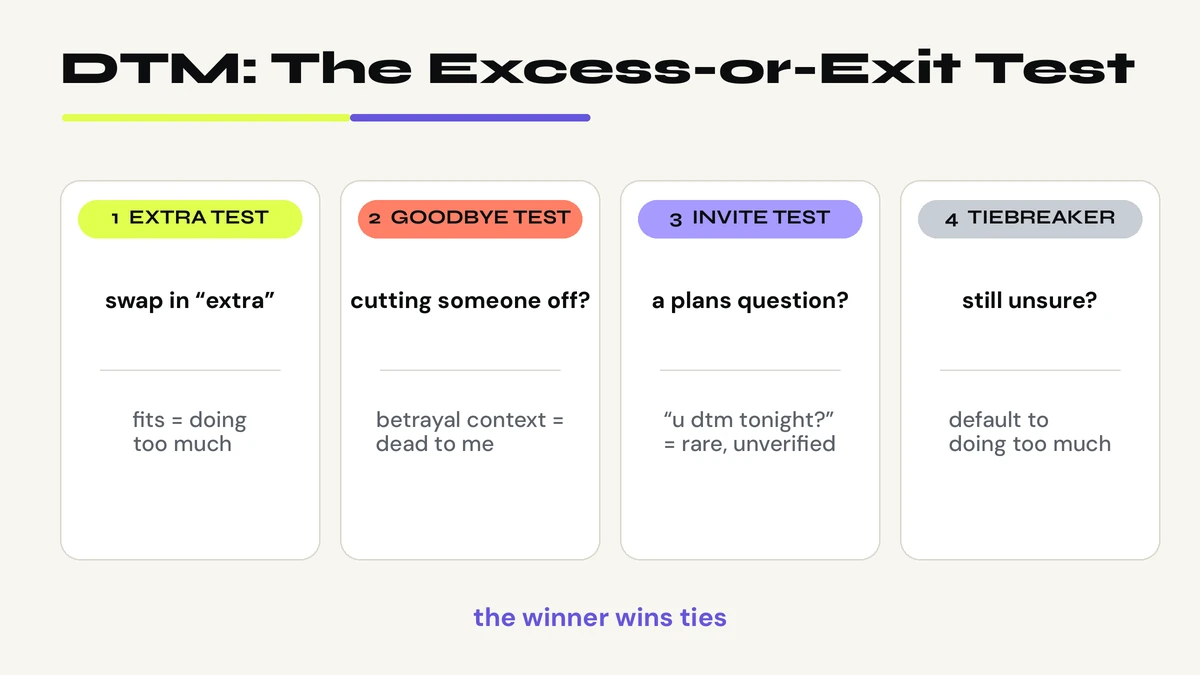
Four steps that resolve “doing too much” (excess) vs “dead to me” (exit) vs the also-rans:
- Step 1 — The Extra Test. Swap in the word “extra.” “You’re being DTM” → “You’re being extra” — if it fits, it means doing too much. This catches most real cases.
- Step 2 — The Goodbye Test. Is someone being cut off after a betrayal or blowup? “After what he did, he’s DTM” is about ending a relationship, not judging behavior — that is the rare “dead to me.”
- Step 3 — The Invite Test. Is it a question about meeting up? “u dtm tonight?” Only here consider “down to meet” — and even then, treat it as rare and unverified.
- Step 4 — The Tiebreaker Rule. If nothing above is clearly true, default to “doing too much.” The winner wins ties; never guess a rare meaning when the common one fits.
Why it works: it anchors on the substitution readers already know (“extra”), isolates the only serious alternate by its unmistakable cold-goodbye context, quarantines the weak claims in step 3, and hands you a default so you are never left guessing.
DTM in Real Chats
Illustrative examples written for this guide — not presented as real transcripts:
- The 2 a.m. triple-text. “sent him 3 paragraphs at 2am” → “bro you’re DTM 😭” — affectionate roast between friends.
- The slideshow. “planned a 40-slide birthday slideshow” → “this is DTM and I love it” — excess as a compliment.
- The selfie streak. “posted 10 selfies in an hour” → “she’s DTM today” — observational, lightly judgy.
- The self-own. “ok I know I be DTM about the group trip, I’ll chill” — self-deprecating ownership; disarming, not defensive.
- The rare goodbye. “after he leaked the screenshots → “he’s DTM to me now” — the serious reading, flagged rare on purpose.
- The trap question. “u dtm tonight?” — run the Invite Test: it is a plans question, so “down to meet” is on the table — but remember it is the unverified reading, and “doing too much” would not fit a question at all.
The Tone Slider: Banter, Roast, or Beef
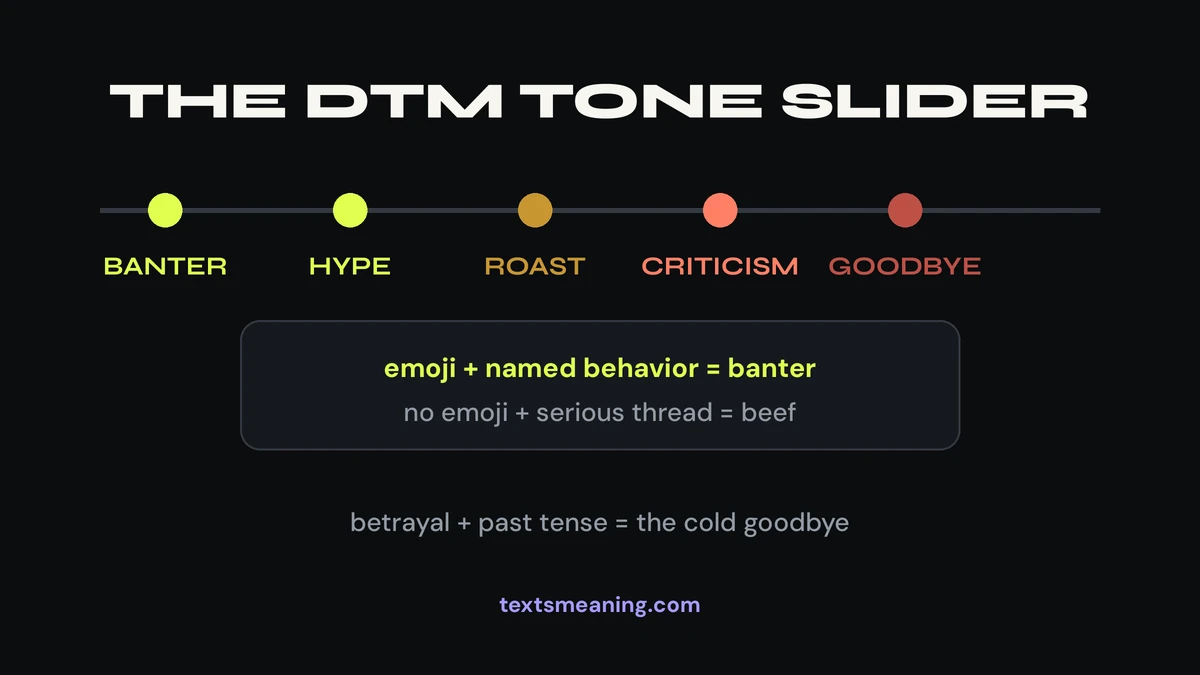
DTM’s tone is a slider, not a fixed setting. The same three letters run from affectionate to cutting:
- Playful banter (most common): “bro you’re DTM for this” + 😂 — an affectionate roast between close friends.
- Admiring / hype: “the decorations are DTM and they look amazing” — excess as a compliment.
- Light roast: “you’ve texted him 6 times, DTM” — real feedback with a soft landing.
- Genuine criticism: a blunt “you’re DTM” in a tense thread — judgmental, dismissive.
- Cold goodbye (dead-to-me sense only): “she’s DTM to me now” — finality and hurt, never humor.
- Self-deprecating: “I be DTM sometimes, I know” — owning your own extra behavior.
The banter-vs-beef detector: emoji present and the behavior named specifically? Banter. No emoji, short sentences, serious thread? Beef. Betrayal context plus past tense? Goodbye. Where a term like LWK deliberately understates, DTM deliberately overstates — they are tonal mirror images.
DTM on TikTok
TikTok is where DTM went mainstream. The 2023 letter-code wave — DTM listed alongside HBS, GNG, TMB in TikTok code roundups — cemented “doing too much” as the platform’s default reading. In captions and comments it is the call-out for extra posts: overproduced videos, dramatic storytimes, thirst-trap marathons. Same meaning as everywhere else; TikTok just gave it a bigger stage.
DTM on Snapchat
On Snapchat, DTM means “doing too much” — the consensus across guides is clear. One listicle claims Snapchat DTM most often means “down to meet,” while another says the same platform’s DTM is “doing too much.” Both cannot be right, and neither cites a source: the contradiction is the proof that platform-specific meanings here are invented, not documented. Default to “doing too much” on Snapchat like everywhere else.
DTM on Instagram
On Instagram, DTM lives in comments on extra posts — the 12-photo carousel, the paragraph-long caption about a coffee — and in stories reacting to friends’ drama. The Extra Test thrives here: if “extra” fits the comment, DTM fits the meaning.
DTM in Text Messages
In plain texts and DMs, DTM is the friend-group regulator: “chill, you’re DTM,” “I be dtm, I know.” Self-deprecating uses cluster here — owning your own extra behavior lands better in a private thread than in a public comment.
What It Means Depending on Who Sends It
The meaning does not change by sender — no source documents a gender or sender split, and guides that invent one are rejected in Checked Claims. What changes is the weight:
- Friend: banter, almost always. The classic case — and the one most likely aimed at your best friend’s extra behavior. Our BSF guide covers the person on the receiving end of most DTMs.
- Crush: playful test. “you’re DTM” from a crush is flirtation with plausible deniability — the classic check-in-and-roast combo. For the check-in half of the pattern, see our WYO guide.
- Partner: real feedback — tread carefully. From a partner, “you’re DTM” is rarely banter; hear the concern inside the call-out.
- Rival: a dig. Same letters, hostile intent — run the banter-vs-beef detector before you reply.
- Stranger: don’t use it. DTM needs a relationship to land as banter; from a stranger it is just an insult.
Is DTM Rude?
Tone-dependent — which is exactly what the slider above is for. Playful among friends, judgmental when blunt, genuinely hurtful in the dead-to-me sense. Two hard rules:
- Never professional. DTM has no business register. At work, say “that might be more than we need” instead.
- Never joke with the goodbye. The “dead to me” reading is fenced as rare and serious for a reason — deploying it as a joke is how friendships end.
Checked Claims: The Other Expansions, Graded

The also-rans, named and graded so you never have to wonder:
- “Don’t text me” — REJECTED. One Snapchat listicle’s claim, almost certainly confusion with the four-letter DTTM (“don’t talk to me”). Different acronym, different meaning.
- “Intense laughter / amusement” — REJECTED. One AI-garbled page claims DTM conveys laughter; its own origin paragraph contradicts it. Zero support anywhere else.
- “Don’t trust men” — REJECTED. A single joke dictionary entry with no texting usage behind it.
- “Down to match” (cannabis) — REJECTED for general texting. One niche dictionary entry; not a texting meaning.
- “Down to m———” — REJECTED. One listicle’s “rare” alternative with zero attestation; not dignified beyond this line.
- Per-platform meaning splits — REJECTED. The Snapchat contradiction above (two listicles, opposite claims, zero sources) is the exhibit.
- Per-gender meaning splits — REJECTED. “From a girl / from a guy” sections are invented SEO filler; the meaning is identical regardless of sender.
Honest footnote: Wiktionary has no slang sense for DTM at all — its entries are dye-to-match, digital terrain model, and the like. That is why this guide leans on Dictionary.com’s slang entry and usage attestation for the texting meaning, and cites Wiktionary only for the non-slang disambiguation.
DTM vs Its Closest Cousins
DTM belongs to the judgmental call-out family. Each cousin judges differently:
- FAFO — judges actions by their consequences: mess around and find out. DTM judges the behavior itself; FAFO judges what it costs you. Our FAFO guide covers the consequences half.
- BFFR — judges with disbelief: “be serious.” BFFR challenges the claim; DTM challenges the volume. Our BFFR guide covers the disbelief half.
- GMFU — the frustration/insult register, hotter and more hostile than DTM’s cool observation. Our GMFU guide marks the line where call-outs become attacks.
The family rule: DTM says “too much,” BFFR says “be serious,” FAFO says “watch out,” GMFU says something unprintable. Different judgments, different temperatures.
Where DTM Came From
The phrase came first. “Doing too much” and its sibling “doing the most” were established youth slang by 2017 — documented in campus writing of the time — with roots in Black American English. The acronym is the internet-era shortening: texting and Twitter culture compressing the phrase into three letters, date of first use undocumented. This guide will not invent one.
The mainstream wave is datable: TikTok’s 2023 letter-code trend put DTM on millions of screens, and mainstream explainers followed in 2026 — the full journey from subculture phrase to dictionary-grade slang entry.
How to Reply When Someone Says DTM
Read the tone first — then pick your branch:
- It’s banter: laugh it off, roast back, or own it — “lol guilty 😂,” “someone had to bring the energy.”
- It’s a real check on your behavior: ask or dial back — “lol what did I do?” “fair, I’ll chill.” The intended effect of a genuine DTM is behavior change; fighting it proves the point.
- It’s the cold goodbye: do not joke back. Give space or address the underlying issue directly — and if you need to step away from the thread first, a quick “brb” keeps it courteous. Our BRB guide covers the etiquette of the pause.
- It’s “u dtm tonight?”: answer the question — “yeah, what time?” — while remembering this reading is the rare one.
Frequently Asked Questions
What does DTM mean in text?
“Doing too much” — a call-out for excessive, dramatic, or over-the-top behavior. It is the default meaning; assume it unless the context clearly says otherwise.
Can DTM mean “dead to me”?
Yes, but it is rare and serious — a cold goodbye after a betrayal, not a joke. Run the Goodbye Test: if the sentence is about ending a relationship rather than judging behavior, it is this reading.
What does DTM mean on Snapchat?
“Doing too much” — same as everywhere else. Claims that Snapchat DTM means “down to meet” are listicle inventions; two guides make opposite claims with zero sources between them.
What does DTM mean on TikTok?
“Doing too much” — TikTok’s 2023 letter-code wave is what took the acronym mainstream. In captions and comments it calls out extra posts and dramatic behavior.
Is DTM rude or an insult?
Tone-dependent. Playful banter between friends is the most common use; blunt DTM in a tense thread reads as judgmental. It is never professional — keep it out of work chats.
What about “down to meet” or “don’t touch me”?
Both are claimed by slang listicles but unverified — no dictionary or usage attestation supports them as established meanings. Treat them as rumors, not definitions.
How do you reply when someone says “you’re DTM”?
Read the tone first. Banter gets a laugh or a roast back; a genuine check gets “fair, I’ll chill”; the cold goodbye gets space, not jokes.
The Takeaway
DTM means “doing too much” — the call-out for extra behavior, from playful roasts to genuine checks. The rare “dead to me” lives behind the Goodbye Test; everything else is listicle folklore. And when the letters wobble, the Tiebreaker Rule never does: default to “doing too much.”