
What does dw mean in text? DW means “don’t worry” — a two-letter reassurance. “DW, you’ll do great” calms nerves; “dw about it” forgives a small mistake; “dw, I already booked the tickets” says the thing is handled. One genuine ambiguity exists — warmth versus brush-off — and the three-step test below settles it.
Most guides define DW in one line and stop. This one maps the full territory: the Comfort-or-Close Test for reading any “dw,” an eight-rung tone ladder from warm comfort to sarcastic dismissal, what DW looks like on TikTok, Snapchat, Instagram, and plain texts, reply scripts for both branches, and a ruthless debunk of the junk expansions the internet attaches to these two letters.
What “DW” Means in Text
“DW” means “don’t worry.” It is a casual reassurance initialism — it releases guilt, calms worry, and signals “handled.” The primary dictionary source is explicit: Wiktionary lists DW as “(Internet slang, text messaging) Initialism of don’t worry.” Every competitor agrees it is the overwhelmingly dominant meaning, and usage attestation is universal across texting, social, and gaming.
Three things DW does in a conversation:
- Releases guilt: “dw about it” after an apology — the two-letter absolution.
- Calms worry: “dw, you’ll do great” — encouragement before something stressful.
- Signals handled: “dw, I checked the weather earlier” — the reassurance comes with proof.
Convention note: DW is written lowercase — “dw” — by standard. There is no documented meaning difference between “dw” and “DW”; lowercase is simply how the internet writes it.
The Comfort-or-Close Test

DW’s only genuine ambiguity is tonal: is this reassurance (comfort) or a brush-off (close)? Three checks decide:
- Check 1 — The Weight Check. Does the “dw” carry weight or travel light? “DW, I’ll take care of it” carries a follow-up clause — comfort. A bare “dw” with nothing after it travels light — a possible close. Weight means reassurance; no weight is suspect.
- Check 2 — The Size Match. Does the “dw” match the size of what you sent? Small worry (a late reply, spilled coffee) plus “dw” = comfort, proportionate. Big problem (a real conflict, bad news) plus “dw” = close — the reply is too small for the moment, and that is the tell.
- Check 3 — The Landing Check. What happened after the “dw”? If the conversation kept moving and you felt settled, it was comfort. If the thread died, the topic got buried, or you still feel unheard, it was a close — and you are allowed to reopen it.
Worked pair. “Sorry I’m late, traffic was awful” → “dw we haven’t even ordered drinks yet” — weight (a clause), size match (small worry), clean landing: comfort. “I’m really upset about what happened yesterday” → “dw” — no weight, size mismatch, dead thread: close. Same letters, opposite readings — the test is the difference.
“DW” in Real Chats
Illustrative examples written for this guide — not presented as real transcripts:
- The late apology. “Sorry I’m running late” → “dw we haven’t even ordered drinks yet” — comfort with a clause.
- The forgotten item. “I forgot the chargers!” → “dw, I have two in my bag” — reassurance with proof.
- Pre-event nerves. “nervous about tomorrow” → “dw, you’ll do great” — pure encouragement.
- The gaming teammate. “we lost again 😭” → “dw, we’ll win next round” — morale repair, speed-typed.
- The minor mistake. “spilled coffee on the notes, sorry” → “dw about it” — guilt release.
The Tone Spectrum of “DW”
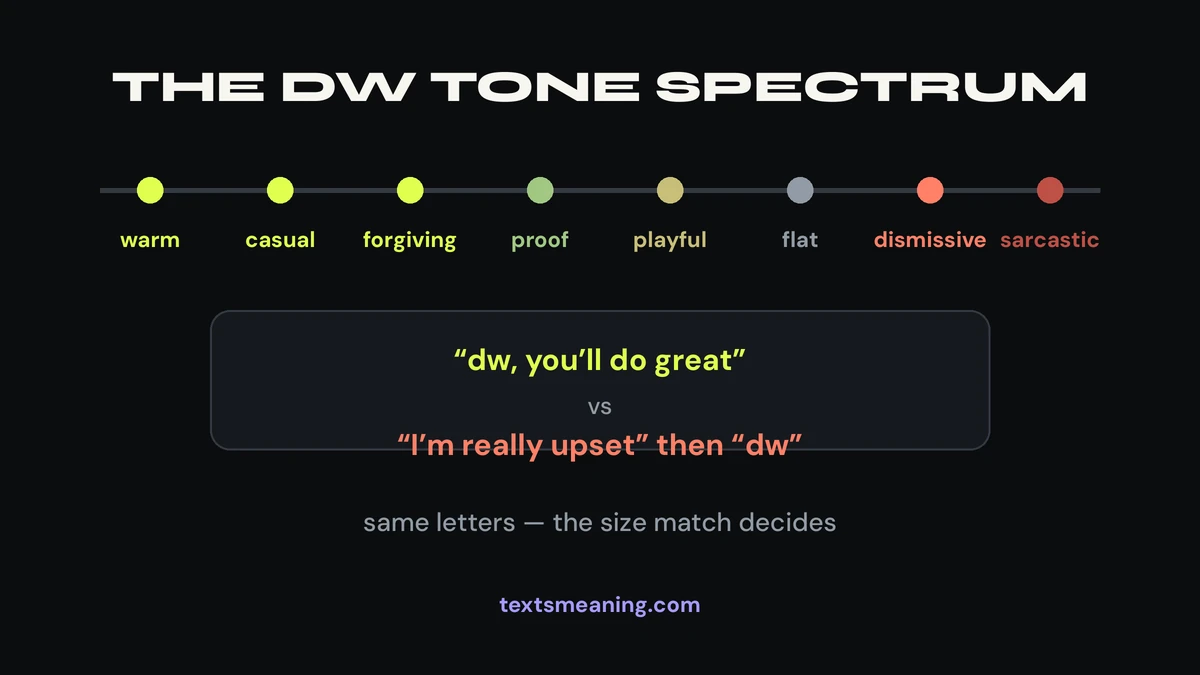
DW’s default is warm reassurance — but the spectrum is wide. Eight rungs, warm to cold:
- Warm / comforting: “dw, you’ll do great” — encouragement before something stressful.
- Casual / breezy: “dw we haven’t even ordered yet” — low-stakes social smoothing.
- Forgiving: “dw about it” after an apology — guilt release.
- Reassuring-with-proof: “dw, I checked earlier” — the worry is answered, not just waved away.
- Playful: “dw lol it’s not that deep” — light, joking.
- Flat / rushed: a bare “dw.” — can read distant, especially with the period.
- Dismissive / closing: “dw about it, just drop it” after a serious message — a conversation ender.
- Sarcastic: “DW 🙄” — the eye-roll flips the meaning inside out.
Punctuation and emoji are tone modifiers, not meaning changers: “dw!” reads brighter than “dw…”, but neither changes the definition. Treat casing and punctuation as tendencies, never as rules — guides that publish “uppercase DW means excited” rules are inventing them. Where BFFR is DW’s confrontational opposite — DW soothes where BFFR challenges — the two mark the ends of the bluntness scale.
“DW” on TikTok
On TikTok, DW lives in comments and captions as public reassurance: “dw, you’ll glow up,” “dw bestie the algorithm loves you.” It is the same “don’t worry” — comment culture just performs it for an audience. No platform-specific meaning exists; the stage changed, the word didn’t.
“DW” on Snapchat
On Snapchat, DW fits the app’s fast, personal messaging style: quick chats, story replies, streak-saving reassurance — “dw I’ll keep the streak.” The meaning is identical to everywhere else; Snapchat just rewards the brevity DW was built for.
“DW” on Instagram
On Instagram, DW shows up in DMs and comment threads between friends: comfort after a vent, dismissal of a minor issue, “dw it’s just a photo.” The casual check-in culture overlaps here — where a WYO (“what you on”) opens the conversation, DW keeps it comfortable.
“DW” in Text Messages
Plain texts are DW’s native habitat: iMessage, WhatsApp, SMS — apologies, logistics, family chats. “DW about the tickets, I already booked them” is the platonic ideal: worry named, worry handled, two letters doing the work of a paragraph. It pairs naturally with other lightweight flow-managers — “dw, brb” is reassurance plus a pause in four letters — and it shares the chatroom era with fellow travelers like BTW, the same generation of conversational shorthand.
Who’s Sending It: How “DW” Lands by Sender
No source documents a different meaning of DW per sender — guides that publish “DW meaning from a girl / from a boy” are writing SEO filler, not linguistics. The meaning stays fixed; the landing changes with the relationship:
- Friend: the default. “dw” from a friend is comfort at face value — accept it and move on.
- Crush: easy to overread. A crush’s “dw” is usually just reassurance; don’t mine it for hidden devotion — or hidden rejection.
- Partner: context rules. “dw, I’ve got it” after you vent is care; a bare “dw” after a real conflict deserves the Size Match check.
- Parent: generational static. Parents use “dw” warmly and literally; teens sometimes read the brevity as dismissive. Both are reading the same word.
- Coworker: proceed with care. “dw” is too casual for most work chats — if you receive it, read it as friendly; if you send it, spell out “No worries at all” instead.
When “DW” Feels Dismissive
The bare-“dw”-after-bad-news pattern is real and documented: after a serious message, a two-letter reply can feel like a door closing. Brevity backfires in serious talks — the smaller the reply, the bigger the moment needs to be. If a “dw” stung you, you are not misreading the cold; you are reading the Size Match correctly.
The professional rule: never “dw” in work messages or email. “No worries at all” or “That’s completely fine” costs you four seconds and buys you all the warmth. Like its cousin CYA, DW can function as a soft conversation closer — the difference is that DW closes a worry-thread while CYA closes the whole chat.
Checked Claims: Expansions That Don’t Hold Up
Two letters attract folklore. The junk expansions, named and rejected:
- “Deep Web” — rejected. No attestation of DW for “Deep Web” in actual texting; the claimant offers no example or source.
- “Disney World” — rejected. The established vacation shorthand is WDW; no evidence for DW.
- “Driving While…” — rejected. The driving-offense term is DWI; the claimant’s own example is incoherent.
- “DWI = Don’t Worry About It” / “DWM = Don’t Worry Much” — rejected. DWI universally means driving while intoxicated; DWM has no currency. Invented variations.
- Gender-split meanings (“from a girl” / “from a boy”) — rejected as meaning splits. Tone interpretation varies by relationship and context — never by sender gender.
- Casing rules (“lowercase = casual, uppercase = excited”) — rejected as a rule. Lowercase is simply the standard form; no source documents a semantic split.
- “Doctor of Welfare” / “Distilled Water” as texting meanings — rejected for texting. “Distilled water” is a real medical abbreviation (Merriam-Webster confirms it), but it has zero texting relevance — category confusion, not a meaning.
Two legitimate footnotes, fenced off from texting: “dear wife” is a real expansion on marriage and parenting forums (the DH / DS / DD family) — and “Doctor Who” is real in fandom. Neither is a texting meaning; both get one line here so searchers land right.
“DW” vs Its Closest Cousins
DW belongs to the reassurance family. Its cousins handle the same moments differently:
- “It’s all good” / “No worries” — the fuller, warmer forms. When DW feels too small for the moment, spell it out.
- NP (“no problem”) — answers thanks and apologies; transactional where DW is emotional. NP closes the ledger; DW closes the worry.
- NVM (“never mind”) — drops the topic entirely. DW says “the worry is handled”; NVM says “the topic is dead.”
- IDC (“I don’t care”) — the hostile cousin. A dismissive “dw” can drift toward IDC territory — which is exactly why the Size Match matters.
The honesty contrast: where ICL (“I can’t lie”) centers the speaker’s honesty, DW centers the other person’s feelings — two different jobs that often show up in the same conversation.
Where “DW” Came From
The phrase “don’t worry” is longstanding everyday English — its most famous pop-culture landmark is Bobby McFerrin’s 1988 “Don’t Worry, Be Happy.” The initialism belongs to the early wave of internet chat acronyms: 1990s–2000s chatrooms and forums, then AIM, Yahoo Messenger, and MSN — the same generation as TBH and AFK.
The first dictionary-recorded definitions date to 2003 — attestation, not coinage; the acronym was already in use. SMS-era small keyboards and character limits kept it alive, gaming chats (“dw, we’ll win next round”) accelerated it, and a fossil survives: the “d/w” slash spelling, documented but largely outdated — the “w/e” of reassurance.
DW’s chatroom-era roots run deep — it shares that 1990s–2000s origin with AFK, and the two still travel together in gaming chats: “dw, afk one sec.”
How to Reply When Someone Says “DW”
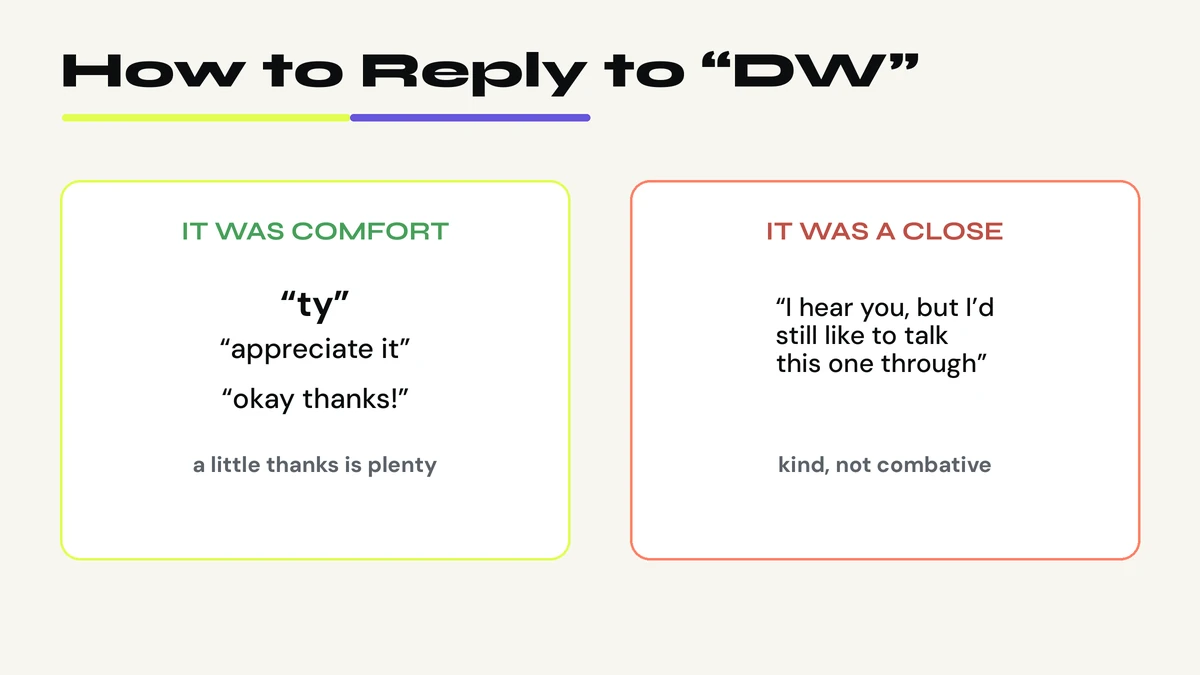
Two branches — run the Comfort-or-Close Test first, then pick:
- It was comfort — accept it lightly: “ty,” “appreciate it,” “okay thanks!”, or a heart emoji. Matching the casual energy is the point — a little thanks is plenty.
- Slightly formal: “sounds good” / “thanks for handling that.”
- It was a close — push back gently: “I hear you, but I’d still like to talk this one through” — kind, not combative. Or set the boundary: “Thanks, but I still want to talk about it later.”
When YOU send dw: pair it with weight when the other person’s worry is real (“dw, I already handled it” beats a bare “dw”); never send a bare “dw” into a serious conversation; and never use it in professional writing — “No worries at all” instead.
Frequently Asked Questions
What does “dw” mean in a text message?
“Don’t worry.” It is a casual reassurance — the sender is calming a worry, forgiving a small mistake, or signaling that something is handled.
Is “dw” rude?
Not by default — its home tone is warm reassurance. It only reads as rude when it is bare and small against a big moment (“I’m really upset” → “dw”). Run the Size Match check: proportionate reassurance is kind; a two-letter reply to real hurt is dismissive.
What does “dw” mean on Snapchat, TikTok, and Instagram?
The same “don’t worry” everywhere — no platform-specific meaning exists. Snapchat gets quick-chat reassurance, TikTok gets comment-section comfort, Instagram gets DM reassurance between friends. Same word, different stage.
Does “dw” ever mean something other than “don’t worry”?
In texting, no. “Dear wife” is real on parenting forums and “Doctor Who” is real in fandom — but neither is a texting meaning. Everything else on the expansion lists (Deep Web, Disney World, DWI variants) failed evidence.
Can I use “dw” in a work message or email?
Don’t. It is too casual for professional writing — use “No worries at all” or “That’s completely fine” instead. Four extra seconds, all the warmth.
What’s the difference between “dw” and “np”?
“NP” (“no problem”) is transactional — it answers thanks and closes the ledger. “DW” is emotional — it answers worry and closes the feeling. Different jobs.
How should I reply when someone texts me “dw”?
If it was genuine reassurance, a light “ty” or “appreciate it” is plenty. If it felt like a brush-off and the issue matters, push back kindly: “I hear you, but I’d still like to talk this one through.”
The Takeaway
“DW” is a two-letter comfort blanket — “don’t worry” — and it works when it carries weight: a clause, a proof, a match for the size of the worry. When a bare “dw” lands wrong, run the Comfort-or-Close Test; when you send it, give it weight; and when it matters, spell it out. Weight is the whole game.