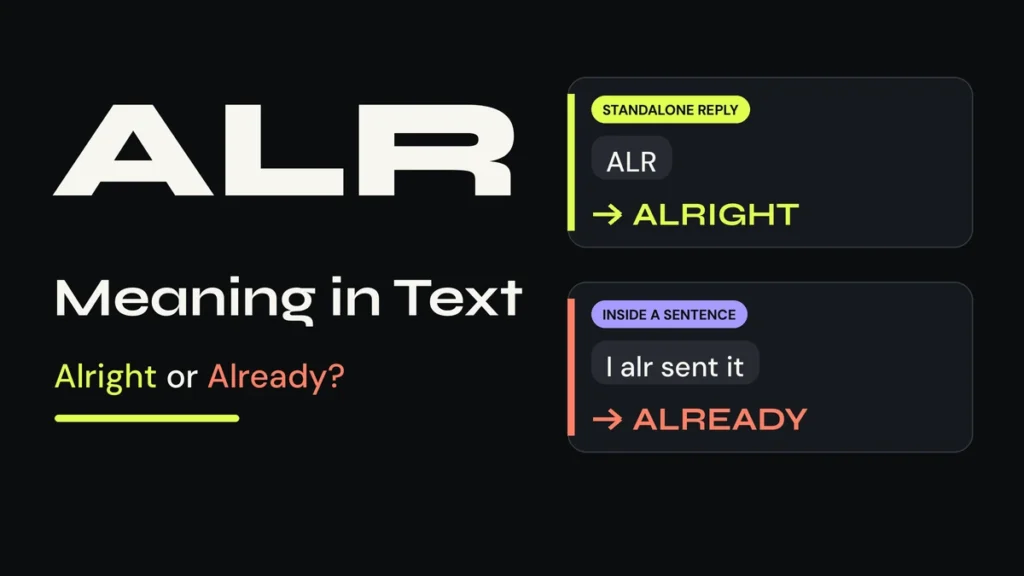

What does GNG mean in text? Most of the time, GNG means “gang” — your friends and crew. “What’s good, gng?” is a greeting, not a question about a criminal organization. But the same three letters can also mean “going”: “I’m gng home” is a departure, not an address. The sentence around them decides, and the Grammar Slot Test below reads it in seconds.
This guide to GNG meaning in text covers the three-check Grammar Slot Test, a six-reading tone spectrum, GNG on TikTok, Snapchat, Instagram, and in plain texts, how it lands by sender, the misreads that cause real confusion, the expansions that do not hold up, its closest cousins, its history, and how to reply to each kind of GNG.
What “GNG” Means in Text
“GNG” usually means “gang” — not a literal gang, but a casual name for friends, a crew, or followers. The primary dictionary source attests it directly: Wiktionary lists “gng” as a noun, “(Internet slang) Abbreviation of gang,” with capital “GNG” as the alternative form. That is the meaning to check first.
GNG does three headline jobs. As an address: “What’s good, gng?” or “Appreciate you, gng.” As a group mention: “Me and the gng are going out tonight.” As a movement word: “I’m gng home,” where the same letters switch jobs and become “going.” Telling them apart is the whole skill of reading GNG.
One flexibility surprises newcomers: GNG can address one person. “You good, gng?” sent to a single friend works like “bro” or “fam” — a term of familiarity, not a claim that the recipient is an entire group. That is also why GNG travels so well on social media, where a creator can address thousands of followers as “gng” and make a broadcast feel like a group chat.
The GNG Grammar Slot Test

GNG has one real ambiguity, and it is grammatical: noun (the people) or verb (the movement)? Three checks settle it:
- Check 1 — The Slot Check. Where does GNG sit? At the start or end as an address (“Yo gng”), or as the subject (“My gng is here”) — a people-slot, so “gang.” Between a subject and a destination (“I’m gng home”) is a verb-slot, so “going.”
- Check 2 — The Verb Swap. Swap in “going” and see if the sentence survives. “I’m gng home” becomes “I’m going home” — it works, so it is “going.” “What’s up, gng?” becomes “What’s up, going?” — it breaks, so it is “gang.” The swap test is the fastest check in the whole guide.
- Check 3 — The Address Check. Is someone being called? If the message still makes sense shouted at a group (“W gng!”), it is “gang,” even when one person reads it. If nobody is being called and something is moving, it is “going.”
Worked trio. “What’s good, gng?” — address slot, verb swap fails: gang. “I’m gng to the store, brb” — verb slot, verb swap works: going. “Goodnight gng” — a good-night plus an address, not a third expansion.
“GNG” in Real Chats
Illustrative examples written for this guide — not presented as real transcripts:
- The greeting. “What’s good, gng?” — the default GNG: a warm, casual address.
- The warm address. “Love you, gng” — affection plus belonging.
- The hype address. “We locked in tonight, gng” — a pep talk before an event.
- The check-in. “You good, gng?” — one person, addressed like a group.
- The movement. “I’m gng home” — a departure, not an address. “I’m going home.”
- The good-night phrase. “Goodnight gng” — “good night, gang.” Not a new expansion.
The GNG Tone Spectrum
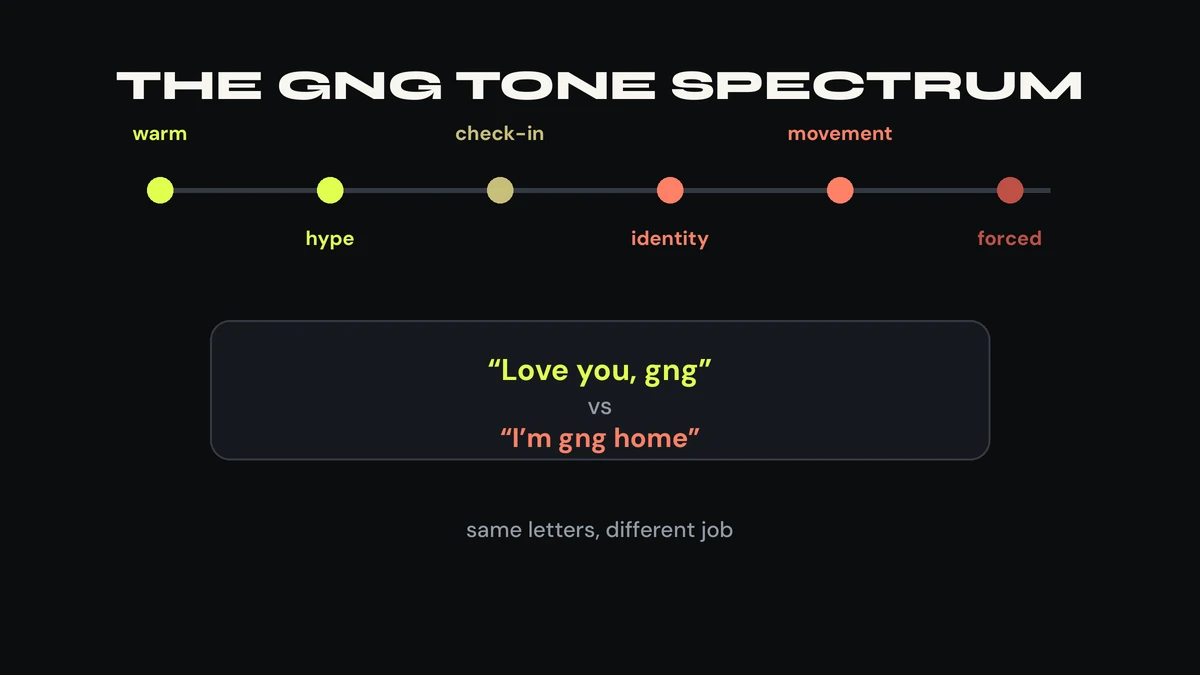
GNG’s tone depends on its job. The “going” reading is nearly toneless; the “gang” reading always claims closeness. Six readings, lightest to heaviest:
- Warm address: “Love you, gng” — affection plus belonging.
- Hype address: “We locked in tonight, gng” — pep-talk energy before an event.
- Casual check-in: “You good, gng?” — friendly, low-stakes, the default one-to-one use.
- Group identity: “Me and the gng are going out tonight” — a belonging claim.
- Plain movement: “I’m gng home” — neutral and functional.
- Presumptuous address: calling near-strangers “gng” —forced familiarity when the relationship does not support it.
The tone lives in the slot, not in GNG alone. A slot misread changes what the message asks of you — which is why the Slot Check comes before any tone judgment.
“GNG” on TikTok
On TikTok, GNG is mostly a broadcast address. Creators thank their audience with “Thanks, gng. Means a lot,” hype a video with “Y’all killed this trend, gng,” or close a caption with “Love y’all, gng.” The trick is the scale: thousands of strangers addressed as if they were one group chat, and the informality is the point.
TikTok also hosts GNG’s second life: the hashtag. Under #GNG, workout footage, study sessions, and early-morning hustle content carry the mantra “Grind Now, Glow-Up Later” — a statement of intent addressed to nobody. That is a caption meaning, not a message meaning, and it never applies to a DM. If someone texts you “gng,” they are addressing you, or telling you they are going somewhere.
“GNG” on Snapchat
On Snapchat, GNG fits the quick, disappearing message. “Yo gng, you coming tonight?” opens a plan; “Yeah gng” confirms it; “I’m gng to the mall” announces movement — all in a format where messages are short and context is thin. Snapchat is where the Slot Check earns its keep, because a bare “gng” with no sentence around it could be either job.
Snapchat is also where the good-night phrase lives: “GNG everyone, see you tomorrow” closing a group chat at the end of a long day. Read it as “good night, gang.” And a GNG under a selfie can carry the niche compliment reading (“you’re gng” as praise) — real in that one setting, but never the default.
“GNG” on Instagram
On Instagram, GNG shows up in DMs, comments, captions, and stories: “Appreciate the support, gng” as a creator thanking followers, “I’m gng out tonight” as a story caption, “W gng” as a comment under a friend’s post. The public version leans broadcast address; in DMs, the full range appears.
Instagram is also where GNG’s compliment reading is most at home: a comment calling someone “gng” under a selfie reads as hype and praise, closer to “you look great” than to “my crew.” Context decides — a selfie comment is a compliment setting, a DM asking “You coming, gng?” is an address, and a caption saying “gng to the gym” is movement.
“GNG” in Text Messages
Plain texts host both GNG readings side by side. It pairs naturally with its conversation-opening cousin WYO — WYO (“what you on”) asks what someone is doing, and GNG answers who is with you or where you are headed. And it sits comfortably with DW in the reassurance cluster: “Gng, dw, we’ll sort it tomorrow.”
Texts are also where GNG’s gaming life lives: a squad chat ending in “We got this, gng” is a team talking to itself. In group chats, GNG is the identity marker: “What’s the gng doing tonight?” asks what everyone is doing, and the word itself does the grouping. In a work Slack, GNG fits a casual team channel at most; a formal email wants “gang” or “going” spelled out, or neither.
Who’s Sending It: How “GNG” Lands by Sender
No source documents a different meaning of GNG per sender — the slot rule still decides. What changes is how the address reads:
- Friend: the default. A friend’s “gng” is an address at face value; run the Slot Check, then take it as warmth.
- Crush: overread territory. A crush’s “Love you, gng” is a warm address, not a confession. A crush’s “I’m gng” is movement, not rejection.
- Partner: belonging rules. A partner’s “gng” claims the two of you as a unit; judge the pattern across messages, not one address.
- Group chat: the gang habitat. A group’s “gng” is an identity marker — the word doing the grouping, not describing it.
- Creator / influencer: the broadcast address. A creator’s “gng” addresses an audience as if it were a group chat; enjoy the closeness, but know it is a performance of it.
- Gaming squad: the team address. A squad’s “gng” is solidarity before a match; the hype reading dominates here.
When “GNG” Gets Misread
Three misfires, graded. First, the slot mix-up: answering “I’m gng home” as if it were a greeting (“Yo! What’s up?”) misses a departure, and answering “What’s good, gng?” with logistics (“Going where?”) misses a greeting. The Verb Swap prevents both. Second, the literal-gang scare: hearing “gang” and picturing a criminal organization. In slang use, “gang” means friends and crew; the literal reading belongs to news reports, not chats — but it is also why GNG stays informal and out of professional writing.
Third, the good-night confusion, where GNG’s closest cousin does real damage. The phrase “gn gng” pairs a GN close (“good night”) with a gang address — two abbreviations, two jobs. Reading the whole phrase as one expansion (“good night gang” as the meaning of GNG) is the single most common GNG error online, and it inverts the grammar: the GN does the good-nighting, the GNG does the addressing.
Checked Claims: Expansions That Don’t Hold Up
Three letters attract folklore. The claims that fail evidence:
- “GNG stands for ‘good night gang’” — rejected as a standalone expansion. “Goodnight gng” parses as “good night” plus “gang”; no primary source expands GNG itself that way.
- “GNG means ‘grind now, glow-up later’ in a text” — rejected as a message meaning, graded as a hashtag reading. The phrase lives in TikTok hustle captions under #GNG, addressed to nobody.
- “GNG means ‘good n’ gorgeous’” — graded as a niche compliment reading, not a primary meaning. It appears in selfie-comment contexts with no dictionary attestation.
- “GNG means ‘going, not going’ (RSVP)” — graded unverified, not taught. It appears in one secondary guide only, as a WhatsApp plans shorthand, with no corroboration.
- “GNG means ‘going nowhere, gang’” — graded unverified meme reading. One secondary guide only, self-deprecating meme use; do not teach it as a meaning.
- “GNG means ‘Ginny and Georgia’” — rejected. A hashtag misread of the Netflix show title, explicitly flagged as such by the TikTok guide.
- “GNG always means a literal gang” — rejected. In slang use, “gang” means friends and crew; the literal reading belongs to other contexts entirely.
- “GNG is the same as GN” — rejected. GN is a good-night sign-off; GNG addresses people or describes movement. Their only overlap is the phrase “gn gng.”
What SURVIVES: “gang” (dictionary-attested, primary) and “going” (strong secondary attestation, verb-slot only), decided per message by the Grammar Slot Test.
“GNG” vs Its Closest Cousins
GNG belongs to the people-and-movement family:
- GM (“good morning”) — the day-pair cousin. GM opens the day; GNG names the group. GM says “good morning”; GNG says “my people.”
- CYA (“see you”) — the goodbye cousin. CYA closes with a promise to return; GNG addresses the people. CYA says “until next time”; GNG says “my crew.”
- BRB (“be right back”) — the pause cousin. BRB promises a return in minutes; “gng” as “going” announces a departure. BRB says “hold on”; GNG-as-going says “I’m out.”
- BTW (“by the way”) — the side-note cousin. BTW adds something extra mid-conversation; GNG addresses the conversation. BTW says “oh, also”; GNG says “you all.”
GNG often travels with a plan — “What’s the gng doing tonight?” — and that is the tell.
Where “GNG” Came From
“Gang” as a loyalty word comes from hip-hop vocabulary, where it carried friendship and solidarity for decades before texting compressed it. The compression is simple: drop the vowels, keep the shape — “gang” became “gng,” and “going” also became “gng” in fast typing. Two words, one compression, one collision.
From group chats, GNG traveled the broadcast route: TikTok creators started addressing audiences of thousands as “gng,” turning a group-chat word into a community word. Gaming added a second branch: squads and Discord servers use GNG as a team address before matches. No inventor or first-use date for “gng” is claimed by any source read; the compression path is the documented mechanism.
How to Reply When Someone Sends “GNG”

Replies matched to the slot:
- Gang-address — answer as addressed: “Yo! What’s up?”, “Appreciate you too.”
- Group mention — answer the plan: “Have fun!”, “Count me in.” Answer the plan attached to the mention.
- Going-statement — answer the movement: “Safe trip”, “See you there.”
- Goodnight-gang sign-off — mirror the close: “GN, gng!” Returned in kind.
- Hashtag mantra — no reply owed: a caption is not a message. A like is the whole reply, if anything.
What never works: answering a “going” with a greeting, or a “gang” address with a logistics question. Answer the slot, not the letters.
Frequently Asked Questions
What does “GNG” mean in a text message?
Usually “gang” — friends or crew. “What’s good, gng?” is a greeting. “I’m gng home” means “going.” Grammar decides.
What does “GNG” mean on TikTok, Snapchat, and Instagram?
The same two readings everywhere. TikTok stages it as a broadcast address and a hustle hashtag, Snapchat as a quick DM, Instagram as a comment or story caption.
How do I tell if GNG means “gang” or “going”?
Run the Grammar Slot Test: check the slot, try the verb swap, and ask whether someone is being called. Address means gang; verb means going.
Does GNG mean “good night gang”?
Not as a standalone expansion. “Goodnight gng” means “good night, gang” — the good-night plus the address.
What’s the difference between “GNG” and “GN”?
GN is a good-night sign-off; GNG addresses people or describes movement. They meet only in “gn gng.”
Can I use “GNG” at work?
In a casual team chat, sparingly. In a formal email, spell out “gang” or “going” instead. The literal “gang” reading can land wrong professionally.
Someone just sent me “GNG”. What do I say?
Answer the slot: greet a gang-address back, answer the plan, or send off a going-statement. If it closed the night, mirror it: “GN, gng!”
The Takeaway
“GNG” is two words wearing one abbreviation — “gang” for the people, “going” for the movement — and grammar tells you which one arrived. When you send one, remember the only rule that matters: a GNG that could be read two ways should carry one more word.