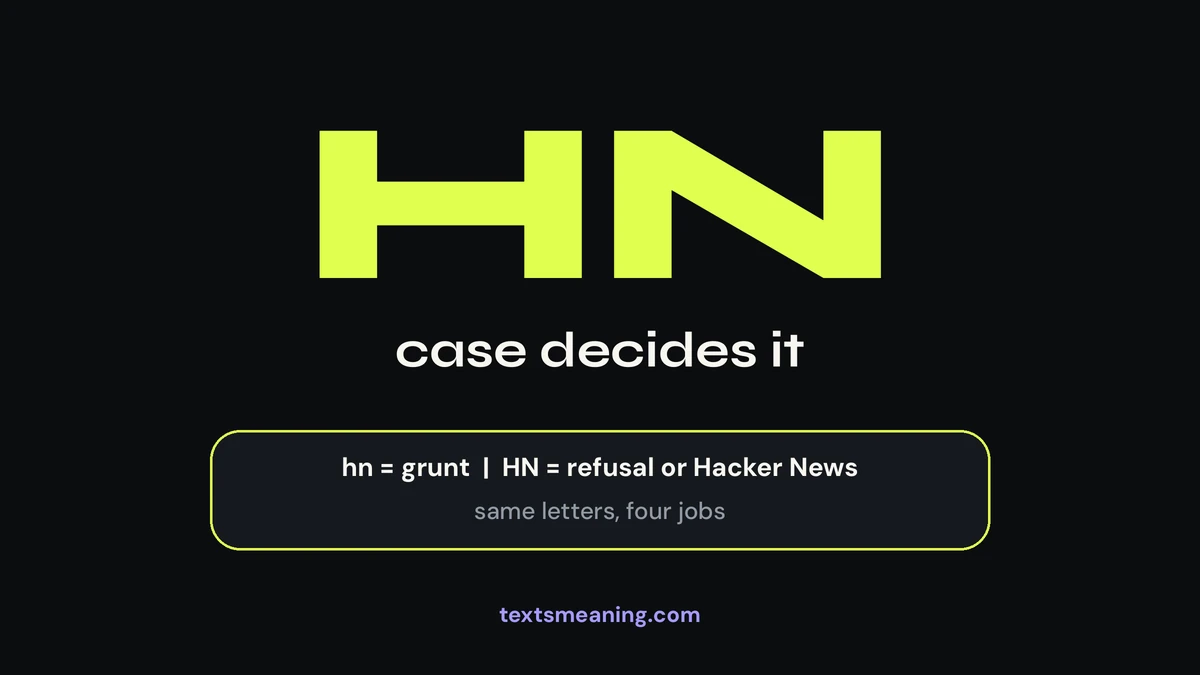
What does HN mean in text? It depends on the case of the letters: lowercase hn is a grunt in the huh and hmm family, while uppercase HN usually means a blunt refusal or, in tech circles, Hacker News. Same two letters, completely different jobs — and the case is the first clue, not a detail.
This guide to hn meaning in text gives you the HN Case Test, a three-check rule that sorts the grunt from the refusal from the tech reference in seconds — plus tone readings, platform notes, sender guidance, the claims that failed checking, and exact replies.
What “HN” Means in Text
Start with the split that matters most. Lowercase hn is a sound typed out, not an abbreviation with hidden letters. It sits in the same family as hm and huh: a short noise that says “I heard you,” “wait, what?” or “let me think.” The primary dictionary source backs the sound reading directly: Wiktionary lists lowercase hn as an interjection used to tag a rhetorical question, quoting Ian Fleming in 1956 — “Not bad for the House, hn?” — which proves the grunt is older than texting itself.
Uppercase HN is a different animal. In everyday chats it most often stands for hell no, a strong, funny, emphatic refusal: “Coming to the 6 a.m. run?” “HN!” That is the one plain spelling of the phrase in this guide; everywhere else it appears as h*ll no. Here is the honest gap: Wiktionary has an entry for uppercase HN and lists no texting expansion at all — only the country code for Honduras, a Navy rank, a biochemistry term, and the Japanese “handle name.” So h*ll no is graded here as strong community attestation, not dictionary fact.
Then there is the third job, and it never overlaps with the other two. In tech group chats and startup conversations, HN is the standard shorthand for Hacker News, the Y Combinator discussion site: “saw it on HN this morning.” Nobody in that sentence is refusing anything or grunting. And there is a fourth, regional job: in Romanized Hindi and Urdu chats, lowercase hn often clips “haan,” meaning yes — a real community usage that misreads badly if you assume the grunt or the refusal instead.
The HN Case Test
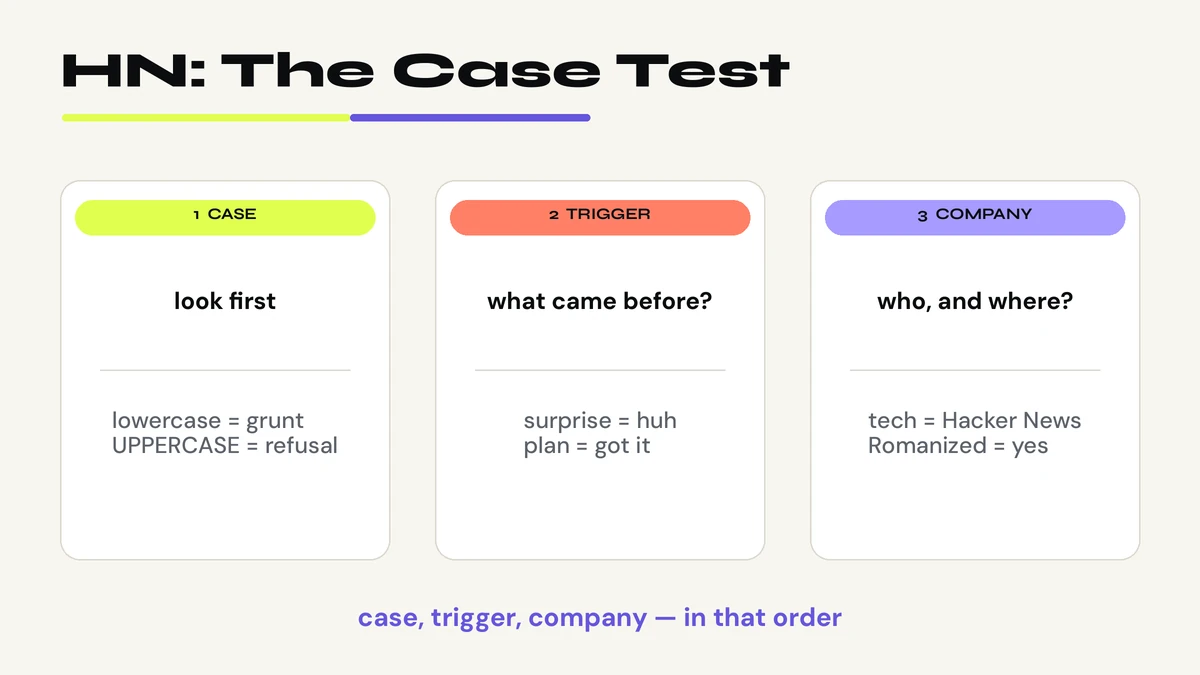
Most guides hand you a list of meanings and leave you to guess. The HN Case Test gives you an order instead, and the order is the whole trick. Run the three checks in sequence, and stop at the first one that answers the question.
Check one is CASE. Look at the letters before you read anything else. Lowercase hn points to the grunt family or, in a Romanized chat, to yes. Uppercase HN points to refusal or, in tech company, to Hacker News. Case alone settles most messages, which is why guides that treat hn and HN as the same word keep getting this wrong.
Check two is TRIGGER. What came right before it? A surprising statement or a confusing question makes a lowercase hn read as “huh.” A plan or a statement of fact makes it read as acknowledgment. A proposal the sender would hate makes an uppercase HN read as refusal.
Check three is COMPANY. Who sent it, and where? A developer friend in a tech channel means Hacker News. A friend who texts in Romanized Hindi or Urdu means yes. A close friend in a fast one-on-one thread means the grunt. When case and trigger conflict, company breaks the tie.
Chat Examples: HN in Real Messages
The examples below are written for this guide to show each reading in its natural habitat. None of them is presented as a real screenshot.
Confusion. A: “Wait, we are meeting at 5, not 6 — they moved it.” B: “hn? I thought we agreed on 6.” The question mark turns the grunt into a request for clarification.
Thinking. A: “Should we book the Friday flight or wait for a price drop?” B: “hn… let me check my calendar first.” The trailing dots are the thinking pause, typed out.
Acknowledgment. A: “I will pick you up at 7, then we grab food.” B: “hn 👍” Nothing more is needed; the plan is confirmed.
Refusal. A: “Double dare: eat the ghost pepper.” B: “HN! Not even for twenty bucks.” Uppercase, exclamation, follow-up — the refusal is loud, funny, and final.
Gaming nod. A: “Rotate to B, they are pushing hard.” B: “hn” In a fast match this is the same quick nod as brb in gaming chat — acknowledgment without a promise attached.
Tech reference. A: “Did you see the new AI model?” B: “yeah, it is blowing up on HN right now.” No refusal, no grunt — a citation, the way you would name any forum.
Regional yes. A: “Kal aa rahe ho?” B: “hn.” In a Romanized chat this is agreement, and reading it as a grunt or a refusal would flip the answer completely.
Cold landing. A: “Hey, I am really sorry about last night.” B: “hn” A bare grunt after an apology is the version that stings, and it is the version this guide spends the most time on below.
Tone: What HN Feels Like
Tone is not carried by the letters; it rides on punctuation, emoji, and what follows:
- Confused — “hn?” asks for clarification and invites you to explain again.
- Thinking — “hn…” buys time and signals a real answer is coming.
- Flat — a bare “hn” with no punctuation reads neutral, busy, or distracted, not angry.
- Warm — “hn 👍” or “hn, sounds good” confirms and keeps the mood light.
- Playful — a doubled “hn hn 😏” teases and flirts rather than answers.
- Dismissive — a bare “hn” after something serious reads cold, whether or not that was the intent.
- Emphatic — an uppercase “HN!” refuses with humor and drama, and usually ends the debate.
Trust the pattern across the conversation, not one message. A friend who always texts in fragments is not punishing you with a grunt; a friend who suddenly drops to one syllable after paragraphs of warmth is telling you something changed.
HN on TikTok
On TikTok, hn lives in comments, not captions. A surprising twist earns a flat “hn” or “hn??” from viewers reacting in real time, and the reading is almost always the grunt: confusion, disbelief, or a stunned beat. The refusal reading barely appears here because comments react to a post rather than answer a proposal, and the Hacker News reading never appears outside tech-creator threads. If you see hn under a TikTok, read it as a reaction, not a reply — closer to a shrug emoji than a statement.
HN on Snapchat
Snapchat is where hn does its fastest work. Snaps and chats move quickly, streaks reward speed, and a one-word grunt keeps the streak alive without breaking the flow. Here the acknowledgment reading leads: “hn” after a photo or a plan means “seen, got it, moving on.” The refusal reading shows up in dare and question stickers, where an uppercase HN answers a prompt with drama. Because Snapchat chats are private and fast, a bare hn carries more emotional weight than it does in a public comment — senders who care usually add an emoji or a follow-up.
HN on Instagram
Instagram splits hn in two places. In DMs it behaves like texting: grunt, acknowledgment, or refusal depending on case and trigger. In comments and story replies it behaves like TikTok: a public reaction to something surprising, usually the grunt. One Instagram-specific habit is worth knowing: story question boxes collect uppercase HN replies to polls and dares, where the refusal is the whole joke and the audience is the point. A private DM hn and a public comment hn are the same letters with different stakes, so check where you saw it before you judge it.
HN in Text Messages
Texts are the home ground of hn, and the place where misreads cost the most. In a private thread there is no audience and no public context, so a flat grunt after serious news lands harder than the sender may have intended. This is also where the regional reading matters most: a Romanized-chat “hn” meaning yes can sit in the same thread as a grunt, and only the sender's language habits tell them apart. The rule for texts is strict: never decide what a lone hn meant from the hn alone. Read the trigger, read the case, read the sender's last five messages, and only then decide.
Who Sent It: What HN Means by Sender

The sender changes the odds, not the letters. A close friend who texts in shorthand sends grunts all day; their hn is almost never a verdict on you. A crush sends hn with more weight attached, because early dating has no established tone yet — a bare grunt from a crush reads as disinterest even when it only meant distraction, so crushes who care tend to add words. A partner's hn is the easiest to read correctly because you know their baseline: if your partner always grunts, nothing changed; if they never do, something did.
A coworker is the sender to handle most carefully. In a work chat, hn is rare precisely because it risks misreading, so a coworker's hn usually means they are slammed, not rude — but do not send hn yourself at work, since a manager can read a grunt as disengagement. A developer or tech-community friend is the one sender for whom HN means Hacker News by default; if their messages mention threads, front pages, or launches, the tech reading wins over the refusal. And a family member who texts in Romanized Hindi or Urdu is the sender for whom hn most likely means yes — rule the regional reading out before assuming the grunt.
One warning covers all senders: nobody's hn means the same thing every time. The same friend grunts at a joke, acknowledges a plan, and refuses a dare in a single afternoon. Judge the message, not the person, and judge it with the Case Test.
Is HN Rude?
Usually not, and the exceptions are about placement, not letters. A bare lowercase hn is rude only when it stands alone after something that clearly deserved more — an apology, bad news, a serious question — with no emoji, no punctuation, and no follow-up. Everywhere else it is efficiency, distraction, or habit. An uppercase HN refusal is blunt by design, but bluntness between friends reads as humor; the same HN to a stranger or a boss reads as disrespect, because the relationship has not earned the joke yet.
If you received a cold-feeling hn, do not escalate over two letters. Wait, check whether the shortness is a pattern or a single message, and if it keeps happening, ask plainly: “hey, everything good? That felt a little short.” One direct question clears up more than a day of re-reading a grunt. And if you are about to send a bare hn after someone's serious message, add five words — “hn, let me think about that” — and the rudeness problem disappears.
Claims That Did Not Check Out
Several listicles pad their hn pages with extra expansions, and every one of them failed grading. “How nice” has no dictionary entry and no community attestation behind it — the example chats that supposedly prove it read invented. “Hey now” is the same story: a plausible-sounding phrase with no evidence that anyone shortens it to hn. “Hello neighbor” is a meme caption, not a meaning, and “his/her name” is a guess dressed as a definition. FWIW, the sites pushing these readings never show a real conversation where hn means any of them, which is why this guide names and rejects them instead of repeating them as options.
Two more claims failed in the other direction. The technical readings — home network, head nurse, host name — are real workplace abbreviations, but they never function as chat replies, so they do not belong in a texting guide. And the claim that hn always means one thing fails against the dictionary itself: Wiktionary attests the lowercase sound and stays silent on the uppercase texting expansion, which is the opposite of a single settled meaning. When a guide gives you one confident answer for hn, that confidence is the tell that it did not check.
HN vs Its Closest Cousins
HN's closest cousin is hm, and the difference is length and commitment. HM is the longer thinking pause — it signals genuine thought and usually earns a follow-up. Lowercase hn is the shorter, flatter version: less thought, less commitment, more likely to be pure acknowledgment. If hm is a pause with a chair pulled up, hn is a pause in the doorway.
Huh is the spoken twin of the grunt reading: “hn?” and “huh?” do the same job, but huh asks more openly while hn can hide behind ambiguity. Nah is the soft cousin of the refusal reading: nah declines gently where HN refuses loudly, so HN ends debates that nah merely sidesteps. Hmm is the engaged cousin of the thinking reading — longer, warmer, more curious than hn's clipped pause. The tech reading has no cousin at all: Hacker News is a proper name wearing two letters, and no other slang term collides with it.
Where HN Comes From
The grunt is the oldest part. Wiktionary's 1956 Fleming quotation shows hn already working as a spoken tag — “Not bad for the House, hn?” — long before anyone texted, and the grunt tradition runs on through fiction and anime fandom, where a cold character's “hn” became a recognizable character beat. The refusal is newer: h*ll no is a spoken phrase that SMS-era typing clipped to two letters. Hacker News launched in 2007, and its HN shorthand grew as a community convention among developers, not as slang. The Romanized “haan” clipping follows the same shortening habit inside South Asian texting. No single inventor exists for any reading; all four grew because millions of people repeated them until they stuck. Btw, that shared history is why the letters feel familiar even when the meaning flips — you have met all four readings before, just never in one place.
How to Reply to HN

Match your reply to the reading the Case Test gave you. To a confused “hn?”, clarify in one line: “sorry, I meant 5, not 6.” To a thinking “hn…”, give room and add one useful detail instead of demanding an answer. To an acknowledgment “hn”, no reply is required — a thumbs-up keeps the flow natural. To a cold-feeling “hn”, wait for the pattern before reacting, and if it repeats, ask directly whether everything is good.
To an uppercase HN refusal, accept the closed door unless the sender reopens it; arguing with a joke refusal only makes it serious. To a Hacker News HN, reply to the topic, not the letters. To a regional “hn” meaning yes, treat it as yes and move on. When you are unsure which reading you got, bounce the question back the way hbu turns a question around: “wait, do you mean yes or are you still thinking?” One clarifying question beats ten minutes of re-reading. If someone just sent you a flat hn after your apology, the reassuring move is the dw move — “don't worry about it, we're good” — which reopens a conversation a grunt just closed.
Quick Answers
What does HN mean in a text message?
It depends on case: lowercase hn is usually a grunt like huh or hmm, or a quick acknowledgment, while uppercase HN usually means h*ll no. In a tech chat it means Hacker News, and in a Romanized Hindi or Urdu chat it can mean yes.
Is HN the same as HM?
No. HM is the longer thinking pause with more commitment behind it; hn is shorter, flatter, and more likely to be pure acknowledgment. They share a sound family but not a job.
Does HN always mean h*ll no?
No, and that is the most common misread. Only uppercase HN in a personal chat leans that way. Lowercase hn almost never means a refusal.
What does lowercase hn mean in a Romanized Hindi or Urdu chat?
It usually clips “haan,” meaning yes. Reading it as a grunt or a refusal in that context flips the answer, so check the sender's language habits first.
Is it rude to reply with just hn?
Only when it stands alone after something serious, with no emoji or follow-up. Anywhere else it reads as efficiency or habit. Adding five words — “hn, let me think about that” — removes the risk.
Someone sent me HN in a tech group chat. What does it mean?
Almost certainly Hacker News, the tech discussion site. Look for companion words like thread, front page, or launch, and reply to the topic rather than the letters.
The Takeaway
HN is two letters doing four jobs, and case is the key that sorts them: lowercase grunts, uppercase refuses or names a tech forum, and a regional chat turns the grunt into yes. Run the HN Case Test — case, trigger, company — before you decide what you just read. And when you send hn yourself, remember the only rule that matters: a grunt with no follow-up is a verdict the reader has to invent.