
What does HM mean in text? HM means “hmm” written short — the thinking sound you make when you need a second before answering. “Hm, let me think about that for a second” is not an abbreviation with a hidden expansion; it is a pause, typed out. And that is why it confuses people: a pause carries no words to argue with, so the reader fills the silence with their own worst guess.
This guide to HM meaning in text covers the HM Pause Test, a seven-reading tone spectrum, HM on TikTok, Snapchat, Instagram, and in texts, how it lands by sender, its cousins, its history, and the rule that saves you from overreading a lone HM.
What “HM” Means in Text
“HM” is the written form of the thinking sound “hmm.” The primary dictionary source attests it directly: Wiktionary lists English interjection hm as “a shorter variant of hmm.” Its fuller hmm entry gives the readings: thinking or pondering, surprise or cluelessness when caught off guard, and a demand for an answer. In a chat, those three readings are the whole story.
HM does three headline jobs. As a thinking pause: “Hm, let me check my calendar first.” As polite doubt: “Hm, are you sure that’s true?” As a soft acknowledgment: “Hm, that actually makes a lot of sense.” The job is decided by what rides on the letters and what follows them, never by the letters alone.
HM is also the run’s first term that is a sound rather than an expansion. Nothing is abbreviated, so there is nothing to decode. With an acronym you ask “what do the letters stand for?”; with HM you must ask “what is this pause doing?” The Pause Test below answers exactly that.
The HM Pause Test
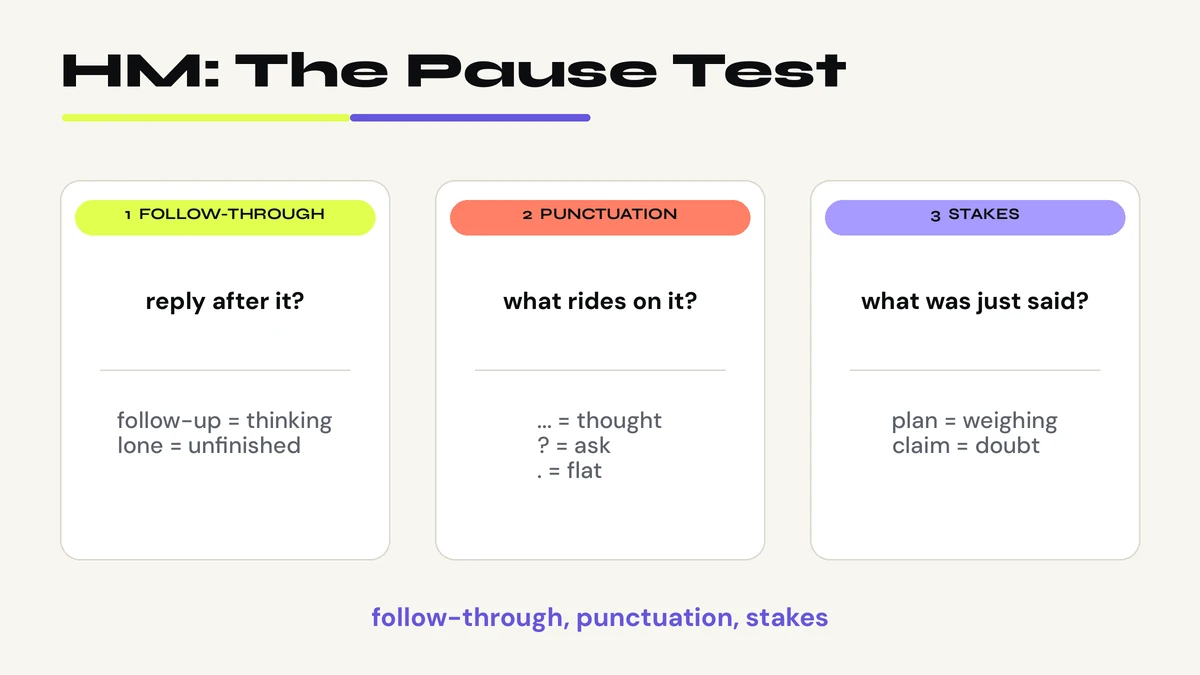
HM has one real ambiguity, and it is not about an expansion: what is this pause doing? Three checks settle it:
- Check 1 — The Follow-Through Check. Does a real reply follow the HM? “Hm, let me check” is thinking out loud. A lone “hm” with nothing after it is unfinished data — wait before judging it.
- Check 2 — The Punctuation Check. What rides on the letters? “hm…” stretches the pause toward thought; “hm?” asks for more or challenges what was said; “hm.” flattens it toward dismissal; “hm” plus a thinking emoji warms it toward curiosity.
- Check 3 — The Stakes Check. What was just said? HM after a plan means “I’m weighing it”; HM after a claim means “I’m not sure I buy it”; HM after a feeling means “I’m not sure how to answer that” — and that last one is the only case where a lone HM risks real hurt.
Worked trio. “Hm, Thai curry sounds amazing” after “Pizza or Thai tonight?” — thinking, resolved fast. “Hm, are you sure about that?” after a boast — polite doubt. “hm.” alone after a long, personal message — dismissal risk; wait for daylight, don’t chase the pause.
“HM” in Real Chats
Illustrative examples written for this guide — not presented as real transcripts:
- The thinking pause. “Hm, let me think about that for a second” — the default HM: processing, no verdict yet.
- The plan reply. “Hm, Thai curry sounds amazing” — thought that lands on a choice.
- The polite doubt. “Hm, are you sure that’s true?” — friendly skepticism.
- The curious prompt. “Hm? Tell me more” — an invitation, not a judgment.
- The hesitant stall. “Hm… I’m not 100% sure I can make it” — reluctance, not refusal.
- The flat dismissal. “hm.” alone, after a personal message — the period and the stakes do the cold work.
The HM Tone Spectrum

HM’s sound stays the same; its tone slides. Seven readings, lightest to heaviest:
- Thinking pause: “Hm, let me think about that for a second” — processing. The default reading.
- Curious prompt: “Hm? Tell me more” — an invitation to keep talking.
- Soft agreement: “Hm, that actually makes a lot of sense” — a gentle yes.
- Polite doubt: “Hm, are you sure that’s true?” — friendly skepticism.
- Hesitant stall: “Hm… I’m not 100% sure I can make it” — reluctance, not refusal.
- Low-energy acknowledgment: “hm ok” — heard, not engaged. The dry-texting zone.
- Flat dismissal: “hm.” alone after something that mattered — cold by context, not by letters.
Punctuation moves a reading up or down this list more than any other signal: an ellipsis lengthens thought, a question mark opens it, a period closes it. When in doubt, assume the thinking pause.
“HM” on TikTok
On TikTok, HM is a comment-section pause: “HM, has anyone actually tested if this works?” under a life-hack video, or “hm… interesting” on a debate clip. The public stage suits HM well — a two-letter reaction thousands of strangers can read without needing anything back.
The dismissal reading is rare here, since a comment cannot cut off a creator; the curious-prompt reading dominates.
“HM” on Snapchat
On Snapchat, HM fits the fast, disappearing message: “hm, busy morning over here” on a streak snap, or a quick “hm?” in a DM when a snap needs explaining. The ephemeral format suits a pause — a reaction that lands lightly and vanishes.
On Snapchat the flat-dismissal reading is easiest to misjudge, because the message vanishes before you can re-read it. If an HM felt off, ask from memory: did anything follow it?
“HM” on Instagram
On Instagram, HM shows up in story reactions and DMs: “HM… love the shoes, not totally sure on the jacket” on an outfit poll, or “hm, that makes sense” as a DM acknowledgment. The public version leans curious prompt; in DMs, the full range appears.
Instagram is also where HM’s playful life shows most: a teasing “hm… is that a challenge?” reads as flirtation, not doubt, because the relationship supplies the warmth the letters lack.
“HM” in Text Messages
Plain texts are HM’s home ground. It pairs naturally with the reassurance companion DW — “hm, dw, take your time” lets a friend think instead of rushing — and with the side-note companion BTW: “Hm, btw, did you check the date?” pauses one thread to open another. Three abbreviations, three jobs, one fluent chat.
Texts are also where HM’s work life lives, and where it should stay out: in a work Slack, a lone “hm” reads as dismissive to colleagues who cannot hear your tone. A formal message wants “Let me think about this” spelled out, and after a heartfelt message a lone HM feels cold no matter what the sender meant.
Who’s Sending It: How “HM” Lands by Sender
No source documents a different meaning of HM per sender — the sound stays fixed; what changes is how the pause reads:
- Friend: the default. A friend’s “hm” is thinking or teasing at face value.
- Crush: overread territory. A crush’s “hm… is that a challenge?” is playful, not a confession; a bare “hm” is usually just thinking.
- Partner: pattern rules. A partner’s “hm” after a serious message stings; judge the pattern across messages, not one pause.
- Parent: common and usually curious. A parent’s “hm?” mostly means “I didn’t follow that.”
- Boss or group chat: the risky habitat. A boss’s “hm” reads as doubt until a follow-up arrives; in a group chat it usually just means someone is still thinking.
When “HM” Is Not Just Thinking
Three misfires, graded. First, the dry-texting trap: a lone “hm” sent repeatedly stops reading as thought and starts reading as checked-out. If you sent it, a follow-up sentence repairs it. If you received it, the Stakes Check decides: after trivia it is nothing; after a feeling, it needs reopening.
Second, the dismissal: “hm.” after a serious message uses a pause as a door. Answer the topic tomorrow, not the pause tonight. Third, the false verdict: treating one HM as proof of disinterest. A pause is not a position. The closest cousin here is FWIW (“for what it’s worth”): FWIW softens an opinion before it is delivered, HM softens a reaction before it is decided. FWIW says “take it or leave it”; HM says “wait, I’m still thinking.”
Checked Claims: Expansions That Don’t Hold Up
Two letters attract folklore. The claims that fail evidence:
- “HM is an acronym with one expansion” — rejected. HM is an interjection, a shorter variant of hmm; it is a written sound, not initials.
- “HM means ‘hit me (up)’” — graded unverified, not taught. No primary attestation exists; HMU is the attested form.
- “HM means ‘home made’” — rejected for chat. A commerce and food label, not a texting reading.
- “HM means ‘high maintenance’, ‘hate me’, or ‘heavy metal’” — rejected for chat. Domain acronyms that never occur as a two-letter chat reply.
- “HM means ‘how much’ in general texting” — graded niche, not general. Wiktionary attests “how much” only as a Philippines Internet-slang determiner in online selling.
- “HM always means disinterest” — rejected. A lone HM is ambiguous data, not a verdict; the follow-through decides.
- “HM is the same as HMM” — rejected as identity. HMM is the longer, more engaged form; length changes the reading.
What SURVIVES: the thinking sound “hmm” written short (strong, universal), with thinking, doubt, curiosity, soft agreement, hesitation, low-energy acknowledgment, and flat dismissal as readings of the same pause — not as different meanings. No competitor statistics are repeated here as fact.
“HM” vs Its Closest Cousins
HM belongs to the pause family — the replies that suspend a conversation rather than fill or end it:
- HMM (the longer form) — the same sound, stretched. HMM signals deeper thought or playful intrigue; HM is the quick, neutral pause. HMM is a separate queue term and is not linked here.
- MHM (“mm-hmm”) — the yes cousin. MHM is a definite, casual affirmative; HM only pauses before deciding. MHM says “yes”; HM says “wait.”
- BRB (“be right back”) — the timed pause cousin. BRB promises a return in minutes; HM promises nothing but thought. BRB says “hold on”; HM says “I’m thinking.”
- GN (“good night”) — the ending cousin. GN closes a conversation; HM only suspends it. GN says “we’re done for tonight”; HM says “not yet.”
- BFFR (“be for real”) — the judgment cousin. BFFR judges a claim as nonsense; HM doubts it politely. BFFR says “you can’t be serious”; HM says “are you sure?”
- CYA (“see you”) — the goodbye cousin. CYA closes with a promise to return; HM suspends without promising anything. CYA says “until next time”; HM says “hold that thought.”
HM often travels with a follow-up — “hm, let me check” — the cheapest way to keep a pause from reading as a verdict.
Where “HM” Came From
HM is older than texting. The thinking sound “hmm” is a spoken interjection in English for centuries — a sound that carries thought without being a formal word. In writing it appears as “hmm” in novels and plays long before phones existed.
Digital messaging shortened it: SMS-era character limits and fast thumb-typing compressed “hmm” to “hm”, and instant messaging, then WhatsApp, Instagram, Snapchat, and TikTok, made the two-letter pause a standard micro-reply. The Philippines “how much” sense is a separate, later online-selling development, not the origin of the thinking sound. No inventor or first-use date for the “hm” spelling is claimed.
How to Reply When Someone Sends “HM”
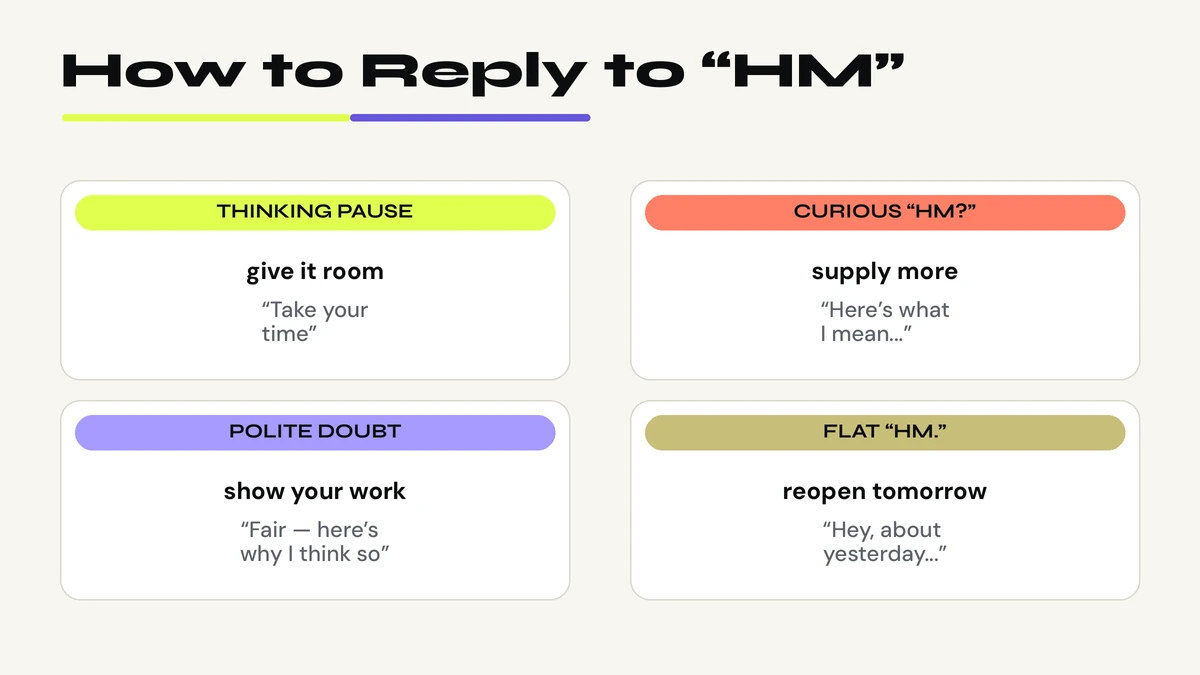
Five replies, matched to the reading:
- Thinking pause — give it room: “Take your time, no rush”, or add the missing detail. A pause deserves space, not pressure.
- Curious prompt — supply more: “Here’s what I mean…” A “hm?” is an invitation; accept it.
- Soft agreement — confirm and move on: “Great, let’s do that.” A gentle yes needs only a gentle yes back.
- Polite doubt — show your work: “Fair — here’s why I think so.” Don’t argue the doubt; answer it.
- Flat dismissal — don’t chase the pause: if the topic matters, reopen it tomorrow in daylight. Never answer a lone HM by assuming the worst reading.
Golden rule: answer the pause, not the letters.
Frequently Asked Questions
What does “HM” mean in a text message?
“Hmm” written short — a thinking pause. “Hm, let me think about that for a second” is processing, not a verdict.
What does “HM” mean on TikTok, Snapchat, and Instagram?
The same pause everywhere — no platform-specific meaning exists. TikTok stages it as a comment reaction, Snapchat as a fast reply, Instagram as a story reaction or DM acknowledgment.
Is a lone “HM” rude?
Not by itself — a lone HM is unfinished data. It reads cold only when it stands alone after something that mattered, with a period and no follow-up.
What’s the difference between “HM” and “HMM”?
Length. HM is the quick, neutral pause; HMM is the longer, more engaged form — deeper thought, genuine curiosity, or playful intrigue. Longer usually means more engaged, not less.
Does “HM” mean “hit me up”?
Not as an attested meaning. HMU is the attested form for “hit me up”; HM as a shortening of it has no primary attestation and is held unverified here.
Can I use “HM” at work?
In a casual team chat, sparingly. In a formal email or after a serious message, spell out what you mean instead; a lone “hm” reads as dismissive without tone.
Someone just sent me “HM”. What do I say?
Answer the pause: give a thinking pause room, supply more to a curious “hm?”, show your work to polite doubt, and never chase a flat “hm.” tonight.
The Takeaway
“HM” is a two-letter thinking pause — a sound, not an acronym, that buys time, voices doubt, or acknowledges without committing. When the letters arrive, run the Pause Test: follow-through, punctuation, stakes. And when you send one, remember the only rule that matters: a pause with no follow-up is a verdict the reader has to invent.