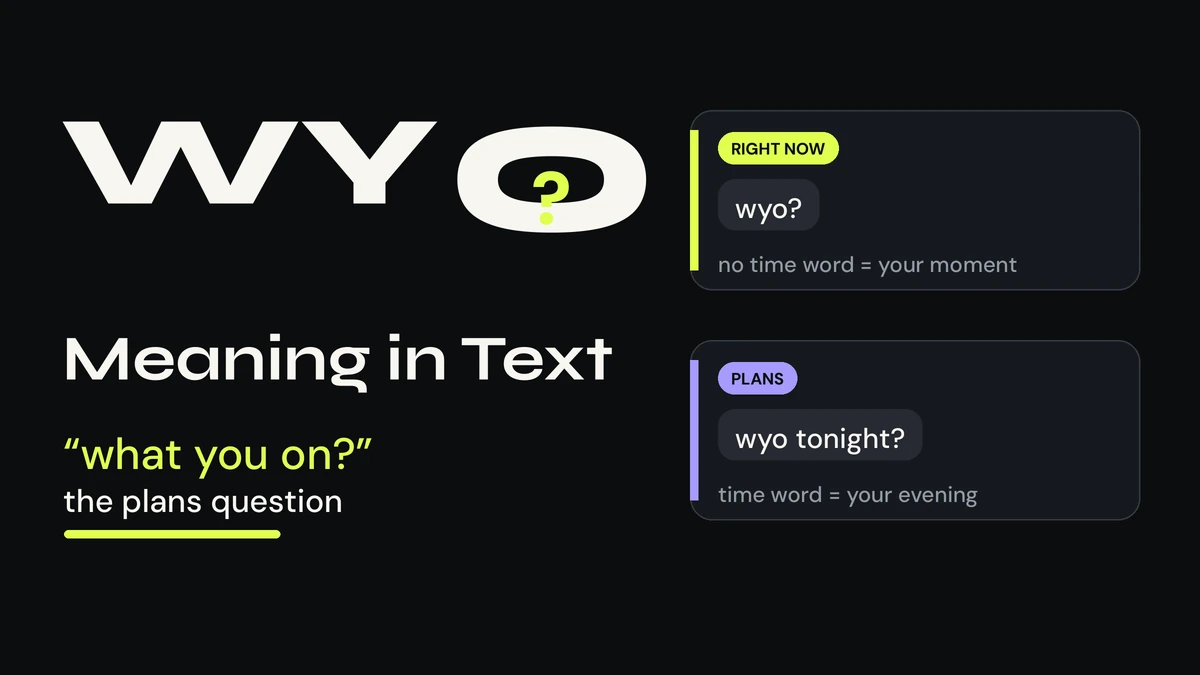
Wyo meaning in text is simple: it means “what you on?” – a casual way of asking what someone is doing, what they are up to, or what their plans are. The message itself tells you which one: a time word means plans, no time word means right now.
That two-second read is the whole game with WYO. It looks like a nothing word – three letters, barely a question – but it carries a small payload of information most people never notice: whether the sender wants your moment or your evening. This guide teaches you to read it instantly, through the Time-Word Test, the Punctuation Tell, and the one warning that actually matters.
What Does WYO Stand For?
WYO stands for “what you on?” – the casual, contracted version of “what are you up to?” or “what are you doing?”, usually with an implied second question hiding underneath: “are you free? want to do something?” Wiktionary lists it as a text-messaging initialism of “what you on,” glossed as “what are your plans? / what are you up to?”
One meaning, two time-senses. When someone texts “wyo?” they are asking about your moment – what you are doing right now. When they text “wyo tonight?” they are asking about your plans – whether your evening is free. Same three letters, different question. The rest of this guide is about telling them apart without thinking.
The Time-Word Test
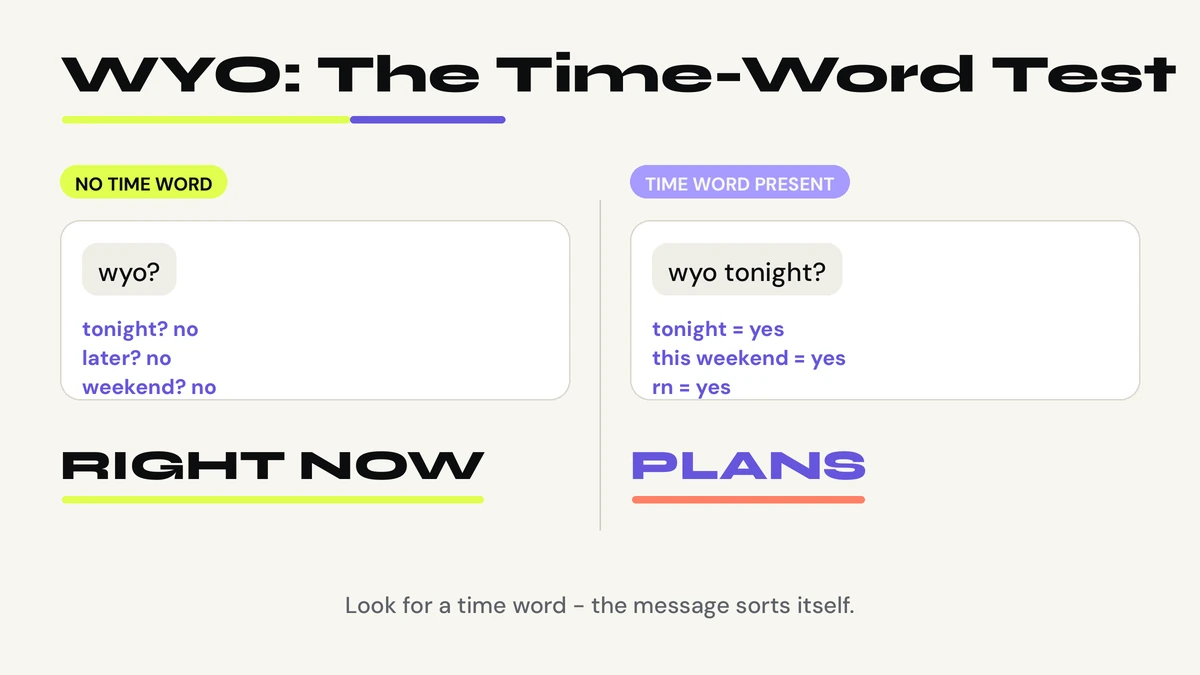
Here is the test: look for a time word. If the message attaches one – tonight, later, this weekend, tomorrow, rn – it is the plans reading: the sender wants to know your availability. If it stands alone – “wyo?” – it is the right-now reading: the sender wants to know what you are up to.
Wiktionary demonstrates this on its own entry: it glosses both senses and gives the example “WYO tonight?” – a time word, triggering the plans reading. Like LWK‘s Volume Test, which the dictionary’s own example proved, this test is shown working on the primary reference itself – and like ALR‘s grammar-and-position test and ICL‘s Position Test, it belongs to the small family of slang readings that grammar alone can decide.
Run it on four messages:
- “wyo?” – no time word. Right now: what are you doing at this moment?
- “wyo tonight?” – time word present. Plans: is your evening free?
- “wyo this weekend?” – time word present. Plans: are you around Saturday?
- “wyo rn?” – time word present (“rn” = right now, doing double duty). Urgent right now: what are you doing this second?
- Ten seconds of practice and the test runs on its own. From here on, every WYO you receive sorts itself before you finish reading it.
WYO vs WYD vs WYA vs HMU
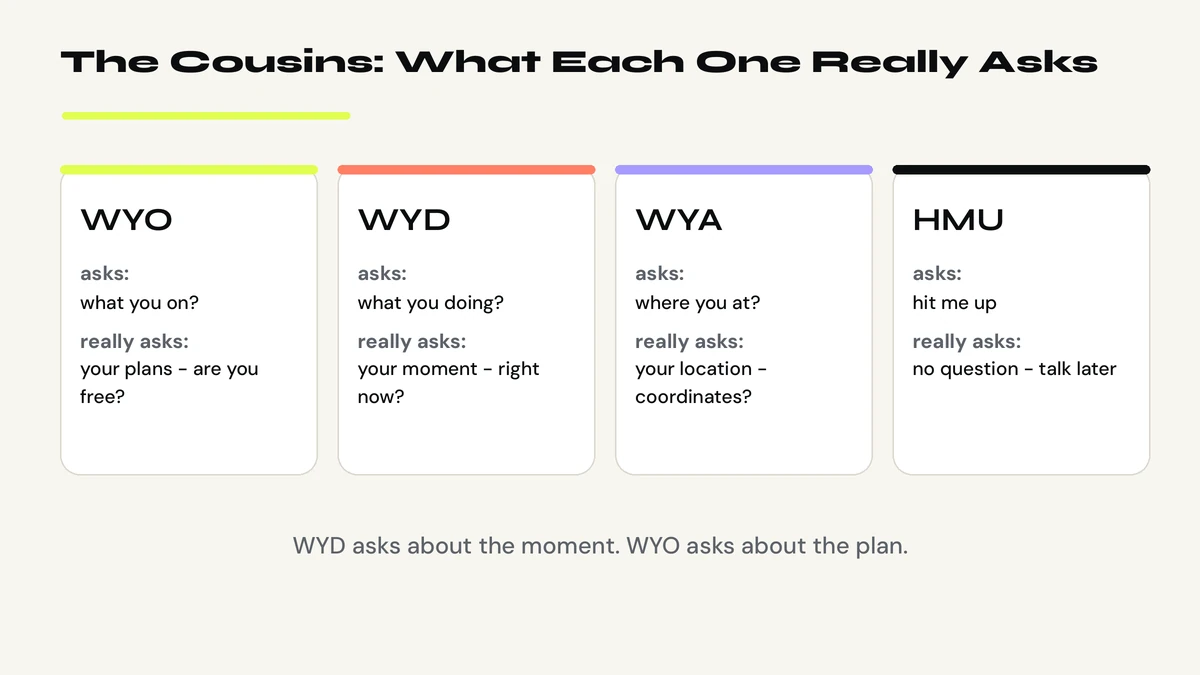
WYO has three close cousins, and each one asks a slightly different question. Here is what each literally asks, versus what it is really asking:
- WYD – literally “what you doing?” Really asking: what is your current activity? The moment question. “WYD?” at 9pm wants to know what you are doing at 9pm.
- WYO – literally “what you on?” Really asking: what are your plans, and are you free? The plans question. “WYO tonight?” wants your evening, not your current activity.
- WYA – literally “where you at?” Really asking: where are you physically? The location question. It wants coordinates, not plans.
- HMU – literally “hit me up.” Really asking: contact me later. The callback question. It does not ask anything at all – it issues an invitation to talk.
- The pair that confuses people is WYO vs WYD: they sound like the same question, but WYD asks about the moment and WYO asks about the plan. Answering “wyo tonight?” with “just watching TV” answers the wrong question – the sender wanted to know if you were free, not what was on the screen.
The Punctuation Tell
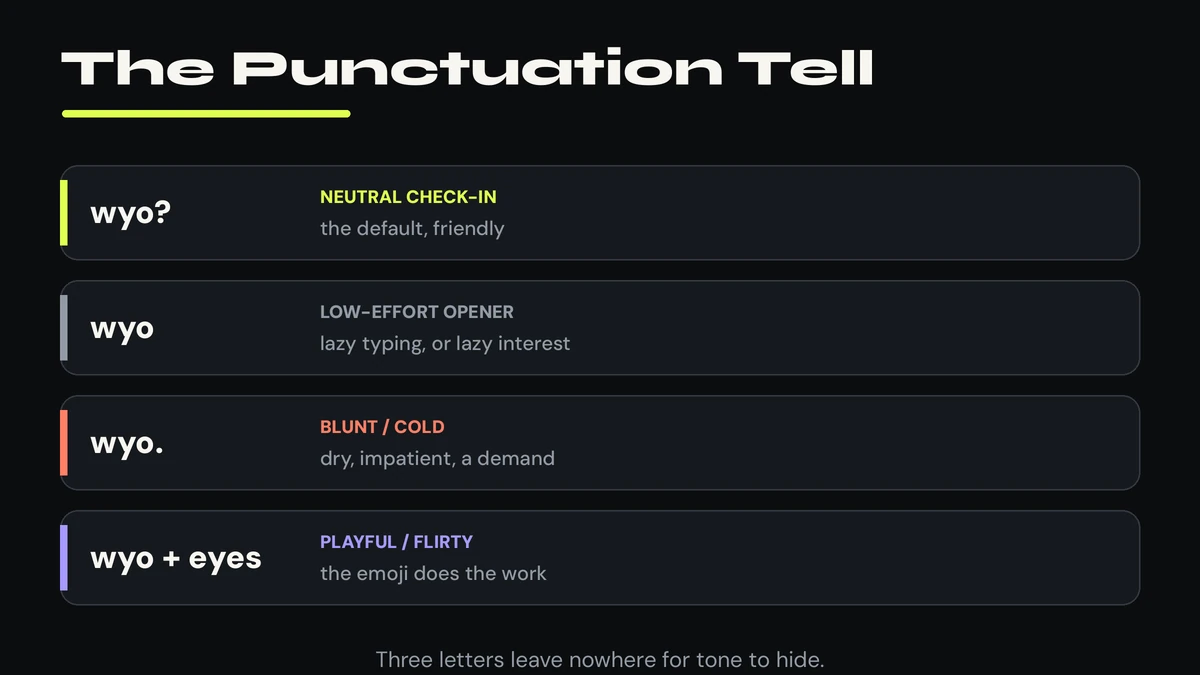
The words may be the same, but the typography changes the temperature. How WYO is typed tells you how the sender feels:
- “wyo?” – the neutral check-in. Friendly, normal, the default. This is WYO at rest.
- “wyo” – the low-effort opener. To a friend, it is just lazy typing. To anyone else, it can read as if the sender could not be bothered with a question mark – which is sometimes the point.
- “wyo.” – the blunt one. A period at the end of a three-letter opener reads dry, impatient, or cold. This is not a check-in; it is closer to a demand for an update.
- “wyo” plus the eyes emoji – the playful one. Suggestive energy, possibly flirty. The emoji does the work the words are too shy to do.
- “wyo rn?” plus a nervous-laugh emoji – the urgent-but-friendly one. Something is happening and the sender wants you in on it.
No earlier TextsMeaning guide has graded tone by punctuation marks before – but three letters leave nowhere else for tone to hide. When the word is tiny, the typography is the message.
Is WYO Flirty?
Not by itself. WYO is not inherently flirty – it is a check-in, and most of the time it stays one. It becomes suggestive the way most short messages do: through sender, timing, and emoji.
A late-night “wyo” from a crush, with the eyes emoji, is flirty. The same message at noon from a friend is a plan being made. The flirty reading lives in the context, not the letters – which is also why WYO is the king of plausible deniability: a bare “wyo” lets the sender shrug it off as casual if the reply is cool. “Just checking in, lol.” The words never committed to anything, so the sender never has to either.
The conversations below are illustrative examples written for this guide, not recorded messages.
Mia (11:47pm): wyo / Jay: just got home, you? / Mia: bored, come through?
Late-night, eyes-emoji energy in the subtext. The invitation was the question all along.
Sam (2pm): wyo tonight? / Rae: free after 7, what’s up?
Daytime, time word, no games. A plan being made in the open.
Who Sent It Matters
The sender does not change the definition, but it changes the stakes – the same habit GMFU‘s Who Test teaches, applied here.
A friend: the safest ground. “wyo?” is a real question about your day, and “wyo tonight?” is a real invitation. Answer at face value.
A crush: read the timing. Afternoon WYO is interest; late-night WYO is a different kind of interest. The time-word test still applies, but the subtext deserves a second read.
A partner or someone you are dating: usually logistics with warmth – “wyo after work?” is a plan being built together, not a test.
A coworker: do not send it here, and read it carefully if you receive it. WYO is never professional – from a colleague it is either boundary-crossing casual or genuinely clueless. Either way, answer briefly and do not mirror the tone.
A stranger or an ex, late at night: the low-effort opener at its worst. You owe it nothing. A short honest answer – or no answer – both end it without rudeness.
WYO on Snapchat, Instagram, TikTok, and in Plain Texts
The platform does not change what WYO means – stated plainly, as the evidence requires. What changes is the form the message takes.
On Snapchat, WYO is a story-reply and streak-reopener classic: “wyo” dropped on someone’s story, or a bare “wyo?” after a streak goes quiet. The disappearing-message format makes the low-effort opener feel even lower-effort – which is the point.
On Instagram, it lives in DMs and story replies, doing its soft-invite job: “wyo this weekend?” under a Friday story is an invitation wearing a question’s clothes.
On TikTok, it shows up in comments and captions as a semi-joking engagement prompt – “wyo if we…” style jokes, and comment-section check-ins. Same meaning, louder room.
In plain texts and WhatsApp, WYO is at home: the default check-in between people who know each other. No caption, no thread, no audience – just the question, and the time-word test doing all the work.
What WYO Is NOT
A few expansions circulate online. Each was checked against the evidence – the same open grading the series uses for every term.
“What you owe” – UNSUPPORTED. One low-quality FAQ page claims this for Snapchat. No dictionary, no Urban Dictionary, no competitor supports it. It is not a thing.
“Where you at?” – UNSUPPORTED. That is WYA’s expansion, misattributed to the wrong letters.
“Wish you over” / “write your own” – UNSUPPORTED. One competitor’s summary table lists these with zero attestation anywhere else.
“Watch your own” – UNSUPPORTED in messaging. Listed for gaming lobbies with no attestation; not a texting meaning.
The organization initials (World Youth Organization and friends) – real initials, but nobody receives them in a text. Not meanings, just collisions.
And the Wyoming note: Dictionary.com lists “Wyo.” as the state abbreviation. If the message is about license plates, it is geography. If it is a text at 11pm, it is not.
The “What Are You On?” Warning
This is the one confusion that matters. “What are you on?” – with the “are” – is a different phrase with a different edge: Urban Dictionary attests it as accusing someone of acting strange, with a drug-or-drunk implication. WYO drops the “are” and drops the edge with it.
The missing word is the whole difference. “Wyo?” is a check-in; “what are you on?” is closer to an accusation. Nobody is saying WYO itself is drug slang – that claim is unsupported – but the two phrases sit close enough in sound that a reader should know the boundary exists. Hear the “are,” and you are in different territory.
Where WYO Came From
The phrase is older than the abbreviation. “What you on?” comes out of AAVE and casual American speech, where dropping the auxiliary “are” is a consistent grammatical feature – the same pattern behind “what you doing,” which became WYD. The credit belongs to the speech community that built the phrase, plainly stated.
The abbreviation compressed it for the SMS era, when every character counted – then Snapchat and Instagram DMs accelerated it through the early-to-mid 2010s, and TikTok comment culture carried it further. Urban Dictionary dates the slang to 2017 or 2018 depending on who is reporting; the sources conflict, so this guide reports the conflict instead of picking a winner. The exact first-use date is not established, and no honest source claims otherwise.
How to Reply to WYO
Two meanings of question, one reply habit: answer what was asked, then mirror it back.
To “wyo?” – answer the moment, then return the question: “Nothing yet, wyo?” / “Just watching a movie, wbu?”
To “wyo tonight?” – answer availability: “I’m free tonight – what’s up?” / “Busy till 9, after that I’m good.”
To the soft invitation – respond to the invitation, not just the question. “wyo this weekend?” answered with “nothing planned” is technically an answer; “nothing planned, what did you have in mind?” is a reply.
To the one you do not want – a short honest answer ends it without rudeness: “Busy tonight, hbu?” / “Can’t, rain check?”
When Not to Use It
Never in work email, never to a teacher or a client, never in anything formal. WYO is casual the way sneakers are casual – perfect in the right room, wrong everywhere else. And like FAFO, whose timing changes what it means, WYO’s timing changes what it signals: a 2pm WYO is a plan, a 2am WYO from a stranger is a red flag wearing three letters.
Frequently Asked Questions
What does WYO stand for?
“What you on?” – a casual way of asking what someone is doing, what they are up to, or what their plans are. Wiktionary lists it as a text-messaging initialism.
Is WYO flirty?
Not by itself. It becomes suggestive through timing (late night), sender (a crush), and emojis. A bare “wyo” carries plausible deniability – the sender can always claim it was just a check-in.
What’s the difference between WYO and WYD?
WYD asks about the moment – what are you doing right now? WYO asks about the plan – what are your plans, are you free? “WYD?” at 9pm wants your current activity; “wyo tonight?” wants your evening.
What does “WYO tonight?” mean?
It is the plans reading: the sender is asking whether your evening is free, usually because they want to make plans. Answer with your availability, not just your current activity.
Is WYO rude or unprofessional?
Not rude among friends, but never professional. Do not use it in work email, with teachers, or with clients – and do not send it to strangers late at night.
Does WYO have anything to do with drugs?
No. WYO itself – “what you on?” – is a check-in. The longer phrase “what are you on?” (with “are”) is a separate expression that can imply drugs or drunkenness. The missing word is the difference.
The Takeaway
WYO is three letters with a small engine inside: “what you on?” asks what you are doing or what you are planning, and the time-word test tells you which one before you finish reading. The punctuation tells you the temperature, the sender tells you the stakes, and the missing “are” tells you what it is not. Read the time word, check the punctuation, and you will never misread the question – or the person asking it.