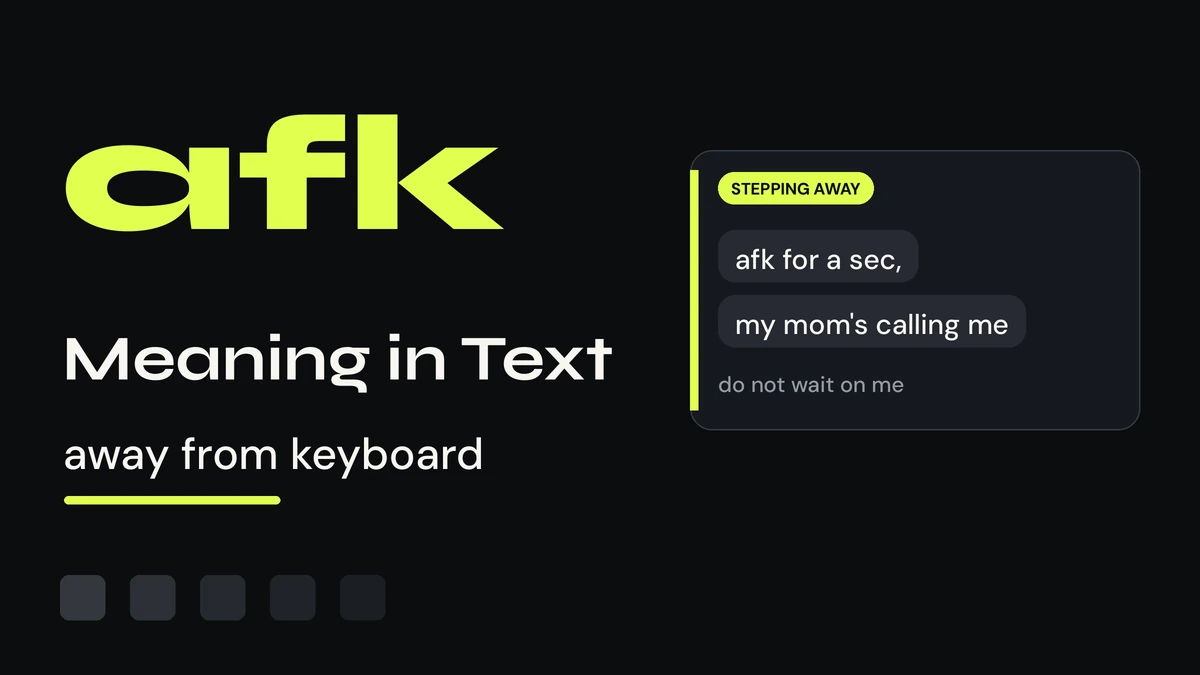
If someone just texted you “afk,” here is the short version: afk meaning in text is “away from keyboard” – they are stepping away and will not reply for a bit. But who said it changes what it really signals, and that is the part most guides skip.
AFK is the oldest, most stable acronym in this guide’s series – three decades old and still typed daily, now mostly on phones that have no keyboard at all. This guide covers the one meaning and its two roles, the Announcement Test that sorts them, the evidence-graded history no competitor publishes, and exactly which cousin acronym to send in which situation.
The Quick Answer
AFK stands for “away from keyboard.” It means: I am stepping away, do not expect a reply for a while. Use it with friends, in group chats, in games, and in casual work chat. Do not use it in formal email, with teachers or clients, or as a way to dodge a conversation you do not want to have.
What AFK Stands For – and the One Expansion That Counts
“Away from keyboard” is the only documented expansion. Wiktionary lists AFK as an initialism of “away from keyboard, i.e. away from one’s computer; idle” – and its own example sentence, “I’m gonna go AFK in a few mins,” shows the verb-like way people actually use it.
Two circulating claims get checked and rejected here, in the open. “Away from keys” appears on one secondary site with no dictionary or corpus support anywhere else – a folk variant, not a meaning. “A free kill” is a documented gamer joke from a 2008 forum thread (an AFK player is easy prey, hence “a free kill”) – a pun on the real meaning, not an alternate one. Neither belongs in a definition.
The Announcement Test
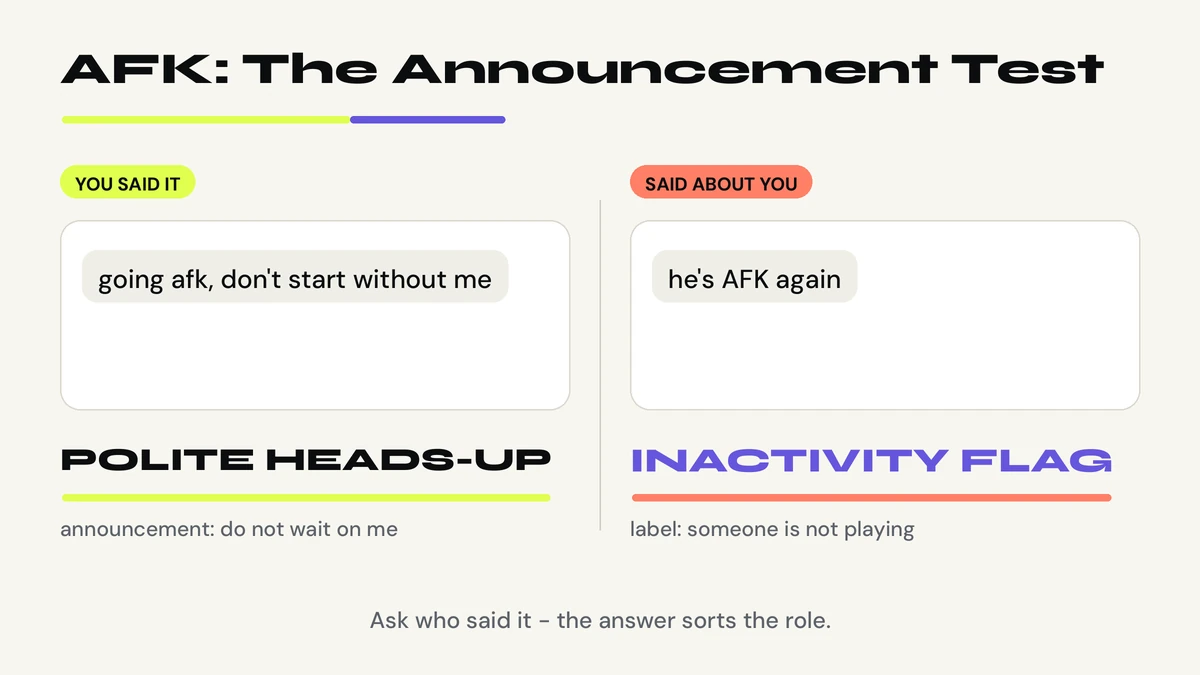
Here is the test: ask who said it. That one question resolves every real-world confusion about AFK.
Self-said – “going afk,” “afking for a sec,” “afkb” – is an announcement. A polite heads-up: I am stepping away, do not wait on me. The tone is courteous and informational; in its original 1990s chatroom life, this was pure netiquette – warn before you vanish so nobody thinks you are ignoring them.
Said about someone – “he’s AFK,” “stop afking mid-match” – is a label. A neutral-to-critical flag that someone is inactive. In gaming the accusatory edge is real: AFK teammates lose matches and get reported, and the label carries the complaint.
The grammar is the giveaway. “Going AFK” and “afking” are the self-announced verb forms; “is AFK” and “the AFK player” are the third-person label forms. Wiktionary’s own example – “I’m gonna go AFK in a few mins” – demonstrates the verb form, the same way LWK’s dictionary example demonstrated the Volume Test. If someone texts “lwk afk” they are softening the exit with both markers at once.
The Keyboard Is Dead
Here is the observation no competitor makes: the keyboard is literally obsolete. AFK is now typed overwhelmingly on phones with no physical keyboard – on touchscreens, in apps, by people who may never have owned a desktop. The literal meaning died; the term thrived anyway.
That is semantic drift in real time, and it is why AFK survived while hundreds of its 1990s siblings vanished. The letters stopped describing hardware and started describing a social state: temporarily unreachable, but not gone. Nobody says “away from phone” because the point was never the keyboard – it was the leaving.
Where AFK Came From
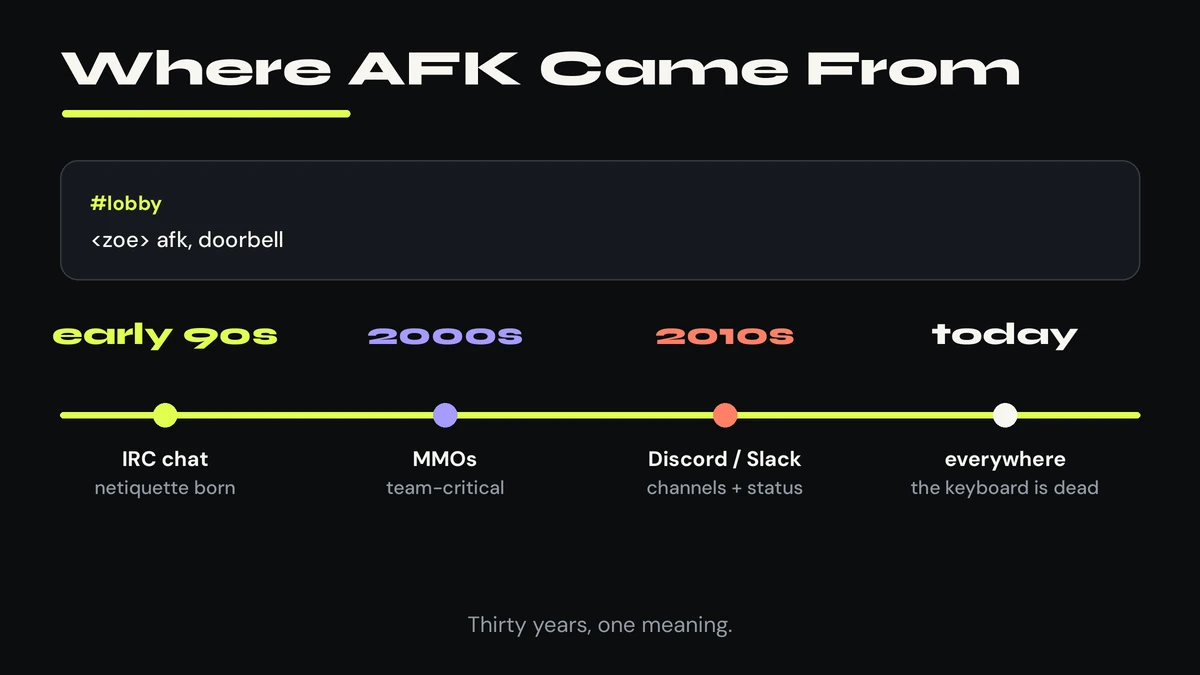
The first evidence-graded origin timeline in this series. Each era carries its grade, honestly labeled.
Late 1980s – plausible, undocumented. One user-generated entry claims abbreviations were developed to speed up communication on 300-baud modems. No citation exists. Grade: attestation only – do not state as fact.
Early-to-mid 1990s – strongly supported. IRC (Internet Relay Chat) is the consensus birthplace across Wiktionary’s categorization, Grammarly (“chat room etiquette in the 1990s, when IRC was at its peak”), and multiple explainer sites. Typing “afk” before stepping away became netiquette here – the polite-announcement role was born.
Late 1990s-2000s – strongly supported. MMOs like EverQuest and World of Warcraft made AFK team-critical: a silent teammate could wipe a raid, so announcing it became protocol. The third-party label role – and its accusatory edge – grew here, along with the first kick and ban mechanics for inactivity.
2010s to today – strongly supported. Discord, Slack, Teams, mobile games, mainstream texting. The technical twist: Discord auto-moves idle voice-channel users to an “AFK channel,” and competitive games auto-flag and penalize inactivity (warnings after roughly 45-70 seconds, remake votes after about 90 seconds per competitor reporting – presented as approximate, not verified patch data).
What Tone Does AFK Carry?
AFK bends further than its three letters suggest:
- Polite – the self-announced heads-up: “afking for a sec, don’t start without me.” The original netiquette function, still courteous today.
- Neutral – the status line: “AFK for lunch, back by 1.” Zero emotion; pure information, like an out-of-office reply shrunk to three letters.
- Mildly critical – the third-party label: “he keeps afking mid-match.” This is a complaint about leeching or poor teamwork wearing an acronym’s clothes. Tone contrast worth noting: where GMFU is emotionally charged slang, AFK is emotionally neutral – the feeling lives in who said it, not in the letters.
- Humorous – the self-deprecating caption: “afking this weekend, unplugging for a bit.” Or the meme: “POV: you went AFK in real life.”
Never romantic, never aggressive, never formal. Skip it with anyone unfamiliar with slang – they may read it as dismissive or just be confused.
AFK on Every Platform
The meaning does not change per app – stated plainly, because one competitor’s platform table implies otherwise. What changes is the tone and the mechanics.
In text messages, WhatsApp, and iMessage, AFK is the casual heads-up: “afking for a sec, my mom’s calling me.” Same meaning it had on IRC, smaller screen.
On TikTok and in captions, it is the humorous register: “afking this weekend” as a caption, “went AFK” as a meme punchline. The joke only works because everyone knows the literal meaning.
On Snapchat and Instagram, it rides along in stories and DMs the same way – quick, informal, understood.
On Discord, it has machinery behind it: idle voice-channel users get auto-moved to an “AFK channel.” On Slack and Teams, it is the casual status line – fine in a friendly channel, never in a formal announcement. In games, it has consequences: auto-flags, warnings, kicks, and bans for the player who goes quiet mid-match.
Who’s Texting You “AFK”
The sender does not change the definition, but it changes the stakes.
A friend: the purest use. “afking, brb in 10” is information and nothing else – no reply required.
A crush: rarely about you at all. “Sorry, went afk” after a slow reply is usually exactly what it says – they stepped away. Do not over-read it; the letters are too boring to be a signal.
A partner: logistics, not drama. “afking for a bit, call you later” is a schedule note. (ICL would be the acronym for the emotional version of this conversation – a different short form for a different job.)
A teammate: the label role, and the stakes are real. “He’s AFK” mid-match is a complaint with consequences – check whether it is you before it gets worse.
A coworker or boss: read-only. In casual Slack it is fine; if your manager types it, it is a status update, not an invitation to chat. Never send “afk” upward in a formal channel – the informality reads as carelessness from below.
Is AFK Rude?
No – with one exception. AFK is polite when self-announced, neutral as a status, and only sharp when used as a third-party label in gaming. The one genuinely rude use: announcing “AFK” mid-argument as an excuse to stop talking. That is not stepping away; that is stonewalling with an acronym, and everyone can tell.
The formal-settings rule: fine in casual work chat, never in formal email, never to a client, never to a teacher. And there is no gendered reading – one competitor’s FAQ correctly answers that nothing about AFK changes “from a girl vs a guy.” Checked and confirmed.
AFK vs BRB vs G2G: Which One Do You Send?
Not a glossary table – a decision guide. Three scenarios, three answers:
The doorbell rings and you will be back in two minutes: send BRB. Be right back is a promise of return, short and specific.
The dentist appointment will take two hours: send G2G. Got to go is a departure with a duration – longer, less certain, still coming back today.
You are stepping away from the raid with no idea when you will be back: send AFK. Away from keyboard is the open-ended one – gone for now, back whenever, do not wait on me.
The test: the shorter and more certain the return, the further from AFK you should be. AFK is what you send when “back soon” would be a lie.
What Happens When You Go AFK in Games
In games, AFK is not just a message – it is a detectable state with machinery behind it. Competitive games auto-flag inactivity: warnings after roughly a minute of no input, escalating to kicks and temporary bans for repeat offenders (figures per competitor reporting, approximate – not verified patch data). Battle-royale games auto-kick idle players so lobbies stay full. Discord moves idle voice users to a dedicated AFK channel so they stop broadcasting silence. AFK shares its gaming-chat vocabulary with terms like FAFO – both live in the same lobbies, doing opposite jobs.
None of this is mysterious: the systems exist because an AFK player is dead weight in a team game, and every era of online play – from MMO raids to mobile lobbies – has built the same solution. Announce it before the system does, and you stay a teammate instead of becoming a warning.
How to Reply When Someone Says AFK
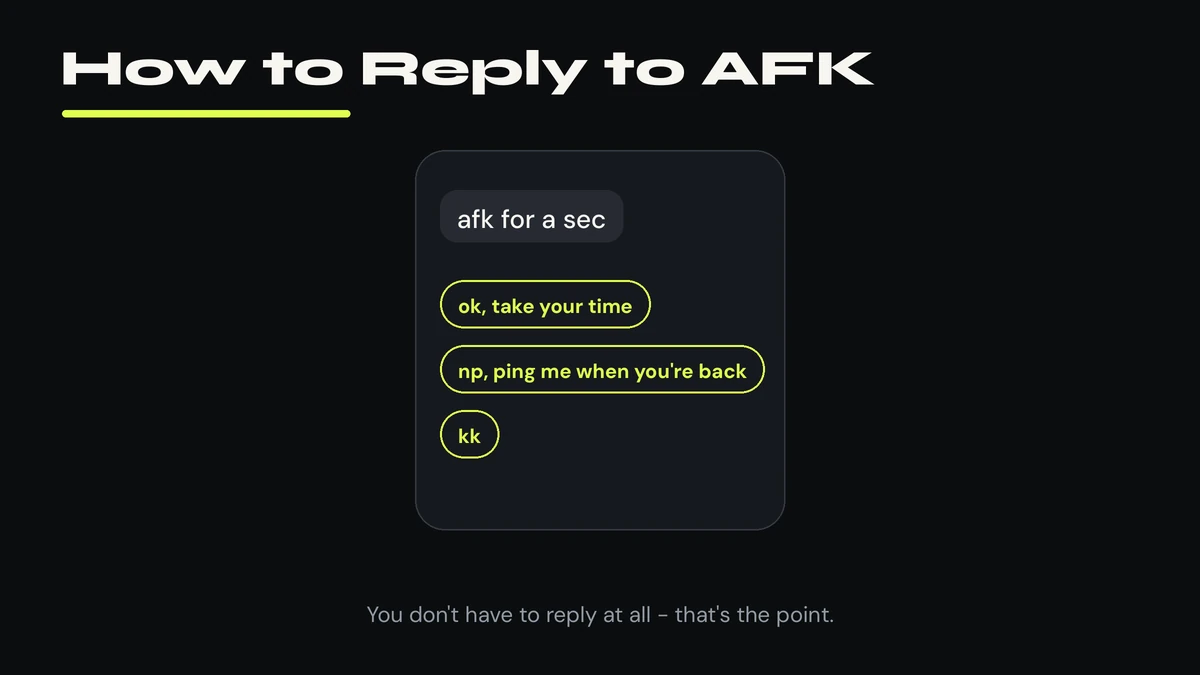
The first rule of AFK replies: you do not need to reply at all. That is the entire point of the message – the sender told you they are gone.
If you do reply, keep it to one line, waiting for them when they return:
“ok, take your time” – the all-purpose acknowledgment.
“np, ping me when you’re back” – the friendly one, with an open door.
“kk” – the minimal one. In gaming, this or a thumbs-up confirms the message landed.
What not to do: do not send three follow-up questions (they literally said they are gone), do not demand an ETA aggressively, and do not take it personally. “Afk” is the least personal message in texting – that is its virtue.
How to Use AFK Yourself
Position: start or end of the message, never buried in the middle – “afking for a sec” or “brb, afk.” Case: lowercase in casual chat (“afk”), uppercase in work status or gaming (“AFK”) – the caps read as an official flag rather than a murmur. Verb forms: “going afk,” “went afk,” “afking” are all live usage; pick the one that matches your sentence. And pair it with a return estimate when you have one – “afking, back in 10” is the polite form; bare “afk” is for when you genuinely do not know.
Frequently Asked Questions
What does AFK mean in texting?
“Away from keyboard” – the sender is stepping away and will not reply for a bit. Wiktionary lists it as an initialism of “away from keyboard, i.e. away from one’s computer; idle.”
Is AFK the same as BRB?
No. BRB (be right back) promises a quick return; AFK is open-ended – gone for now, back whenever. Doorbell: BRB. Dentist: closer to G2G. Raid break of unknown length: AFK.
Can you get banned for going AFK in games?
Yes, for repeat or ranked offenses. Competitive games auto-flag inactivity with warnings, then kicks and temporary bans; battle-royale games auto-kick idle players. Announcing it first does not grant immunity, but it keeps you a teammate instead of a warning.
Is it “afk” or “AFK”?
Both. Lowercase in casual chat, uppercase in work status lines and gaming – the caps read as an official flag. The meaning does not change.
Does AFK mean something different on TikTok or Snapchat?
No. The meaning is the same everywhere; only the tone shifts – humorous in captions and memes, casual in DMs. No platform invents a second meaning.
Is AFK rude to send?
Not when self-announced – that is its polite function. It turns sharp as a third-party label in gaming, and it is genuinely rude only when used to dodge a conversation mid-argument. Never in formal email or to clients.
The Takeaway
AFK is the oldest acronym in this guide and the most honest one: three letters that have meant exactly one thing for thirty years – I am stepping away. Run the Announcement Test (who said it?), remember the keyboard is dead and the term outlived it, and send BRB when “back soon” would be a lie. Like ALR’s grammar-and-position test, the best slang tools are the ones grammar gives you for free.