
What does FYI mean in text? FYI means “for your information” — a heads-up, not a request. “FYI, the meeting starts at 3 PM” delivers a fact and quietly adds: no reply needed. But the same three letters can also carry a dig — or a disguised demand. The expansion never changes; the job does. And the Heads-Up Test below tells you which job this FYI is doing.
This guide to FYI meaning in text covers the three-check test for a genuine heads-up versus a dig versus a hidden request, a six-reading tone spectrum, FYI on TikTok, Snapchat, Instagram, and in plain texts, how it lands by sender, the cousins it gets confused with, a history from a 1948 magazine cable to the modern inbox, and the work-email register that sets FYI apart in this series.
What “FYI” Means in Text
“FYI” means “for your information.” It is a heads-up — a way of saying “here’s something you might want to know” in three letters, with the unspoken second half: “and you don’t need to say anything back.” The primary dictionary source attests it directly: Wiktionary lists FYI as an initialism of “for your information,” with a citation from Time magazine in 1948 — decades before texting existed — and notes that its usage “long predates the internet and text messaging.”
FYI does three headline jobs inside ordinary conversation. As a notice: “FYI, the library closes at 7 tonight.” As an update: “FYI, I updated the report this morning.” As a forward: “FYI, your favorite show has a new season!” Same expansion, one constant: the sender is delivering information, not asking a question.
FYI is also the rare abbreviation with a noun life of its own: Wiktionary attests “give you an FYI” and the plural “FYIs” (“I just wanted to give you an FYI about the donuts in the break room”). The lowercase “fyi” is common in casual chats; all-caps “FYI” in emails and posts. Caps carry no signal here — what carries the signal is everything around it.
The FYI Heads-Up Test
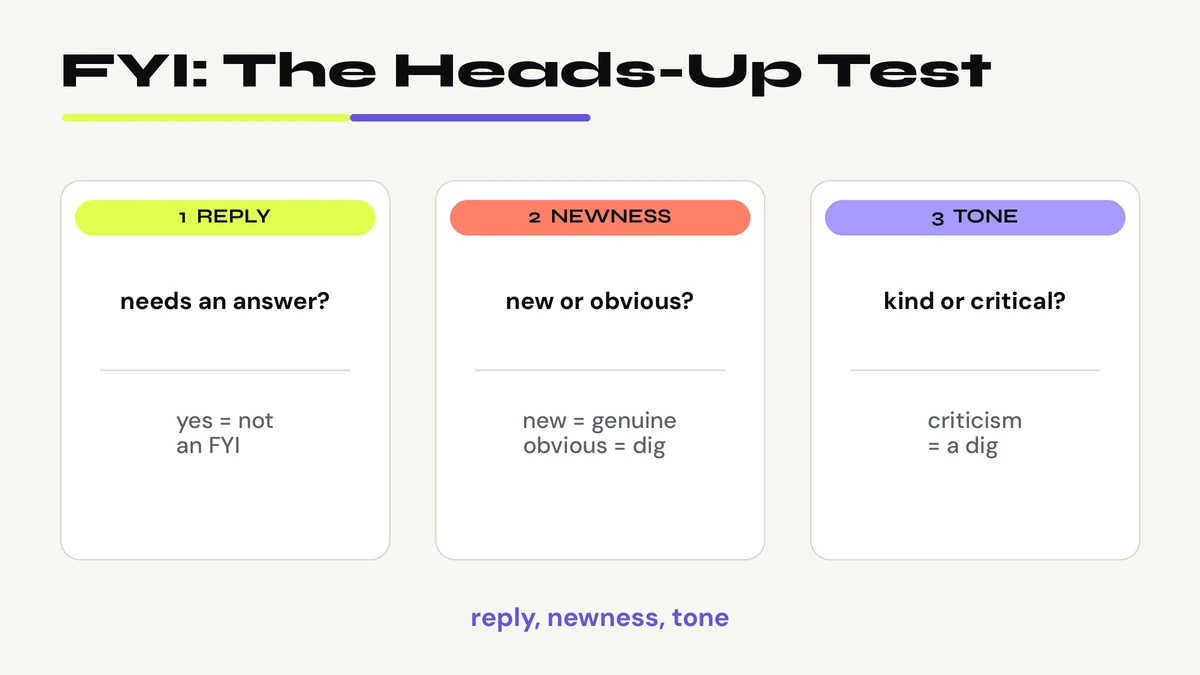
FYI has one real ambiguity, and it is not about the expansion: is this a genuine heads-up, or is it something else wearing a heads-up’s clothes? Three checks settle it:
- Check 1 — The No-Reply Check. Does the message need an answer or an action? If yes, FYI is the wrong opener — it promises “no reply needed,” so a hidden request inside an FYI feels like a trap. The classic misuse: “FYI, can you help me with this?”
- Check 2 — The Newness Check. Is the information actually new or useful to the reader? FYI before obvious information reads as condescension, not help — the sender is “reminding” you of what you should already know.
- Check 3 — The Tone Check. Is the wording neutral or friendly, or does it carry criticism? FYI plus criticism equals passive-aggression: “FYI, you forgot to send the file… again.”
Worked trio. “FYI, the meeting moved to 4 PM” — new, neutral, no reply needed: genuine heads-up. “FYI, you must finish this today” — a request pretending not to be one: disguised demand, Check 1 failure. “FYI, you forgot… again” — criticism in a heads-up costume: dig, Check 3 failure. Same letters, three jobs, all decided by reply, newness, and tone.
“FYI” in Real Chats
Illustrative examples written for this guide — not presented as real transcripts:
- The meeting move. “FYI, the meeting starts at 3 PM” — the platonic FYI: useful, neutral, no reply owed.
- The file note. “I sent you the file, FYI” — FYI at the end works too; position carries no meaning change here.
- The report update. “FYI, I updated the report this morning” — the workplace register, neutral and clean.
- The dig. “FYI, you forgot to send the file… again” — criticism wearing a heads-up costume.
- The disguised demand. “FYI, you must finish this today” — a request pretending not to be one.
The FYI Tone Spectrum

FYI’s meaning stays “for your information”; its tone slides. Six readings, lightest to heaviest:
- Helpful heads-up: “FYI, the library closes at 7 tonight” — genuine, no reply needed. The information is the point.
- Friendly update: “FYI, your favorite show has a new season!” — sharing excitement, not doing information work.
- Professional notice: “FYI, I updated the report this morning” — the workplace register, neutral and expected.
- Dry reminder: “FYI, today is the last day to submit the form” — useful but pointed; the deadline does the pushing.
- Passive-aggressive dig: “FYI, you forgot to send the file… again” — criticism in a heads-up costume.
- Disguised demand: “FYI, you must finish this today” — a request pretending not to be one; the Heads-Up Test’s Check 1 failure.
The tone lives in the reply obligation, the newness, and the criticism — not in FYI alone.
“FYI” on TikTok
On TikTok, FYI shares news fast: “FYI, new episode drops tonight!” as a caption, or “FYI, tickets go on sale Friday” in a video about an event. The platform rewards speed, so FYI’s job here is pure delivery — a fact, dropped quickly, with no reply expected from the audience. TikTok is also where FYI’s age shows most clearly: a 1948 abbreviation doing delivery work on a 2020s app.
The disguised-demand reading is rare on TikTok, because a caption cannot demand anything of a viewer. The dig reading appears in comments — “FYI, that’s not how it works” under a video is a correction wearing a heads-up costume.
“FYI” on Snapchat
On Snapchat, FYI fits casual notes on a snap or a quick DM: “FYI the party’s at mine now”, or a heads-up to a friend that plans changed. The ephemeral, in-the-moment format suits FYI’s job — information that lands lightly and disappears, rather than sitting in a thread as a permanent record.
On Snapchat the dig reading is easiest to miss, because the message vanishes. If one feels off, run the Tone Check.
“FYI” on Instagram
On Instagram, FYI shows up in captions and DMs: “FYI, tickets go on sale Friday” as a caption that shares news with followers, or “FYI, the cafe moved” as a DM that updates one person. The public-facing version leans friendly update — news-sharing is Instagram’s cheapest engagement. In DMs, the full range appears, including the professional notice and the private dig.
Instagram is also where FYI’s noun use pops up: “quick FYI for everyone asking” opens a story like a headline.
“FYI” in Text Messages
Plain texts are FYI’s home ground: the update text, the reminder text, the news text. It pairs naturally with its conversation-opening cousin WYO — WYO (“what you on”) opens the conversation, FYI delivers the news inside it — and with BRB in the status-update cluster: FYI shares the information, BRB marks the pause. It also travels with the site’s reassurance move DW — “FYI, the bus is late, dw, I saved you a seat.” Three abbreviations, three jobs, one fluent conversation.
Texts are also where FYI’s second home lives: work email. FYI is one of the very few abbreviations genuinely at home in a workplace inbox — “FYI, I updated the report this morning” is a normal team-email sentence, and “FYI” alone in a subject line is a normal way to forward something. In very formal emails, spell it out as “for your information” instead — but FYI itself will not raise an eyebrow.
Who’s Sending It: How “FYI” Lands by Sender
No source documents a different meaning of FYI per sender — the meaning stays fixed; what changes is how the heads-up reads:
- Friend: the default. A friend’s “FYI” is news or an update at face value.
- Crush: overread territory. A crush’s “FYI, I’ll be at the show tonight” is information, not an invitation — unless it says so.
- Partner: context rules. A partner’s “FYI, I’m running late” is logistics, not a message to decode.
- Parent: common and usually genuine. A parent texting “FYI” is usually passing along something useful the way parents do.
- Boss / coworker: the formal edge, and FYI’s natural habitat. A boss’s “FYI” is a notice — file it, reply only if it changes your plan. A coworker’s “FYI” with criticism attached is where the dig reading lives.
When “FYI” Is Not Just a Heads-Up
Three misfires, graded. First, the disguised demand: “FYI, you must finish this today” is not a heads-up at all — it is a request that borrowed FYI’s clothes to avoid sounding demanding. Treat it as the request it is. Second, the dig: “FYI, you forgot… again” delivers criticism with deniability (“I was just informing you”). Answer the substance (“Thanks — sending it now”) or let it pass.
Third, the obvious-info trap: FYI before something the reader plainly already knows (“FYI, the meeting is at 9” to the person who set the meeting) is not help — it is condescension, and the Newness Check is how you catch it. The closest cousin here is FWIW (“for what it’s worth”): FWIW softens an opinion, FYI delivers a fact. FWIW says “take it or leave it”; FYI says “here, you should know this.” If the message is a fact you need, it is FYI; if it is an opinion you may ignore, it is FWIW.
Checked Claims: Expansions and Origins That Don’t Hold Up
Three letters attract folklore. The claims that fail evidence:
- “FYI means ‘for your interest’” — rejected. The attested expansion is “for your information.”
- “FYI is rude” — rejected as a blanket claim. FYI is neutral; rudeness comes from criticism or obvious-info framing around it, not from the letters.
- “FYI is always polite / always safe at work” — rejected. FYI before criticism reads passive-aggressive, and FYI used as a disguised demand misfires.
- “FYI requires a reply” — rejected. The defining feature of FYI is that no reply is expected; a short acknowledgment is optional, not owed.
- “FYI was invented for texting / by Gen Z” — rejected. FYI is attested in print in 1948, decades before texting.
- “FYI comes from military telegrams” — graded unverified, not repeated as fact. Secondary explainers claim early-20th-century military/telegram roots, but the primary source attests only the 1948 print use and pre-internet usage generally; no military origin is established.
- “FYI is the same as ICYMI” — rejected. ICYMI repeats something the reader may have missed; FYI delivers information regardless of whether it was seen before.
What SURVIVES: “for your information” (strong, universal, register-fluid), with the dig and disguised-demand readings as real but bounded misfires, and the military/telegram story held unverified. Everything else failed evidence.
“FYI” vs Its Closest Cousins
FYI belongs to the information family — the words that move facts between people:
- BTW (“by the way”) — the side-note cousin. BTW adds something extra and casual; FYI delivers something you should know. BTW says “oh, also”; FYI says “heads up.”
- BFFR (“be for real”) — the reaction cousin. BFFR reacts to nonsense; FYI delivers news. BFFR judges; FYI informs.
- FR (“for real”) — the sincerity cousin. FR certifies that something is true; FYI shares something useful. FR swears a claim; FYI hands over a fact.
The conversational companion: FYI often travels with a thank-you that costs nothing — “Got it, thanks” — the cheapest acknowledgment texting ever invented, and the only reply a genuine FYI ever needs.
Where “FYI” Came From
“For your information” was in print use by 1948 at the latest. The dictionary entry’s earliest citation is Time magazine, June 14, 1948: a cable postscript from a Life photographer in Jerusalem — “FYI, Burke narrowly escaped death outside Jerusalem a few days ago.” The abbreviation’s usage, the entry notes, “long predates the internet and text messaging.”
From there FYI traveled the office route: memos, then email, then workplace messaging, then casual texting. That office pedigree is why it stays acceptable in professional writing while most texting slang is not — FYI reached the inbox before the group chat, and never left either. The military/telegram origin story circulates in secondary explainers but has no primary attestation and is not repeated here as fact.
How to Reply When Someone Sends “FYI”
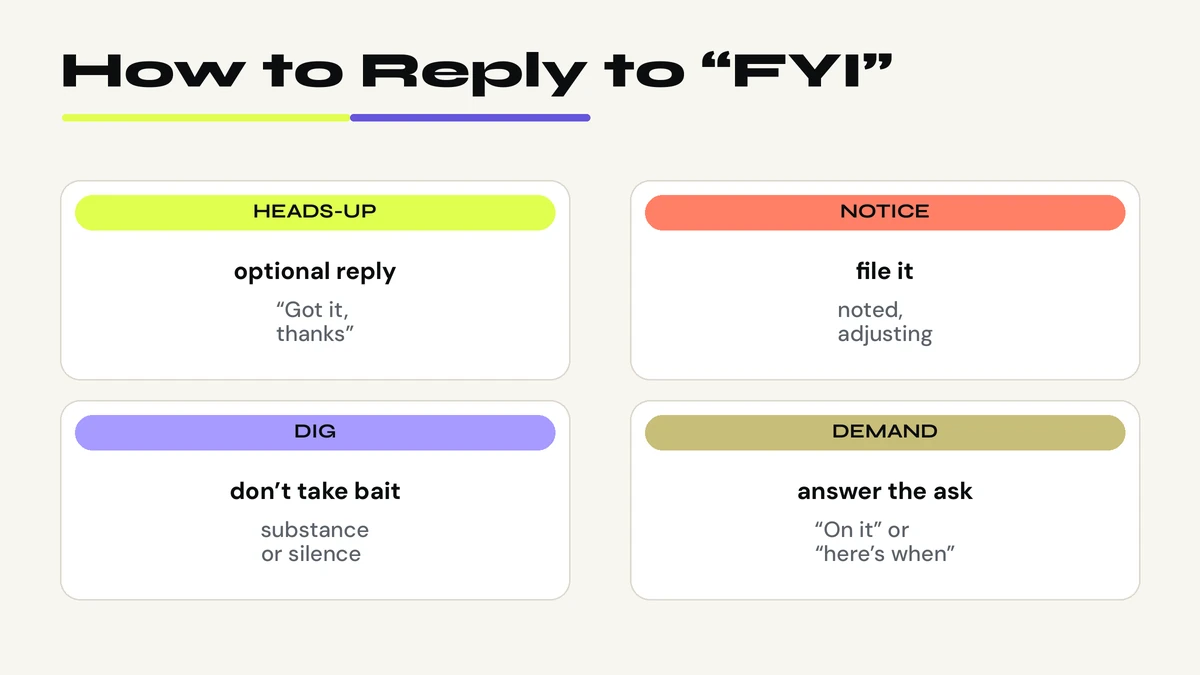
Five replies, matched to the reading:
- Genuine heads-up — optional acknowledgment: “Got it, thanks!”, “Thanks for the info”, “Good to know”, or silence. A heads-up wants nothing; a thank-you is a gift, not a debt.
- Professional notice — file it: reply only if the information changes your plan. “Noted, adjusting the timeline” beats a paragraph.
- Dry reminder — act on the deadline: answer the date, not the tone. “On it” is enough.
- Dig — don’t take the bait: answer the substance (“Thanks — sending it now”) or let it pass. Never answer the deniability.
- Disguised demand — answer the request: treat it as the request it is. “On it” or “Can’t today, here’s when” both work.
What never works: apologizing for not replying sooner to a message that asked for nothing. The golden rule: a genuine FYI needs no reply — and a fake one needs the reply it was hiding.
Frequently Asked Questions
What does “FYI” mean in a text message?
“For your information” — a heads-up that delivers useful information and signals that no reply is needed. “FYI, the meeting starts at 3 PM” is a fact, not a question.
What does “FYI” mean on TikTok, Snapchat, and Instagram?
The same heads-up everywhere — no platform-specific meaning exists. TikTok stages it as fast news in captions, Snapchat keeps it as a casual note, Instagram uses it in captions and DMs. Same letters, different stage.
Is “FYI” rude?
Not by itself — it is neutral. It turns passive-aggressive only when it carries criticism (“FYI, you forgot… again”) or frames obvious information as news.
What’s the difference between “FYI” and “FWIW”?
FYI delivers a fact you should know; FWIW softens an opinion you may ignore. FYI says “heads up”; FWIW says “take it or leave it.”
What’s the difference between “FYI” and “BTW”?
BTW adds something extra and casual (“oh, also”); FYI delivers something you should know (“heads up”). BTW is a side note; FYI is the notice itself.
Can I use “FYI” at work?
Yes — FYI is at home in workplace emails and subject lines (“FYI, I updated the report this morning”). In very formal emails, spell it out as “for your information” instead.
Someone just sent me “FYI”. What do I say?
Usually nothing — a genuine FYI needs no reply. If you want to acknowledge it, “Got it, thanks!” is enough; if it hides a request or a dig, answer the request or the substance instead.
The Takeaway
“FYI” is a three-letter heads-up — “for your information,” delivering useful news while canceling the reply obligation. When the letters arrive, run the Heads-Up Test: reply, newness, tone. And when you send one, remember the only rule that matters: a heads-up that hides a demand is not a heads-up.