
What does FR mean in text? FR means “for real” — and what it does depends on where it sits. Alone as a reply, “fr” agrees with you. Tacked onto a sentence, “I’m tired fr” swears the tiredness is genuine. Asked as a question, “FR?” means “really?” One abbreviation, three jobs — and the Direction Test below tells you which one you just received.
Most guides give FR one definition and stop. This one maps the whole territory: the three-check test for agreement versus sincerity versus surprise, a six-reading tone spectrum, what FR looks like on TikTok, Snapchat, Instagram, and in plain texts, how it lands depending on who sends it, the collisions where FR is not “for real” at all, and the doubled FR FR that is emphasis, not a new word.
What “FR” Means in Text
“FR” means “for real.” It is a sincerity marker — a way of saying “I mean this” or “I agree, truly” in two letters. The primary dictionary source attests it directly: Wiktionary lists FR/fr as (Internet slang) “for real” as an adjective, an adverb, and a noun — the same expansion doing several grammatical jobs, which is exactly why position matters so much for this term.
FR does two headline jobs. Pointed at someone else, it co-signs: your friend says the new album is overrated, you reply “fr,” and the agreement is sealed. Pointed at yourself, it vouches: “I’m tired fr” tells the reader the tiredness is not an exaggeration. The all-caps “FR” carries the same meaning, just slightly louder — caps add volume, not a new definition.
FR also has a genuine secondary life as a verb meaning “friend request” (“FR me after the game”), attested by the same dictionary entry. That sense is real but context-bound: it lives in gaming and social-platform requests, not in ordinary conversation. When someone replies “fr” to your opinion, they are not asking to be your friend — they are agreeing with you.
The Direction Test

FR has exactly one real ambiguity: which direction is it pointing? Three checks settle it:
- Check 1 — The Position Check. Where does FR sit? Alone as a reply (“fr”) = agreement. At the end of a sentence (“tired fr”) = sincerity stamp on your own words. At the start as a question (“FR?”) = surprised disbelief. Position is the meaning.
- Check 2 — The Doubling Check. Is it doubled? “FR FR” is the same abbreviation said twice for dramatic effect and rhythm — maximum sincerity, often playful. Doubling turns the volume up; it does not invent a new word.
- Check 3 — The Collision Check. Is the message about countries, codes, or a request? “FR me” as a verb = friend request; a country code or technical label = not slang at all. Otherwise, “for real” wins.
Worked trio. “That movie was terrible” → “fr” — standalone reply: agreement. “I’m so tired fr” — sentence-final: sincerity. “I got the tickets!” → “FR?” — question: surprise. Same letters, three jobs, all decided by position.
“FR” in Real Chats
Illustrative examples written for this guide — not presented as real transcripts:
- The co-sign. “that album is overrated” → “fr” — the platonic FR: agreement sealed in two letters.
- The sincerity stamp. “I’m tired fr” — not exaggeration, not a joke: genuinely tired, and saying so.
- The surprised question. “I got the tickets!” → “FR?” — disbelief asking for confirmation.
- The doubled emphasis. “FR FR, that was unreal” — the same meaning, said twice, at full volume.
- The collision. “FR me after the game” — a verb, not a reaction: a friend request, not agreement.
The FR Tone Spectrum
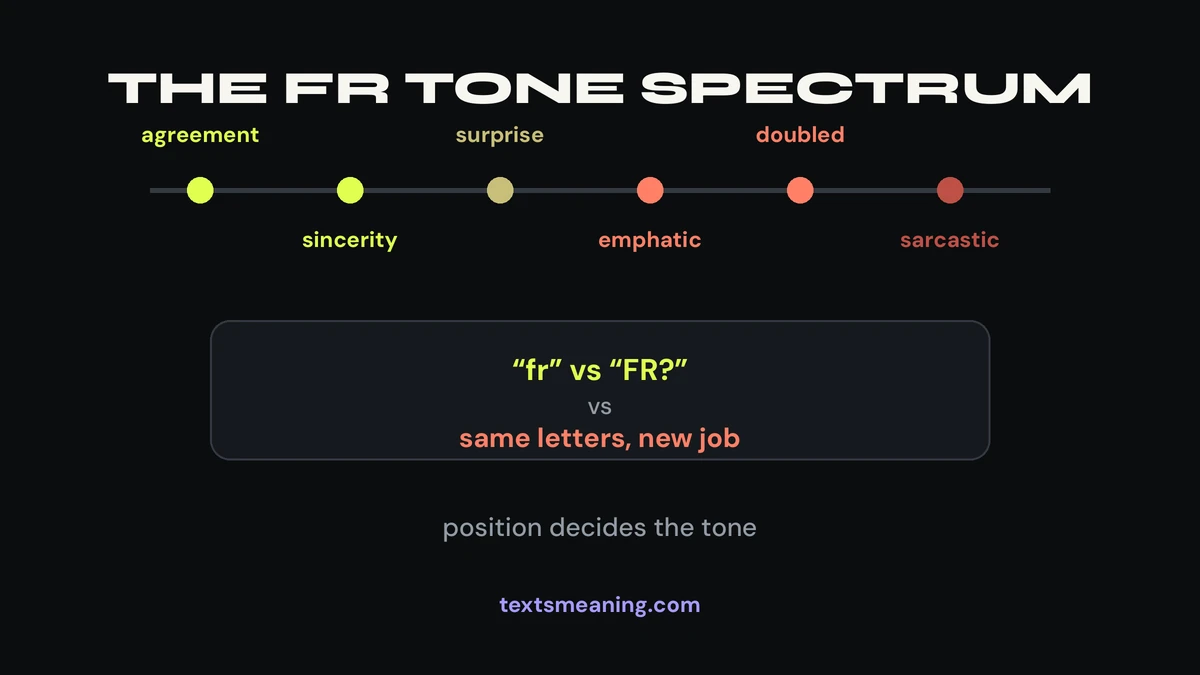
FR’s meaning stays “for real”; its tone slides. Six readings, lightest to heaviest:
- Casual agreement: “fr” — a nod. Low effort, high warmth.
- Sincere emphasis: “I’m tired fr” — I mean it. The claim is the point.
- Surprised check: “FR?” — really? Disbelief asking to be convinced.
- Emphatic co-sign: “FR, that album is unreal” — strong agreement, not a shrug.
- Doubled intensity: “FR FR” — maximum sincerity, often playful. The volume is the message.
- Sarcastic echo: “yeah, fr” after a flat or absurd claim — agreement performed, not felt. The sarcasm lives in the surrounding words, not the letters.
The tone lives in position and company, not in the letters alone. A lowercase “fr” from a close friend reads warm; an uppercase “FR?” from a stranger reads like a challenge. The Direction Test plus the surrounding sentence is how you tell.
“FR” on TikTok
On TikTok, FR is a comment-section co-sign: “fr” under a take you agree with, “FR FR” under one you love, and “FR?” under a claim you doubt. The platform rewards the doubled version — repetition is TikTok’s native emphasis. No platform-specific meaning exists; TikTok just stages agreement publicly, where the co-sign is the content.
“FR” on Snapchat
On Snapchat, FR fits fast, private agreement: a snap of a bad day captioned “fr” back, a “tired fr” in a late-night chat. The ephemeral, in-the-moment format suits FR’s job — a feeling that needs confirming right now. The meaning is identical to everywhere else; Snapchat just keeps it between people who already know which direction it points.
“FR” on Instagram
On Instagram, FR shows up in comments (“fr, this outfit”), in Reels captions, and in DMs where friends trade takes. The public-facing version leans agreement — a co-sign is Instagram’s cheapest currency. In DMs, the full range appears, including the sincerity stamp and the surprised question.
“FR” in Text Messages
Plain texts are FR’s home ground: the co-sign text, the sincerity text, the “FR?” text. It pairs naturally with its conversation-opening cousin WYO — where WYO (“what you on”) opens the conversation, FR manages the agreement inside it — and with BRB in the status-update cluster, where FR confirms the plan and BRB marks the pause. It also travels with the site’s reassurance move DW — “dw, fr, I’ve got you”: reassurance, sworn sincere.
Who’s Sending It: How “FR” Lands by Sender
No source documents a different meaning of FR per sender — the meaning stays fixed; what changes is how the direction reads:
- Friend: the default. A friend’s “fr” is a co-sign at face value — believe the agreement.
- Crush: overread territory. An “fr” from a crush is agreement, not a confession — do not sprint from a co-sign to a romance.
- Partner: context rules. A partner’s “FR?” after a surprising claim is a real question, not an accusation — answer it, do not defend against it.
- Parent: rare and usually literal. A parent texting “fr” is likely echoing the phrase rather than the abbreviation’s full slang range — take it at face value.
- Coworker / boss: the formal edge. FR in a work chat is casual sincerity — fine among peers, out of place in a formal message. If a boss writes “FR?”, they are asking whether you are serious.
When “FR” Is Not “For Real”
Three collisions, graded. First, FR as the ISO country code for France — real outside chats, never a chat meaning: nobody texting “FR that was wild” is talking about geography. Second, FR as a verb meaning “friend request” — real, but only where requests live (gaming, social platforms): “FR me” is an action, not agreement. Third, technical FR (Formula Regional, functional requirement, Federal Register) — real in their fields, invisible in chats. The Collision Check is the whole distinction: if the sentence is about a place, a code, or a request, the slang reading loses; otherwise it wins.
Checked Claims: Expansions That Don’t Hold Up
Three letters attract folklore. The claims that fail evidence:
- “FR FR is a different word” — rejected. Doubling is emphasis, documented as repetition “for dramatic effect and rhythm” — not a new expansion, not a new meaning.
- “FR was invented by TikTok” — rejected. The phrase predates texting, the abbreviation predates TikTok by years (first dictionary-style attestation 2003), and TikTok spread it without inventing it.
- “FR always means France in texts” — rejected. The country code is real and irrelevant: no source documents it as a conversational meaning, and context makes the slang reading obvious.
- “FR is only a question” — rejected. Sources document agreement, sincerity, emphasis, and question uses. Reducing FR to “FR?” deletes three quarters of its job.
What SURVIVES: “for real” (strong, universal, position-dependent) and “friend request” as a secondary verb sense (real, context-bound). Everything else failed evidence.
“FR” vs Its Closest Cousins
FR belongs to the sincerity-and-agreement family — the words that swear something is true:
- BFFR (“be f***ing for real”) — the confrontational cousin. BFFR challenges someone else (“be serious”); FR vouches for a claim or agrees with one. BFFR is a demand; FR is a stamp.
- ICL (“I can’t lie”) — the confession cousin. ICL introduces an honest take; FR certifies one. ICL opens honesty; FR seals it.
- FML (“f*** my life”) — the reaction cousin. FML reacts to bad luck; FR reacts to truth. FML mourns; FR confirms.
- “No cap” — the twin. Same job as FR’s sincerity sense (“I’m not lying”), different generation of slang. FR is shorter; “no cap” is louder.
The conversational companion: FR often travels with BTW (“btw, fr, that was unreal”) — the same generation of shorthand, one adding information, the other adding sincerity.
Where “FR” Came From
“For real” as a spoken sincerity marker long predates the internet: sources trace the phrase to 1940s “for true?” roots and to 1960s popularization as a comedian’s punchline. The two-letter spelling grew out of texting culture through the 2010s, alongside the rest of the abbreviation wave, and went mainstream around 2019 as TikTok and Snapchat captions pushed it to millions. Multiple sources credit the phrase’s roots in African American Vernacular English speech, carried by Black creators into short-form video and then into wider Gen Z use — FR is not a TikTok invention, even if TikTok is where most people first saw it.
The doubled form has its own dated trail: FR FR surfaced in tweets from 2014, driven by Vine-era repetition humor, where saying a thing twice was the joke and the emphasis at once. Where FR certifies truth, its reaction cousin FML — already live on this site — certifies feeling instead: one swears a claim is real, the other swears a day was bad.
How to Reply When Someone Sends “FR”

Four replies, matched to the direction:
- Agreement FR — continue it: “right?” or a matching take. A co-sign is an invitation to keep talking.
- Sincerity FR — take it seriously: do not joke a sincere claim away. “I hear you” beats a laugh here.
- Question FR? — confirm or correct: “yeah, for real” or “no, I’m joking.” A question wants an answer, not a performance.
- Friend-request FR — answer the request: accept or decline the request itself. Do not debate the claim that was never made.
What never works: answering a sincerity FR with sarcasm, answering a question FR with more mystery, or treating a friend-request FR as agreement. The golden rule: match the direction, then match the need.
Frequently Asked Questions
What does “FR” mean in a text message?
“For real” — agreement, sincerity, emphasis, or a surprised question, depending on where it sits. “fr” alone agrees; “tired fr” swears sincerity; “FR?” asks “really?”
What does “FR FR” mean?
The same thing, louder. FR FR is “for real” said twice for dramatic effect and rhythm — maximum sincerity, often playful. It is not a different word.
Does “FR” ever mean “friend request”?
Yes — as a verb, in gaming and social-platform contexts (“FR me after the game”). In ordinary conversation, “fr” means “for real”, not a request.
What does “FR” mean on TikTok, Snapchat, and Instagram?
The same meaning everywhere — no platform-specific meaning exists. TikTok stages it as a public co-sign, Snapchat keeps it as private agreement, Instagram uses it in comments and DMs. Same letters, different stage.
Is “FR” rude?
Not by itself — it is casual sincerity, not profanity. It only stings when it is sarcastic (“yeah, fr” as dismissal) or when a sincere FR is answered with a joke.
What’s the difference between “FR” and “BFFR”?
FR vouches for a claim or agrees with one; BFFR (“be f***ing for real”) challenges someone else to be serious. FR is a stamp; BFFR is a demand.
Someone just sent me “FR?” What do I say?
Answer the question: confirm (“yeah, for real”) or correct (“no, I’m joking”). A surprised FR wants a straight answer, not more mystery.
The Takeaway
“FR” is a two-letter sincerity marker — “for real,” pointing at someone else’s claim, at your own words, or at a surprising fact. When the letters arrive, run the Direction Test: check the position, check for doubling, check for collisions. And when you send one, remember the only rule that matters: position is the meaning — put FR where you mean it.