
What does FS mean in text? FS means “for sure” — the two-letter yes. Alone as a reply, “fs” confirms the plan. Tacked onto a sentence, “that was the best part fs” stamps the opinion as certain. Beside an item and a price, though, the same letters mean something else entirely. One abbreviation, several jobs — and the Spot Test below tells you which one you received.
Most guides give FS one definition and stop. This one maps the whole territory: the five-check test for agreement versus emphasis versus a listing versus a dare, a six-reading tone spectrum, FS on TikTok, Snapchat, Instagram, and in plain texts, how it lands depending on who sends it, the collisions where FS is not “for sure” at all, and the head-to-head with its closest cousin, FR.
What “FS” Means in Text
“FS” means “for sure.” It is a certainty marker — a way of saying “definitely,” “absolutely,” or “yes, I agree” in two letters. The primary dictionary source attests it directly: Wiktionary lists fs as (text messaging) an abbreviation of “for sure.” The complexity of FS lives entirely in where it sits and what sits next to it.
FS does three headline jobs inside ordinary conversation. Alone as a reply, it confirms: “movie at 8?” → “fs, see you there.” At the end of a sentence, it emphasizes: “that was the best part fs” tells the reader the opinion is not lukewarm. At the start, it leads with confidence: “FS, I’ll be there” promises before it explains.
The lowercase “fs” is the current default; all-caps “FS” means the same thing, just slightly louder. Caps add volume, not a new definition — context is what changes FS’s meaning, not capitalization.
The FS Spot Test
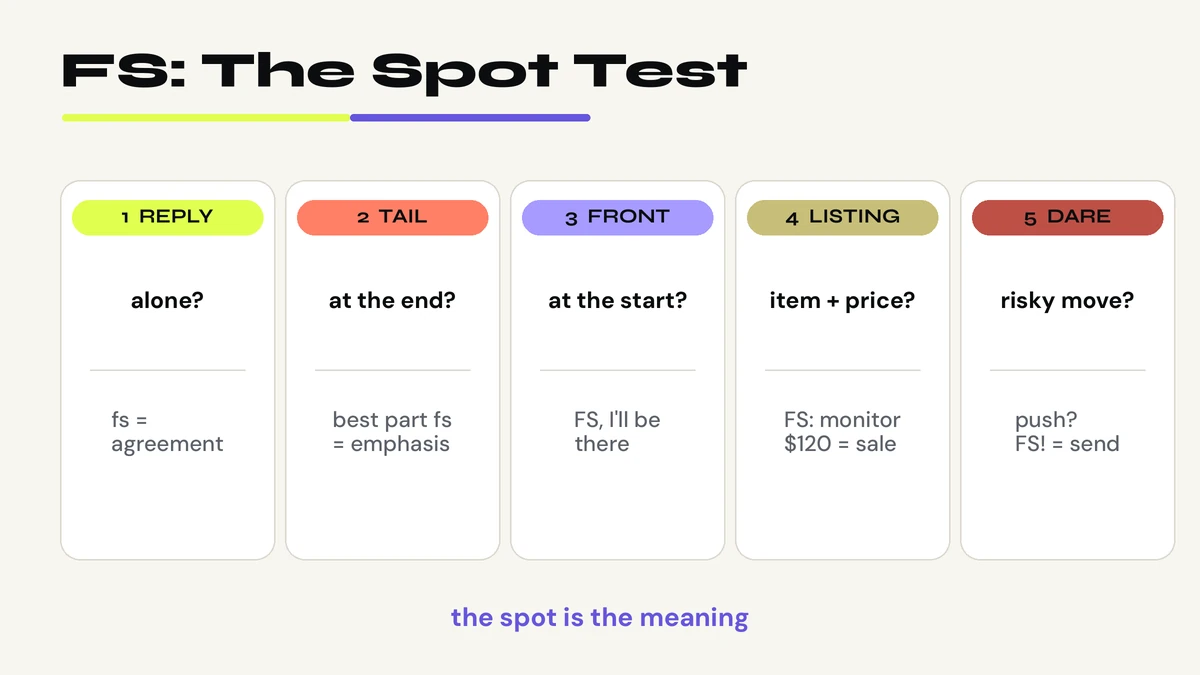
FS has one real ambiguity: is this agreement, a listing, or a dare? Five checks settle it:
- Check 1 — The Reply Spot. FS alone as a reply (“fs”) = agreement and confirmation. It answers a question, confirms a plan, or co-signs an opinion. This is the default reading.
- Check 2 — The Tail Spot. FS at the end of a sentence = emphasis stamp on a claim already made.
- Check 3 — The Front Spot. FS at the start of a sentence (“FS, I’ll be there”) = confident confirmation of what follows.
- Check 4 — The Listing Spot. FS beside an item and a price (“FS: gaming monitor, $120”) = “for sale.” The listing format overrides the chat reading.
- Check 5 — The Dare Spot. FS answering a risky-move question in gaming or sports = “full send.” Without a dare context, “for sure” wins.
Worked set. “Are we still meeting at 7?” → “fs”: agreement. “That was the best part fs”: emphasis. “FS: vintage record player, $75”: for sale. “Should we just FS this?” before a risky play: full send. Same letters, four expansions, decided by the spot and its neighbors.
“FS” in Real Chats
Illustrative examples written for this guide — not presented as real transcripts:
- The plan confirmation. “movie at 8?” → “fs, see you there” — the platonic FS: a yes with the details attached.
- The opinion co-sign. “that song is unreal” → “fs, best track this year” — agreement plus enthusiasm, not just agreement.
- The emphasis tail. “that was the best part fs” — not a reply at all: a stamp on a claim already made.
- The reassurance. “you got my back if this goes weird?” → “fs, always” — certainty offered as comfort.
- The listing collision. “FS: gaming monitor, $120” — no conversation here at all: an item for sale.
- The dare collision. “should we push the objective?” → “FS!” — a dare accepted, not an opinion agreed with.
The FS Tone Spectrum
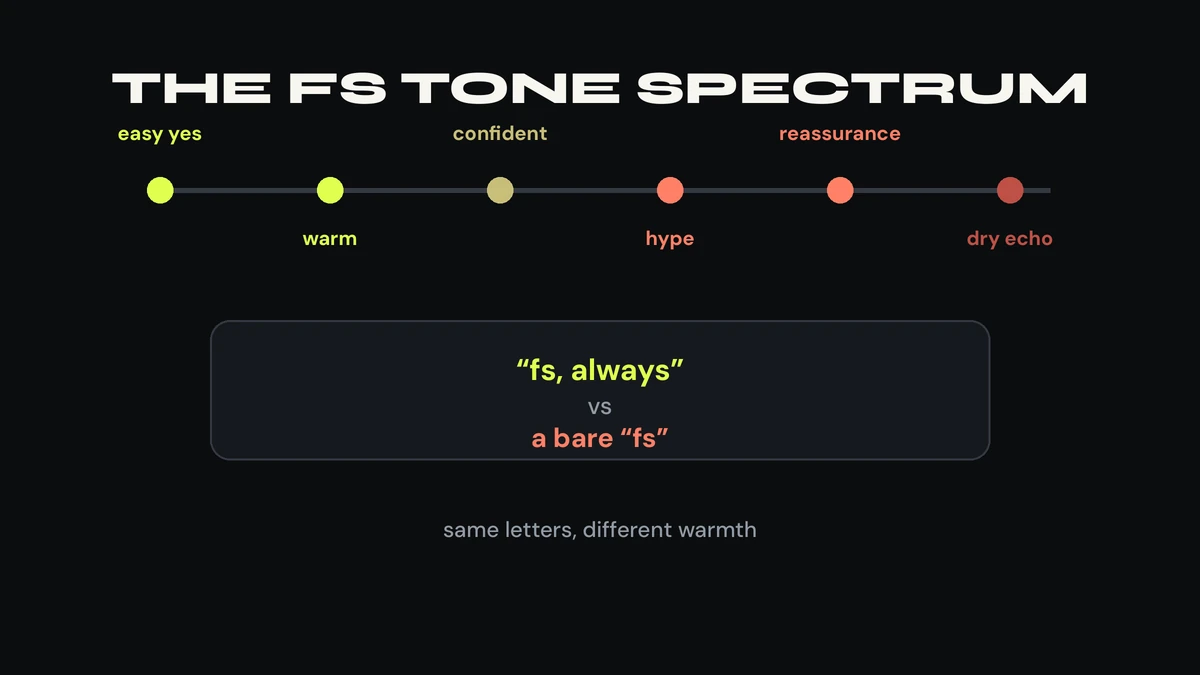
FS’s meaning stays “for sure”; its tone slides. Six readings, lightest to heaviest:
- Easy yes: “fs” — a low-effort confirmation. The plan is on, no speech needed.
- Warm agreement: “fs, anytime!” — agreement plus friendliness. The extra words warm the reply up.
- Confident emphasis: “FS, I wouldn’t miss it” — certainty is the point. The speaker is not hedging.
- Hype co-sign: “FS 🔥” under a take — enthusiastic agreement, performed in public.
- Reassurance: “fs, always” answering a worry — certainty offered as comfort, not as opinion.
- Flat or dry echo: a bare “fs” in a serious or emotional exchange — it can read blunt or cold. The dryness lives in the surrounding moment, not the letters.
The tone lives in the words around FS, not in FS alone. A lowercase “fs” from a close friend reads warm; a bare “fs” after a heartfelt thank-you reads thin.
“FS” on TikTok
On TikTok, FS is a comment-section yes: “fs” under a take you agree with, “FS” under one you love, and “FS!” under a dare the comments are egging on. The platform rewards the short version — a two-letter reply fits a fast comment thread better than a sentence does. No platform-specific meaning exists; TikTok just stages agreement publicly, where the co-sign is the content. The one TikTok twist is the dare spot: in challenge and gaming clips, “FS” can tip into “full send” when the video itself is a risky move.
That dare reading is the only TikTok twist. Everywhere else on TikTok, FS is “for sure” and nothing else.
“FS” on Snapchat
On Snapchat, FS fits fast, private confirmation: a snap of plans captioned “fs, see you there,” a “fs, always” in a late-night chat. The ephemeral format suits FS’s job — a confirmation that needs to land right now. The meaning is identical elsewhere; Snapchat just keeps it between people who already know which spot it sits in.
Snapchat is also where FS’s history lives: the abbreviation spread through mid-2010s DM culture, and Snapchat DMs were one of its first homes. The app did not invent FS, but it raised it.
“FS” on Instagram
On Instagram, FS shows up in comments (“fs, love that outfit”), in Reels captions, and in DMs where friends trade takes. The public version leans agreement — a co-sign is Instagram’s cheapest currency. In DMs, the full range appears, including reassurance and the emphasis tail.
Instagram is also where the listing spot matters most: marketplace posts use “FS” for “for sale” right alongside the slang, so check whether the post is selling something before you read FS as agreement. The item and the price are the tell.
“FS” in Text Messages
Plain texts are FS’s home ground: the confirmation text, the reassurance text, the emphasis text. It pairs naturally with its conversation-opening cousin WYO — where WYO (“what you on”) opens the conversation, FS confirms the plan inside it — and with BRB in the status-update cluster, where FS locks the plan in and BRB marks the pause. It also travels with the site’s reassurance move DW — “dw, fs, I’ve got you”: reassurance, sworn certain.
In texts, the lowercase “fs” dominates; an uppercase “FS” usually just adds emphasis. Either way, the reading does not change.
Who’s Sending It: How “FS” Lands by Sender
No source documents a different meaning of FS per sender — the meaning stays fixed; what changes is how the confirmation reads:
- Friend: the default. A friend’s “fs” is a yes at face value — believe the confirmation.
- Crush: overread territory. An “fs” from a crush is agreement, not a confession — do not sprint from a yes to a romance.
- Partner: context rules. A partner’s “fs, always” after a worry is reassurance, not dismissal — take the comfort, do not test it.
- Parent: rare and usually literal. A parent texting “fs” is likely echoing the phrase rather than the abbreviation’s full slang range — take it at face value.
- Coworker / boss: the formal edge. FS in a work chat is casual certainty — fine among peers, out of place in a formal message. If a boss writes “fs,” they are confirming, not slang-posturing.
When “FS” Is Not “For Sure”
Three collisions, graded. First, FS as “for sale” — real, and the only collision that regularly appears in ordinary social feeds: marketplace listings and buy/sell groups. The format gives it away: an item, a price, and a selling context. If those three are present, “for sure” loses.
Second, FS as “full send” — real, but community-bound: gaming and sports circles where “full send” is already a phrase. It needs a dare in the conversation; in an ordinary chat, it does not compete. Third, the technical readings — file system, financial statement, full screen, flight simulator — real in their fields, invisible in chats. If the message is about selling, daring, or a technical subject, the slang reading loses; otherwise it wins.
Checked Claims: Expansions That Don’t Hold Up
Two letters attract folklore. The claims that fail evidence:
- “FS always means ‘for sale’ in texts” — rejected. “For sale” requires a listing context; in an ordinary conversation “for sure” wins.
- “FS is short for FFS” — rejected. FFS is a different abbreviation with its own vulgar expansion; FS is not a shortening of it.
- “FS has a different meaning on TikTok” — rejected. No platform-specific meaning exists; TikTok stages the same “for sure” publicly, with “full send” only where a dare context is present.
- “FS is only a reply, never emphasis” — rejected. Sources document standalone agreement, sentence-final emphasis, and sentence-initial confirmation — three spots, one expansion.
- “FS was invented in the 2000s AIM era” — rejected as the dominant origin. The documented trail is mid-2010s DM culture with the first Urban Dictionary “for sure” definition in 2016; no source establishes a 2000s origin for the abbreviation.
What SURVIVES: “for sure” (strong, universal, spot-dependent), plus “for sale” (marketplace-bound) and “full send” (dare-bound). Everything else failed evidence.
“FS” vs Its Closest Cousins
FS belongs to the certainty-and-agreement family — the words that swear something is definite:
- FR (“for real”) — the twin, and the head-to-head that matters. FR certifies that something is true; FS certifies that something is certain. “FR, that movie was great” swears the movie is genuinely great; “FS, I’ll be there” swears the plan is definite. FR points at truth, FS at commitment — overlapping in agreement, not interchangeable.
- BFFR (“be f***ing for real”) — the confrontational cousin. BFFR challenges someone else; FS confirms your own stance. BFFR is a demand; FS is a yes.
- FML (“f*** my life”) — the reaction cousin. FML reacts to bad luck; FS to plans. FML mourns; FS confirms.
- “Bet” — the deal cousin. “Bet” accepts a plan; FS confirms it is definite. “Bet” seals a deal; FS swears certainty.
The conversational companion: FS often travels with BTW (“btw, fs, that was unreal”) — the same generation of shorthand, one adding information, the other adding certainty.
Where “FS” Came From
“For sure” as a spoken phrase is long-established English — the established dictionaries define the phrase, though none carries an entry for the abbreviation itself. The two-letter shorthand is much younger: a mid-2010s creation tied to direct-message culture, as Snapchat, WhatsApp, and Instagram DMs made every keystroke count.
The first Urban Dictionary definition of FS as “for sure” dates to 2016 — attestation, not proof of invention, but a useful marker for when the abbreviation entered the slang record. By 2018 it was standard in Snapchat and Instagram DM culture; by 2020 the lowercase “fs” was the Gen Z default in public comments as well as private chats.
How to Reply When Someone Sends “FS”

Four replies, matched to the spot:
- Agreement FS — move it forward: “Perfect, see you at 7?” A confirmation is an invitation to act on the plan.
- Emphasis FS — acknowledge it: do not re-litigate a claim someone just swore is certain. “Right?” beats a fresh argument.
- Reassurance FS — accept it: a “fs, always” wants trust, not a test. Take the comfort.
- Listing FS — reply as a buyer: ask the price or the condition. Do not treat a listing as a conversation.
- Dare FS — answer the dare: accept or decline the risky move itself. Do not debate a claim that was never made.
What never works: answering reassurance with suspicion, a listing with small talk, or a dare as agreement. The golden rule: answer what FS confirmed, not the letters.
Frequently Asked Questions
What does “FS” mean in a text message?
“For sure” — agreement, confirmation, or emphasis, depending on where it sits. “fs” alone confirms; “that was the best part fs” emphasizes; “FS, I’ll be there” leads with confidence.
What does “FS” mean on TikTok, Snapchat, and Instagram?
The same meaning everywhere — no platform-specific meaning exists. TikTok stages it as a public co-sign, Snapchat as private confirmation, Instagram in comments and DMs — with Instagram’s marketplace posts the one place to watch for “for sale.”
Does “FS” ever mean “for sale”?
Yes — in marketplace listings and classified-style posts, where an item and a price sit beside it (“FS: gaming monitor, $120”). In an ordinary conversation, “for sure” is the reading.
Does “FS” ever mean “full send”?
Yes — in gaming, sports, and extreme-sports circles, where it means committing fully to a risky move. It needs a dare context; without one, “for sure” wins.
Is “FS” rude?
Not by itself — it is casual certainty, not profanity. It only stings when a bare “fs” lands in a serious or emotional exchange, where it can read blunt.
What’s the difference between “FS” and “FR”?
FS certifies certainty (“for sure”); FR certifies truth (“for real”). “FS, I’ll be there” swears the plan is definite; “FR, that movie was great” swears the movie is genuinely great.
Someone just sent me “FS”. What do I say?
Answer what it confirmed: move the plan forward, acknowledge the certainty, or accept the reassurance. If it sits beside an item and a price, reply as a buyer instead.
The Takeaway
“FS” is a two-letter certainty marker — “for sure,” confirming a plan, stamping a claim, or leading with confidence. When the letters arrive, run the Spot Test: reply, tail, front, listing, dare. And when you send one, remember the only rule that matters: the spot is the meaning — put FS where you mean it.