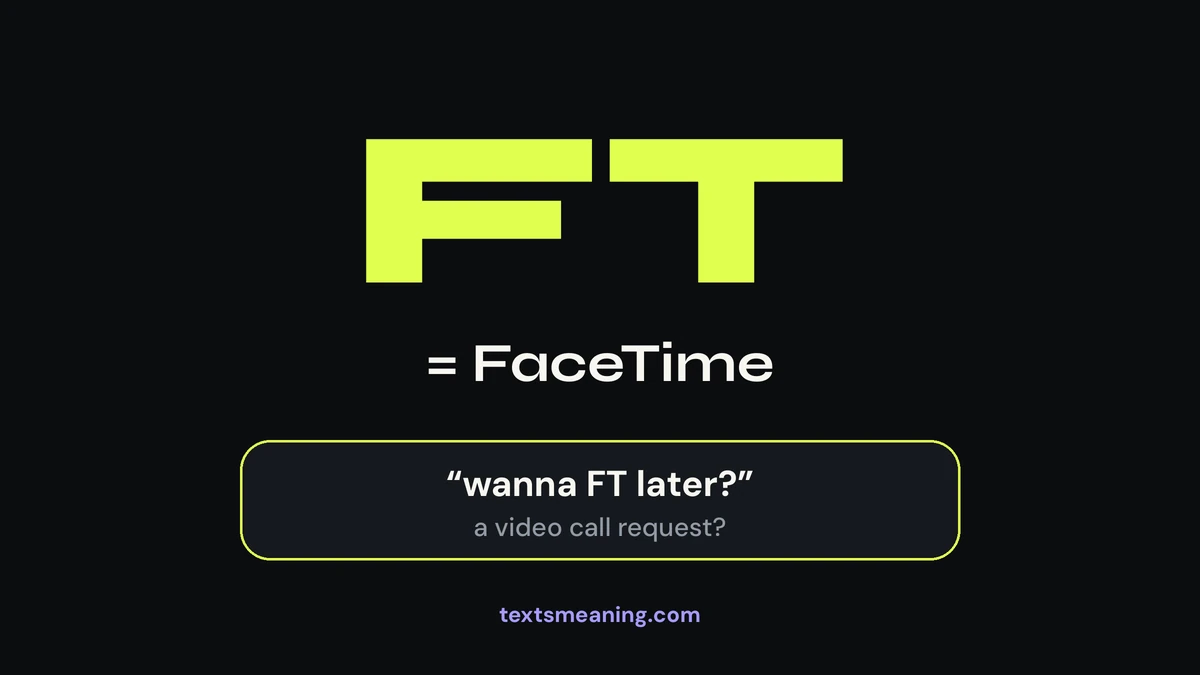
What does FT mean in text? FT means “FaceTime” — Apple’s video-call app, and by now a generic word for any video call. “Wanna FT later?” is an invitation. “FT me at 8” is a plan. But beside a song title, a number, or a job ad, the same two letters mean something else entirely. One abbreviation, five jobs — and the Job Test below tells you which one you just received.
Most guides give FT one definition and stop. This one maps the whole territory: the five-check test for a call request versus a music credit versus a measurement versus a job versus a trade, a six-reading tone spectrum, FT on TikTok, Snapchat, Instagram, and in plain texts, how it lands by sender, the collisions where FT is not “FaceTime” at all, the FS/FT pair, and the Android link.
What “FT” Means in Text
“FT” means “FaceTime.” It is a video-call word — a way of asking for a face-to-face call in two letters. The primary dictionary source attests the product and the verb directly: Wiktionary lists FaceTime as a videotelephony software developed by Apple, introduced in 2010, and as an informal verb meaning to communicate using FaceTime — and, in a second sense, to communicate using any video telephony software at all. That second sense matters: the generic reading is dictionary-backed, not just slang drift.
FT does three headline jobs inside ordinary conversation. As a request, it asks: “wanna FT later tonight?” As a verb, it acts: “FT me so I can show you something.” As a noun, it reports: “we were on FT for like 3 hours last night.” Same expansion, three grammatical jobs — and on Snapchat or Instagram, the call itself often happens on that app’s own video feature, not literally on FaceTime. The word outgrew the app, like “Google it” outgrew the search engine.
The lowercase “ft” is normal in casual chats; all-caps “FT” means the same thing, just slightly louder. But capitalization carries a weak signal elsewhere: measurement and music uses are almost always lowercase (“6 ft,” “song ft. artist”), while FaceTime and full-time lean uppercase. Caps hint; the sentence decides.
The FT Job Test
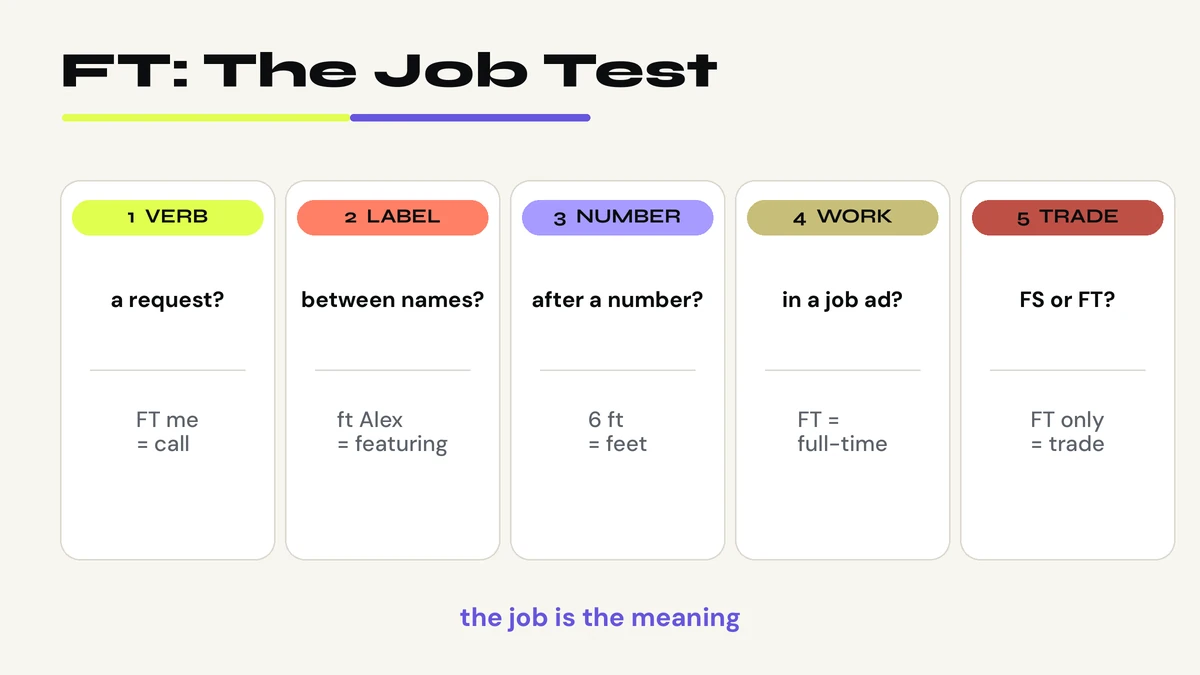
FT has one real ambiguity: what job is it doing in this sentence? Five checks settle it:
- Check 1 — The Verb/Request Job. FT as a verb or request (“FT me,” “wanna FT?,” “FT me asap”) = FaceTime, or a video call generally. Questions, plans, and urgency all point here.
- Check 2 — The Label Job. FT between names or in a title/caption (“new video ft Alex”) = featuring. A label introduces someone; it never asks for a call.
- Check 3 — The Number Job. FT right after a number (“5 ft 10 in”) = feet or foot. Numbers take the measurement reading every time.
- Check 4 — The Workplace Job. FT in a job ad (“FT position, benefits included”) = full-time, the opposite of PT. Hours, not a call.
- Check 5 — The Trade Job. FT in a buy/sell/trade post, especially beside FS (“FT only”) = for trade. The marketplace context is the giveaway.
Punctuation helps, too: “FT?” leans a call request; “ft.” leans featuring. If none of the five jobs fits and the context is news or business (“the FT reported”), the Financial Times reading wins. Otherwise, FaceTime wins.
“FT” in Real Chats
Illustrative examples written for this guide — not presented as real transcripts:
- The call request. “hey wanna FT later tonight?” — the classic: an invitation, not a statement.
- The verb. “FT me so I can show you something” — FT as an action you are asking someone to do.
- The noun. “she didn’t answer my FT” — the missed call, talked about like an object.
- The past call. “we were on FT for like 3 hours last night” — closeness measured in call time.
- The deferral. “can’t talk rn, FT me in 10?” — a call promised later, not a call now.
- The label collision. “new video ft Alex” — no call here at all: Alex is featured in the video.
- The trade collision. “Is the hoodie FS or FT?” → “FT only, not selling” — a swap offered, not a call requested.
The FT Tone Spectrum
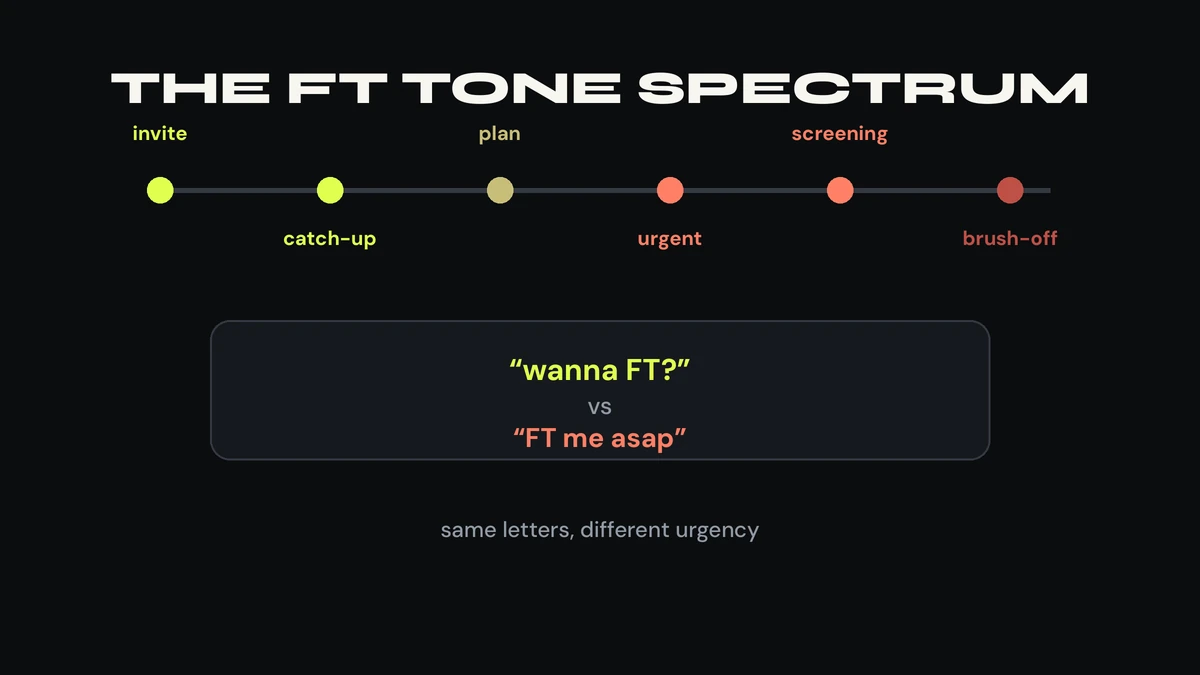
FT’s meaning stays “FaceTime”; its tone slides. Six readings, lightest to heaviest:
- Casual invite: “wanna FT later?” — friendly, low-pressure. The call is an offer, not a demand.
- Warm catch-up: “we were on FT for like 3 hours” — closeness, not just a call. The length is the point.
- Practical plan: “FT me at 8” — scheduling, no emotion. The time is the message.
- Urgent request: “FT me asap” — immediacy. The call matters now, and the sender is not hiding it.
- Screening move: “wanna FT?” before meeting someone new — a trust check, not romance itself. The call verifies before the date does.
- Flat brush-off: “can’t talk rn, FT me in 10?” — can read as deferral when the other person wanted a real conversation now.
The tone lives in the sentence around FT, not in FT alone. A “wanna FT?” from a close friend reads warm; from a stranger, like a test.
“FT” on TikTok
On TikTok, FT shows up in two places: comments asking for a call (“FT me, I have to show you this”) and captions crediting a creator (“video ft Alex”). The platform stages both jobs side by side, which is why the Job Test matters here most. A comment is usually a request; a caption is usually a label.
TikTok is also where the generic reading thrives: creators say “FT” for a call that will happen on TikTok itself, or on whatever app both people already have.
“FT” on Snapchat
On Snapchat, FT is a video-call word first: “FT me” usually means “video call me,” and the call itself often happens right inside Snapchat’s own video feature — a Snapchat call wearing FaceTime’s name.
That is the generic reading in its purest form: on Snapchat, “FT” means video telephony generally, whatever the app.
“FT” on Instagram
On Instagram, FT splits by surface. In DMs, it is a call request like anywhere else (“FT me after dinner?”). In comments, captions, and Reels titles, it leans label: “photo ft Maya” credits Maya, it does not invite a call.
Instagram is also a marketplace surface, so the Trade Job appears here too: buy/sell stories use “FS or FT?” exactly like the trade groups do. Check the surface first: DM = call, caption = label, listing = trade.
“FT” in Text Messages
Plain texts are FT’s home ground: the request text, the verb text, the past-call text. It pairs naturally with its conversation-opening cousin WYO — where WYO (“what you on”) opens the conversation and FT upgrades it to video — and with BRB in the status-update cluster, where FT starts the call and BRB marks the pause. It also travels with the site’s reassurance move DW — “dw, FT me when you’re free”: reassurance, then a call.
In texts, the FaceTime reading dominates so strongly that the other jobs rarely appear — unless the text is a caption, a measurement, or a listing. A plain “FT?” is a call request until proven otherwise.
Who’s Sending It: How “FT” Lands by Sender
No source documents a different meaning of FT per sender — the meaning stays fixed; what changes is how the call request reads:
- Friend: the default. A friend’s “FT me” is an invitation at face value.
- Crush: overread territory. A crush’s “wanna FT?” is a call, not a confession.
- Partner: context rules. A partner’s “FT me when you’re free” is closeness, not surveillance.
- Parent: rare and usually literal. A parent texting “FT” usually means an actual FaceTime call.
- Coworker / boss: the formal edge. FT in a work chat is casual — fine among peers, out of place in a formal message.
When “FT” Is Not “FaceTime”
Five collisions, graded. First, featuring — real, and the only collision that regularly appears in ordinary social feeds: song titles, video captions, photo credits. The label format gives it away: FT sits between names, often lowercase, often with a period.
Second, feet/foot — real, and the easiest to spot: FT sits right after a number in a sentence about length or height. Third, full-time — real in job ads, where FT describes hours and PT is its opposite. Fourth, for trade — real in buy/sell/trade groups, usually paired with FS. Fifth, the Financial Times — real in news contexts (“the FT reported”), invisible in chats. If the sentence is about a credit, a number, hours, a swap, or the news, the FaceTime reading loses; otherwise it wins.
Checked Claims: Expansions That Don’t Hold Up
Two letters attract folklore. The claims that fail evidence:
- “FT always means FaceTime” — rejected. Featuring, feet, full-time, and for trade are all real, context-bound readings.
- “FT only means FaceTime on Apple devices” — rejected as a usage claim. The word is used generically for any video call (dictionary sense 2), and Android users can join FaceTime calls via link since iOS 15.
- “FT is only a noun” — rejected. Sources document noun (“she didn’t answer my FT”), verb (“FT me”), and question/request (“wanna FT?”) uses.
- “FT means ‘for trade’ in all chats” — rejected. For trade is confined to buy/sell/trade groups, usually paired with FS.
- “FT has a different meaning on Snapchat” — rejected. No platform-specific meaning exists; Snapchat stages the same FaceTime/generic-call reading, sometimes on its own call feature.
What SURVIVES: “FaceTime” (strong, universal, job-dependent, including the generic any-video-call sense), plus featuring, feet, full-time, and for trade, each bound to its context. Everything else failed evidence.
“FT” vs Its Closest Cousins
FT belongs to the connection family — the words that move a conversation from text to something more:
- FS (“for sure”) — the marketplace pair, and the head-to-head that matters. FS confirms a plan; FT upgrades it to video. In trade groups the pair is literal: “FS or FT?” asks whether an item is for sale or for trade.
- FR (“for real”) — the sincerity cousin. FR certifies that something is true; FT asks for a face.
- FML (“f*** my life”) — the reaction cousin. FML reacts to bad luck; FT to distance.
- “Call me” — the ancestor. “Call me” was the old request; “FT me” is its video-age replacement. Same job, new medium.
The conversational companion: FT often travels with BTW (“btw, FT me later”) — one adding information, the other opening a call.
Where “FT” Came From
FaceTime launched with the iPhone 4 in June 2010, Apple-only software ever since. “FT” as shorthand grew with FaceTime’s adoption, becoming the new “call me” — and then, as video calling spread to every app, a generic verb for video-calling anyone, on anything.
The Android loophole matters for real chats. Since iOS 15 (2021), an Apple user can create a FaceTime link and share it with anyone: an Android or Windows user taps the link and joins in a browser — no app, no Apple account. It is a one-way invite — an Android user can join but cannot start a FaceTime call — so for everyday mixed-phone calls most people use an app both sides already have. If someone on Android asks you to FT, send the link; if you are on Android and get asked, ask for the link.
How to Reply When Someone Sends “FT”
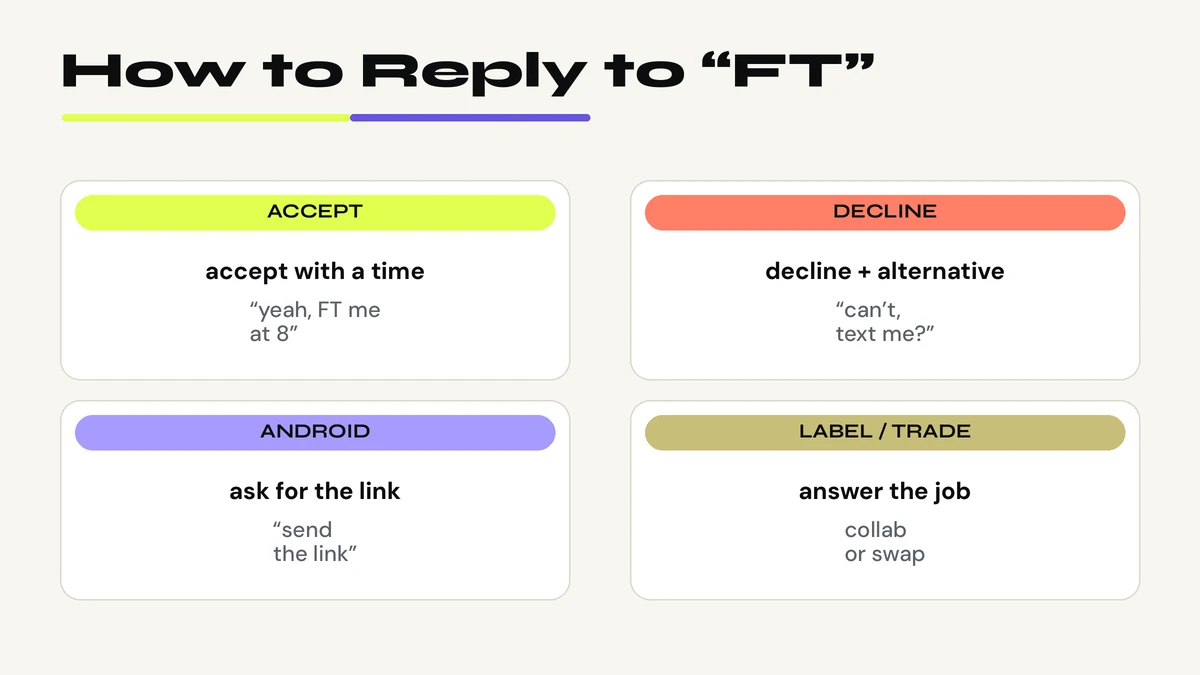
Five replies, matched to the job:
- Call request FT — accept with a time: “yeah, FT me at 8.” A request wants a time, not just a yes.
- Call request FT — decline with an alternative: “can’t, text me?” A no lands softer with a replacement.
- Android FT — ask for the link: “I’m on Android — send the link.” The link is the whole workaround.
- Label FT — react to the content: “love that collab.” A credit is not a call; do not answer it like one.
- Trade FT — answer the swap: offer or decline the trade itself. Do not debate a claim that was never made.
What never works: answering a call request with a credit reaction, a label with a time, or a trade FT as a call. The golden rule: answer the job FT is doing, not the letters.
Frequently Asked Questions
What does “FT” mean in a text message?
“FaceTime” — a video call request, or any video call at all. “Wanna FT?” asks for a call; “FT me at 8” schedules one; “we were on FT” reports one.
What does “FT” mean on TikTok, Snapchat, and Instagram?
The same FaceTime/generic-call reading everywhere, with one twist per surface: TikTok comments ask for calls while captions credit creators; Snapchat calls often happen on Snapchat’s own feature; Instagram DMs ask for calls while captions credit people.
Does “FT” ever mean “featuring”?
Yes — in song titles, video captions, and photo credits, where FT sits between names, usually lowercase and often with a period (“song ft. Artist B”).
Does “FT” ever mean “feet” or “full-time”?
Yes — “feet” right after a number (“6 ft fence”), and “full-time” in job ads (“FT position, benefits included”, the opposite of PT).
Can Android users FT?
Not with a FaceTime app — FaceTime is Apple-only. But since iOS 15, Android users can join a FaceTime call through a shared web link in their browser. They cannot start one; for everyday calls they use Snapchat, WhatsApp, Messenger, or Google Meet.
What’s the difference between “FT” and “FS”?
FT opens a video call; FS confirms a plan. In trade groups the pair is literal: “FS or FT?” asks whether an item is for sale or for trade.
Someone just sent me “FT?” What do I say?
Answer the question: accept with a time, decline with an alternative, or — if you are on Android — ask for the link. A call request wants a time, not a performance.
The Takeaway
“FT” is a two-letter video-call word — “FaceTime,” asking for a face, reporting a call, or just meaning video chat generally. When the letters arrive, run the Job Test: verb, label, number, workplace, trade. And when you send one, remember the only rule that matters: the job is the meaning — put FT where you mean it.