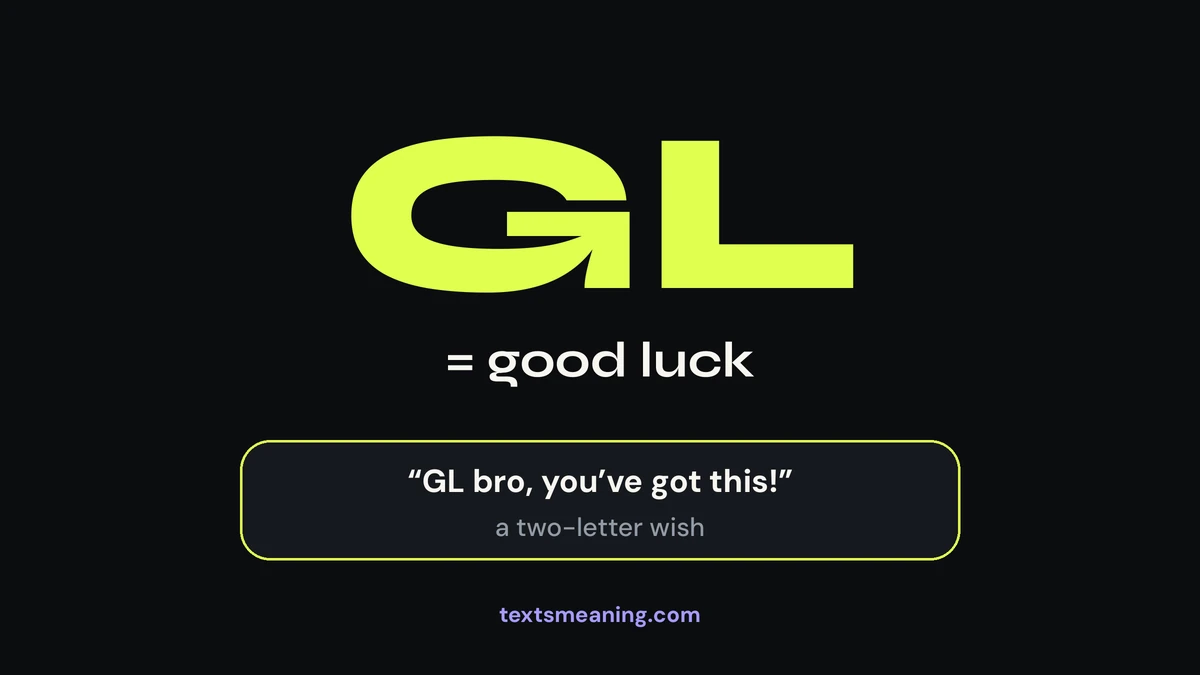
What does GL mean in text? GL means “good luck” — a two-letter wish you send before something that could go well or badly: an exam, an interview, a match, a first day. “GL bro, you’ve got this!” is encouragement in its lightest form. But a bare GL can also sting, or fall flat. This guide to gl meaning in text shows how to tell a real wish from sarcasm, a brush-off, or a technical term wearing the same two letters.
You will learn the Sincerity Test for judging any GL, a six-reading tone spectrum, GL on TikTok, Snapchat, Instagram, and in plain texts, how it lands by sender, the cousins it gets confused with, the GLHF ritual, and a history from 1990s gaming chats to the modern group chat.
What “GL” Means in Text
“GL” means “good luck.” It is a wish, not information: a way of saying “I hope it goes well for you” in two letters, sent at the moment before the thing happens. The primary dictionary source attests it directly: Wiktionary lists “gl” as an interjection, “(text messaging) Initialism of good luck.” Note the spelling: the texting sense lives under the lowercase entry. The uppercase “GL” entry carries other senses entirely — Greenland’s country code, a Dutch political party, and “girls’ love” media — none of which is what a texter means.
GL does three headline jobs inside ordinary conversation. As a cheer before a test: “GL on your exam!” As a send-off before a big day: “GL on your first day at work.” As a sportsmanship greeting before a match: “GLHF” — good luck, have fun — typed to opponents as the game begins. Same expansion, one constant: the sender is wishing, not telling.
GL is also the rare abbreviation whose warmth is the whole message. It carries almost no information — not what the event is, or when it is. All it carries is goodwill, which is why a GL with no warmth behind it feels so strange.
The GL Sincerity Test
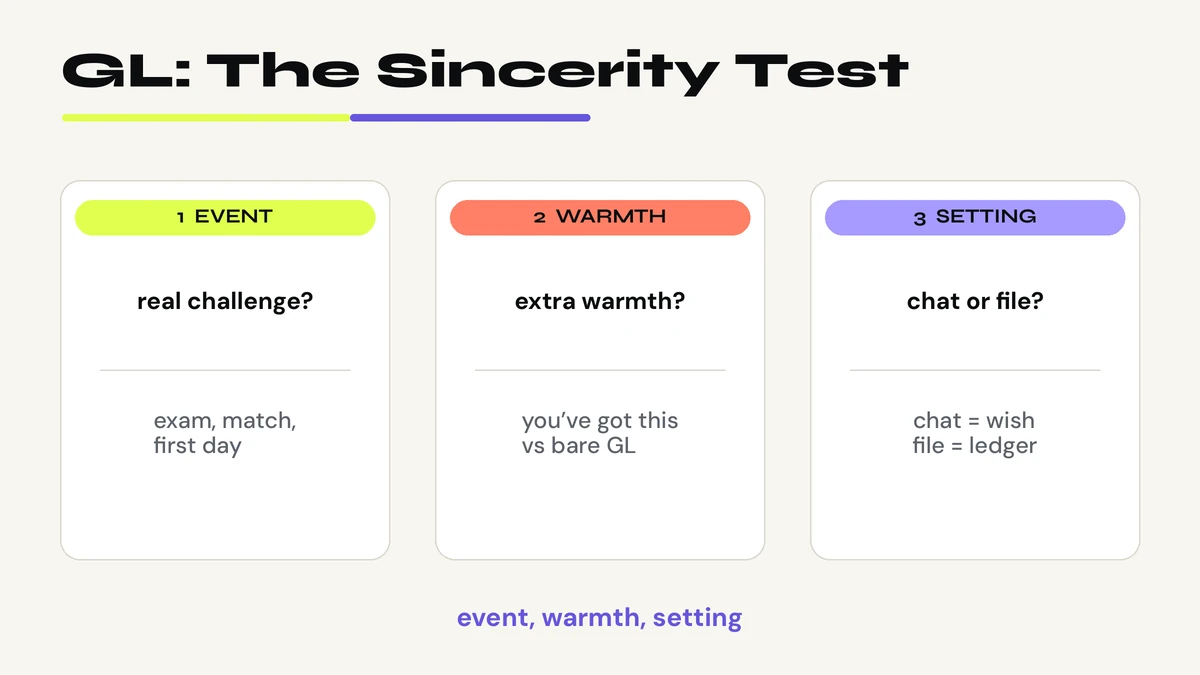
GL has one real ambiguity, and it is not about the expansion: did they mean it? A wish can be warm, teasing, sarcastic, or empty — all in the same two letters. Three checks settle it:
- Check 1 — The Event Check. Is a real challenge actually coming — an exam, interview, match, first day? A wish needs something to wish about. GL before nothing is irony or filler, not encouragement.
- Check 2 — The Warmth Check. Does the rest of the message add warmth? “GL bro, you’ve got this!” passes easily. A bare GL standing alone — especially after a disagreement — fails: the wish form is there, the goodwill is not.
- Check 3 — The Setting Check. Is this a casual chat, a comment, or a game lobby — or a technical document? In a casual setting GL means “good luck”; in an accounting file it means “general ledger.” The setting picks the expansion.
Worked trio. “GL bro, you’ve got this!” before an exam — real event, real warmth: genuine wish. “GL with that” after an argument — no warmth, no real event: sarcastic jab. “GL” as the whole reply to “I’m terrified about tomorrow” — the wish too small for the moment: brush-off. Same letters, three jobs, decided by event, warmth, and setting.
“GL” in Real Chats
Illustrative examples written for this guide — not presented as real transcripts:
- The exam. “Heading into the exam hall now, super nervous!” → “GL bro, you’ve got this!” — warmth plus a real event.
- The interview. “Wish me luck, my interview starts in 5 minutes” → “GL bestie, kill it!”
- The match. “GLHF” — the pre-match ritual between opponents.
- The tease. “GL… you’ll need it” — affectionate only between friends who tease.
- The brush-off. “I’m terrified about tomorrow” → “GL” — felt as dismissal.
The GL Tone Spectrum
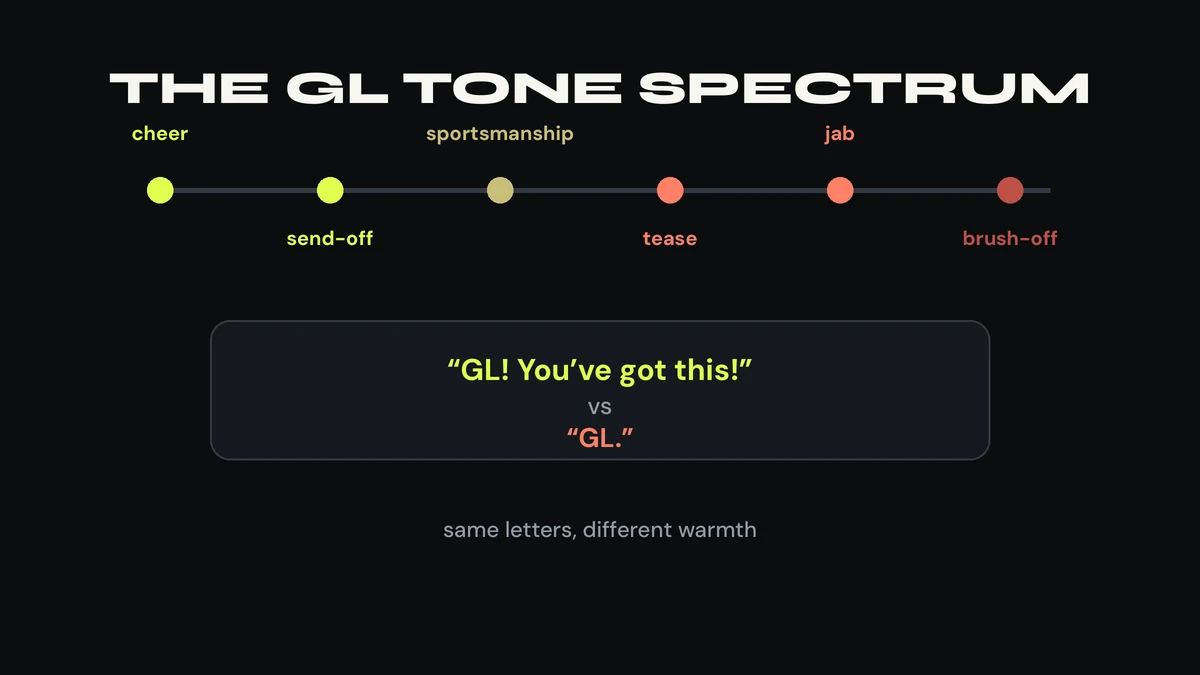
GL’s meaning stays “good luck”; its warmth slides. Six readings, lightest to heaviest:
- Warm cheer: “GL! You’ve got this!” — genuine, the default.
- Casual send-off: “GL bro” — low-effort, friendly, the everyday form.
- Pre-match sportsmanship: “GLHF” — ritual politeness between opponents.
- Playful tease: “GL… you’ll need it” — affectionate between friends who tease.
- Sarcastic jab: a bare “GL” after an argument — the wish form worn by mockery.
- Empty brush-off: “GL” as the whole reply to real nerves — felt as dismissal.
The warmth lives in the event, the extra words, and the relationship — not in GL alone.
“GL” on TikTok
On TikTok, GL is a cheer in the comments: “GL!” under a creator’s “starting my fitness challenge today” video, or “GL on the launch!” under a project announcement. The platform rewards speed, so GL’s job here is pure encouragement — goodwill dropped fast, no reply expected. TikTok is also where GL’s teasing reading thrives: “GL to me” on a challenge video is self-deprecating humor, not a real wish.
The sarcastic reading appears in comments too — a bare “GL” under a video of someone attempting something absurd is the audience laughing with deniability.
“GL” on Snapchat
On Snapchat, GL fits quick notes on a snap or a fast DM: “GL with your driving test” before a friend heads out, or a send-off to a friend starting something new. The ephemeral, in-the-moment format suits GL’s job — a wish that lands lightly and disappears, rather than sitting in a thread as a permanent record.
On Snapchat the brush-off reading is easiest to miss, because the message vanishes. If a bare GL after real nerves feels cold, it probably was.
“GL” on Instagram
On Instagram, GL shows up in comments, stories, and DMs: “GL on the project launch!” as a public cheer, or “GL, you are going to crush it” as a private DM. The public version leans warm cheer; in DMs, the full range appears, including the private tease and the quiet brush-off.
Instagram is also where GL’s gaming roots still show: “GLHF” in a story about a tournament is a nod to the lobby ritual, even far from any game.
“GL” in Text Messages
Plain texts are GL’s home ground: the pre-exam text, the pre-interview text, the good-luck-before-the-big-day text. It pairs naturally with its conversation-opening cousin WYO — WYO (“what you on”) opens the conversation, GL delivers the wish inside it — and with BRB in the status-update cluster: GL wishes you well, BRB marks the pause. It also travels with the site’s reassurance move DW — “GL, dw, you’ve got this” is the full encouragement package: the wish plus the reassurance. Three abbreviations, three jobs, one fluent conversation.
Texts are also where GL’s one hard limit lives: serious moments. A friend sharing real fear, grief, or bad news does not need two letters — they need a sentence: “I wish you the best of luck, I am here for you.” GL is a light wish; heavy moments deserve heavier words.
Who’s Sending It: How “GL” Lands by Sender
No source documents a different meaning of GL per sender — the meaning stays fixed; what changes is how the wish reads:
- Friend: the default. A friend’s “GL” is encouragement at face value.
- Crush: overread territory. A crush’s “GL on your presentation!” is a wish, not a confession.
- Partner: context rules. A partner’s “GL” is support, not a message to decode.
- Parent: common and usually genuine. A parent texting “GL” is wishing, plainly.
- Boss / coworker: the formal edge, and GL’s weakest ground. A boss’s “GL” is friendly but informal; in a formal thread, expect “good luck” spelled out.
- Teammate / opponent: the ritual home. A teammate’s “GL” is team spirit; an opponent’s “GLHF” is sportsmanship.
When “GL” Is Not Just a Wish
Three misfires, graded. First, the sarcastic jab: a bare “GL” after an argument, or “GL with that” aimed at an impossible plan, wears the wish form while meaning the opposite. Do not take the bait. Second, the empty brush-off: “GL” as the whole reply to real nerves is a wish too small for the moment, and the receiver feels dismissed, not encouraged.
Third, the wrong setting: GL in a formal email, a professional document, or a technical file does not read as a wish at all — it reads as carelessness, or as a technical term. The closest cousin here is FWIW (“for what it’s worth”): FWIW softens an opinion, GL delivers a wish. FWIW says “take it or leave it”; GL says “I hope it goes well.” If the message is an opinion you may ignore, it is FWIW; if it is encouragement before a challenge, it is GL.
Checked Claims: Expansions That Don’t Hold Up
Two letters attract folklore. The claims that fail evidence:
- “GL means ‘good looking’ in modern texting” — rejected as a current meaning. Attested only as outdated early-2000s teen slang.
- “GL means ‘get lost’ when it sounds sarcastic” — rejected as an expansion. Sarcasm is tone, not meaning; no dictionary attests “get lost.”
- “GL means something different on each platform” — rejected. Per-app labels like “great life” describe tone, not new expansions.
- “GL means ‘gay and lesbian’ in chats” — graded as a separate, dated community shorthand, not a texting meaning.
- “GL is safe in formal emails” — rejected. In formal writing GL reads lazy or careless; spell out “good luck” instead.
- “GL was invented for texting / by Gen Z” — rejected. GL predates mobile texting, rooted in 1990s IRC and gaming chat rooms.
- “GL means ‘general ledger’ in a chat” — rejected for texting. Technical senses belong to their own documents, not chats.
What SURVIVES: “good luck” (strong, universal, casual-register), with the sarcastic and brush-off readings as bounded tone failures, “good looking” as outdated history, and technical senses fenced off to their own settings.
“GL” vs Its Closest Cousins
GL belongs to the encouragement family — the words that lift someone before the moment:
- BTW (“by the way”) — the side-note cousin. BTW adds something extra; GL delivers a wish.
- BFFR (“be for real”) — the reaction cousin. BFFR reacts to nonsense; GL encourages. BFFR judges; GL cheers.
- FR (“for real”) — the sincerity cousin. FR certifies a claim is true; GL wishes it goes well.
The conversational companion: GL often travels with a thank-you that costs nothing — “Thanks, you too!” — the only reply a genuine GL ever needs.
Where “GL” Came From
GL’s texting life began in 1990s internet relay chat and gaming chat rooms, where players typed GL, HF, and GG to save keystrokes in real time before matches. The paired form GLHF — “good luck, have fun” — became the standard pre-match greeting and a signal of sportsmanship between opponents, typed at the exact moment a competitive match began.
From gaming lobbies the wish spread to forums, texts, and social platforms, keeping its gaming-era brevity. By the mid-2000s it had crossed into mainstream mobile texting, and it never left. The “good looking” reading belongs to early-2000s teen slang and lost the contest for the letters; “girls’ love” comes separately from Japanese media fandom, not from texting.
How to Reply When Someone Sends “GL”
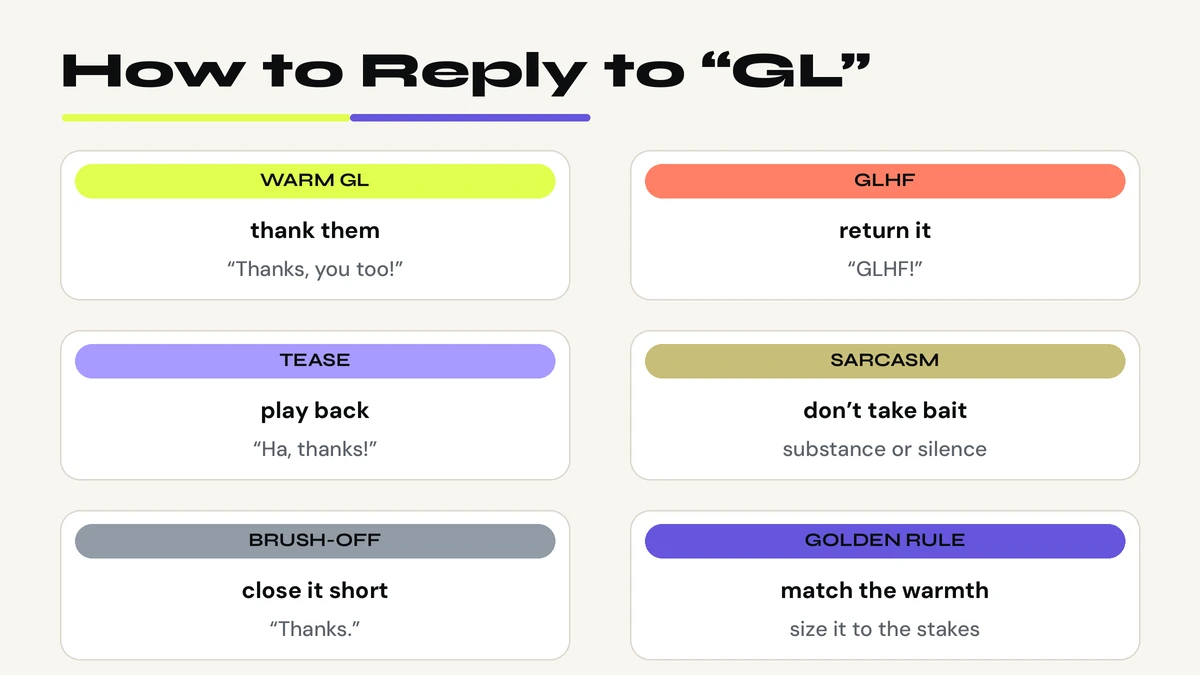
Five replies, matched to the reading:
- Genuine warm GL — thank them: “Thanks! I will need it”, “Thank you, you too!”, or a quick “TY!”
- Pre-match GLHF — return it: “GLHF!” is the ritual answer.
- Playful tease — play back: a friend’s tease earns “Ha, thanks, I will need it.”
- Sarcastic GL — don’t take the bait: answer the substance or let it pass.
- Brush-off GL — close it short: do not chase warmth that was not offered.
What never works: answering a genuine GL with a long anxious paragraph. The wish is light, and the reply should be too. Match the warmth you received, and size the reply to the stakes.
Frequently Asked Questions
What does “GL” mean in a text message?
“Good luck” — a short wish of success before a challenge: an exam, an interview, a match, a first day.
What does “GL” mean on TikTok, Snapchat, and Instagram?
The same wish everywhere — no platform-specific meaning exists. TikTok stages it as a fast cheer, Snapchat as a quick send-off, Instagram in comments and DMs.
Is “GL” sarcastic?
It can be — a bare GL after an argument or before an impossible task is mockery wearing a wish’s clothes. Run the Sincerity Test: real event plus real warmth means a genuine wish.
What’s the difference between “GL” and “GLHF”?
GLHF means “good luck, have fun” and is the pre-match greeting between gamers — a sportsmanship ritual. GL alone is the general wish, used anywhere; GLHF belongs to the lobby.
What’s the difference between “GL” and “GG”?
Timing: GL comes before the event, GG (“good game”) comes after it. GL wishes success; GG shows respect for the play that already happened.
Can I use “GL” at work?
In a friendly team chat, yes — “GL with your presentation!” is fine. In a formal email or document, no: spell out “good luck” instead, or the abbreviation reads careless.
Someone just sent me “GL”. What do I say?
“Thanks! I will need it” or “Thank you, you too!” is plenty for a genuine wish. If it was GLHF, answer “GLHF!” If it was sarcasm, a short “Thanks” beats taking the bait.
The Takeaway
“GL” is a two-letter wish — “good luck,” carrying nothing but goodwill before the moment that matters. When the letters arrive, run the Sincerity Test: event, warmth, setting. And when you send one, remember the only rule that matters: a wish with no warmth behind it is not a wish.