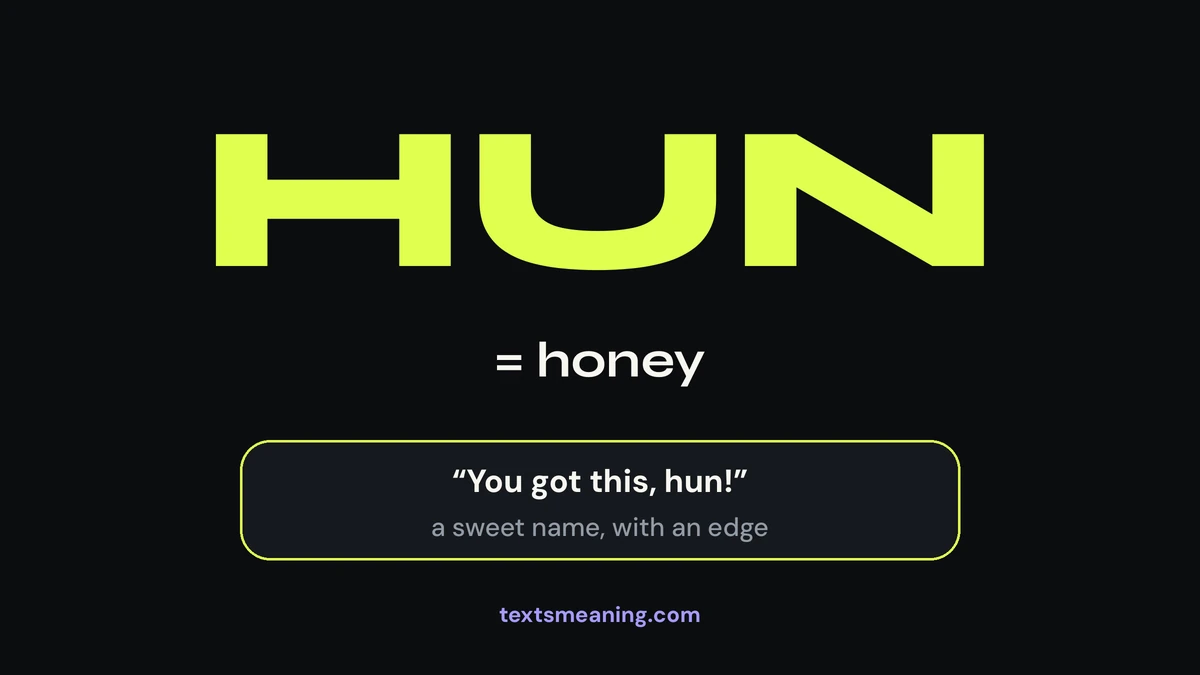
What does hun mean in text? Hun means honey — a short, warm way to address someone. “You got this, hun!” is encouragement with a smile tucked into one small word. That smallness is the trap: hun carries no statement and asks no question, so its meaning lives entirely in who says it, where it sits, and what rides with it.
This guide covers the HUN Warmth Test, a seven-reading tone list, hun on TikTok, Snapchat, Instagram, and in texts, senders, the shady hun, graded claims, cousins, history, and reply scripts — including what to say when you do not like being called hun.
What “Hun” Means in Text
“Hun” means “honey” — not as an acronym, not as a code, but as a clipping: honey with its ending snipped off and its spelling matched to how it sounds. The primary dictionary source attests it directly: Wiktionary lists lowercase hun as “(informal) Alternative spelling of hon (affectionate abbreviation of honey)”, and Cambridge defines hun as a “short form of honey: a way of speaking to someone you like or love, or someone who you want to be friendly to”, with the example “You OK, hun?”
Hun does four headline jobs. As an address: “Sleep tight, hun” names the person with affection. As encouragement: “You got this, hun!” cheers someone on. As manners: “Here you go, hun” from a shop assistant is friendliness as good service. As a wrapper: “Oh hun, bless your heart” delivers a judgment inside sweetness. Same letters, four jobs — the Warmth Test below tells you which.
Hun is also the run’s first address term. Earlier guides taught questions, pauses, sign-offs, and returns — words that say or ask something. Hun says nothing and asks nothing; it names you. So the reader’s question changes: not “what does it mean?” but “how am I being positioned?” The Warmth Test answers exactly that.
The HUN Warmth Test
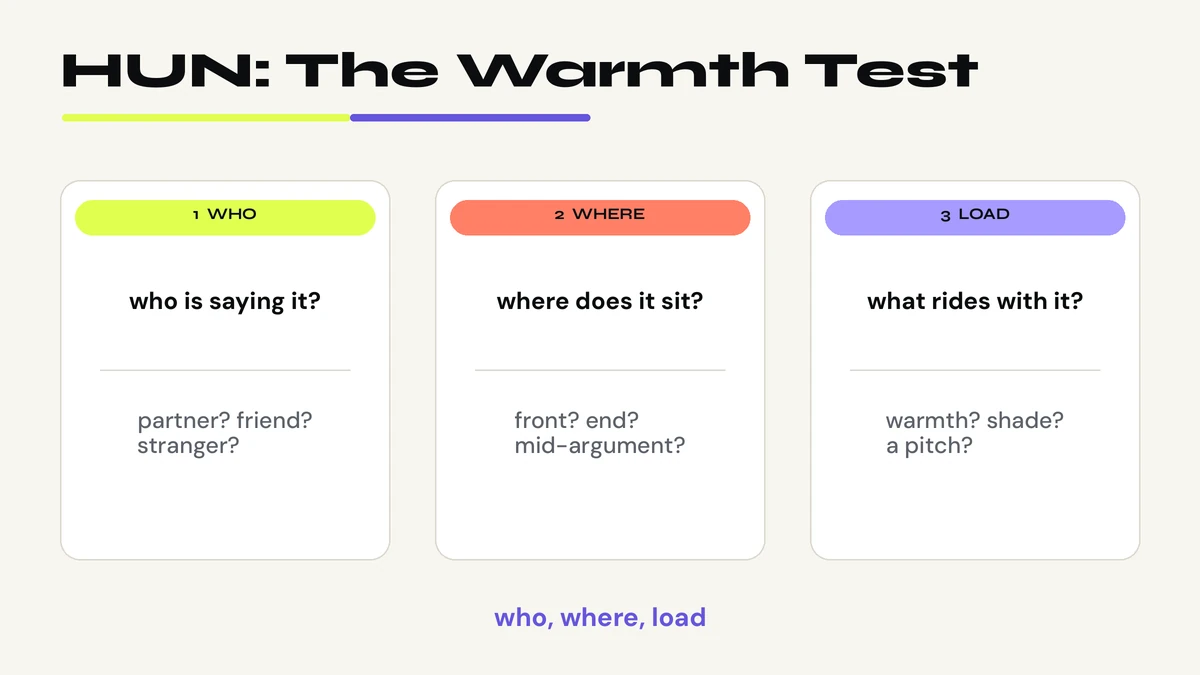
Hun has one real ambiguity, and it is not the expansion: what temperature is this hun? Three checks settle it:
- Check 1 — The Who Check. Who is saying it? A partner, close friend, or parent means warmth at face value. A drag queen or best friend means playful camp. A shop assistant or waitress means regional friendliness. A stranger in your DMs means read on before deciding — the word alone tells you nothing yet.
- Check 2 — The Where Check. Where does hun sit? At the front (“Hun, you got this”) it softens what follows. At the end (“You got this, hun”) it warms what came before. Alone as a greeting (“Hey hun”) it is the whole message — an opener that claims closeness. Mid-argument (“Oh hun, please”) it is almost never warm.
- Check 3 — The Load Check. What rides with it? An emoji, a compliment, or a real sentence (“Good luck, hun!”) loads warmth. “Bless your heart”, an eye-roll, or a correction (“Hun, that’s not how it works”) loads shade. A product, a link, or a “hey girl” opener loads a pitch.
Worked trio. “You got this, hun!” from a best friend before an exam — friend, end position, encouragement load: pure warmth, answer warmly. “Oh hun, bless your heart” from a stranger in a comment thread — stranger, front position, bless-your-heart load: shade in a sweet wrapper, do not take the sweetness at face value. “Hey hun! I have an amazing opportunity for you” from a near-stranger — stranger, greeting position, opportunity load: the pitch hun, read the pitch, not the pet name.
“Hun” in Real Chats
Illustrative examples written for this guide, not real transcripts:
- The tender address. “Sleep tight, hun” — the word doing exactly what honey does, no edge attached.
- The encouragement. “You got this, hun!” — support with a smile tucked into one word.
- The shop greeting. “Here you go, hun” — warmth as manners, not intimacy.
- The camp exaggeration. “HUNNNN! You better werk!” — the word itself is the joke, and everyone in on it knows it.
- The teasing nudge. “Hun, why? You knew they were mine” — affection with a poke; the relationship carries it.
- The sweet-wrapper shade. “Oh hun, bless your heart” — the sentence underneath is the judgment; the hun is the wrapping paper.
- The pitch opener. “Hey hun! I have an amazing opportunity for you” — warmth as a funnel; the opportunity is the message.
The HUN Tone List
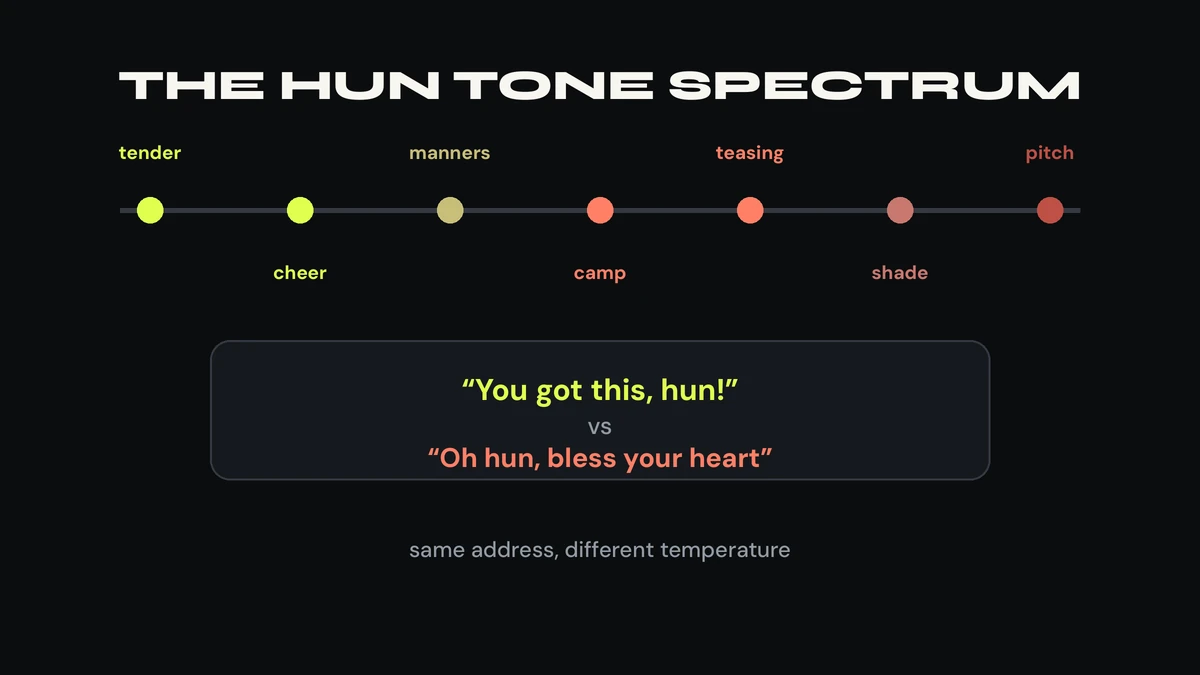
Hun’s meaning stays “honey”; its temperature slides. Seven readings, warmest to sharpest:
- Tender address: “Sleep tight, hun” from a partner — real affection; the word is doing what honey does.
- Friendly encouragement: “You got this, hun!” — support with a smile.
- Casual regional friendliness: “Here you go, hun” from a shop assistant — warmth as manners, common in the US South and North-West England, not intimacy.
- Playful camp: “HUNNNN! You better werk!” — drag and best-friend exaggeration; the word itself is the joke.
- Teasing nudge: “Hun, why? You knew they were mine” — affection with a poke; the relationship carries it.
- Passive-aggressive shade: “Oh hun, bless your heart” — sweetness as a wrapper; the sentence underneath is the judgment.
- Sales-pitch opener: “Hey hun!” from a near-stranger followed by an opportunity — warmth as a funnel, not warmth at all.
Who, where, and load move a reading up or down this list: a close relationship warms it, a mid-argument position sharpens it, and a product load turns it into a pitch.
“Hun” on TikTok
On TikTok, hun is a comment-section address: “You ate that, hun!” under a creator’s video, or “Okay hun, explain” as a reply to a familiar commenter. The public stage suits hun’s camp and teasing readings best — a pet name thousands can read without anyone owing intimacy. The tender reading is rare here, since a comment cannot carry a real relationship; the playful and teasing readings dominate, and the pitch hun shows up too, in comments that warm you up before a link.
“Hun” on Snapchat
On Snapchat, hun fits the fast, private DM: “Hey hun, you up?” as a streak opener, or “You got this, hun!” as a story reply before a big day. The private format suits the tender and encouragement readings — a pet name lands differently when only one person reads it. Snapchat is also where the pitch hun is easiest to spot: a “Hey hun!” from someone you barely know, followed by an opportunity, is a funnel, and the disappearing format is no excuse to answer the pet name instead of the pitch.
“Hun” on Instagram
On Instagram, hun shows up in story replies and DMs: “Living for this, hun!” as a story reply, or “Hey hun, loved your post” as a DM opener. Public replies lean camp and teasing; DMs carry the full range, from tender to pitch. Instagram is also where hun’s drag and best-friend life shows most: a “HUNNNN” in all caps with extra letters is a performance, and everyone in on it knows the word itself is the joke.
“Hun” in Text Messages
Plain texts are hun’s home ground, and the place its oldest job survives: the spoken word typed. It pairs with the reassurance companion DW — “dw, hun, it’s fine” pairs reassurance with the address in one breath — and with the side-note companion BTW: “btw, hun, did you see this?” pairs an aside with the address. Two abbreviations, two jobs, one fluent chat.
Texts are also hun’s work limit — and its clearest one: in a casual team chat, a “hun” to a teammate you know well can read as warm, but in a formal email or a message to a stranger at work it reads as presumptuous. The test: if you would not call the person “honey” to their face, do not call them “hun” in a message.
Who’s Calling You Hun: How It Lands by Sender
No source documents a different meaning of hun per sender — the address stays “honey”; what changes is what the address claims:
- Partner: the default. A partner’s “hun” is tenderness at face value; answer in kind.
- Close friend: playful territory. A friend’s “hun” is encouragement, teasing, or camp — read the load, not just the word.
- Parent: common and usually warm. A parent’s “hun, call me later” is care, plain and simple.
- Shop assistant or waitress: regional friendliness. A stranger’s “here you go, hun” is manners, not a claim on you; a smile and a normal answer are all that is owed.
- Coworker: context decides. From a teammate you know well it can be warm; from a stranger at work it can feel presumptuous — judge the relationship, not the letters.
- Group chat: the camp habitat. A group’s “okay huns, listen” is a playful collective address; nobody is singled out.
- Stranger or near-stranger with a pitch: the funnel habitat. A “Hey hun!” followed by an opportunity is the sales-pitch hun; answer the pitch, not the pet name.
When “Hun” Is Not Warm
Four misfires, graded. First, the always-friendly assumption: taking every hun as warmth leaves you answering shade and pitches as if they were hugs. Run the Load Check first — “bless your heart” and an opportunity change everything. Second, the always-flirty assumption: a pet name is not a romantic signal. A waitress’s hun and a partner’s hun are the same word doing different jobs; check the relationship before the romance. Third, the stranger panic: treating a shop assistant’s regional “hun” as creepy or intimate misreads manners as a claim. Regional friendliness is a real, documented use — in the US South and North-West England, hun is how strangers are warm to each other.
Fourth, the pitch trap: answering a sales-pitch hun with warmth (“Aww, thanks hun!”) accepts the claimed closeness and opens the funnel. The closest cousin here is FWIW (“for what it’s worth”): FWIW softens an opinion; hun softens the address itself. FWIW says “take it or leave it”; hun says “we are close enough for pet names” — and sometimes that closeness is the sales pitch.
Checked Claims: Expansions and Readings That Don’t Hold Up
Three letters attract folklore. The claims that fail evidence:
- “Hun is an acronym with a hidden expansion” — rejected. Hun is a clipping of honey, not an initialism; no dictionary lists a phrase expansion, and any claimed expansion is invented.
- “Hun means something different on each platform” — rejected. No source documents a platform-specific meaning; platforms stage the same address differently.
- “Hun is always flirty” — rejected. The letters are neutral; flirtation comes from the relationship, timing, and what rides with it.
- “Hun is always friendly” — rejected. The passive-aggressive hun is well attested; sweetness can be the wrapper for shade.
- “Only women use hun” — rejected as a rule. Usage skews female in the attested examples, but men use it to partners and in some regional speech; the skew is a tendency, not a rule.
- “Every hun from a stranger is a sales pitch” — rejected. The MLM hun is real, but a stranger’s friendly hun in a shop or a comment is usually just regional friendliness; the pitch reading needs an actual pitch riding with it.
- “Hun means ‘Hungarian’ in a text” — rejected for chat. Hun/HUN as a language and country code are standards codes, not chat usage.
- “The MLM hun and the British hun are the texting meaning” — fenced, not the texting meaning. Wiktionary attests both noun senses — a woman in a multi-level marketing scheme, and a British woman of a certain brash, fun-loving type — but neither is the DM address sense. A “hun” that addresses you is honey; a “hun” that labels someone else (“she’s such a hun”) is a different word wearing the same letters.
- “Hun is an insult in itself” — fenced. The insult readings are real but regional and register-bound: the Scotland/Ireland football-sectarian slur, the World War-era slur for a German, and the figurative “vandal” sense. None is the default reading of a lowercase hun in a DM, and none should be used as an insult on the strength of this guide.
What SURVIVES: “honey” as an address (strong, universal), with the readings above as temperatures of the same address — not different meanings. No competitor percentages are repeated here as fact.
“Hun” vs Its Closest Cousins
Hun belongs to the address-and-flow family — words that name the person or steer the chat:
- HRU (“how are you?”) — the greeting cousin. HRU asks how you are; hun addresses you by a sweet name. HRU says “how are you?”; hun says “you, dear one.”
- HBU (“how about you?”) — the return cousin. HBU hands a question back; hun hands you a name. HBU says “now yours”; hun says “you, dear one.”
- HMU (“hit me up”) — the contact cousin. HMU asks you to reach out; hun claims closeness. HMU says “contact me”; hun says “we are close.”
- HM (“hmm”) — the sound cousin. HM hums while thinking; hun names the person. HM says “I am thinking”; hun says “you, dear one.”
Hun often travels with a greeting — “Hey hun” — the cheapest way to claim closeness in four letters.
Where “Hun” Came From
Honey as a term of endearment is old English — used affectionately for centuries, long before any abbreviation. Hun as its clipped, pronunciation-spelled form belongs to spoken English first: the US South’s universal friendly address, North-West England shop and salon speech (“Here you go, hun”, “Come on hun”), and later drag and online culture, which made the exaggerated “HUNNNN” a signature. The texting hun is the spoken word typed, not a new internet coinage — unlike a greeting born in the SMS era, hun arrived online already warm from a long spoken life. The MLM noun sense is recent, and the British “hun culture” noun sense is recent too; both are dictionary-attested, and neither is the DM address sense. No inventor or first-use date for the address sense is claimed.
How to Reply When Someone Calls You “Hun”
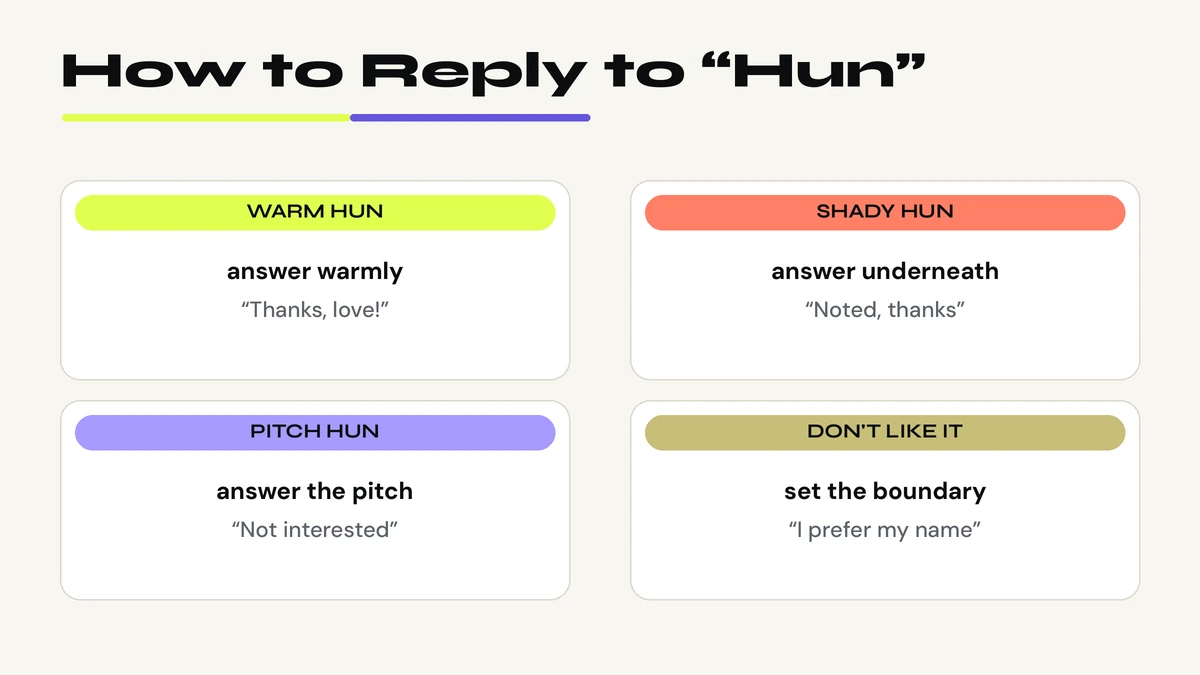
One rule, then six replies: match the temperature, not the word. Answering warmth with warmth works; answering shade with sweetness does not:
- Warm hun — answer warmly: “Thanks, love!” or “Thanks hun!” A real pet name deserves a real answer.
- Regional-friendly hun — smile and move on: “Thank you!” A normal answer; no return pet name is owed to a stranger.
- Playful hun — play back: “I know, hun, I know” Playful, at the same level, no escalation.
- Shady hun — answer the sentence underneath: “Noted, thanks” Brief, unbothered, and it refuses both the sweetness and the sting.
- Pitch hun — answer the pitch: “Not interested, thanks” Or ignore it. Never answer the pet name instead of the pitch.
- Hun you do not like — set the boundary: “I prefer my name, actually” Warm, direct, no lecture. For repeat offenders: “Please don’t call me hun” — plain, and final.
Weak versus strong. Weak: “ok” to a warm hun, or “Aww, thanks hun!” to a pitch hun. Strong: “Thanks, love!” to the warm one, and “Not interested, thanks” to the pitch. Golden rule: never answer a shady hun with a sharper hun — two pet names in a row is a fight wearing a smile.
Frequently Asked Questions
What does “hun” mean in a text message?
“Honey” — a short, warm way to address someone. “You got this, hun!” is encouragement with a smile tucked into one small word.
What does “hun” mean on TikTok, Snapchat, and Instagram?
The same address everywhere — no platform-specific meaning exists. TikTok stages it as a comment address, Snapchat as a private DM address, Instagram as a story reply or DM address.
Is “hun” flirty?
Not by itself. A pet name is not a romantic signal — a waitress’s hun and a partner’s hun are the same word doing different jobs. Check the relationship, the timing, and what rides with it.
Is “hun” rude or condescending?
It can be, when the load is shade: “Oh hun, bless your heart” mid-argument is a judgment in a sweet wrapper. But a regional “here you go, hun” from a stranger is manners, not condescension — run the Warmth Test before deciding.
What does “hun” mean when a stranger sends it with a sales pitch?
That is the MLM hun: warmth as a funnel. Wiktionary attests the noun sense — a woman in a multi-level marketing scheme — and the pitch reading needs an actual pitch riding with it. Answer the pitch, not the pet name.
What’s the difference between “hun” and “honey”?
Almost none — hun is honey clipped and spelled as it sounds. Honey is slightly warmer and more formal; hun is quicker, chattier, and more likely to carry sass.
Someone just called me “hun” and I don’t like it. What do I say?
“I prefer my name, actually” — warm, direct, no lecture. For repeat offenders: “Please don’t call me hun.” You do not owe a pet name back to anyone.
The Takeaway
“Hun” is a three-letter pet name — “honey”, clipped short — that warms, teases, or wounds depending on who says it, where it sits, and what rides with it. When the letters arrive, run the Warmth Test: who, where, load. And when you send one, remember: a pet name claims a closeness the reader may not have granted you.