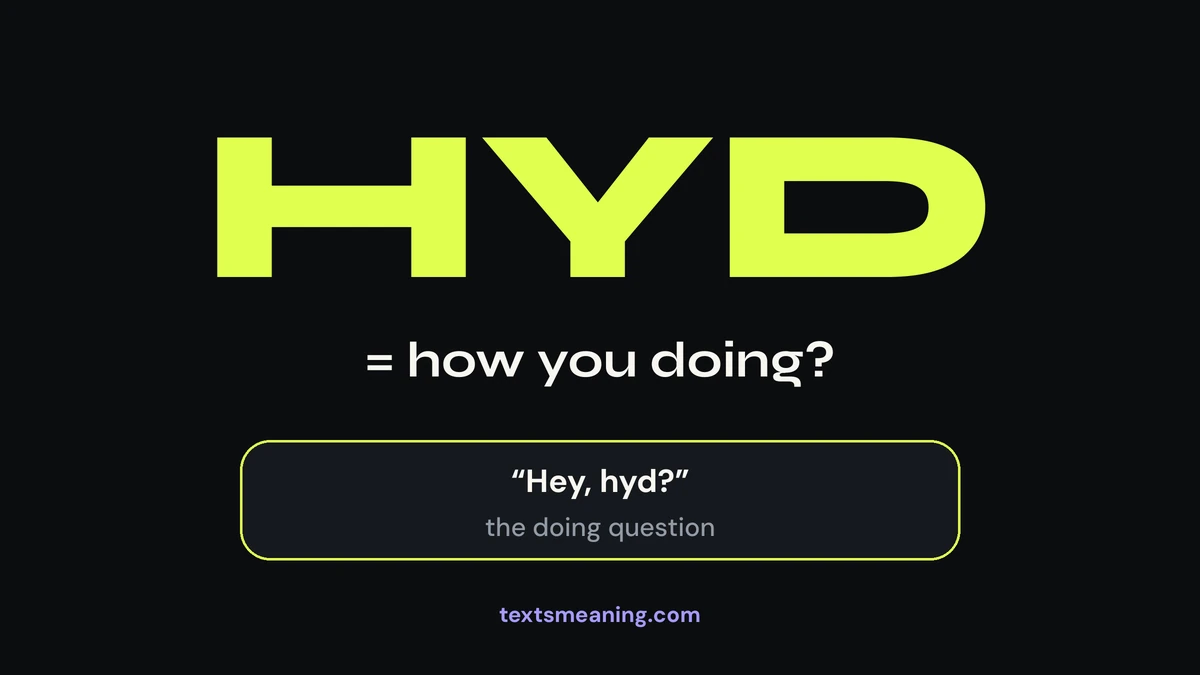
What does HYD mean in text? HYD means “how you doing?” — a friendly check-in typed in three letters. That last word is the catch: “doing” invites two answers at once, how you are and what you are up to, and most replies only give one.
This guide covers the HYD Doing Test, a seven-reading tone list, HYD on TikTok, Snapchat, Instagram, and in texts, senders, misreads, graded claims, cousins, history, and the reply rule.
What “HYD” Means in Text
“HYD” means “how you doing?” The letters stand for how, you, and doing, with “you” compressed to “y”. Every secondary guide read agrees on that expansion. Here is the honest caveat: the primary dictionary does not attest this sense. Wiktionary's lowercase hyd entry carries only historical and non-English senses, and its uppercase HYD entry carries only the Hyderabad airport code. This guide therefore grades HYD as strong secondary consensus, not dictionary-attested.
HYD does three jobs. As an opener: “Hey! hyd?” starts a conversation with no topic yet. As a check-in: “Heard you were sick. hyd?” asks about someone for real. As a pass-back: “Good here. hyd?” hands the question over after answering it. Same letters, three jobs — and one puzzle the Doing Test solves: which half of “doing” does the sender want?
HYD is the run's first greeting with a dictionary gap. Earlier guides could point to a dictionary entry and move on; HYD cannot, so this guide answers both questions out loud: how solid is this, and what answer does it want?
The HYD Doing Test
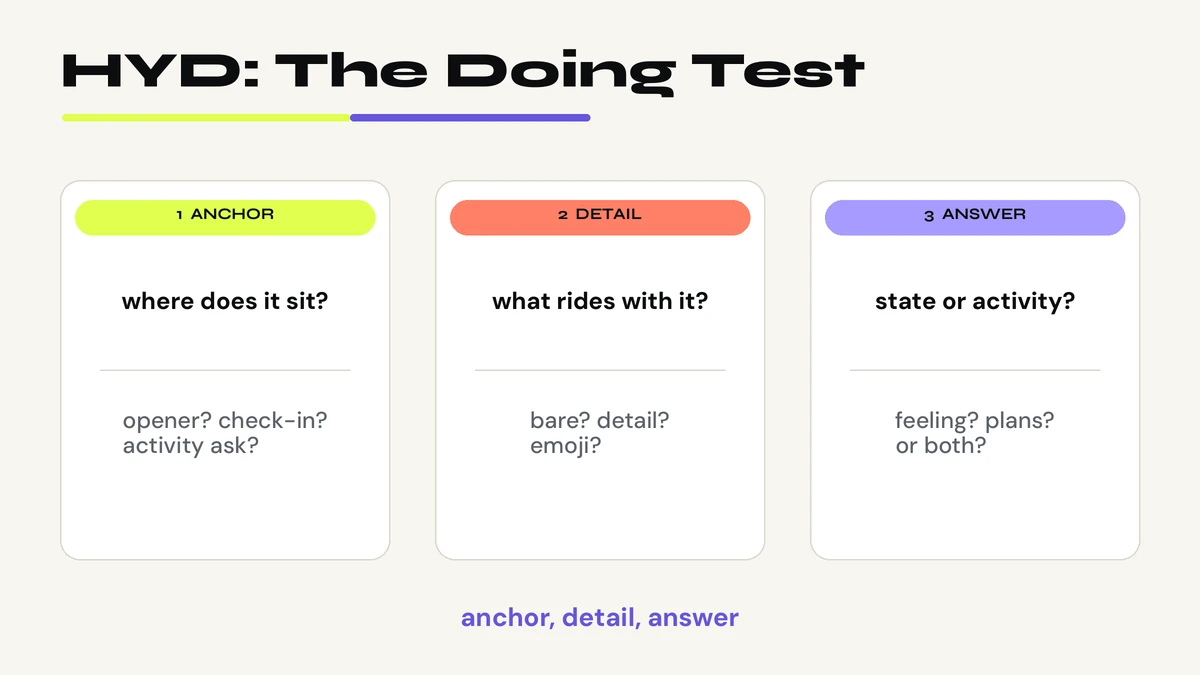
HYD has one real ambiguity, and it is not the expansion: does “doing” want a state report or an activity report? Three checks settle it:
- Check 1 — The Anchor Check. Where does HYD sit? At the start of a thread after silence it is an opener. Mid-chat after news, illness, or a hard week it is a check-in: the sender wants to know how you are. After a plan or a photo it leans activity.
- Check 2 — The Detail Check. What rides with it? A bare “hyd?” travels light and wants the lightest answer. “hyd today?” or “hyd after the move?” carries a detail naming the topic. An emoji or follow-up (“hyd? long time!”) adds warmth the letters cannot.
- Check 3 — The Answer Check. State or activity? If the anchor is wellbeing, lead with state: “doing better, thanks.” If the anchor is plans, lead with activity: “just chilling at home.” When unsure, give one line of each: “Pretty good, just got home.” A two-part answer can never misfire the way a bare “good” can.
Worked trio. “Hey, hyd?” after a month of silence — opener, light load: a hello; answer warmly and briefly. “Heard you were sick. hyd?” — check-in, loaded: answer honestly about how you are. “hyd? what are you up to tonight?” — activity-leaning: answer the plans, not just the mood.
“HYD” in Real Chats
Illustrative examples written for this guide, not real transcripts:
- The friendly opener. “Hey! hyd?” — the default HYD: a hello with a question attached.
- The warm check-in. “Heard you were sick. hyd?” — the sender means it; this one deserves a real answer.
- The soft re-entry. “Long time no chat. hyd?” — “I thought of you” without any pressure.
- The pass-back. “Good here. hyd?” — the question, handed over after an answer.
- The activity ask. “hyd? what are you up to tonight?” — the “doing” half doing the work; answer the plans.
- The playful nudge. “hyd tho?” late at night from a crush — flirtation lives in the timing, not the letters.
The HYD Tone List
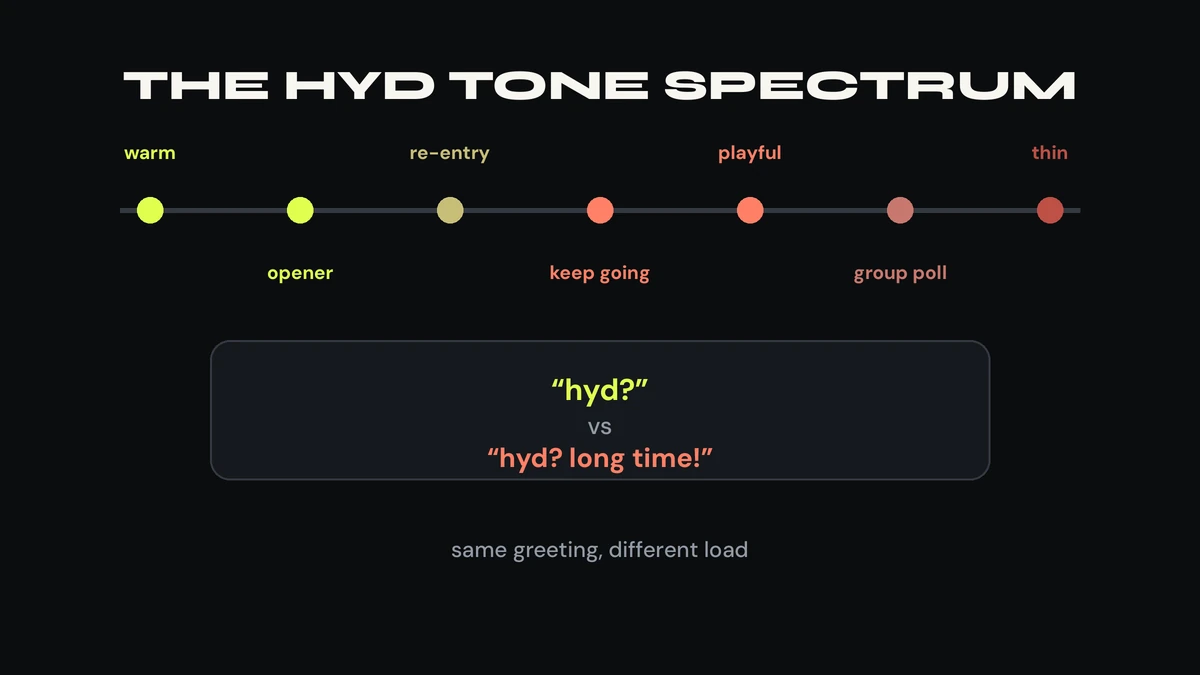
HYD's meaning stays “how you doing?”; its tone slides. Seven readings, warmest to thinnest:
- Warm check-in: “Heard you were sick. hyd?” — genuine care; the sender means it.
- Friendly opener: “Hey! hyd?” — the default: a hello with a question attached.
- Soft re-entry: “Long time no chat. hyd?” — “I thought of you,” no pressure.
- Casual keep-it-going: “Good here. hyd?” — small talk; the pass-back doing its job.
- Playful nudge: “hyd tho?” or “hyd 😏” late at night from a crush — timing and emoji flirt, never the letters alone.
- Group poll: “hyd everyone?” — an open check-in; nobody owes a private answer.
- Low-effort or thin: a bare “hyd” from a stranger, or after distance or bad news, with no detail and no warmth — reads as checked-out, not caring.
Anchor, detail, and answer move a reading up or down this list: a detail warms it, bareness thins it.
“HYD” on TikTok
On TikTok, HYD is a comment-section greeting: “hyd everyone?” under a creator's video, or “hyd today?” as a reply to a familiar commenter. A hello thousands can read without owing an answer. The warm check-in reading is rare here; the opener and group-poll readings dominate.
“HYD” on Snapchat
On Snapchat, HYD fits the fast, disappearing DM: “hyd?” on a streak snap, or “hey hyd today?” as a story reply opening a private chat. The disappearing format suits an opener: a greeting that lands lightly and vanishes. The thin reading is easiest to misjudge here, since the message vanishes before you can re-read it.
“HYD” on Instagram
On Instagram, HYD shows up in story replies and DMs: “hyd? loved the photos” as a story reply, or “hey, hyd?” as a DM opener. Public replies lean group poll; DMs carry the full range. A match's “hyd today?” is the classic low-pressure opener.
“HYD” in Text Messages
Plain texts are HYD's home ground. It pairs with the reassurance companion DW — “hyd? dw, I'm doing fine” — and with the side-note companion BTW: “hyd? btw, did you see the game?” It also travels with the invitation companion HMU: “hyd? hmu later.” Four abbreviations, four jobs, one fluent chat.
Texts are also HYD's work habitat — and its limit: in a work Slack, an “hyd” to a teammate you know well is friendly small talk, but a formal email wants “how are you doing?” spelled out. The test: if you would not say “hey” in the message, do not say “hyd.”
Who's Sending It: How “HYD” Lands by Sender
No source documents a different meaning of HYD per sender — the greeting stays fixed; what changes is what the sender wants:
- Friend: the default. A friend's “hyd?” is an opener or check-in at face value; answer the topic.
- Crush: overread territory. A crush's “hyd tho?” feels bigger than it is — a nudge, not a confession.
- Partner: pattern rules. A partner's “hyd?” is usually genuine; judge the pattern, not one message.
- Parent: common and usually warm. A parent's “hyd, sweetie?” is care, plain and simple.
- Coworker: context decides. In a casual channel it is friendly small talk; in a deadline thread, answer the work first.
- Group chat: the poll habitat. A group's “hyd everyone?” is an open check-in; answer briefly in the group.
- Stranger or ex: the low-effort habitat. A bare “hyd” here is a door cracked open; a short answer, or silence, ends it without rudeness.
When “HYD” Is Not Just Friendly
Four misfires, graded. First, the activity trap: answering “hyd?” with only what you are doing when the sender asked how you are — “just watching TV” after “Heard you were sick. hyd?” dodges the real question. Run the Anchor Check first. Second, the flirting assumption: a simple greeting is not a romantic signal; check timing, emoji, and history first. Third, the overthinking trap: treating a bare “hyd” as a deep check-in, when most senders want a line or two.
Fourth, the thin reply after bad news: a bare “hyd” where a real sentence was owed reads as checked-out. If you sent it, a follow-up with a detail repairs it. If you received it, apply the Detail Check: no detail plus bad news equals thin. The closest cousin here is FWIW (“for what it's worth”): FWIW softens an opinion; HYD opens a chat. FWIW says “take it or leave it”; HYD says “tell me how you're doing.”
Checked Claims: Expansions That Don't Hold Up
Three letters attract folklore. The claims that fail evidence:
- “HYD means 'Hey You Dude'” — rejected. A listed mistake in one secondary guide, with no attestation and no chat example.
- “HYD means 'How'd you do?'” — rejected. A garbled, past-tense expansion from a low-quality source; the unanimous form is present-tense “how you doing?”
- “HYD means 'hydration' in a text” — rejected for chat. A health shorthand in its own register; a “hyd?” in a DM is not asking about water intake.
- “HYD means 'hydrogen' in a text” — rejected. A science abbreviation with zero chat relevance.
- “HYD means 'High-Yield Debt' in a text” — rejected for chat. A finance expansion floated by one guide with no chat attestation.
- “HYD means 'Hyderabad' in a text” — fenced, not a texting meaning. Real as the IATA code HYD and a travel shorthand, but only in travel contexts; in a DM it is “how you doing?”
- “HYD comes from the Friends sitcom” — rejected as origin. The show popularized the spoken catchphrase, but no source dates the abbreviation to the show; the first slang-dictionary entry dates to 2010, after the show ended.
- “HYD is flirty by itself” — rejected. The letters are neutral; flirting comes from timing, emojis, and the relationship.
- “HYD means something different on each platform” — rejected. No source documents a platform-specific meaning; platforms stage the same check-in differently.
- “HYD works in formal writing” — rejected. Formal contexts want “how are you doing?” spelled out; if you would not say “hey” in the message, do not say “hyd.”
What SURVIVES: “how you doing?” (strong secondary consensus, dictionary gap disclosed), with the readings above as jobs of the same greeting — not different meanings. No competitor percentages are repeated here as fact.
“HYD” vs Its Closest Cousins
HYD belongs to the conversation-flow family — words that open, steer, or close a chat:
- HRU (“how are you?”) — the state cousin, and the most important one. HRU asks about state; HYD asks about state plus activity. HRU checks the feeling, HYD checks the feeling and the day.
- WYD (“what you doing?”) — the activity cousin, mentioned without a link because no live TextsMeaning WYD guide was verified. WYD asks about plans; HYD asks about wellbeing first.
- HBU (“how about you?”) — the return cousin. HBU asks second; HYD asks first. HYD answers usually end with a bounce-back: “Pretty good, just got home. hbu?”
- GN (“good night”) — the closer cousin. GN ends the night; HYD opens the chat. GN says “we're done”; HYD says “let's talk.”
HYD often travels with a bounce-back — “hyd? hbu?” — the cheapest way to keep a new conversation two-sided.
Where “HYD” Came From
The phrase “how you doing?” is old everyday English — centuries older than any abbreviation. The HYD shortening belongs to the SMS and instant-messaging era: secondary guides converge on the early 2000s, when AIM, MSN Messenger, and the 160-character SMS limit punished every extra letter. The first slang-dictionary entry dates to 2010, which is attestation, not coinage. No inventor, first-use date, or Friends origin is claimed.
How to Reply When Someone Sends “HYD”
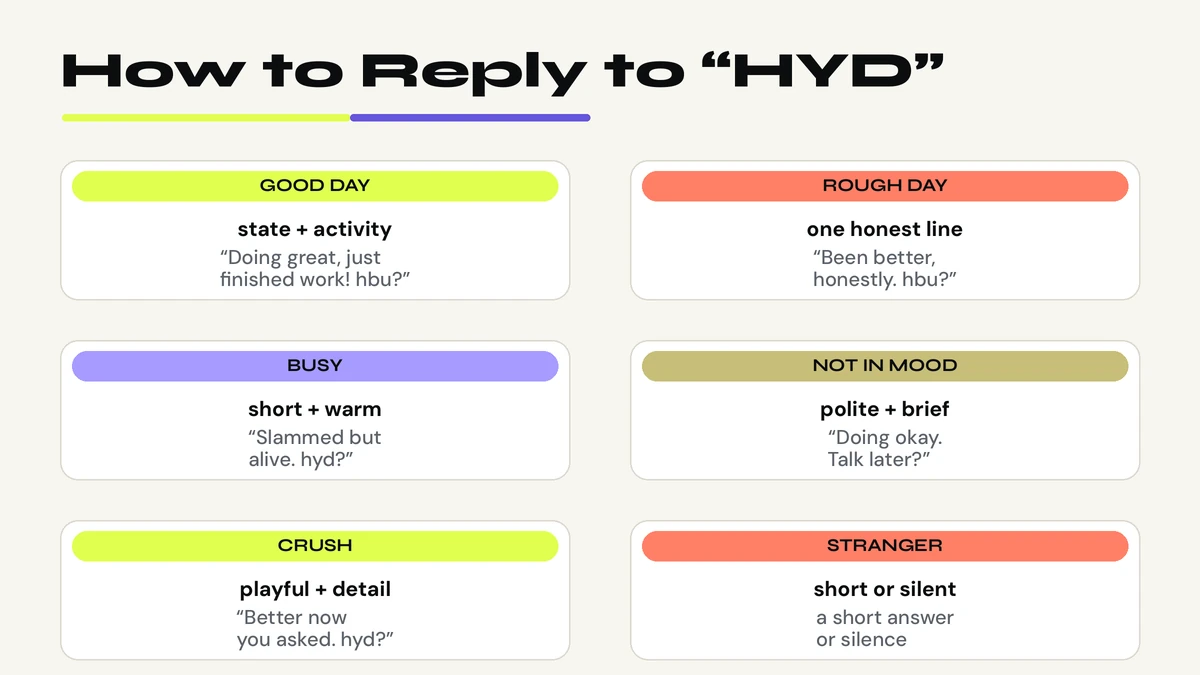
One rule, then six replies: answer with state plus activity, then send it back. A bare “good” answers neither half of HYD properly; one line of each keeps every thread alive:
- Good day — match the energy: “Doing great, just finished work! hbu?” A warm opener deserves a warm answer.
- Rough day — one honest line: “Been better, honestly. hbu?” True, brief, and it leaves the door open.
- Busy — short and warm: “Slammed but alive. hyd?” Friendly, without pretending you have time you do not.
- Not in the mood — polite and brief: “Doing okay. Talk later?” A complete answer that closes nothing rudely.
- Crush — playful plus one detail: “Better now that you asked. hyd?” Playful, but still a real answer.
- Stranger or ex — short or silent: a short answer or silence ends it without rudeness.
Weak versus strong. Weak: “good.” Strong: “Pretty good, just got home. hbu?” Small change, big difference. Golden rule: never answer an HYD with another bare “hyd?”
Frequently Asked Questions
What does “HYD” mean in a text message?
“How you doing?” — a quick, friendly check-in. “Hey, hyd?” invites a state report, an activity report, or both.
What does “HYD” mean on TikTok, Snapchat, and Instagram?
The same check-in everywhere — no platform-specific meaning exists. TikTok stages it as a comment greeting, Snapchat as a DM opener, Instagram as a story reply.
Is a bare “hyd” rude?
Not by itself — a bare HYD is usually just shorthand. It reads thin only when it lands after distance or bad news with no detail and no warmth.
What's the difference between “HYD” and “HRU”?
HRU asks about state; HYD asks about state plus activity. Answer an HRU with a feeling; answer an HYD with a feeling and a doing.
What's the difference between “HYD” and “WYD”?
WYD asks about activity; HYD asks about wellbeing first. WYD wants your plans; HYD wants to know how you are doing.
Can I use “HYD” at work?
In a casual team chat, yes. In a formal email, spell out “how are you doing?” instead. If you would not say “hey” in the message, do not say “hyd.”
Someone just sent me “HYD”. What do I say?
Answer with state plus activity, then send it back: “Pretty good, just got home. hbu?” beats a bare “good.”
The Takeaway
“HYD” is a three-letter friendly check-in — “how you doing?” — that asks about doing in both senses. When the letters arrive, run the Doing Test: anchor, detail, answer. And when you send one, remember: a greeting that asks about doing deserves an answer with a doing in it.