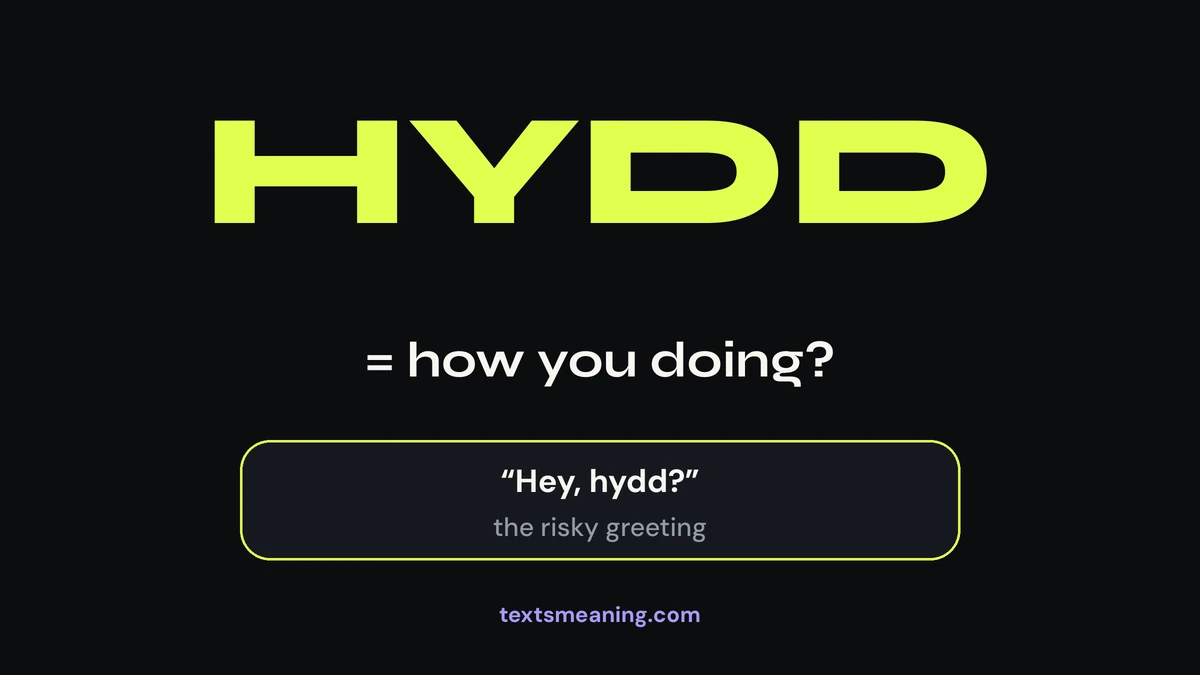
What does HYDD mean in text? HYDD means “how you doing?” — a quick, casual greeting typed in four letters. “Hey, hydd?” is the whole question, shortened for speed. But HYDD carries a warning no earlier guide in this series needed: no dictionary lists it yet, so some readers will not know it at all.
This guide to hydd meaning in text covers the HYDD Recognition Test, a seven-reading tone list, HYDD on TikTok, Snapchat, Instagram, and in texts, senders, misreads, graded claims, cousins, history, and the confusion-proof reply rule.
What “HYDD” Means in Text
“HYDD” means “how you doing?” It is the greeting HYD — how, you, doing — with one extra D, an emphatic spelling of “doing” that also happens to be the easiest typo in texting: one finger slipping on the D key turns HYD into HYDD. Both paths lead to the same question, which is why received HYDD is almost always safe to read as HYD.
Here is the honesty part, stated plainly because it changes how you should use the word. The primary dictionary source does not attest HYDD as a texting term: Wiktionary’s lowercase hydd entry lists only the Welsh noun for a stag, with no English texting sense at all, and no other established dictionary was found to list it either. The expansion rests on community attestation: the fullest HYDD guide defines it as “How You Doing?”, and a second guide notes HYDD is “often a typo or extended version of HYD”, with context deciding intent. That is real usage evidence, but it is not dictionary evidence — and the rest of this guide is built around that gap.
HYDD does the same three headline jobs as its parent HYD. As an opener: “Hey! hydd?” starts a conversation with no topic yet. As a check-in: “Heard about your week. hydd?” asks about someone for real. As a group poll: “hydd guys?” opens a chat to everyone at once. Same letters, three jobs — but unlike HRU, HYDD adds a fourth question the reader must answer first: is this even a word? The Recognition Test below settles it.
The HYDD Recognition Test
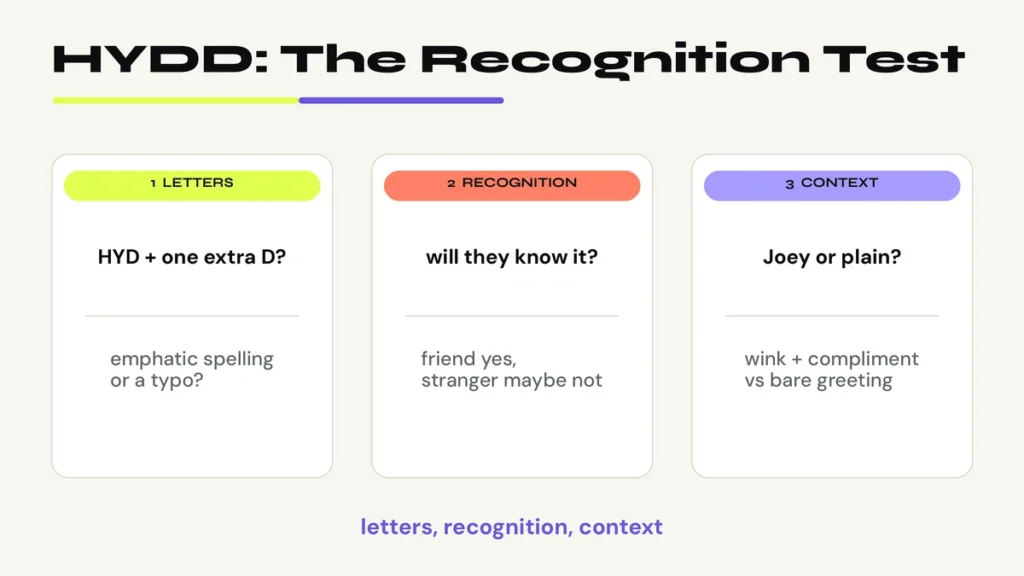
Before you trust or send an HYDD, run three checks:
- Check 1 — The Letters Check. Does it read as HYD plus one extra D? HYDD = H(ow) Y(ou) D(oing) D. The doubled D is the tell: either an emphatic spelling of “doing” or a finger slipping on the D key. Either way the intended question is “how you doing?” — never a different meaning.
- Check 2 — The Recognition Check. Would THIS reader know HYDD? A slang-savvy friend probably reads it instantly; a parent, a coworker, or a new match may stall on it. If the reader might stall, the greeting has already failed at its one job — a greeting that needs explaining is not a greeting.
- Check 3 — The Context Check. Is it Joey-mode or plain-mode? A HYDD with a wink, a compliment, or a story reply leans Joey (“How you doin’?”); a bare “hydd?” after a gap leans plain check-in. Context, never the letters alone, decides the flirtation.
Worked trio. “Hey, HYDD? It’s been a minute!” — letters pass, recognition likely with an old friend, context plain: a re-entry, answer warmly. “HYDD, looking great in that photo!” — Joey-mode: the compliment flirts, not the letters. A bare “hydd” from a stranger — recognition fails and context is empty: treat it as a low-effort HYD, answer short or not at all.
“HYDD” in Real Chats
Illustrative examples written for this guide, not real transcripts:
- The friendly opener. “Hey! hydd?” — the default HYDD: a door opening, no weight attached.
- The warm check-in. “Heard about your week. hydd?” — the sender means it; this one deserves a real answer.
- The Joey-flirt. “HYDD, looking great in that photo!” — the Friends line doing the flirting, not the letters.
- The soft re-entry. “Long time no talk. hydd?” — “I thought of you” without any pressure.
- The group poll. “hydd guys? Anyone up for a game tonight?” — an open check-in; nobody owes a private answer.
- The confusing bare HYDD. A lone “hydd” from someone you barely know — the greeting becomes a puzzle, and the sender looks careless, not casual.
The HYDD Tone List
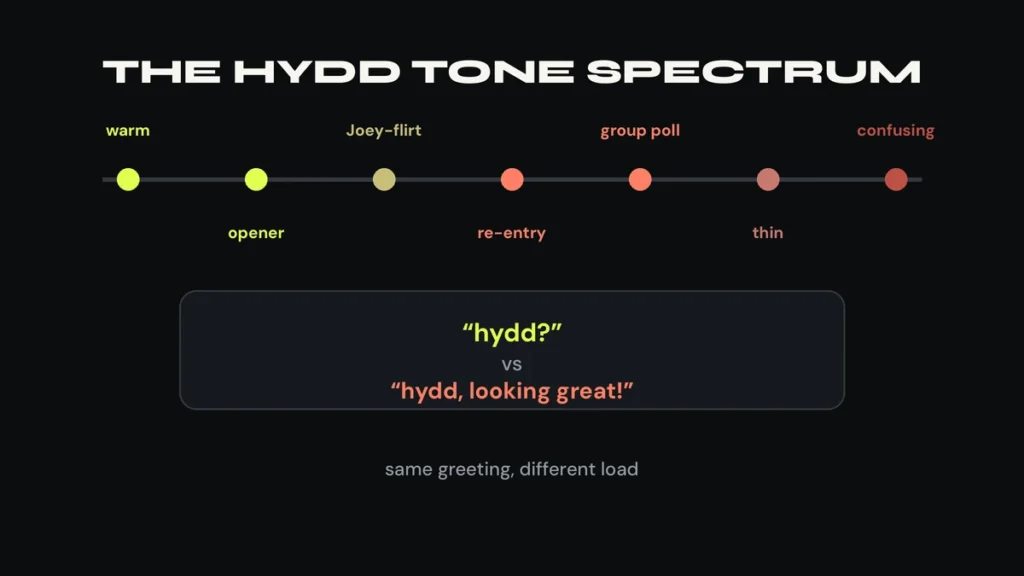
HYDD’s meaning stays “how you doing?”; its tone slides — and at the far end it slides off the scale entirely into confusion. Seven readings, warmest to riskiest:
- Warm check-in: “Heard about your week. hydd?” — genuine care; the sender means it.
- Friendly opener: “Hey! hydd?” — the default: a door opening, no weight.
- Joey-flirt: “hydd, looking great in that photo!” — playful, but only because the compliment and the timing say so.
- Soft re-entry: “Long time no talk. hydd?” — “I thought of you,” no pressure.
- Group poll: “hydd guys?” — an open check-in; nobody owes a private answer.
- Low-effort or thin: a bare “hydd” from a stranger, or after distance or bad news, with no detail and no warmth — reads as checked-out, not caring.
- Confusing or typo-read: any HYDD sent to a reader who does not know it — the greeting becomes a puzzle, and the sender looks careless. This seventh reading is HYDD’s alone: no earlier term in this series carried it.
Letters, recognition, and context move a reading up or down this list: a detail warms it, a compliment flirts it, and an unknown reader sinks it straight to the bottom.
“HYDD” on TikTok
On TikTok, HYDD is a comment-section greeting — “hydd everyone?” under a creator’s video, or “hydd today?” as a reply to a familiar commenter. The public stage suits a greeting, but it punishes HYDD’s weakness: a comment cannot carry a private explanation, so a reader who does not know HYDD has nowhere to ask. The opener and group-poll readings dominate here; the warm check-in reading is rare, since a comment cannot carry a real relationship. If you want a TikTok greeting everyone gets, HYD or HRU is the safer pick.
“HYDD” on Snapchat
On Snapchat, HYDD fits the fast, disappearing DM: “hydd?” on a streak snap, or “hey hydd today?” as a story reply opening a private chat. The disappearing format suits an opener: a greeting that lands lightly and vanishes. But disappearance also removes the evidence: if an HYDD felt off, you cannot re-read it, so judge from memory what rode with it — a detail, an emoji, or nothing at all. And because streak culture rewards speed, Snapchat is where the HYD-to-HYDD typo is most likely born; a streak-snap HYDD deserves the benefit of the doubt.
“HYDD” on Instagram
On Instagram, HYDD shows up in story replies and DMs: “hydd? loved the photos” as a story reply, or “hey, hydd?” as a DM opener. Public replies lean group poll; DMs carry the full range. Instagram is also where HYDD’s dating life shows most: a match’s “hydd today?” is the classic low-pressure opener, and a match’s “hydd, looking great in that photo!” is Joey-mode in its natural habitat. Either way, the rule holds: if the match is new and the greeting is bare, the confusion reading is live.
“HYDD” in Text Messages
Plain texts are HYDD’s home ground, and the place its typo story is easiest to see: fast thumbs, small keyboards, and a D key pressed twice. It pairs with the reassurance companion DW — “hydd? dw, I’m doing fine” pairs question with reassurance in one breath — and with the side-note companion BTW: “hydd? btw, did you see the game?” opens the chat and pivots in the same message. It also travels with the opener companion HMU in reunion texts: “hydd? hmu when you’re free” asks how you are and asks you to reach out, in one breath.
Texts are also HYDD’s work limit: in a casual team chat, a “hydd” to a teammate you know well is friendly small talk, but a formal email wants “how are you doing?” spelled out — and a client who does not know HYDD will read it as a typo in a professional message, which is worse than informal. The test: if you would not say “hey” in the message, do not say “hydd.”
Who’s Sending It: How “HYDD” Lands by Sender
No source documents a different meaning of HYDD per sender — the greeting stays fixed; what changes is how likely the reader is to know it, and what the sender wants:
- Friend: the default. A friend’s “hydd?” is an opener or check-in at face value; recognition is likely, so answer the topic and add one detail.
- Crush: overread territory. A crush’s “hydd, looking great in that photo!” feels bigger than it is — a nudge in Joey-mode, not a confession.
- Partner: pattern rules. A partner’s “hydd?” is usually genuine; judge the pattern across days, not one message, and the spelling quirk is just theirs.
- Parent: recognition risk. A parent’s “hydd?” is usually care, but a parent is also the reader most likely to stall on the letters — answer warmly, and do not mirror a spelling they may not know.
- Coworker: context decides. In a casual channel it is friendly small talk; in a deadline thread, answer the work first — and never open a client message with it.
- Group chat: the poll habitat. A group’s “hydd guys?” is an open check-in; answer briefly in the group, not privately, and someone in the group will usually get it even if one person does not.
- Stranger or ex: the low-effort habitat. A bare “hydd” here is a door cracked open, not a conversation; a short answer, or silence, both end it without rudeness.
When “HYDD” Is Not Just Friendly
Four misfires, graded. First, the flirting assumption: a simple greeting is not a romantic signal, even in Joey-mode — check timing, emoji, and history before reading flirtation into it. Second, the overthinking trap: treating a bare “hydd” as a deep check-in. Most senders want a line or two, not a life update. Third, the thin reply after bad news: a bare “hydd” where a real sentence was owed reads as checked-out; if you sent it, a follow-up with a detail repairs it.
Fourth, the confusion misfire — HYDD’s own, and the one no earlier guide needed: sending HYDD to someone who reads it as a typo makes you look careless, not casual. The closest companion here is FWIW (“for what it’s worth”): FWIW softens an opinion; HYDD opens a chat. FWIW says “take it or leave it”; HYDD says “how you doing?” — but only if the reader knows the word. On appropriateness: HYDD is not rude and not vulgar in any reading; its risk is social, not moral — confusion, not offense. Keep it out of formal, professional, and first-impression messages, where a spelled-out question costs nothing.
Checked Claims: Expansions That Don’t Hold Up
- “HYDD means ‘How You Doing, Dear Dude Doll?’” — rejected. A nonsense expansion surfaced in one search snippet with no source, no attestation, and no chat example.
- “HYDD means ‘here’, or HYDD is huddle slang” — rejected. Content-farm filler that confuses the sound of the letters with a texting meaning; no dictionary, no chat example, no usage.
- “Joey Tribbiani invented HYDD” — rejected as stated. Joey popularized the spoken line “How you doin’?”; no evidence ties the four letters HYDD to the show, and even the fullest HYDD guide admits the exact moment cannot be pinpointed.
- “Everyone knows what HYDD means” — rejected. HYDD is rare and non-dictionary; many readers will read it as a typo of HYD. A guide that promises universal recognition is selling comfort, not fact.
- “HYDD means something different on each platform” — rejected. No source documents a platform-specific meaning; platforms stage the same greeting differently.
- “HYDD is flirty by itself” — rejected. The letters are neutral; flirting comes from the Joey-line delivery, timing, emojis, and the relationship.
- “HYDD means Hyderabad” — rejected for chat. That is a HYD/geography confusion, and HYDD carries no city sense anywhere.
- “HYDD is always a typo, never a term” — fenced, not fully rejected. One guide says “often” a typo or extended HYD, which leaves a real minority usage as an intentional greeting; this article treats received HYDD as HYD unless context says otherwise.
- “HYDD works in formal writing” — rejected. Formal contexts want “how are you doing?” spelled out; if you would not say “hey” in the message, do not say “hydd.”
What SURVIVES: “how you doing?” (community-attested, not dictionary-attested), with the readings above as jobs of the same greeting — not different meanings. No competitor percentages are repeated here as fact, and nothing is claimed about the one dictionary page that could not be read.
“HYDD” vs Its Closest Cousins
HYDD belongs to the conversation-flow family — words that open, steer, or close a chat. Its parent HYD (“how you doing?”) is discussed by name throughout this guide. The published cousins:
- HRU (“how are you?”) — the closest published cousin, and the most important one. HRU asks “how are you?”; HYDD asks “how you doing?” HRU says “how are you feeling?”; HYDD says “how are things going?” HRU is dictionary-attested; HYDD is not — when in doubt, send HRU.
- HBU (“how about you?”) — the return cousin. HBU asks second; HYDD asks first. HBU says “now yours”; HYDD says “how you doing?” The pair is one system: HYDD opens, HBU returns.
- HMU (“hit me up”) — the opener companion: HMU asks for contact later; HYDD asks how you are now. HMU says “reach out”; HYDD says “talk to me.”HMU
- BRB (“be right back”) — the pause cousin. BRB suspends a chat with a promise to return; HYDD starts one with a question. BRB says “hold on”; HYDD says “how you doing?”
HYDD often travels with a bounce-back — “hydd? hbu?” — but never answer an HYDD with another bare “hydd?”: two unclear greetings do not make a clear one.
Where “HYDD” Came From
The phrase “how you doing?” is ordinary English, and the spoken catchphrase “How you doin’?” was popularized by Joey Tribbiani on Friends (1994–2004) — that much is pop-culture fact, and every HYD guide repeats it. The abbreviation path is the usual SMS-era story: early-2000s character limits and T9 keypads rewarded short greetings, HYD condensed “how you doing?” to three letters, and HYDD appears as its extended or mistyped four-letter shadow. No inventor, no first-use date, and no dictionary entry is claimed for HYDD itself: this article dates the phrase and the HYD shortening, and leaves HYDD undated, because inventing a birthday for a word would be worse than admitting we do not know it.
How to Reply When Someone Sends “HYDD”
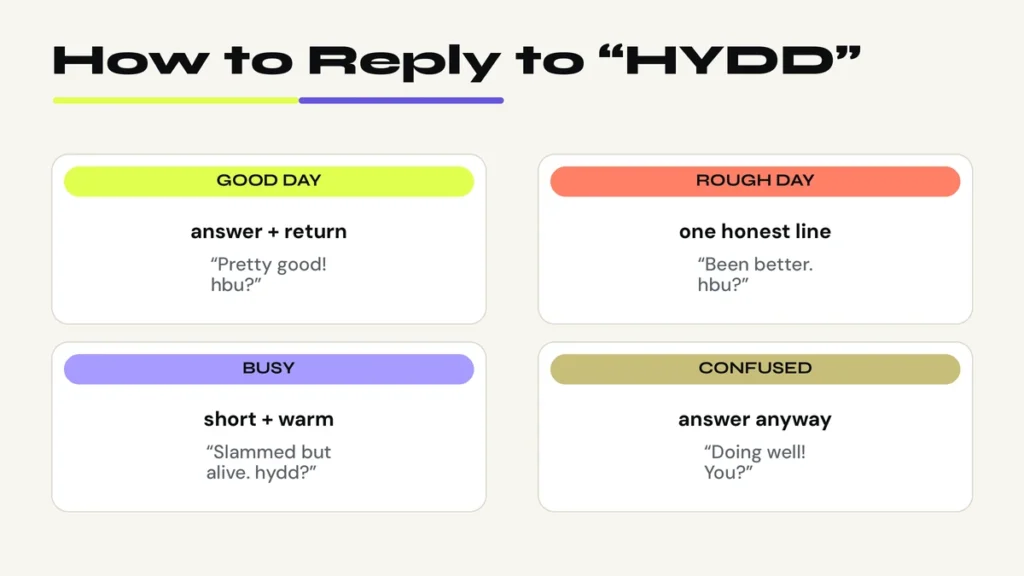
One rule, then six replies: answer the question, add one detail, and do not mirror a risky spelling back. A bare “good” or “fine” kills most threads; one small detail keeps them alive:
- Good day — match the energy: “Pretty good, just got home. hbu?” A warm opener deserves a warm answer.
- Rough day — one honest line: “Been better, honestly. hbu?” True, brief, and it leaves the door open.
- Busy — short and warm: “Slammed but alive. hydd?” Friendly, without pretending you have time you do not — mirroring is safe here, because the sender already used the word.
- Not in the mood — polite and brief: “Doing okay. Talk later?” A complete answer that closes nothing rudely.
- Crush — playful plus one detail: “Better now that you asked. hydd?” Playful, but still a real answer.
- Confused — you cannot tell typo from term: answer the question anyway: “Doing well! You?” covers both readings, and never ask “what does hydd mean?” unless you actually need to — the question answers itself.
Weak versus strong. Weak: “fine.” Strong: “fine, just finished a long meeting. hbu?” Small change, big difference. Golden rule: never answer an HYDD with another bare “hydd?” — unless, like the busy reply above, the sender already set the spelling and you are matching their energy, not starting a puzzle.
Frequently Asked Questions
What does “HYDD” mean in a text message?
“How you doing?” — a quick, casual greeting and check-in, the same question as HYD with an extra D.
Is HYDD a real word or just a typo of HYD?
Both, depending on the message. It is used as a real greeting in community guides, and it is also the easiest HYD typo to make. Treat a received HYDD as HYD unless the context says otherwise, and treat a sent HYDD as a clarity risk.
Does any dictionary list HYDD?
No dictionary entry for the texting sense was found: Wiktionary’s lowercase hydd entry lists only the Welsh word for a stag. That does not make HYDD meaningless — it makes it community slang, not dictionary slang — but it is why this guide recommends HYD or HRU when clarity matters.
What does “HYDD” mean on TikTok, Snapchat, and Instagram?
The same greeting everywhere — no platform-specific meaning exists. TikTok stages it as a comment greeting, Snapchat as a disappearing DM opener, Instagram as a story reply or DM opener, and every stage carries the same recognition risk.
Is a bare “hydd” rude?
Not rude — but riskier than a bare HYD. A bare HYDD is usually just shorthand; it reads thin only after distance or bad news with no detail, and confusing whenever the reader does not know the word.
What’s the difference between “HYDD” and “HRU”?
HYDD asks “how you doing?”; HRU asks “how are you?” HYDD is the doing-question, HRU the feeling-question — and HRU is dictionary-attested while HYDD is not, so HRU is the safer send to anyone who might stall.
Did Joey from Friends invent HYDD?
No. Joey popularized the spoken line “How you doin’?”; no evidence ties the four letters HYDD to the show. The catchphrase made the question famous — the abbreviation came later, from texting culture.
Someone just sent me “HYDD”. What do I say?
Answer the question, add one detail, send it back: “Pretty good, just got home. hbu?” beats a bare “good” — and if you cannot tell typo from term, “Doing well! You?” covers both.
The Takeaway
“HYDD” is a four-letter casual greeting — “how you doing?” — that opens, checks in, or polls a group. When the letters arrive, run the Recognition Test: letters, recognition, context. And when you send one, remember: a greeting your reader cannot read is not a greeting at all — it is a typo wearing a greeting’s clothes.