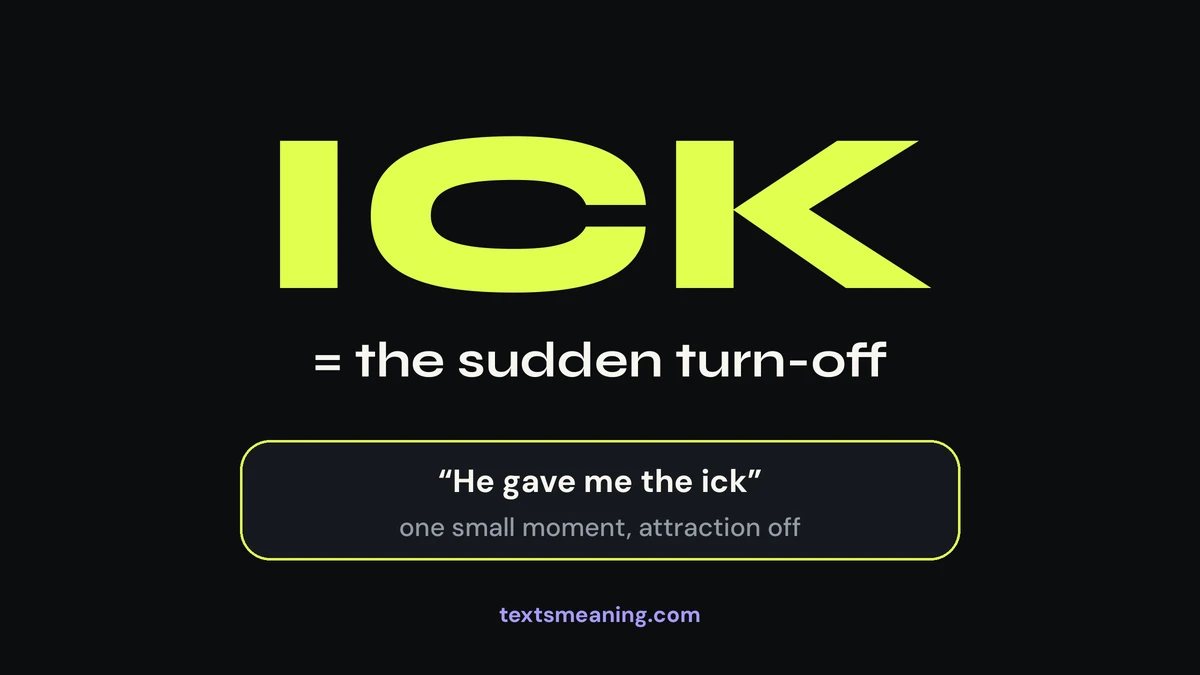
What does ick mean in text? Ick means a sudden feeling of repulsion — in dating, usually “the ick”: one small moment that flips attraction off, fast, for no reason you can defend. “He chews so loudly. Instant ick.” That is the whole feeling in one line.
This guide to ick meaning in text covers the ICK Flip Test, a real tone list, ick on TikTok, Snapchat, Instagram, and in texts, senders, misuse, graded claims, cousins, history, and what to say when someone mentions the ick.
What “Ick” Means in Text
In text, “ick” names a feeling, not a person. The dictionary backs the feeling itself: Wiktionary lists ick as an exclamation of disgust, a noun for something distasteful, and (informal) “a feeling of revulsion” — with the phrase “to have the ick” and dated citations from 1999 onward. Collins agrees: an interjection for disgust, and in British English a noun for a feeling of disgust, especially in “give or get the ick.” So when someone texts “ick,” the word is doing dictionary-approved work.
The dating usage builds on that feeling. “The ick” is the moment attraction drops because of something small: a laugh, a walk, a way of texting, a pair of shoes. The trigger is almost always innocent. That is the point, and the problem: the feeling is real, but it says nothing reliable about the other person. An ick reports your reaction. It is not a verdict on their character, and this guide never treats it as one.
Ick also works with no romance at all. “Ick, not touching that sticky handle” is the plain exclamation, the same word your grandmother used for a smell. Same word, three jobs: exclamation (“Ick!”), noun (“that gave me the ick”), and dating feeling (“I got the ick”). Context tells you which job it is doing, and the Flip Test below tells you what to do about the third one.
The ICK Flip Test
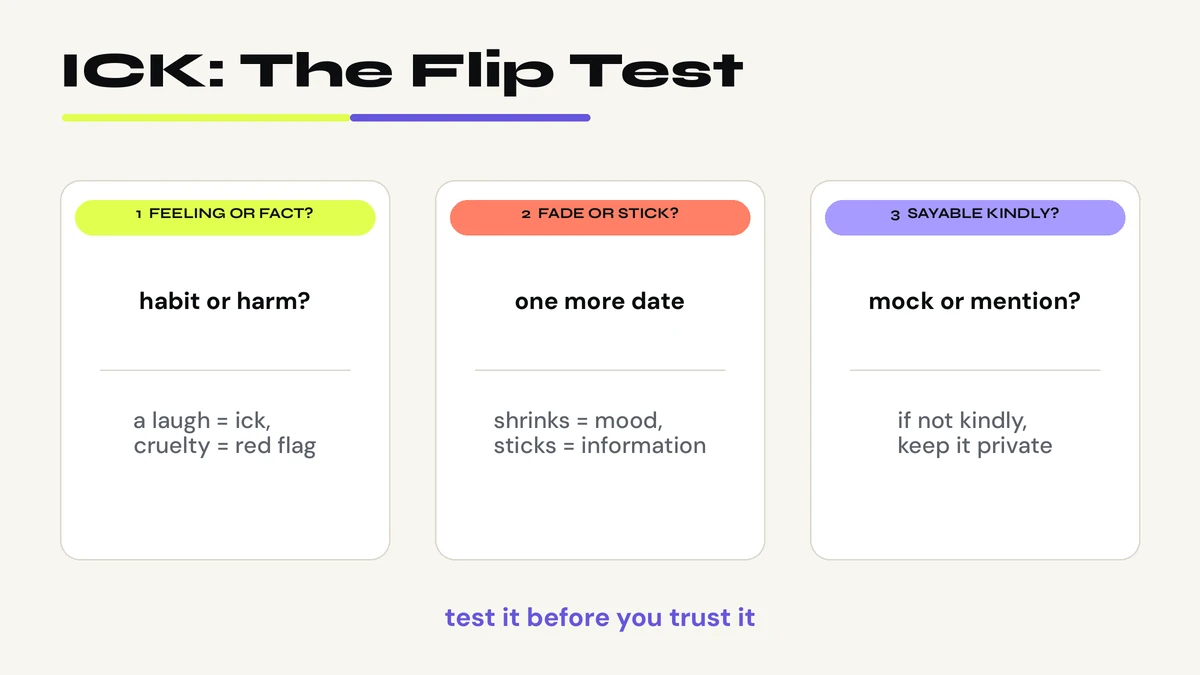
When an ick hits, do not act on it yet. Run three checks:
- Check 1 — Feeling or Fact? Is the trigger a small habit or a harmful behavior? A laugh, a walk, a texting style: a habit, and therefore an ick. Lying, cruelty, pressure: harmful behavior, and therefore a red flag, which needs a different response entirely. Sorting this first stops the commonest ick mistake — treating a feeling as evidence.
- Check 2 — Fade or Stick? Wait for one more normal interaction. Did the feeling shrink, stay flat, or grow? A fading ick was a mood, a bad day, or one odd moment. A sticking ick, still there on a good date, is information worth listening to. Time is the only honest test here; no list of ick types can substitute for it.
- Check 3 — Sayable Kindly? Could you describe the trigger to the person without mocking them? If yes, it is a private observation you may one day mention gently. If no, keep it private: an ick you cannot say kindly is not a post, not a group-chat bit, and not a breakup line. It is a note to yourself.
Worked trio. “He chewed loudly once at lunch and I felt the ick” — habit, not harm; wait one more meal; it probably fades. “Every date, his jokes at waiters make me pull back” — repeated, and kindness to strangers is a value, not a quirk; this one sticks and deserves a real conversation. “Ick, that sandwich smells awful” — not dating at all: the plain exclamation, no test needed.
“Ick” in Real Chats
Illustrative examples written for this guide, not real transcripts:
- The playful joke. “The way he opens soda cans gives me the ick lol” — a bit, not a verdict.
- The date debrief. “The way he chews gives me the ick every single time” — the feeling is becoming a pattern, which is exactly what Check 2 is for.
- The private confession. “I got the ick and I feel awful about it” — honest and self-aware; this sender knows the feeling is theirs, not the other person's fault.
- The group-chat vent. “Total ick. I could not focus after that” — venting to friends, not to the person, which is where an untested ick belongs.
- The plain exclamation. “Ick, not touching that” — no person, no romance, just disgust at a thing.
- The cold date. A date goes quiet after one odd moment, with no explanation — the receiving end of an ick, where silence does the talking.
The Ick Tone List
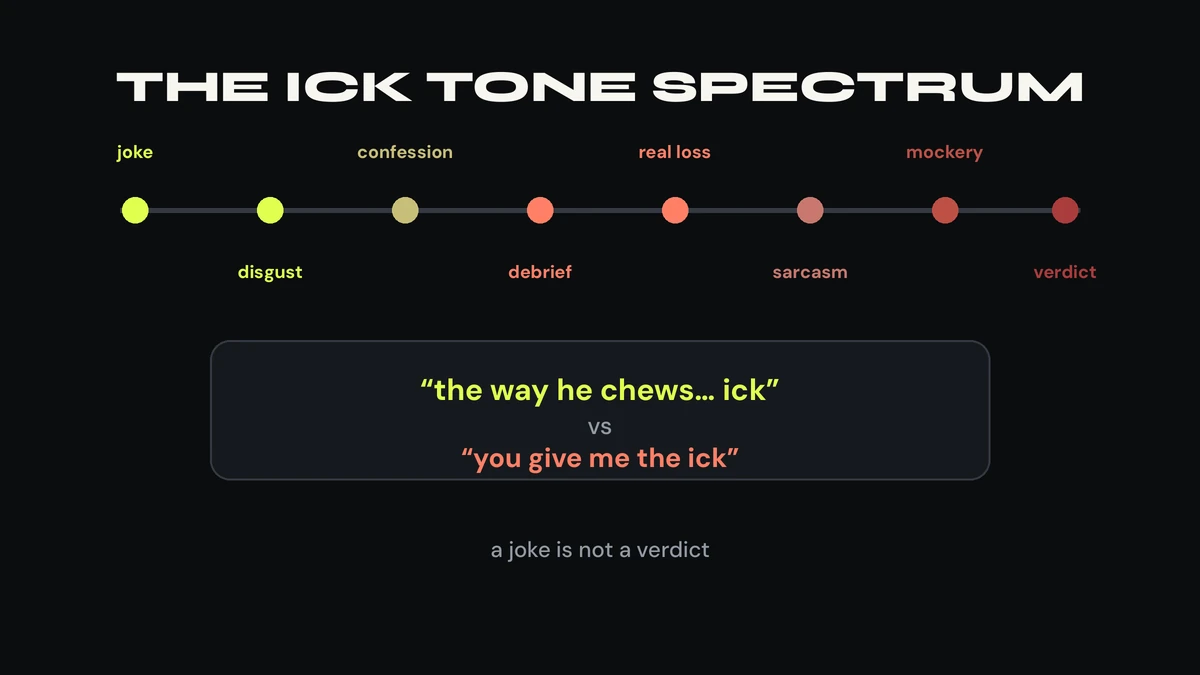
The word stays the same; the weight changes. Eight readings, lightest to heaviest:
- Playful joke: “the way he opens soda cans gives me the ick lol” — a bit, not a verdict.
- Plain disgust: “Ick, not touching that” — no person involved at all.
- Private confession: “I got the ick and I feel awful about it” — honest, self-aware, and private.
- Group-chat debrief: “Total ick. I could not focus after that” — venting to friends, not to the person.
- Genuine loss of attraction: “I actually cannot date him anymore, I got the ick” — a real decision forming, and the one that needs Check 2 first.
- Sarcastic dismissal: “Oh, the ick? So dramatic” — teasing someone else's feeling instead of hearing it.
- Public mockery: posting someone's ick list for likes — funny to readers, unkind to the person in it.
- Misread as a verdict: treating any ick as proof someone is bad — the heaviest misuse, because a feeling has been promoted to a judgment.
The list is also a warning label: everything from playful joke down to genuine loss is a normal use. The last two readings are where ick stops being a word and starts being unkind.
“Ick” on TikTok
On TikTok, ick is a list genre: creators film their personal icks — loud chewing, bad texting, odd shoe choices — and commenters add their own. The format rewards the smallest, funniest triggers, which is why TikTok icks look trivial: the platform selects for jokes, not for decisions. Treat a TikTok ick list as entertainment, not as a checklist for your own dating life. Nobody's list is your list, and a trigger that kills a video's comments section may mean nothing on a real date.
“Ick” on Snapchat
On Snapchat, ick lives in fast, disappearing DMs between friends: “got the ick, tell you later” after a date, or a snap captioned with one word. The disappearing format suits a private confession — it is said, heard, and gone. But disappearance also removes the record: if a friend's ick becomes a pattern, you cannot scroll back to check whether it faded or stuck. Judge a Snapchat ick by what the friend does next, not by the snap itself: did they go on another date, or did they quietly stop replying?
“Ick” on Instagram
On Instagram, ick shows up in story replies, comments, and DMs — and in dating profiles themselves, where a bio or a photo can trigger a dating-app ick before any meeting. A story reply like “that caption gave me the ick lol” is usually the playful reading; a DM debrief after a date is usually the genuine one. Instagram is also where the public-mockery reading is easiest: a screenshot of someone's ick-worthy moment can travel farther than the sender intended. The private-first rule matters most here, because Instagram makes private feelings public by default.
“Ick” in Text Messages
Plain texts are where icks get confessed, and where they do their quiet damage. A friend texts “got the ick” and the conversation becomes a debrief; a date goes cold after one odd text and nobody says why. Ick travels with the reassurance companion DW — “got the ick, dw, I am fine, just not feeling it” softens a confession with reassurance — and with the side-note companion BTW: “btw, got the ick from his voicemail” drops the feeling in as an aside, which is how most real icks arrive: not announced, just mentioned. It also travels with the opener companion HMU in the other direction: “hmu when you are free, need to debrief this date” turns an ick into a call for a friend.
Texts are also ick's work limit: never text an ick about a coworker or a client, never put someone's ick in a group chat they can read, and never deliver an ick as a breakup text. A feeling that cannot be said kindly in person should not be sent in writing, where it cannot be softened.
Who’s Feeling It: How “Ick” Lands by Sender
No source documents a different meaning of ick per sender — the feeling stays fixed; what changes is what the feeling costs:
- Friend: the debrief habitat. A friend's “got the ick” is a confession to hear, not a verdict to join: validate, then ask whether it will stick.
- Crush: the highest stakes. A crush's ick about you is one you will almost never hear about — silence after one odd moment is the usual signal, and chasing it rarely helps.
- Partner: pattern rules. A partner's ick, if it ever surfaces, is about a habit after months, not a first-date moment — and a habit can be discussed, unlike a first impression.
- Date or match: the classic habitat. A match's ick is usually a dating-app ick: a bio, a photo, an opener — decided before any meeting, and often unfair, which is why Check 2 exists.
- Group chat: the pile-on habitat. One ick in a group chat invites ten more, and the person being discussed is not there to answer. Do not add a stranger's name to the pile.
- Stranger online: the mockery habitat. A stranger's ick list is content, not information about you — read it as a joke, not as a standard.
- Yourself: the only sender you control. Your own ick deserves the Flip Test before it becomes a decision, a text, or a post.
When “Ick” Is Not Just a Joke
Three misuses, graded. First, the verdict misuse: treating an ick as proof someone is bad. A feeling proves nothing about character; only behavior over time does. Second, the public-mockery misuse: posting someone's habits as ick content. The person in the post did nothing wrong, and the likes do not make it kind. Third, the self-harm misuse in reverse: torturing yourself over an ick you feel, as if feeling it made you shallow. It does not. Everyone's attraction has irrational edges; the shallow move is acting on an untested feeling, not having it.
On appropriateness: ick is not rude and not vulgar in any reading; its risk is social, not moral — unkindness and unfair judgment, not offense. Keep it out of professional messages, out of public posts naming real people, and out of breakup conversations, where it explains nothing and cannot be answered. A breakup deserves a reason; “you give me the ick” is not one.
Checked Claims: Ideas That Don’t Hold Up
- “The ick always means the relationship is over” — rejected. Some icks pass quickly, and daters report “sticking” past icks that faded. The Flip Test's Check 2 exists because endings need time, not a first reaction.
- “The ick is the same as a red flag” — rejected. A red flag warns about behavior that may be harmful; an ick names a feeling. One is about the other person, the other is about your reaction, and confusing them is how small habits get treated as dangers.
- “The ick is just hate” — rejected. Most icks target tiny, innocent habits, and the feeler often likes the person otherwise. Disappointment and disgust at a moment are not hatred of a person.
- “Everyone gets the same icks” — rejected. Icks are personal: one reader's ick is another's non-event, which is why ick lists are entertainment, not standards.
- “Love Island invented the ick” — rejected as stated. Love Island (2017) popularized the dating usage; Wiktionary's “to have the ick” citation dates to 1999 and the interjection to c. 1942. Television amplified the term; it did not invent it.
- “The ick is always illogical, so it means nothing” — fenced, not fully rejected. Often illogical, yes — but a repeated, sticking ick can point at a real mismatch. Dismissing every ick is as careless as obeying every one.
- “You should post your icks publicly” — rejected. Public ick lists mock real people for habits they cannot defend. The private-first rule stands: confess to a friend, not to an audience.
- “Ick only happens in dating” — rejected. The exclamation and the revulsion noun work for food, smells, and sights with no romance involved at all.
- “An ick proves the other person did something wrong” — rejected. Most triggers are innocent. The feeling is evidence about the feeler, not a verdict on the other person.
What SURVIVES: ick as a sudden feeling of repulsion (dictionary-attested), “the ick” as the dating form of that feeling (community-attested with a 1999 paper trail), and the Flip Test as the decision rule. No popularity figure is claimed, and no competitor percentage is repeated as fact.
“Ick” vs Its Closest Cousins
Ick belongs to the reaction family — words that name what you feel, not what someone is. Its closest cousins, all published in this series where linked:
- HYDD (“how you doing?”) — the dating-chat cousin. HYDD opens a chat; ick can close one. HYDD asks a question; ick answers a feeling. The two share a habitat — dating chats — and nothing else.
- HYD (“how you doing?”) — the parent greeting. HYD starts conversations; an ick ends the desire for one. Same three-letter world, opposite directions.
- HRU (“how are you?”) — the check-in cousin. HRU asks how someone feels; ick reports how you feel about them. HRU opens; ick, untested, shuts.
- HBU (“how about you?”) — the return cousin. HBU bounces a question back; an ick bounces attraction away. HBU keeps a chat going; an ick, acted on too fast, ends it.
Two cousins have no TextsMeaning article and are discussed by name only, never linked: red flag (a warning about harmful behavior, not a feeling) and cringe (embarrassment on someone's behalf, not repulsion). Ick is smaller than a red flag and sharper than cringe — and unlike either, it fades on a good second date more often than guides admit.
Where “Ick” Came From
The sound is old and imitative: Wiktionary dates first use c. 1942 and calls ick probably imitative, the noise disgust makes. “Icky” — unpleasant, overly sentimental — circulated in 1930s American usage, and the noun for something distasteful follows from it. The dating sense has its own trail: a 1999 citation for “to have the ick,” a 1995 Friends episode titled “The One with the Ick Factor,” and the 2017 Love Island moment that carried the term onto TikTok in the early 2020s. No single inventor is claimed, because there is none: the sound is imitative, and the dating usage is a community coinage that television amplified.
How to Reply When Someone Mentions “the Ick”
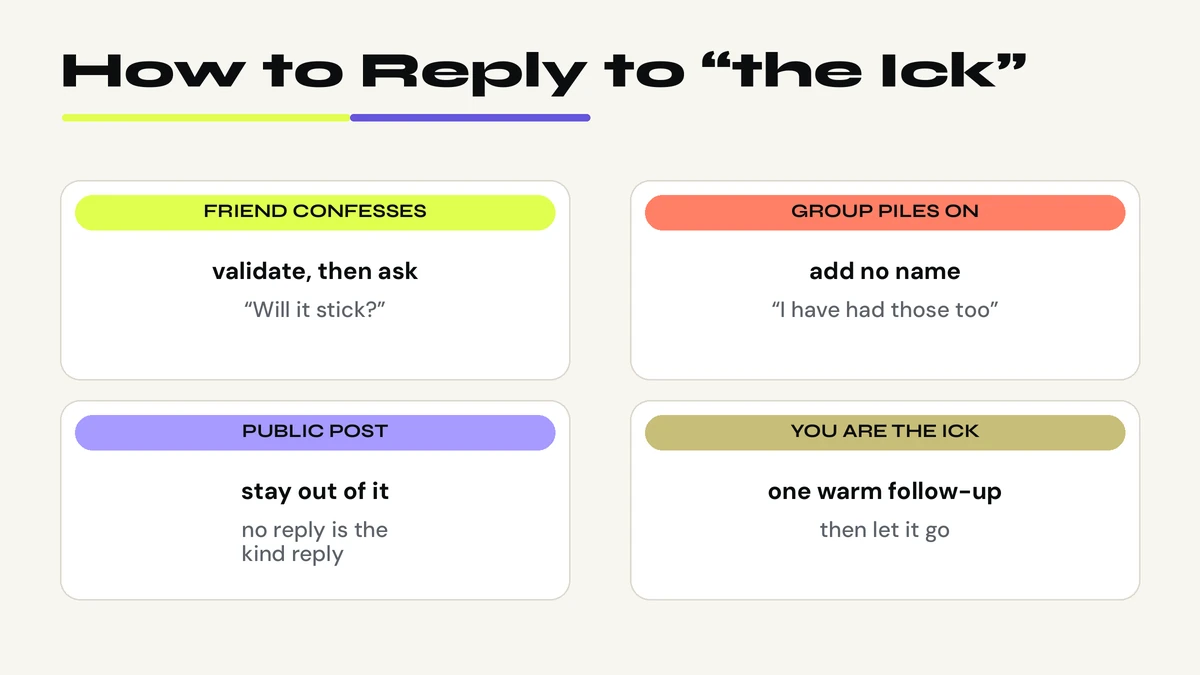
Match the use, not the word. Four replies for the four situations you will actually meet:
- Friend confesses an ick — validate, then ask: “That happens. Do you think it will stick?” Validation first, Check 2 second, and no piling on.
- Group chat piles on — do not add a name: “Ha, I have had those too” keeps you in the joke without adding a stranger to the pile.
- Someone posts icks publicly — stay out of it: no reply is the kind reply. Liking a mockery post is joining it.
- You are the ick — one warm follow-up: if a date goes cold after one odd moment, one normal, warm message beats chasing an explanation you will probably never get. Then let it go.
- You got the ick yourself — reply to yourself first: run the Flip Test before you text, post, or decide. The reply you owe is to your own feeling, not to an audience.
Weak versus strong. Weak: “yeah, dump him, huge ick” on a first-reaction feeling. Strong: “Give it one more date and see if it sticks?” Small change, big difference. Golden rule: never deliver an ick as a breakup line — it explains nothing and cannot be answered.
Frequently Asked Questions
What does “ick” mean in a text message?
A sudden feeling of repulsion — usually “the ick” toward a crush or date, triggered by something small, like a habit or a moment.
Is “the ick” a real dictionary term?
The feeling is dictionary-attested: Wiktionary lists ick as an exclamation of disgust and a feeling of revulsion, with “to have the ick.” The dating rulebook around it — that it always ends things — is community lore, not dictionary fact.
Is the ick the same as a red flag?
No. A red flag warns about behavior that may be harmful; an ick names a feeling about a small habit. Run Check 1 of the Flip Test before you confuse them.
Does getting the ick mean the relationship is over?
Not necessarily. Some icks fade on the next date; others stick and become real information. Wait for one more normal interaction before deciding.
What does “ick” mean on TikTok, Snapchat, and Instagram?
The same feeling everywhere — no platform-specific meaning exists. TikTok stages it as a joke list, Snapchat as a disappearing confession, Instagram as a story reply or dating-profile reaction.
Can you get the ick from a friend, not a date?
Yes, though dating is the classic habitat. A friend's habit can trigger the same sudden pull-back — and the same Flip Test applies before you act on it.
Should I tell someone they give me the ick?
Almost never as a sentence. If you cannot say it kindly, keep it private, run the fade-or-stick check, and make your decision quietly. “You give me the ick” explains nothing and cannot be answered.
Someone just told me they got the ick. What do I say?
Validate, then ask one question: “That happens. Do you think it will stick?” Do not pile on, and do not add a stranger's name to a public list.
The Takeaway
“Ick” is a sudden feeling of repulsion — an exclamation, a noun, and in dating, “the ick” that flips attraction off over something small. When it hits, run the Flip Test: feeling or fact, fade or stick, sayable kindly. And when you act on one, remember: an ick is information about your reaction, not a verdict on a person — test it before you trust it.