
What does IDC mean in text? IDC means “I don’t care” — a blunt, three-letter way of saying you have no preference, no interest, or no wish to keep talking about something. “Pizza or tacos?” “Idc, you pick.” That is the whole message, and over dinner it is a gift.
But the same three letters can shut a conversation down cold, which is why this guide to idc meaning in text does not stop at the definition. It covers the IDC Weight Test, an eight-reading tone list, IDC on TikTok, Snapchat, Instagram, and in texts, senders, misreads, graded claims, cousins, history, and the reply rule that matches the weight, not the letters.
What “IDC” Means in Text
“IDC” means “I don’t care.” It is an initialism, spoken letter by letter — I-D-C — built from the first letters of the phrase, and it does three jobs that look identical on screen but feel very different in real life. As a preference pass: “idc, you pick” hands a low-stakes choice to someone else. As a topic close: “idc about celebrity gossip” ends a subject, not a friendship. As a feeling statement: “idc anymore” after a fight says the sender is done — or says they are hurt and hiding it, which is the opposite of done.
Unlike the last term in this series, IDC is dictionary-attested, and that matters for how firmly you can trust it. Wiktionary’s lowercase idc entry lists it directly as “(Internet slang, text messaging) Initialism of I don’t care,” with the near-synonym idm (“I don’t mind”) and the alternative form IDC. When a friend, a caption, or a comment says IDC, you are not guessing at slang folklore: the expansion is settled. What is not settled — and what no dictionary can settle for you — is the weight. That is the reader’s job, and the Weight Test below is how you do it.
Two traps to clear before anything else. First, IDC is not IDK. IDK (“I don’t know”) is about knowledge; IDC is about attitude. Answering “idc” when you meant “idk” tells someone you do not care about their question, when all you meant was that you did not know the answer — a small slip with a large social cost. Second, outside chat, IDC belongs to other worlds entirely: in a medical report it is invasive ductal carcinoma, in business it is International Data Corporation, and the same Wiktionary page even lists idc as the ISO 639-3 language code for Idon. In a chat, though, context selects “I don’t care” every time. If you are reading a message, not a report, you already know which IDC you have.
The IDC Weight Test
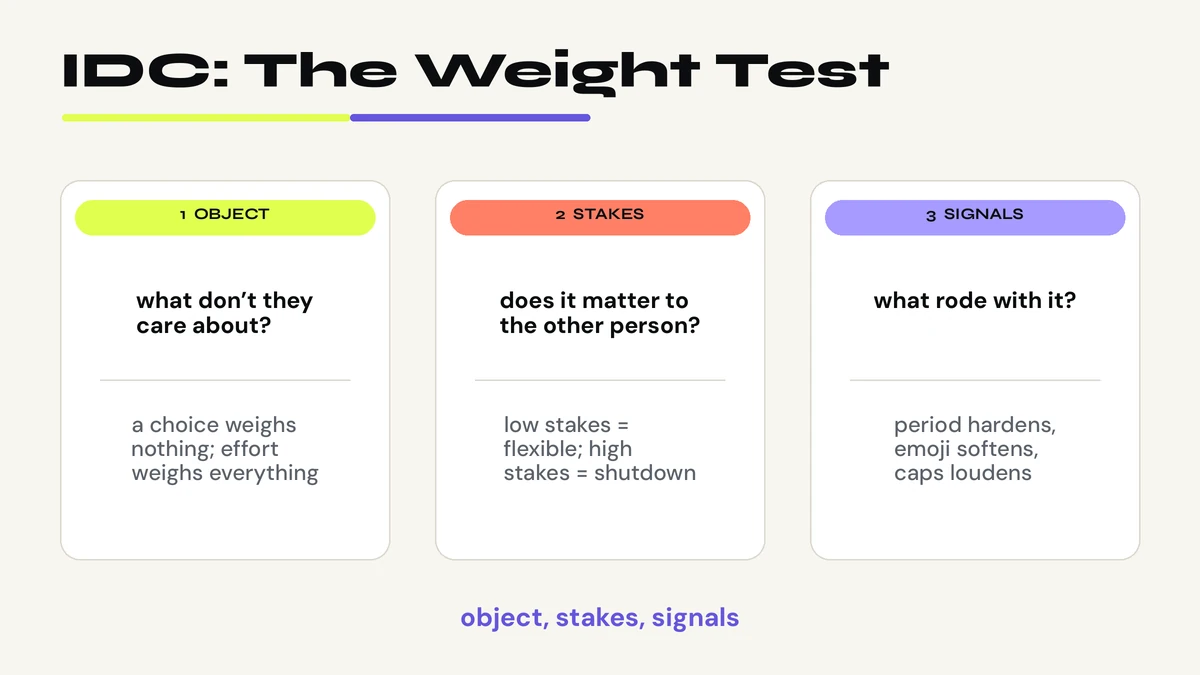
The letters never change, so weigh the message around them. Three questions, in order:
- Question 1 — The Object. What exactly don’t they care about? A choice (“idc, you pick”) weighs nothing. A topic (“idc about the game”) weighs a little. A person’s effort, apology, or bad news weighs everything. If you cannot name the object, you cannot judge the IDC — ask what it attaches to before you react to it.
- Question 2 — The Stakes. Does this topic matter to the OTHER person? Low stakes plus a bare IDC is usually flexible: nobody is hurt by indifference over pizza. High stakes plus a bare IDC is a shutdown: indifference over someone’s effort or feelings is a statement, whatever the sender intended. Stakes, not letters, decide whether an IDC is kind.
- Question 3 — The Signals. What rode with it? A period hardens it (“idc.” feels colder than “idc”). “Lol” or an emoji softens it. All caps loudens it (“IDC” reads as shouting, or at least as emphasis). A follow-up explains it (“idc, either works, I’m just tired”). A long silence before it darkens it. And the sender’s history is the best signal of all: a friend who always writes “idc, you pick” is not suddenly cruel today.
Worked trio. “Pizza or tacos?” → “idc, you pick” — object: dinner; stakes: low; signals: soft follow-up. Verdict: flexible. Decide happily. “I spent all night finishing this for you.” → “idc” — object: your effort; stakes: high; signals: bare, one word after a long message. Verdict: shutdown. Do not answer the words; answer the wound. “IDC what they think. I’m doing this anyway.” — object: strangers’ opinions; stakes: chosen by the sender; signals: a confident full sentence. Verdict: armor, not indifference. Same letters, three weights — and three different replies.
“IDC” in Real Chats
Illustrative examples written for this guide, not real transcripts:
- The flexible pick. “Pizza or tacos?” “Idc, you pick.” The default IDC, and the kindest one: a real no-preference, handed over cleanly.
- The easygoing anywhere. “Where should we meet?” “Idc, anywhere works.” Relaxed, warm enough with the follow-up doing the softening.
- The playful shrug. “Did you see the drama?” “Idc lol.” Teasing indifference among friends; the laugh carries the softness.
- The confident caption. “New hair, idc what anyone thinks.” Not a reply at all — a statement of armor, posted for an audience.
- The tired deferral. “Pick a movie.” “Idc, honestly, I’m too tired to choose.” Decision fatigue, not dismissal — and the explanation is what saves it.
- The cold shutdown. “I need to talk about what happened yesterday.” “Idc.” One bare word after a long message. This is the IDC that ends conversations.
- The shield after a fight. “Whatever. Idc anymore.” The words deny care the situation proves. Read it as hurt wearing indifference, not as indifference itself.
- The contemptuous caps. “IDC. Do whatever you want.” Caps, a period, and a dismissal in one breath — withdrawal used as punishment, not a shrug.
The IDC Tone List
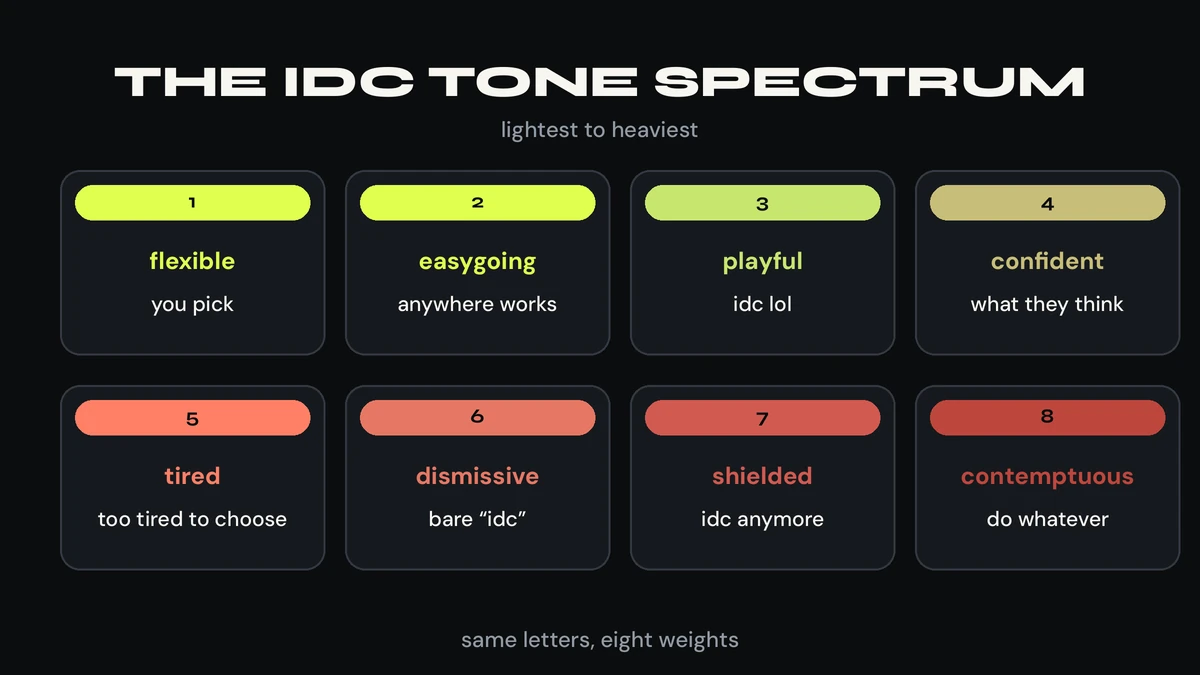
IDC’s meaning stays “I don’t care”; its weight slides from gift to weapon. Eight readings, lightest to heaviest:
- Flexible: “idc, you pick” — a genuine no-preference over a low-stakes choice; the default, and the kindest IDC.
- Easygoing: “idc, anywhere works” — relaxed, with a follow-up that keeps it warm.
- Playful: “idc lol” — teasing indifference among friends; the laugh does the softening.
- Confident: “idc what they think” — armor in a caption or comment; indifference as self-expression.
- Tired: “idc, honestly, I’m too tired to choose” — decision fatigue, not dismissal; the explanation saves it.
- Dismissive: a bare “idc” after a long or personal message — shuts the topic, and reads cold whatever was intended.
- Shielded: “idc anymore” after a fight — the words deny care the situation proves; hurt, not indifference.
- Contemptuous: “IDC. Do whatever you want.” in caps after an argument — not indifference at all, but withdrawal as punishment.
Object, stakes, and signals move a reading up or down this list: a follow-up lightens it, a period hardens it, caps loudens it, and high stakes sink even a friendly IDC straight toward the bottom.
“IDC” on TikTok
On TikTok, IDC is a caption and comment attitude statement more than a reply: “idc, this song is amazing” under a video, or “new hair, idc” as a caption. The public stage suits the confident reading best — indifference as armor, posted for strangers whose opinions the poster has already decided not to weigh. That is also why TikTok IDC rarely wounds: nobody in a comment thread is owed a careful answer the way a friend in a DM is. The flexible and dismissive readings barely appear here, because a caption is not a conversation — and a commenter who writes “idc” at a creator is performing unbothered, not deciding dinner. If you want to borrow TikTok’s confident IDC for your own posts, borrow the full sentence with it: a bare “idc” in a caption reads empty, while “idc what they think” reads like a position.
“IDC” on Snapchat
On Snapchat, IDC fits the fast, disappearing DM: “idc 😂” as a reply to a snap, or “idc, you choose” in a streak chat. Speed is the platform’s whole character, so the flexible and playful readings dominate here — a snap reply is expected to be short, and nobody grades a streak message for warmth. The emoji does real work on Snapchat: a shrug or laugh after “idc” is the difference between playful and cold, and Snapchat’s emoji-first culture makes that signal easy to send. But disappearance cuts the other way too: if an IDC felt cold, you cannot re-read it, so judge from memory what rode with it — an emoji, a follow-up, or nothing at all. And because streak culture rewards speed over care, Snapchat is where the careless IDC is most forgivable — and where a bare “idc” after something serious is most confusing, because the format itself says “this was quick,” not “this was cold.”
“IDC” on Instagram
On Instagram, IDC shows up in captions, comments, and DMs, and the three stages carry three different weights. Captions lean confident: “Wearing what I want, idc” is armor, and the audience is the point — the poster is telling strangers their opinions do not count. Comments lean performative: “idc if people disagree” under a post is a stance, not a conversation, and arguing with it misses what it is for. DMs carry the full range, exactly like texts: a friend’s “idc, you pick” in a DM is flexible, while a match’s bare “idc” after you shared something personal is dismissive, and the platform changes nothing about either. Instagram is also where IDC’s dating life shows most clearly: a match who answers every getting-to-know-you question with “idc” is not being mysterious, they are showing low interest — a pattern, not a single message, is the evidence, and one flexible IDC over dinner plans proves nothing at all.
“IDC” in Text Messages
Plain texts are IDC’s home ground, and the place its weight is easiest to misread: no voice, no face, and a single bare word doing the work of a sentence. It pairs with the opener companion HMU in reunion texts: “idc, hmu when you’re free” shrugs at the plan and asks for contact later, in one breath — and with the side-note companion BTW: “idc, btw, did you see the game?” closes one topic and pivots to another in the same message, which is why the BTW pairing usually reads flexible rather than cold: the sender is moving on, not shutting down.
Texts are also IDC’s work limit, stated plainly: in a casual team chat, an “idc, either works” over lunch plans is friendly enough, but a formal email wants “I have no preference” spelled out — and a client who reads “idc” in a professional message will hear dismissal, not flexibility, because the stakes of work make every shrug heavier. The test: if the topic matters to the other person, do not send the three letters. Send the sentence.
Who’s Sending It: How “IDC” Lands by Sender
No source documents a different meaning of IDC per sender — the indifference stays fixed; what changes is the stakes, and therefore the weight. Note what this section replaces: the main competitor organizes its sender section by gender (what IDC means “from a girl” versus “from a guy”), while admitting gender carries no different dictionary meaning. Gender does not decide an IDC’s weight. Relationship and stakes do, so this guide uses those instead:
- Friend: the default. A friend’s “idc, you pick” is flexible at face value; answer by deciding, and add one warm detail so the thread does not die on a shrug.
- Crush: overread territory. A crush’s “idc” after you shared something real feels bigger than it is — check the pattern across days before calling it low interest; one bare IDC is a data point, not a verdict.
- Partner: pattern rules. A partner’s “idc, either works” over dinner is flexible; a partner’s bare “idc” after a serious talk is shielded or contemptuous — judge the pattern across days, not one message, and answer the feeling underneath it.
- Parent: stakes run high. A parent’s “idc” usually means genuine no-preference, but a parent is also the reader most likely to hear a child’s “idc” as dismissal — if you send one to a parent, add the follow-up; it costs three words and saves a misunderstanding.
- Coworker: context decides. In a casual channel, “idc, either works” over lunch is fine; in a deadline thread, answer the work first — and never open a client message with it.
- Group chat: the poll habitat. A group’s “idc, whatever everyone wants” is flexible and useful — it unblocks a decision — but a bare “idc” in a group where someone just shared bad news reads as public dismissal, which is worse than private dismissal.
- Stranger or ex: the shutdown habitat. A bare “idc” here is a door closing, not a conversation; a short answer, or silence, both end it without rudeness — and if it is an ex, read shielded before you read contemptuous, because history raises the stakes of every shrug.
When “IDC” Is Not Just Flexible
Four misfires, graded. First, the always-harmless assumption: treating every IDC as flexible. A bare “idc” after bad news or a long personal message is not flexible; it is dismissive, and the sender’s intent does not rescue the reader’s experience. Second, the always-rude assumption: treating every IDC as an insult. “Idc, you pick” over pizza is a gift, not an attack, and answering it with hurt punishes someone for being easygoing. Third, the shield misread: taking “idc anymore” at face value after a fight. The words deny care; the timing proves it. Answer the feeling, not the denial, or you will argue with a sentence while the person behind it walks away.
Fourth, the escalation trap: answering a dismissive IDC with a colder one. Two shrugs do not make a conversation, and a returned “idc” in caps ends the thread with both people pretending not to care. The closest companions here are reassurance and softening, and IDC is the opposite of both: DW (“don’t worry”) says the worry is unnecessary; IDC says the topic is unworthy — DW comforts, IDC closes. FWIW (“for what it’s worth”) softens an opinion before offering it; IDC hardens indifference before refusing it. On appropriateness: IDC is not vulgar and not profane in any reading; its risk is social, not moral — dismissal, not offense. Keep it out of formal, professional, and first-impression messages, and out of any conversation where the other person’s feelings are the topic. When you need the flexibility without the edge, swap in the warmer phrase: “I don’t mind” (IDM) for a preference, “Either works for me” for a plan, or a full sentence — “I’m happy with whatever you choose” — for anything that matters.
Checked Claims: Expansions That Don’t Hold Up
- “IDC means ‘I do care’” — rejected. Dropping the n’t inverts the phrase; no source attests it. The teasing “idc” from someone who plainly cares is a shield use, not a second meaning.
- “IDC means something different on each platform” — rejected. No source documents a platform-specific meaning; TikTok captions, Snapchat DMs, and texts stage the same indifference differently.
- “IDC is always rude” — rejected. “Idc, you pick” over pizza is flexible, not rude; rudeness lives in stakes and signals, not the letters.
- “IDC is always harmless” — rejected with equal force. A bare “idc” after bad news or a long personal message wounds, whatever the sender intended.
- “IDC from a girl always means she’s upset or testing you” — rejected as a rule. The main competitor itself admits gender carries no different dictionary meaning; its girl/guy patterns are tendencies at best, and relationship plus stakes decide the reading.
- “IDC in a medical report means ‘I don’t care’” — rejected for that context. In a medical report IDC is invasive ductal carcinoma; in business it is International Data Corporation. Chat context selects “I don’t care”; document context selects something else entirely.
- “IDC = IDK” — rejected. IDK is knowledge (“I don’t know”); IDC is attitude (“I don’t care”). Confusing them changes the message.
- “IDC means ‘in due course’ in texts” — rejected for chat. That is a formal and legal phrase, not a texting sense; nobody texts “idc” to mean “at the appropriate time.”
- “Everyone who says idc truly doesn’t care” — rejected. The shield reading — hurt, pulling back, avoiding a fight — is documented by both full competitors and is this article’s fourth weight.
- “IDC is pronounced as a word” — rejected as stated. IDC is an initialism, spoken letter by letter (I-D-C), like IDK — not pronounced as a single word.
What SURVIVES: “I don’t care” (dictionary-attested, Wiktionary), with the eight weights above as readings of the same indifference — not different meanings. No competitor percentages are repeated here as fact, and nothing is claimed about a Dictionary.com entry, which was only cited second-hand and was not independently verified.
“IDC” vs Its Closest Cousins
IDC belongs to the attitude family — words that state how much you care, know, or want to engage. Its knowledge twin IDK (“I don’t know”) is discussed by name throughout this guide but is not linked: its TextsMeaning article is still a pending queue row, not a live page, and this series never links a draft. The published cousins:
- HRU (“how are you?”) — the question-family contrast. HRU opens a conversation by asking about you; IDC closes a topic by refusing it. HRU says “I care how you are”; IDC says “I don’t care about this.”
- HBU (“how about you?”) — the return cousin. HBU hands a question back; IDC hands a topic away. HBU says “now yours”; IDC says “not mine.” The pair is one system: HBU keeps a chat alive, IDC lets one part of it die.
- BRB (“be right back”) — the pause cousin. BRB suspends a chat with a promise to return; IDC shuts a topic with no promise at all. BRB says “hold on”; IDC says “I’m done with this.”
- IDGAF (“I don’t give a f***”) — the stronger cousin, named here in asterisked form only. IDGAF is IDC with the volume turned past blunt into profane: it does not mean something different, it means the same indifference with aggression attached. If IDC is a shrug, IDGAF is a slammed door — and it is never the warmer alternative.
- IDRC (“I don’t really care”) and IDM (“I don’t mind”) — the softer cousins, discussed by name, not linked: no TextsMeaning article for either is live. IDRC softens IDC by one word (“really” paradoxically makes it gentler, because it admits a little care); IDM is the friendly replacement, the phrase to send when you mean flexible and want to be heard as flexible.
IDC often travels with a bounce-back — “idc, hbu?” — but never answer an IDC with another bare “idc”: two shrugs do not make a conversation.
Where “IDC” Came From
IDC emerged in 1990s internet chatrooms and forums alongside TBH and BRB, then spread with SMS texting and instant messaging in the early to mid-2000s, when character limits and T9 keypads rewarded three-letter phrases over full sentences. The dating note comes with a grade: one secondary guide dates the first Urban Dictionary definition to 2003 while noting the term was likely older, and Urban Dictionary is attestation only, never authority — so this article dates the era and that attestation, and claims no inventor and no exact birthday. What is certain is the mechanism, because it is the same one behind every term in this series: a common phrase, shortened for speed, kept because it also carried attitude. “I don’t care” was already blunt in full; in three letters it became effortless, and effortlessness is exactly what makes IDC sting — the shrug costs the sender nothing, which is why it can cost the reader so much.
How to Reply When Someone Sends “IDC”
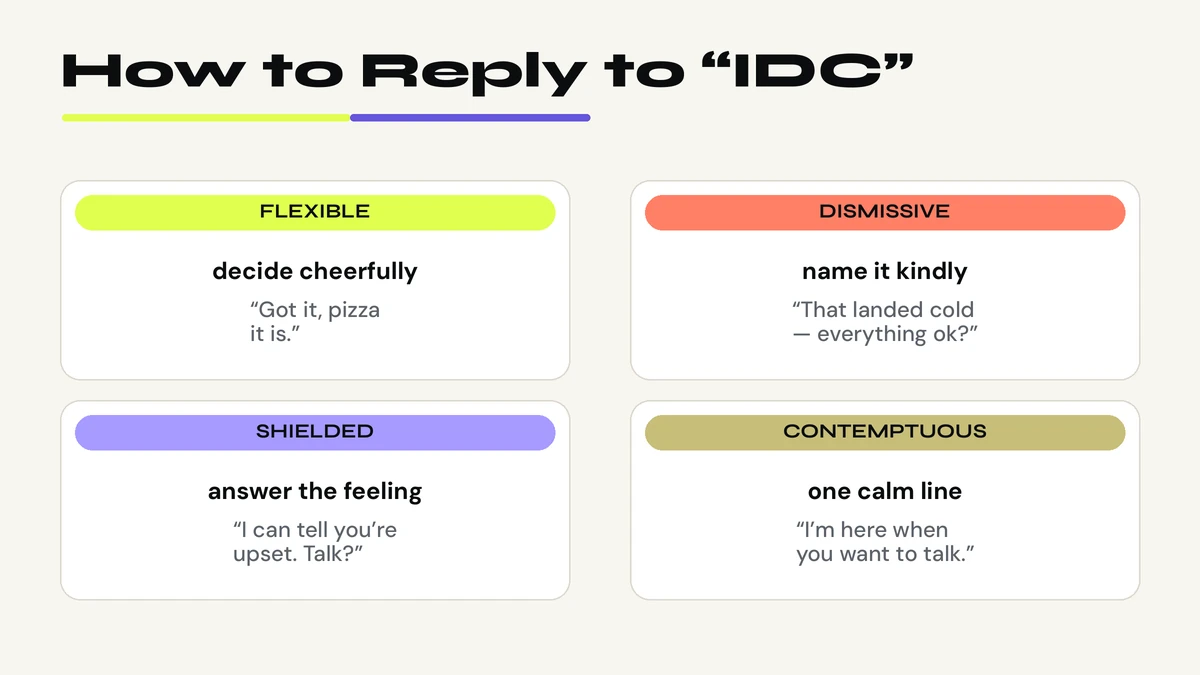
One rule, then replies keyed to weight: match the weight, not the letters. A flexible IDC wants a decision; a dismissive IDC wants a kind check-in; a shielded IDC wants the feeling answered; a contemptuous IDC wants space, not a chase:
- Flexible — decide cheerfully: “Got it, pizza it is.” A real no-preference deserves a real decision, not a second round of “no, you pick.”
- Easygoing — add one detail: “Perfect, anywhere works for me too — how about the place on Main?” Keeps the thread alive past the shrug.
- Playful — match the laugh: “Lol, fair enough.” Teasing indifference answered in kind, with no weight added.
- Dismissive — name it once, kindly: “That landed cold — everything okay?” One open question beats an argument about three letters.
- Shielded — answer the feeling: “I can tell you’re upset. Want to talk about it?” Do not argue with the denial; the person behind it is the conversation.
- Contemptuous — one calm line, then space: “Okay. I’m here when you want to talk.” Chasing a slammed door only proves the sender right about the fight.
Weak versus strong. Weak: answering “idc” with “idc.” Strong: answering a flexible IDC with a decision, a dismissive IDC with a question, and a shielded IDC with care. Golden rule: never answer a bare IDC with another bare IDC — unless the sender already set a playful tone and you are matching their laugh, not their shutdown.
Frequently Asked Questions
What does “IDC” mean in a text message?
“I don’t care” — a blunt statement of no preference, no interest, or no wish to keep discussing something. The meaning is fixed; the weight depends on the object, the stakes, and the signals around it.
Is IDC rude?
It can be, but it is not always. “Idc, you pick” over dinner is flexible and kind; a bare “idc” after bad news or a long personal message is dismissive. Run the Weight Test — object, stakes, signals — before deciding.
What does “IDC” mean on TikTok, Snapchat, and Instagram?
The same indifference everywhere — no platform-specific meaning exists. TikTok stages it as confident caption armor, Snapchat as a fast, emoji-softened DM reply, Instagram as a caption stance or a full-range DM, and every stage carries the same Weight Test.
What’s the difference between “IDC” and “IDK”?
IDC is attitude (“I don’t care”); IDK is knowledge (“I don’t know”). Answering “idc” when you meant “idk” tells someone you do not care about their question, when all you meant was that you did not know the answer.
Does IDC mean the same thing from a girl and a guy?
Yes, the meaning is identical — gender carries no different dictionary meaning. What changes a reading is the relationship and the stakes, not the sender’s gender, which is why this guide organizes senders by relationship instead.
Can IDC mean something other than “I don’t care”?
In documents, yes: in a medical report it is invasive ductal carcinoma, and in business it is International Data Corporation. In a chat, though, it almost always means “I don’t care” — context selects the sense.
What should I say instead of IDC when the topic matters?
Use a warmer phrase: “I don’t mind” for a preference, “Either works for me” for a plan, or a full sentence — “I’m happy with whatever you choose” — for anything involving someone’s feelings. If you must send IDC, add a follow-up.
Someone just sent me “IDC”. What do I say?
Match the weight, not the letters: a flexible IDC gets a decision (“Got it, pizza it is”), a dismissive IDC gets one kind question (“That landed cold — everything okay?”), a shielded IDC gets care for the feeling underneath, and a contemptuous IDC gets one calm line and space.
The Takeaway
“IDC” is a three-letter shrug — “I don’t care” — that can hand over a decision, wear armor, hide hurt, or shut a door. When the letters arrive, run the Weight Test: object, stakes, signals. And when you send one, remember: a shrug costs the sender nothing, which is exactly why it can cost the reader so much — so spend the extra words whenever the topic matters.