What does ntm mean in text? NTM usually means “not too much” or “nothing much” — a short, relaxed reply when someone asks what you are doing. This guide to ntm meaning in text gives you the NTM Position Test, so you can tell in seconds whether the ntm you just got was a shrug, an extra point, or a warning to ease up.
This guide covers the three live readings, the three-check test, seven tones, NTM on TikTok, Snapchat, Instagram, and in texts, how it lands by sender, when it crosses a line at work, school, and in French-language chats, graded claims, cousins, an honestly undocumented history, and a reply bank keyed to the reading you just identified.
What “NTM” Means in Text
NTM is an initialism, and its most common job is the smallest one in texting: answering a question about what you are doing. When someone asks “what’s up?” or “what are you doing?”, a bare “ntm” means there is nothing much to report. It is the typed version of a shrug, and it usually comes with a bounce-back question: “ntm, u?” The question it most often answers is the one our WYO guide covers in full — “wyo?” asks what you are doing, and “ntm” answers it with as little effort as the question took to ask.
Two expansions share that one job, and they are near-synonyms rather than rivals: “not too much” and “nothing much.” They sit in the same slot, answer the same question, and carry the same shrug. The competitors disagree about which of the two leads — one guide leads with “not too much,” another leads with “nothing much,” a third treats them as a co-lead — and no frequency study exists to settle it, so this guide makes no dominance claim between them. What matters is the slot: a standalone reply to a check-in question is the shrug reading, whichever of the two words you expand it to.
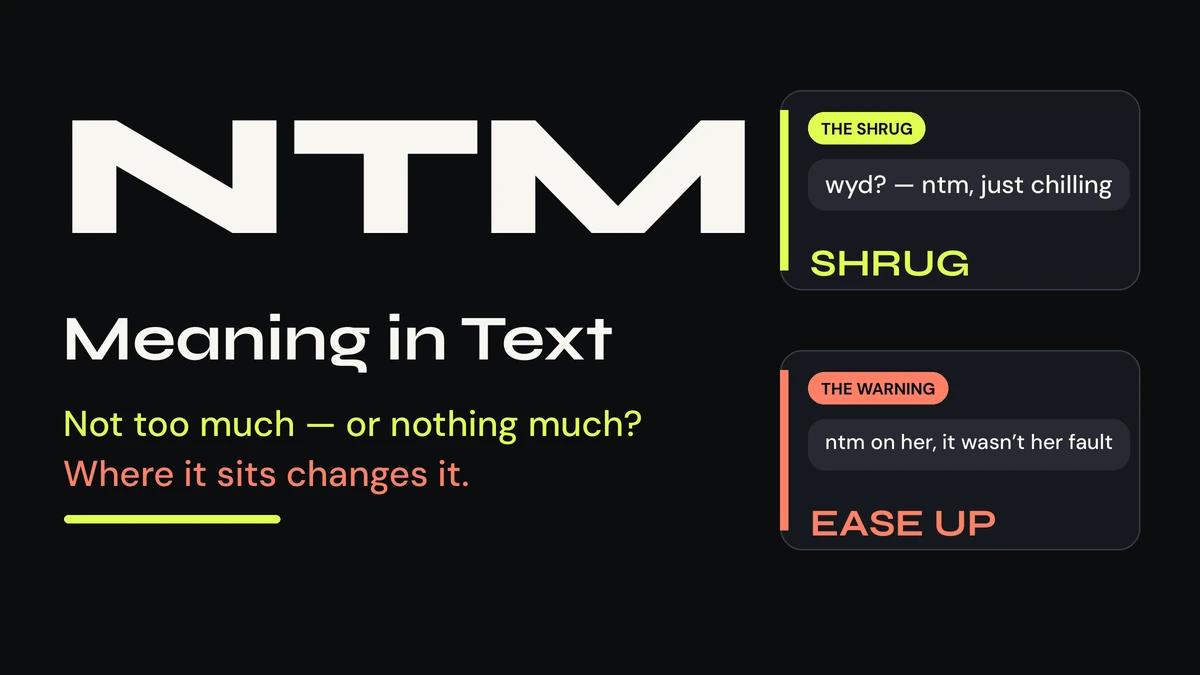
But NTM has two more live readings, and both are decided by position, not by spelling. Mid-sentence, NTM usually means “not to mention”: it tacks one more point onto a list, often while venting. “The flight got delayed three hours, ntm they lost my bag” is not a shrug at all — it is an extra complaint. And in the pattern “NTM on” someone or something, NTM means “don’t do too much”: ease up, stop going so hard on them. That third reading is the only one a dictionary actually documents. Wiktionary, read directly for this article, lists the English slang sense as an initialism of “not too much,” referring to insults or criticism, with the example “ntm on her it wasn’t her fault.” The dictionary backs the warning, not the shrug — and that inversion is exactly why this article runs a position test instead of handing you one definition.
The NTM Position Test
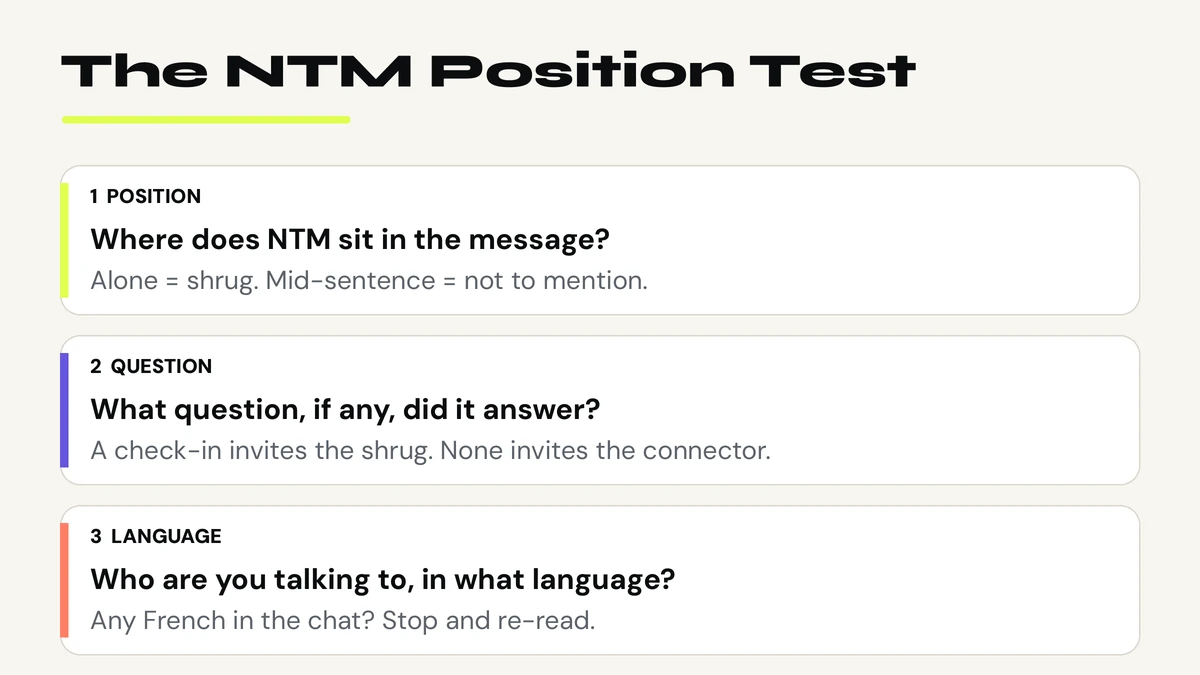
Before you answer an NTM — or send one — run three checks. They take about five seconds, and they beat every shortcut the competitors offer, because the competitors all say “it depends on context” without giving you a procedure for reading it:
- Check 1 — The Position Check. Where does NTM sit in the message? Standing alone as the whole reply (“wyd?” → “ntm”) means the shrug: not too much, nothing much. Sitting mid-sentence between two complaints means “not to mention.” Sitting in front of “on” plus a person (“ntm on her”) means “don’t do too much.” Position alone sorts most NTMs before you read another word.
- Check 2 — The Question Check. What question, if any, did it answer? A check-in question (“what’s up?”, “what are you doing?”, “how’s your day?”) invites the shrug. No question at all — a statement that just keeps going — invites the connector reading. A criticism or a pile-on invites the warning. If no question was asked, the shrug reading is already unlikely.
- Check 3 — The Language Check. Who are you talking to, and in what language? In an English chat, NTM is harmless. In a French-language chat, or with French speakers, the same three letters are a well-known vulgar insult — a different phrase entirely, covered in the appropriateness section below. If the conversation has any French in it, stop and re-read before you send or answer. The language check is the only one that can turn a harmless shrug into a serious insult.
Worked trio. “wyd?” → “ntm, just chilling”: standalone, answers a check-in, English chat. Shrug — nothing much is happening. “He showed up late, ntm he forgot the tickets”: mid-sentence, no question, second complaint in a list. Connector — not to mention. “ntm on her, it wasn’t her fault”: “NTM on” plus a person, after criticism. Warning — don’t do too much. Three messages, one abbreviation, three readings — and the test, not the spelling, sorted them.
“NTM” in Real Chats
Illustrative examples written for this guide, not real transcripts. The greeting it answers most often is the one our HYB guide covers: “how you been?” is a check-in, and “ntm” is the smallest honest answer to it.
- The check-in shrug. “what are you doing?” → “ntm, just chilling, u?”: the default. A shrug with a bounce-back question, and the conversation stays open.
- The bare shrug. “what’s up?” → “ntm.”: the same reading with nothing added. Flat, but not rude between close friends — it only sounds cold when the question deserved more.
- The tired shrug. “how’s your day?” → “ntm, pretty chill day tbh.”: the shrug with a little colour. The extra words are the warmth; the letters only carry the facts.
- The vent connector. “The flight got delayed three hours, ntm they lost my bag.”: mid-sentence, second complaint. Not a shrug — an escalation of the list.
- The extra point. “I’m tired, ntm I’m hungry.”: two small complaints stacked. The NTM is the hinge between them, and removing it leaves two separate sentences.
- The warning. “ntm on her, it wasn’t her fault.”: “NTM on” plus a person, after criticism. Don’t do too much — the dictionary’s own example, used as a defence, not a shrug.
- The caption shrug. “ntm, just vibing today.”: no question was asked at all. As a caption, NTM stops answering and starts setting a mood — relaxed, low-key, nothing to report.
The NTM Tone List
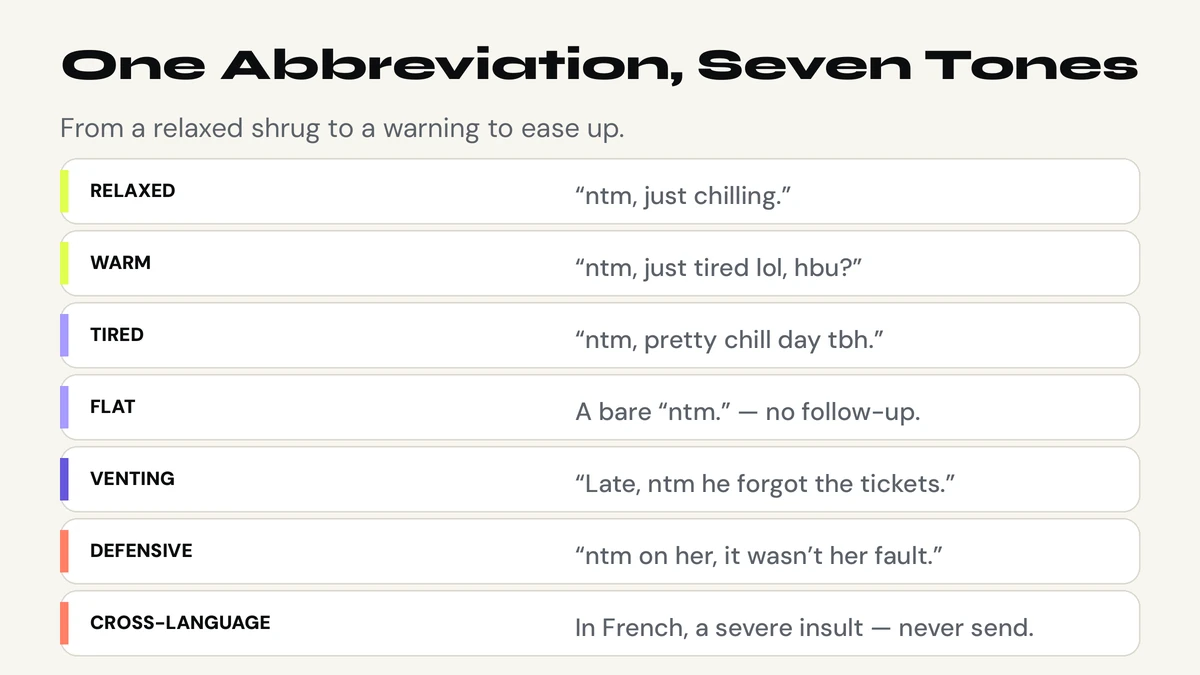
NTM’s letters never change; its feeling slides across seven readings, lightest to riskiest. The first five are safe to send; the last one is never safe to send in English by mistake:
- Relaxed: “ntm, just chilling.” — the default shrug. Nothing is happening, and that is fine.
- Warm: “ntm, just tired lol, hbu?” — the shrug with a follow-up and a laugh. The extra words do the warmth; the letters only do the facts.
- Tired: “ntm, pretty chill day tbh.” — low energy, honestly reported. The shrug is the tiredness, not the indifference.
- Flat: a bare “ntm.” with no punctuation and no follow-up — reads as disinterested, even when it is not meant that way. The flatness is in the delivery, not the letters.
- Venting: “He showed up late, ntm he forgot the tickets.” — the connector reading, exasperated. Each extra point raises the temperature a little.
- Defensive: “ntm on her, it wasn’t her fault.” — the warning reading. Somebody is being criticised too hard, and NTM is the brake.
- Cross-language danger: the same three letters in a French-language chat — a severe vulgar insult, not a shrug at all. The only tone on this list that can offend before you finish typing.
What moves a reading between these tones is never the letters alone: it is the position (standalone, mid-sentence, or before “on”), the question it answers, and the language of the chat. The same “ntm” that is a warm shrug to a friend on Saturday can be a flat wall to a worried friend on Monday — and the test, not the spelling, tells you which day you are on.
“NTM” on TikTok
On TikTok, NTM lives in captions and comment threads, and the comment thread is where its two English readings split most visibly. As a caption, it is usually the shrug as a mood: “ntm, just vibing today” sets a relaxed, low-key tone for the whole post rather than answering a question at all. As a comment, it is usually a quick reply to a creator’s question (“what are you all up to this weekend?”) — the same shrug, in public, where brevity is the norm and nobody expects a sentence.
TikTok is also where the warning reading shows up most. In phrases such as “NTM on” a creator or a celebrity, it can mean “don’t do too much” — ease up, stop exaggerating, stop going so hard on them. That use is defensive: it shuts down criticism of a favourite person, film, or show rather than answering a question. If the NTM you see on TikTok sits before “on” and a name, read it as the warning, not the shrug — and if it sits alone under a question, read it as the shrug.
“NTM” on Snapchat
On Snapchat, NTM fits the fast, private, disappearing DM: a bare “ntm” as a streak reply, or “ntm, u?” as the whole conversation for a minute. The streak culture rewards quick, frequent replies, which favours a three-letter shrug over a sentence — and the disappearing format suits it, because a shrug does not need to be re-read. Story replies work the same way: a low-effort but friendly response to a story that does not need a detailed reaction, the tap-to-reply version of a shrug.
Snapchat is also where the flat tone costs the most. A disappearing message cannot be re-read, so a bare “ntm” to a caring question (“hey, you seemed off earlier, are you okay?”) leaves only the flatness behind, with no sentence to soften it afterward. If the question had emotional weight, add the warmth before you send: “ntm, just tired lol, hbu?” reads completely differently from a bare “ntm”, and on Snapchat you do not get a second draft.
“NTM” on Instagram
On Instagram, NTM shows up in three spaces, each with its own texture. DMs work exactly like regular texting: a quick, casual reply to “hey, what’s up?” between friends. Comments are often a reply to a creator’s caption question, or a way to answer another commenter without writing a full sentence. Story replies are the lightest of all — a low-effort but friendly response to a story that needs no detail. The reading is the same shrug in all three; what changes is how much warmth the space expects.
Instagram is also where NTM meets its closest platform trap: reading a public comment as a private brush-off. A bare “ntm” left as a public comment on someone’s post can look more dismissive than the same reply in a DM, because public comments are read by everyone scrolling past, not just the person they answer. If you want a comment to read warmer, pair the shrug with an emoji or a compliment on the post — “ntm, love this song though” — instead of leaving the letters alone. And in captions, NTM can carry the connector reading too: a caption that lists complaints can use “ntm” to add one more, so check the position before you assume a shrug.
“NTM” in Text Messages
Plain texts are NTM’s home ground, and the one-to-one setting makes the position test sharpest. A check-in question invites the shrug: “wyd?” → “ntm, u?” is the most common exchange in the whole article, and it works because both sides already know the shorthand. A longer text that keeps going after the NTM is the connector: “I’m tired, ntm I’m hungry” is a list, not a reply. And a text that defends someone — “ntm on her” — is the warning, aimed at the criticism, not at you.
Texts are also where a flat NTM does its quiet damage. If someone sends a caring or detailed question and the reply is just “ntm,” the mismatch between the weight of the question and the flatness of the answer is what stings — not the abbreviation itself. The fix is cheap: an emoji, a follow-up question, or one short extra sentence. “ntm, just tired lol, hbu?” keeps the conversation open; a bare “ntm” often closes it. And texts are NTM’s work limit in miniature: never send NTM in a professional message. A client, a manager, or a first contact deserves a full sentence, not three letters that presume a casualness you do not have.
Who Is Sending It: How “NTM” Lands by Sender
No source documents a different meaning of NTM per sender — the abbreviation stays fixed; what changes is which reading you should expect, and therefore what you owe back:
- Friend: the default. A friend’s NTM is the shrug at face value; run the test and answer that, not the letters.
- Crush: overread territory. A crush’s NTM feels bigger than it is — usually “I have nothing to report,” not a verdict on you. Answer the shrug, not a rejection you invented.
- Partner: pattern rules. A partner’s NTM is usually routine small talk; judge the pattern across days, not one message — but a sudden run of bare, flat NTMs after warm ones is worth one plain question, not a fight.
- Parent: usually literal and plain. A parent who writes NTM has usually learned it from you and means the shrug plainly; do not read a parent’s NTM as cold unless the question it answered deserved more.
- Coworker or boss: context decides. In a casual team chat a colleague’s NTM to “what’s up?” is a normal shrug; in any formal thread it is out of place, and never send one upward to a manager or client — and never one that answers a work question with a shrug.
- Group chat: both habitats at scale. A group’s “ntm” answers a check-in for everyone at once; a group’s “ntm on him” defends one person in front of everyone. Answer in the group either way, and do not single one sender out for a private reading of a public shrug.
- Stranger or creator: the public habitat. A stranger’s NTM under your post, or a creator’s NTM in a caption, is a public reaction, not a message to you personally. A thank-you or a matching shrug is enough; never answer a public reaction with a private confession about your day.
When “NTM” Is Too Much: Work, School, and French Chats
This section is mandatory for NTM in a way it is not for most terms in this series, because NTM’s risk is not vulgarity in English — the word is clean — but two different failures: sounding dismissive when someone needed more, and meaning something else entirely in another language. Four rooms, four rules. At work: never send NTM in a professional message, a client thread, or a formal channel. If a colleague asks how a project is going, an actual sentence is expected. A casual internal team chat is the only work room where a shrug fits, and even there, never answer a real question with a bare “ntm.”
At school: the same rule, with a younger audience. A teacher’s check-in deserves a sentence, and a classmate who asked a serious question deserves more than a shrug. The flat NTM is the school risk, not the letters: a bare “ntm” to “are you okay?” reads as a closed door, and in a class chat that door stays visible. In family chats, read the room person by person: a sibling group may love the shorthand, a grandparent group may not know the letters, and a parent who dislikes being brushed off will dislike the abbreviation exactly as much as the shrug, once they learn what it stands for. Abbreviation is not permission.
In French-language chats, the rule is different and absolute: do not use NTM at all. In French, NTM is the written abbreviation of a vulgar insult aimed at someone’s mother — the phrase is “Nique ta mère” — and the English gloss, asterisked once here, is “f*** your mother.” It is a severe insult, not a casual curse word, and it gained mainstream visibility through Suprême NTM, the French hip-hop duo formed in the late 1980s who took the phrase as their name. The same three letters that shrug in English insult in French, so if the conversation has any French in it — a French speaker, a French group chat, a French comment thread — skip the abbreviation entirely and write “not much” instead. And one boundary worth stating plainly: if someone tells you your NTM felt dismissive, simply add the words next time. Switching from a bare shrug to a shrug with a sentence is easy, and it shows respect.
Checked Claims: Expansions That Do Not Hold Up
Three letters attract folklore, and an abbreviation this short attracts more than most. Each claim below was graded against the dictionary read in full and the competitors read in full; nothing is repeated here as fact on a single blog’s say-so:
- “NTM means ‘not too much’ in about 90% of cases” — graded as a competitor’s figure, not a statistic. One guide states the shrug reading covers roughly 90% of uses. No frequency study, corpus, or survey is cited for the number, and no other source repeats it, so this guide does not repeat it as a fact. The shrug is the most common reading by agreement across competitors; how common, exactly, nobody has measured.
- “‘Nothing much’ is fading and ‘not too much’ is taking over” — rejected as an unsupported trend. One 2026 guide claims the “nothing much” expansion is slowly fading in favour of “not too much,” especially among Gen Z users. No data is offered for the shift, and the other guides still lead with one or the other with no pattern, so the article reports the disagreement and treats the two as near-synonyms in the same slot.
- “NTM means ‘need to meet’” — unverified. One guide lists “need to meet” as an occasional meaning in group chats and gaming. No other competitor repeats it, no dictionary lists it, and no example conversation is given, so this guide does not teach it as a live reading. If a friend group uses it that way, it is their private shorthand, not a documented meaning.
- “NTM means ‘nice to meet’, ‘new to me’, or ‘need to move’” — rejected as acronym-list padding. Acronym lists and one 2026 guide offer these expansions with no example of anyone using them in a message. They are what the letters could stand for, not what anyone is observed to mean by them. An expansion is not a meaning until somebody uses it.
- “NTM means ‘nice teamwork’ or ‘not too mad’ in games” — rejected. One low-quality guide claims these gaming readings for Valorant and other shooters. No other source repeats them, and the gaming sections of the stronger guides say NTM keeps its standard shrug meaning in lobbies. Gamers say “ntm” between matches the same way texters do.
- “NTM means ‘not this time’” — rejected. One guide opens by defining NTM as “not this time,” then spends the rest of its own article using the shrug reading. A definition its own author does not use is not a live meaning.
- “NTM has a different meaning on each platform” — rejected. One guide assigns the shrug to texting and the connector to Instagram as if the platform decided it. The evidence in this article says otherwise: position in the sentence decides the reading on every platform, and the same platform carries all three readings. Platforms change the room, not the word.
- “NTM is a TikTok invention” — rejected. The abbreviation predates TikTok by years: one competitor traces the oldest user-dictionary entry to 2004, and the shorthand belongs to the SMS and instant-messaging era. TikTok revived the shrug and spread the warning reading; it invented neither.
What SURVIVES: the shrug (“not too much” / “nothing much”) as a standalone reply to a check-in; the connector (“not to mention”) mid-sentence; the warning (“don’t do too much”) in the “NTM on” pattern, the only reading a dictionary documents; “next to me” as an occasional location use, competitor-reported only; “next twelve months” as a formal finance term, fenced off from slang; and the French vulgar reading, dictionary-documented and genuinely dangerous across languages. The two lead expansions are near-synonyms in one slot, and no dominance claim is made between them.
“NTM” vs Its Closest Cousins
NTM belongs to the shrug family — short replies that say little and keep the conversation moving. Its closest cousins split by what they do with the silence:
- DTM (doing-too-much cousin). Our DTM guide covers the opposite side of the same scale: where NTM says “not too much is happening,” DTM says “you are doing too much.” One measures the day; the other measures the person. And NTM’s warning reading — “don’t do too much” — is DTM’s sentence in three letters.
- IDK (flat-shrug cousin). Our IDK guide covers the other flat reply: where NTM says “nothing much is happening,” IDK says “I don’t know.” Both are shrugs, but they shrug at different questions — activity versus knowledge. Answering “what are you doing?” with IDK confuses the asker; answering “what do you think?” with NTM does the same.
- “NM” (near-twin cousin). The closest look-alike in texting: NM can mean “not much” just like NTM, but NM has a second job NTM never does — it can mean “never mind,” used to withdraw a statement and drop a topic entirely. NTM only describes a low-key status; it cannot cancel a sentence.
- “HBU” (bounce-back cousin). The question that usually follows the shrug: “ntm, hbu?” is one message, not two. HBU turns a shrug into a conversation; without it, a bare NTM often ends one.
- “WYD” (opener cousin). The question NTM most often answers: “wyd?” opens, “ntm” closes the opening. One asks what you are doing; the other reports that the answer is not much.
- “TBH” (honesty cousin). The softener that often rides with the shrug: “ntm, pretty chill day tbh” uses TBH to certify that the shrug is honest, not dismissive. One reports the day; the other swears the report is true.
Where “NTM” Came From
The honest answer is that nobody knows exactly, and this article says so rather than repeating a tidy story. NTM is a transparent initialism: “not too much” shortens to three letters the way any long phrase shortens under a keypad, and no person, post, or platform is documented as coining it. One competitor dates the shorthand to the early instant-messaging era — MSN Messenger and AOL chat rooms in the late 1990s and early 2000s — and another traces the oldest user-dictionary entry to 2004, but neither claim is documented with a citable first use, so this guide reports them as competitor-reported, not as established fact.
What is documented is the shape of the spread. The abbreviation belongs to the SMS era, when physical keypads and per-message costs rewarded every saved keystroke: “not too much” is five words and twelve characters, “ntm” is one word and three. Smartphones did not kill it; Snapchat streaks, Instagram DMs, and later TikTok comments revived it, because fast public threads and disappearing private messages reward exactly the same brevity. The warning reading — “NTM on” someone — is the newer arrival, carried by TikTok comment culture, and it is the only reading a dictionary has yet recorded. The French reading is older still in its own language, carried by a hip-hop duo formed in the late 1980s. Three histories, one abbreviation, no single birth year — and that is the whole origin story, honestly told.
How to Reply When Someone Sends “NTM”
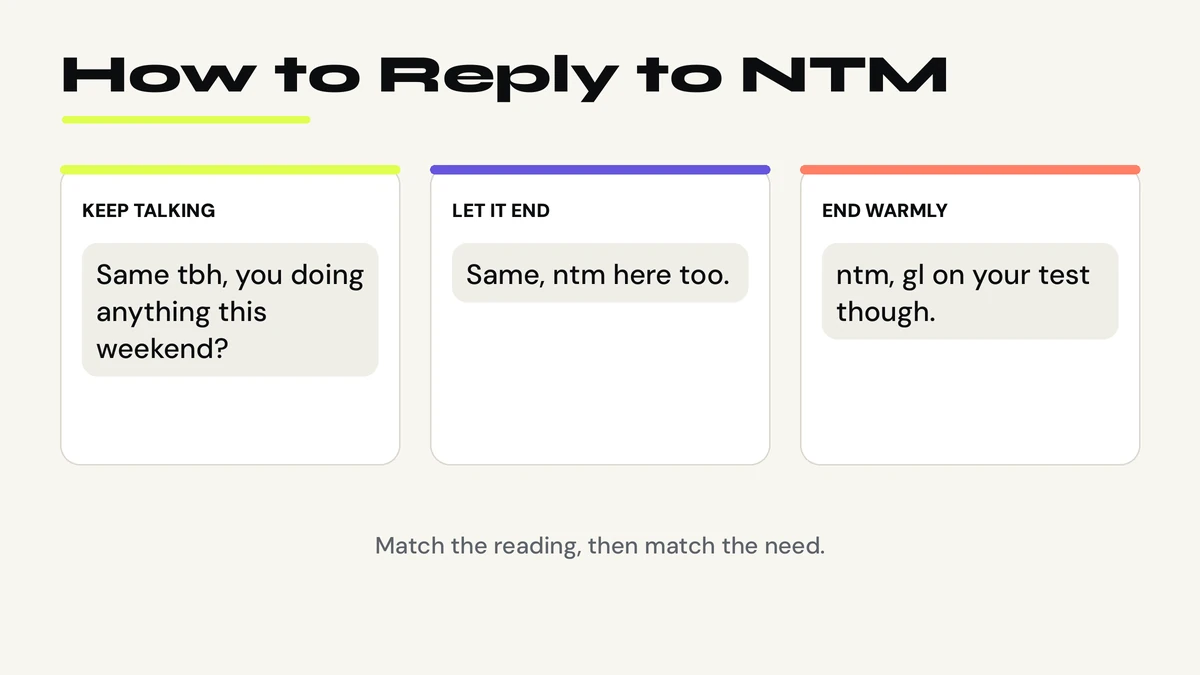
Golden rule: answer the reading the test found, not the letters. A reply bank keyed to the reading:
- Shrug, and you want to keep talking — ask something specific: “Same tbh, you doing anything this weekend?” A vague question got a vague answer; a specific question is what moves the conversation forward instead of bouncing another flat reply back.
- Shrug, and you are fine letting it end — mirror it: “Same, ntm here too.” A mirrored shrug is a normal, low-pressure way to close a casual exchange without it feeling abrupt.
- Shrug, and you want to turn it into a plan — make one: A flat NTM is an opening, not just a shrug — our HML guide covers the open invitation in full, because “ntm, hml later?” turns a shrug into a plan, and plans beat shrugs every time.
- Connector, and you are venting too — add your own point: “Ugh, and ntm the wifi died too.” The connector invites a matching point, not a new topic — answer the list, not the letters.
- Warning, and you agree — ease up with them: “Fair, I will drop it.” A warning answered with agreement ends the criticism cleanly; defending the criticism restarts it.
- Any reading, and you want to end warmly — add a wish: A shrug plus a wish reads warmer than a shrug alone — our GL guide covers the good-luck wish in full, because “ntm, gl on your test though” proves the shrug was relaxed, not cold.
Frequently Asked Questions
What does NTM mean in a text message?
NTM usually means “not too much” or “nothing much” — a short, relaxed reply when someone asks what you are doing. Run the Position Test before you decide: a standalone NTM is the shrug, a mid-sentence NTM means “not to mention,” and “NTM on” someone means “don’t do too much.”
What does NTM mean, not too much or nothing much?
Both, in the same slot. “Not too much” and “nothing much” answer the same check-in question with the same shrug, and the competitors disagree about which leads — one leads with “not too much,” another with “nothing much.” No frequency study exists to settle it, so this guide makes no dominance claim and treats them as near-synonyms.
What does NTM mean on TikTok?
On TikTok, NTM usually means the shrug in captions (“ntm, just vibing today”) and comments answering a creator’s question. But in the pattern “NTM on” a creator or celebrity, it means “don’t do too much” — a defensive warning to ease up on criticism. Position decides which one you just saw.
What does “NTM on someone” mean?
It means “don’t do too much” — stop going so hard on them. It is the only NTM reading a dictionary documents: Wiktionary lists it as an initialism of “not too much,” referring to insults or criticism, with the example “ntm on her it wasn’t her fault.” It is a defence, not a shrug.
What does NTM mean in French?
In French, NTM is the written abbreviation of a vulgar insult aimed at someone’s mother, made famous by the hip-hop duo Suprême NTM. It is a severe insult, not a casual curse word. Never use NTM in a French-language chat — write “not much” instead.
Is NTM rude?
In English, NTM itself is not rude — it is a neutral, informal shrug. But a bare “ntm” can read as dismissive when it answers a serious or caring question, because the flatness mismatches the weight of the question. In French, the same letters are a severe insult. The rudeness lives in the delivery and the language, not in the abbreviation.
Can I use NTM at work or school?
Generally, no. NTM belongs in casual digital conversations. In work messages, formal chats, or school messages it can sound unprofessional, and a bare NTM to a real question reads as a brush-off. In a casual peer chat it is fine; anywhere formal, or anywhere a question deserves a sentence, spell it out instead.
What should I reply when someone sends NTM?
Answer the reading the test found. A shrug you want to continue gets a specific question (“Same tbh, you doing anything this weekend?”); a shrug you are fine ending gets a mirror (“Same, ntm here too”); a warning you agree with gets a stand-down (“Fair, I will drop it”). The full reply bank is in the section above.
The Takeaway
NTM usually means not too much or nothing much — a shrug in three letters. But where it sits changes it: mid-sentence it means “not to mention,” and before “on” it means “don’t do too much.” When an NTM lands, run the Position Test: check the position, check the question, check the language. And when you send one, remember the only rule that matters: a shrug answers a check-in, a sentence answers a real question — so if you mean it warmly, prove it with a follow-up, and if the chat has any French in it, do not send the letters at all.