What does mk mean in text? MK means “okay,” said the way you would hum it out loud — a quick, casual “mm-kay.” This guide to mk meaning in text gives you the MK Warm-or-Flat Test, so you can tell in seconds whether the MK you just got was a warm yes, a flat shrug, or a quiet “I am done talking about this.”
This guide covers the one dictionary-supported meaning, the three-check test, seven tones, MK on TikTok, Snapchat, Instagram, and in texts, how it lands by sender, when it is too much for work, school, and family, graded claims, cousins, history, and a reply bank keyed to the reading you just identified.
What “MK” Means in Text
MK is not an initialism built from a phrase the way most texting abbreviations are. It is a sound, written down: the hummed “mm-kay” people say when they agree without much ceremony. Say it out loud — mm-kay — and you can hear the whole meaning in the hum. It is “okay” with the effort taken out, and that missing effort is exactly what makes it so easy to misread.
The dictionary record is unusually direct for a two-letter term, and this guide leans on it exactly as read. lists mk as an English interjection in internet slang and text messaging, an alternative spelling of m’kay, and its m’kay entry defines it as a nasalized variant of okay, popularized by the school counselor Mr. Mackey’s catchphrase in South Park, meaning an expression of acknowledgment or affirmation, “now sometimes used in an ironic or condescending sense.” One entry, one meaning, and the warning about irony built into the definition itself — that is the whole puzzle of MK in miniature: a yes that can sound like a shrug, and no spelling difference between the two.
Dictionary.com’s slang entry for mmk, also read directly for this article, says the same thing from a different angle: mmk is a casual, half-humming way to say OK, a versatile sound used to express mild disapproval and suspicion, or warm affirmation, and it warns that mmk can come across as a little patronizing or rude. The same entry traces the earliest written “mkay” to a 1998 South Park online forum and notes that the 1999 film Office Space gave the world Bill Lumbergh, whose droning “mmk” turned polite requests into grating orders. Two references, read in full, agree on the shape: a spoken hum first, a typed shortcut second, and a tone that slides from warm to condescending without ever changing the letters. The test in the next section turns that observation into a procedure, because “context matters” is true and useless on its own.
The MK Warm-or-Flat Test
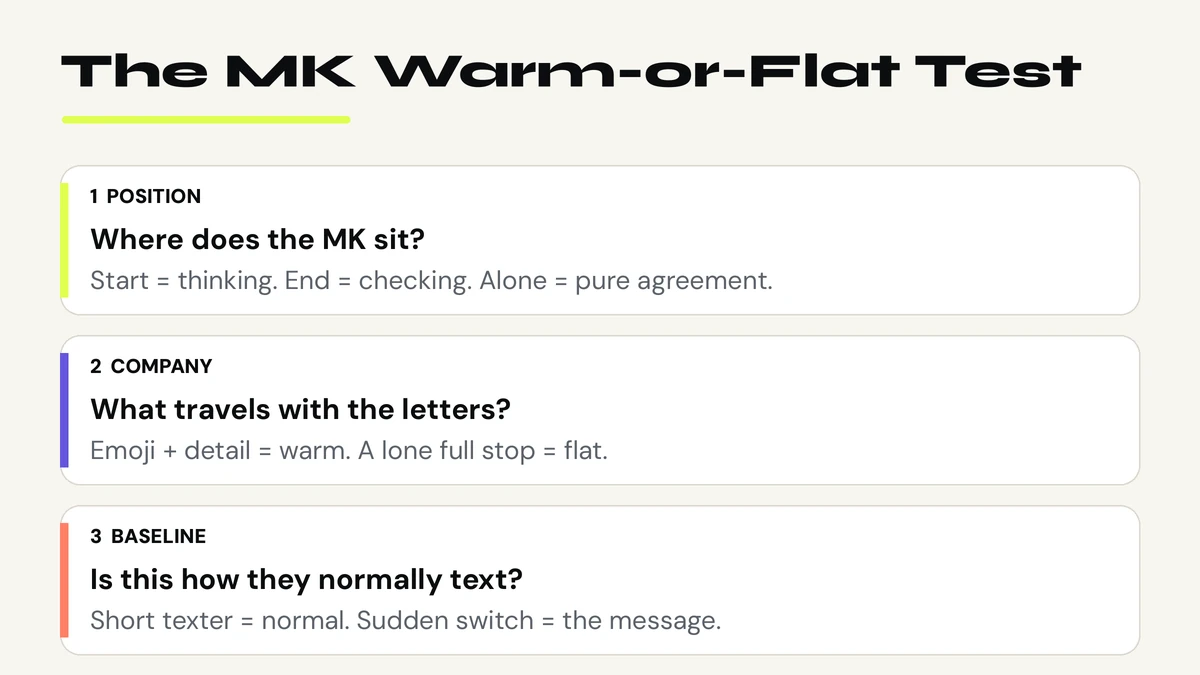
Before you answer an MK — or send one — run three checks. They take about five seconds, and they beat every shortcut the competitors offer, because the competitors all say “read the context” without giving you a procedure for reading it:
- Check 1 — The Position Check. Where does the MK sit in the message? Dictionary.com describes three position patterns, and each one points somewhere different. At the start of a sentence, the writer may be thinking or focusing: “Mk, where did I leave my phone?” At the end of a sentence, the writer may be checking that you understand or offering comfort: “Tomorrow is a new day, mmk?” Standing alone as the whole reply, MK is pure agreement — and pure agreement is where the flat reading lives, because a lone “okay” with nothing around it is the easiest reply in the world to send and the hardest to read.
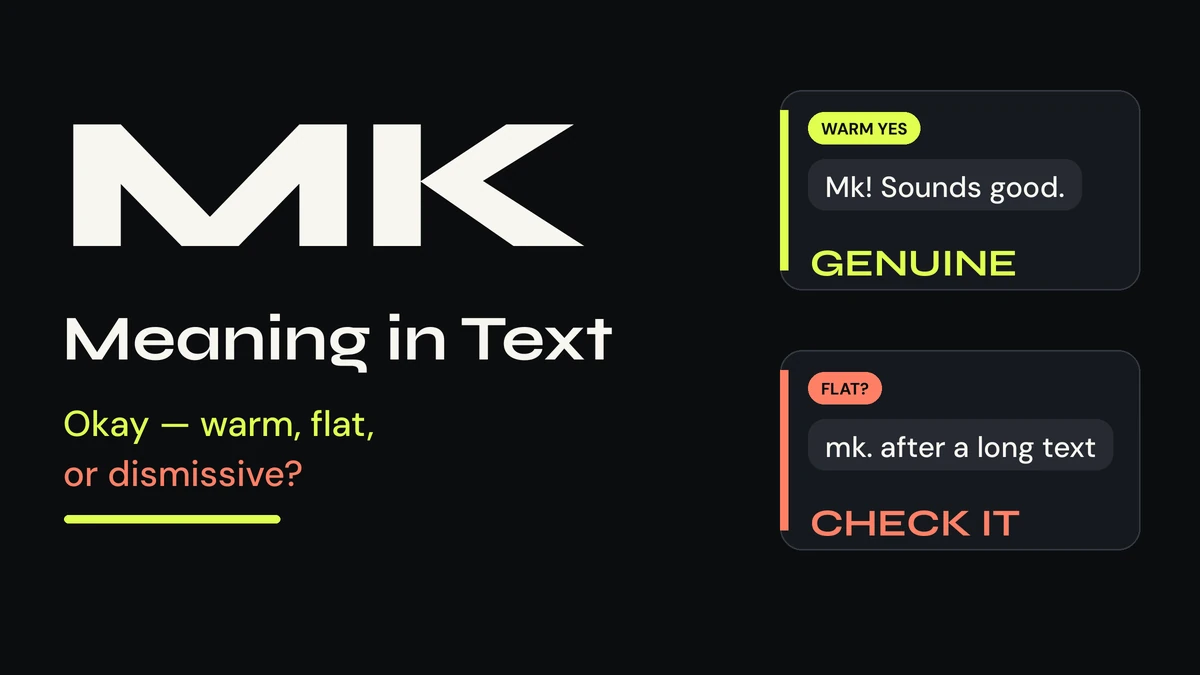
- Check 2 — The Company Check. What travels with the letters? An emoji, an exclamation mark, or a follow-up sentence (“Mk, sounds good, see you at 7”) points to a warm yes. A full stop after a bare mk points the other way: Binghamton University researchers asked 126 undergraduates to rate short exchanges and found that texts ending in a period scored as less sincere than texts without one, while a follow-up found that an exclamation mark read as more sincere. The study tested one-word replies like “okay,” not MK itself, and its lead researcher called the work modest and exploratory — so treat the period as a clue, not a verdict. Company is still the fastest single signal: warmth brings company, flatness travels light, because the sender who means it warmly usually proves it with one extra word.
- Check 3 — The Baseline Check. What does this sender normally sound like? If the person always texts in short bursts, a bare “mk” is just their handwriting — normal, not a message. If they usually write full sentences and suddenly switch to a lone “mk” after your long message, something changed, and the change is the message. Judge the reply against the sender’s own habit, not against your own texting style: a terse person’s warmest reply can look exactly like a chatty person’s coldest one.
Worked trio. “Meet at 7?” — “mk, see you then”: position standalone-plus-follow-up, company warm, baseline normal for a short texter. A warm yes, nothing to decode. “I just felt left out today, and it really hurt” — “mk.”: position standalone, company a full stop and nothing else, baseline a switch from full sentences to two letters. Flat at best, dismissive at worst: the reply says “heard” where the message asked for care. “Trust me, this movie is amazing” — “mkay, if you say so” with a laughing emoji: position standalone, company playful, baseline teasing. Skeptical teasing, not agreement at all — the hum is doing the doubting. Three messages, one meaning, three readings — and the test, not the spelling, sorted them.
“MK” in Real Chats
Illustrative examples written for this guide, not real transcripts:
- The quick confirmation. “Running 10 min late.” — “mk, I will grab a table”: agreement plus a plan, in one breath. Nothing to decode; the plan is the warmth.
- The warm yes. “Do you want to go to the beach?” — “Mk! The weather is perfect”: the exclamation mark and the extra sentence prove the enthusiasm. Answer the plan, not the letters.
- The reluctant yes. “Please clean the kitchen tonight.” — “mk”: agreement given, enthusiasm withheld. The sender will do it and wants you to know they noticed being asked.
- The flat reply. “I just felt left out today” — “mk.”: a long, emotional message answered with two letters and a full stop. Run the Baseline Check before you decide whether this is distraction or distance.
- The skeptical tease. “Trust me, this movie is amazing.” — “mkay, if you say so”: the hum is doing the doubting. The sender is not agreeing; they are reserving judgment with a smile.
- The thinking aloud. “Mk, where did I leave my phone?”: MK opens the sentence, not closes it. This is the writer thinking in text, and it is not a reply to you at all — it is a note to themselves that you happened to see.
- The comfort check. “I know you had a rough day, but tomorrow is a new one, mmk?”: MK ends the sentence as a soft check that you are still with them. Same letters, opposite job — comfort, not dismissal, and the question mark is doing the work.
“MK” on TikTok
On TikTok, MK lives in comments, and the comment thread is its natural habitat: a creator posts an overconfident claim, a bold take, or a flex, and the comments fill with “mkay” or “mk, sure” — the skeptical tease, performed for an audience. The public stage suits the teasing readings best, because a comment thread is an audience, not a private conversation: nobody there is owed a sentence, and the doubt lands precisely because everyone in the thread can hear the hum.
The trap on TikTok is taking a public joke personally. A stranger’s “mkay” under your video is a reaction to the post, not a verdict on you, and a creator who captions their own video with “mk” is usually doing self-aware irony, not asking for sympathy. If an MK arrives in a TikTok DM, though, run the test as usual — a DM is private again, and the flat-distance and dismissive readings return with it.
“MK” on Snapchat
On Snapchat, MK fits the fast, private, disappearing DM: “mk, see you at 7” as a story reply, or a bare “mk” on a streak snap between close friends. The disappearing format suits the warm and neutral readings — agreement that lands lightly and is gone. But disappearance also removes your evidence: if an MK felt flat or sharp, you cannot re-read it, so judge from memory what rode with it — an emoji, a follow-up, or nothing at all.
Snapchat is also where the photo does half the work. A snap of a plan — a time, a place, a ticket — plus “mk” needs no explanation: the image names what is being agreed to, and the letters only say how the viewer feels about it. That is the Position Check working in real life — remove the MK and the snap still shows a plan, which is how you know the job was agreement, not information.
The MK Tone List
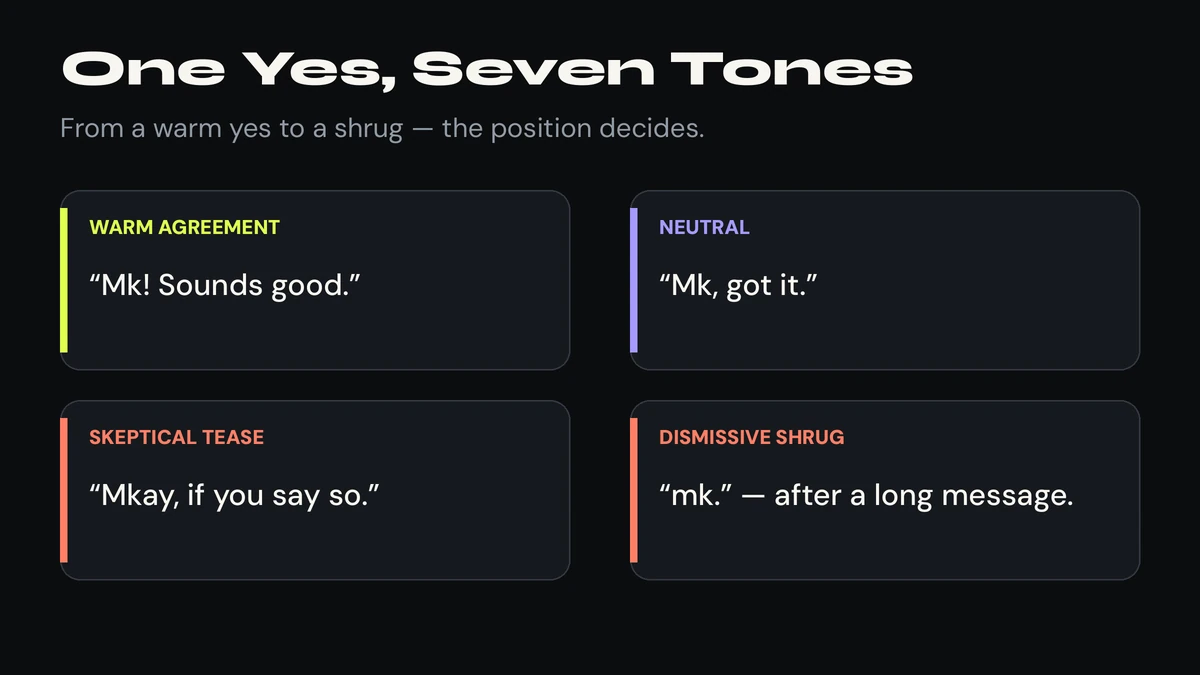
MK’s meaning never changes; its feeling slides across seven readings, warmest to riskiest. The first three are safe to send; the last two are safe only where the friendship already speaks that language:
- Warm agreement: “Mk! Sounds good” — a yes with energy behind it. The exclamation mark or the extra sentence proves the warmth is real.
- Neutral acknowledgment: “Mk, got it” — “message received, moving on.” No feeling either way, and none is needed: the plan is set, the thread can rest.
- Reluctant agreement: “Mk, fine” — a yes given under protest. The sender agrees and wants you to know it cost them something; answer the concession, not just the yes.
- Hesitant agreement: “Mk, I suppose I can” — agreement with a doubt still attached. The sender is not refusing, but they are not convinced either, and a little reassurance goes further than a celebration.
- Skeptical tease: “Mkay, if you say so” — doubt dressed as agreement. The hum is the whole message: “I hear your claim, and I am not buying it yet.”
- Flat distance: A bare “mk.” after a message that deserved more. Not hostile, just closed: the sender heard you and stopped there. The Baseline Check decides whether this is a busy day or a cooling friendship.
- Dismissive shrug: A lone “mk” after a long, emotional message — the digital equivalent of a nod while walking away. The sender is not disagreeing; they are declining to engage, and that refusal is the message.
What moves a reading between these tones is never the letters alone: it is the position (start, end, or alone), the company (emoji, punctuation, follow-up sentence), and the baseline (this sender’s normal habit). The same “mk” that is a warm yes on Saturday can be a dismissive shrug on Monday morning — and the test, not the spelling, tells you which day you are on.
“MK” on Instagram
On Instagram, MK shows up in comments, story replies, and DMs, and the stage decides the tone the way it does for every agreement term. Story replies lean quick and neutral: “mk” under a story usually just acknowledges what you posted. Comments lean teasing: “mkay, if you say so” under a bold claim is the skeptical reading, performed for the thread. DMs carry the full range, exactly like texts — a friend’s warm yes and a stranger’s flat shrug live in the same inbox, and only the test tells them apart.
Instagram is also where MK meets its closest platform trap: reading a public comment as a private message. A stranger’s “mk” under your post is not a conversation opener, and answering it with a long explanation embarrasses both sides. A thank-you, a matching laugh, or silence all end it cleanly; the comment was never asking for more.
“MK” in Text Messages
Plain texts are MK’s home ground, and the one-to-one setting makes the distinction sharpest. A warm text wants a witness: “Mk! Sounds good, see you then.” A flat text wants a decision from you: is this a busy day, or is this distance? The reply each one deserves is completely different, which is why the Baseline Check comes before the reply — answering distance with warmth you do not feel, or warmth with suspicion, is the classic MK misfire.
Texts are also where a warm MK turns into a plan, and the plan usually moves somewhere private. A friend who replies “mk, sounds good” and means it often follows up with an invitation — our DM guide covers that move in full, because the channel changes what the next message can say. And texts are MK’s work limit in miniature: never send MK in a professional message. A client, a manager, or a first contact deserves a plain “okay, will do” spelled out, not two letters that presume a casualness you do not have.
Who Is Sending It: How “MK” Lands by Sender
No source documents a different meaning of MK per sender — the meaning stays fixed; what changes is which tone you should expect, and therefore what you owe back:
- Friend: the default. A friend’s MK is usually neutral agreement or playful teasing at face value; run the test and answer that, not the letters.
- Crush: overread territory. A crush’s MK feels bigger than it is — usually “I heard you,” not a verdict on you. Answer the agreement, not a romance you invented.
- Partner: pattern rules. A partner’s MK is usually routine shorthand; judge the pattern across days, not one message — but a sudden run of bare “mk.” replies after warm ones is worth one plain question, not a fight.
- Parent: usually literal and plain. A parent who writes MK has usually learned it from you and means the agreement plainly; do not read a parent’s MK as shade unless the sentence around it is sharp.
- Coworker or boss: context decides. In a friendly team chat a colleague’s MK about a meeting time is a normal confirmation; in any formal thread it is out of place, and never send one upward to a manager or client.
- Group chat: both habitats at scale. A group’s “mk, see you there” confirms for everyone; a group’s single flat “mk.” after your long message still stings, but answer briefly in the group either way, and do not single one sender out for a private reading of a public reply.
- Stranger or creator: the applause habitat. A stranger’s MK under your post, or a creator’s MK in a caption, is a public reaction, not a message aimed at you personally. A thank-you or a matching laugh is enough; never answer a public reaction with a private confession.
When “MK” Is Too Much: Work, School, and Family
This section is mandatory for MK in a way it is not for most terms in this series, because MK’s risk is not vulgarity — the word is clean — but dismissal: two letters can say “I heard you” in a way that sounds like “I do not care.” Four rooms, four rules. At work: never send MK in a professional message, a client thread, or a formal channel. A meeting-time confirmation among close peers in a casual chat is one thing; the same letters as your only reply to a manager’s instructions read as reluctant, and reluctance is the opposite of reliability. If the room would want a “will do,” the letters do not fix it.
At school: the same rule, with a younger audience. Teachers, school groups, and class chats are not MK rooms, and a student who answers a teacher’s message with a bare “mk” has sent a dismissive reply whether they meant to or not. The clean swap is a full sentence: “okay, will do.” In family chats, read the room person by person: a sibling group may love the shorthand, a grandparent group may not know the letters, and a parent who dislikes being answered in grunts will dislike the abbreviation exactly as much as the hum, once they learn what it stands for. Abbreviation is not permission.
The general rule covers every room at once: if someone tells you MK bothers them, simply stop. Switching words is easy, and it shows respect. The swap menu is free and it loses nothing: “okay, sounds good” for agreement, “got it, thanks” for acknowledgment, “sure, I am in” for anything that deserves enthusiasm. And one boundary worth stating plainly: never use MK as your only reply to something emotional. A reaction that says “heard” where the message asked for care is not shorthand; it is a shrug wearing a yes’s clothes, and the Baseline Check catches it, because the room that receives repeated shrugs is not a casual room at all.
Checked Claims: Expansions That Do Not Hold Up
Two letters attract folklore. Each claim below was graded against the dictionary sources read in full and the competitors read in full; nothing is repeated here as fact on a single blog’s say-so:
- “MK means ‘my kid’” — rejected. One competitor’s own trust note says it left this reading out precisely because no dictionary supports it. No source shows anyone using MK to mean “my kid” in a text, and this guide does not repeat it as a live meaning.
- “MK means ‘my king’” — rejected as a texting meaning. A secondary guide reports that some fan communities type “mk” as “my king,” but gives no example, no dictionary, and no context where it would appear in an ordinary text. In everyday chats MK means okay; a fan-community in-joke is not a second texting meaning.
- “MK means ‘mistake’” — rejected. One competitor reports that in some very specific circles “MK” might stand for “mistake,” as in “that was an mk on my part.” No dictionary entry and no example sentence from a real conversation support it, and no source shows it outside that single report. Graded as folklore, not a live meaning.
- “MK is always passive-aggressive” — rejected. The most common misreading of the term, and one competitor names it directly: most of the time MK is just a quick yes, and reading anger into it without other clues creates problems that were not there. The dictionary itself names warm affirmation alongside suspicion, and every competitor guide read in full shows warm and neutral uses.
- “MK is always just okay, with no tone at all” — rejected. The mirror-image error. A bare “mk.” after an emotional message, or a “mkay, if you say so” with a laughing emoji, is not a toneless yes; it is a different tone wearing the same letters. The definition itself carries the irony warning.
- “90% of teens use YouTube, so MK spreads fastest there’” — graded, not repeated as fact. One competitor cites Pew Research Center’s 2024 survey of U.S. teens (90% YouTube, 63% TikTok, 61% Instagram, 55% Snapchat) to argue that short acronyms spread fastest on those platforms. The survey figures describe platform use, not MK use, and this guide repeats neither as evidence about MK itself.
- “MK means Mortal Kombat” — fenced, not a texting meaning. Mortal Kombat is real, and in a gaming chat MK does mean the fighting game franchise, whose first arcade game launched in 1992. Outside a gaming chat it is a collision, not a meaning: nobody replying “mk” to “meet at 7?” is naming a video game. The fence is the context — games talk, games meaning; anything else, okay.
- “MK means Michael Kors, Mary Kay, Magic Kingdom, or Milton Keynes” — fenced, not texting meanings. All four are real uses of the letters outside chat: a fashion brand, a cosmetics brand, a theme park, and a UK postcode area. None of them is a texting meaning, and none of them survives the Position Check: in a text thread, “mk” is the hum, not the handbag.
What SURVIVES: “okay” as a hummed acknowledgment or affirmation, with the seven tones above as feelings of the same agreement — not different meanings. Technical collisions (Macedonian language code mk, the Finnish markka, the Filipino TV drama MMK) are real outside chat and irrelevant inside it: nobody texting “mk” to a friend is tagging a language.
“MK” vs Its Closest Cousins
MK belongs to the agreement family — words that say yes, not words that start a conversation. Its closest cousins split by how much feeling they carry with the yes:
- IGHT (relaxed cousin). Our IGHT guide covers “alright” said with a shrug; MK says “okay” with a hum. IGHT relaxes the yes, MK shortens it. The feeling is close; the sound is the difference.
- IK (agreement cousin). Our IK guide covers “I know” as a claim of shared knowledge; MK claims only that the message landed. IK says “I already knew”; MK says “I heard you.” One shares knowledge, the other confirms receipt.
- IKR (echo cousin). Our IKR guide covers an echo that agrees with a feeling; MK agrees with a plan or a fact. IKR says “I feel that too”; MK says “okay, noted.” One shares feeling, the other closes the loop.
- FR (co-sign cousin). Our FR guide covers a sincerity stamp that certifies a claim; MK accepts a message without certifying anything. FR says “that is true”; MK says “okay, got it.” One certifies truth, the other acknowledges receipt.
- K (letter-trap cousin). K is the coldest yes in texting — one letter, no hum, and almost always read as annoyed. MK adds the hum, and the hum is the whole difference: it softens the yes into something human, where K slams the door. If K is a door closing, MK is a door left ajar.
- “Okay” and “okay!” (plain-English cousins). The spelled-out versions of MK’s two warmest tones. “Okay” is the neutral default, “okay!” is the warm one, and both say the same thing with the tone built in. They are the swap menu: when MK feels too ambiguous, these words say the same thing with no test required.
- HN (grunt cousin). Our HN guide covers the lowercase grunt in the huh and hmm family — or, in capitals, a blunt refusal. MK is the hummed “okay”; HN is the grunt. One agrees, the other reacts — both without using a real word.
- MHM (nod cousin). Our MHM guide covers the sound of a nod, typed out — yes. MK is the hummed okay; MHM is the nod that agrees. One hums it, the other nods it.
Where “MK” Came From
The sound came first, by a long way. People have probably been voicing mmk for as long as OK has been around — Dictionary.com dates OK itself to 1839, and notes that informal sounds like this do not always get written down early on. The hum is older than the spelling: it is the sound of agreement made while thinking, or while softening a demand, or while filling a pause, and it lived in speech for generations before anyone typed it.
The typed form has a paper trail, and the dates come from the dictionary entry read directly. The earliest written “mkay” the entry finds is on a 1998 South Park online forum, where the school counselor Mr. Mackey ends sentences with a droning “mkay” that mocks educators who overuse the filler. A year later, the 1999 film Office Space gave the world Bill Lumbergh, whose “mmk” turned polite requests into grating orders. Wiktionary agrees on the shape, calling m’kay a nasalized variant of okay, perhaps popularized by Mr. Mackey’s catchphrase, with earlier use apparently chiefly in linguistic transcriptions of speech. Two pop-culture moments, one spoken habit: the sound was already in people’s mouths, and television gave it a spelling. No inventor is claimed, and no single year is asserted as the birth of MK — the hum predates its letters by a century and a half.
How to Reply When Someone Sends “MK”
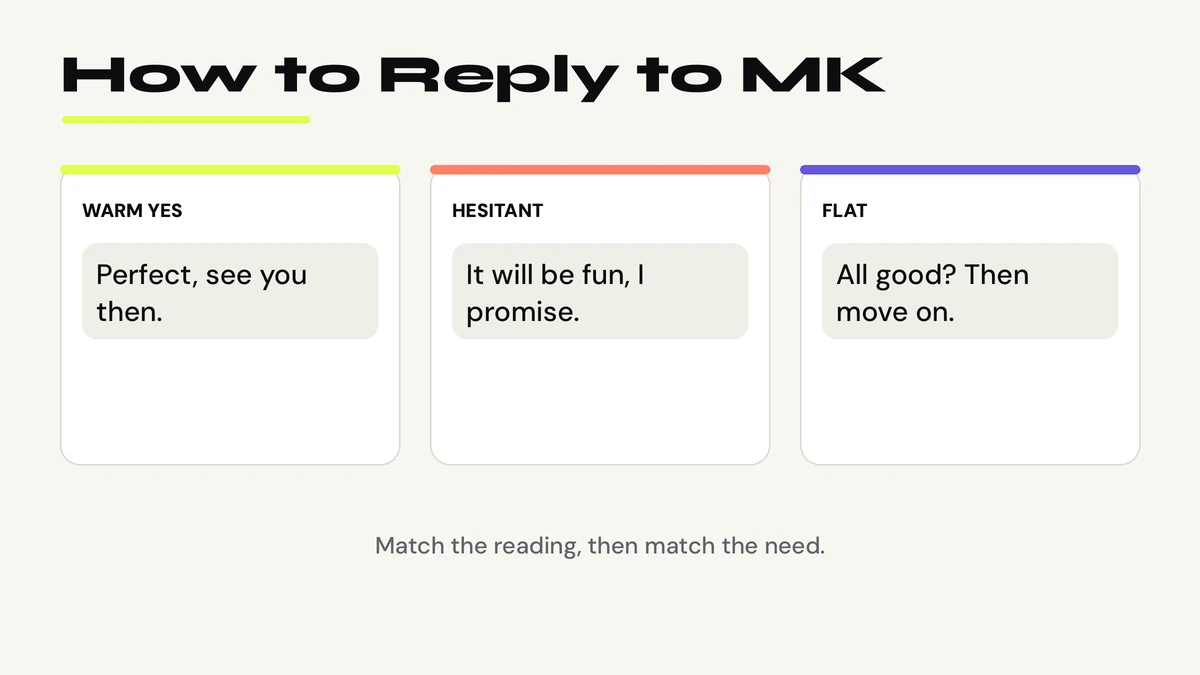
Golden rule: answer the tone the test found, not the letters. A reply bank keyed to the reading:
- Warm agreement — accept it and move on: “Perfect, see you then” or just carry on with the plan. A warm yes needs no reply at all — the plan is the reply.
- Neutral acknowledgment — nothing needed: “Cool” or silence. The loop is closed; adding more words reopens a conversation nobody asked to reopen.
- Reluctant or hesitant agreement — reassure, do not celebrate: “It will be fun, I promise” or “we can keep it short.” The sender agreed with a doubt attached; answer the doubt, not the yes.
- Skeptical tease — play back: “Just wait, you will see” or a laughing emoji. The joke is the bond; answer the joke, and let the claim prove itself.
- Flat distance — do not chase it: A light “All good?” and then move on. If the pattern repeats, one plain question beats ten anxious replies: “Hey, did that land weird?”
- You want them included — turn the agreement into a plan: A warm MK is an opening, not just a yes — our HMU guide covers the open invitation in full, because “next time, you are coming too” turns agreement into a plan, and plans beat replies every time.
Frequently Asked Questions
What does MK mean in a text message?
MK means “okay.” It is a typed version of the hummed “mm-kay,” used to acknowledge a message, show agreement, or signal that the conversation can move forward. It can sound warm, neutral, hesitant, or dismissive depending on the position, the company, and the sender’s baseline. Run the Warm-or-Flat Test before you decide which one you just got.
Is MK rude?
Not by default. Among friends it is often harmless, just a quick yes. It turns rude when it is the only reply to something emotional, when it carries a full stop and nothing else after a long message, or when it arrives as a flat pattern after every piece of news. When in doubt, choose clearer words: “okay, sounds good” leaves no ambiguity at all.
What does MK mean on TikTok?
On TikTok, MK usually means “okay” in comments or replies, most often as a playful or sarcastic reaction — “mkay, if you say so” under an overconfident claim. The public stage suits the skeptical tease best: a commenter is reacting to a post, not sending you a private message, so read it as doubt aimed at the post.
What does MK mean on Instagram?
On Instagram, MK usually means “okay” in story replies, comments, and DMs. Story replies lean quick and neutral, comments lean teasing, and DMs carry the full range exactly like texts. A stranger’s MK under your post is a public reaction, not a private message.
Is MK the same as K?
Close, not identical. Both mean okay, but a single K is often read as cold or annoyed, while MK adds a hum that makes it feel a little more casual and human. MK sits between K and “okay!”: less blunt than K, less expressive than a full “okay!” with an exclamation mark.
Can I use MK at work or school?
Generally, no. MK belongs in casual digital conversations. In work emails, formal chats, or school messages it can sound dismissive or unprofessional, and as your only reply to a manager’s instructions it reads as reluctant. In a casual peer chat about a meeting time, it is fine; anywhere formal, spell the confirmation out.
What should I reply when someone sends MK?
Answer the tone the test found. Warm agreement needs nothing, or a simple “perfect, see you then”; hesitant agreement gets reassurance; a skeptical tease gets a joke back; flat distance gets a light “all good?” and no chase. The full reply bank is in the section above.
Does lowercase mk mean something different from MK?
No. Capitalization changes volume, not meaning: capital MK reads a touch louder, lowercase mk reads softer and faster, but both mean okay. What changes the reading is the position, the company, and the baseline — never the case alone.
The Takeaway
MK means “okay,” hummed: a two-letter yes that can sound warm, flat, or dismissive depending on the moment. The letters never change; the feeling does. When an MK lands, run the Warm-or-Flat Test: check the position, check the company, check the baseline. And when you send one, remember the only rule that matters: warmth brings company, flatness travels light — so if you mean it warmly, prove it with one extra word, and if you mean it as a joke, make sure the friendship already speaks that language.