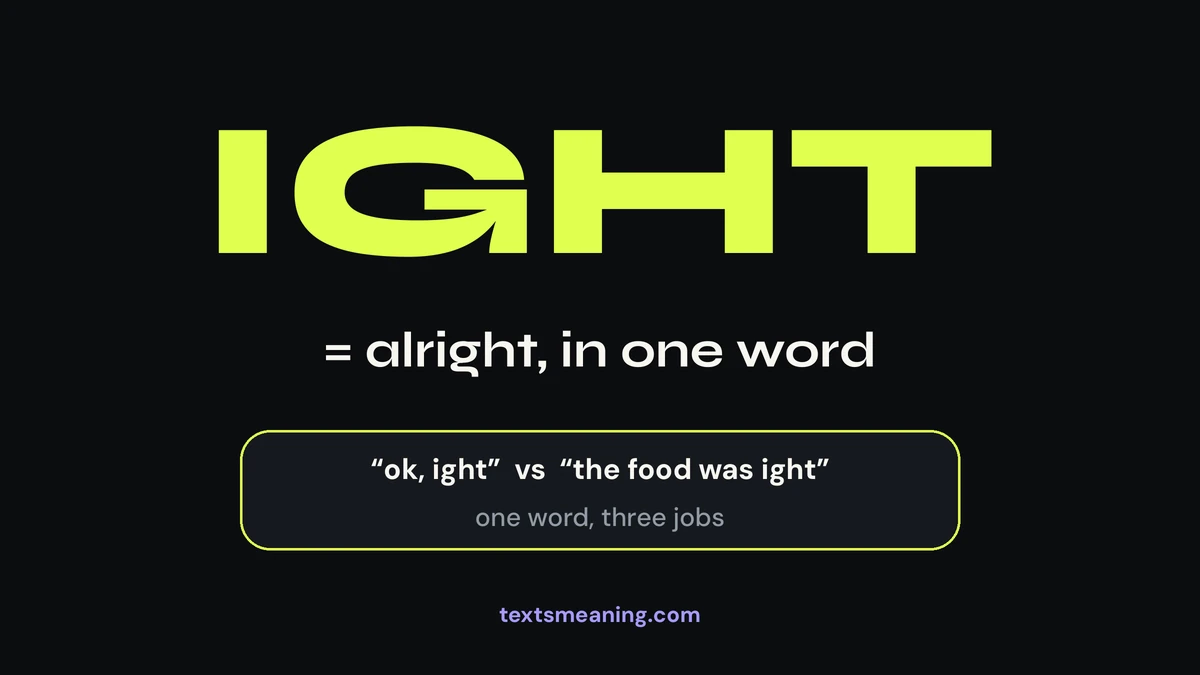
What does ight mean in text? Ight means “alright” — a one-word yes, a nod of agreement, or a lukewarm “fine” depending on where it sits. In a reply it usually means “okay, sounds good”; at the start of a message it opens a new topic; after a noun it rates something as just okay.
This guide to ight meaning in text covers the one meaning and its three jobs honestly, the IGHT Job Test, a seven-reading tone list, ight on TikTok, Snapchat, Instagram, and in texts, senders, misreads, graded claims, cousins, history, and a reply bank keyed to the job you just identified.
What “IGHT” Means in Text
“Ight” has one meaning and three jobs, and keeping those two facts apart is the whole trick of this guide. The meaning is “alright” — full stop. Wiktionary lists ight as a slang alternative form of aight, and its aight entry calls aight a contraction of “all right”, chiefly African-American Vernacular and Multicultural London English slang, with a second adjective sense: “Okay; average; nothing special.” Dictionary.com agrees, calling ight Black colloquial English for “all right”, a variant of aight produced by elision — leaving out sounds — so that “all right” became “aight”, which further shortened to “ight”. It rhymes with “night” because it follows the sound, not the spelling.
The three jobs are where readers go wrong, because the letters never change while the job does. Job one, the reply: ight answers a plan, a question, or a statement — “Meet at 6?” — “Ight.” That is agreement or acknowledgment, a yes with the volume turned down. Job two, the opener: ight starts a message and steers it somewhere new — “Ight, so here is the plan” — or raises an eyebrow at what came before — “Ight, you sure about that?” Job three, the rating: ight describes something as just okay — “This food is ight” — which is not a yes at all, and answering it as one is the most common misread in this guide. Dictionary.com spells out the grammar behind the jobs: like “all right”, ight can be an interjection expressing affirmation or assent (“Ight, I’ll meet you there”), a discourse marker introducing a new subject or a skeptical attitude, an adjective (“This food is ight”), or an adverb (“We did ight”).
Two lookalikes need fencing before they confuse you. First, IGH — the shorter spelling in this series — is a different spelling family, not a different word in a useful sense. Second, the history books hold a completely different ight: Wiktionary also lists an obsolete noun meaning “possession”, from Old English ǣht, quoted from the poet Gower in 1390. That word has been dead since Middle English. Nobody texting you in 2026 means “possession”, and this guide mentions it only so you never mistake a historical dictionary entry for a chat meaning.
The IGHT Job Test
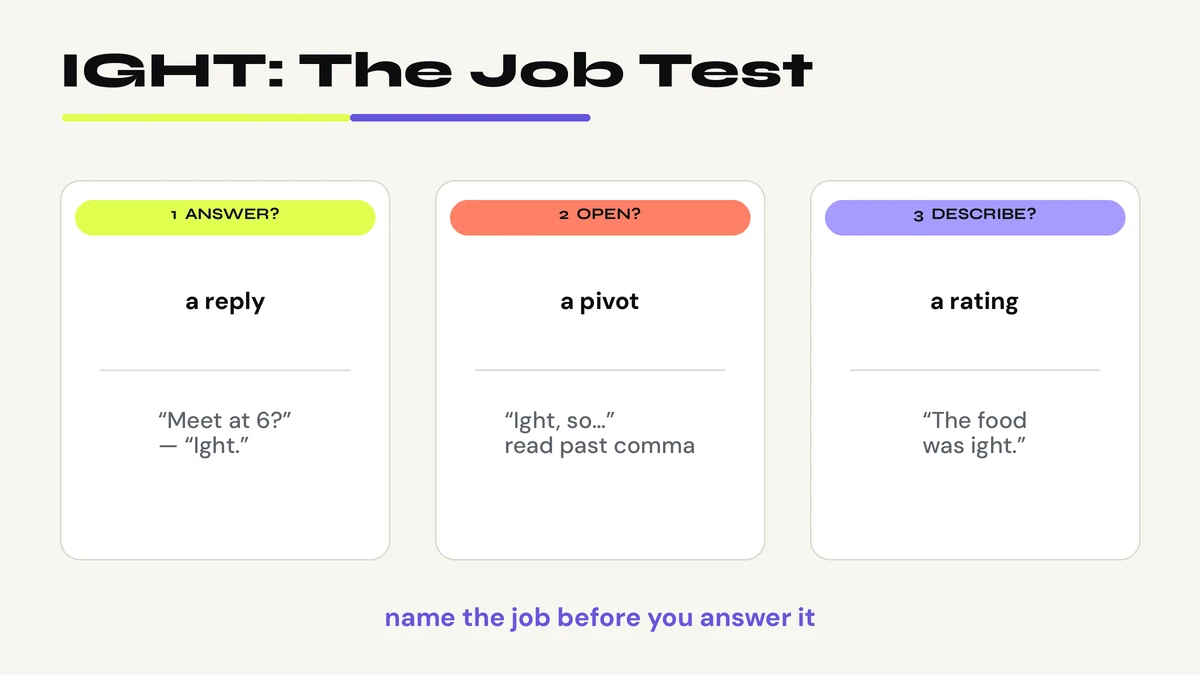
Before you answer an ight, run three checks plus a load check. They take about five seconds, and they beat every shortcut the competitors offer — including the main competitor’s advice, which is only to “look at the earlier messages”:
- Check 1 — Does it answer something? If ight replies to a plan, a question, or a statement — “Meet at 6?” — “Ight” — it is agreement or acknowledgment. Answer the plan, not the word.
- Check 2 — Does it open something? If ight starts a message and a comma follows — “Ight, so here is the plan”, “Ight, and who is driving?” — it is a topic opener, sometimes with a skeptical edge. Read what comes after the comma; that is the real message.
- Check 3 — Does it describe something? If ight sits where an adjective or adverb sits — “The food was ight”, “We did ight” — it is a lukewarm rating: not great, not terrible, just okay. Do not book, buy, or praise on the strength of it.
- Load check — What rides with it? An emoji, a detail, or a follow-up clause warms an ight (“ight sounds good” is warm); nothing at all after a big ask or a serious message cools it. The load, not the letters, decides the temperature.
Worked trio. “Meet at 6? Ight” — answers something, job one, a warm yes: show up at 6. “Ight, so are we still doing Saturday?” — opens something, job two, a topic pivot: answer the Saturday question, not the ight. “How was the concert?” — “ight honestly, sound was bad” — describes something, job three, a lukewarm rating: do not buy tickets on that review. When no check fits cleanly, ask one plain question instead of guessing — “You mean that is fine, or just okay?” costs nothing and has never embarrassed anyone.
“IGHT” in Real Chats
Illustrative examples written for this guide, not real transcripts:
- The warm yes. “Meet at 6?” — “Ight, see you then.” Agreement with a detail attached; the plan is on and the warmth is real.
- The bare acknowledgment. “Don’t forget the keys.” — “ight.” Not enthusiasm, not coldness: “I saw that, we are good.” No reply is owed.
- The skeptical opener. “I’m 100% waking up at 6 tomorrow to run.” — “ight, we’ll see.” Polite doubt, worn lightly. The comma is the tell: everything after it is the message.
- The lukewarm rating. “How was the concert?” — “ight honestly, sound was bad.” Neither a yes nor a no. Treat it as a review, not an approval.
- The committed pair. “I’ll pay you back Friday for real.” — “ight bet.” “Alright, I’m in” — warmer and more committed than a bare ight, unless the promise is unlikely, in which case it is sarcastic “we’ll see”.
- The cold reply. A personal message — something that hurt, something that mattered — answered with a bare “ight” and nothing else. The word has not changed, but the situation has, and the smallness of the reply is the message.
- The closing signal. “ight, talk later.” Not goodbye as a word — it still means “alright” — but as a signal it says “okay, we are done here.” Answer it like a closing, not like a farewell.
The IGHT Tone List
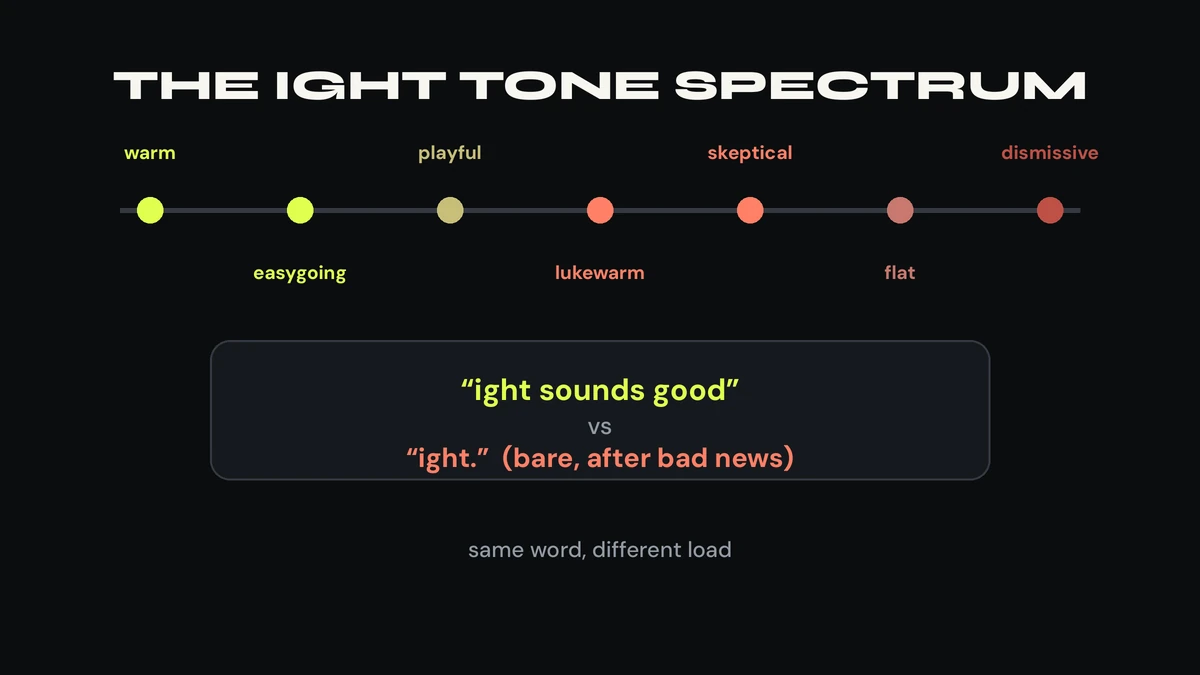
The meaning never changes; the temperature slides. Seven readings, warmest to coldest:
- Warm agreement: “ight sounds good” with an emoji or a detail — a real yes, warmly given.
- Easygoing acknowledgment: “ight, got it” — “I saw that, we are good.” The default reading between friends.
- Playful or confident: “ight, let’s roll!” and “ight bet” — up for it, committed, a little swagger.
- Lukewarm rating: “the food was ight” — fine, not amazing. The only reading on this list that is not a yes at all.
- Skeptical opener: “ight, we’ll see” after a big claim — polite doubt, not a yes and not a no.
- Flat or low-energy: a bare “ight” to an ordinary message — agreement without energy. Usually fast thumbs, not hostility.
- Dismissive: a bare “ight” after a personal message, bad news, or a real question that deserved a real answer — reads as checked-out, not caring.
What moves a reading up or down this list is never the letters alone: it is the job (reply, opener, rating), the size of what came before, the warmth of the history, and what rides with the word — an emoji, a detail, or nothing at all.
“IGHT” on TikTok
On TikTok, ight lives in comments and captions, and the comment section stages two jobs side by side — which is the trap. A bare “ight” under a video usually means agreement with it (“ight this is so real” is a nod, not a review), while a comment that rates something (“the food was ight, not worth the drive”) is job three, and answering it as a yes would misread a review as approval. Creator captions use the opener job — “ight, so here is part 2” — to pivot a series forward. The meaning stays “alright” everywhere; TikTok just makes the jobs collide in one thread, so run the Job Test on comments before you assume the rating or the yes.
“IGHT” on Snapchat
On Snapchat, the reply job rules and the rating barely shows up. Streak replies and story replies say “ight, same”, “ight we should go”, and “ok ight” because Snapchat is a private, fast, disappearing DM — the natural habitat of a one-word yes, not of a restaurant review. The disappearing format also removes your evidence: if an “ight” felt cold, you cannot re-read it, so judge from what rode with it — a detail, an emoji, or nothing. And because streak culture rewards speed, Snapchat is where the barest ight lives: a lone “ight” on a streak snap is usually low-energy agreement, not a verdict on you.
“IGHT” on Instagram
On Instagram, ight shows up in story replies, DMs, and comments, and the split is the same as everywhere else — only the staging changes. A story reply that says “ight lol” is agreeing with the story; a DM that says “ight, sounds fun” to a date idea is a hedged yes; a comment under a restaurant reel that says “the place was ight” is a lukewarm rating, and the owner who reads it as praise has misread it. Public replies lean playful and confident (“ight, let’s roll!”), while DMs carry the full range, including the cold bare ight after a real question. The rule holds on every surface: the job, not the app, decides the reading.
“IGHT” in Text Messages
Plain texts are ight’s home ground, where all three jobs show up in one thread. “Ight” arrives as a whole reply (“Coming tonight?” — “ight”), tucked at the end of a sentence (“That would be ok, ight”), or at the start of one (“Ight, so what time?”). It pairs with the reassurance companion DW — “ight, dw, it will be fine” pairs a yes with reassurance in one breath — and with the side-note companion BTW: “ight, btw, did you see the game?” agrees and pivots in the same message. It also travels with the committed pair “ight bet” when the plan needs enthusiasm, and with “ight then” when the sender is accepting what was said and moving on.
Texts are also ight’s work limit, and the limit is blunt: never use ight in a client, customer, teacher, or manager message. “We can ship tomorrow ight” sounds unsure and unprofessional even if you meant it casually, because the reader cannot tell whether you are confirming the date or rating it lukewarm — and that ambiguity is exactly what this guide exists to remove. In a bio, a caption, or a private chat where the reader already knows your tone, ight is friendly and clear; in formal writing, spell out “alright” or “okay” and remove the whole question.
Who’s Sending It: How “IGHT” Lands by Sender
No source documents a different meaning of ight per sender — the meaning stays “alright”; what changes is which job is likely, and how much a bare ight can sting:
- Friend: the default yes. A friend’s “ight” is usually lazy agreement with no hidden meaning; answer the plan, not the word.
- Crush: overread territory. A crush’s “ight, sounds fun” feels bigger than it is — it is a hedged yes, not a confession and not a rejection. Ask one question and the hedge usually resolves; and a lone “ight” from a crush is not proof of lost interest, only of short thumbs.
- Partner: pattern rules. A partner’s “ight” is usually just tired or unsure; judge the pattern across days, not one message, and a sudden run of bare ights is worth one plain question, not a fight.
- Parent: usually literal. A parent who writes “ight” usually means plain “alright” and may not know the slang at all — so do not read a parent’s “ight” as attitude; they probably typed the word they meant.
- Coworker: context decides. In a casual channel a coworker’s “ight” is a yes you can act on; in a work thread, answer the work first — and never send ight to a client.
- Group chat: the poll habitat for ratings, the yes habitat for plans. A group’s “the place was ight” is a review the group should hear as lukewarm; a group’s “ight, up to you guys” is one member stepping back from deciding. Answer briefly in the group either way.
- Stranger or ex: the cold habitat. A bare “ight” here, after a real question, reads dismissive — and a stranger’s “ight bet” is enthusiasm you did not ask for. A short answer, or silence, both end it without rudeness.
When “IGHT” Is Not Just Friendly
Four misfires, graded. First, the rating-as-yes misfire: answering “the food was ight” as if the sender approved it, when they rated it lukewarm — the most expensive mistake in this guide, because it books the table, buys the ticket, or repeats the error. Second, the passive-aggression assumption: a bare “ight” is not automatically hostile — between close friends it is often just lazy agreement, and the hostile reading needs a big ask, a serious message, or a cold history behind it. Third, the overthinking trap: treating a friend’s “ight” as a deep signal. Most senders want a line or two, not an analysis. Fourth, the professional misfire: ight in a customer message, where the ambiguity itself — yes or lukewarm? — is the one thing a customer must never hear.
On appropriateness: ight is not rude or vulgar in itself, and no source calls it offensive. Its risk is social, not moral — it can sound unenthusiastic, unsure, or dismissive, and it lands worst after a big ask or bad news, where a real sentence was owed. One note deserves plain handling: Dictionary.com records that ight is closely associated with Black vernacular English, and that use by people outside that community may be considered cultural appropriation. This guide reports that as the dictionary states it, without adding a verdict of its own — readers can weigh it for themselves. Keep ight out of formal, professional, and first-impression messages, where spelling out “alright” costs a few letters and removes the whole ambiguity.
Checked Claims: Expansions That Don’t Hold Up
- “Ight is an acronym with a hidden expansion” — rejected. Ight is not initials for anything; it is a phonetic clipping produced by elision (all right -> aight -> ight), and no dictionary lists an acronym expansion.
- “Ight means goodbye” — rejected. It can show up when a chat is ending (“ight, talk later”), but the word still means “alright”; it signals “okay, we are done here”, not farewell.
- “Ight and aight are different words” — rejected. Wiktionary lists ight as an alternative form of aight; they are two spellings of one word, and neither is standard English, so there is no single correct version.
- “Ight means something different on each platform” — rejected. The main competitor states it explicitly, and no source documents a platform-specific meaning; platforms stage the same word differently.
- “A bare ight is always rude or dismissive” — rejected. Between close friends it is usually lazy agreement; the cold reading needs a big ask, a serious message, or a cold history behind it.
- “Ight bet always means enthusiastic agreement” — fenced, not fully rejected. Usually it means “alright, I’m in”, but after an unlikely promise it can mean sarcastic “sure you will”; the surrounding messages settle it.
- “Ight is standard, formal English” — rejected. Dictionaries record it as slang and informal in writing; formal contexts want “alright” or “okay” spelled out.
- “Ight means possession” — rejected as a chat reading. The Old English possession noun is obsolete since Middle English and survives only in historical dictionaries; it is never the meaning of a text you receive.
- “Ight is only for Gen Z” — rejected. The spellings date to the 1990s, before Gen Z texting, and the word’s roots are in spoken AAVE decades older.
What SURVIVES: “alright” in every live use — as a reply, an opener, and a lukewarm rating — dictionary-attested through aight, with the obsolete possession noun fenced as history. No competitor percentages are repeated here as fact, and the Doug E. Fresh link is reported as suggested, not established, exactly as the sources grade it.
“IGHT” vs Its Closest Cousins
Ight belongs to the shrug-and-agreement family — words that answer, hedge, or rate without a full sentence. Its closest published cousin is IG (“I guess” or Instagram): IG and ight look alike and both live in two letters, but they are not the same job. IG hedges (“I guess”) or points (Instagram); ight agrees (“alright”) or rates (just okay). Confusing them turns a yes into a shrug: “ok ig” is uncertain, “ok ight” is settled. IDK (“I don’t know”) is the uncertainty cousin: IDK admits a gap where ight gives a hedged yes. IDK says “I don’t know”; ight says “alright” — and confusing them turns a maybe into a no, or a no into a maybe.
- HBU (“how about you?”) — the return cousin. HBU bounces a question back; ight answers one. HBU says “now yours”; ight says “alright”. The pair is one system: ight answers, HBU returns.
- BRB (“be right back”) — the pause cousin. BRB suspends a chat with a promise to return; ight settles a question with a yes. BRB says “hold on”; ight says “alright”.
On the rating side, ight has no true cousin in this series yet — no other term here rates something as “average; nothing special” — which is itself the point: when ight describes a thing, it is doing a job no shrug-word can substitute for, and that is why the Job Test checks the describe case before anything else.
Where “IGHT” Came From
The phrase “all right” is centuries old in English; the clipped spoken forms are the new part. Dictionary.com dates the spellings aight and ight to the 1990s, with speech use almost certainly earlier: aight appears in DJ Jazzy Jeff & The Fresh Prince’s early-1990s track “I’m Looking for the One (To Be With Me)” and in Blueface’s 2018 “Deadlocs” (“Yeah, aight”), while ight itself is recorded online in the late 1990s, perhaps influenced by Doug E. Fresh’s 1993 track “I-ight” — a suggested link, not an established one. The mechanism is elision in colloquial Black English: “all right” lost sounds until it became “aight”, then lost one more until it became “ight”, a sound spelled the way it is heard. Hip-hop, social media, and texting carried the spelling mainstream in the 2000s while it stayed closely associated with Black culture. No inventor or first-use date is claimed for the abbreviation itself: this article dates the spellings and the tracks, and leaves the abbreviation’s birthday undated, because inventing one would be worse than admitting we do not know it.
How to Reply When Someone Sends “IGHT”
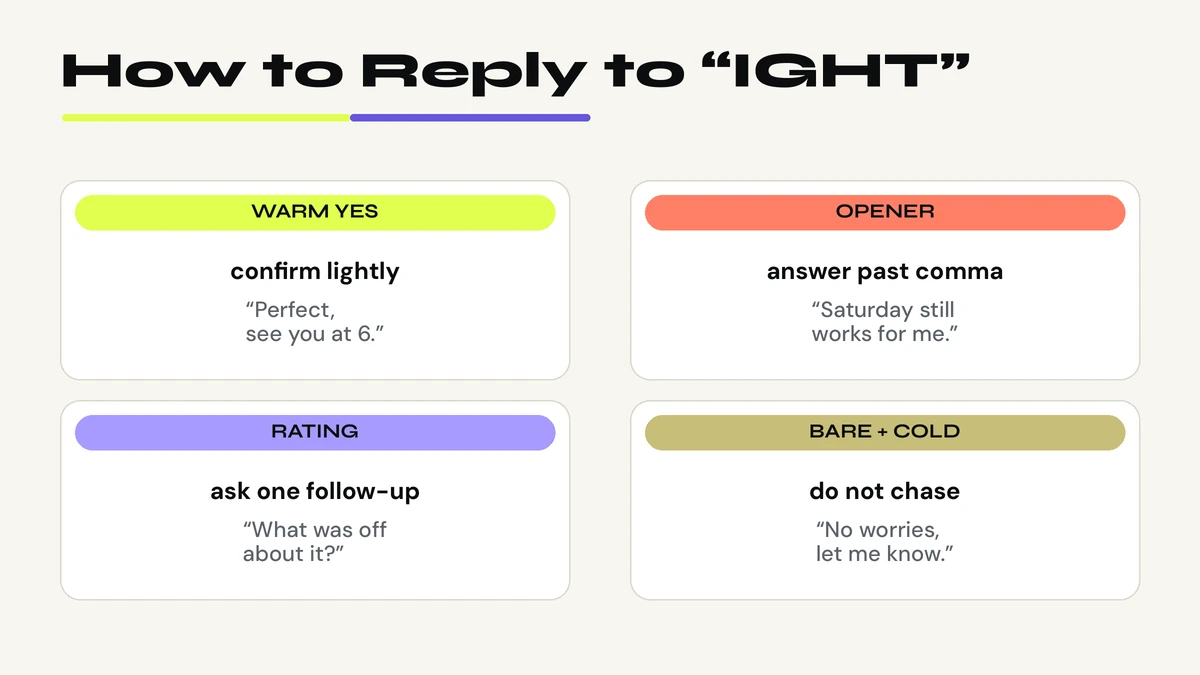
One rule, then six replies: first name the job with the Job Test, then answer that job — never answer a rating as if it were a yes, and never reply to a bare ight with a bare ight of your own:
- Warm yes — confirm lightly: “Perfect, see you at 6.” A warm yes deserves a warm confirmation, not a question.
- Bare acknowledgment — no reply needed: a short “cool” or nothing at all. The thread is already closed; reopening it buys nothing.
- Opener — answer after the comma: “Saturday still works for me.” The ight was a pivot; the question after it is the message.
- Skeptical opener — give proof, not a defense: “For real this time — alarm is set.” Doubt names itself when answered with evidence.
- Lukewarm rating — ask one follow-up: “What was off about it?” A rating deserves a question, not a celebration and not an argument.
- Dismissive bare ight — do not chase, do not mirror: “No worries, let me know.” One calm line, then leave it. If the issue matters, one plain question instead: “You good?” Chasing a shrug only buys another shrug.
Weak versus strong. Weak: “ight” back. Strong: “Sounds good — Friday works for me. You in?” Small change, big difference. Golden rule: when the job is unclear, spell it out — “alright, sounds good” costs a few letters and removes the whole ambiguity.
Frequently Asked Questions
What does “ight” mean in a text message?
Ight means “alright”. In a reply it usually means “okay, sounds good”; at the start of a message it opens a new topic; after a noun it rates something as just okay. Run the Job Test: if it answers something, it is a yes; if it opens something, it is a pivot; if it describes something, it is a lukewarm rating.
Is “ight” the same as “aight”?
Yes. Wiktionary lists ight as an alternative form of aight; they are two spellings of one word, a contraction of “all right”. Neither is standard English, so there is no single correct version — use whichever matches how you normally type.
Does “ight” mean goodbye?
No. It can show up when a chat is ending (“ight, talk later”), but the word still means “alright”. Read it as “okay, we are done here”, not as farewell.
What does “ight bet” mean?
“Ight bet” means something like “alright, I’m in” or “okay, sounds good” — warmer and more committed than a bare ight. It can also be sarcastic, as in “sure, we’ll see”, after an unlikely promise, so the surrounding messages settle it.
Is a bare “ight” rude?
Not by itself. Between close friends it is usually just lazy agreement. It reads dismissive only when it answers a personal message, bad news, or a real question that deserved a real answer — the smallness of the reply, not the word, does the damage.
What does “ight” mean on TikTok, Snapchat, and Instagram?
The meaning does not change per platform; the staging does. TikTok comments mix agreement and ratings in one thread, Snapchat leans on the one-word reply, and Instagram DMs carry the full range including the cold bare ight. The job, not the app, decides the reading.
Is “ight” a real word?
Yes, in the sense that dictionaries record it as slang: Wiktionary lists it as an alternative form of aight, and Dictionary.com records it as Black colloquial English for “all right”. It is not standard English, so keep it for casual use.
Someone just sent me “ight”. What do I say?
First name the job with the Job Test, then answer that job: for a warm yes, confirm lightly (“Perfect, see you at 6”); for an opener, answer what comes after the comma; for a rating, ask one follow-up (“What was off about it?”); for a dismissive bare ight, one calm line and no chase. Never answer a bare ight with a bare ight.
The Takeaway
“Ight” is one word doing three jobs — a yes, a pivot, and a lukewarm rating — and the sentence around it is the only test you need. When the letters arrive, run the Job Test: does it answer something, open something, or describe something — and what rides with it? And when you send one, remember: if you cannot name the job, spell it out — “alright, sounds good” removes the whole ambiguity.