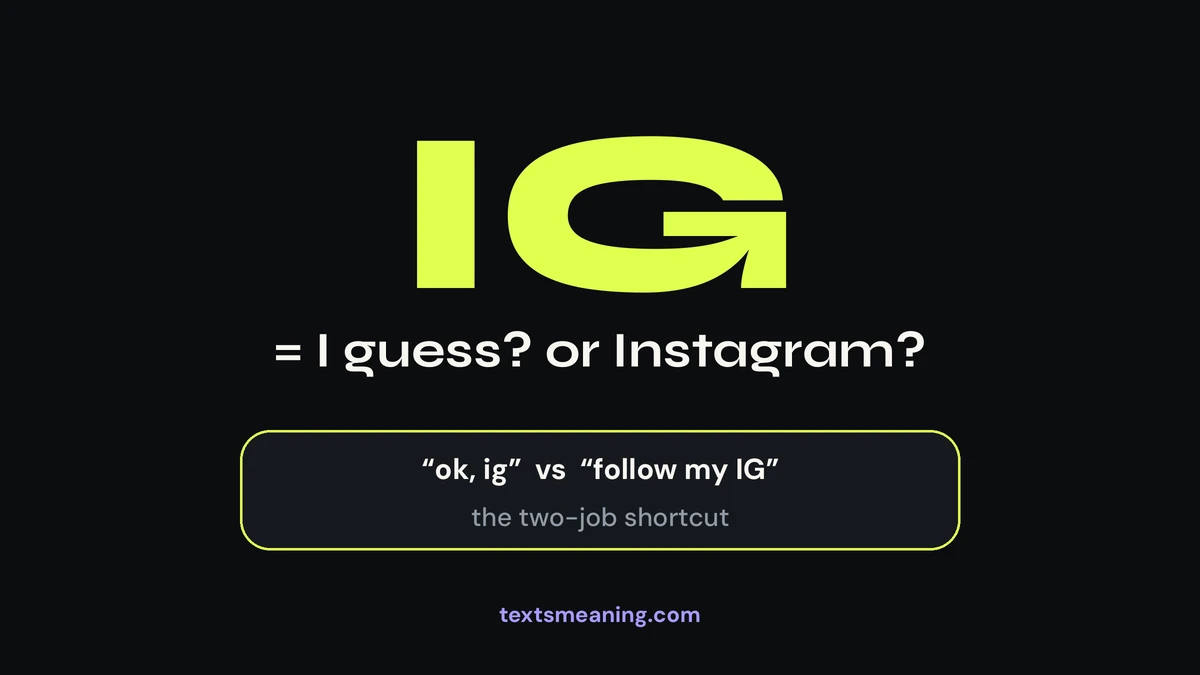
What does ig mean in text? In a text, ig usually means “I guess” — a shrug of uncertain agreement — while on social media, IG usually means Instagram. Same two letters, two different jobs, and the sentence around them tells you which one you are reading.
This guide to ig meaning in text covers both readings honestly, the IG Swap Test, a seven-reading tone list, IG on TikTok, Snapchat, Instagram, and in texts, senders, misreads, graded claims, cousins, history, and a reply bank keyed to the reading you just identified.
What “IG” Means in Text
“IG” does two genuinely different jobs, and that is what makes it the trickiest two-letter term in this series so far. Job one, the shrug: in a private text or reply, lowercase “ig” usually means “I guess.” It answers, hedges, or softens something — “ok ig” is a yes with the enthusiasm turned down, and “we could go tomorrow ig” is a suggestion the sender is not quite sure about. Job two, the app: on social media, in bios, captions, and cross-platform posts, uppercase “IG” usually means Instagram — the app, an account, a story, or a handle. “Follow me on IG” is a direction to a profile, not a shrug.
Both readings are dictionary-attested, which is rarer than it sounds in this series. Wiktionary’s uppercase IG entry lists, first, “(Internet slang, text messaging) Initialism of I guess” and, second, “(social media) Abbreviation of Instagram,” with lyric citations from 2018, 2021, and 2024 showing the app sense in real use. Its lowercase ig entry calls the lowercase form an alternative letter-case form of IG, so the two cases are the same word wearing different clothes — which is exactly why capitalization cannot be your test. This guide gives you a better one.
Two more readings live at the edges, and you should know them so they do not ambush you. In gaming chats, IG can mean “in-game,” the opposite of IRL: “Meet me IG” means meet inside the game, not on Instagram. In news and official writing, IG can mean “inspector general,” the official who investigates a government department. Neither will turn up in an ordinary DM, but the gaming one will turn up in a Discord chat — and the Swap Test below catches it, because neither “meet me Instagram” nor “meet me I guess” makes sense.
The IG Swap Test
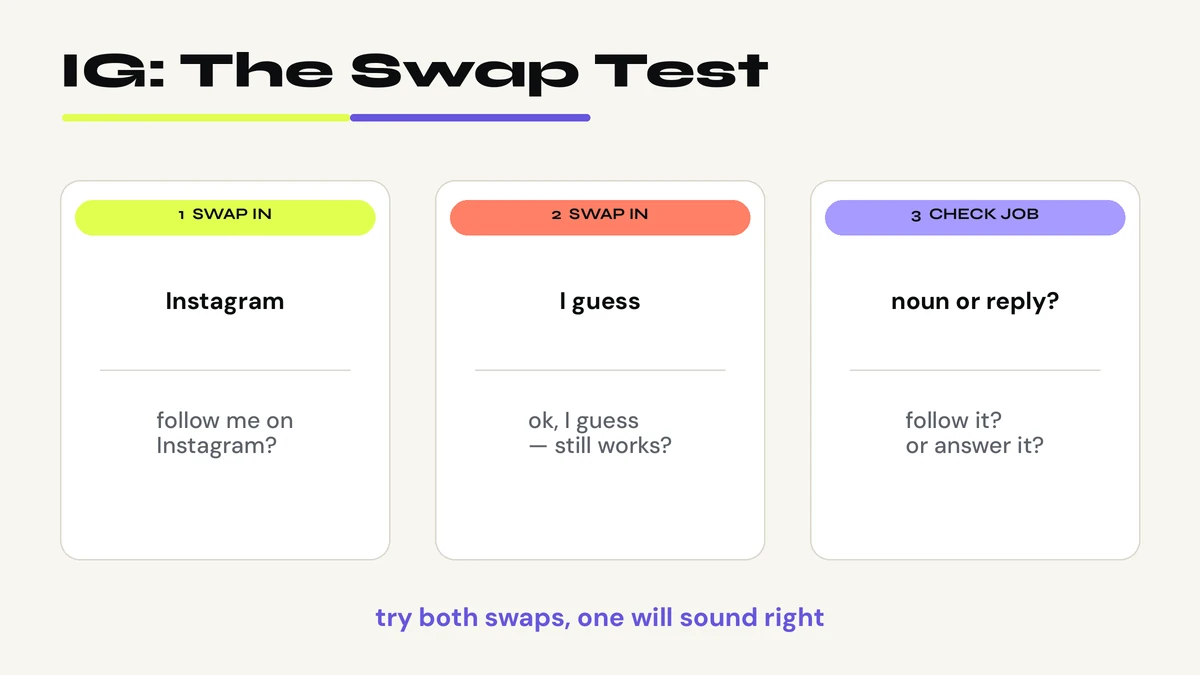
Before you answer an IG, run three steps. They take about five seconds, and they beat every shortcut the competitors offer:
- Step 1 — Swap in Instagram. Replace IG with “Instagram” (or “my Instagram”). If the sentence still works — “follow me on Instagram,” “posted it on Instagram last night,” “what is your Instagram?” — the app wins. Stop here.
- Step 2 — Swap in I guess. Replace ig with “I guess.” If the sentence still works — “ok, I guess,” “we could go tomorrow, I guess,” “I guess not” — the shrug wins. Stop here.
- Step 3 — Check the job. Instagram-IG does a noun job: a place, an account, a handle, a story — something you can follow, post on, or link to. Shrug-ig does a reply job: it answers, softens, or hedges a statement, and it can stand alone as a whole reply. Noun job means app; reply job means shrug. This step is the one that saves you when someone types everything in lowercase, because a noun job stays a noun job in any case.
Worked trio. “Follow me on IG!” — the Instagram swap works, the job is a noun (an account to follow): app, follow them. “Movie night? ig, if you are picking the film” — the I-guess swap works, the job is a reply (a hedged yes): shrug, and the condition matters more than the yes. “Meet me IG after class” — neither swap works, and the job is neither a profile nor a reply: in a gaming chat, that is the in-game tell. When neither swap works and there is no game in sight, ask one plain question instead of guessing — “Do you mean Instagram or I guess?” costs nothing and has never embarrassed anyone.
“IG” in Real Chats
Illustrative examples written for this guide, not real transcripts:
- The app pointer. “Follow me on IG!” — a direction to a profile; answer about Instagram, not about a plan.
- The reluctant yes. “Movie night? ok ig” — yes, but not thrilled. The plan is on; the enthusiasm is not.
- The softened no. “ig not, sorry” — the shrug takes the edge off a no, so the no lands kindly.
- The unsure plan. “we could go tomorrow ig” — leaning yes, not certain. Ask one question and the doubt usually names itself.
- The playful shrug. “ig, why not” — easy, low-stakes, and warm enough that nobody needs to decode it.
- The gaming tell. “Meet me IG after class” — neither swap works, so it is not the app and not the shrug: in a gaming chat, it is in-game.
- The wrong-swap trap. “Saw it on IG” read as a shrug — nonsense, because nobody “saws” a shrug. The noun job gives it away before the swap even starts.
The IG Tone List
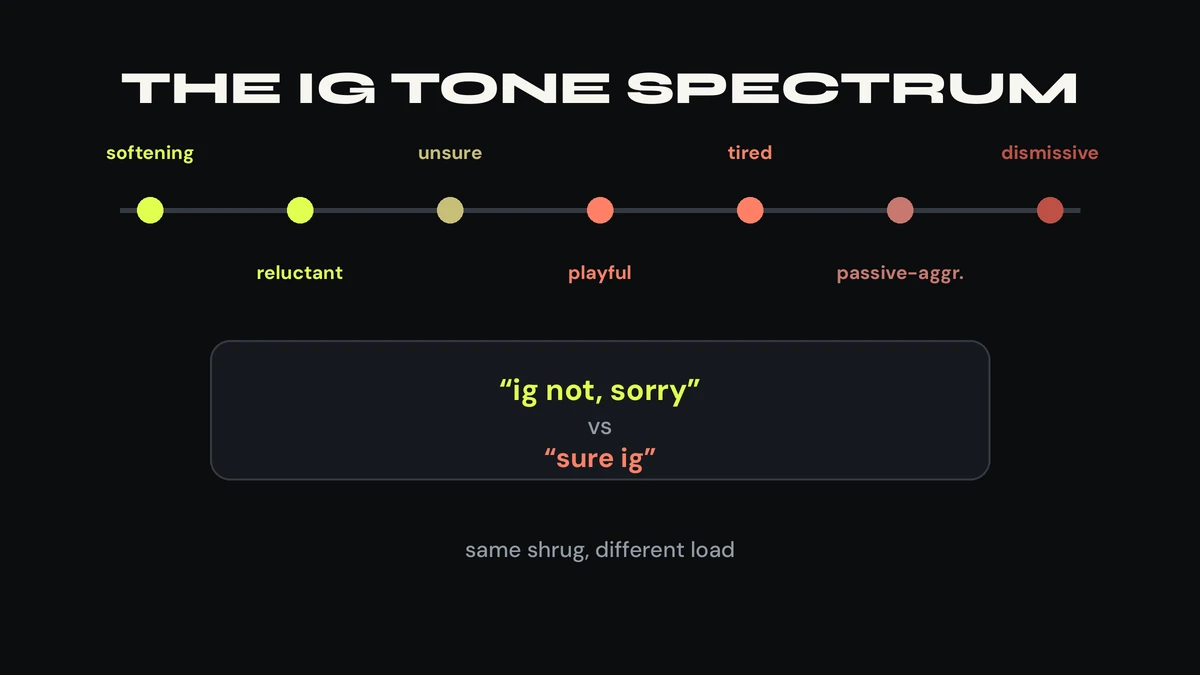
Instagram-IG has no tone of its own — it is a neutral noun, and that neutrality is itself a clue: “check my IG” cannot be passive-aggressive. Shrug-ig, though, slides across seven readings, warmest to riskiest:
- Softening: “ig not, sorry” — the shrug takes the edge off a no or a disagreement, so the message lands kindly.
- Reluctant yes: “ok ig” — yes, but not thrilled. The plan is on; do not mistake it for excitement.
- Unsure: “ig that could work” — leaning yes, not certain. One question usually clears it.
- Playful shrug: “ig, why not” — easy and low-stakes, the warmest shrug there is.
- Tired or low-energy: “ig, whatever you want” — agreement without energy. It is not hostility; it is an empty tank.
- Passive-aggressive: “sure ig” after a big ask, with a cold history behind it — a yes that punishes. This reading needs all three ingredients together: a big ask, a short reply, and a cold history. One alone is not enough.
- Dismissive: a bare “ig” to a real question that deserved a real answer — reads as checked-out, not caring.
What moves a reading up or down this list is never the letters alone: it is the size of the ask, the warmth of the history, and what rides with the shrug — an emoji, a detail, or nothing at all.
“IG” on TikTok
On TikTok, IG leans hard toward the app — and that lean is the trap. Comments and bios say “IG in bio,” “posted the full thing on IG,” and “follow my IG for part 2” because TikTok creators use IG to send followers somewhere else, exactly the pattern the main competitor notes: IG is most often used to mean Instagram on other platforms. A TikTok comment that says “ig” on its own, though, is usually still the shrug — “ig this is so real” is agreement with the video, not a pointer to a profile. Run the Swap Test on TikTok comments before you assume the app, because TikTok stages both readings in the same thread.
“IG” on Snapchat
On Snapchat, the shrug rules and the app barely shows up. Snaps and streak replies say “ig, same,” “ig we should go,” and “ok ig” because Snapchat is a private, fast, disappearing DM — the natural habitat of a hedged reply, not of a profile pointer. The disappearing format also removes your evidence: if an “ig” felt cold, you cannot re-read it, so judge from what rode with it — a detail, an emoji, or nothing. And because streak culture rewards speed, Snapchat is where the barest shrug lives: a lone “ig” on a streak snap is usually low-energy agreement, not a verdict on you.
“IG” on Instagram
This section needs care, because it is where readers most often confuse the two readings — and where this guide most differs from the competitors. On Instagram itself, people rarely write “IG” to mean Instagram, because everyone already knows where they are: inside the app, it is just “my story,” “my post,” or “my profile,” not “my IG.” The app reading shows up around Instagram, not in it: in a TikTok bio (“IG: @yourname”), in a cross-post (“full video on IG”), in an email signature listing social profiles, and in conversation about Instagram (“Saw it on IG”).
In an Instagram DM, though, “ig” is usually still the shrug. A match who replies “ig, sounds fun” to a date idea is hedging, not pointing at the app — and a story reply that says “ig lol” is agreeing with the story, not naming the platform it sits on. The rule for this platform, then, is backwards from what you would expect: if the message is about Instagram, IG means Instagram; if the message is inside Instagram and is not about Instagram, ig almost always means “I guess.” The Swap Test settles both cases without needing to know where the message was typed.
“IG” in Text Messages
Plain texts are the shrug’s home ground. “ig” arrives as a whole reply (“Coming tonight?” — “ig”), tucked at the end of a sentence (“That would be ok, ig”), or at the start of one (“IG we could try that place”). It pairs with the reassurance companion DW — “ig, dw, it will be fine” pairs a hedge with reassurance in one breath — and with the side-note companion BTW: “ig, btw, did you see the game?” hedges and pivots in the same message. It also travels with the opener companion HMU in reunion texts: “ig we should catch up. hmu when you are free” hedges the wish and asks for contact, in one breath.
Texts are also the shrug’s work limit, and the limit is blunt: never use the shrug in a client or customer message. “We can ship tomorrow ig” sounds unsure and unprofessional even if you meant it casually, because the reader cannot tell whether you are hedging the date or doubting the order. The app sense has no such limit in a bio or signature — “Find us on IG” is friendly and clear — but the shrug belongs only in private chats where the reader already knows your tone.
Who’s Sending It: How “IG” Lands by Sender
No source documents a different meaning of IG per sender — the two readings stay fixed; what changes is which reading is likely, and how much a shrug can sting:
- Friend: the default shrug. A friend’s “ig” is usually lazy agreement with no hidden meaning; answer the plan, not the shrug.
- Crush: overread territory. A crush’s “ig, sounds fun” feels bigger than it is — it is a hedged yes, not a confession and not a rejection. Ask one question and the hedge usually resolves.
- Partner: pattern rules. A partner’s “ig” is usually just tired or unsure; judge the pattern across days, not one message, and a sudden run of bare shrugs is worth one plain question, not a fight.
- Parent: the app reading, mostly. A parent who writes “IG” usually means Instagram (“Saw your IG photos”) and may not know the shrug at all — so do not read a parent’s “ig” as passive-aggression; they probably typed the app.
- Coworker: context decides. In a casual channel a coworker’s “ig” is a shrug you can ignore; in a work thread, answer the work first — and never send the shrug to a client.
- Group chat: the poll habitat for the app, the shrug habitat for plans. A group’s “IG link?” wants a profile; a group’s “ig, up to you guys” is one member stepping back from deciding. Answer briefly in the group either way.
- Stranger or ex: the cold habitat. A bare “ig” here, after a real question, reads dismissive — and a stranger’s “Follow my IG” is a self-promotion, not a conversation. A short answer, or silence, both end it without rudeness.
When “IG” Is Not Just Friendly
Four misfires, graded. First, the passive-aggression assumption: a bare “ig” is not automatically hostile — between close friends it is often just lazy agreement, and the hostile reading needs a big ask, a short reply, and a cold history together. Second, the wrong-swap misfire: answering the app when they meant the shrug (“Following you now!” to “ok ig”) or the shrug when they meant the app (“Yeah, I guess” to “Follow my IG”) — both are fixed by one plain question, not by doubling down. Third, the overthinking trap: treating a friend’s “ig” as a deep signal. Most senders want a line or two, not an analysis. Fourth, the professional misfire: the shrug in a customer message, where uncertainty is the one thing a customer must never hear.
On appropriateness: neither reading is rude or vulgar in itself. The shrug’s risk is social, not moral — it can sound unenthusiastic, unsure, or dismissive, and it lands worst after a big ask or bad news, where a real sentence was owed. The closest companion here is FWIW (“for what it’s worth”): FWIW softens an opinion the way ig softens a yes — both are hedges, and both misfire when the moment needed a straight answer. Keep the shrug out of formal, professional, and first-impression messages, where spelling out “I guess” costs seven letters and removes the whole ambiguity.
Checked Claims: Expansions That Don’t Hold Up
- “IG always means Instagram” — rejected. In private texts “ig” is far more often “I guess”; “ok ig” is not about the app.
- “IG always means I guess” — rejected. “Follow me on IG” cannot be “follow me on I guess.”
- “Capitals mean Instagram and lowercase means I guess” — rejected as a rule. It is a useful hint, but plenty of people type everything in lowercase and plenty type the shrug in capitals for emphasis; the sentence, not the case, decides.
- “IG means ignorant” — rejected as a chat reading. Surfaced in one guide as rare slang with no dictionary attestation and no chat example; never taught as a meaning.
- “IG means ignore” — fenced, not fully rejected. Wiktionary lists lowercase ig as an alternative form of “igg” (“to ignore”), and one competitor notes it occasionally, but no ordinary-chat example of “ig” as a standalone “ignore” command was found; do not assume it.
- “IG means something different on each platform” — rejected. The two readings do not change per platform; what changes is which reading a platform stages most often.
- “A bare ig is always passive-aggressive” — rejected. Between close friends it is often just lazy agreement; passive aggression needs a big ask, a short reply, and a cold history together.
- “IG is fine in a customer message” — rejected for the shrug. “We can ship tomorrow ig” sounds unsure and unprofessional; the app sense in a bio is fine, the shrug in a client message is not.
What SURVIVES: “I guess” in private texts and replies, and Instagram on social media — both dictionary-attested — plus the fenced gaming sense “in-game” and the official sense “inspector general” outside chat. No competitor percentages are repeated here as fact, and nothing is claimed about Dictionary.com beyond what the main competitor reports, because that entry was not read directly.
“IG” vs Its Closest Cousins
IG belongs to two families at once, which is why its cousins split in two directions. On the shrug side, its closest published cousin is HRU (“how are you?”): HRU asks a real question; ig answers one with a hedge. HRU says “how are you feeling?”; ig says “I guess.” The pair is one system: a question deserves an answer, and a shrug is the thinnest answer there is. IDK (“I don’t know”) is published in this series: IDK says “I don’t know”; ig says “I guess” — uncertainty versus a hedged yes, and confusing them turns a maybe into a no.
- HBU (“how about you?”) — the return cousin. HBU bounces a question back; ig hedges an answer. HBU says “now yours”; ig says “I guess.” The pair is one system: ig answers, HBU returns.
- HMU (“hit me up”) — the opener companion: HMU asks for contact later, including on IG DMs; ig hedges a plan now. HMU says “reach out”; ig says “I guess.” (Linked in the text-messages section above.)
- BRB (“be right back”) — the pause cousin. BRB suspends a chat with a promise to return; ig suspends a decision with a hedge. BRB says “hold on”; ig says “I guess.”
On the app side, IG has no true cousin in this series yet — no other term here is a platform name — which is itself the point: when IG means Instagram, it is a proper noun doing a pointing job, and no shrug-word can substitute for it. That is why the Swap Test checks the noun job first.
Where “IG” Came From
The phrase “I guess” is centuries old: the main competitor, reporting Dictionary.com, dates “I guess” to at least the late 1600s as moderate or ironic certainty, and the eye-rolling texting version to the 1990s–2000s, when SMS character limits and T9 keypads rewarded two-letter replies — the same SMS hotbed that produced most of this series’ terms. Instagram launched in 2010 and was bought by Facebook in 2012, and IG as the app nickname followed shortly after, on the same pattern as FB for Facebook. The two histories then collided in one inbox: a shrug born in SMS met an app born in 2010, and the same two letters now carry both. No inventor or first-use date is claimed for either abbreviation itself: this article dates the phrase and the app, and leaves the abbreviations undated, because inventing a birthday for a word would be worse than admitting we do not know it.
How to Reply When Someone Sends “IG”
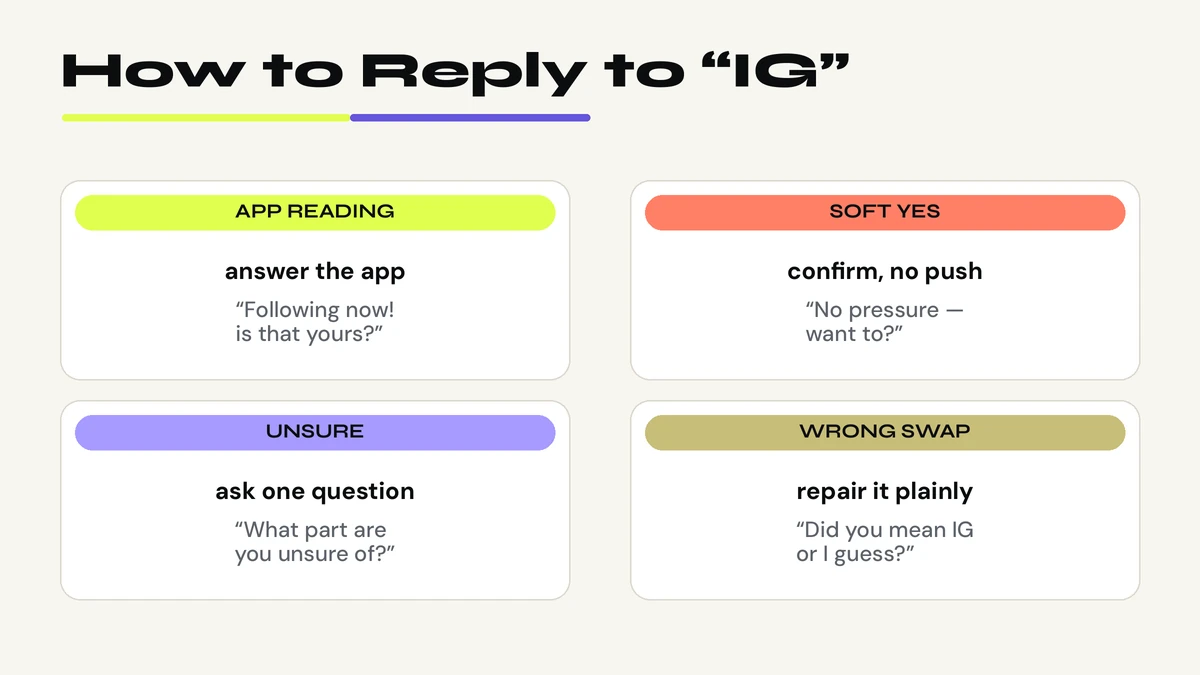
One rule, then six replies: first name the reading with the Swap Test, then answer that reading — never answer the wrong job, and never reply to a shrug with a bare shrug of your own:
- App reading — answer about Instagram: “Following now — is that your photo account?” A pointer deserves a pointer back, not a hedge.
- Soft yes — confirm without pressure: “No pressure — want to, or skip it?” A reluctant yes deserves an easy out, not a push.
- Unsure — ask one question: “What part are you unsure about?” Doubt names itself when asked directly, and the plan gets unstuck.
- Passive-aggressive — do not mirror it: “Got it, let us do Friday then.” Answer warmly and plainly; the chill shows itself or fades, and you did not add to it.
- Dismissive — do not chase: “No worries, let me know.” One calm line, then leave it. Chasing a shrug only buys another shrug.
- Wrong swap — repair it plainly: if you answered the app and they meant the shrug (or the reverse), say so: “Sorry — did you mean Instagram or I guess?” A plain repair beats a confident wrong answer every time.
Weak versus strong. Weak: “ig” back. Strong: “Sounds good — Friday works for me. You in?” Small change, big difference. Golden rule: a full-word answer cannot be misread as the other job, so when the reading is unclear, spell it out.
Frequently Asked Questions
What does “IG” mean in a text message?
In a private text, ig usually means “I guess” — uncertain, reluctant, or softening agreement. On social media, IG usually means Instagram. Run the Swap Test: if “Instagram” fits the sentence, it is the app; if “I guess” fits, it is the shrug.
Does “IG” mean Instagram or “I guess”?
Both, depending on the sentence. “Follow me on IG” is Instagram; “ok ig” is “I guess.” Both readings are listed in Wiktionary, so neither is a mistake — the mistake is answering the wrong one.
Can capital letters tell me which meaning it is?
Only as a hint, never as a rule. Capitals often point to the app and lowercase to the shrug, but plenty of people type everything in lowercase and plenty type the shrug in capitals. The sentence, and the noun-versus-reply job, decide.
What does “IG” mean on TikTok, Snapchat, and Instagram?
The readings do not change per platform; the mix does. TikTok leans app (“IG in bio”), Snapchat leans shrug (private streak replies), and Instagram itself is the trap: messages about Instagram mean the app, while “ig” inside an Instagram DM usually still means “I guess.”
Is a bare “ig” passive-aggressive?
Not automatically. Between close friends it is often just lazy agreement. It reads passive-aggressive only when a big ask, a short reply, and a cold history arrive together — one ingredient alone is not enough.
What does “IG” mean in gaming?
In gaming chats, IG can mean “in-game,” the opposite of IRL. “Meet me IG” means meet inside the game. The Swap Test catches it: neither “Instagram” nor “I guess” fits that sentence.
Does “IG” mean “ignore” or “ignorant”?
Not in ordinary chat. “Ignorant” has no dictionary attestation and no chat example, so this guide rejects it. “Ignore” exists only as a rare form tied to “igg” in Wiktionary, and no ordinary example of it was found — do not assume either reading.
Someone just sent me “ig”. What do I say?
First name the reading with the Swap Test, then answer that reading: for the app, answer about Instagram; for a soft yes, confirm without pressure (“No pressure — want to, or skip it?”); for doubt, ask one question. Never answer a shrug with a bare shrug.
The Takeaway
“IG” is two letters doing two real jobs — “I guess” in a text, Instagram on social media — and the sentence around them is the only test you need. When the letters arrive, run the Swap Test: swap in Instagram, swap in I guess, check the job. And when you send one, remember: if you cannot swap it cleanly, spell it out — “I guess” costs seven letters and removes the whole ambiguity.