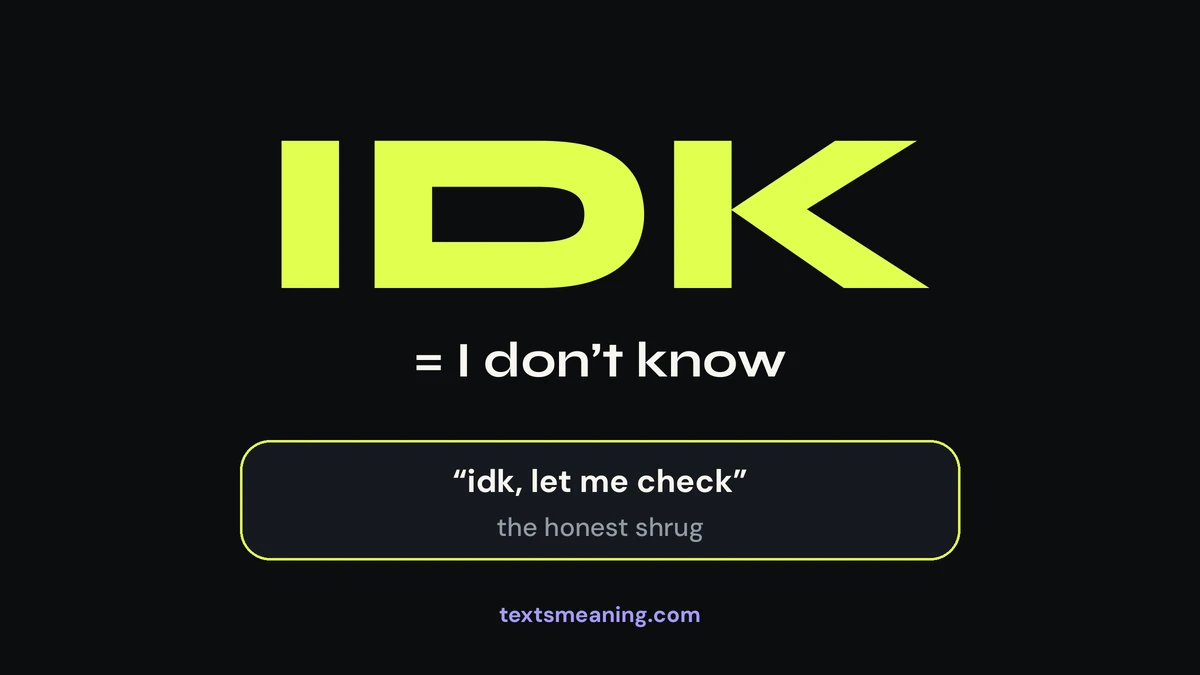
What does IDK mean in text? IDK means “I don’t know” — a three-letter shrug that answers a question by admitting it cannot. “What time does the movie start?” — “IDK, let me check.” That is the whole exchange, and it is honest.
But this guide to idk meaning in text is not about the expansion, because the expansion is the easy part. The hard part is the reading: the same three letters can be an honest gap, an open decision, a softened opinion, or a door closing. This guide covers the IDK Know-or-Dodge Test, a seven-reading tone list, IDK on TikTok, Snapchat, Instagram, and in texts, senders, misreads, graded claims, cousins, history, and the reply rule that replaces a bare shrug with an answer.
What “IDK” Means in Text
“IDK” means “I don’t know.” It is an initialism of the full sentence, and it works two ways: as a standalone reply (“What time is it?” — “IDK.”) and inside a sentence (“IDK if the store is open now”). Unlike the last guide in this series, this one can point to a dictionary and stop: Wiktionary lists IDK as “(Internet slang, text messaging) Initialism of I don’t know,” with a 2026 citation to prove it is still in live use. That makes IDK the best-attested term this series has covered in a while — and it moves the puzzle somewhere more interesting. When the meaning is certain, the uncertainty moves to the intent.
IDK does four headline jobs, and only the first is literal. As a genuine gap: “IDK what time it starts” admits a missing fact. As an open decision: “idk if I can come yet” admits a missing decision, not a missing fact — and the word “yet” is the tell. As a softener: “idk, I kind of liked it” cushions an opinion before it lands, and here IDK does not claim ignorance at all. As a full stop: a bare “idk” after a real question ends the thread without answering it. Same letters, four jobs — and the Know-or-Dodge Test below is how you tell them apart.
Two usage rules come straight from the sources. First, case changes tone, not meaning: capitalized IDK is the initialism-correct form, but lowercase idk is standard in casual chat and reads softer — and a period hardens it, so “IDK.” lands heavier than “idk” with nothing after it. Second, IDK only ever pairs with “I”: there is no “YDK” for “you don’t know” and no “WDK” for “we don’t know,” because the shrug is always first-person. Keep it informal, too: every source agrees IDK belongs in chats, not in formal writing, where “I don’t know” spelled out — plus a detail — is owed.
The IDK Know-or-Dodge Test

Before you answer an IDK — or send one — run three checks:
- Check 1 — The Knowledge Check. Does the sender actually lack the fact, or are they undecided, or dodging? “IDK what time it starts” when the schedule was never shared is a genuine gap. “IDK if I can come” before a decision is undecided, not ignorant. A bare “idk” to a question the sender could answer in ten seconds is dodge-shaped until proven otherwise.
- Check 2 — The Load Check. Is the IDK bare or loaded? A bare IDK (“idk”) carries nothing but the shrug. A loaded IDK (“idk, let me check,” “idk yet, I’ll ask”) carries a promise, a detail, or a next step — and a loaded IDK is almost always honest. Load is the single most reliable honesty signal in this guide: senders who mean it add something; senders who do not, don’t.
- Check 3 — The Setting Check. Casual or formal? In a friend chat a bare idk is fine, even friendly. In a work thread, a serious conversation, or anywhere someone is waiting on you, a bare IDK reads as checked-out, and the spelled-out sentence plus a detail is owed. The letters do not change; the room does.
Worked trio. “What time does the movie start?” — “IDK, let me check”: genuine gap plus a promise — wait for the answer, do not re-ask. “Are you coming Saturday?” — “idk yet”: undecided — give them time, then ask again once. “Did you read what I sent?” — “idk” and nothing else: dodge-shaped — do not chase; the shrug is the answer.
“IDK” in Real Chats
Illustrative examples written for this guide, not real transcripts:
- The genuine gap. “What time does the movie start?” — “IDK, let me check.” The default honest IDK: a missing fact plus a promise.
- The undecided. “Are you coming Saturday?” — “idk if I can come yet.” Not ignorance — an open decision, honestly labeled.
- The softened opinion. “idk, I kind of liked it.” The shrug as a cushion: the sender has a view and is softening it, not hiding it.
- The playful shrug. “idk lol, you tell me.” The shrug as a joke; the “lol” disarms it completely.
- The hesitant. “idk… maybe?” The ellipsis and the question mark do the doubting; this sender wants help deciding.
- The dismissive bare IDK. “Did you read what I sent?” — “IDK.” The period hardens it: a door closing, not an answer.
The IDK Tone List

IDK’s meaning stays “I don’t know”; its intent slides — and at the far end it slides off honesty entirely into avoidance. Seven readings, most honest to most evasive:
- Genuine gap: “IDK what time it starts, let me check.” The sender truly lacks the fact and says so, with a promise attached.
- Undecided: “idk if I can come yet.” Not ignorance but an open decision; “yet” is the tell.
- Softened opinion: “idk, I kind of liked it.” IDK as a cushion before a view, not a claim of ignorance at all.
- Playful shrug: “idk lol, you tell me.” The shrug as a joke; the “lol” or emoji disarms it.
- Hesitant or unsure: “idk… maybe?” The sender is doubting out loud and probably wants help, not pressure.
- Dismissive or conversation-ender: a bare “IDK.” with a period, or a lone “idk” after a real question — the shrug as a door closing.
- Dodge: a bare “idk” to a question the sender could answer — the shrug as avoidance. The reader’s job here is to notice, not to argue.
Case, punctuation, and load move a reading up or down this list: lowercase softens it, a period hardens it, “lol” disarms it, and a loaded promise (“let me check”) pulls almost any IDK back toward honest.
“IDK” on TikTok
On TikTok, IDK is a comment-section shrug — “idk lol” under a confusing video, or “idk who started this trend” as a reply to a familiar commenter. The public stage suits the playful and softened readings: a shrug thousands can read without anyone owing an answer. The dodge reading barely exists here, because nobody in a comment thread is owed a fact in the first place. What TikTok does punish is the bare, period-hardened IDK in a creator’s replies: in public, a shrug with no load reads as attitude, not honesty.
“IDK” on Snapchat
On Snapchat, IDK fits the fast, disappearing DM: “idk yet” on a streak snap about weekend plans, or “idk lol” as a story reply. The disappearing format suits the undecided and playful readings — a shrug that lands lightly and vanishes. But disappearance also removes the evidence: if an IDK felt dismissive, you cannot re-read it, so judge from memory what rode with it — a promise, an emoji, or nothing at all. And because streak culture rewards speed, Snapchat is where the honest-but-bare IDK is most common: fast thumbs, not evasion, explain most of them.
“IDK” on Instagram
On Instagram, IDK shows up in story replies and DMs: “idk, I kind of liked it” as a story reply, or “idk if I can come yet” as a DM about plans. Public replies lean playful shrug; DMs carry the full range, including the dodge — a match’s bare “idk” to a direct question about meeting up is the classic low-effort answer, and the Load Check is the tool for it: no promise, no detail, no next step means the shrug is doing the talking. Either way, the rule holds: on Instagram, a loaded IDK keeps the conversation alive, and a bare one lets it die.
“IDK” in Text Messages
Plain texts are IDK’s home ground, and the place its companion phrases are easiest to see. It pairs with the reassurance companion DW — “idk, dw, I’ll check and let you know” pairs a shrug with a promise in one breath — and with the side-note companion BTW: “idk btw, did you see the game?” shrugs and pivots in the same message. It also travels with the promise companion BRB in fact-finding texts: “idk, brb, let me check” turns the shrug into a two-minute errand instead of a dead end.
Texts are also IDK’s work limit: in a casual team chat, an “idk, let me check” to a teammate is perfectly professional — it is honest and it carries a next step. But a bare “idk” in a work thread, or in a formal email, reads as checked-out, and a client who needed an answer will read it as indifference. The test: if the person is waiting on you, the shrug alone is never enough — load it or spell it out.
Who’s Sending It: How “IDK” Lands by Sender
No source documents a different meaning of IDK per sender — the shrug stays fixed; what changes is how much honesty the reader should expect, and what the shrug costs:
- Friend: the default. A friend’s “idk lol” is a playful shrug at face value; a friend’s loaded “idk, let me check” is a promise. Judge the load, not the letters.
- Crush: overread territory. A crush’s “idk… maybe?” feels bigger than it is — usually hesitation, not rejection, and the hesitant reading wants a gentle nudge, not a verdict.
- Partner: pattern rules. A partner’s “idk” is usually genuine or undecided; judge the pattern across days, not one message — but a sudden run of bare IDKs after real questions is a conversation worth having.
- Parent: usually literal. A parent’s “IDK” is almost always a genuine gap — the least slang-fluent sender is also the least likely to use a shrug as a dodge.
- Coworker: load decides. In a casual channel a loaded “idk, let me check” is professional; a bare “idk” in a deadline thread reads as checked-out, and the reader is right to notice.
- Group chat: the poll habitat. A group’s “idk, anyone else know?” is an open shrug; answer briefly in the group, and someone else will usually supply the fact.
- Stranger or ex: the dodge habitat. A bare “idk” here is a door closing, not a conversation; accept the shrug or ask once, directly, and then drop it.
When “IDK” Is Not Just Honest
Four misfires, graded. First, the dodge misread in reverse: assuming every bare IDK is evasive. Fast thumbs, streak pressure, and a genuinely missing fact explain most bare IDKs — run the Knowledge Check before accusing anyone of dodging. Second, the overthinking trap: treating an “idk lol” as a deep signal, when most senders just shrugged at something small. Third, the softened-opinion miss: answering “idk, I kind of liked it” as if the sender had no view, when the view is right there under the cushion.
Fourth, the bare-IDK-as-answer misfire — the one this guide exists to fix: sending a bare “idk” to someone who is waiting on you, where a loaded IDK or a spelled-out sentence was owed. The closest companion here is FWIW (“for what it’s worth”): FWIW softens an opinion the way IDK softens a shrug — FWIW says “take it or leave it”; IDK says “I don’t know” — but only a loaded IDK says “and here is what happens next.” On appropriateness: IDK is not rude and not vulgar in any reading; its risk is social, not moral — indifference, not offense. Keep it out of formal, professional, and first-impression messages, where a spelled-out answer costs nothing.
Checked Claims: Expansions That Don’t Hold Up
- “IDK means ‘I disagree kindly’” — rejected. A joke expansion floated as a question by one guide’s headline; no attestation, no usage, no chat example.
- “IDK means ‘I don’t care’” — rejected. That is IDC, a different term. The two can share a sentence — “idk and idc” — precisely because they mean different things.
- “IDK is rude by itself” — rejected. The letters are neutral; rudeness comes from bareness plus timing — after a real question, after bad news, as a conversation-ender.
- “IDK means something different on each platform” — rejected. No source documents a platform-specific meaning; platforms stage the same uncertainty differently.
- “IDK is only for Gen Z” — rejected. Text-speak dating to at least 2002 puts IDK older than Gen Z texting itself, and the mainstream guides describe it as widely understood, not youth-only.
- “IDK always means the sender truly has no information” — rejected. The core finding of this article: IDK also covers undecided (“idk yet”), softened opinion (“idk, maybe”), and dodge (a bare shrug as a full stop).
- “IDK must be capitalized” — rejected as a rule. Capitalized IDK is the initialism-correct form, but lowercase idk is standard in casual chat and changes tone, not meaning.
- “IDK works in formal writing” — rejected. Every source agrees IDK is informal; formal contexts want “I don’t know” spelled out, with a detail attached.
What SURVIVES: “I don’t know” (dictionary-attested, Wiktionary plus mainstream consensus), with the readings above as jobs of the same shrug — not different meanings. No competitor percentages are repeated here as fact, and the 2002/2003 dates are reported as earliest attestation, not coinage.
“IDK” vs Its Closest Cousins
IDK belongs to the conversation-flow family — words that open, steer, or close a chat. Its closest cousins IDC (“I don’t care”) and IDEK (“I don’t even know”) are published in this series: IDC says indifference where IDK says ignorance, and IDEK adds the “even” — exasperation on top of not-knowing. The published cousins:
- HM (“hmm”) — the hesitation cousin. HM hesitates out loud; IDK shrugs out loud. HM says “I’m thinking”; IDK says “I don’t know.” A hesitant “idk… maybe?” is HM and IDK wearing one message.
- HBU (“how about you?”) — the return cousin. HBU asks second; IDK answers first, or refuses to. The pair is one system: a loaded IDK plus a bounce-back — “idk, let me check. hbu?” — keeps a chat two-sided.
- HYD (“how you doing?”) — the question cousin. HYD is the question an IDK most often answers: “hyd?” — “idk, pretty good I guess.” HYD asks about doing; IDK answers about knowing.
IDK often travels with a bounce-back — “idk, hbu?” — but never answer an IDK with another bare “idk”: two shrugs do not make an answer.
Where “IDK” Came From
The phrase “I don’t know” is ordinary English, centuries older than any abbreviation. The shortening belongs to the SMS and instant-messaging era: Grammarly dates idk in text speak to at least 2002, and How-To Geek cites an Urban Dictionary definition from 2003, a skyrocketing in web usage in 2007, and another rise during the pandemic, when memes carried the confusion of the moment. No inventor or first-use date is claimed beyond that attestation window: 2002/2003 is the earliest evidence, not a birthday, and the pandemic bump is a usage rise, not a coinage.
How to Reply When Someone Sends “IDK”
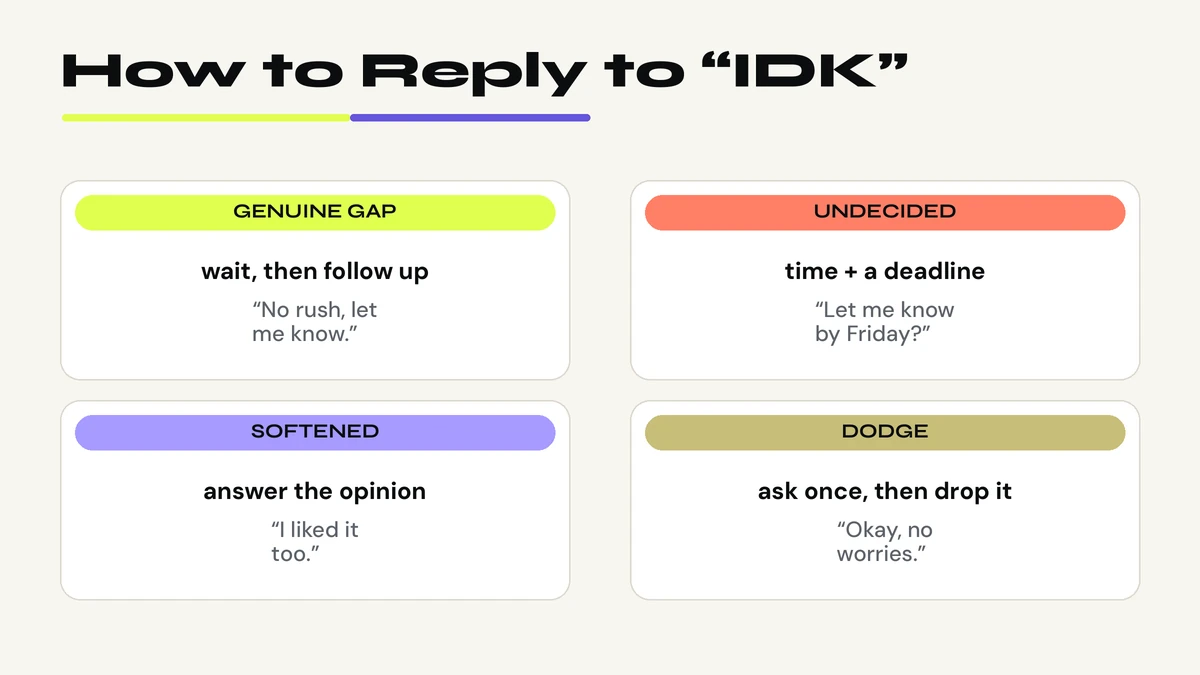
One rule, then six replies: match the reading, not the letters. A bare “idk” and a loaded “idk, let me check” are different messages wearing the same three letters:
- Genuine gap with a promise — wait, then follow up once: “No rush, let me know when you find out.” The promise deserves patience, not a second question.
- Undecided — give time and a deadline: “No pressure — let me know by Friday?” An open decision needs a frame, not pressure.
- Softened opinion — answer the opinion: “I liked it too, honestly.” The view is under the cushion; answer that, not the shrug.
- Playful shrug — play back: “lol fair, you tell me then.” A joke shrug deserves a joke back.
- Hesitant — help, don’t push: “Want help deciding? Here’s what I’d pick.” Doubt out loud is a request, not a refusal.
- Dismissive or dodge — accept it or ask once, then drop it: “Okay, no worries.” Or, if the fact matters: “Could you check when you get a chance?” — asked once, directly, and then left alone.
Weak versus strong — as a sender. Weak: “idk.” Strong: “idk, let me check and I’ll tell you by tonight.” Small change, big difference. And the replace-it ladder, for every time a bare IDK tempts you: genuine gap → “I don’t know yet, let me check”; undecided → “I’m not sure yet, I’ll decide by Friday”; softened opinion → “I’m not sure, but I lean toward yes”; dodge → say nothing, or say the true thing. Golden rule: never send a bare IDK as the answer to a question you could answer, or to a person who is waiting on you.
Frequently Asked Questions
What does “IDK” mean in a text message?
“I don’t know” — a quick, informal admission that you lack a fact, have not decided, or are softening a view, depending on context.
Is IDK rude?
Not by itself. A loaded IDK (“idk, let me check”) is polite and honest; a bare “IDK.” after a real question reads dismissive because it carries no promise and no detail.
What is the difference between “IDK” and “IDC”?
IDK means “I don’t know”; IDC means “I don’t care.” They answer different questions — knowledge versus interest — and they can share a sentence (“idk and idc”) precisely because they are not the same.
What does “IDK” mean on TikTok, Snapchat, and Instagram?
The same shrug everywhere — no platform-specific meaning exists. TikTok stages it as a comment shrug, Snapchat as a disappearing DM shrug, Instagram as a story reply or DM shrug, and every stage carries the same intent question.
Does “IDK” mean something different when it is lowercase?
No — lowercase idk means the same thing, but it reads softer. Capitalized IDK is the initialism-correct form; a period after it (“IDK.”) hardens it; “lol” or an emoji softens it.
What does “IDEK” mean, and how is it different from “IDK”?
IDEK means “I don’t even know” — IDK with emphasis. It is the stronger shrug, used when the not-knowing itself is the point, often with surprise or exasperation.
Can I use “IDK” at work?
In a casual team chat, a loaded “idk, let me check” is fine — honest, with a next step. In a formal email, spell out “I don’t know” and add a detail; a bare “idk” to someone waiting on you reads as checked-out.
Someone just sent me “IDK”. What do I say?
Match the reading: a promise gets patience (“No rush, let me know”), an undecided gets a deadline (“let me know by Friday?”), a dodge gets acceptance or one direct ask — and then you drop it.
The Takeaway
“IDK” is a three-letter shrug — “I don’t know” — that can be honest, undecided, softened, or evasive. When the letters arrive, run the Know-or-Dodge Test: knowledge, load, setting. And when you send one, remember: a bare IDK is a shrug, but a loaded IDK is an answer — so load it.