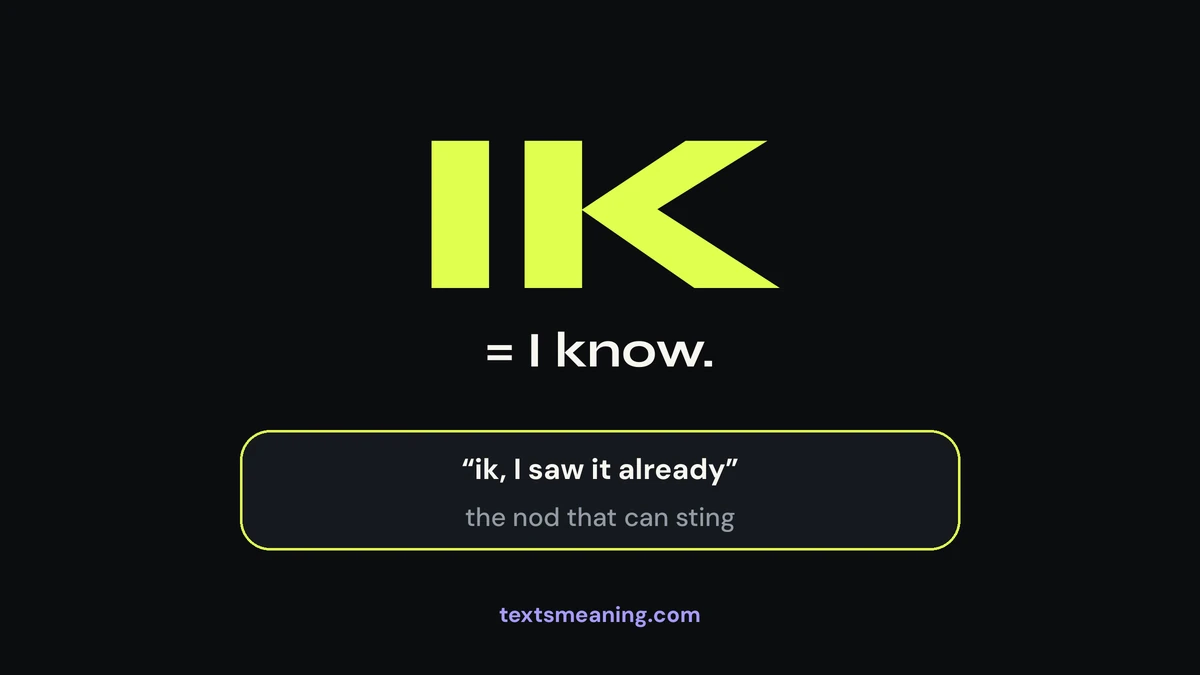
What does ik mean in text? IK means “I know.” It is the shortest possible way to say you already knew something, you agree, or — less kindly — that what you just heard was obvious. Two letters, one fixed meaning, and a whole range of intent hiding behind them.
This guide to ik meaning in text covers that fixed meaning honestly, the IK Before Test, a seven-reading tone list, IK on TikTok, Snapchat, Instagram, and in texts, senders, misreads, graded claims, cousins, history, and a reply bank keyed to the message that came before the ik.
What “IK” Means in Text
“IK” means “I know.” It is an initialism of a full sentence, and like its exact opposite IDK (“I don’t know”), it can stand alone as a whole reply — “The show starts at eight” — “ik” — or tuck inside a longer sentence: “ik, I saw the trailer this morning.” The expansion never changes. What changes is the job it is doing, and the job is decided by the message it answers, not by the letters themselves.
Three jobs cover nearly every ik you will ever receive. Job one, the already-knew reply: someone shares news or a fact, and ik says “that is not new to me.” “The shop closes at nine” — “ik, I was there yesterday.” Job two, the agreement nod: someone states an opinion you share, and ik says “same here.” “This song is unreal” — “ik, on repeat all week.” Job three, the obvious flag: someone states something everyone knows, or reminds you of something you obviously remember, and a bare ik says “yes, obviously” — the only job where ik regularly stings. Same letters, three jobs, and the Before Test below tells them apart in seconds.
Two writing facts keep readers out of trouble. First, case changes tone, not meaning: uppercase IK is the initialism-correct form, but lowercase ik is standard in casual chat and reads softer, and a period hardens it, so “IK.” lands heavier than a bare “ik.” Second, watch the lookalike trap the main competitor flags: an uppercase I is easy to confuse with a lowercase l on a phone screen, so “ik” misread in a hurry can look like “lk” — nonsense, not a word. If a message looks like gibberish, re-read the first letter before you decode anything else.
An honesty note this series owes you: unlike IDK and IG, IK has no dedicated Wiktionary slang entry to point at. Searching Wiktionary for the texting term turns up only collisions — lowercase ik as the ISO language code for Inupiaq, and -ik as a Slavic word-forming suffix — neither of which is the chat term. The attestation for “I know” therefore rests on mainstream explainers and acronym lists, not on a dictionary entry: How-To Geek (read in full, 2022) defines IK as “I know” and dates its first slang-dictionary definition to October 2004, and The Free Dictionary’s acronym list gives “IK — I Know” as its first expansion. Every competitor agrees on the same expansion, and none documents a second texting meaning. This guide says so plainly instead of inventing a dictionary citation that does not exist.
The IK Before Test
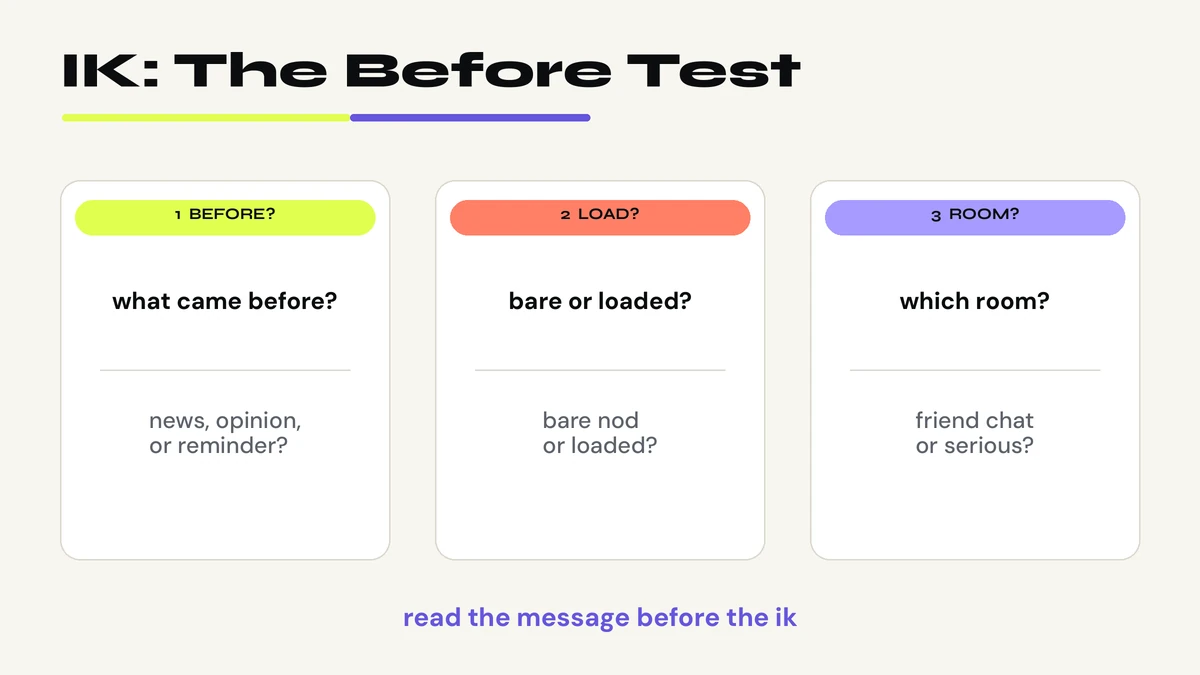
IK is the first term in this series where the meaning is certain and the puzzle is entirely about intent — so this test reads backwards. Do not stare at the ik. Read the message that came before it. Three checks, five seconds:
- Step 1 — What came before? News or a fact you had not shared yet (“the shop closes at nine”) means the already-knew job: the sender is claiming prior knowledge. An opinion you could share (“this song is unreal”) means the agreement job: the sender is nodding along. A reminder or instruction about something obvious (“don’t forget your keys” to someone holding their keys) means the obvious-flag job: the sender may be saying “obviously,” and that is where the sting lives. Name the before, and you have named the job.
- Step 2 — Check the load. A bare ik (“ik” and nothing else) carries no proof, no warmth, and no next step — it is the form most likely to sting, because the reader has to supply the tone. A loaded ik (“ik, I saw it this morning,” “ik, same, I have had it on repeat”) carries a detail that proves the knowledge or the agreement, and a loaded ik almost never reads as dismissive. Load is the single most reliable kindness signal in this guide: senders who mean it warmly add something; senders who do not, don’t.
- Step 3 — Check the room. In a friend chat a bare ik is normal texture. In a work thread, a serious conversation, or anywhere someone is waiting on you, a bare ik reads as checked-out, and a spelled-out sentence plus a detail is owed. The letters do not change; the room does. If the room is serious and the ik is bare, treat it as a flag to ask one plain question, not as a verdict on the sender.
Worked trio. “Did you hear the shop closes at nine?” — “ik, I was there yesterday”: before = news, loaded with a detail — already-knew, warm, done. “This song is unreal” — “ik!! on repeat all week”: before = opinion, loaded with enthusiasm — agreement, warmest form there is. “Don’t forget your keys” (to someone already holding them) — “ik.”: before = obvious reminder, bare, period-hardened — obvious-flag, and the sting is real. When the before is unclear, ask one plain question — “wait, did you already know, or are you agreeing?” — instead of answering the wrong job.
“IK” in Real Chats
Illustrative examples written for this guide, not real transcripts:
- The already-knew reply. “The show starts at eight” — “ik, I booked the tickets” — prior knowledge, proved with a detail.
- The agreement nod. “This song is unreal” — “ik, on repeat all week” — shared taste, not new information.
- The softened yes. “We should go tomorrow, right?” — “ik, let us do it” — agreement plus a next step, the kindest loaded form.
- The tired nod. “We have talked about this” — “ik” — bare, low-energy, not hostile; the tank is empty, not the friendship.
- The obvious flag. “Don’t forget your keys” — “ik.” — bare, period-hardened, after an obvious reminder: this is the sting, and it is the only example here that needs a repair, not a reply.
- The playful stretch. “You already told me twice” — “ikk, I knowww” — the stretched spelling turns the nod into a joke; exaggeration disarms it completely.
- The wrong-before trap. Answering an agreement ik as if it were an obvious flag — “no need to be rude” to “ik, same!” — invents a fight from a nod. The Before Test exists so this never happens.
The IK Tone List
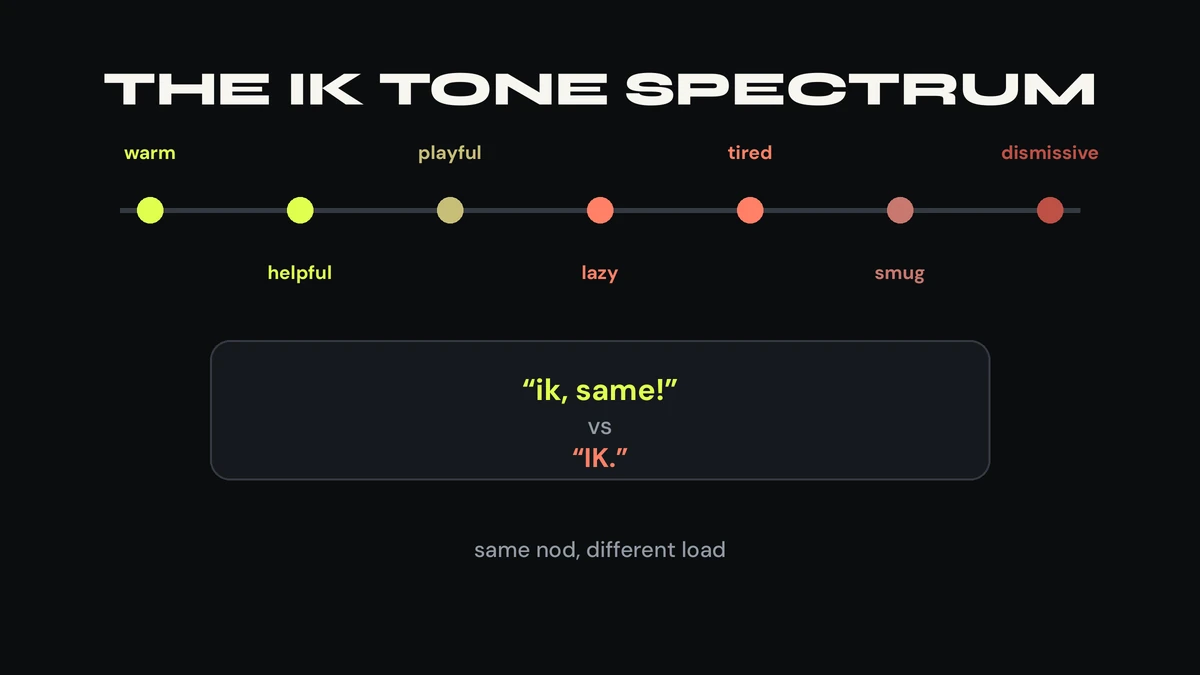
IK’s meaning stays “I know”; its intent slides. Seven readings, warmest to riskiest:
- Warm agreement: “ik, same, I have had it on repeat” — a nod with proof. The warmest ik there is.
- Helpful confirmation: “ik, I booked the tickets” — prior knowledge plus a useful fact. The reader learns something, not just that the sender knew.
- Playful stretch: “ikk, I knowww” — exaggeration as a joke. The stretch spelling is the tell that nobody is annoyed.
- Lazy nod: a bare “ik” between friends about something small — fast thumbs, no hidden meaning. Most bare iks live here.
- Tired or low-energy: “ik” after a long day, to a message that deserved more — agreement without energy. Not hostility; an empty tank.
- Smug or know-it-all: “ik” to a fact someone was proud to share — the nod claims the fact as old news and steals the sharer’s moment. This is the reading the main competitor warns about, and it needs no extra ingredient: a bare ik after someone’s news is enough.
- Dismissive: a bare, period-hardened “IK.” after a real question or an obvious reminder — reads as “obviously, stop telling me.” The coldest form, and the one worth one plain question instead of a fight.
What moves a reading up or down this list is never the letters alone: it is the before (news, opinion, or reminder), the load (bare or detailed), and the room (friend chat or serious thread). A bare ik after good news is the riskiest combination in the whole list — the sender may mean nothing by it, but the sharer hears their news downgraded to old news.
“IK” on TikTok
On TikTok, ik is a comment-section nod — “ik this is so real” under a video, or “ik right??” as a reply to a familiar commenter. The public stage suits the agreement job: a nod thousands can read without anyone owing an answer. The trap is the same as on every platform, only public: a bare “ik” under a creator’s proud announcement reads as smug to an audience, not just to one person, because the downgrade happens in front of everyone. Loaded agreement (“ik, this lives in my head rent-free”) is the TikTok-safe form.
“IK” on Snapchat
On Snapchat, ik fits the fast, disappearing DM: “ik, saw it” on a streak snap about weekend plans, or “ikk lol” as a story reply. The disappearing format suits the lazy and playful readings — a nod that lands lightly and vanishes. But disappearance also removes your evidence: if an ik felt dismissive, you cannot re-read it, so judge from memory what rode with it — a detail, an emoji, or nothing at all. And because streak culture rewards speed, Snapchat is where the honest-but-bare ik is most common: fast thumbs, not attitude, explain most of them.
“IK” on Instagram
On Instagram, ik shows up in story replies and DMs: “ik, same” as a story reply, or “ik, I already saw it” as a DM about a post. Public replies lean agreement; DMs carry the full range, including the smug reading — a match’s bare “ik” to a photo they were excited to share is the classic low-effort answer, and the Load Check is the tool for it: no detail, no enthusiasm, no next step means the nod is doing all the talking. Either way, the rule holds: on Instagram, a loaded ik keeps the conversation alive, and a bare one lets it cool.
One Instagram-adjacent trap deserves its own line: do not confuse ik with IG. A caption that says “follow my IG” is pointing at Instagram, and a reply that says “ik” is nodding at something already known — two letters apart in spelling, unrelated in job. Readers who mix them up answer a profile pointer with a nod, or a nod with a follow, and both misfires are fixed by reading the before, not the letters.
“IK” in Text Messages
Plain texts are ik’s home ground, and the place its companion phrases are easiest to see. It pairs with the reassurance companion DW — “ik, dw, I already handled it” pairs a nod with reassurance in one breath — and with the side-note companion BTW: “ik btw, did you see the game?” nods and pivots in the same message. It also travels with the opener companion HMU in reunion texts: “ik, we should catch up. hmu when you are free” nods at a shared history and asks for contact, in one breath.
Texts are also ik’s work limit, and the limit is blunt: never send a bare ik where a real sentence was owed. “We need the report by Friday” — “ik” sounds dismissive even if you meant it warmly, because the reader cannot tell whether you are confirming, agreeing, or waving them off. In a casual team chat, a loaded “ik, already on it, will send it by Thursday” is perfectly professional — it is a nod with proof. The test: if the person is waiting on you, the nod alone is never enough — load it or spell it out.
Who’s Sending It: How “IK” Lands by Sender
No source documents a different meaning of IK per sender — the meaning stays fixed; what changes is which job is likely, and how much a bare nod can sting:
- Friend: the default. A friend’s “ik” is usually lazy agreement or prior knowledge at face value; answer the plan or the news, not the nod.
- Crush: overread territory. A crush’s “ik, same” feels bigger than it is — it is agreement, not a confession and not a rejection. Ask one question and the nod usually resolves.
- Partner: pattern rules. A partner’s “ik” is usually just tired or already-knew; judge the pattern across days, not one message, and a sudden run of bare iks after real news is worth one plain question, not a fight.
- Parent: usually literal. A parent’s “IK” is almost always prior knowledge, stated plainly — the least slang-fluent sender is also the least likely to use a nod as a weapon.
- Coworker: load decides. In a casual channel a loaded “ik, already on it” is professional; a bare “ik” in a deadline thread reads as checked-out, and the reader is right to notice.
- Group chat: the poll habitat. A group’s “ik, same” is an agreement vote; answer briefly in the group, and someone else will usually carry the thread.
- Stranger or ex: the cold habitat. A bare “ik” here, after a real message, reads dismissive — and a stranger’s “ik” to your proud news is a downgrade, not a conversation. A short answer, or silence, both end it without rudeness.
When “IK” Is Not Just Friendly
Four misfires, graded. First, the smug misread in reverse: assuming every bare ik is dismissive. Fast thumbs, streak pressure, and a genuinely shared fact explain most bare iks — run the Before Test before accusing anyone of smugness. Second, the wrong-job misfire: answering an agreement nod as if it were an obvious flag, or an already-knew nod as if it were agreement — both are fixed by one plain question, not by doubling down. Third, the overthinking trap: treating a friend’s “ik lol” as a deep signal, when most senders just nodded at something small. Fourth, the news-downgrade misfire — the one this guide exists to fix: sending a bare ik to someone who was proud to share news, where a loaded nod or a spelled-out sentence was owed.
On appropriateness: IK is not rude and not vulgar in any reading; its risk is social, not moral — smugness, not offense. The closest companion here is FWIW (“for what it’s worth”): FWIW softens an opinion the way a loaded ik softens a nod — both are hedges, and both misfire when the moment needed a straight answer. Keep a bare ik out of formal, professional, and first-impression messages, where spelling out “I know, I already handled it” costs a few words and removes the whole ambiguity.
Checked Claims: Expansions That Don’t Hold Up
- “IK means ‘I knew’, a different meaning” — fenced, not a separate meaning. “I knew” is the same nod shifted into the past tense (“ik, I knew that already”); it is one meaning with two tenses, not two meanings.
- “IK means the same as IKR” — rejected. IKR (“I know, right?”, the next queue term, discussed by name only here) adds an agreement-seeking question; a bare ik asks nothing. IK nods; IKR nods and asks you to nod back.
- “IK is rude by itself” — rejected. The letters are neutral; rudeness comes from bareness plus timing — after someone’s proud news, after an obvious reminder, as a conversation-ender.
- “IK means something different on each platform” — rejected. No source documents a platform-specific meaning; platforms stage the same nod differently, public agreement on TikTok, private nods on Snapchat.
- “IK means something different from a girl or a guy” — rejected as a meaning split. Tone interpretation varies by relationship and context — never by sender gender; guides that publish gender-split meanings are writing filler, not linguistics.
- “IK is only for Gen Z” — rejected. A first slang-dictionary definition dated October 2004 puts IK older than Gen Z texting itself, and the mainstream guides describe it as widely understood, not youth-only.
- “IK is a typo for ‘ok’” — rejected as a meaning, kept as a misread warning. The uppercase-I versus lowercase-l lookalike can make “ik” look like gibberish on a phone screen, but no source treats ik as a misspelling of ok.
- “IK means ‘I know karate’ / ‘Instagram king’ / other joke expansions” — rejected. Abbreviation-farm jokes with no attestation, no usage, and no chat example; never taught as meanings.
What SURVIVES: “I know” (mainstream consensus across every competitor and acronym list read, with an October 2004 first slang-dictionary attestation), with the three jobs above as jobs of the same nod — not different meanings. No competitor percentages are repeated here as fact, and no Wiktionary slang entry is claimed, because none was found.
“IK” vs Its Closest Cousins
IK belongs to the knowing family — words that report what the sender already holds in their head. Its cousins each move one step away from the nod:
- IDK (“I don’t know”) — the opposite cousin, linked in the meaning section above. IDK says the fact is missing; IK says it is already held. The pair is one system: IDK opens a gap, IK closes one. Confusing them turns knowledge into ignorance and back.
- IG (“I guess”) — the hedge cousin. IG says “probably”; IK says “certainly, already.” IG hedges a yes; IK claims a fact. A hedged “ig” and a certain “ik” are two letters apart and a world apart in confidence.
- BRB (“be right back”) — the pause cousin. BRB suspends a chat with a promise to return; IK suspends nothing — it answers and moves on. BRB says “hold on”; IK says “already got it.”
Two more relatives, named but not linked. IKR (“I know, right?”) is IK with a question attached — the next queue term, still pending, so this series never links it until it is live. AFAIK (“as far as I know”) is IK with a limit attached: it claims knowledge and fences it in the same breath (“AFAIK the shop closes at nine”), where a bare ik claims it flat. IK says “I know”; AFAIK says “I know, as far as I know” — and that fence is the whole difference.
Where “IK” Came From
The phrase “I know” is ordinary English, centuries older than any abbreviation. The shortening belongs to the early internet acronym wave: instant messaging and SMS, where character limits and small keyboards rewarded two-letter replies — the same hotbed that produced IDK, its opposite, at the same time. The main competitor dates the first slang-dictionary definition of IK to October 2004, reading “Used in IM. Means I Know,” where IM means instant messenger. That date is attestation, not coinage: the acronym was already in use when someone bothered to define it.
From IM, IK spread the way all early acronyms did: into SMS, then into every chat app, then into comment sections — and it never picked up a second texting meaning along the way, which is rarer than it sounds in this series. Early IK was usually uppercase, the way early internet acronyms were; as phone keyboards became the main way people type, lowercase “ik” became the standard casual form, with sentence-case “Ik” in between. No inventor or exact coinage date is claimed for the abbreviation itself: this article dates the phrase, the attestation, and the era, and leaves the abbreviation undated, because inventing a birthday for a word would be worse than admitting we do not know it.
How to Reply When Someone Sends “IK”
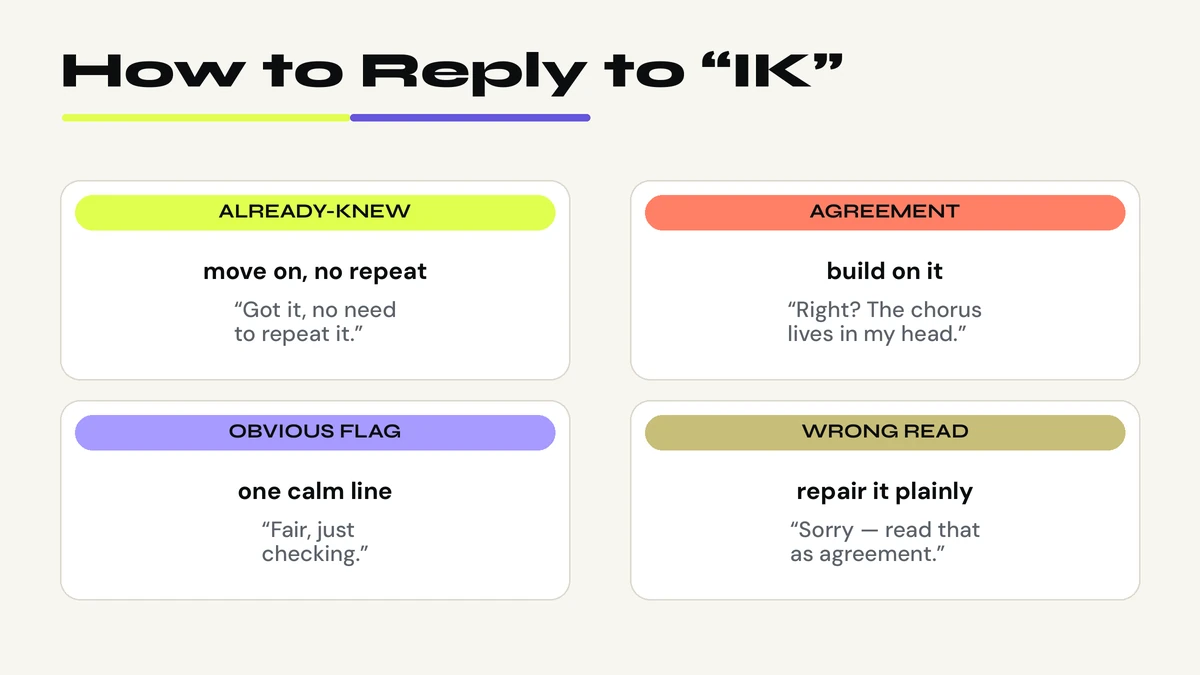
One rule, then six replies: first run the Before Test, then answer the job you just identified — never answer the wrong job, and never reply to a nod with a bare nod of your own:
- Already-knew — move on, do not re-explain: “Got it, no need to repeat it then.” A nod with proof deserves a nod back, not a second copy of the news.
- Agreement — build on it: “Right? The chorus lives in my head now.” Shared taste wants a shared detail, not a bare echo.
- Obvious flag — do not take the bait: “Fair, just checking.” One calm line, then leave it. Defending an obvious reminder only buys another bare ik.
- Smug nod after your news — reclaim the moment lightly: “Well, I was excited to share it anyway.” Warm, plain, and it names the downgrade without starting a fight.
- Unclear job — ask one plain question: “Wait — did you already know, or are you agreeing?” A plain repair beats a confident wrong answer every time.
- Wrong read — repair it plainly: if you answered agreement and they meant obvious-flag (or the reverse), say so: “Sorry — read that as agreement, my bad.” A plain repair beats doubling down.
Weak versus strong. Weak: “ik” back. Strong: “Nice — what did you think of the ending?” Small change, big difference. Golden rule: a loaded answer cannot be misread as a bare nod, so when the job is unclear, add one detail and the ambiguity usually dissolves.
Frequently Asked Questions
What does “ik” mean in a text message?
“I know.” In a text it usually means the sender already knew what you just shared, or agrees with an opinion you just stated. Run the Before Test: news before it means already-knew, an opinion before it means agreement, an obvious reminder before it means the obvious flag.
Is “ik” rude?
Not by itself. Its home tone is a neutral nod. It reads rude only when it is bare and small against a big moment — after someone’s proud news, or after an obvious reminder — where a loaded nod or a spelled-out sentence was owed.
What is the difference between “ik” and “ikr”?
IK nods; IKR nods and asks you to nod back. IKR means “I know, right?” — agreement plus an invitation to agree. A bare ik asks nothing, which is why it can read colder than an ikr in the same spot.
What does “ik” mean on TikTok, Snapchat, and Instagram?
The same “I know” everywhere — no platform-specific meaning exists. TikTok stages it as public agreement in comments, Snapchat keeps it as fast private nods in disappearing DMs, and Instagram splits it between story-reply agreement and DM nods. Same word, different stage.
Does “ik” mean something different from a girl or a guy?
No. No source documents a gender-split meaning; tone interpretation varies by relationship and context, never by sender gender. A crush’s ik is overread territory for everyone, not a different definition.
What does “ikk” mean — is it the same as “ik”?
Yes, with feeling. “Ikk” (and stretched forms like “I knowww”) is the expressive, playful version of ik — agreement or prior knowledge said with exaggeration, so it reads warmer, not colder. Do not confuse it with “ick,” the disgust term: different word, different job.
Can I use “ik” at work or in a formal message?
A bare ik, no. In a casual team chat a loaded “ik, already on it, will send it by Thursday” is professional, because it carries proof. In formal writing, or anywhere someone is waiting on you, spell it out: “I know, I already handled it.”
Someone just sent me “ik”. What do I say?
First run the Before Test, then answer the job: for already-knew, move on without re-explaining; for agreement, build on it with a detail; for an obvious flag, one calm line and leave it. Never answer a nod with a bare nod.
The Takeaway
“IK” is two letters doing one job three ways — already-knew, agreement, or obvious flag — and the message before it is the only test you need. When the letters arrive, run the Before Test: what came before, how loaded is it, what room is it in. And when you send one, remember: a bare ik after someone’s news downgrades their moment to old news — one detail costs nothing and removes the whole sting.