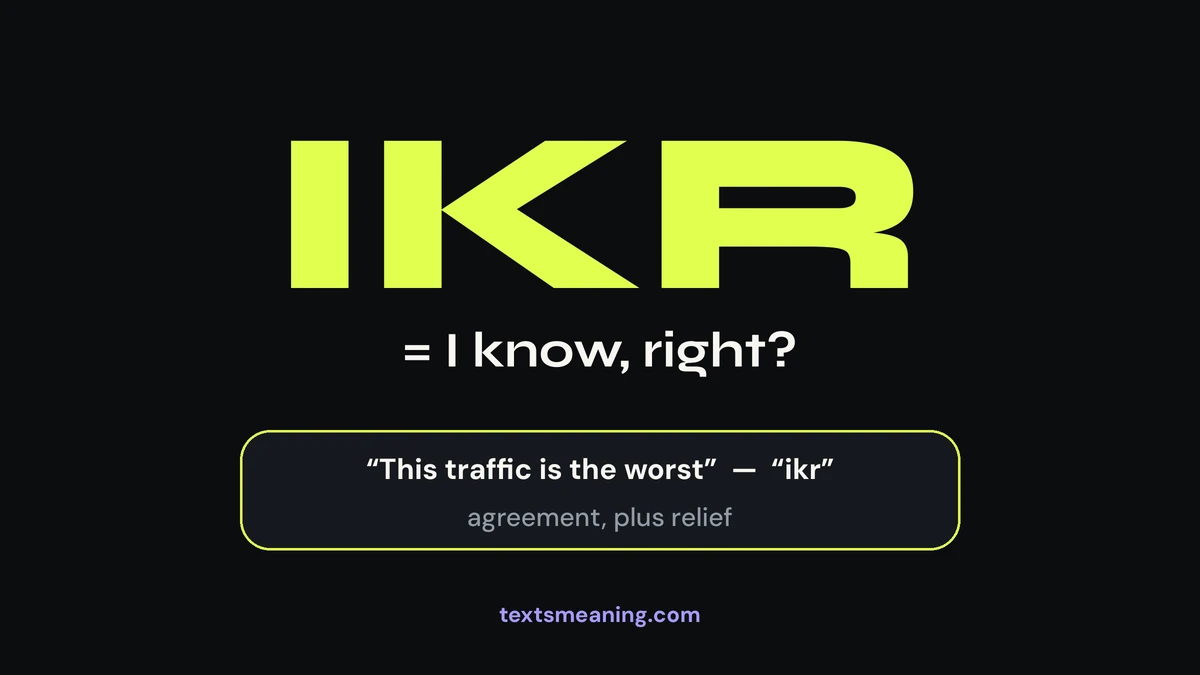
What does ikr mean in text? IKR means “I know, right?” — a three-letter way of saying you agree completely, and you are a little relieved someone else feels the same way. “This traffic is the worst” — “ikr, I have been stuck for an hour.” That is the whole exchange, and it is warmer than a plain yes.
This guide to ikr meaning in text covers the one meaning honestly, the IKR Echo Test, a seven-reading tone list, IKR on TikTok, Snapchat, Instagram, and in texts, senders, misreads, graded claims, cousins, history, and a reply bank keyed to the feeling you just identified.
What “IKR” Means in Text
“IKR” is an initialism of “I know, right?” It is a reply, not a statement: it only works when someone else has already said something, because its job is to echo that something back with agreement attached. The dictionary record is unusually clean. Wiktionary lists IKR, in Internet slang and text messaging, as an “Initialism of I know, right?: indicates agreement with a previously mentioned idea, statement, viewpoint, etc.” Every mainstream competitor agrees on the same expansion, and no source read for this article documents a second texting meaning.
Break the phrase into its two halves and the force of it becomes clear. “I know” claims shared knowledge: I already thought this. “Right?” turns that claim into a rhetorical question that invites the other person to nod along: you think so too, do you not? Together they do more than a plain “yes.” A yes agrees with a fact. IKR agrees with a feeling, and adds relief that the feeling is shared. That relief is the part most short guides miss, and it is the part that explains why IKR feels so warm when it lands right — and so hollow when it does not.
Three usage rules come straight from the sources. First, IKR is a reply word: it answers a statement, an opinion, or a feeling, and it cannot open a conversation on its own. A bare “ikr” with nothing before it is not a message; it is a punchline with the joke missing. Second, case changes tone, not meaning: capital IKR reads a touch louder, lowercase ikr reads softer and faster, but both mean the same thing, and a question mark is optional — “ikr?”, “ikr!”, and plain “ikr” all land as the same agreement. Third, IKR belongs in informal chats only. It is not rude, but it is casual, and in a formal message the spelled-out “I know, right?” — or better, a full sentence of your own — is owed.
The IKR Echo Test
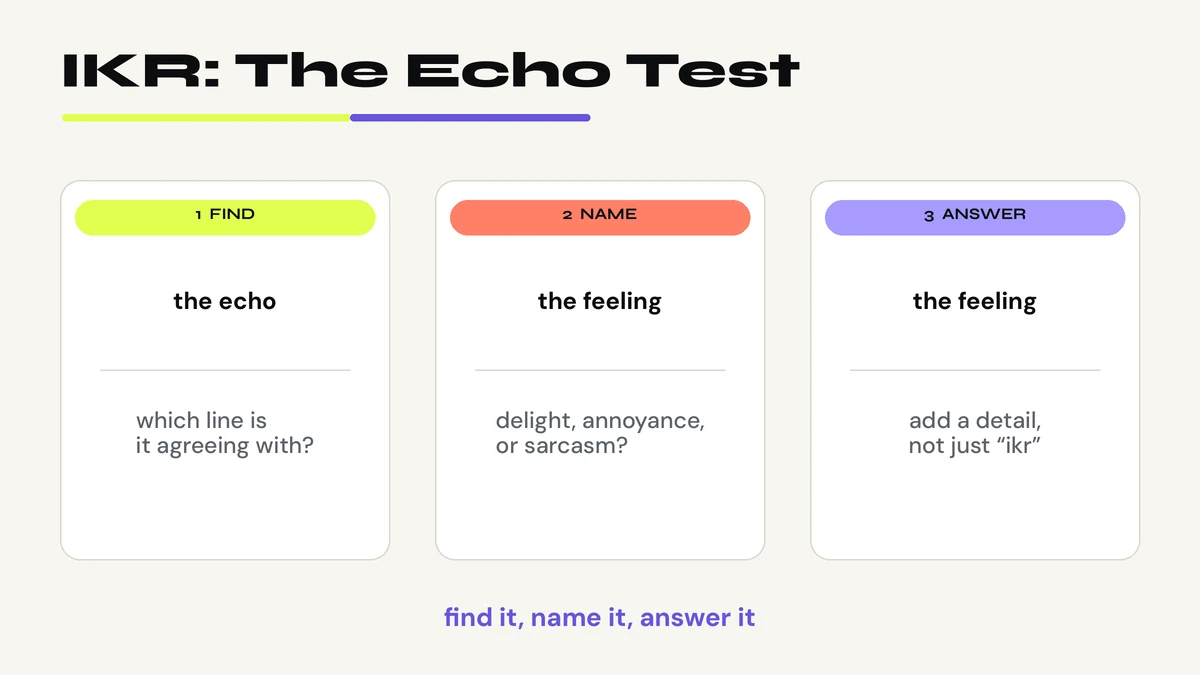
Before you answer an IKR — or send one — run three steps. They take about five seconds, and they are the difference between an agreement that bonds and an agreement that misfires:
- Step 1 — Find the echo. Point to the exact line the IKR is agreeing with. “This traffic is the worst” — “ikr” echoes the traffic complaint. If you cannot point to a line, there is no echo, and the IKR is either a joke, a mistake, or a reply to a message you have not seen. Do not guess; ask what it was agreeing with.
- Step 2 — Name the feeling. Is the echoed feeling shared delight (“This song is perfect”), shared annoyance (“This meeting could have been an email”), shared exhaustion (“I am so tired”), or sarcasm (“Oh great, another meeting” said with an eye-roll)? IKR takes the feeling of the line it echoes. Get the feeling wrong and you agree with the opposite of what was meant.
- Step 3 — Answer the feeling, not the letters. A good reply to IKR continues the shared feeling: add a detail, a laugh, or a next step. “Ikr, and it is only Tuesday” continues the annoyance. “Ikr!” and nothing else, after a real feeling, ends the thread where it should have grown.
Worked trio. “This show is so good” — “ikr, I watched the whole season in one night”: echo found (the show), feeling named (shared delight), feeling answered (a detail added). “Ugh, Mondays” — “ikr”: echo found, feeling named (shared exhaustion), but the reply adds nothing — acceptable between close friends, thin anywhere else. “Oh great, another surprise quiz” — “ikr!!”: if the first line was sarcastic, the IKR joins the joke; it does not agree that surprise quizzes are great. The Echo Test catches that, because Step 2 names sarcasm before Step 3 answers.
“IKR” in Real Chats
Illustrative examples written for this guide, not real transcripts:
- The shared delight. “This song is perfect” — “ikr, I have had it on repeat all day.” Agreement plus a detail: the warmest IKR there is.
- The shared annoyance. “This traffic is the worst” — “ikr, I have been stuck for an hour.” Two people, one complaint, instant bond.
- The shared exhaustion. “I am so tired” — “ikr, I barely slept.” The agreement says: you are not alone in this.
- The sarcasm join. “Oh great, another meeting” — “ikr, my favorite thing ever.” The IKR agrees with the joke, not with the words. Read Step 2 first.
- The bare echo. “That movie was amazing” — “ikr.” Fine between close friends; thin after a real feeling from someone you barely know.
- The enthusiastic echo. “We actually won!” — “IKR!!!” Capitals and exclamation marks turn the volume up, not the meaning.
- The hollow echo. “I am really struggling lately” — “ikr.” The echo is there, but the feeling deserved a sentence, not three letters. This is the misfire this guide exists to fix.
The IKR Tone List
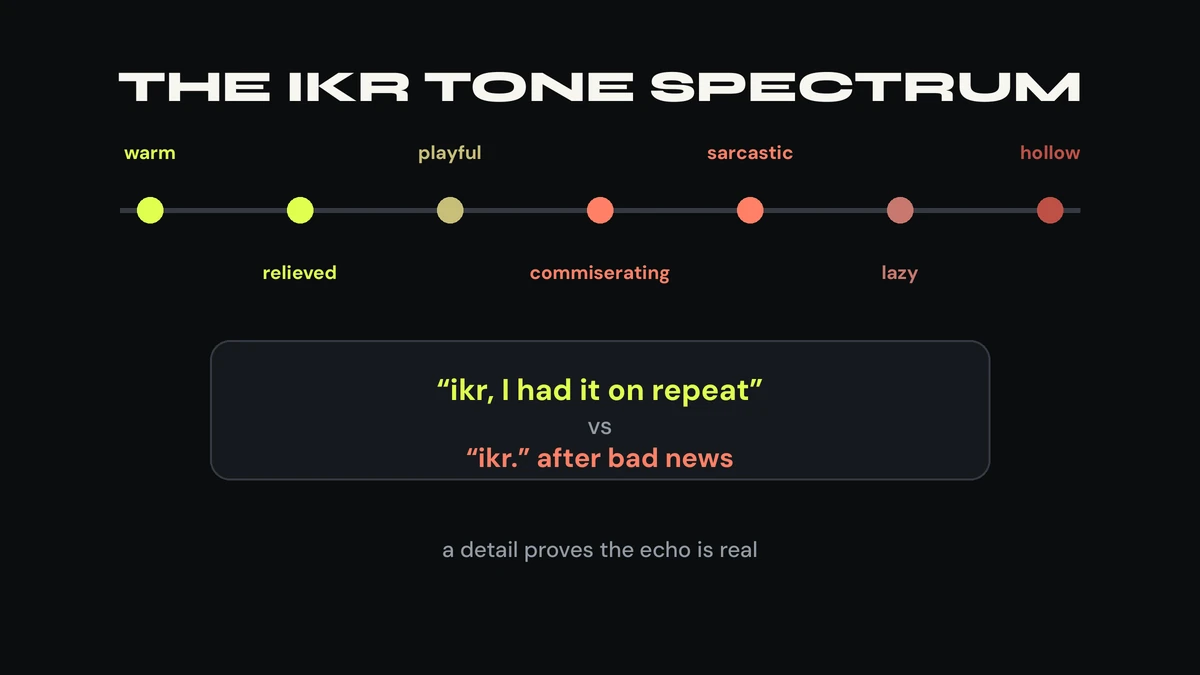
IKR’s meaning never changes; its feeling slides across seven readings, warmest to riskiest:
- Warm agreement: “ikr, I have had it on repeat all day” — agreement plus a detail. The default, and the one to aim for when you send it.
- Relieved agreement: “ikr, I thought I was the only one” — the relief is the point. This is the reading the competitors describe as the “relief that someone else shares your thoughts,” and it is real.
- Playful agreement: “ikr lol, same” — light, joking, low-stakes. The “lol” disarms any weight the agreement might have carried.
- Commiserating agreement: “ikr, it has been a week” — shared annoyance or exhaustion. The bond is the complaint, and that is fine.
- Sarcastic agreement: “ikr, my favorite thing ever” after an obviously sarcastic line — agreement with the joke. Only works when both people know it is a joke.
- Lazy agreement: a bare “ikr” to a real feeling — not hostile, just thin. The sender agreed and stopped there, and the conversation stalls.
- Hollow agreement: a bare “ikr” after bad news or a vulnerable message — reads as checked-out. The feeling deserved a sentence, and three letters said: I heard you, and I am moving on.
What moves a reading up or down this list is never the letters alone: it is what rides with the IKR — a detail, an emoji, an exclamation mark, or nothing at all — and the size of the feeling it echoes. A detail pulls any IKR toward warm; nothing at all, after a big feeling, pulls it toward hollow.
“IKR” on TikTok
On TikTok, IKR is a comment-section echo. “Ikr, this is so real” under a video agrees with the creator and with every other commenter at once, which is why it is one of the most common comments on relatable videos: it turns a private agreement into a public one. The public stage suits the warm and playful readings, and it punishes the hollow one least — nobody in a comment thread is owed a sentence. What TikTok does punish is the sarcasm misread: agreeing literally with a sarcastic video (“ikr, I love Mondays” under a video mocking Mondays) marks you as someone who missed the joke, in front of everyone. Run Step 2 before you comment.
“IKR” on Snapchat
On Snapchat, IKR fits the fast, private, disappearing DM: “ikr, same” as a story reply, or “ikr, it has been a week” on a streak snap. The disappearing format suits the warm and lazy readings — an agreement that lands lightly and vanishes. But disappearance also removes your evidence: if an IKR felt hollow, you cannot re-read it, so judge from memory what rode with it — a detail, an emoji, or nothing. And because streak culture rewards speed, Snapchat is where the barest echo lives: a lone “ikr” on a streak snap is usually lazy agreement, not a verdict on you.
“IKR” on Instagram
On Instagram, IKR shows up in comments and DMs: “ikr, this place is unreal” under a photo, or “ikr, I have been waiting for this” as a story reply. Public comments lean warm and playful — an echo the whole thread can join — while DMs carry the full range, including the hollow reading after a vulnerable message. One Instagram-specific trap: a creator’s caption that ends in a complaint (“Why is this app like this”) collects hundreds of “ikr” replies that agree with each other more than with the creator. That is still the same meaning; the echo just has a crowd in it.
“IKR” in Text Messages
Plain texts are IKR’s home ground, and the place its companion phrases are easiest to see. It pairs with the reassurance companion DW — “ikr, dw, we will figure it out” pairs shared feeling with reassurance in one breath — and with the side-note companion BTW: “ikr, btw, did you see the new episode?” agrees and pivots in the same message. It also travels with the opener companion HMU in reunion texts: “ikr, we should catch up. hmu when you are free” agrees, then opens a door.
Texts are also IKR’s work limit, and the limit is blunt: never use IKR in a client or customer message, and never use it as the whole reply to bad news. “We lost the contract, ikr” is not agreement; it is indifference wearing agreement’s clothes, because the feeling echoed was someone else’s disappointment and the reply added nothing to it. The test: if the feeling deserves a sentence, a three-letter echo is never enough — spell the sentence out.
Who’s Sending It: How “IKR” Lands by Sender
No source documents a different meaning of IKR per sender — the meaning stays fixed; what changes is how much the echo can carry, and how much a hollow one can sting:
- Friend: the default echo. A friend’s “ikr” is warm agreement at face value; answer the feeling, not the letters.
- Crush: overread territory. A crush’s “ikr, same” feels bigger than it is — it is shared feeling, not a confession. Do not mine an echo for devotion.
- Partner: pattern rules. A partner’s “ikr” is usually just tired agreement; judge the pattern across days, not one message, and a sudden run of bare echoes after real feelings is worth one plain question, not a fight.
- Parent: usually literal and warm. A parent who writes “ikr” has learned the term from you, and means the agreement plainly — do not read a parent’s echo as sarcasm unless the joke is obvious.
- Coworker: context decides. In a casual channel a coworker’s “ikr” is friendly agreement; in a work thread about a real problem, answer the work first — and never send IKR to a client.
- Group chat: the crowd echo. A group’s “ikr” agrees with the room, not just with you; answer briefly in the group either way, and do not take a group echo personally.
- Stranger or ex: the thin habitat. A bare “ikr” here, after a real message, reads hollow — and a stranger’s “ikr” under your post is public agreement, not an invitation. A short answer, or silence, both end it without rudeness.
When “IKR” Is Not Just Friendly
Four misfires, graded. First, the fake-agreement trap: IKR claims a shared feeling, so sending it when you do not share the feeling is not polite — it is dishonest, and it collapses the moment the conversation asks for a detail. Unlike a hedged yes, which only softens, IKR certifies. Do not certify what you do not feel. Second, the hollow-echo misfire: a bare “ikr” after bad news or a vulnerable message, where a sentence was owed. Third, the sarcasm misread: agreeing literally with a sarcastic line, or joining a joke nobody was telling — both fixed by Step 2, naming the feeling before answering it. Fourth, the professional misfire: IKR in a customer or formal message, where casualness reads as indifference.
On appropriateness: IKR is not rude or vulgar in itself, and it carries no profanity. Its risk is social, not moral — it can sound lazy, hollow, or fake, and it lands worst after a big feeling or bad news, where a real sentence was owed. The closest companion here is FWIW (“for what it’s worth”): FWIW softens an opinion the way IKR strengthens an agreement — both are pressure valves, and both misfire when the moment needed a straight answer. Keep IKR out of formal, professional, and first-impression messages, where spelling out a full sentence costs seconds and removes the whole ambiguity.
Checked Claims: Expansions That Don’t Hold Up
- “IKR means ‘I know, really’” — rejected. A near-miss expansion with no dictionary attestation; the attested phrase is “I know, right?” and the question mark is part of the force.
- “IKR is just a fancy yes” — rejected as a full account. A yes agrees with a fact; IKR agrees with a feeling and adds relief that the feeling is shared. That extra half is the whole word.
- “IKR means something different on each platform” — rejected. The meaning never changes per platform; what changes is which feeling a platform stages most often — TikTok stages public delight, Snapchat stages private commiseration.
- “A bare ikr is always dismissive” — rejected. Between close friends it is often just lazy agreement; the hollow reading needs a big feeling plus a bare echo together. One alone is not enough.
- “IKR is only for Gen Z” — rejected. The phrase “I know, right?” dates to 1990s spoken English and the abbreviation to the mid-2000s texting era; mainstream guides describe it as widely understood, not youth-only.
- “IKR works in formal writing” — rejected. Every source agrees IKR is informal; formal contexts want a full sentence, not an initialism.
- “IKR can open a conversation” — rejected. IKR is a reply word: with no prior statement to echo, there is nothing for it to agree with.
- “IKR means ‘I knew it’ or ‘I told you so’” — rejected. Those claim prior knowledge as a victory; IKR claims shared feeling as a bond. The direction is opposite.
What SURVIVES: “I know, right?” (dictionary-attested, Wiktionary plus mainstream consensus), with the seven tone readings above as feelings of the same echo — not different meanings. No competitor percentages are repeated here as fact, and nothing is claimed about a dictionary entry that was not read directly.
“IKR” vs Its Closest Cousins
IKR belongs to the agreement family — words that say how much you share someone else’s feeling, not just that you heard it. Its closest cousins split by how much they certify. The bare cousin IK is “I know” without the rhetorical question: it claims knowledge, while IKR claims shared feeling. “Ik” says I know; IKR says I know, and you do too.
- IDK (“I don’t know”) — the opposite cousin. IDK says the speaker lacks the knowledge; IKR says the speaker shares the feeling. IDK says “I don’t know”; IKR says “I know, right?” Confusing them turns certainty into ignorance.
- IG (“I guess”) — the hedged cousin. IG softens a yes; IKR strengthens one. IG says “I guess”; IKR says “I know, right?” The pair is one scale: hedge at one end, full-throated agreement at the other.
- HBU (“how about you?”) — the return cousin. HBU bounces a topic back; IKR closes a topic by agreeing with it. HBU says “now yours”; IKR says “same here.” The pair is one system: IKR agrees, HBU returns.
The rule that ties them together: never answer an IKR with a bare shrug of your own. IKR asks for a shared feeling; answering it with uncertainty (“idk”) or a hedge (“ig”) does not continue the feeling, it cancels it.
Where “IKR” Came From
The phrase “I know, right?” is spoken American English from the 1990s, strongly associated with Valley Girl speech, and it gained wider popularity in 2004 when the movie Mean Girls put that speech on screen — the dating the main competitor, How-To Geek, reports, and the same history the other mainstream guides repeat. The abbreviation followed shortly after, in the mid-2000s texting era: How-To Geek notes IKR was first added to Urban Dictionary in 2005, with the original definition reading like a quote from Mean Girls, and that it gained serious popularity around 2009 by search trends. Urban Dictionary is user-generated attestation only in this series, never a primary source, so those dates are reported as attestation history, not coinage.
Today IKR is no longer thought of as Valley Girl slang or a movie quote. It is, as the main competitor puts it, just a useful internet initialism for strong agreement — one that survived because it does a job no shorter word does: it certifies a shared feeling in three letters. No inventor or first-use date is claimed for the abbreviation itself: this article dates the phrase, the film, and the first slang-dictionary attestation, and leaves the abbreviation’s birthday undated, because inventing one would be worse than admitting we do not know it.
How to Reply When Someone Sends “IKR”
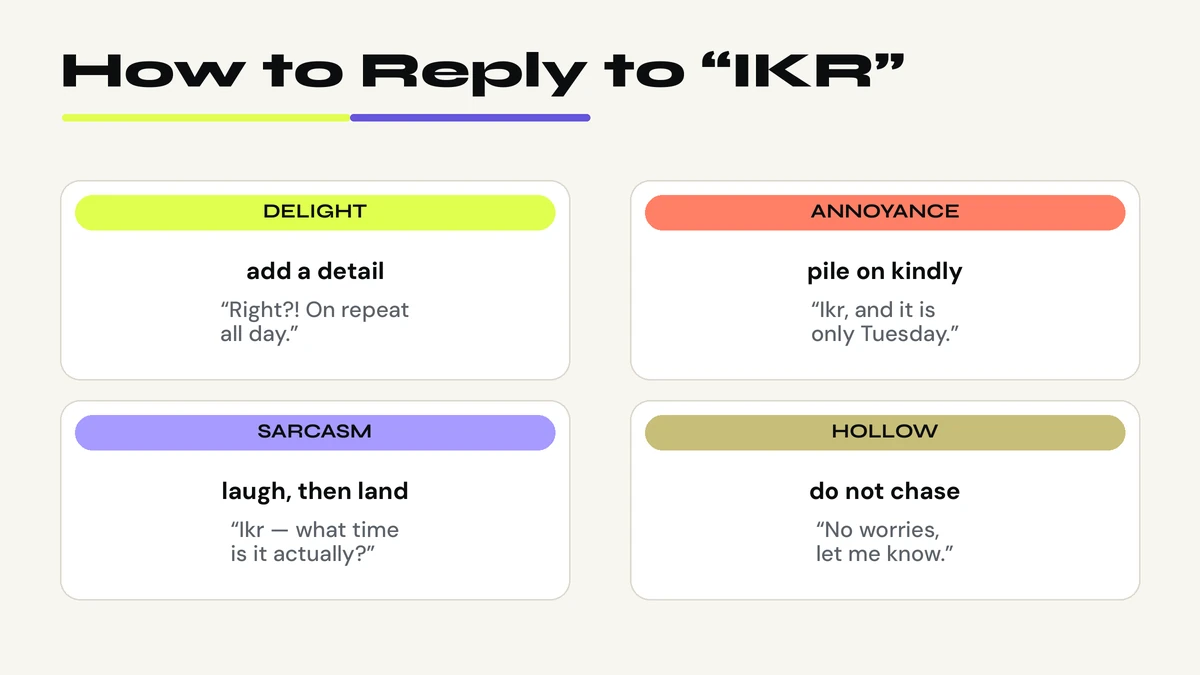
One rule, then six replies: first run the Echo Test — find the echo, name the feeling — then answer that feeling. Never answer an echo with a bare echo of your own:
- Shared delight — add a detail: “Right?! I have had it on repeat all day.” A detail proves the feeling is really shared.
- Shared annoyance — pile on kindly: “Ikr, and it is only Tuesday.” Commiseration wants company, not solutions.
- Shared exhaustion — offer rest, not advice: “Same. Want to just stay in tonight?” The feeling, plus a next step.
- Sarcasm join — laugh along, then land: “Ikr, my favorite thing ever — what time is it actually?” Join the joke, then return to the real question underneath it.
- Hollow echo — do not chase: “No worries, let me know.” One calm line, then leave it. Chasing an echo only buys another echo.
- Unclear echo — repair it plainly: if you cannot find what it was agreeing with, say so: “Sorry — agreeing with which part?” A plain repair beats a confident wrong answer every time.
Weak versus strong. Weak: “ikr” back. Strong: “Right?! Same here — what did you think of the ending?” Small change, big difference. Golden rule: a full-word answer cannot be misread as hollow, so when the feeling mattered, spell it out.
Frequently Asked Questions
What does “IKR” mean in a text message?
In a text, IKR means “I know, right?” — strong agreement with a shared feeling. It echoes something someone else just said and adds relief that the feeling is shared: “This traffic is the worst” — “ikr, I have been stuck for an hour.”
Is “IKR” just a fancy way of saying yes?
No. A yes agrees with a fact; IKR agrees with a feeling. “Yes” to “This song is perfect” is agreement. “Ikr, I have had it on repeat all day” is agreement plus shared delight plus proof. That extra half is the whole word.
What does “IKR” mean on TikTok, Snapchat, and Instagram?
The meaning never changes per platform; the stage does. TikTok stages public agreement in comments (“ikr, this is so real”), Snapchat stages private commiseration in disappearing DMs, and Instagram stages both — public echoes in comments, private ones in DMs.
Is a bare “ikr” rude?
Not by itself. Between close friends it is usually just lazy agreement. It reads hollow only when it follows a big feeling or bad news, where a sentence was owed — the feeling plus the bareness together, not the letters alone.
Can “IKR” be sarcastic?
Yes, when the line it echoes was sarcastic. IKR takes the feeling of the line it echoes, so after “Oh great, another meeting” it joins the joke. Run Step 2 of the Echo Test — name the feeling — before you answer, or you will agree literally with a joke.
What is the difference between “IKR” and “IG”?
IG (“I guess”) softens a yes; IKR strengthens one. “Ok ig” is a reluctant yes. “Ikr!” is a full-throated one. They sit at opposite ends of the agreement scale, and answering one with the other cancels the feeling.
Can I use “IKR” at work?
No. IKR is informal and casual; in a work message, a client message, or a formal email, spell out a full sentence instead. A three-letter echo to a colleague’s real problem reads as indifference, not agreement.
Someone just sent me “ikr”. What do I say?
First run the Echo Test: find the line it echoes, name the feeling. Then answer that feeling — add a detail for delight, pile on kindly for annoyance, laugh along for sarcasm. Never answer an echo with a bare echo of your own.
The Takeaway
“IKR” is three letters doing one warm job — “I know, right?”, agreement with a shared feeling, plus relief that the feeling is shared. When the letters arrive, run the Echo Test: find the echo, name the feeling, answer the feeling. And when you send one, remember: if the feeling mattered, give it more than three letters — a detail proves the echo is real.