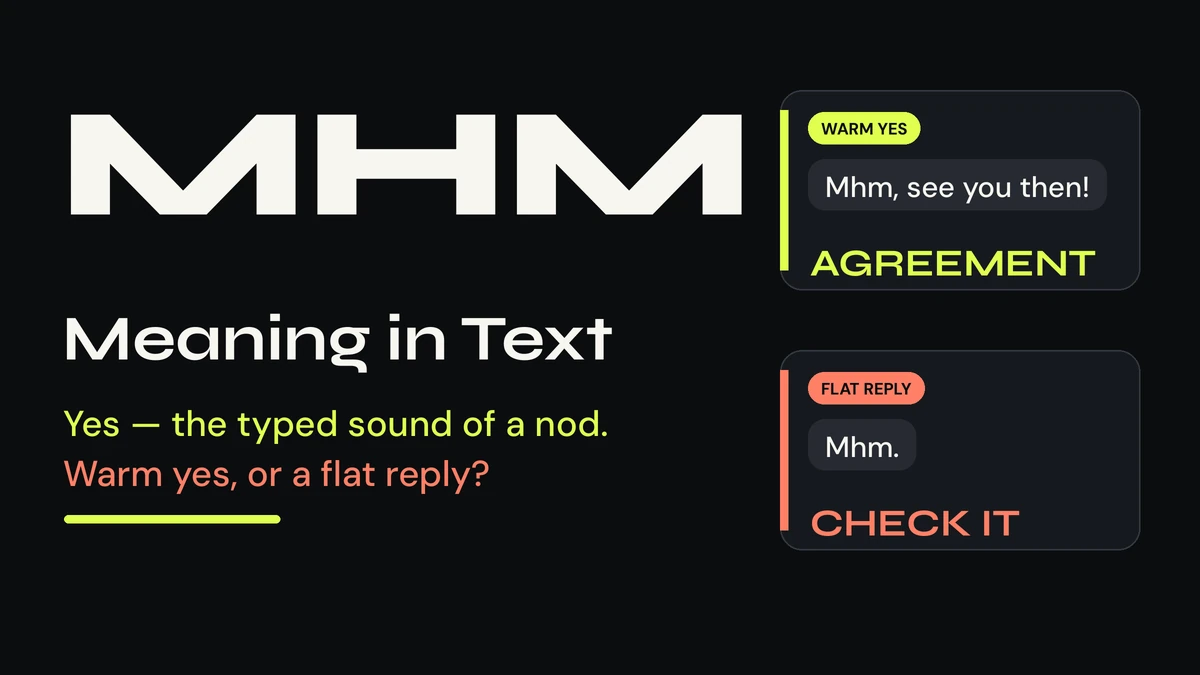
What does mhm mean in text? MHM means yes — it is the sound of a nod, typed out. This guide to mhm meaning in text gives you the MHM Nod Test, so you can tell in seconds whether the mhm you just got was warm agreement, a flat acknowledgment, or sarcasm wearing a yes’s clothes.
This guide covers the one dictionary-supported reading, the three-check test, seven tones, MHM on TikTok, Snapchat, Instagram, and in texts, how it lands by sender, when it is too thin for work, school, and serious news, graded claims, cousins, history, and a reply bank keyed to the job the mhm is doing.
What “MHM” Means in Text
MHM is not an initialism, and it stands for nothing. It is the written form of the spoken sound “mm-hmm” — the two-hump hum people make to say yes without saying the word. Nobody invented MHM as a code; somebody heard the sound, typed the closest spelling of it, and the spelling stuck. That is why the letters look odd: they were never designed to be spelled. They were designed to be heard.
The dictionary record is unusually direct for a texting term, and this guide leans on it in full. lists English mhm as an interjection meaning “expressing agreement or affirmation,” gives its synonym as uh-huh and its antonym as mm-mm, and traces it to a nasalized form of uh-huh, a form imitative of non-verbal sounds. Its listed spellings run mm-hm, mm-hmm, mm hmm, mmhm, mmhmm, mhmm, and um-hum — one sound, many spellings, one job. Oxford Learner’s Dictionaries agrees and adds the second job in the same breath: mhm is an exclamation “used to say ‘yes’, or to show somebody that you are listening to them.” Dictionary.com, read directly too, calls mhm a version of mm-hmm, an interjection “variously used to express agreement or make an acknowledgment,” and notes the same page is an informal word summary, not a formal definition — so this guide treats it as an established reference’s summary of usage, not as a laboratory-grade definition, and claims nothing more for it.
Those two jobs — agreeing and listening — are the whole term, and confusing them is the classic MHM misread. Agreeing answers a question: “Are we still on for tonight?” — “Mhm, see you then.” Listening keeps a story going: “I phoned Alan…” — “Mhm.” — “…and he said he’s going to come,” which is Oxford’s own example. The first mhm closes a question; the second holds a door open. Same letters, different job, and the test in the next section tells you which door you are looking at.
The MHM Nod Test
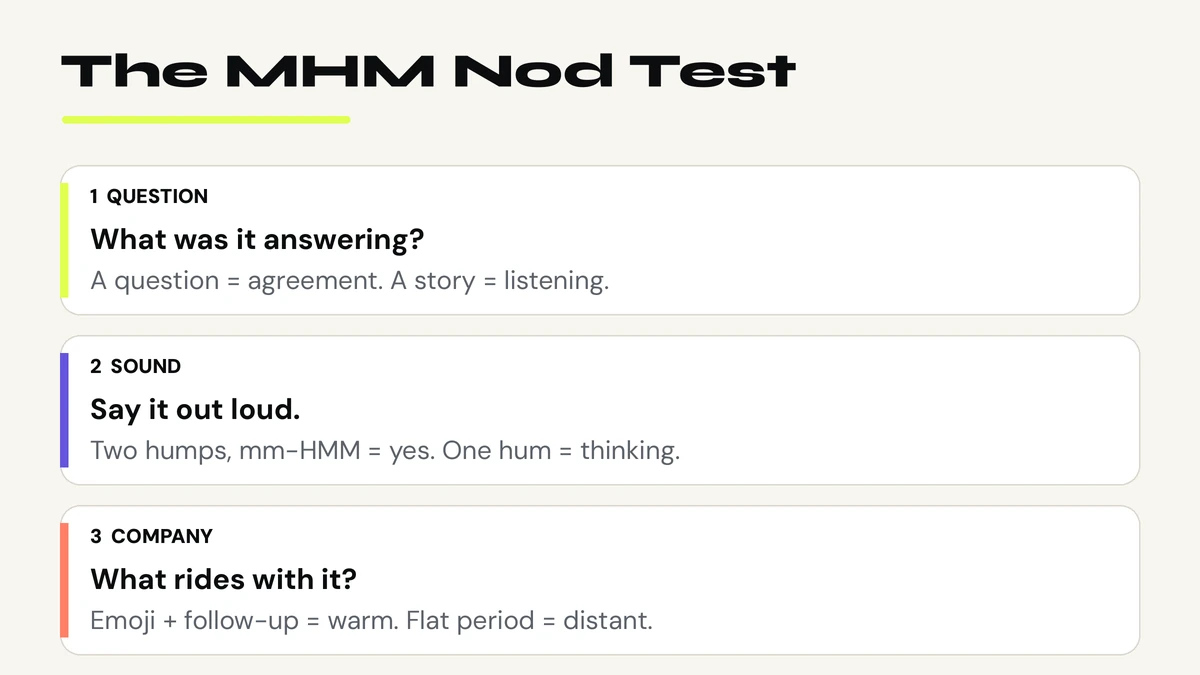
Before you answer an mhm — or send one — run three checks. They take about five seconds, and they beat every shortcut the competitors offer, because the competitors all say “tone matters” without giving you a procedure for reading it:
- Check 1 — The Question Check. What was the mhm answering? A yes-or-no question makes it agreement: “Are you free Saturday?” — “Mhm” is a yes. A story in progress makes it listening: a bare mhm in the middle of someone’s news is a nod that says “go on.” A bold claim or a promise nobody believes makes it a candidate for sarcasm: “I’ll wake up at 5 AM tomorrow, I promise” — “Mhm, sure you will” is not agreement at all. The sentence before the mhm does more work than the mhm itself.
- Check 2 — The Sound Check. Say it out loud. MHM is two humps: mm-HMM, the second hump higher than the first — that rise is the yes. HMM is one long hum: hmmm, flat or falling — that stretch is thinking. The spelling shows it if you look: in MHM the h sits in the middle (m-h-m: hum, then hum), while in HMM the h leads (h-m-m: one hum, stretched). And there is a swap test: if you can replace the mhm with “yes” and the sentence still works, you are reading MHM; if “let me think” fits better, you are reading HMM, not MHM. This is the check no competitor gives you, and it is the one that stops the most common confusion in the series.
- Check 3 — The Company Check. What rides with the letters? A bare “mhm” is relaxed and friendly. A period flattens it: “mhm.” reads final, settled, sometimes distant. An ellipsis stretches it toward hesitation: “mhm…” is unsure. An exclamation warms it: “mhm!” is a genuine, energetic yes. A follow-up sentence warms it further: “mhm, I loved it too” cannot be mistaken for indifference. And a tag-on phrase flips it: “mhm, sure” is sarcasm, because “sure” is doing the doubting the letters will not do alone. Company is the fastest single clue: warmth brings company, flatness travels light, sarcasm brings a second clause.
Worked trio. “Are we still on for lunch tomorrow?” — “mhm, 1pm works for me”: a question answered, company warm, sound two-humped. Warm agreement. “I had a really tough day today.” — “mhm”: a story met with a bare nod and nothing after it, sound flat, company absent. Not a yes at all — a listening nod that stopped listening, and it lands as dismissive. “I’ll definitely clean my room today.” — “Mhmmm, sure you will”: a bold claim answered, the hum stretched, the tag-on doubting. Sarcasm, and the Sound Check plus the Company Check caught it together. Three messages, one spelling, three jobs — and the test, not the letters, sorted them.
“MHM” in Real Chats
Illustrative examples written for this guide, not real transcripts:
- The warm yes. “Want to grab coffee later?” — “Mhm, see you then”: agreement with a plan attached. Answer with the plan, not another yes.
- The plan confirmation. “We will meet at 5?” — “Mhm”: a fact confirmed, nothing more needed. The shortest correct answer in the guide.
- The listening nod. “So then she said…” — “Mhm… yeah… go on”: the nod that keeps a story moving. The sender is not agreeing with anything yet — they are asking for the next sentence.
- The flat reply. “That movie was amazing!” — “Mhm.”: no emoji, no follow-up, no warmth. Run the Question Check before you decide whether this is tiredness, multitasking, or distance.
- The sarcastic “sure.” “I’ll wake up at 5 AM tomorrow, I promise.” — “Mhm, sure you will”: the hum stretched, the tag-on doubting. Do not answer this like a yes.
- The group-chat wave. A popular comment reads “she said what she said,” and the replies stack up: “mhm,” “mhm fr,” “mhm, exactly.” Nobody is answering a question; the crowd is nodding together. Answer the group, not the coldest single reply.
- The stretched tease. “Do you like him?” — “mhm, I know”: the hum drawn out, the confidence showing. The stretch is the message — playful, a little smug, and warm underneath.
The MHM Tone List

MHM’s job never changes — it is always a nod — but the feeling behind the nod slides across seven readings, warmest to riskiest. The first three are safe to send anywhere casual; the last two are safe only where the friendship already speaks that language:
- Warm agreement: “Mhm, I loved it too” — a yes with feeling in it. The follow-up sentence proves the warmth is real.
- Relaxed confirmation: “Mhm, 1pm works for me” — a fact confirmed without ceremony. The default reading, and the one to assume first.
- Active listening: “Mhm… go on” — not a yes to anything yet, just a held door. Oxford’s second sense, and the one most guides forget to name.
- Playful agreement: “Mhm, I know” with a stretched hum — confidence showing, a little smug, warm underneath. The stretch is the joke, not a warning.
- Flat acknowledgment: A bare “Mhm.” with a period and nothing after it. Not hostile, just closed: the sender heard you and stopped there. The Question Check decides whether this is tiredness, multitasking, or distance.
- Reluctant agreement: “Mhm… yeah probably” — technically a yes, with the enthusiasm removed. The ellipsis is doing the reluctance the letters will not say out loud.
- Sarcastic “sure”: “Mhm, sure you will” — the hum stretched, the tag-on doubting. The sarcasm lives in the sentence around the letters, not in the letters themselves.
What moves a reading between these tones is never the letters alone: it is the question (answered or story in progress), the sound (two humps or one long hum), and the company (emoji, punctuation, follow-up sentence). The same “mhm” that is warm agreement on Saturday can be a flat acknowledgment on Monday morning — and the test, not the spelling, tells you which day you are on.
“MHM” on TikTok
On TikTok, MHM lives in comments, and the comment thread is its natural habitat: a creator says something the crowd agrees with, and the comments fill with “mhm,” “mhm fr,” and “mhm, she said what she said.” Nobody there is answering a question — the crowd is nodding together, a wave of agreement without anyone typing much. A stretched “mhmmm” or a “mhm” with a nail-polish emoji adds attitude to the nod, which is the platform’s way of saying the agreement comes with confidence attached.
The trap on TikTok is taking a public nod personally. A stranger’s “mhm” under your video is applause, agreement, or irony aimed at the post, not a verdict on you, and a creator who captions their own video with “mhm” is usually doing playful confidence, not asking for sympathy. If an MHM arrives in a TikTok DM, though, run the test as usual — a DM is private again, and the flat and sarcastic readings return with it.
“MHM” on Snapchat
On Snapchat, MHM fits the fast, private, disappearing DM: “mhm, be there by 8” as a story reply, or a bare “mhm” on a streak snap between close friends. The disappearing format suits the relaxed readings — agreement that lands lightly and is gone. But disappearance also removes your evidence: if an MHM felt flat or sharp, you cannot re-read it, so judge from memory what rode with it — an emoji, a follow-up, or nothing at all.
Snapchat is also where the photo does half the work. A picture of the plan plus “mhm” needs no explanation: the image names what is being agreed to, and the letters only say yes to it. That is the Question Check working in real life — remove the MHM and the snap still shows the plan, which is how you know the job was confirmation, not information.
“MHM” on Instagram
On Instagram, MHM shows up in comments, captions, story replies, and DMs, and the stage decides the tone the way it does for every short reply. Comments lean public and playful: “mhm!!” under a friend’s post is applause the whole thread can join. Captions lean confident: “mhm, I know” under a good photo is the sender nodding at themselves. DMs carry the full range, exactly like texts — a friend’s warm yes and a stranger’s flat acknowledgment live in the same inbox, and only the test tells them apart.
Instagram is also where MHM meets its closest platform trap: reading a public comment as a private message. A stranger’s “mhm” under your post is not a conversation opener, and answering it with a life story embarrasses both sides. A thank-you, a matching laugh, or silence all end it cleanly; the comment was never asking for more.
“MHM” in Text Messages
Plain texts are MHM’s home ground, and the one-to-one setting makes the distinction sharpest. A warm text wants a witness: “Mhm, see you then, I’m excited.” A flat text wants a decision from you: is this tiredness, multitasking, or distance? The reply each one deserves is completely different, which is why the Question Check comes before the reply — answering distance with warmth you do not feel, or warmth with suspicion, is the classic MHM misfire.
Texts are also where a warm MHM turns into a plan, and the plan usually moves somewhere private. A friend who replies “mhm, 1pm works for me” and means it often follows up with the details — our DM guide covers that move in full, because the channel changes what the next message can say. And texts are MHM’s work limit in miniature: never send MHM in a professional message. A client, a manager, or a first contact deserves a plain yes spelled out, not three letters that presume a casualness you do not have.
Who Is Sending It: How “MHM” Lands by Sender
No source documents a different meaning of MHM per sender — the nod stays fixed; what changes is which tone you should expect, and therefore what you owe back. One honest verdict up front, because the girl-focused guides all circle it: the gender of the sender does not change what mhm means. A girl texting mhm to a guy is saying yes, okay, or I hear you — the same thing anyone else would mean. Flirting comes from the whole conversation, not from one word:
- Friend: the default. A friend’s mhm is relaxed confirmation or warm agreement at face value; run the test and answer that, not the letters.
- Crush: overread territory. A crush’s mhm feels bigger than it is — usually “I hear you,” not a confession about you. Answer the nod, not a romance you invented, unless the emoji and the follow-up say more.
- Partner: pattern rules. A partner’s mhm is usually routine confirmation; judge the pattern across days, not one message — but a sudden run of flat mhms after warm ones is worth one plain question, not a fight.
- Parent: usually literal and plain. A parent who writes mhm has usually learned it from you and means the nod plainly; do not read a parent’s mhm as cold unless the sentence around it is sharp.
- Coworker or boss: context decides. In a friendly team chat a colleague’s mhm about a meeting time is a confirmation; in any formal thread it is out of place, and never send one upward to a manager or client.
- Group chat: both habitats at scale. A group’s “mhm!!” cheers for everyone; a group’s single flat “mhm.” after your news still stings, but answer briefly in the group either way, and do not single one sender out for a private reading of a public nod.
- Stranger or creator: the applause habitat. A stranger’s mhm under your post, or a creator’s mhm in a caption, is a public reaction, not a message aimed at you personally. A thank-you or a matching laugh is enough; never answer a public reaction with a private confession.
When “MHM” Is Too Much: Work, School, and Family
This section is mandatory for MHM in a way it is not for most terms in this series, because MHM’s risk is not vulgarity — the word is clean — but thinness: a three-letter nod where a real answer was owed. Four rooms, four rules. At work: never send MHM in a professional message, a client thread, or a formal channel. A meeting time confirmed among close peers in a casual chat is one thing; the same letters as the only reply to an important decision read as “I barely read this,” and thinness is the opposite of respect. If the room would want a clear yes, the letters do not fix it.
At school: the same rule, with a younger audience. Teachers, school groups, and class chats are not MHM rooms, and a student who answers a serious question with a bare mhm has answered with a shrug whether they meant to or not. The clean swap is a full sentence: “Yes, that works for me, thank you.” In family chats, read the room person by person: a sibling group may love the shorthand, a grandparent group may not know the letters, and a parent who dislikes casual dismissal will dislike the abbreviation exactly as much as the sound, once they learn what it stands for. Abbreviation is not permission.
The general rule covers every room at once: never answer serious or emotional news with a bare mhm. Somebody telling you about a tough day, a loss, or an important decision deserves a sentence, not a nod — the nod says you heard them, and the sentence says you care. And if someone tells you MHM bothers them, simply stop. Switching words is easy, and it shows respect. The swap menu is free and it loses nothing: “Yes, that works for me” for confirmation, “Got it, tell me more” for listening, “I agree, that’s exactly right” for warm agreement. And one boundary worth stating plainly: never use MHM to end a conversation you owe someone. A nod that closes a door is not agreement; it is avoidance wearing a yes’s clothes.
Checked Claims: Expansions That Do Not Hold Up
Three letters attract folklore. Each claim below was graded against the dictionary sources read in full and the competitors read in full; nothing is repeated here as fact on a single blog’s say-so:
- “MHM stands for a phrase” — rejected. MHM is not an acronym and it expands to nothing. It is a phonetic spelling of the sound mm-hmm, and every dictionary source read for this article says so in the same terms. Any expansion you see attached to MHM was invented after the fact.
- “MHM means no” — rejected. Almost always yes, or at minimum “I acknowledge this.” Even a reluctant mhm is technically agreement, just without the enthusiasm. The opposite sound is mm-mm, which Wiktionary lists as mhm’s antonym — the no-sound is a different hum entirely.
- “MHM means the same as HMM” — rejected. The confusion is real and Dictionary.com names it: mhm “may be used to mean similar-sounding interjections like hmm (puzzlement).” But the dictionary meanings are opposites in job: mhm is agreement, hmm is thinking. The Sound Check in this guide exists because the mix-up is documented, not because the two sounds are the same.
- “MHM is a typo for HMM” — rejected. The letters differ by design, not by accident: MHM has the h in the middle (m-h-m, two humps), HMM has the h first (h-m-m, one hum stretched). Both spellings are attested as separate entries, and the series covers each in its own article, because each does a different job.
- “MHM from a girl means she is flirting” — rejected as a reading of the word alone. The girl-focused guides themselves agree the sender’s gender does not change what mhm means. A flirty mhm is a warm conversation plus a playful emoji plus a teasing follow-up; the three letters on their own carry no flirtation. Reading romance into a bare mhm is projection, not reading.
- “MHM is always cold or rude” — rejected. Short replies do not equal anger. Many people text briefly out of habit, multitasking, or tiredness, not emotion, and the relaxed-confirmation reading is the default for a reason. Coldness is a property of the conversation, not of the letters.
- “MHM is always enthusiastic agreement” — rejected. The mirror-image error. A flat “mhm.” after serious news, or a stretched “mhmmm, sure” after a bold claim, is not enthusiasm that misfired; it is a different tone wearing the same letters.
- “78% of mhm uses mean agreement, 12% soften suggestions, 5% show positive feeling” — rejected as statistics. One competitor publishes exact percentages from a self-described analysis of chat logs in five games, with no checkable method, no sample size, and no named dataset. A number without a method is decoration, not evidence, and this guide repeats no figure as fact.
What SURVIVES: mhm as the written mm-hmm, a yes-sound doing two jobs — agreeing and listening — with the seven tones above as feelings of that nod, not different meanings. Collisions are real outside chat and irrelevant inside it: Wiktionary lists mhm as the ISO 639-3 language code for Makhuwa-Moniga, and one gaming guide notes MHM as a graduate degree in hotel management. Nobody replying “mhm” to a lunch plan is naming a language code or a degree.
“MHM” vs Its Closest Cousins
MHM belongs to the yes family — sounds and words that agree, confirm, or acknowledge, not words that start a conversation. Its closest cousins split by what kind of yes they give:
- HMM (thinking cousin). Our HMM guide covers the thinking sound, held a beat longer: the pause you type when one second of thought is not enough. HMM says “let me think”; MHM says “yes.” The Sound Check in this guide is the border between them.
- HM (short-pause cousin). Our HM guide covers the quick, neutral pause — two letters, gone in a breath. HM says “wait a second”; MHM says “yes.” One is a pause, the other is an answer, and the h’s position tells you which.
- IKR (agreement cousin). Our IKR guide covers an echo that agrees with a feeling; MHM agrees with a fact or a plan. IKR says “I feel that too”; MHM says “yes, that works.” One shares feeling, the other confirms the thing itself.
- FR (co-sign cousin). Our FR guide covers a sincerity stamp that certifies a claim; MHM confirms a question or a plan. FR says “that is true”; MHM says “yes, agreed.” One certifies truth, the other answers the ask.
- “Uh-huh,” “yep,” and “yeah” (plain-English cousins). The spelled-out versions of MHM’s warmest tones. Wiktionary names uh-huh as mhm’s synonym, and yep and yeah are the same yes with the volume turned up. They are the swap menu: when MHM feels too thin, these words say the same thing with the yes built in, and no test required.
- MMK (rushed cousin). A blend of mhm and okay, used for quick confirmations that also end the topic. MMK says “yes, and we are done here”; MHM says “yes” and leaves the door open. The difference is the ending: one closes, one nods.
- MH (hum cousin). Our MH guide covers “mhmm” — most often a quick yes, okay, or I agree. MHM is the nod; MH is the hum. One nods the yes, the other hums it.
- MK (hummed-okay cousin). Our MK guide covers “okay” said the way you would hum it out loud — a quick, casual “mm-kay.” MHM is the nod that agrees; MK is the hum that says okay. Both are sounds doing a word’s job.
Where “MHM” Came From
The sound came first, by a long way. Dictionary.com records mm-hmm in English as early as 1934, and the sound itself — a nasal hum of agreement — is far older than any record of it, because people hummed yes long before anyone wrote the hum down. The texting spelling followed the usual path: as chat applications spread, the sound migrated from speech into writing, because typing “yes” on an early phone keypad took nine clicks and MHM took four, by Dictionary.com’s own count. The first Urban Dictionary entry for MHM dates to 2004, which the same page ties to the rise of early chat applications like AOL Instant Messenger.
Dating the texting spelling precisely is where honest guides stop. The spoken sound is recorded from 1934; the repository entry is dated 2004; Oxford lists the word as a real exclamation with no origin year attached. Those are three different kinds of evidence — a reference’s earliest record, a user-generated repository’s first entry, and a dictionary’s current listing — and this guide does not blend them into a single birth year for MHM. What the sources agree on is the direction: spoken hum first, written spelling second, everyday texting staple third. No inventor is claimed, and no single year is asserted as the birth of MHM.
How to Reply When Someone Sends “MHM”

Golden rule: answer the job the test found, not the letters. A reply bank keyed to the reading:
- Warm agreement — accept it warmly: “Perfect, see you then” or “Great, I’m excited too.” Warmth answered with warmth keeps the thread alive.
- Relaxed confirmation — confirm back, briefly: “Sounds good” or “Cool, locked in.” The nod did its job; a short echo closes the loop.
- Active listening — keep talking: The mhm was a held door, not an answer. Give the next sentence: “So anyway, he said…” A nod that asks for more deserves more.
- Flat acknowledgment — do not chase it: A light “Haha, fair enough” and then move on. If the pattern repeats, one plain question beats ten anxious replies: “Hey, did that land weird?”
- Sarcastic “sure” — laugh, or move on: “I know, right? Wild how that worked out” matches the energy; silence ends it. Never answer a jab with a longer jab unless the friendship runs on that.
- You want them included — turn the nod into a plan: A warm mhm is an opening, not just an answer — our HMU guide covers the open invitation in full, because “next time, you are coming too” turns a yes into a plan, and plans beat nods every time.
Frequently Asked Questions
What does MHM mean in a text message?
MHM means yes. It is the written form of the spoken sound “mm-hmm,” used to agree, confirm, or acknowledge something, or to show you are listening. Run the Nod Test before you decide which job the mhm you just got is doing.
Is MHM the same as HMM?
No, and the mix-up is the most common confusion in the series. MHM is the yes-sound: two humps, mm-HMM, the second hump higher. HMM is the thinking sound: one long hum, hmmm, flat or falling. Say it out loud and the swap test decides it: if “yes” fits, it is MHM; if “let me think” fits, it is HMM.
What does MHM mean on TikTok?
On TikTok, MHM usually means yes or agreement in comments or live chats, often as a wave of nods under a post the crowd agrees with: “mhm, she said what she said.” A stretched “mhmmm” or a nail-polish emoji adds attitude. A stranger’s mhm under your video is a public reaction, not a private message.
What does MHM mean on Instagram?
On Instagram, MHM usually means yes or agreement in DMs, comment replies, and Story reactions. Comments lean public and playful, captions lean confident, and DMs carry the full range exactly like texts. A stranger’s mhm under your post is a public reaction, not a private message.
Is MHM rude?
Not by itself. Among friends it is often harmless, warm, or funny. It turns rude when it is the only reply to serious or emotional news, when it arrives as a flat pattern after every message, or when it is used to end a conversation someone was owed. When in doubt, choose clearer words: “Yes, that works for me” leaves no ambiguity at all.
Can I use MHM at work or school?
Generally, no. MHM belongs in casual digital conversations. In work emails, formal chats, or school messages it can sound dismissive or unprofessional, and as the only reply to an important decision it reads as if you barely read the message. In a casual peer chat confirming a time, it is fine; anywhere formal, spell the yes out.
What should I reply when someone sends MHM?
Answer the job the test found. Warm agreement gets warmth back (“Perfect, see you then”); relaxed confirmation gets a short echo (“Sounds good”); a listening nod gets the next sentence; flat acknowledgment gets a light reply and no chase; sarcasm gets a laugh or silence. The full reply bank is in the section above.
Does lowercase mhm mean something different from MHM?
No. Capitalization changes volume, not meaning: capital MHM reads a touch louder, lowercase mhm reads softer and faster, but both mean yes. What changes the reading is the question it answers, the sound it spells, and the company it keeps — never the case alone.
The Takeaway
MHM means yes: a three-letter nod, the sound of mm-hmm typed out, doing two jobs — agreeing and listening — with the feeling decided by the moment. The letters never change; the job does. When an mhm lands, run the Nod Test: check the question, say the sound out loud, check the company. And when you send one, remember the only rule that matters: a nod is an answer, not a conversation — so if you mean it warmly, prove it with a follow-up sentence, and if the news deserved a sentence, send the sentence instead.