What does pfp mean in text? PFP means “profile picture” — the small image beside your name on every social account you touch. This guide to pfp meaning in text gives you the PFP Profile-Picture Test, so you can tell in seconds whether the pfp you just got means “I love that photo,” “who is that person,” “let’s match,” or “prove it with a picture.”
This guide covers the one dictionary-backed texting meaning, the three-check test, seven tones, PFP on TikTok, Snapchat, Instagram, and in texts, how it lands by sender, when it crosses a line at work, school, and home, graded claims about rival expansions, cousins, a dated history from Instagram’s 2010 launch to the 2021 NFT boom, and a reply bank keyed to the reading you just identified.
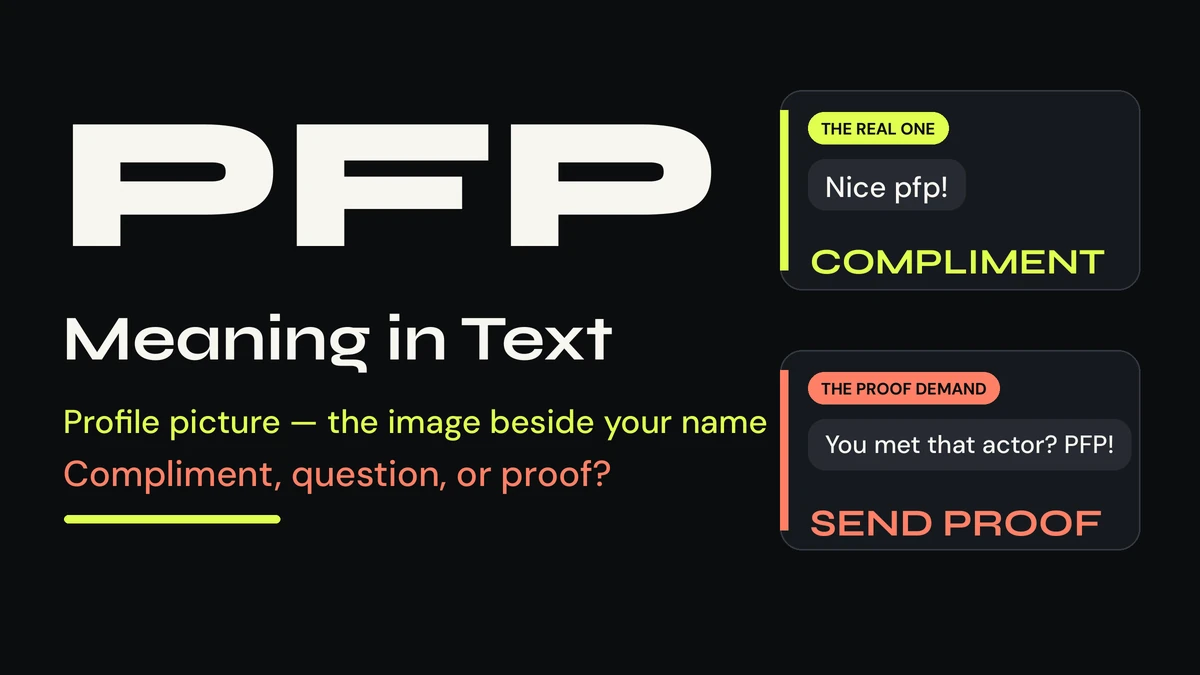
What “PFP” Means in Text
PFP is an initialism: take the first letters of the phrase “profile picture” and squeeze out the spaces, and you get P, F, P. It does exactly what the full phrase does, only faster. It names the image attached to an account — the small photo, drawing, or meme that shows up next to a username in comments, posts, and messages. “Nice pfp.” “Just changed my pfp.” “Who’s in your pfp?” That is the whole job in three letters: a question or a comment about a picture, and an answer that is really about identity. It is also a substitute for a whole sentence — “I love your new profile photo,” “I changed the picture on my account,” “whose face is that in your avatar” — without typing any of them. Nobody says PFP out loud in a real conversation; you type it, and when you read it aloud you just say “profile picture.”
The dictionary record is short and unusually unanimous for a slang term, and this guide leans on all of it. Wiktionary, read directly for this article, lists lowercase pfp as an abbreviation of “profile picture,” marked as internet slang and text messaging, with a 2021 example from VICE about a man trying to get his stolen Bored Ape NFT pfp back. No other texting sense is listed on the page; there is no “picture for proof” sense in Wiktionary at all. No dedicated Merriam-Webster slang page for PFP exists; Merriam-Webster defines only the full phrase “profile picture,” so the abbreviation’s dictionary record rests on Wiktionary, and this guide says so rather than pretending otherwise. Wikipedia’s avatar article, found while checking the established references, agrees in passing: in computing, an avatar is also known as a profile picture, or pfp.
One meaning, then, with a sliding scale of closeness underneath it. In a chat, a comment, or a DM, PFP means “profile picture,” full stop — but “profile picture” can mean four different things in practice. It can mean a real photo of the person. It can mean a cartoon or anime character. It can mean a meme or a pet. And, honestly, it can mean nothing at all — a gray default circle that says the account never bothered. The letters do not tell you which one you got. The test in the next section does, because the picture itself, the place you saw it, and the purpose behind the comment are what separate a compliment from a question, a matching set from a roast, and an identity from a demand for proof. And one warning worth carrying into every section: the image is not the person. Our IRL guide covers the gap between a profile picture and the real-life person behind it, because a PFP is a chosen image, not a verified face.
The PFP Profile-Picture Test
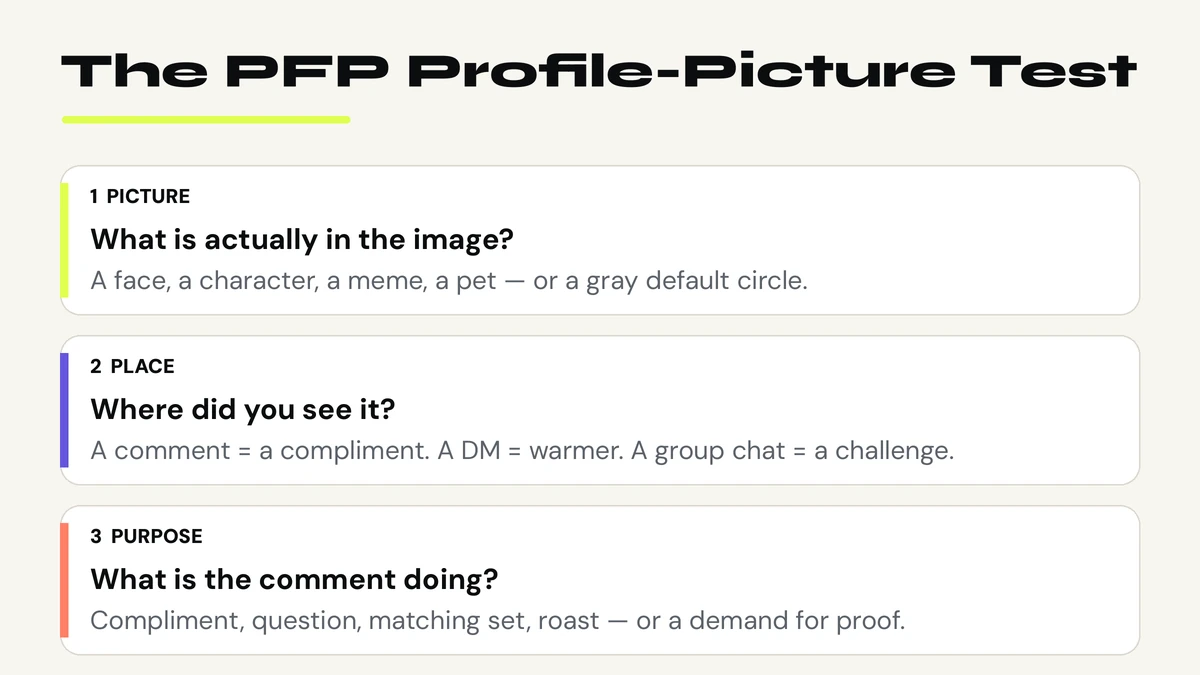
Before you answer a pfp — or send one — run three checks. They take about five seconds, and they beat every shortcut the competitors offer, because the competitors all say “it means profile picture” without giving you a procedure for telling a compliment from a question, a matching set from a roast, or an identity from a demand for proof:
- Check 1 — The Picture Check. What is actually in the image? A real face, a character, a pet, a meme, or a gray default circle? A selfie PFP invites a compliment about the person. An anime or meme PFP invites a comment about taste, not about a face — “who’s in your pfp?” about a cartoon is a question about a show, not about a person. A default gray circle invites no comment at all, or a gentle roast from a friend. The picture is the first fact, and every reading that skips it is a guess.
- Check 2 — The Place Check. Where did you see it? A public comment under a post, a private DM, a group chat, or a marketplace thread? A “nice pfp” in a public comment is a friendly opener the whole thread can see. The same words in a DM are a private compliment, and a little warmer. In a group chat they are a performance for the room. In a marketplace or verification chat, “pfp?” is not a compliment at all — it is a demand for a photo as proof, and the room is what tells you so. The place is the context, and a pfp with no place attached is a word with no sentence around it.
- Check 3 — The Purpose Check. What is the comment doing? Showing identity, starting a chat, proposing a matching set, teasing a friend, or asking for proof? A “matching pfps?” from a best friend is a friendship signal. A “pfp?” after a wild claim is a challenge. A “bro’s still on default” from a friend is a joke. The purpose is the meaning behind the meaning, and it is the check the competitors skip — they list what PFP stands for, and stop, while the purpose is what tells you how to answer.
Worked trio. “Nice pfp” under a friend’s new selfie: picture a real face, place a public comment, purpose a compliment. Answer with thanks, nothing more. “Matching pfps??” in a DM from your best friend: picture two halves of one illustration, place a private chat, purpose a friendship signal. Answer yes, and send options. “You met that actor? PFP!” in a group chat after a wild claim: picture none at all, place a group thread, purpose a demand for proof. Not a compliment — a challenge, and the letters mean “picture for proof” this once. Three messages, one abbreviation, three readings — and the test, not the spelling, sorted them.
“PFP” in Real Chats
Illustrative examples written for this guide, not real transcripts:
- The compliment. “Your new pfp is so cute!” A friend notices the change and says so in one line. The picture is the whole message; the compliment is the whole reply.
- The question. “Who’s in your pfp?” Someone does not recognize the person, the character, or the moment in the image. The answer is one line of identification: “my dog Milo, he’s 3.”
- The matching proposal. “Matching pfps??” A best friend proposes sharing a two-part PFP set. The question is really a friendship signal, and “yesss, send options” is the only answer that matches it.
- The proud showcase. “Just changed my pfp. Took forever to pick.” The sender is not asking a question; they are showing off a choice. A compliment is the expected reply, and silence reads as a shrug.
- The default roast. “Bro’s still on default 💀” A friend teases an account that never set a picture. The gray circle is the joke, and the reply is to laugh it off or finally pick a photo.
- The pfp check. “Pfp check on this server.” A Discord or TikTok thread asks everyone to show their profile picture at once. The comment is a roll call, not a compliment — it is the room asking who is who.
- The proof demand. “You met that actor? PFP!” No picture is being discussed at all. The letters are a challenge: send a photo or the claim falls apart. The room is a group chat, the purpose is proof, and the reading is the fenced second sense.
The PFP Tone List
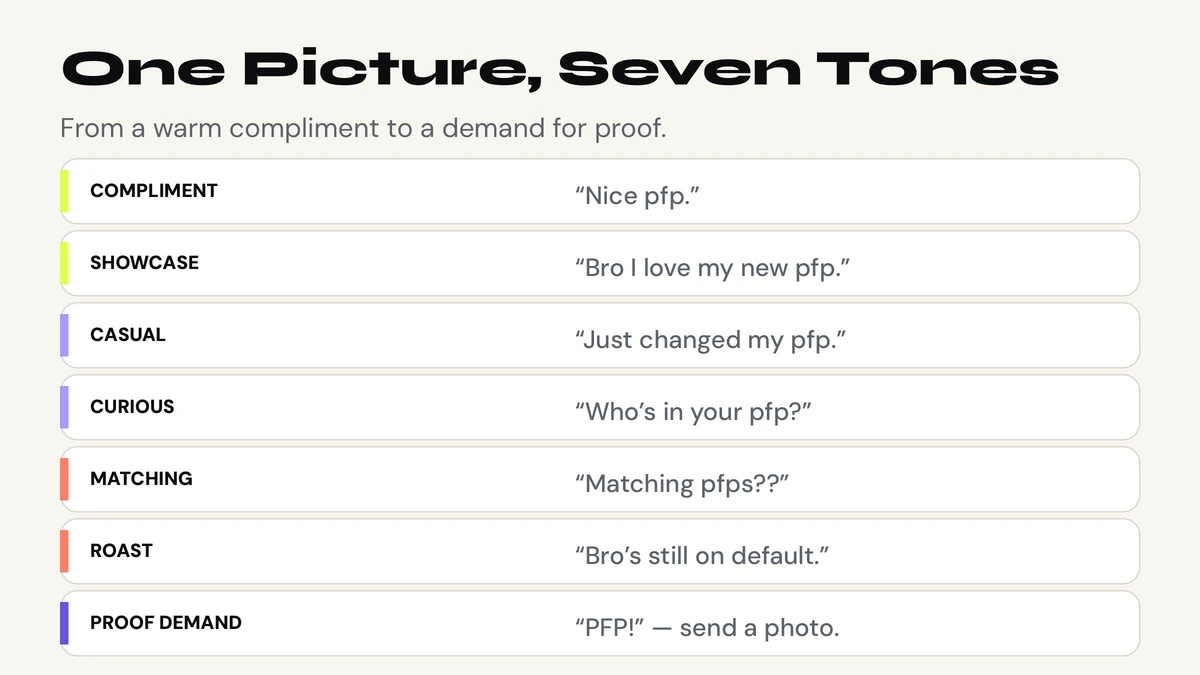
PFP’s meaning never changes; its feeling slides across seven readings, most warm to least. The first three are safe to send anywhere casual; the last two are safe only when the friendship can carry them:
- Genuine compliment: “Nice pfp.” Short, warm, and complete. The sender likes the image and says so in two words. Compliments almost always land as compliments, not sarcasm — a stranger’s “nice pfp” on a photo you posted is a friendly opener, not a setup.
- Proud showcase: “Bro I love my new pfp.” The sender is showing off a choice they are happy with. The tone is self-congratulation, and the expected reply is agreement, not a question.
- Casual mention: “Just changed my pfp.” Lowercase, unhurried, unbothered. The sender is reporting a small update, and the message needs nothing back except a like or a nod.
- Curious question: “Who’s in your pfp?” The sender does not recognize the person, the character, or the moment, and wants one line of identification. Curiosity, not judgment, is the whole tone.
- Matching-set signal: “Matching pfps with my best friend.” Two halves of one illustration, or two portraits that belong together. The tone is closeness made public — the PFP is a friendship badge, and the comment is the badge being worn.
- Gentle roast: “Bro’s still on default.” A friend teases an account that never set a picture. The gray circle reads as inactive or bot-adjacent, and the roast is mild precisely because the fix is easy: pick a photo.
- The proof demand: “PFP!” after a wild claim. The letters stop being a noun and become a challenge: send a picture or the story falls apart. It is the one tone that is not about a profile at all — and it only works when the room already knows the second sense.
What moves a reading between these tones is never the letters alone: it is the picture (a face, a character, a meme, or nothing), the place (a comment, a DM, a group chat, or a marketplace thread), and the purpose (a compliment, a question, a friendship signal, or a demand for proof). The same “pfp” that is a warm compliment under a new selfie on Saturday can be a challenge in a group chat on Monday night — and the test, not the spelling, tells you which day you are on.
“PFP” on TikTok
On TikTok, PFP lives in comments and captions, and the comment thread is its natural habitat: a creator posts a “getting ready” video captioned with a PFP change, and the thread answers with “pfp check” — a roll call where everyone shows their profile picture at once. The public stage suits the compliment and the curious-question readings best, because a comment thread is an audience, not a private conversation — nobody there is owed an explanation, and the update lands precisely because everyone in the thread already knows the picture. The matching-set reading travels well here too: “matching pfps?” under a best-friend video is a friendship signal the whole thread can enjoy, and “new pfp, new era” under a rebrand video is a mood shift the followers are invited to celebrate.
TikTok is also the one platform where a PFP change rides a bigger wave. Creators change PFPs to match promotions, trend cycles, or aesthetic seasons, and a fresh PFP often arrives with a video the feed is already pushing — our FYP guide covers the For You Page that surfaces it, because a PFP change nobody sees is a rebrand in an empty room. TikTok also supports video PFPs, a short moving loop that plays when someone lands on the profile, which makes the picture itself a tiny performance. If a PFP comment arrives in a TikTok DM, though, run the test as usual — a DM is private again, the public readings fall away, and the compliment reading returns with it, because a private “nice pfp” still deserves a real thank-you.
“PFP” on Snapchat
On Snapchat, PFP most often refers to the Bitmoji avatar rather than a photograph. Users pair Bitmoji outfits with mood, holiday, or friend group, and when Snapchatters say “nice pfp,” the Bitmoji is what they are talking about, not a photo. The disappearing DM suits the casual and compliment readings — an update that lands lightly and is gone. But disappearance also removes your evidence: if a pfp comment felt like a roast, you cannot re-read it, so judge from memory what rode with it — a laugh, a question, or nothing at all. A bare “nice pfp” with no company is the one case where the plain reading is the right one; a roast needs a stage, and a disappearing snap gives it none.
Snapchat is also where the picture does half the work. A snap of a new Bitmoji outfit plus “new pfp” needs no explanation: the image shows the change, and the letters only label it. That is the Picture Check working in real life — remove the PFP and the snap still shows a new avatar, which is how you know the job was labelling, not claiming. And because streaks run on speed, pfp is a streak-saver: it keeps the conversation alive in three letters when a full sentence would slow the whole exchange down.
“PFP” on Instagram
On Instagram, PFP works as aesthetic identity. Users choose profile images to match their feed’s colour palette, mood, or brand direction, and the profile circle reads as a visual signature across every comment, DM, and Reel. A refresh signals a rebrand: a new PFP is a new era, and the comments know it. Comments lean public and excited: “nice pfp” under a friend’s new photo is applause the whole thread can join. Captions lean playful: a new selfie with a fresh PFP is a showcase the followers are invited to enjoy. DMs carry the full range, exactly like texts — a friend’s compliment and a crush’s curious question live in the same inbox, and only the test tells them apart.
Instagram is also where a PFP change meets its closest platform trap: reading a public refresh as a private message. A creator’s new PFP is a rebrand, not a signal aimed at you, and answering it with “why did you change it, are we okay?” embarrasses both sides. A like, a matching compliment, or silence all end it cleanly; the refresh was never asking for more. The exception is a PFP change that rides with a post asking for engagement — a “like my status” moment, where the picture and the post are one move — and our LMS guide covers that pairing in full, because a PFP change plus an engagement ask is a campaign, not a coincidence. For a business, PFP talk is one of the safer slang areas to use in a casual reply — “Love the new PFP!” feels warm in a DM — but avoid it when the customer needs a real answer, because a compliment about a picture is not a reply to a question, and in that case an actual answer is kinder. And our IG guide covers the platform shorthand itself, because “IG” is the word people use when they mean Instagram without typing it.
“PFP” in Text Messages
Plain texts are PFP’s home ground for the proof sense, and the one-to-one setting makes the distinction sharpest. A compliment text wants a thank-you: “Your new pfp is so cute!” A proof text wants a photo: “You met that actor? PFP!” The reply each one deserves is completely different, which is why the Purpose Check comes before the reply — answering a proof demand with “thanks!” misses the challenge entirely, and answering a compliment with a photo of your ID misses the compliment. Lowercase pfp is significantly more common here than the capitals, because texts are typed fast and lowercase reads softer; capitals in a text are a choice, and a choice is information.
Texts are also where a PFP conversation turns into a longer exchange, and the exchange usually moves somewhere private. A friend who compliments your PFP often follows up with the details themselves — where the photo was taken, who is in it, why they picked it — and our DM guide covers that move in full, because the channel changes what the next message can say. And texts are PFP’s work limit in miniature: never use PFP in a professional message. A client, a manager, or a first contact deserves plain language, not three letters that presume an intimacy and a casualness you do not have — and never one that could be read as a demand for proof from someone you have just met.
Who Is Sending It: How “PFP” Lands by Sender
No source documents a different meaning of PFP per sender — the picture stays fixed; what changes is how much weight you should give the comment, and therefore what you owe back:
- Friend: the default. A friend’s “nice pfp” is a compliment at face value; run the test and answer that, not the letters. If the test says proof demand, one photo is the whole answer.
- Crush: overread territory. A crush’s “nice pfp” feels bigger than it is — usually “I like that photo of you,” not a confession about you. Answer the compliment, not a romance you invented.
- Partner: pattern rules. A partner’s PFP comment is usually routine affection; judge the pattern across days, not one message — but a sudden run of matching-PFP proposals after months of silence is worth one plain question, not a fight.
- Parent: usually literal and plain. A parent who writes “nice pfp” has usually learned it from you and means the picture plainly; do not read a parent’s PFP comment as a roast unless the message around it is all laughing emojis and no compliment.
- Coworker or boss: context decides. In a friendly team chat a colleague’s “nice pfp” about a new headshot is a compliment; in any formal thread it is out of place, and never send one upward to a manager or client — and never one that could sound like a demand for proof from someone you work with.
- Group chat: both habitats at scale. A group’s “matching pfps??” cheers for everyone; a group’s single “PFP!” after your wild claim still challenges, but answer briefly in the group either way, and do not single one sender out for a private reading of a public challenge.
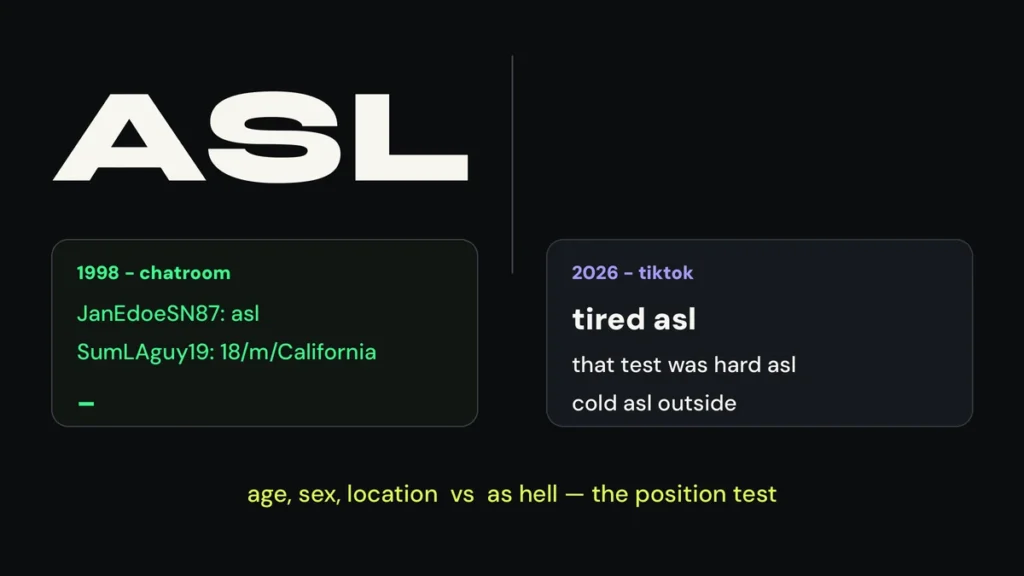
- Stranger: the identity question. Someone you do not know commenting on your PFP is usually asking who you are, and the question often arrives wrapped in other identity shorthand — our ASL guide covers the age, sex, and location questions that travel with it. Answer the compliment if there is one, and nothing else; a stranger is owed a thank-you, not your details.
When “PFP” Is Too Much: Work, School, and Family
PFP’s risk is not rudeness — the word is clean, and there is no vulgar reading at all — but the proof demand and the roast: a “PFP!” can sound like an accusation when the claim was a joke, and a “bro’s default pfp” can sting when the account belongs to someone new, shy, or private. Four rooms, four rules. At work: never send PFP in a professional message, a client thread, or a formal channel. An update among close peers in a casual chat is one thing; the same letters answering a client’s question read as a shrug, and a client who feels brushed off does not come back. If the room would want an answer, give one that names the picture plainly: “Here is the headshot you asked for.”
At school: the same rule, with a younger audience, and the same roast in miniature. Teachers, school groups, and class chats are not PFP rooms, and a student who answers a classmate’s new photo with “bro’s default pfp” has sent a small roast whether they meant to or not. In family chats, read the room person by person: a sibling group may love the shortcut, a grandparent group may not know the letters, and a parent who dislikes being judged on a photo will dislike the abbreviation exactly as much as the full phrase, once they learn what it stands for. Abbreviation is not permission. The general rule covers every room at once: if someone tells you PFP bothers them, simply stop. Switching words is easy, and it shows respect. The swap menu is free and it loses nothing: “profile picture” for any formal room, “your new photo looks great” for a real compliment, “can you send a photo?” for a real proof request. And one boundary worth stating plainly: never use “PFP!” as a demand for proof from someone you do not know well, because you cannot control what the photo will show or who will see it once it is sent.
Checked Claims: Expansions That Do Not Hold Up
Three letters attract folklore, and a word this common attracts more than most. Each claim below was graded against the dictionary read in full and the competitors read in full; nothing is repeated here as fact on a single blog’s say-so:
- “PFP means ‘picture for proof’” — fenced, not the default. The second sense is real but narrow: several guides record it as a request for a photo after a wild claim, usually in older texting circles or marketplace and verification chats, and the guides agree it is rare in 2026. But Wiktionary lists no such sense at all, and every competitor in this build agrees “profile picture” wins nearly every casual conversation. Treat “picture for proof” as a live secondary reading that only the Purpose Check can confirm — never as the first meaning, and never as a reason to answer a compliment with a photo.
- “PFP means ‘picture for profile’” — rejected as an expansion. One guide offers “Picture For Profile” as a memory trick for remembering the letters, but a mnemonic is not an expansion: no dictionary lists it, no guide uses it as a live meaning, and the letters map to “profile picture,” not to “picture for profile.” Never quote it as what the letters stand for.
- “PFP means ‘personal favorite photo’” — rejected. One guide lists it as a rare interpretation, but no dictionary supports it, no other guide in this build repeats it, and it reads as a guess built from the letters rather than from use. A favorite photo can be a PFP; “personal favorite photo” is not what PFP means.
- “PFP means ‘paid for post’” — fenced, not a texting meaning. “Paid for post” genuinely exists as influencer-marketing shorthand for sponsored content, but it lives in brand deals and campaign sheets, not in chats. Nobody replying “nice pfp” under a photo is disclosing a sponsorship.
- “PFP means ‘personal financial planner’” — fenced, not a texting meaning. “Personal financial planner” genuinely exists in finance and accounting, where PFP is a professional title, but it lives in wealth-management offices, not in chats. A finance memo gives you a planner; a group chat gives you a picture.
- “PFP means ‘patellofemoral pain’” — fenced, not a texting meaning. “Patellofemoral pain” genuinely exists in sports medicine, where PFP is shorthand for a knee condition, but it lives in physio notes and running communities, not in chats. A runner’s physio note gives you a knee; a TikTok comment gives you a picture.
- “PFP is the same as your cover photo” — rejected. The PFP is the small circle beside your name; the banner or cover is the wide background image behind your name. They are different images with different jobs, and confusing them is how a new user uploads a landscape photo into a circle and loses half of it.
- “Changing your PFP means you broke up or started a new era” — rejected as a rule. A PFP change can signal a breakup, a rebrand, a mood, a new season, or nothing at all — one guide notes that a refreshed PFP in one half of a matching set is a way of saying a friendship ended, but that is a signal in one specific situation, not a rule. No single reading is guaranteed, and the Picture Check is what tells you which one you are looking at.
What SURVIVES: in chats, PFP means “profile picture,” the small image beside your name, a dictionary-backed reading with the seven tones above as feelings of the same picture — not different meanings; the “picture for proof” reading is real but fenced to older texting circles and verification chats, and only the Purpose Check can confirm it; the finance, medical, and marketing senses are real but fenced to their own rooms; and the picture-versus-banner split — the PFP is the circle, the banner is the background — is the one distinction every competitor in this build agrees on.
“PFP” vs Its Closest Cousins
PFP belongs to the identity family — words that say who an account is before a single post is read. Its closest cousins split by what kind of identity they give:
- DP (older cousin). The twin that came first: “display picture” means the same image, and it is still the standard term on WhatsApp and across South Asia, while PFP is the newer Gen Z default. No published guide for DP exists in this series yet, so it is named here, not linked.
- Avi (older cousin). “Avi” is avatar shortened, from the older Twitter and MySpace era, and it is nearly extinct now. No published guide for avi exists in this series yet, so it is named here, not linked.
- Avatar (broad cousin). The wide word: an avatar can be a photo, a drawing, an animated character, or a 3D figure, while a PFP is usually one still image in a circle. The PFP is the avatar’s most common form, not its whole range.
- OOTD (outfit cousin). Our OOTD guide covers the outfit-of-the-day photo that becomes a PFP more often than any other kind of picture — a new outfit post is a new profile picture waiting to happen, and the two terms travel together in fashion and selfie threads.
- Banner or cover photo (frame cousin). The wide image behind your name, not the circle beside it. A banner sets the scene; a PFP shows the face. Change one and nobody notices your identity; change the other and everyone does.
- “Profile pic” (full-phrase cousin). The spoken form PFP becomes when the room is casual but the letters feel too clipped. “Nice profile pic” and “nice pfp” are the same compliment in different clothes, but the full phrase carries a warmth the abbreviation skips, while PFP keeps the update to three letters and no effort.
Where “PFP” Came From
The phrase came first, by decades. “Profile picture” is ordinary English for the image that represents a person on an account, and it was a complete, everyday phrase long before anyone typed it. The abbreviation is the new part, and it was born the way most texting abbreviations were: out of impatience. As profile images moved from an occasional forum-avatar concept into a central feature of every social account, users needed a faster way to talk about the image beside their name, and “PFP” filled the gap. No single person coined it: a community shortened it, the way communities shorten everything they say often.
The rise of Instagram gave the abbreviation its stage. Instagram launched in July 2010, and the profile image became the visual signature of every account; Discord’s 2015 launch pushed PFP further, because Discord servers recognize members by their profile image before their username. By 2020, lowercase “pfp” was the Gen Z default across every major platform, while the capitals survived for emphasis and for glossary entries. The first Urban Dictionary entry for “pfp = profile picture” dates from June 2017, according to the main competitor in this build, though the shorthand was already in circulation across Twitter, Instagram, and gaming forums before then — and Urban Dictionary is attestation only, never primary evidence, so this guide reports the date as the competitor’s record, not as a verified first use.
The split that did survive is the NFT one. Around 2021, “PFP projects” became a huge trend, where collections like Bored Ape Yacht Club and CryptoPunks sold digital art specifically designed for people to use as profile pictures, and owning a rare or expensive PFP became a status symbol in crypto communities — the VICE example Wiktionary quotes is exactly that story, a man trying to get his stolen Bored Ape pfp back. The letters never needed a second meaning in chats, because one job — naming the image beside your name — was enough to keep them alive for a decade. That is why the Picture Check works at all — the history of the abbreviation is a history of one image doing more and more work, and the image you are looking at still tells you which PFP you are reading.
How to Reply When Someone Sends “PFP”
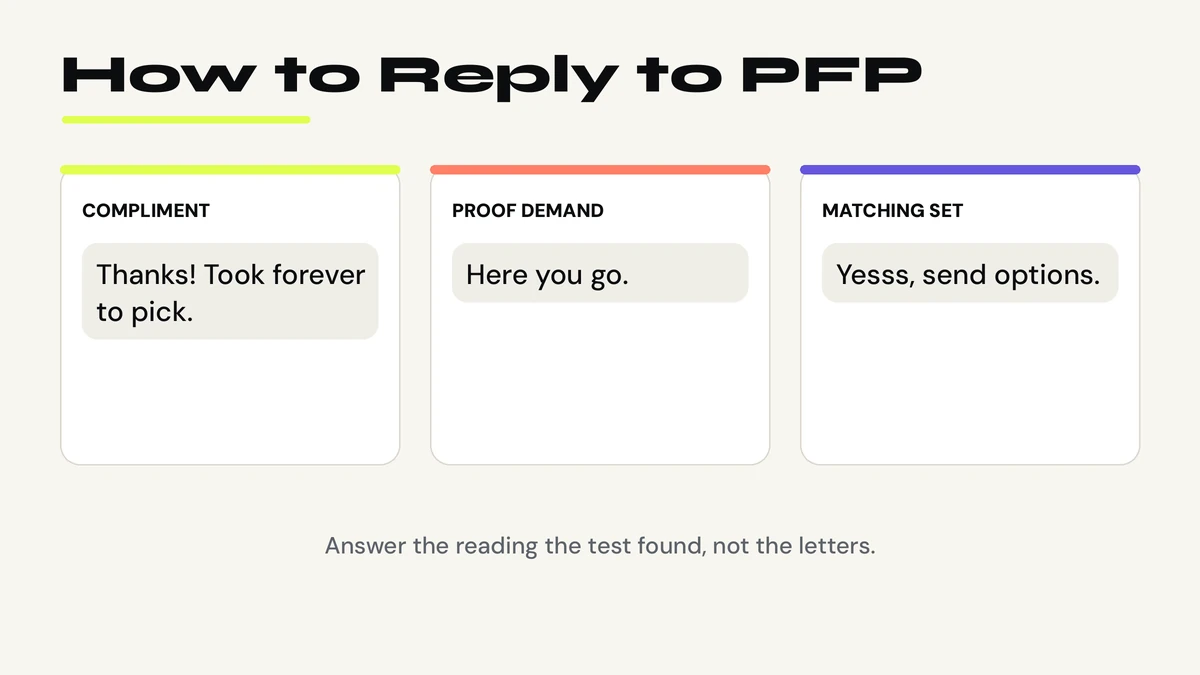
Golden rule: answer the reading the test found, not the letters. A reply bank keyed to the reading:
- Compliment received — thank them plainly: “Thanks! Took forever to pick” or “Thank you!” The picture was the whole message; a thank-you is the whole reply. Do not ask “are you sure?” when the compliment already proved itself.
- Asked about the person in it — identify in one line: “It’s my dog Milo, he’s 3” or “That’s my sister at the beach.” The question was about a picture; the answer is one line of identification, not a life story.
- Matching set proposed — answer the friendship, not the picture: “Yesss, send options” or “Let’s do it — you pick the style.” The proposal is a friendship signal, and a yes with an image suggestion is the only answer that matches it.
- Default-PFP roast — laugh it off or fix it: “Working on it, deciding between three photos” or “Haha, fair — picking one now.” One light answer beats a lecture, because a roast answered with anger is how a joke turns into a fight. If the roast repeats, stop answering and change the picture.
- Proof demand — send the photo or say no plainly: “Here you go” with the picture attached, or “No photo, take my word for it.” The challenge was the whole message; a photo ends it, and a plain refusal ends it too — what does not end it is a compliment, because the letters were never a compliment in the first place.
- Asked to change it — decide, don’t debate: “Sure, I’ll switch it” or “I like this one, keeping it for now.” A request to change your PFP is a suggestion, not an order, and a short answer either way ends it cleanly; a long argument about a picture embarrasses both sides.
Frequently Asked Questions
What does PFP mean in a text message?
PFP means “profile picture” in a text message — the small image attached to someone’s social media or messaging account. Run the Profile-Picture Test before you decide whether the pfp you just got is a compliment, a question, a matching-set proposal, or a demand for proof.
What does PFP mean on Snapchat?
On Snapchat, PFP usually means the Bitmoji avatar rather than a photograph — the cartoon character users pair with mood, holiday, or friend group. A “nice pfp” on Snapchat is a compliment about the Bitmoji, and a bare “pfp” in a DM with no photo and no context is a claim about a picture, not proof of one.
What is the difference between PFP and DP?
PFP and DP mean the same thing — the image beside your name. DP stands for “display picture” and is the older term, still standard on WhatsApp and across South Asia. PFP is the newer Gen Z default, dominant on Instagram, TikTok, Discord, and X. Different generations, same profile image.
Does PFP mean “picture for proof”?
Rarely, and only in older texting circles and verification chats. In 2026, “profile picture” wins nearly every casual conversation. “Picture for proof” still surfaces as a challenge when a friend claims something outlandish and you fire back “pfp?” to demand evidence — but Wiktionary lists no such sense, so treat it as a fenced secondary reading, not the default.
Is PFP rude?
No. The letters themselves are clean, and there is no vulgar reading of PFP at all. The rudeness, when there is any, lives in the roast — “bro’s default pfp” can sting — or in the proof demand, which can sound like an accusation, not in the abbreviation.
Can I use PFP at work?
Generally, no. PFP belongs in casual digital conversations. In work messages, formal chats, or school messages it can sound unprofessional, and a bare “PFP!” answering a colleague’s claim reads as a demand, not a question. In a casual peer chat about a new headshot, it is fine; anywhere formal, spell it out instead.
What does PFP mean on TikTok?
On TikTok, PFP still means profile picture, often in comments asking users to “check” or react to someone’s avatar — the “pfp check” roll call. Creators also change PFPs to match promotions, trend cycles, or aesthetic seasons, and TikTok supports video PFPs, a short moving loop on the profile.
Does lowercase pfp mean something different from PFP?
No. Capitalization changes volume, not meaning: capital PFP reads a touch louder and can feel more formal or declarative, lowercase pfp reads softer, faster, and more relaxed, but both mean “profile picture.” What changes the reading is the picture, the place, and the purpose — never the case alone.
The Takeaway
PFP means “profile picture”: the small image beside your name, the first thing people notice before they read a single word you wrote. The picture never changes; the purpose does — compliment, question, matching set, roast, or proof demand. When a PFP lands, run the Profile-Picture Test: check the picture, check the place, check the purpose. And when you send one, remember the only rule that matters: a profile picture is a chosen image, not a verified face, and the kindest PFP comment is the one that treats the person behind it as real — so if you mean it honestly, say what you like about the picture and leave the person’s real life out of it, because three letters are the fastest identity update in the language, and the fastest update deserves the clearest one.