What “PPM” Means in Text
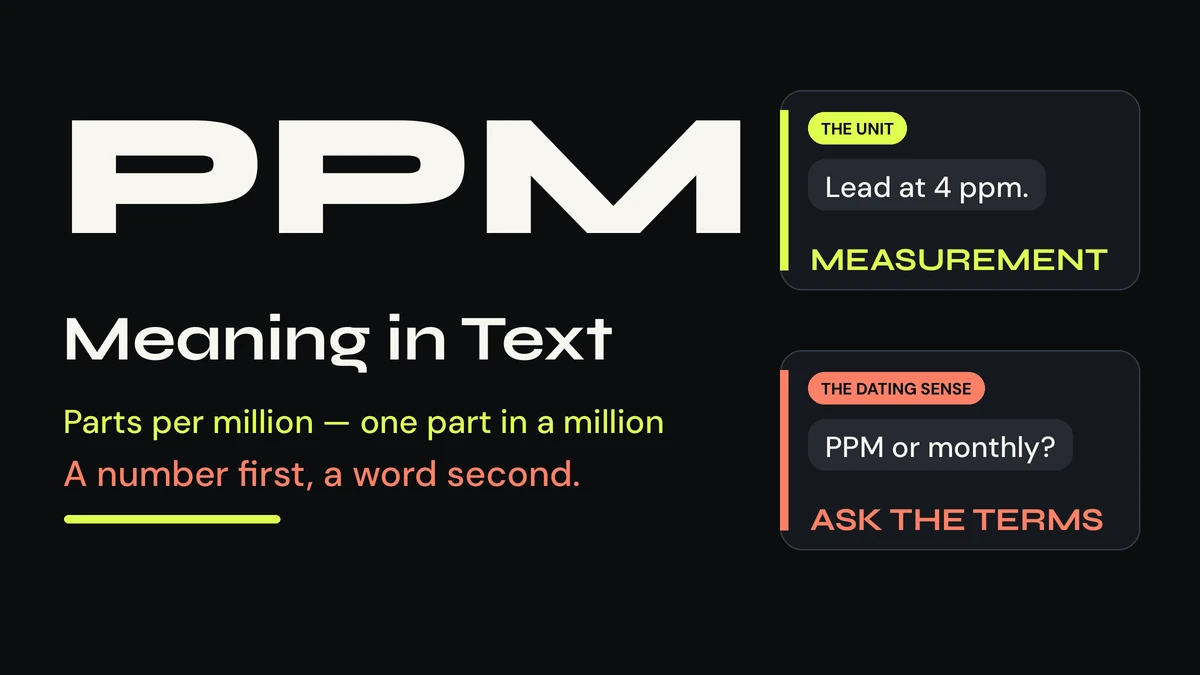
PPM means parts per million — one part in a million. If someone texts you “the water tested at 12 ppm,” they are handing you a measurement, not slang: twelve parts of something in every million parts of water. That is the ppm meaning in text in one sentence, and it is also the reason this guide is different from the others in the series. PPM is not a word texting invented. It is a hundred-year-old science unit that wandered into chats, and it picked up a second life in dating messages along the way.
The ppm meaning in text is really two answers wearing the same three letters. In most messages it means parts per million, a unit for tiny concentrations — the chlorine in a pool, the lead in a tap-water report, the ammonia in a fish tank. In dating and arrangement chats it can mean pay per meet, a fixed amount agreed for each meeting instead of a monthly allowance. The room you are standing in decides which one you are hearing, and this guide gives you a three-check test that sorts them in seconds.
Here is the habit that saves you the most confusion: treat a PPM message as a number first and a word second. A bare “PPM?” with no number and no money talk is almost always someone asking what the letters stand for, and a “12 ppm” with a number attached is almost always a measurement someone is passing along, the way you would pass along any FYI guide fact that expects nothing back but a nod. Numbers are the tell. Slang almost never arrives with a digit in front of it, and PPM almost always does.
How small is one part per million? Small enough that everyday language has no good word for it, which is exactly why the unit exists. One ppm is one milligram of something in a litre of water, or one milligram in a kilogram of soil. Ten thousand ppm makes one percent, so one ppm is one ten-thousandth of one percent. Wiktionary lists it plainly as an initialism of parts per million, with pages per minute as its only other entry, and the Cambridge dictionary defines it the same way: an abbreviation for parts per million, a unit for measuring the amount of a substance mixed with a liquid or another substance. One part per million is about thirty-two seconds out of a whole year, or a single drop of water diluted into fifty litres. When a lab report says lead levels were above 3,500 ppm, that number is doing work no adjective could do.
The letters bend a little with the room. Lowercase ppm dominates lab notes, homework, aquarium forums, and water-test screenshots, because that is how the unit is written in science. Capital PPM dominates dating profiles and arrangement chats, because that is how the pay-per-meet sense is written there. “Ppm” with one capital shows up in printer specs and product pages. None of that changes the meaning by itself — the case is a hint about the room, not a second definition — and a confused “ppm??” with two question marks is a question about the letters in any case, from anyone, on any app.
The PPM Room Test
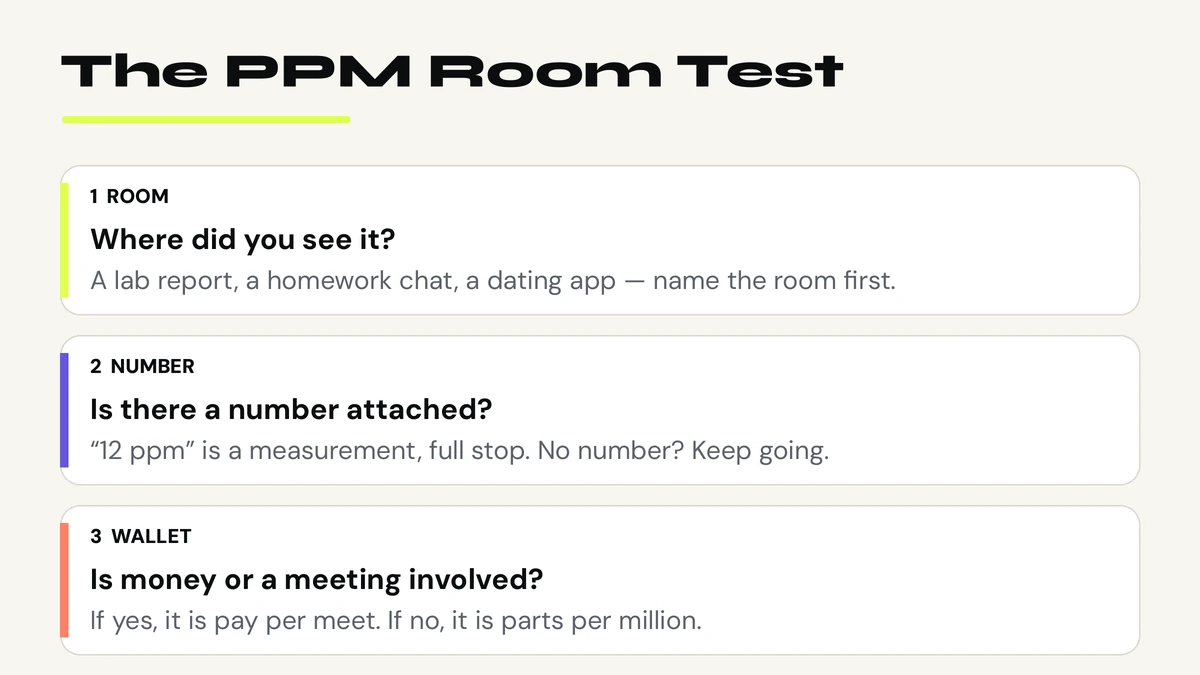
Most slang in this series is sorted by tone: the same letters, said warmly or coldly, mean different things. PPM is sorted by room instead, which is why this guide’s test is built differently from every test before it. The PPM Room Test asks three questions in order, and the first answer that fits is usually the right one. It takes about five seconds, and it works on a lab report, a TikTok comment, and a dating DM alike, because the test follows the context instead of the letters.
- Check 1 — Room. Where did you see it? A lab report, a homework chat, an aquarium group, or a water-filter listing means parts per million. A dating app, an arrangement forum, or a DM that is already negotiating a meeting means pay per meet. A printer box or an office-supply page means pages per minute. Name the room before you read the letters.
- Check 2 — Number. Is there a number attached? “12 ppm,” “0 ppm ammonia,” “3,500 ppm” — a number in front of PPM is a measurement, full stop. No source in this build records a slang sense that takes a number. If the number is missing and the message is just “PPM?” or “what’s your PPM?”, move to the third check, because the letters alone cannot decide.
- Check 3 — Wallet. Is money or a meeting being negotiated? If the conversation is about an amount per meeting, a date, or an allowance, you are in the pay-per-meet room, and the right reply is about terms, not chemistry. If no money is anywhere in sight, you are almost certainly looking at parts per million, and the right reply is about the number — is it high, is it low, is it safe?
Run it on the hardest case: a stranger DMs you “PPM?” with nothing else. Room: a DM from a stranger, which fits both a marketplace thread and a dating app. Number: none attached, so Check 2 cannot decide. Wallet: you do not know yet, which is the test telling you to ask one question before you answer — “PPM for what, the water test or a meet?” One clarifying question is cheaper than answering the wrong meaning, and anyone asking in good faith will answer it without a fuss.
What the test cannot do is read minds, and it does not try. If the room is mixed — say, a group chat where one person is talking about a fish tank and another is joking about dating — the test will point at both rooms, and that is honest. Say which one you mean before you reply, the way you would in any conversation where a word has two jobs. The test’s job is to stop you from guessing, not to guess for you.
“PPM” in Real Chats
PPM shows up in fewer everyday chats than any term in this series so far, and that scarcity is itself the first thing to understand about it. CyberDefinitions, the main guide this build was measured against, calls it a rare term outright and warns that it might mean something else. The examples below are written for this guide from the documented uses — lab numbers, homework, aquariums, printer specs, and dating terms — so you can recognise each room the moment you land in it.
- The water test. “Just got the tap report back. Lead at 4 ppm, limit is 15, so we’re fine.” A number, a substance, a limit. This is the home ground of PPM, and the reply is about the number, not the letters.
- The aquarium win. “Finally got ammonia to 0 ppm! The tank is cycled!” A proud result after weeks of testing. The zero is the whole message; PPM is just the unit the zero is measured in.
- The homework ask. “Wait what does ppm mean in this question? It says the solution is 250 ppm salt.” A student meeting the unit for the first time, asking about the letters inside a number they already have.
- The printer spec. “This one prints 30 ppm, the other does 18. Worth the extra $40?” Here PPM quietly means pages per minute, and nobody in the chat stops to define it, because the printer box already did.
- The dating DM. “Are you PPM or monthly?” A terms question in an arrangement chat, asked early, before any meeting is planned. The reply it wants is a preference, not a definition.
- The TikTok comment. “Bro what does ppm mean, the caption says 400 ppm CO2??” A viewer meeting a climate number in a video caption and asking the comments, where the answer is one sentence long.
- The group-chat confusion. “He said his PPM is 300?? I thought we were talking about the pool.” Two rooms colliding in one chat — a pool number and a dating term — and the fix is naming the room out loud.
Notice what none of these examples do: nobody uses PPM as a greeting, a reaction, or a joke. It is not a word you drop to sound casual, the way you would drop a laugh or a shrug. It arrives carrying information — a number, a spec, or a term — and the chat either understands the information or asks what it is. If you treat every PPM message as a small delivery of facts, you will read nearly all of them correctly.
The PPM Tone List
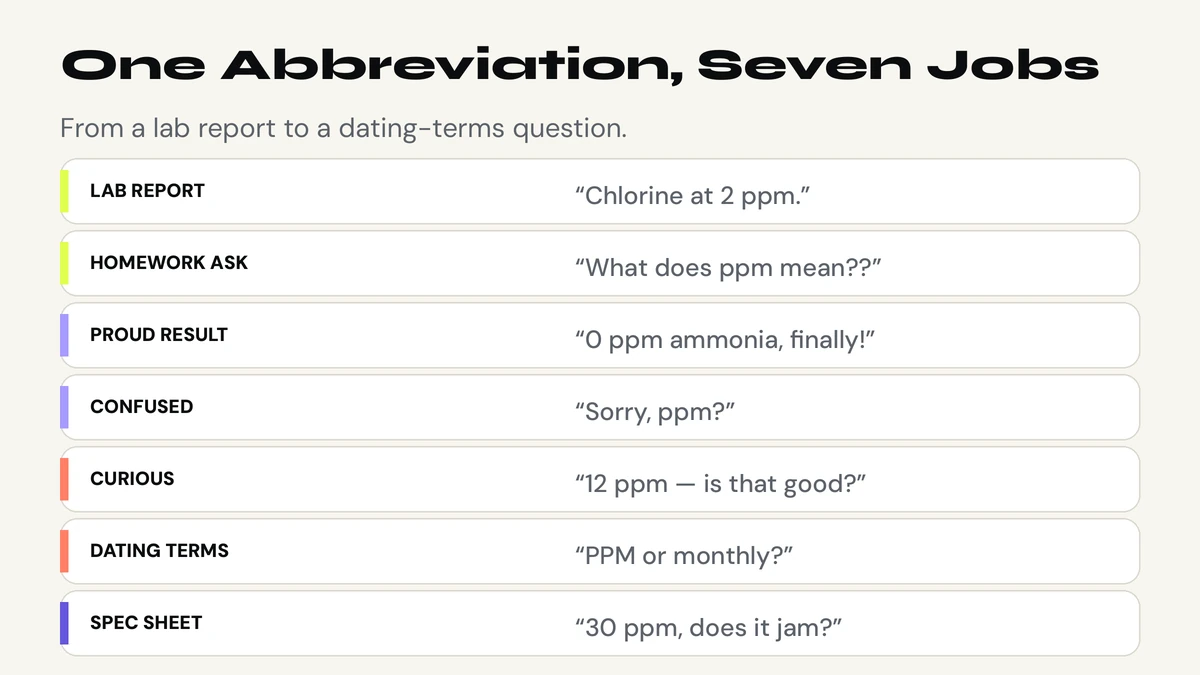
Seven readings, one abbreviation. Unlike the last few terms in the series, these are not seven moods of the same joke — they are seven jobs the letters do in seven different rooms, and the tone tells you which job is running. Read the list as a set of rooms with a voice attached, not as a set of feelings.
- The lab report. Flat, factual, no feeling at all. “Chlorine at 2 ppm.” The number is the message, and the tone is the tone of a clipboard.
- The homework ask. Genuinely confused, openly so. “What does ppm mean??” The double question mark is doing the work — this person wants a definition, not a debate.
- The proud result. Relieved and a little boastful. “0 ppm ammonia, finally!” The exclamation mark belongs to the zero, not to the letters.
- The confused question. Polite, a beat behind the conversation. “Sorry, ppm?” This is someone who missed a step and would rather ask than pretend, and the kind reply is one sentence, not a lecture.
- The curious follow-up. Interested, not alarmed. “12 ppm — is that good or bad?” The number arrived, and now the reader wants the verdict that makes the number mean something.
- The dating-terms check. Businesslike, deliberately plain. “PPM or monthly?” No flirting, no joke, just terms. The flatness is the point: this is a negotiation, and both sides know it.
- The spec-sheet mention. Bored, practical, price-conscious. “30 ppm, whatever, does it jam?” The letters are furniture in a buying decision, and nobody in the room finds them interesting.
Three of these are safe to send anywhere casual — the homework ask, the confused question, and the curious follow-up — because asking what a unit means is never rude. Two belong to technical rooms only, the lab report and the spec-sheet mention, where they will bore anyone who did not ask for a number. One belongs to dating rooms only, the dating-terms check, which will confuse or alarm anyone outside that room. The proud result belongs wherever people share small wins, which is everywhere. If you are unsure which tone you are hearing, answer the question the tone is asking — define it, judge the number, or name the terms — and the conversation will correct you gently if you picked wrong.
“PPM” on TikTok
On TikTok, PPM almost always arrives as a number inside a caption or a comment, not as slang in its own right. Climate videos quote CO2 at 400-plus ppm, aquarium creators celebrate 0 ppm ammonia, pool-care creators test chlorine in ppm, and gardening creators argue about nutrient strength in ppm. The comments underneath do what comments always do: someone asks what the number means, and someone else answers in one line. No source in this build documents a distinct TikTok-only meaning for PPM, and this guide claims none — the unit means the same thing on TikTok as it does in a textbook, and the platform only changes who is doing the asking.
That sameness is useful to know, because it tells you how to reply. A “what does ppm mean” comment under a science video wants the one-sentence answer — one part in a million — and nothing else. A longer explanation will be scrolled past, and a joke will be read as dodging the question. If you are the creator, pin the definition: it will save you answering the same comment fifty times. The feed that surfaces these videos is the same one our FYP guide explains, and the PPM numbers riding on it are passengers, not drivers — nobody follows an account for the unit, they follow it for the tank, the pool, or the planet.
The one TikTok habit worth naming is the caption-number trap: a creator writes “400 ppm” in a caption with no substance named, and half the comments argue about the wrong thing — carbon dioxide, pool chlorine, or salt — because the number arrived without its noun. If you post a ppm number, name the substance in the same line. “CO2 at 420 ppm” ends the argument before it starts; “420 ppm” starts it.
“PPM” on Snapchat
PPM is rare on Snapchat, and the reason is simple: Snapchat is built for pictures and disappearing messages, and PPM is built for numbers and terms that need to stay visible. What does show up is second-hand PPM — a screenshot of a water-test result, a homework question, or a dating-app conversation, shared as a snap to ask a friend what it means. The disappearing format suits the question (“what does this mean?”) far better than the answer, which is worth keeping.
If a snap asks you about PPM, answer in the chat, not in another snap, so the answer survives. One sentence is enough for the unit sense, and the dating sense deserves a real conversation, not a ten-second photo. Nothing about Snapchat changes the meaning; the app only changes how long your answer lasts, so put the answer where it can be re-read.
“PPM” on Instagram
On Instagram, PPM lives in captions and DMs, in two different rooms that rarely meet. In captions it is the unit sense: aquarium keepers posting test-strip photos, gardeners posting nutrient schedules, pool owners posting maintenance logs, science accounts posting climate graphics. The number is usually in the photo itself — a test strip, a meter, a report — and the caption names the substance, because an Instagram audience will not read a bare number twice.
In DMs it is the dating sense that does the travelling. Arrangement and dating conversations that start on an app often move to Instagram DMs, and that is where “PPM or monthly?” gets asked, in plain text, early, before a meeting is planned. The public feed never sees that conversation, which is why a reader who only knows Instagram from the feed can be genuinely surprised by it. Our IG guide covers the shorthand itself; the point here is narrower — on Instagram, the room is decided by public versus private, and the same three letters mean different things on either side of that line.
The practical rule follows from that split. In a public caption, spell the substance out and let the number speak. In a private DM, spell the terms out and let the answer speak. A bare “PPM?” in either place will be misread by half your audience, and on Instagram the half that misreads it is the half you cannot see.
“PPM” in Text Messages
Text messages are the home ground for both live senses of PPM, which is why this section matters more than the three platform sections above it. The unit sense arrives as a forwarded result — “pool guy says chlorine is 3 ppm” — or a homework question, or a number from a test strip photographed and sent to a partner. The dating sense arrives as a terms question, usually after a few messages of ordinary chat, and it expects a direct answer about preference, not a definition.
Lowercase dominates here. “ppm” in a text is nearly always the unit, written the way science writes it, and the number beside it does the identifying. Capital “PPM” in a text is a small flag: it is more likely to be the dating sense, or a headline-style emphasis (“PPM IS 300, that’s insane”). Neither flag is proof, and the Room Test still outranks the case of the letters — but if you had to bet on one signal before asking, the case is the cheapest one you have.
One habit makes texting PPM painless: put the substance or the terms in the same message as the letters. “Ammonia 0 ppm” cannot be misread. “PPM or monthly?” cannot be misread either, because the alternative names the room. It is the bare “PPM?” with no noun and no alternative that causes every confusion in this guide, and it is also the easiest message in the world to fix — add one word. If the conversation needs to move somewhere private or longer, that is what a DM guide move is for: take the terms question out of the group chat and into a one-to-one thread, where a number and a negotiation both belong.
Who Is Sending It: How “PPM” Lands by Sender
The letters do not change with the sender. The weight you give them does, and so does the reply they deserve. A number from a teacher is homework; the same number from a stranger is a sales pitch; a terms question from a dating match is a negotiation. Read the sender first, then the letters.
- Friend. Default, low stakes. A friend sending a pool number wants a reaction (“nice, safe to swim?”), and a friend asking what ppm means wants the one-sentence answer. No performance required on either side.
- Crush. Overread territory, but gently. A crush asking about a ppm number is usually just asking about a number — do not turn a water test into a confession. Answer the question that was asked, and let the crush part happen somewhere else.
- Partner. Pattern rules. A partner who texts pool numbers every Saturday is sharing a chore, not starting a debate, and a partner who asks about PPM terms is asking about money, which deserves a real conversation, not a one-line reply.
- Parent. Usually literal and plain. A parent forwarding a water report wants to know if the water is safe, and the kind answer is the verdict first (“yes, fine”) and the number second. Skip the lecture on what a part per million is unless they ask.
- Teacher or classmate. Homework room, no ambiguity. “What does ppm mean in question 4?” is a request for the definition plus the worked step, and the helpful reply shows the maths: 250 ppm means 250 parts of salt in a million parts of solution.
- Coworker or boss. Specs and reports only. A coworker texting “printer does 30 ppm” is comparing machines, and a boss forwarding a water-quality number is forwarding a compliance figure. The dating sense has no business in this room at all, and sending it there would be a serious misread.
- Stranger. The identity question. A stranger asking about ppm in a marketplace thread — a filter listing, a tank for sale — usually wants a number, and a stranger asking it in a dating app wants terms. Either way, a stranger is owed a short, factual answer and nothing personal: no details about your home, your schedule, or your money beyond the question itself. The same caution that travels with any stranger’s identity question applies here, and our ASL guide covers the shorthand that usually arrives with it.
The sender rule that covers all seven is short: answer the job the sender is doing, not the letters they used to do it. A parent wants a verdict, a classmate wants a definition, a stranger wants a fact, and a dating match wants terms. Get the job right and the letters take care of themselves.
When “PPM” Is Too Much: Work, School, and Family
The unit sense of PPM is welcome almost everywhere, because a measurement is not a mood. A water report in a family chat, a homework question in a class group, a printer spec in a work thread — none of these will offend anyone, and none of them need a content warning. The risk in this article lives entirely in the second sense, and the rule for it is just as simple: the dating sense stays in dating rooms, between consenting adults, in private.
At work, never use PPM to mean pay per meet — not as a joke, not as a test, not in a DM to a colleague. The letters carry a money-for-meetings meaning that a coworker did not agree to discuss, and a joke that needs a footnote to be safe is not a joke worth sending. At school, the unit sense is homework and the dating sense is off-limits entirely: teachers, class chats, and school groups are not dating rooms, and a terms question sent there will be read exactly as badly as it sounds. In family chats, read the room person by person — a grandparent forwarding a water report is sharing a fact, and nobody needs the dating sense explained at the dinner table.
The stop-when-asked rule applies to both senses, for different reasons. If someone says a ppm number bores them, stop sending numbers. If someone says the dating sense makes them uncomfortable, stop using the letters that way with them, full stop. And the swap menu is easy: say “parts per million” in any formal room, say “the water tested at twelve parts per million” when a number needs a verdict, and say “let’s agree the terms before we meet” when a negotiation needs words instead of letters. Plain language is never the wrong choice with a term this easy to misread.
Checked Claims: Expansions That Do Not Hold Up
PPM collects expansions the way a junk drawer collects batteries: most of them are real, a few are guesses, and the job is sorting which is which. The rule for this section is the series rule — grade every claim, fence the real-but-narrow ones, and reject the invented ones openly, with the reason stated. The dating sense sits in the middle of this list on purpose, because it is the expansion most guides either hide or hype, and neither helps a reader.
- FENCED — “PPM means pay per meet.” Real, but room-bound. Multiple dating guides — SugaryMatch, SugarDaddyMeet, DatingScout, MoneySmart — agree it means a fixed amount agreed for each meeting instead of a monthly allowance, usually the starting structure for a new arrangement. It lives in dating and arrangement chats, not in everyday texting, and it never means this on a lab report. The same dating-shorthand room holds our MFM guide term, which is why the two are cousins of context, not of meaning.
- FENCED — “PPM means pages per minute.” Real, but printer-bound. Wiktionary lists page(s) per minute as its second entry, and printer boxes use it as a speed rating. It never means this in a text about water, and it never means this in a dating chat.
- FENCED — “PPM means points per minute.” Real, but scoreboard-bound. Games and sports broadcasts use points per minute as a pace stat. It is a cousin of the unit sense — a rate, not a concentration — and it stays in that room.
- FENCED — “PPM means pay per mille.” Real, but advertising-bound. In ad buying, pay per mille is the cost per thousand impressions, usually written CPM. A marketing thread can mean this; a text about a pool cannot.
- FENCED — “PPM means prediction by partial matching.” Real, but technical to the point of invisibility. It is a text-compression algorithm, and it appears in computer-science papers, not in chats. True, and almost never what anyone means.
- REJECTED — “PPM means parts per minute.” No source in this build records this expansion. The per-minute senses are pages, packs, and points — never parts. A guess built from the letters, and a good reminder that an expansion has to be attested, not merely plausible.
- REJECTED — “PPM is slang Gen Z invented.” The unit is attested by 1913, according to the etymology record, which puts it about a century ahead of any texting generation. Texting borrowed PPM; it did not coin it, and the article says so instead of letting the slang frame swallow a science term.
- REJECTED — “A normal PPM rate is $500” (or any single fixed figure). The published rates contradict each other — about $100 to $1,000 per meet in one guide, $300 to $800 in another, $500 as both an average and an overnight rate in a third — and none of them cites a survey, a sample size, or a date. SugaryMatch says so openly: the numbers read like figures copied between sites until they sounded official. Treat any precise rate as unsourced, and agree terms person to person instead.
Two habits follow from this list. First, when someone offers you an expansion of PPM, ask which room it lives in before you believe it — a real expansion always has a room, and an invented one never does. Second, when a rate or a figure arrives without a source, treat it as a rumour with a dollar sign, not a fact. Both habits are cheaper than unlearning a wrong meaning in front of the person who used it correctly.
“PPM” vs Its Closest Cousins
PPM is a member of a family, not a lone invention, and meeting the relatives makes the term itself easier to hold. The cousins below sort into three groups: the parts-per family, the technical-initialism family, and the advertising family. One of them is linked; the rest are named only, because no TextsMeaning article exists for them yet.
- PPB — parts per billion. The next step down the same ladder: one part in a billion, a thousand times smaller than a ppm. Water reports quote both, and the two travel together so often that learning one teaches you the other. Name only — no TextsMeaning article exists.
- PPT — parts per trillion. One more step down: one part in a trillion. It appears in the same lab reports and the same textbooks, for substances measured in traces so faint that parts per million would round them to zero. Name only — no TextsMeaning article exists.
- Percent. The famous older sibling: one part in a hundred, where PPM is one part in a million. Ten thousand ppm makes one percent, which is the single conversion worth memorising from this whole guide. Name only.
- IP — Internet Protocol. The technical-initialism cousin, and the linked one: our IP guide covers another borrowed technical initialism that texting uses without inventing. Both terms arrived in chats fully formed from a technical field, both keep their technical meaning in every room, and neither is slang in the ordinary sense.
- mg/L — milligrams per litre. The twin, not the cousin: in water, one ppm equals one milligram per litre, so a lab report can write either and mean the same thing. If a report says mg/L and a text says ppm, nobody is disagreeing. Name only.
- CPM — cost per mille. The advertising cousin: the cost of a thousand impressions, the same “per mille” idea as the pay-per-mille sense of PPM, wearing different letters. It lives in marketing threads, and it is the clearest sign that PPM’s expansions multiply wherever money or measurement is discussed. Name only.
The pattern across the cousins is the point of the section: PPM is not special because it is confusing, it is confusing because it belongs to three different professional vocabularies at once — chemistry, printing, and advertising — plus a dating shorthand that borrowed the same letters. Learn the room, and the cousins sort themselves.
Where “PPM” Came From
The unit is old, older than the telephone in most homes. The etymology record attests ppm, also written p.p.m., as an abbreviation of parts per million by 1913, when chemists and engineers needed a way to talk about amounts too small for percentages. Percent had done the job for centuries — one part in a hundred — but industrial chemistry kept meeting quantities a thousand times smaller than that, and a new rung on the ladder was needed. Parts per million was that rung, and the abbreviation followed the phrase the way abbreviations always do: because people got tired of writing it out.
For most of the twentieth century, PPM stayed where it was born: in water reports, soil tests, air-quality standards, and factory specs. It crossed into everyday messages only when the things it measures crossed into everyday life — home water-test kits, aquarium test strips, pool-care apps, and school chemistry homework photographed and texted to a friend. Nobody coined a slang sense in that crossing. The letters simply kept their meaning while the room changed around them, the way a borrowed tool keeps its shape when it moves to a new toolbox.
The dating sense is much younger, and it grew in a different place: arrangement forums and dating guides, where people needed a short way to name a payment structure. Pay per meet shortened to PPM the same way monthly allowance never did — because three letters fit in a profile and a sentence does not. No first use is claimed here, because no source in this build documents one, and the guides that use the term treat it as established shorthand rather than a new coinage. The two histories never meet: one is a century of chemistry, the other is a few years of dating shorthand, and the letters are the only thing they share.
How to Reply When Someone Sends “PPM”

The reply follows the test. Find the room, check for a number, check for a wallet — then answer the job, not the letters. Six replies cover nearly every PPM message you will ever receive, and each one names its room out loud so the other person can correct you if you picked wrong.
- To a number. “Got it — is that high or low for this?” Works on water reports, pool tests, and aquarium readings alike. It accepts the number and asks for the verdict, which is what most people actually want.
- To a homework question. “It means parts per million — one part in a million. So 250 ppm is 250 parts of salt in a million parts of solution.” One sentence of definition, one sentence of maths, and the homework moves on.
- To a terms question. “I’d rather agree the terms before we meet — what did you have in mind?” Direct, unembarrassed, and it puts the negotiation where it belongs: in words, before any meeting, with nothing assumed.
- To a confused “ppm??”. “Parts per million — one tiny part in a million parts of something. What were you reading?” The definition first, then an invitation to name the room, so the next answer lands.
- To a printer spec. “30 pages a minute is decent — does it jam much?” Accepts the pages-per-minute reading without a blink and moves the conversation to the question that actually decides a purchase.
- To a TikTok comment. “One part per million! The video means 400 parts of CO2 in every million parts of air.” Short, specific, and it names the substance, which is the piece the commenter was actually missing.
The reply to avoid is the confident wrong one: answering a dating-terms question with chemistry, or a water report with a joke about dating. Both mistakes come from skipping the Room Test, and both are fixed the same way — one clarifying question, asked early, before you commit to an answer. “PPM for what, the test or the terms?” costs nothing and saves the conversation.
Frequently Asked Questions
What does PPM mean in a text message?
In most texts it means parts per million, a unit for tiny concentrations — the chlorine in a pool, the lead in a water report, the ammonia in a fish tank. In dating and arrangement chats it can mean pay per meet, a fixed amount agreed for each meeting. Check the room: a number beside the letters means the unit, and money or a meeting being discussed means the dating sense.
What does PPM mean on TikTok?
The same thing it means everywhere else: parts per million, usually as a number in a caption — CO2 levels, aquarium readings, pool chlorine. No source documents a distinct TikTok-only meaning. If a comment asks what ppm means under a science video, the one-sentence answer is “one part in a million.”
Does PPM mean “pay per meet”?
Yes, in one room: dating and arrangement chats, where it names a payment structure — a fixed amount agreed for each meeting, instead of a monthly allowance. Multiple dating guides agree on this sense. It does not mean pay per meet on a lab report, in homework, or in a printer manual, and it is never the default reading outside dating rooms.
Is PPM rude?
The unit sense is never rude; it is a measurement, like a temperature. The dating sense is not rude either, but it is adult and private — it belongs in dating conversations between consenting adults, not at work, at school, or in a family chat. The rudeness risk is sending the dating sense into a room that did not ask for it.
Can I use PPM at work?
The unit sense, yes — water reports, printer specs, and compliance figures are ordinary work messages. The dating sense, never. If your work message could be read as a terms question, spell it out in full words instead of letters, and the ambiguity disappears.
What does PPM mean on Snapchat?
Usually the unit sense, second-hand: a screenshot of a water test, a homework question, or a dating-app conversation shared to ask a friend what it means. Snapchat has no distinct meaning of its own for PPM. Answer in the chat rather than in another snap, so the answer can be re-read.
What is the difference between PPM and PPB?
Scale. PPM is parts per million — one part in a million — and PPB is parts per billion — one part in a billion, a thousand times smaller. Water reports quote both, for substances present in different amounts. Ten thousand ppm makes one percent; the same maths runs one rung further down for PPB.
Does lowercase ppm mean something different from PPM?
No, not by itself. Lowercase ppm is how science writes the unit, so it leans toward the measurement sense, and capital PPM is how dating profiles write the pay-per-meet sense, so it leans that way — but the case is only a hint. The room, the number, and the money are what decide, and the Room Test outranks the capitalisation every time.
The Takeaway
PPM is the rare term in this series that texting did not invent, and that is the whole guide in one line. In most messages it means parts per million — one part in a million, a century-old unit for amounts too small for percentages — and in dating chats it means pay per meet, a fixed amount per meeting instead of a monthly allowance. Run the Room Test: name the room, look for a number, check for a wallet. The answer that fits is the answer you use.
Keep the two habits this guide is built on. Put the substance or the terms in the same message as the letters, so nobody has to guess which room you are standing in. And when a PPM message arrives bare — no number, no noun, no alternative — ask one question before you answer, because the cheapest reply in this whole guide is “PPM for what?” and it is also the one that never gets the meaning wrong.