What “RN” Means in Text
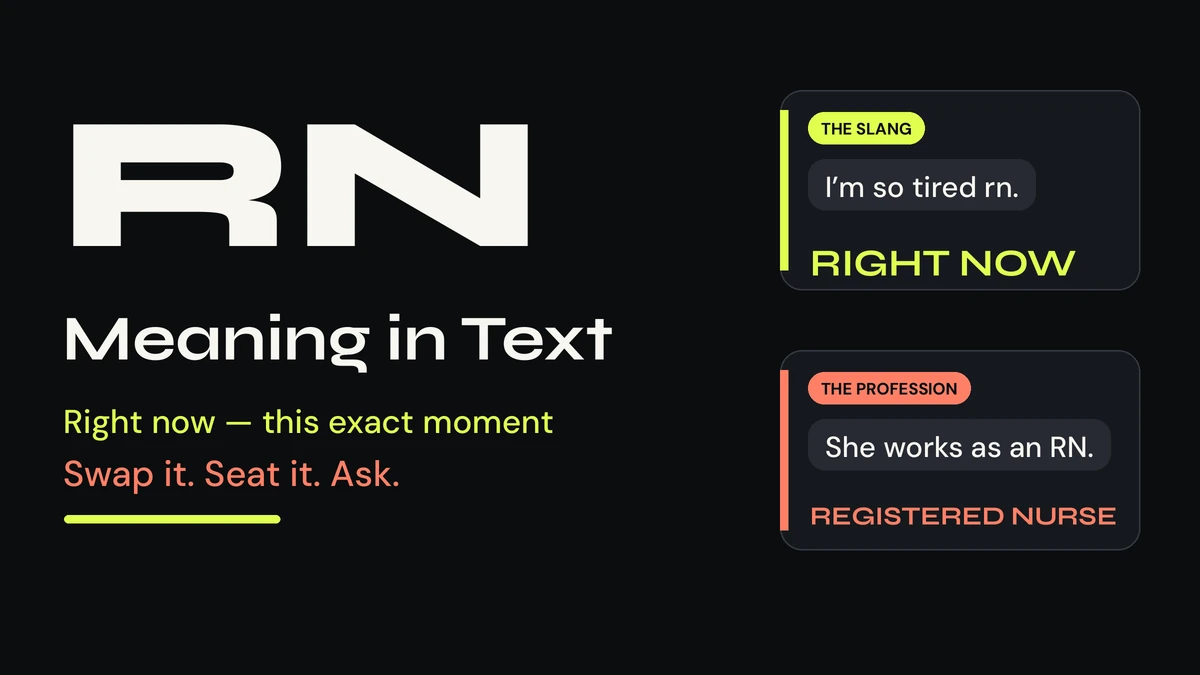
RN means right now. If someone texts you “I’m so tired rn,” they are telling you how they feel at this exact moment — tired, now, not yesterday and not later. That is the rn meaning in text in one sentence, and it is also the reason this guide starts with a warning label instead of a victory lap. RN is one of the shortest abbreviations in texting, and it is also one of the easiest to misread, because the same two capital letters name a licensed nurse.
The rn meaning in text is really one answer with a professional twin standing next to it. In nearly every chat, DM, comment, and caption, rn means right now — a time stamp glued to the end of a sentence about what someone is doing, feeling, or needing at this moment. Outside of chats, RN means registered nurse, the licensed healthcare professional, and that reading shows up after a person’s name, in a job title, or on a hospital badge. The sentence you are reading decides which one you are looking at, and this guide gives you a three-check test that sorts them in seconds.
Watch how the letters behave in a real message. They almost always land at the end of a clause, like a period with a pulse: “at work rn,” “so hungry rn,” “can you call me rn?” The question they most often answer is the one every chat asks sooner or later — what are you doing — and our WYO guide covers that question itself, the open-ended “what are you doing” that RN pins to this exact second. Lowercase rn is the everyday form in texts and comments, and capital RN shows up for emphasis (“I need this RN”) or at the start of a sentence, which is where the nurse confusion begins.
The dictionary record is split in a way that tells the whole story. Wiktionary lists rn plainly as internet slang and text messaging, an initialism of right now, with RN as the capitalised form — and its usage example comes from a 2024 Cosmopolitan shopping piece: “Barrel jeans are all the rave rn.” The established dictionaries have not caught up: Parade reports that Dictionary.com and Merriam-Webster both carry entries for RN, but neither currently lists “right now” as a definition, and instead list the professional meanings, including registered nurse. That gap is exactly why a reader needs this guide — the slang meaning is documented by usage, not by the big dictionaries yet.
The RN Swap Test
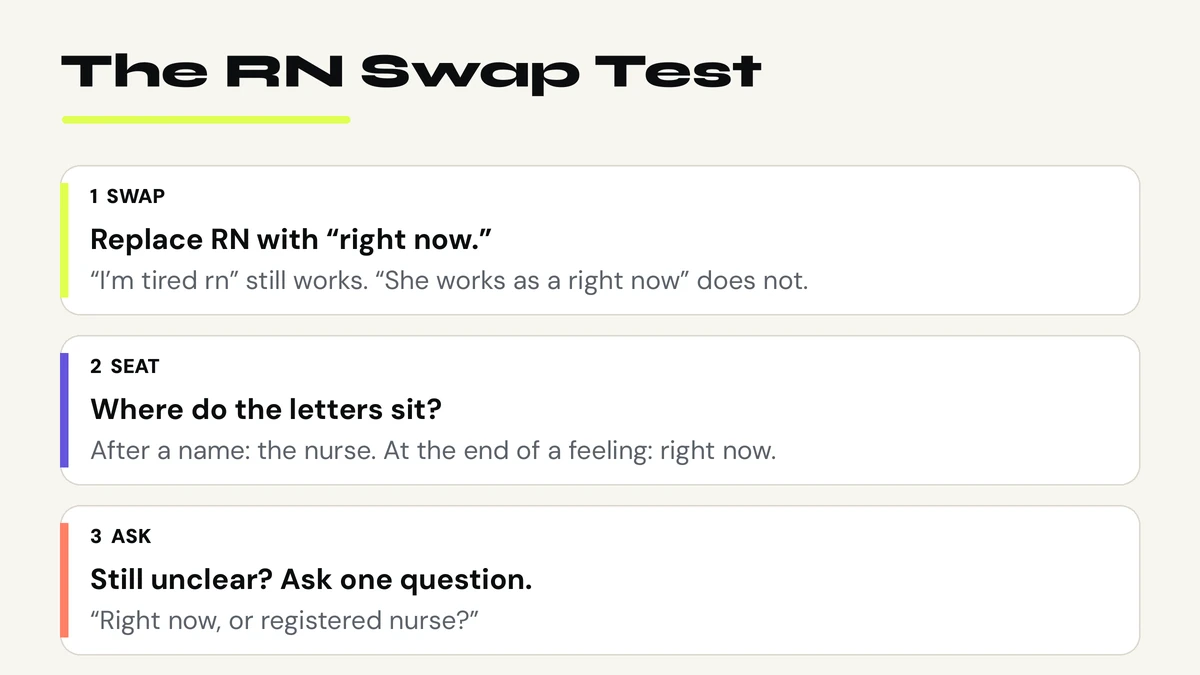
Most slang in this series is sorted by tone: the same letters, said warmly or coldly, mean different things. RN is sorted by grammar instead — by whether the letters can be swapped for the words “right now” without breaking the sentence. That is why this guide’s test is built differently from every test before it. The RN Swap Test asks three questions in order, and the first answer that fits is usually the right one. It takes about five seconds, and it works on a text, a TikTok comment, and a hospital badge alike, because the test follows the sentence instead of the letters.
- Check 1 — Swap. Read the sentence again with “right now” in place of RN. “I’m tired rn” becomes “I’m tired right now,” which works perfectly — that is the texting meaning. “She works as an RN” becomes “She works as a right now,” which is nonsense — that is the nurse. If the swap works, you are done; the test takes one second and it settles most messages on its own.
- Check 2 — Seat. Where do the letters sit? After a person’s name (“Sarah, RN”), in a job listing, on a badge, or in a sentence about a hospital — that seat belongs to the registered nurse. At the end of a sentence about feelings, plans, food, or a call (“so tired rn,” “can you talk rn?”) — that seat belongs to right now. Position is the second-best signal in this guide, and it catches the cases the swap leaves unclear.
- Check 3 — Ask. If the swap fails both ways and the seat is unclear — a bare “RN?” with nothing else, or a bio that just says “RN” — ask one question before you answer: “Right now, or registered nurse?” Anyone writing in good faith will answer it without a fuss, and one clarifying question is cheaper than congratulating a nurse on being tired.
Run it on the hardest case in this guide, a pair of sentences that differ by one word and mean opposite things. “My mom is an RN” — the swap fails, the seat is a job sentence after the word “an”: registered nurse, a profession. “My mom is mad rn” — the swap works (“mad right now”), the seat is the end of a feeling sentence: right now, a mood. Same letters, same family member, opposite meanings — and the test sorts them without knowing anything about your mom.
What the test cannot do is read minds, and it does not try. If the room is mixed — say, a group chat where one person is a nurse and another is venting about being tired rn — the test will point at both readings, and that is honest. Say which one you mean before you reply, the way you would in any conversation where a word has two jobs. The test’s job is to stop you from guessing, not to guess for you.
“RN” in Real Chats
RN shows up in more everyday chats than any term in this series so far, and that frequency is itself the first thing to understand about it. How-To Geek, the main guide this build was measured against, calls it a staple of all kinds of online conversations, between close friends and near-total strangers alike. The examples below are written for this guide from the documented uses — status checks, mood reports, urgent asks, availability questions, and captions — so you can recognise each job the moment you meet it.
- The status check. “What are you up to rn?” / “I’m doing homework rn.” The most common job in the whole guide: one person asks what the other is doing now, and the other answers with the activity plus the time stamp. The reply is about the activity, not the letters.
- The mood report. “I’m so tired rn. Maybe tomorrow.” A feeling with a clock attached. The “maybe tomorrow” is doing the real work — the tiredness is now, and the plan is later — and the kind reply answers the plan, not the tiredness.
- The urgent call. “Can you hop on FaceTime rn?” An invitation that expires in minutes. The rn is doing the urging: not later today, not when you get around to it, now. A “yeah, one sec” is the whole answer this message wants.
- The availability ask. “Are you free rn?” / “I’m busy rn.” A yes-or-no question about this moment, and a no that is also a soft rejection. “I’m busy rn” can mean “not now” without meaning “not ever,” and the difference matters — read it as a delay, not a door slamming.
- The caption. “Me rn” under a photo of someone asleep at a desk, or a meme about being broke before payday. The letters turn a picture into a self-portrait: this image is me, at this moment. No sentence is needed, because the picture is the sentence.
- The nurse mix-up. “My mom is an RN” in a conversation about jobs, then “My mom is mad rn” in a conversation about a curfew argument. Both sentences are real, both use the same letters, and the Swap Test sorts them before either one can embarrass you.
- The doubled urgent ask. “I need this rn rn.” Two rns stacked for extra urgency or excitement — the doubled form means right now, right now, and it is the texting equivalent of tapping someone on the shoulder twice.
Notice what nearly all of these examples do: they put rn at the end, after the news. The letters are a time stamp, not the message itself — the message is the homework, the tiredness, the invitation, the mood. If you read every rn as a small clock glued to the end of a sentence, you will read nearly all of them correctly, and the one that breaks the pattern — the capital RN after a name — will stand out precisely because it refuses to sit at the end.
The RN Tone List
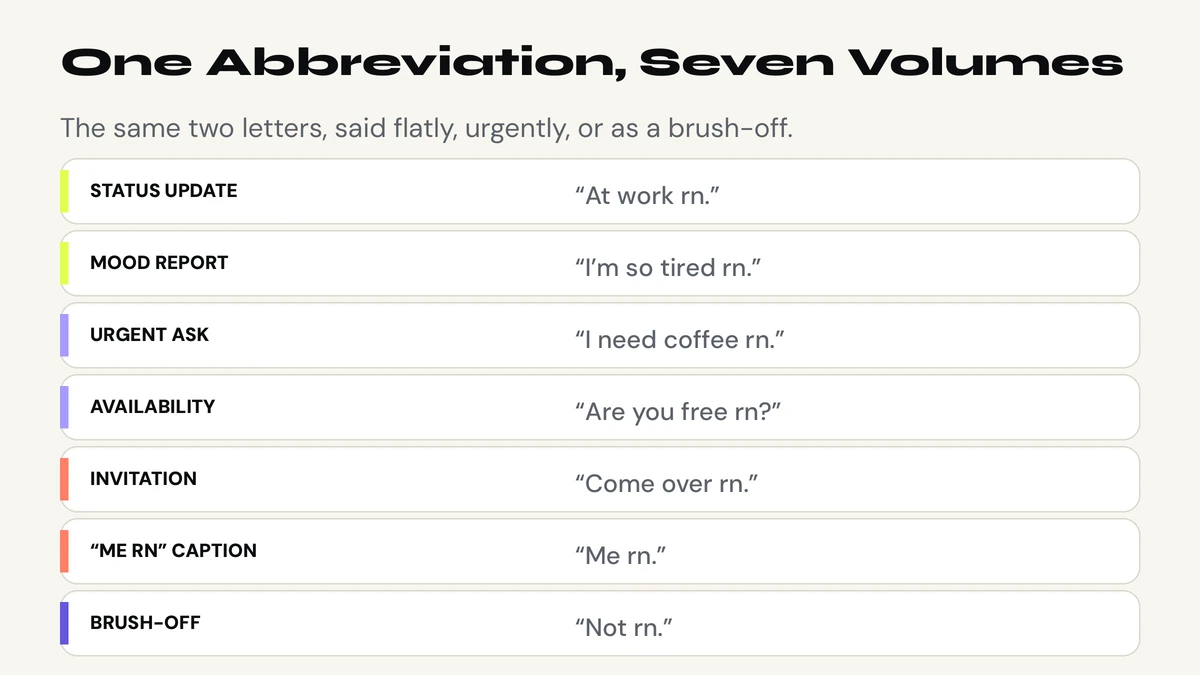
Seven readings, one abbreviation. Unlike the last term in the series, whose readings were seven jobs in seven different rooms, these are seven shades of the same moment — the same two letters, said flatly, urgently, warmly, or as a brush-off. Read the list as a set of volumes, not as a set of meanings, because the meaning barely moves and the volume moves a lot.
- The status update. Flat, factual, no feeling at all. “At work rn.” The letters are a clock, and the tone is the tone of a timetable. Nothing is being asked, and nothing is being offered — just a fact about now.
- The mood report. Warm, confessional, a little dramatic. “I’m so tired rn.” The feeling is the message and the rn is the underline. This is the tone that travels best with friends, because it invites sympathy without demanding a solution.
- The urgent ask. Sharp, immediate, a little breathless. “I need coffee rn.” The rn is doing the pushing, and the sentence without it would be a wish — with it, it is a request with a deadline of about five minutes.
- The availability check. Casual on the surface, careful underneath. “Are you free rn?” The asker wants a yes, and the rn is the reason the question cannot wait for later. The answer it fears is “I’m busy rn,” which is a no dressed as a schedule.
- The invitation. Bright, open, a little impatient. “Come over rn.” The rn turns an invitation into a plan, and the plan starts now. Say yes quickly or the moment passes, which is the whole point of the letters.
- The “me rn” caption. Playful, self-aware, often funny at its own expense. “Me rn” under a photo of a burnt dinner or a crashed laptop. The tone is a shrug with a laugh in it — this is me, right now, and I know how it looks.
- The brush-off. Short, closed, a door half-shut. “Not rn.” Two words that mean “not right now, maybe later, do not push.” The tone is not angry, but it is final for this moment, and the kind reply accepts it without arguing.
Three of these are safe to send anywhere casual — the status update, the mood report, and the “me rn” caption — because describing your own moment is never rude. Two belong to people you know well, the urgent ask and the invitation, because urgency and invitations both assume a welcome that strangers have not granted yet. The availability check belongs wherever a question needs a quick answer, and the brush-off belongs wherever you need a polite no. If you are unsure which tone you are hearing, answer the question the tone is asking — the activity, the feeling, or the timing — and the conversation will correct you gently if you picked wrong.
“RN” on TikTok
On TikTok, RN lives in captions and comments, and the “me rn” caption is its home ground. A video of someone dancing in their kitchen at midnight, captioned “me rn,” means the video is the creator’s current mood — the letters turn a performance into a confession. A comment that says “I need this rn” means the commenter wants the thing in the video right now, not someday, and the urgency is the whole comment. The meaning is the same as in texts — Parade says so plainly, and no source in this build documents a distinct TikTok-only meaning — but the platform changes the shape: on TikTok, rn points at a video instead of a sentence.
The feed that surfaces these videos is the same one our FYP guide explains, and the “me rn” captions riding on it are passengers, not drivers — nobody follows an account for the letters, they follow it for the dance, the joke, or the outfit. The one TikTok habit worth naming is the caption trap: a creator writes “me rn” under a video that shows nothing about a mood, and half the comments ask what the video is supposed to mean, because the letters promised a self-portrait and the video did not deliver one. If you caption a video “me rn,” make sure the video shows the feeling.
Replying on TikTok rewards the same shortness the platform rewards everywhere else. A “what does rn mean” comment under a video wants the one-sentence answer — right now — and nothing else. A longer explanation will be scrolled past, and a joke will be read as dodging the question. If you are the creator, pin the definition: it will save you answering the same comment fifty times.
“RN” on Snapchat
RN is everywhere on Snapchat, and the reason is simple: Snapchat is built for quick, disappearing messages between people who already know each other, and rn is built for exactly that kind of message — a status, a mood, a “where are you” that expires in minutes. “What are you up to rn?” is a Snapchat-native question, and “I’m out rn” is a Snapchat-native answer, because both of them are about this moment and this moment only.
The disappearing format suits rn better than it suits almost any other term in this series. A “me rn” snap — a photo of where you are, captioned with the letters — says “this is me, here, now” and then vanishes, which is the honest lifespan of a status update anyway. A streak snap with “rn” in it is not a keepsake; it is a pulse check, and the next snap will replace it within the hour.
One habit makes Snapchatting rn painless: keep it in the chat, where it can be answered, rather than in a snap that disappears before the other person sees it. “Can you talk rn?” sent as a snap can vanish before it is read; the same question sent as a chat message waits for an answer. Nothing about Snapchat changes the meaning; the app only changes how long your question lasts, so put the question where it can be read.
“RN” on Instagram
On Instagram, RN lives in two places that rarely meet: captions and DMs. In captions it is the “me rn” self-portrait — a photo, a reel, or a meme captioned with the letters to say the image is the poster’s current mood. In DMs it is the status and availability question — “what are you doing rn?”, “are you free rn?” — asked in private, where the answer can be honest. The public feed never sees the DM conversation, which is why a reader who only knows Instagram from the feed can miss half of what the letters do.
Our IG guide covers the shorthand itself; the point here is narrower — on Instagram, the room is decided by public versus private, and the same two letters do different jobs on either side of that line. A caption “me rn” is a performance for an audience, and a DM “what are you doing rn?” is a question for one person, and confusing the two is how a private question ends up as a public comment.
The practical rule follows from that split. In a public caption, let the picture carry the mood and let the letters point at it. In a private DM, ask the question plainly and expect a plain answer. A bare “rn?” in either place will be misread by half your audience, and on Instagram the half that misreads it is the half you cannot see.
“RN” in Text Messages
Text messages are the home ground for rn, which is why this section matters more than the three platform sections above it. The letters were born in chatrooms and grew up in SMS, and they still do their best work in a one-to-one text: a status (“at work rn”), a mood (“so tired rn”), an ask (“can you call me rn?”), or a brush-off (“not rn”). No platform adds a meaning, and no platform takes one away — the text message is the original room, and every other room is a copy of it.
Lowercase dominates here. “rn” in a text is nearly always the slang, written the way texting writes it, and the sentence around it does the identifying. Capital “RN” in a text is a small flag: it is more likely to be emphasis (“I need this RN”) or, after a name, the nurse — but neither flag is proof, and the Swap Test still outranks the case of the letters. If you had to bet on one signal before asking, the seat of the letters is the cheapest one you have: at the end of a clause, it is right now; after a name, it is a nurse.
One habit makes texting rn painless: keep the news in the same message as the letters. “I’m tired rn” cannot be misread, because the feeling names the room. “Can you talk rn?” cannot be misread either, because the question names the job. It is the bare “rn?” with no noun and no question that causes every confusion in this guide, and it is also the easiest message in the world to fix — add one word. If the conversation needs to move somewhere private or longer, that is what a DM guide move is for: take the “can you talk rn?” out of the group chat and into a one-to-one thread, where a call and a conversation both belong.
Who Is Sending It: How “RN” Lands by Sender
The letters do not change with the sender. The weight you give them does, and so does the reply they deserve. A “what are you doing rn?” from a friend is small talk; the same question from a stranger is an opening move; from a boss, it is a schedule check. Read the sender first, then the letters.
- Friend. Default, low stakes. A friend asking “what are you up to rn?” wants a real answer and probably a plan, and a friend saying “I’m so tired rn” wants sympathy, not a solution. No performance required on either side.
- Crush. Overread territory, but gently. A crush asking “what are you doing rn?” is usually just asking what you are doing — do not turn a status check into a confession. Answer the question that was asked, and let the crush part happen somewhere else.
- Partner. Pattern rules. A partner who texts “where are you rn?” every Friday at six is checking a routine, not starting a fight, and a partner who texts “I need you rn” is asking for presence, not for a debate. The history between you answers faster than the letters do.
- Parent. Usually literal and plain. A parent asking “where are you rn?” wants a location, and the kind answer is the location first (“home”) and the detail second. A parent saying “call me rn” means call now, and the urgency is real, not a style choice.
- Teacher or classmate. Homework room, no ambiguity. “What are we doing rn?” in a class group is a question about the lesson, and “I’m stuck rn” is a request for help with this problem, at this moment. The reply that helps is the next step, not a definition.
- Coworker or boss. Schedules and availability only. A coworker texting “are you free rn?” is asking about this moment’s calendar, and a boss texting “call me rn” is asking for a call now. The letters are professional here only because the sentence is — never dress them up as formal, and never use them to soften a deadline.
- Stranger. The identity question. A stranger asking “what are you doing rn?” in a DM is opening a conversation you did not agree to, and a stranger is owed a short, factual answer and nothing personal: no details about where you are, what your schedule is, or whether you are alone. The same caution that travels with any stranger’s identity question applies here, and our ASL guide covers the shorthand that usually arrives with it.
The sender rule that covers all seven is short: answer the job the sender is doing, not the letters they used to do it. A friend wants a plan, a crush wants a conversation, a partner wants presence, a parent wants a location, a classmate wants a next step, a boss wants a call, and a stranger wants nothing you have not chosen to give. Get the job right and the letters take care of themselves.
When “RN” Is Too Much: Work, School, and Family
RN is welcome almost everywhere casual, because a time stamp is not a mood and describing your own moment offends nobody. A “so tired rn” in a friends’ group, a “me rn” caption, a “can you talk rn?” to a partner — none of these will offend anyone, and none of them need a content warning. The risk in this article lives in the other reading, and the rule for it is just as simple: the nurse reading belongs to professional rooms, and the slang reading belongs to casual ones, and the two rooms should not be mixed.
At work, write “right now” in full. A boss who reads “send it rn” in an email will understand it, but the message will read as careless in a room where care is the job — and a nurse colleague who reads “the RN is here rn” will have to sort out which RN you meant before she can do anything else. At school, the slang sense is homework-adjacent and harmless in a class group, but a formal essay or an email to a teacher deserves the full phrase. In family chats, read the room person by person — a grandparent asking “where are you rn?” is asking a question, and nobody needs a lecture on texting slang at the dinner table.
The stop-when-asked rule applies here the way it applies to every term in this series. If someone says your “rn” reads as urgent when you meant it as casual, believe them and soften it next time — “when you get a sec” costs nothing. And the swap menu is easy: say “right now” in any formal room, say “at the moment” when you want a softer clock, and say “call me when you can” when an urgent ask needs words instead of letters. Plain language is never the wrong choice with a term this easy to misread.
Checked Claims: Expansions That Do Not Hold Up
RN collects expansions the way a junk drawer collects batteries: most of them are real, a few are guesses, and the job is sorting which is which. The rule for this section is the series rule — grade every claim, fence the real-but-narrow ones, and reject the invented ones openly, with the reason stated. The nurse sense sits near the top of this list on purpose, because it is the expansion most guides either hide or hype, and neither helps a reader.
- FENCED — “RN means real name.” Real, but rare and room-bound. Parade reports that in online gaming circles and internet chat rooms, RN can occasionally stand for real name, when someone asks about a user’s offline identity rather than their screen handle. It is far less frequent than right now or registered nurse, and it lives in that room only — nobody in a text about dinner means real name.
- FENCED — “RN means registered nurse.” Real, and the most important fence in this guide. Dictionary.com lists registered nurse as a definition of R.N., and Merriam-Webster’s entry carries the professional meanings too — neither dictionary currently lists “right now.” The nurse reading turns on position: after a name, in a job title, on a badge. It never means this at the end of a sentence about being tired.
- FENCED — “RN means Royal Navy.” Real, but British and military-bound. Merriam-Webster’s RN entry lists Royal Navy among its meanings, and the letters appear after a name or in defence writing in the UK. A text about weekend plans never means this, and an American reader will almost never meet it outside a history book.
- FENCED — “Rn means radon.” Real, but chemistry-bound. Rn is the chemical symbol for radon, and Merriam-Webster’s entry lists radon first. It appears on periodic tables and in science writing, never in a chat about feelings, and the capital R with a lowercase n is the tell — the element symbol, not the abbreviation.
- FENCED — “rn rn means right now, right now.” Real, but doubling-bound. The doubled form is an intensifier: extra urgency or extra excitement, the way repeating any word makes it louder. It still means right now — it just means it twice, and it belongs in casual chats, not in a message that needs to stay calm.
- REJECTED — “RN always means right now.” No. “She works as an RN” breaks it in four words, and so does every hospital badge, job listing, and nursing-school application. The texting sense is the default in chats, not the only meaning in English, and the absolute claim is the one that gets a reader embarrassed in front of a nurse.
- REJECTED — “Capital RN always means registered nurse.” No. Parade’s own texting examples use capital RN — “I’m busy RN,” “Can you talk RN?” — and How-To Geek notes the slang is often spelled lowercase rn without ever claiming the capitals belong to the hospital. Case leans, position decides: capitals after a name mean the nurse, capitals at the end of a feeling sentence mean right now.
- REJECTED — “RN is Gen Z slang invented on TikTok.” No. How-To Geek traces RN to internet chatrooms in the 1990s, widespread with SMS and instant messaging in the early 2000s, with the first Urban Dictionary definition dated 2004 — about fifteen years before TikTok existed. Gen Z uses rn constantly, and TikTok spreads it, but neither invented it, and the article says so instead of letting the newest platform claim the oldest letters.
Two habits follow from this list. First, when someone offers you an expansion of RN, ask which room it lives in before you believe it — a real expansion always has a room, and an invented one never does. Second, when a claim arrives as an absolute — always, never, only — test it against the nurse sentence, because the absolute that survives “She works as an RN” is the one worth keeping. Both habits are cheaper than unlearning a wrong meaning in front of the person who used it correctly.
“RN” vs Its Closest Cousins
RN is a member of a family, not a lone invention, and meeting the relatives makes the term itself easier to hold. The cousins below sort into two groups: the time words, which say when, and the availability words, which say whether you can be reached. Two of them are linked; the rest are named only, because no TextsMeaning article exists for them yet.
- ATM — at the moment. The closest cousin in the whole guide: “I’m busy ATM” and “I’m busy rn” mean nearly the same thing, and Parade says RN puts more emphasis on the immediate present while ATM sounds slightly more like a general description of the current situation. Name only — no TextsMeaning article exists.
- GTG — got to go. The leaving cousin, and the linked one: our GTG guide covers the abbreviation you send when right now turns into goodbye. “Gtg rn” is the two of them stacked — leaving, and leaving this second — and the pair shows how rn glues itself to verbs of motion.
- AFK — away from keyboard. The availability cousin, and the second linked one: our AFK guide covers the abbreviation for stepping away, and “afk rn” is its mirror image — RN says you are here now, AFK says you are gone now, and the two of them are how chats keep track of who is actually at the screen.
- BRB — be right back. The other half of the timing pair: BRB promises a return, and RN describes the present, and the two of them together are the smallest possible story about leaving and returning — “brb” now, “back rn” in a minute. Name only.
- ASAP — as soon as possible. The urgency cousin: ASAP asks for speed, RN asks for now, and the difference is a deadline. “Send it ASAP” means soon; “send it rn” means this second. Name only — no TextsMeaning article exists.
- Now — the one-word original. The plain word underneath all of it: every rn can be replaced by “right now” and every “right now” can be shortened to rn, and the only thing the letters add is speed and a casual tone. If you ever doubt an rn, say the full phrase out loud and the sentence will tell you what it means.
The pattern across the cousins is the point of the section: RN is not special because it is confusing, it is confusing because it is small — two letters doing the work of a time stamp, a mood marker, and an urgency flag at once, while sharing those letters with a profession. Learn the seat, and the cousins sort themselves.
Where “RN” Came From
RN is old by internet standards, older than the smartphone in your pocket and older than most of the people who use it daily. How-To Geek traces it to internet chatrooms in the 1990s, when live digital conversation was new and typing was slow, and says it became widespread in the early 2000s with SMS and instant messaging apps like AOL Instant Messenger and Yahoo! Messenger. The first Urban Dictionary definition dates to 2004, and its most popular definition — four words, “It means Right Now” — was written in 2018. The letters were already a staple before the iPhone made texting universal.
The spread followed the apps, one by one. From chatrooms to SMS, from SMS to instant messaging, from instant messaging to iMessage and WhatsApp and Snapchat and Instagram DMs — each new app inherited the letters along with the habit of shortening “right now” to two keystrokes. Wiktionary’s newest citation shows how far the letters have travelled from those chatrooms: a 2024 Cosmopolitan shopping piece writes “Barrel jeans are all the rave rn,” in a fashion magazine, in a sentence about jeans, with no explanation offered and none needed. When a fashion editor can use a term without defining it, the term has finished its journey from slang to ordinary language.
The nurse sense is older still, and it grew in a different place: hospitals, nursing schools, and licensing boards, where RN has named a registered nurse for generations — the credential predates texting by decades. The two histories never meet: one is a century of healthcare, the other is thirty years of chatrooms, and the letters are the only thing they share. Nobody coined the slang sense on purpose, and nobody in a hospital invented it as a joke. Two different worlds needed the same two letters, and both of them got them.
How to Reply When Someone Sends “RN”
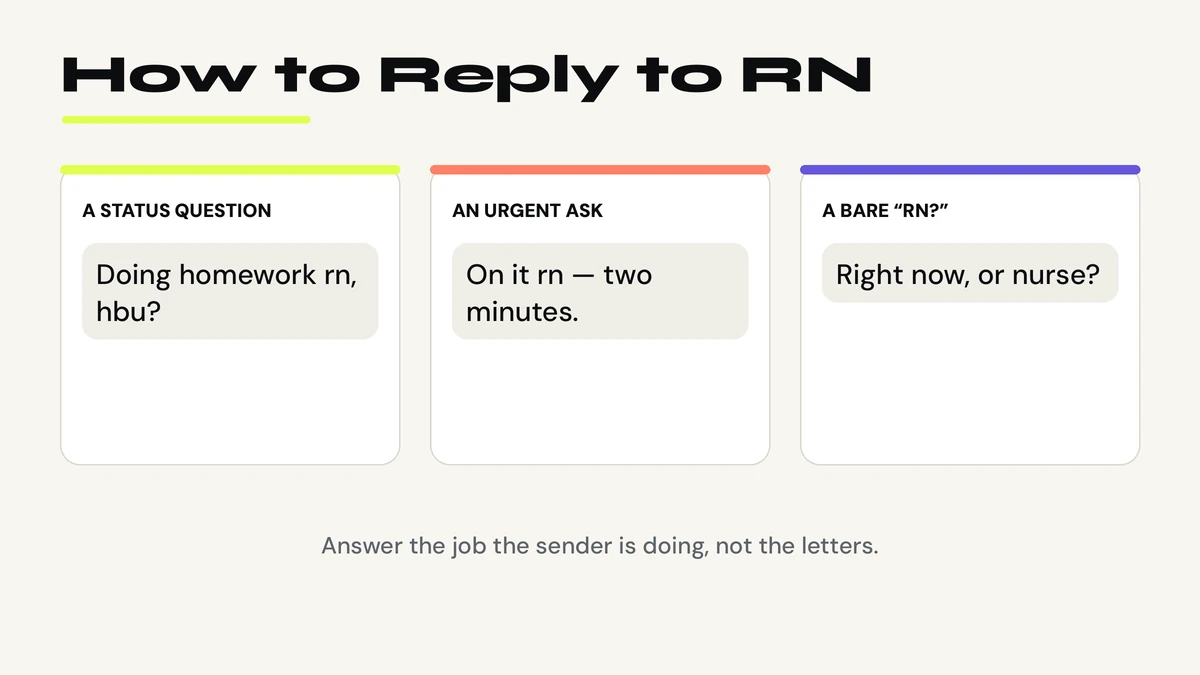
The reply follows the test. Swap the letters, check the seat, ask if you must — then answer the job, not the letters. Six replies cover nearly every RN message you will ever receive, and each one names its moment out loud so the other person can correct you if you picked wrong.
- To a status question. “Doing homework rn, hbu?” The status first, then the question back — the same pairing How-To Geek documents, where rn and the “how about you” question travel together. Our HBU guide covers that return question in full.
- To a mood report. “Same rn, honestly. Want to talk about it or just vent?” Accepts the feeling, matches the moment, and offers two doors — a conversation or a listening ear — without forcing either one.
- To an urgent ask. “On it rn — give me two minutes.” The fastest honest reply in this guide: you heard the urgency, you are moving, and the wait is two minutes, not “soon.”
- To an availability check. “Free rn, what’s up?” or “Busy rn, can I call you in an hour?” Both answers name the moment and then name the next step, which is what an availability question is actually asking for.
- To a “me rn” caption. “Literally me rn.” Short and warm, a second vote for the same joke — the caption is a joke about a shared feeling, and the reply agrees without adding anything. Keep it short; the picture already said the rest.
- To a bare “rn?”. “Right now? As in, what am I doing, or what do you need?” The clarifying question, asked early, before you commit to an answer. It costs nothing and it saves the conversation.
The reply to avoid is the confident wrong one: answering a nurse’s job title as if it were a mood, or answering a mood as if it were a job title. Both mistakes come from skipping the Swap Test, and both are fixed the same way — one clarifying question, asked early, before you commit to an answer. “Right now, or registered nurse?” costs nothing and never gets the meaning wrong.
Frequently Asked Questions
What does RN mean in a text message?
In nearly every text it means right now — what someone is doing, feeling, or needing at this exact moment. “I’m so tired rn” means “I’m so tired right now.” The only common exception is the professional reading: capital RN after a person’s name, in a job title, or on a badge means registered nurse. Run the Swap Test — replace RN with “right now” and see if the sentence still works.
What does RN mean on TikTok?
The same thing it means everywhere else: right now, usually in a “me rn” caption that says a video or image reflects the poster’s current mood, or in a comment like “I need this rn.” No source documents a distinct TikTok-only meaning. If a comment asks what rn means under a video, the one-sentence answer is “right now.”
Does RN mean “registered nurse”?
Yes, in one room: healthcare and professional contexts, where RN is the credential for a registered nurse — after a name, in a job listing, or on a badge. Dictionary.com lists registered nurse as a definition of R.N., and Merriam-Webster’s entry carries the professional meanings too. It does not mean registered nurse at the end of a sentence about being tired, and it is never the default reading in a casual chat.
Is RN rude?
No. RN is neutral — a time stamp, not an attitude. It can sound urgent when the sentence around it is urgent (“I need this RN”), and it can sound like a brush-off when the sentence is short (“not rn”), but the urgency and the brush-off live in the sentence, not in the letters. Nobody is offended by the abbreviation itself.
Can I use RN at work?
In a quick internal chat with colleagues you know well, yes — “are you free rn?” reads as normal. In a formal email, a report, or a message to someone senior, write “right now” in full; the abbreviation reads as careless in a formal room, and a nurse colleague will have to sort out which RN you meant. When in doubt, spell it out.
What does RN mean on Snapchat?
Right now, in quick disappearing messages between people who know each other — status checks (“what are you up to rn?”), mood reports, and “me rn” snaps that say “this is me, here, now.” Snapchat has no distinct meaning of its own for RN. Keep time-sensitive questions in the chat rather than in a snap, so the answer can be re-read.
What does “me rn” mean?
“Me right now.” It is a caption or a reply that says a photo, video, meme, or joke describes the sender’s current mood or situation. Someone posts a picture of a person asleep at a desk captioned “me rn” to say that image is how they feel at this moment. The meaning is the same on TikTok, Instagram, and in texts.
Does lowercase rn mean something different from RN?
No, not by itself. Lowercase rn is how texting writes the slang, so it leans toward the right-now reading, and capital RN is how the nurse credential is written, so it leans that way — but the case is only a hint. “I’m busy RN” is ordinary texting, and the seat of the letters decides: after a name it is the nurse, at the end of a feeling sentence it is right now. The Swap Test outranks the capitalisation every time.
The Takeaway
RN is the shortest lesson in this series and the one most worth learning, because it is two letters doing three jobs at once. In nearly every message it means right now — a time stamp on a status, a mood, an ask, or a caption. In professional rooms it means registered nurse, a credential earned over years and written after a name. Run the Swap Test: replace the letters with “right now,” check where they sit, and ask when both fail. The answer that fits is the answer you use.
Keep the two habits this guide is built on. Put the news in the same message as the letters, so nobody has to guess which room you are standing in — “I’m tired rn” cannot be misread, and “call me rn” cannot be mistaken for a job title. And when an RN message arrives bare — no feeling, no question, no name — ask one question before you answer, because the cheapest reply in this whole guide is “Right now, or registered nurse?” and it is also the one that never gets the meaning wrong.