What “SNM” Means in Text
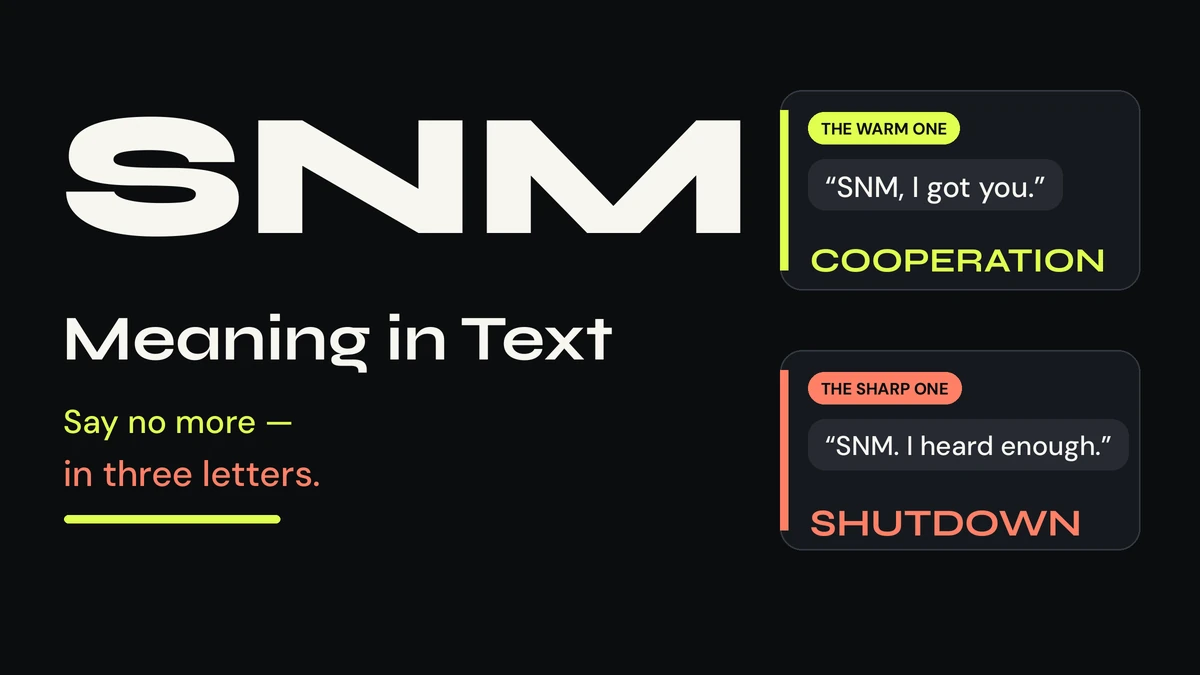
SNM means “say no more” in text. If a friend writes “Movie at mine tonight?” and you answer “SNM, what time?”, you have just told them the plan needs no more selling — and that is the snm meaning in text in one sentence: three letters that mean “I understand, I agree, and you can stop explaining now.” SNM is an initialism, three letters standing in for three words, and it is one of the most efficient replies in texting, because it does four jobs at once: it acknowledges the message, agrees with it, closes the explanation, and signals readiness to act.
The first thing to say about SNM is that the dictionaries do not agree on it — or rather, only one of them shows up at all. Wiktionary lists SNM as an Internet slang initialism of “say no more,” and even tags where it comes from: Multicultural London English, the street slang of London, alongside text messaging. Merriam-Webster has no SNM entry, and Dictionary.com has none either. That gap matters, because the last article in this series found all three dictionaries lined up behind one meaning, while the article before that found Merriam-Webster missing entirely. SNM sits with the second group: one dictionary, two empty chairs. The meaning itself is not in doubt — every guide read for this article agrees on “say no more” — but the reader should know that the agreement comes from usage guides and slang dictionaries, not from the three big references, and this guide says so in the opening rather than burying it.
What SNM does in a sentence is different from what most abbreviations in this series do. It is not a reaction to something, like a head-shake or a laugh, and it is not a piece of information, like a time or a place. It is a verdict on the conversation itself: enough has been said. Picture the moment it lands. Someone explains a plan, asks a favor, drops a hint, or floats an idea, and the other person has already decided. Instead of typing “Okay, I understand what you mean, you do not need to explain any further, and I am on board,” they type three letters and move on. The best way to hear SNM is as a door closing gently behind a finished thought — not slammed, just shut, because there is nothing left to add.
SNM can stand alone as a complete reply. A friend writes “Can you bring some food when you come over?” and a single “SNM, I got you” carries the whole answer. It can sit at the end of a sentence, at the start of one, or in front of the plan itself: “SNM, what time?” It can even carry the whole weight of a yes: “Late-night food after the movie?” — “SNM, I’m down.” That last use is the one that surprises new readers, because nobody in that exchange literally asked anyone to stop talking. The phrase has stretched from its literal meaning — stop explaining — into a social one: you have already convinced me. The letters stay the same, and the job changes, which is why this guide spends a whole section on the test that sorts the jobs apart.
One small thing about capital letters, because every guide mentions it and most of them overstate it. Lowercase “snm” often reads softer and more relaxed, and ALL-CAPS “SNM” often reads more emphatic and deliberate. That is a real tendency, not a rule. A lowercase “snm.” with a period after bad news can still shut a conversation down, and an uppercase “SNM” between friends who back each other up is still warm. Punctuation, the words around it, and the history between the two people decide the temperature far more than the shift key does, and this guide grades the hard lowercase rule as an overclaim in the checked-claims section below.
The SNM Enough Test
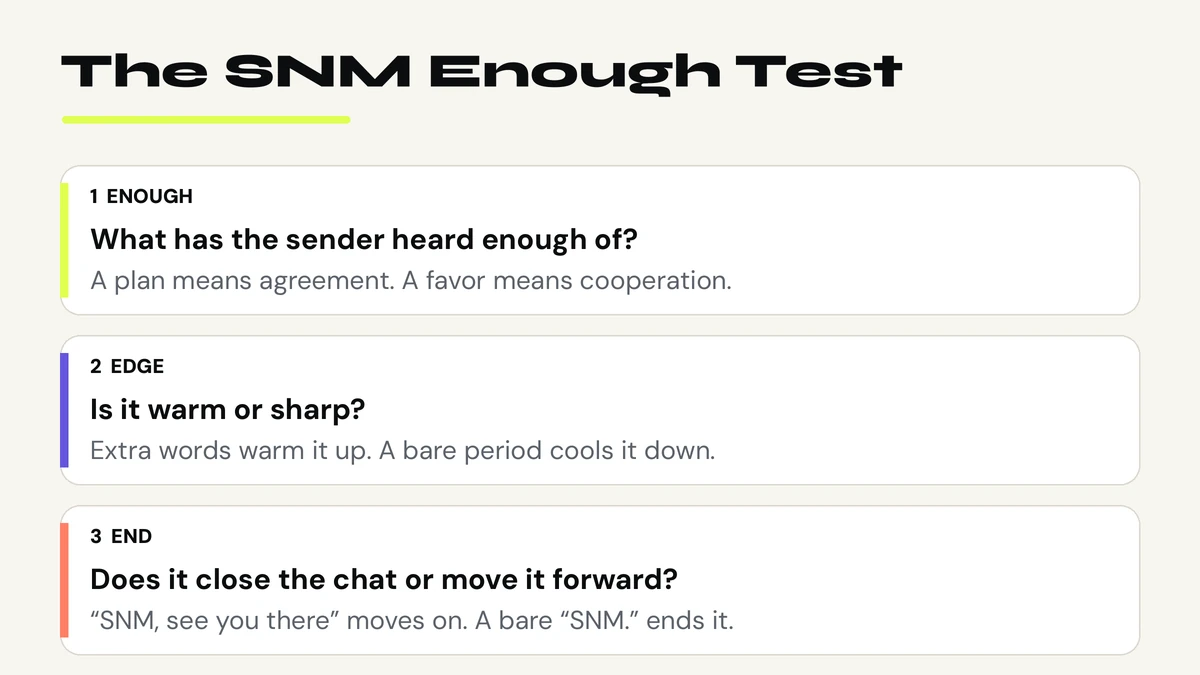
SNM is easy to define and hard to read, because the same three letters can mean “I completely agree,” “I understand, leave it with me,” “I have heard enough, stop talking,” or simply “got it.” The SNM Enough Test sorts those out with three questions, asked in order. Stop at the first question that gives a clear answer, and if two questions disagree, trust the second one, because edge beats enough: a warm message about a plan is still warm, and a sharp message about a favor is still sharp, no matter what was being discussed.
- Question 1 — ENOUGH: what has the sender heard enough of? A plan, a favor, an explanation, or a hint. A plan means agreement: “Movie at mine tonight?” gets “SNM, what time?” A favor means cooperation: “Can you grab my charger?” gets “SNM, I’ll bring it.” An explanation means understanding: “I was going to explain why I left early, but—” gets “SNM, I understand.” A hint means recognition: “You know who suddenly liked my post again” gets “SNM, I already know.” The thing being cut short tells you which job SNM is doing.
- Question 2 — EDGE: is it warm or sharp? Extra words warm it up: “SNM, I got you,” “SNM, I’m in,” and “SNM, get some rest” are all friendly, because the sender added something kind after the abbreviation. A bare “snm.” with a period, no extra words, and no emoji is sharp or at best neutral, especially mid-argument. “SNM!” with an exclamation is enthusiastic. Read the words around SNM before you read the letters.
- Question 3 — END: does it close the conversation or move it forward? “SNM, see you there” moves the conversation forward to the plan itself. “SNM, what time?” asks the next question. A bare “SNM.” with nothing after it ends the conversation, and in a tense exchange that ending is the whole message. If SNM is followed by a question or a next step, it is cooperation. If it stands alone with a period, it is closure.
Run it on a real example. “Movie at mine tonight?” — “SNM, what time?” Enough: a plan, which means agreement. Edge: warm, because “what time?” adds eagerness. End: it moves forward, asking the next question. All three questions agree, and the answer is enthusiastic agreement — the sender is in, and the only thing left is the time. The test earns its keep on the messages where the questions disagree, so here is one of those: “I still want to explain what actually happened.” — “SNM. I heard enough.” Enough: an explanation, which could mean understanding. Edge: sharp, because “I heard enough” adds finality instead of warmth. End: it closes the conversation, hard. The edge and the end overrule the enough, and the answer is a shutdown — the sender is not saying “I understand,” they are saying “stop talking.”
One more, because cooperation is the flavor readers miss most often. “Can you bring my bag too?” — “SNM, I got you.” Enough: a favor, which means cooperation. Edge: warm, because “I got you” is a promise. End: it moves forward to the action, not backward to more discussion. That is the reliable flavor of SNM, the one between close friends, and answering it with suspicion would land wrong while answering it with a simple “thanks” would land right. The test is the difference between those two replies.
The hardest case for the test is a bare “snm” alone, sent as a whole reply with nothing else attached. The test cannot decide it, because there is no sentence to run the questions on — the enough, the edge, and the end all live in the message above it, the one SNM is answering. Read that message, run the three questions on it, and if it is still unclear, ask. “That snm — are you in, or do you want me to stop?” is a better move than guessing, because a wrong guess about SNM is a wrong guess about whether someone agreed to help you.
When “SNM” Does Not Mean “Say No More”
Almost always, SNM means say no more. Almost is doing real work in that sentence, because the letters SNM belong to a long list of unrelated initialisms outside texting, and a few more readings show up in guides without any dictionary backing. This section lists the documented ones first, then the ones that only exist in guides, so the reader can tell them apart.
- Special nuclear material. The United States Nuclear Regulatory Commission uses SNM for plutonium and enriched uranium, and the term appears in federal regulations. If the sentence is about nuclear material, it is the regulation, not the slang.
- Sacral neuromodulation. In medicine, SNM is a therapy for bladder and bowel control. If the sentence is about urology, it is the treatment, not the texting abbreviation.
- Sindicato Nuevo Mexico. SNM is the name of a New Mexico prison gang, also called the Syndicate. If the sentence is about organized crime in New Mexico, it is the gang, not the slang.
- The SNM cryptocurrency token. SNM trades as a crypto ticker, and posts tagged #SNM on Twitter and X are often about the token, not the phrase. If the sentence is about a coin price, it is the ticker, not the texting.
- An ISO language code. Wiktionary notes that lowercase “snm” is the ISO 639-3 code for Southern Ma’di, a language of South Sudan and Uganda. If the sentence is about linguistics, it is the code, not the slang.
- “Show no mercy,” “sex n money,” and “smoke n mirrors.” One guide lists these as other expansions of SNM, with no example sentence and no source behind any of them. “Show no mercy” is a real phrase, but no evidence shows anyone typing SNM to mean it in a chat, and the other two have even less behind them. This guide grades all three as rejected texting readings in the checked-claims section below.
- “Snapchat me.” One guide claims SNM means “Snapchat me” on Snapchat, with no other source agreeing and no example sentence supporting it. The main competitor’s platform section says Snapchat SNM means “say no more,” like everywhere else. This guide grades the Snapchat-only reading as rejected.
The practical rule is simple. Read the sentence first. If it is a text, a DM, a comment, or a reply between two people who know each other, SNM means say no more, and no further thought is needed. Only if that reading makes no sense at all should the alternates come out — a hospital points to the therapy, a regulation points to the nuclear material, and a coin chart points to the token. The next section shows the default reading doing its work in real chats.
“SNM” in Real Chats
The examples below are written for this guide, in the shape of real messages, so the reader can see the Enough Test working instead of just reading about it. Each one names its flavor, because the flavor is the lesson.
- “Movie at mine tonight?” — “SNM, what time?” Enthusiastic agreement. The plan needed no selling, and the reply skips straight to logistics, which is the warmest thing SNM can do.
- “Can you bring my bag too?” — “SNM, I got you.” Warm cooperation. A favor, accepted without a second thought, and the “I got you” after it is the promise that makes the reply kind instead of curt.
- “The meeting point changed to the front entrance.” — “SNM, front entrance.” Neutral acknowledgment. No emotion, just confirmation that the update landed, and the repeated detail proves it was actually read.
- “I still want to explain what actually happened.” — “SNM. I heard enough.” A sharp shutdown. The added sentence turns the abbreviation into a door closing, and the period after SNM does the rest of the work.
- “You know who suddenly liked my post again.” — “SNM, I already know.” Shared knowledge. A hint recognized instantly, and the reply says the two of them are on the same page without spelling out what the page says.
- “Free food at my place.” — “SNM, I’m coming.” Enthusiastic agreement. Nobody needed convincing, and the reply is a yes wearing three letters.
- “I need someone to cover me for five minutes.” — “SNM bro, I got you.” Warm cooperation between friends. The “bro” is doing the social work here, and SNM is just the fast way to say the yes that follows it.
Notice what the examples share. In every one of them, the message around SNM does the heavy lifting, and SNM itself adds only the temperature and the timing. Remove SNM from “Movie at mine tonight?” and the question is still a question. Remove it from “I got you” and the promise is still a promise. SNM is a seasoning, not the meal, which is why the Enough Test starts with what the sender has heard enough of instead of the letters.
The SNM Tone List
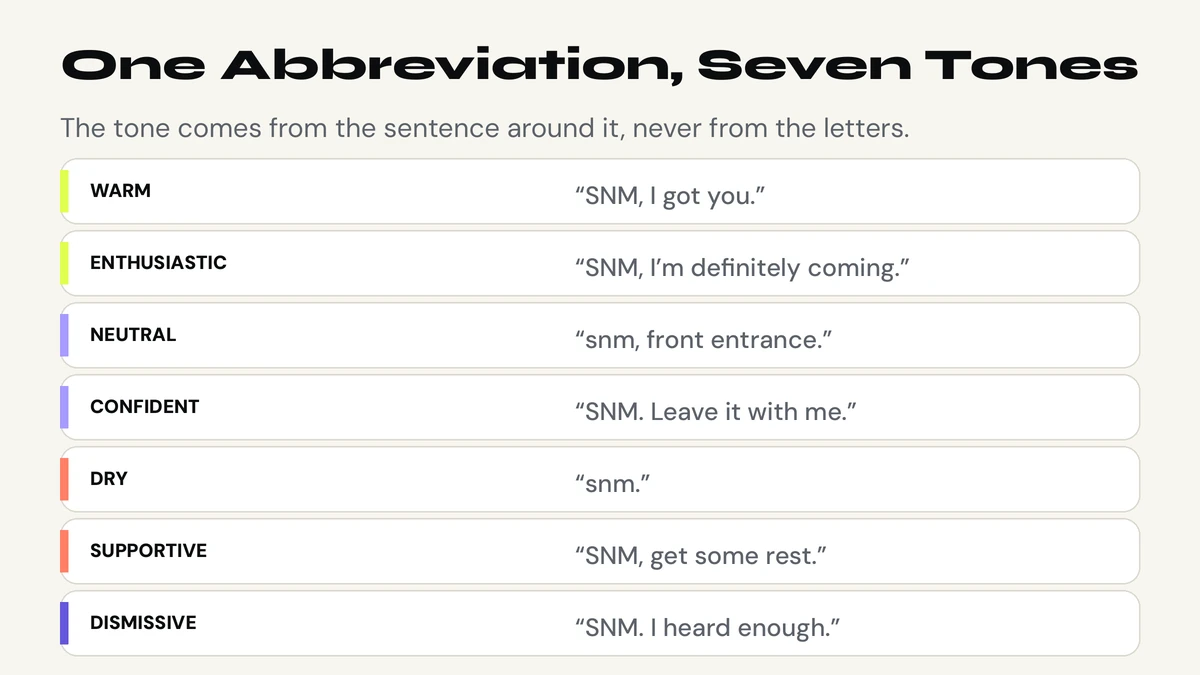
SNM wears seven tones, and the letters never change between them. Read the tone off the sentence around SNM, the punctuation, and the relationship — never off the three letters alone, because the same “snm” can be a warm promise or a cold door depending on what sits next to it.
- Warm. “SNM, I got you.” The friendly flavor, for a favor accepted without hesitation. The extra words after SNM are doing the warming, and a reply like this is the one SNM was built for.
- Enthusiastic. “SNM, I’m definitely coming.” The “you already convinced me” version, for a plan too good to need discussion. The exclamation point or the extra word is the giveaway.
- Neutral. “snm, front entrance.” The plain confirmation, for an update that just needs a receipt. No warmth, no edge, just “message received” in three letters.
- Confident. “SNM. Leave it with me.” The competent flavor, for a task taken on without fuss. The sender is not just agreeing, they are taking ownership.
- Dry. “snm.” The bare reply, for a message that needs nothing more than acknowledgment. Shortness alone does not prove irritation — the sender might just be busy — but it does not prove warmth either.
- Supportive. “SNM, get some rest.” The kind flavor, for someone who feels they have to justify themselves. The reply removes pressure instead of adding to it, and the tone is set by what follows SNM, not by the letters.
- Dismissive. “SNM. I heard enough.” The sharp flavor, for a conversation the sender wants over. The period after SNM and the added sentence are the tells, and this is the only tone on this list that can actually hurt.
The tones overlap, and that is the point of listing them separately from the test: the test sorts agreement from cooperation from closure, and the tone list gives the reader the vocabulary for the in-between cases, the dry SNM and the confident SNM that are neither jokes nor fights. Two signals help more than any other. Extra words after SNM almost always warm it up, and a bare SNM with a period almost always cools it down. Everything else is context, and context is the message above it.
“SNM” on TikTok
On TikTok, SNM lives mostly in comments and private messages, reacting to clips rather than to people the commenter knows. “This is the only snack you need for movie night” gets “SNM, buying it tomorrow” — the shape of it: a persuasive video, a convinced viewer, and three letters doing the work of “you had me at the first frame.” The meaning is the same as everywhere else — say no more — but the stage makes it louder. A comment is a public performance of agreement in front of strangers, where a text is a private reply in front of one person, and TikTok comments reward the most enthusiastic version of the reply.
That public stage is also why TikTok is the likeliest home of the enthusiastic flavor. A creator posts a recommendation, the comments fill with “SNM, I’m in” and “SNM, buying it tomorrow,” and nobody involved is asking anyone to stop talking — they are saying the video already did the convincing. The FYP guide covers the feed those comments collect on, and the same rule applies there as here: the clip supplies the context, the comment supplies the temperature, and the platform supplies neither the meaning nor the feeling. SNM does not gain a TikTok-only definition, and no source in this guide claims one.
“SNM” on Snapchat
On Snapchat, SNM is usually a quick reply to a friend’s snap or story, and it is usually the most casual version of itself. The setting is private, the audience is one person, and the message is often a reaction to something visual — a photo of the plan, a story about the night ahead — where the snap itself supplies the thing being agreed to. “Come over after 8, everyone should be gone” gets “snm” — the shape of it: a plan, a lowercase reply, and nothing else, because nothing else is needed.
The disappearing context matters more on Snapchat than anywhere else. A snap vanishes, and with it goes the evidence of what SNM was answering, which is why a Snapchat SNM read days later can feel colder than it felt at the time. The meaning never changes — it is still say no more — but the reader loses the message above it, and the Enough Test needs that message. If a Snapchat SNM feels dismissive out of context, it is usually the missing snap, not the sender, that makes it feel that way. One guide claims SNM means “Snapchat me” on Snapchat, but no other source agrees, no dictionary lists it, and the main competitor’s own platform section says Snapchat SNM means “say no more” — the claim is graded as rejected in the checked-claims section below, and this guide does not repeat it as a real reading.
“SNM” on Instagram
On Instagram, SNM shows up in DMs, in comments on posts, and in replies to stories, usually as a quick acknowledgment before an action. “Send me the name of that restaurant” gets “SNM, sending it now” — the shape of it: a request, a confirmation, and the action already starting. The abbreviation acts as a receipt with a promise attached, and the DM is where that combination feels most natural, because the two people already know each other well enough that three letters are plenty.
Instagram is also where SNM is most likely to be aimed at a creator the sender has never met. A recommendation lands, a viewer is convinced, and “SNM, buying it tomorrow” appears in the comments. That is still the same meaning — say no more, I am convinced — aimed further away. The distance changes the stakes, not the definition: a stranger’s SNM costs nothing and promises nothing, while a friend’s SNM is a promise that will be checked on later, but neither one means anything different. The IG guide covers the platform itself, the app where most of these DMs and story replies live.
“SNM” in Text Messages
Private texting is the widest home SNM has. There is no audience, no algorithm, and no performance, just one person answering another, and the relationship between the two does more work than the platform ever could. In a one-to-one thread, SNM is usually the whole reply — a friend asks for help, you send “SNM, I got you,” and the conversation moves on with the understanding intact. The DM guide covers the thread itself, the private room where most texting SNM lives, and the same logic applies: the fewer people watching, the more honest the reply.
Texting is also where the two stretched uses from the opening section show up most. SNM as enthusiastic agreement — “Late-night food after the movie?” — “SNM, I’m down” — needs a private thread to feel natural, because the sender is saying yes to something the other person only hinted at, and that kind of yes assumes shared history. And SNM as a sharp shutdown — “SNM. I heard enough.” — needs a private thread to sting, because a public shutdown is a performance and a private one is a real feeling. In a group chat the same patterns still work, but the audience is bigger and the risk of misreading is higher, which is why the sender section below matters: the same “snm” from a best friend and from a coworker is not the same message.
Who Is Sending It: How “SNM” Lands by Sender
The meaning of SNM does not change with the sender. What changes is how it lands, how much it promises, and how much room the reader has to take it lightly. The sender is the second question of the Enough Test for a reason: what the sender has heard enough of tells you the job, and the sender tells you how seriously to take the answer.
- Close friend. The safest SNM there is. Usually warm and cooperative, almost always a real yes, and the extra words — “I got you,” “I’m in” — are doing the work of saying “I mean it.” A friend’s “SNM, I got you” after a favor is a promise, not a brush-off.
- Crush. The most over-read SNM in texting. A crush’s “SNM. Friday it is” after your hint about being free is usually recognition wearing three letters — they caught the hint, and they are saying yes to the date without saying the word “date.” But a dry “snm” after you pour your heart out is a door closing, and the period is the tell. Decode the conversation around it, not the acronym.
- Partner. Usually comfortable shorthand rather than a real message, built on shared history. A partner’s SNM about a plan is the fastest possible yes, and it rarely needs a reply longer than “perfect.” A partner’s bare “snm.” after an argument is a different thing entirely: a request for space, not an agreement, and it deserves a real answer later rather than a deflection now.
- Parent or family. Rarer than a friend’s, which is why it lands heavier, and usually the plain acknowledgment flavor: a parent’s “snm” after an update means “noted, no need to explain.” Because it is rare, it is easy to over-read; a parent’s SNM is usually just a parent learning to text like everyone else.
- Coworker. Friendly but risky, because work threads keep receipts. A coworker you are actually friends with can send a warm “SNM, I’ll handle it” in a private message; the same SNM in a group channel reads as curt, and in writing that might get forwarded it reads as unwilling to engage. Save the warm version for people who already know your tone.
- Stranger or creator. Public agreement aimed at content, not at the reader, and the easiest SNM to ignore. A stranger’s “SNM, buying it tomorrow” under a video says more about the video than about the stranger, and it costs nothing to scroll past.
- Group chat. Broadcast acknowledgment, aimed at whoever just spoke, and performed for the rest of the room. A group-chat SNM keeps a busy conversation efficient — “Everyone meet outside at 6:30” gets “SNM, see you there” — but it is also the version most likely to be read as dismissive by someone who needed more than three letters, because the whole room is watching the shortest reply win.
Gender does not change the meaning. Whether SNM comes from a girl, a guy, or a group chat, it still signals “I understand, no more explanation needed,” and the real difference is tone and context. If a close friend sends “SNM, I got you” with a laughing emoji, they are backing you up. If someone sends a cold “SNM.” after an emotional message, they are shutting the conversation down. That is the same answer every careful guide gives, and it is the answer this guide gives too: don’t decode the acronym, decode the conversation around it.
Checked Claims: Expansions That Do Not Hold Up
SNM attracts confident claims, and several of them fall apart when checked against the dictionaries. Eight claims are graded here against Wiktionary, Merriam-Webster, Dictionary.com, and the two full competitor reads. A claim graded REJECTED is not repeated anywhere else in this article as if it were true.
- “SNM means ‘suck my’ in texts” — REJECTED. One low-quality guide claims “snm” stands for “suck my,” usually followed by another word that is implied or typed out. No dictionary lists it, no other guide corroborates it, and the construction gives it away: “suck my” is not a complete phrase, it needs a word after it, while SNM in real chats stands alone as a complete reply. The vulgar reading is a meme-culture invention, not a texting sense, and it is not repeated as a real reading anywhere in this article. It appears here once, in plain text, because grading a false claim honestly means naming it — and it appears nowhere else in this guide, never in a title, heading, SEO field, slug, or image.
- “SNM means ‘Snapchat me’ on Snapchat” — REJECTED. One guide claims that on Snapchat, SNM sometimes means “Snapchat me,” depending on context. No dictionary lists it, no other guide corroborates it, and the main competitor’s own platform section says Snapchat SNM means “say no more,” like everywhere else. A platform-specific reading needs platform-specific evidence, and there is none.
- “SNM also stands for ‘sex n money,’ ‘show no mercy,’ and ‘smoke n mirrors'” — REJECTED as texting readings. One guide lists these three as other acronyms for SNM, with no example sentence and no source behind any of them. “Show no mercy” is a real phrase, but no evidence shows anyone typing SNM to mean it in a chat, and the other two have even less behind them. All three are graded as rejected texting readings, not as real alternate meanings.
- “The first Urban Dictionary entry for SNM was in July 2010” — UNVERIFIED. One guide states this as a fact, with no citation, no link, and no screenshot. No other source gives any date for SNM’s first appearance, and the entry was not verified by a direct read in this build. It is reported here as an uncited claim from a single guide, not as a fact, and the origin section below claims no first-use date.
- “SNM gained popularity in the 1990s to the 2000s” — REJECTED as dated. One guide claims the abbreviation gained traction in the 1990s to the 2000s. The phrase “say no more” is old, but the initialism’s popularity in the 1990s has no evidence behind it: texting abbreviations of this shape spread with SMS and smartphones in the 2000s, and the only dated milestone any guide offers is the unverified July 2010 Urban Dictionary entry in the claim above. The 1990s half of the range is invented, and it is not repeated.
- “SNM is a universally understood term” — REJECTED. One guide calls SNM “a universally understood term in text language” that “applies across all English-speaking nations.” The main competitor disagrees with its own guide’s confidence: it warns that SNM’s effectiveness depends on shared slang knowledge, and that if the recipient does not recognize SNM, the abbreviation actually increases communication effort rather than reducing it. Three letters unknown to many readers are not universal, and this guide does not repeat the claim.
- “People typically type SNM in lowercase, not capitals” — REJECTED as a rule. One guide states that people typically type the acronym in lowercase, not capitals. Every other guide read for this article shows both forms in real use, and the main competitor notes that capitalization affects perceived tone rather than correctness. Lowercase may be more common in casual chats, but a tendency is not a rule, and this guide does not present it as one.
- “Using SNM is generally rude because it shows authority over the other person” — REJECTED as a general claim. One Snapchat-focused guide states that using SNM is generally considered rude because it shows some authority over the other person. The main competitor’s FAQ answers the same question the other way — SNM is not inherently rude — and this guide agrees with the competitor: SNM can feel dismissive when it shuts down an emotional conversation, but rudeness is a context effect, not the meaning. A warm “SNM, I got you” is not rude by any reading, and a general rudeness claim fails on that example alone.
No frequency or dominance claim in this guide is stated as a percentage, because no frequency study of SNM exists in the sources read for this article. “Most common,” “rare,” and “almost always” are qualitative judgments backed by Wiktionary and competitor consensus, and they are labeled as such wherever they appear.
“SNM” vs Its Closest Cousins
SNM closes a conversation by saying enough has been said, and that direction — toward closure, not toward a feeling — is the key to telling it apart from its cousins. If the reply says “I understand and we can stop here,” it is SNM. If it says something else — I agree with the claim, I know already, I confirm it is true — it is something else, and this section names the difference for each one.
- SMH — “shaking my head.” The easiest pair in the series to confuse, because both are three letters, both start with S and M, and both live in the same chats — and the previous article in this series named SNM as a term it could not yet link, because SNM was still unpublished. This guide returns the link the other way, with the SMH guide linked properly. SMH reacts to a letdown with a gesture: disbelief, disappointment, or playful exasperation at something foolish. SNM closes a conversation with a verdict: enough has been said. A friend’s bad decision gets SMH. A friend’s plan that needs no more discussion gets SNM.
- IKR — “I know, right?” Agreement with a claim or an opinion: someone says something you already believe, and IKR says “exactly.” SNM agrees with a plan, a favor, or a request, and says “no more explanation needed.” “That restaurant is way better than the other one” gets IKR. “Let’s order from that restaurant instead of cooking” gets SNM. The IKR guide covers the agreement with a claim.
- FR — “for real.” A truth flag: it confirms that something is true or serious. SNM confirms that something is understood, not that it is true. “FR, he really did that” says it happened; “He really did that, SNM” would not make sense, because SNM answers a request or an explanation, not a fact. The FR guide covers the confirmation.
- IK — “I know.” States that the information was already known before the message arrived. SNM says additional explanation is unnecessary, which is a different claim: the main competitor puts it cleanly, that SNM is primarily about having enough information, not necessarily having known it beforehand. “You need to charge it first” gets IK. “Just remember what we discussed yesterday” gets SNM. The IK guide covers the already-known.
- “Say less.” The closest cousin of all, and the only one that does nearly the same job: both tell the speaker that further explanation is unnecessary. The difference is the form — SNM directly abbreviates “say no more,” while “say less” is usually written out as a full slang phrase — and the emphasis: “say less” leans toward “I’m convinced,” while SNM leans toward “I understand.” No TextsMeaning article covers “say less” yet, so it is named here unlinked, and the two phrases are close enough that either one works in most of the examples in this guide.
- Bet. Agreement and acceptance, usually about a plan: “Meet at 6?” gets “Bet.” SNM places slightly more emphasis on already understanding enough, while bet places the emphasis on confirming the arrangement. The main competitor draws the same line, and it is a useful one: bet confirms the plan, SNM confirms the understanding behind it. No TextsMeaning article covers bet yet, so it is named here unlinked.
- MHM — “mhm.” The flat acknowledgment: a hum that says “I heard you.” SNM is acknowledgment with closure — it does not just say the message landed, it says the conversation can stop. A bare “mhm” keeps the door open; a bare “snm” closes it. MHM is named here in plain text and linked once, in the reply bank below, because “mhm” is also the flattest possible answer to an SNM.
The short version is the semantic core the main competitor states best, credited here in plain text because it is theirs: the core of SNM is sufficient understanding. Everything else — agreement, cooperation, closure, readiness — grows out of that one idea. If the sender has heard enough, it is SNM. If they have not, it is something else.
Where “SNM” Came From
The phrase came first, and the abbreviation came much later — and the two histories should not be confused, because the guides that confuse them are the ones that get the dates wrong. “Say no more” is an old English idiom. Cambridge defines it, mainly British, as something “said to show that you understand exactly what the other person is suggesting,” with the example “I saw him coming out of her flat.” “Say no more!” — the implication hanging in the air, the rest left unsaid. The phrase was famous enough to become a catchphrase: it is the punchline of Monty Python’s “Nudge Nudge” sketch, where “say no more” and “nudge nudge” do all the work of a joke the sketch never tells outright. That sketch aired in the 1970s, which is the earliest solid date in SNM’s story — and it belongs to the phrase, not to the letters.
When the phrase became the abbreviation is a different question, and it has no documented answer. One guide claims the expression “say no more” dates back to the 1900s, with no citation, and this guide grades that date as unverified rather than repeating it. Another claims the abbreviation gained popularity in the 1990s to the 2000s, which the checked-claims section grades as rejected, because texting abbreviations of this shape spread with SMS and smartphones in the 2000s and no evidence puts SNM in the 1990s. A third claims the first Urban Dictionary entry appeared in July 2010, with no citation, and that claim is graded unverified too. What the sources do support is the shape of the story: a spoken phrase that already meant “I understand, stop explaining” was a natural candidate for abbreviation once texting rewarded short replies, and the initialism spread through the same channels as every other piece of texting slang — chats, DMs, comments, and group messages where speed matters more than formality.
Why did it survive while most texting abbreviations fade? Because the job it does never goes away. Every conversation has a moment when enough has been said, and every generation of texters needs a fast way to mark it. The phrase was already in the language before phones existed, the abbreviation only had to compress it, and the meaning never needed updating — “I understand, no more explanation needed” is as useful in a 2026 group chat as it was in a 1970s comedy sketch. No first-use date is claimed anywhere in this article beyond the documented milestones above, and every dated claim from the guides is graded in the checked-claims section rather than repeated.
How to Reply When Someone Sends “SNM”
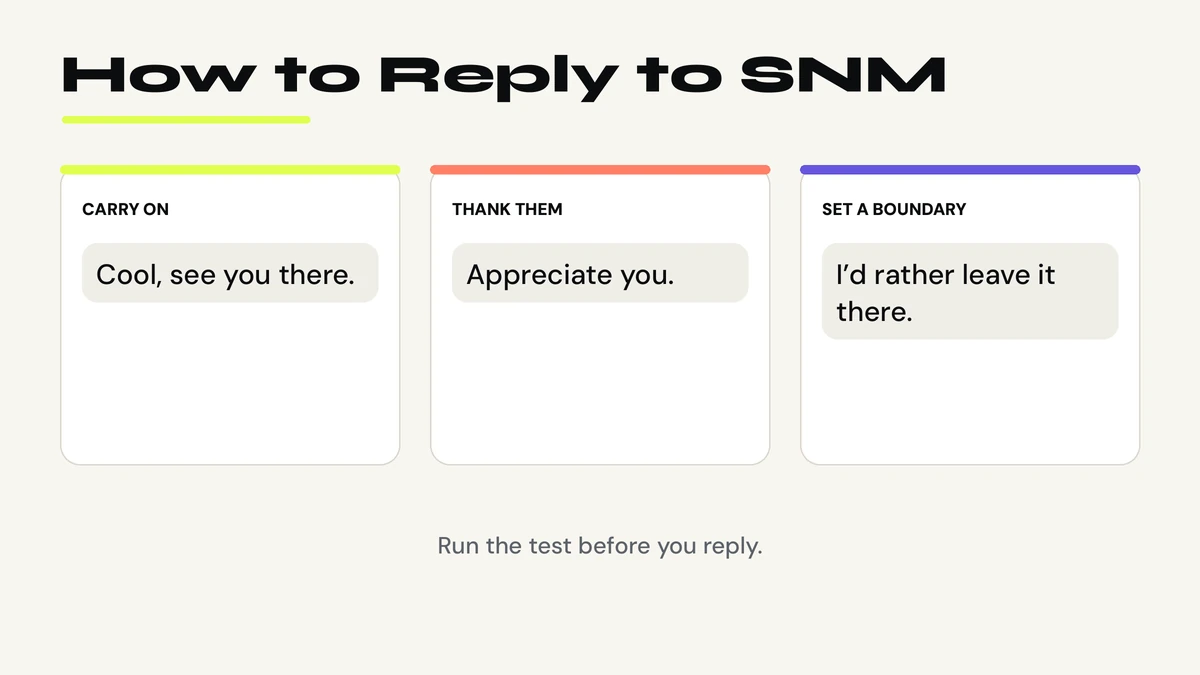
Getting hit with an SNM puts the reader in a simpler spot than most abbreviations in this series, because SNM usually closes the exchange rather than opening one. The reply depends on which job SNM was doing: agreement, cooperation, or closure. Three strategies cover basically every situation, and the reply bank below them gives the exact words.
Carry on, when it was agreement or cooperation. The SNM was a yes, and the right move is to move forward to the plan itself. “Cool, see you there,” “Perfect,” or “Sounds good” are all the reply that is needed, because SNM already closed the discussion part and what is left is the doing part. Do not re-explain the plan to someone who just told you they understand it; that is the one thing SNM was asking you not to do.
Thank them, when it was support. The SNM was warm — “SNM, I got you” — and the sender just promised help. “Appreciate you” or “Thanks, I knew you’d understand” keeps the warmth of the interaction, and it costs nothing. If the SNM came with an offer to handle something, the thank-you is also the receipt: it confirms the promise landed.
Set a boundary, when it was a shutdown. Sometimes the SNM was not an agreement at all: the sender cut off an explanation you still needed to give, or shut down a conversation that mattered to you. “Thanks for understanding. I’d rather leave it there” works when you accept the closure. “I appreciate it, but I don’t want to discuss the details right now” works when you want the privacy without the fight. And if the SNM landed mid-argument, the honest reply is not a reply at all, but a later question: “That snm — are you in, or do you want me to stop?” A clear boundary matters more than matching someone’s slang.
- “Cool, see you there.” The agreement SNM, answered by moving on to the plan. The single most useful reply in this guide.
- “Perfect.” The cooperation SNM, answered in one word. Use it when the plan is set and nothing else needs saying.
- “Appreciate you.” The supportive SNM, thanked properly. Use it when someone just promised to help.
- “Sounds good.” The neutral SNM, answered with the same energy. Use it when the update just needed a receipt.
- “You good?” The later check-in, for the SNM that felt heavy and the person who matters. Ask it later, not in the moment.
- “mhm.” The flat acknowledgment, for the SNM that needs no fixing and no joke — just a sign that the message was read. The MHM guide covers the sound of agreement itself.
The mistake to avoid is answering the wrong flavor. A shutdown answered with “perfect” accepts a closure you did not want, and a warm agreement answered with a long explanation ignores the one thing SNM asked for. Run the Enough Test before replying: enough, edge, end. Ten seconds of reading saves a conversation.
Frequently Asked Questions
What does SNM mean in a text message?
SNM means “say no more” in a text message. People use it to show they understand what was said and do not need any further explanation, and it can also signal agreement, cooperation, or readiness to act. It can stand alone as a whole reply, sit at the end of a sentence, or come first to set the tone before the plan: “SNM, what time?”
What does SNM mean on Snapchat?
The same thing it means everywhere: “say no more.” On Snapchat it usually appears as a quick reply to a snap or a story, acknowledging a plan or an explanation in a private thread. The platform changes the setting, not the meaning, and one guide’s claim that it means “Snapchat me” on Snapchat is graded as rejected in the checked-claims section, because no other source supports it.
Is SNM rude?
SNM itself is not a bad word, and it is not automatically rude. Warm SNM between friends — “SNM, I got you” — is about as rude as a nod, which is to say not rude at all. But SNM can sting when it is used to shut down an emotional conversation, especially with a bare “SNM.” and a period, where it reads as dismissive. The rudeness lives in the context, not in the letters.
What does “snm” mean from a girl?
It means the same thing it means from anyone: say no more. The letters do not change based on who is typing them. What changes is the context. If she sends “SNM. Friday it is” after you hint that you are free Friday, that is recognition — she caught the hint, and she is saying yes to the plan. If she sends a dry “snm” after an emotional message, she is closing the conversation, and the SNM is the polite version of “I don’t want to talk about this.” Decode the conversation around it, not the acronym.
Can I use SNM at work?
No, not in anything formal. SNM is far too informal for work email, and it can confuse colleagues who do not know the abbreviation — which is exactly the opposite of what an acknowledgment is supposed to do. If the same energy is needed in a professional setting, “Understood. I’ll take care of it,” “Got it, thanks,” or “Thanks for clarifying” carry the acknowledgment without the risk. Save SNM for private messages with coworkers who are actually friends, and even then think twice before putting it in writing anywhere a manager might see it.
What is the difference between SNM and “say less”?
Almost nothing, and that is the honest answer. Both tell the speaker that further explanation is unnecessary, and both can mean “I understand” or “I’m convinced.” The difference is the form: SNM directly abbreviates “say no more,” while “say less” is usually written out as a full slang phrase. If anything, “say less” leans a little more toward “I’m convinced” and SNM leans a little more toward “I understand,” but the two are close enough that either one works in most of the examples in this guide.
Does SNM have a rude meaning?
Not as a real texting sense. One low-quality guide claims SNM stands for “suck my,” usually followed by another word, but no dictionary lists it, no other guide corroborates it, and the construction gives it away: “suck my” is not a complete phrase, while SNM in real chats stands alone as a complete reply. The vulgar reading is a meme-culture invention, and this guide grades it as rejected. The standard slang meaning of SNM is “say no more,” and it is not offensive.
Does capital SNM mean something different from lowercase snm?
No, not as a rule. Capital letters can add emphasis, but they do not create a separate definition, and lowercase “snm” and uppercase “SNM” normally mean the same thing. Lowercase tends to read softer and more relaxed, and ALL-CAPS tends to read more emphatic, but the words around it and the relationship between the two people decide the temperature far more than the shift key does.
The Takeaway
SNM means “say no more,” and it is the internet’s shorthand for the most useful moment in any conversation: the moment when enough has been said. It has been around in its spoken form for decades — a Cambridge-listed idiom, a Monty Python catchphrase — and it settled into texting as the fastest possible way to say “I understand, I agree, and you can stop explaining now.” It means agreement when a plan needs no selling, cooperation when a favor needs no discussion, and closure when an explanation has run its course.
The next time SNM lands in your messages, run the Enough Test before you answer it. Ask what the sender has heard enough of, whether the edge is warm or sharp, and whether the message closes the conversation or moves it forward. Agreement gets a “cool, see you there” and a plan. Cooperation gets a thank-you. A shutdown gets a boundary, or a later “you good?” if the person matters. The three letters never change, but the job always does, and reading the job is the whole skill. That is the snm meaning in text, and it is the only reading you will need almost every time you see it.