What does oml mean in text? OML means “oh my lord” — a fast, emotional reaction to news that is shocking, funny, embarrassing, or just too much. This guide to oml meaning in text gives you the OML Reaction-or-Oath Test, so you can tell in seconds whether the oml you just got was a gasp, a laugh, a complaint, or a sworn promise.
This guide covers the one dictionary-backed meaning and the second, situational meaning, the three-check test, seven tones, OML on TikTok, Snapchat, Instagram, and in texts, how it lands by sender, when it crosses a line at work, school, and home, graded claims about the expansions that do not hold up, cousins, a dated history from early chat rooms to a 2026 guide, and a reply bank keyed to the reading you just identified.
What “OML” Means in Text
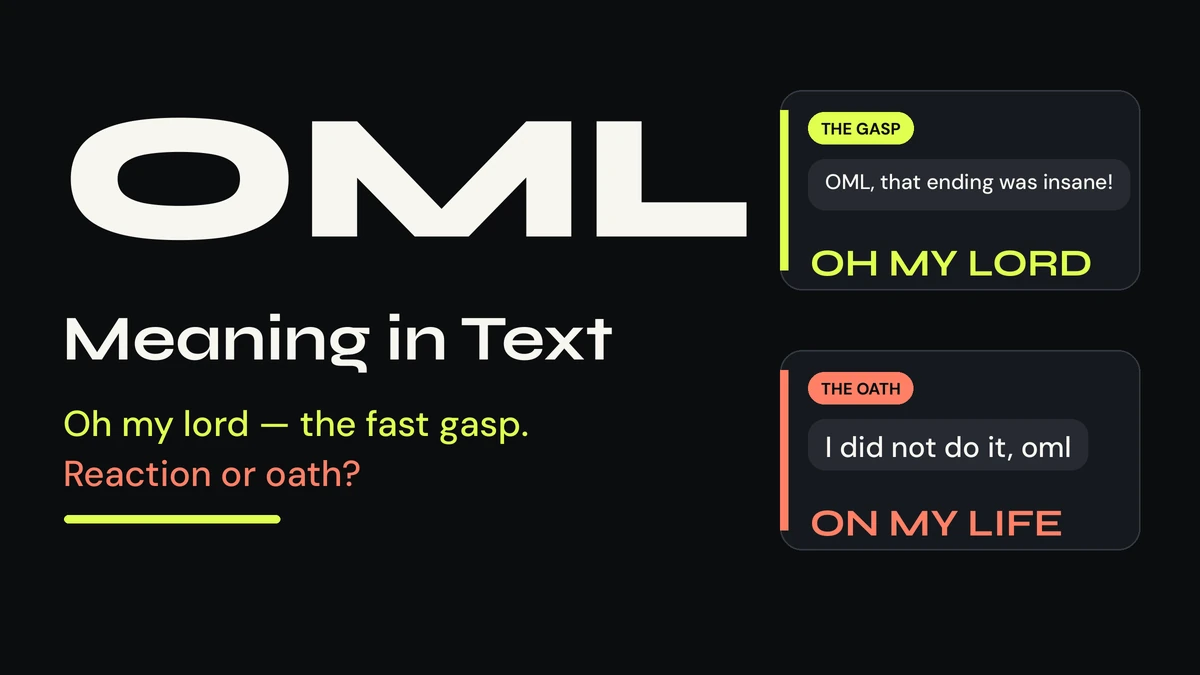
OML is an initialism: take the first letters of the phrase “oh my lord” and squeeze out the spaces, and you get O, M, L. It does exactly what the full phrase does, only faster. It reacts. Somebody tells you the exam moved to tomorrow, somebody posts a clip of a fall timed perfectly to the music, somebody admits they posted the wrong photo to the group chat — and OML is the sound of a person processing it in real time. “OML, are you serious?” “OML, that ending was insane.” “OML, I cannot stop laughing.” That is the whole job in most messages: a reaction, not an answer, and the feeling inside it is the message. Nobody says OML out loud in a real conversation; you type it, and when you read it aloud you just say “oh my lord.”
The dictionary record is short — shorter than for most terms in this series — and this guide leans on all of it. Wiktionary, read directly for this article, lists OML as one interjection with one sense: “(Internet slang, text messaging) Oh my Lord.” Its lowercase entry, oml, is only an alternative letter-case form of the same word, with no second sense of its own. That is the entire dictionary record for the abbreviation: one meaning, no controversy note, no poll, no second reading. No dedicated Dictionary.com slang page for OML surfaced in search for this build, and Merriam-Webster has no dedicated OML slang entry either; it defines only the full phrase, and its texting-abbreviations coverage lists OMG, not OML. So the abbreviation’s dictionary record rests on Wiktionary alone, and this guide says so rather than pretending otherwise. Everything beyond that one sense — the promise reading, the music reading, the love reading — comes from competitor guides, and each one is graded on its evidence in the Checked Claims section below.
Two jobs, then, and the sentence decides which one you are reading. Most of the time, OML is a reaction: it sits at the start of a sentence and answers news with feeling — shock, delight, annoyance, embarrassment, panic, or playful drama. Sometimes, though, it is an oath: it sits at the end of a denial or a claim and swears the words are true — “I did not do it, oml,” “That really happened, oml.” The lowercase form, oml, is the relaxed, everyday reaction, and it is the form you will see most in texts; the capitals, OML, read a touch louder and can feel more dramatic. Stretching the letters — OMLLL, OMLLLLL — stretches the feeling, not the meaning. Neither spelling changes what the letters stand for — only how hard they land — and the test in the next section is what actually sorts the readings, because the sentence around OML does more work than the letters ever will.
The OML Reaction-or-Oath Test
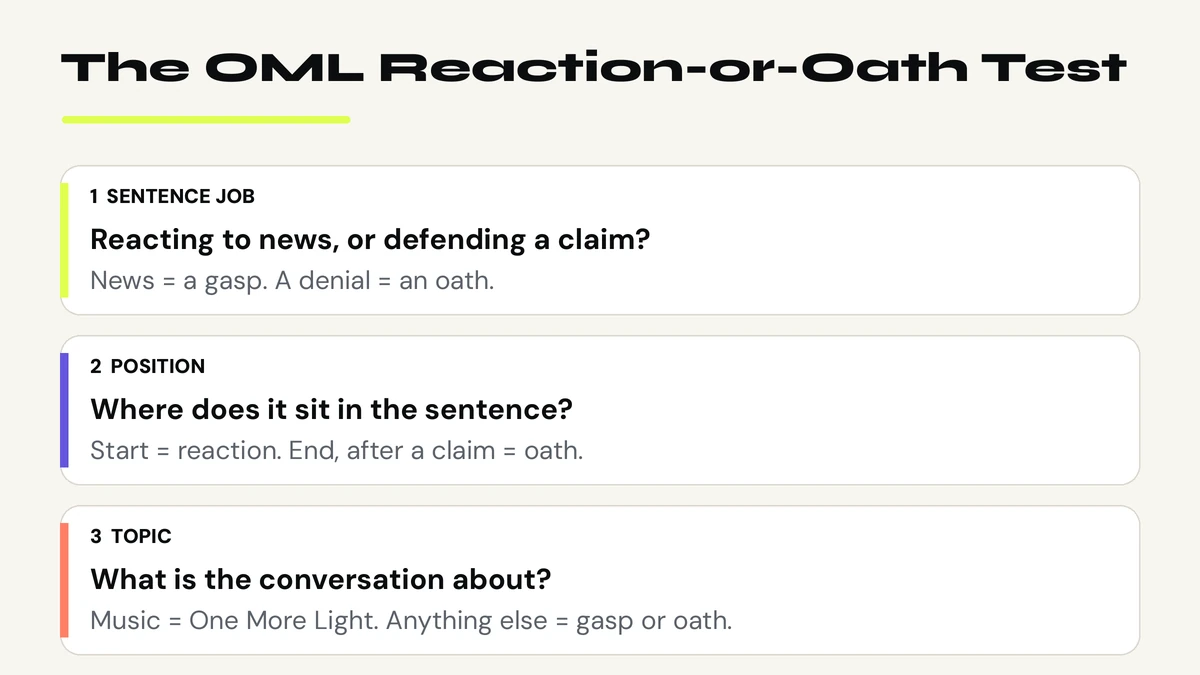
Before you answer an oml — or send one — run three checks. They take about five seconds, and they beat every shortcut the competitors offer, because the competitors all say “it depends on the sentence” without giving you a procedure for reading it:
- Check 1 — The Sentence Job. What is the sentence doing: reacting to news, or defending a claim? If OML reacts to something that just happened — a result, a clip, a confession, a mistake — it means “oh my lord,” a gasp with letters. If OML backs up a claim somebody is being doubted on — a denial, an insistence, a promise — it means “on my life,” an oath with letters. The job is the fastest single clue, because a reaction and a promise are different speech acts, and the sender chose one of them on purpose.
- Check 2 — The Position. Where does it sit in the sentence? At the start, OML is almost always a reaction: “OML that ending was insane.” At the end, after a denial or a claim, it is usually an oath: “I did not touch your phone, oml.” On its own as a one-word reply, it is a pure reaction — a gasp with nothing attached. Position is the check the main competitor builds its whole guide around, and it holds up: a promise needs a claim to attach to, and a claim usually comes first.
- Check 3 — The Topic. What is the conversation about? If the topic is music — a Linkin Park album, a playlist, a favourite track — OML can mean “One More Light,” the band’s 2017 album and song, and the topic names it before the letters do. If the topic is anything else, the music reading falls away, and you are back to Check 1: a reaction or an oath, decided by the sentence. No other topic check is needed, because no other expansion survives grading — the love reading, the gaming reading, and the rest are dealt with in Checked Claims.
Worked trio. “OML, they moved the exam to tomorrow”: job a reaction to news, position at the start, topic school. Shocked gasp, no doubt anywhere. “I did not say that, oml”: job a defence of a claim, position at the end, topic a dispute. An oath — “on my life” — and the right reply is to the claim, not the gasp. “OML deserved more love as an album”: job a judgment, position at the start, topic Linkin Park. Not a reaction at all — a record title. Three messages, one abbreviation, three readings — and the test, not the spelling, sorted them.
“OML” in Real Chats
Illustrative examples written for this guide, not real transcripts:
- The exam bombshell. “They moved the exam to tomorrow.” “OML, are you serious?” A shocked gasp at sudden news. The OML sits at the start, the job is pure reaction, and the reply should be about the exam, not the letters.
- The Wi-Fi betrayal. “The Wi-Fi cut out again.” “OML, not tonight.” Annoyance at a day going wrong on cue. The complaint rides with the letters, and the feeling is frustration, not surprise.
- The job win. “I got the job!” “OML, that is amazing!” Delighted shock, the happiest reading in the list. The exclamation marks are the celebration; the letters are only the gasp.
- The denial. “Did you really not know?” “Oml, I had no idea.” Not a reaction — an oath. The OML sits at the end of a denial, the job is swearing the truth, and answering it with a laugh would miss the point entirely.
- The embarrassing post. “OML, you really posted that.” Playful drama with a sting of secondhand embarrassment. The sentence is a reaction to something already done, and the only good reply matches the energy back.
- The perfect fall. “OML, the timing of that fall.” A comment on a clip, not a conversation. The reaction is public, the audience is the whole thread, and the letters are applause dressed as shock.
- The music verdict. “OML deserved more love as an album.” No gasp anywhere in the sentence. The topic is Linkin Park, the job is a judgment about a record, and the letters name “One More Light.”
The OML Tone List
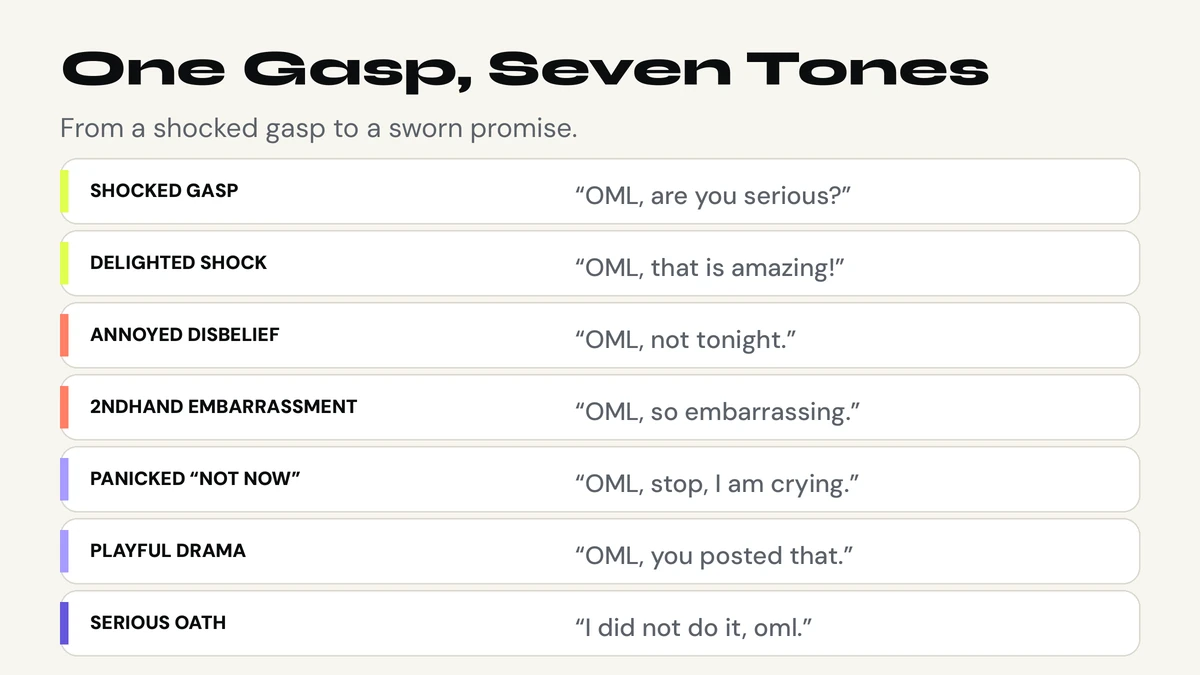
OML’s meaning has two jobs, but its feeling slides across seven readings, loudest to quietest. The first three are safe to send anywhere casual; the last one is a promise, and a promise should only be made when you mean it:
- Shocked gasp: “OML, are you serious?” The default reading. Sudden news, wide eyes, no time for a full sentence. The sender is still processing, and the letters say so.
- Delighted shock: “OML, that is amazing!” Happy news landing all at once. The exclamation marks are the celebration; the letters are only the gasp that came first.
- Annoyed disbelief: “OML, not tonight.” The day going wrong exactly on schedule. The feeling is frustration aimed at the situation, not at you — unless the sentence names you.
- Secondhand embarrassment: “OML, that is so embarrassing.” Somebody else’s awkward moment, felt in your own chest. Playful between friends; a small sting if the person in the story is reading.
- Panicked “not now”: “OML, stop, I am crying.” Overwhelm in three letters — too much feeling, too fast, and the sender needs a second. The reply should slow things down, not add to them.
- Playful drama: “OML, you really posted that.” Exaggeration as a joke. The sender is performing the shock, not suffering it, and a matching laugh is the reply the performance was built for.
- Serious oath: “I did not do it, oml.” The only reading that is not a reaction. The sender is putting their credibility on the line, and the right answer is to the claim — believe it, question it, or ask what happened — never to the letters.
What moves a reading between these tones is never the letters alone: it is the sentence job (reaction or oath), the position (start, end, or alone), and the topic (a chat, a dispute, or a record). The same “oml” that is delighted shock at the start of a sentence on Saturday can be a serious oath at the end of one on Monday — and the test, not the spelling, tells you which day you are on.
“OML” on TikTok
On TikTok, OML lives in comments and captions, and the comment thread is its natural habitat: a creator posts a clip, a fan answers “oml”, and the thread moves on. The public stage suits the playful and delighted readings best, because a comment thread is an audience, not a private conversation — nobody there is owed a sentence, and the gasp lands precisely because everyone in the thread already saw the same clip. The clips themselves usually arrive through the For You feed, and our FYP guide covers that feed in full, because the comment thread under a For You video is where the gasp gets its audience. The ironic reading travels well here too: “oml, the timing of that fall” under a fail video is a compliment dressed as shock, and “oml, I need part two” under a storytime is a demand dressed as a gasp.
TikTok is also the one platform where the music meaning can ambush you. A video captioned “OML still hits hard” is not reacting to anything; it is talking about a Linkin Park track, and the Topic Check catches it before you answer a gasp that was never offered. If an OML arrives in a TikTok DM, though, run the test as usual — a DM is private again, the music reading falls away unless the conversation is about a song, and the oath reading returns with it, because a private denial still needs a promise to back it.
“OML” on Snapchat
On Snapchat, OML fits the fast, private, disappearing DM: “oml, your filter game is strong” as a story reply, or a bare “oml” on a streak snap between close friends. The disappearing format suits the shocked and playful readings — a gasp that lands lightly and is gone. But disappearance also removes your evidence: if an oml felt like an oath, you cannot re-read it, so judge from memory what rode with it — a denial, a claim, or nothing at all. A bare “oml” with no company is the one case where the plain reaction reading is the right one; an oath needs a claim to attach to, and a disappearing snap gives it none.
Snapchat is also where the photo does half the work. A snap of a ruined outfit plus “oml” needs no explanation: the image names the disaster, and the letters only gasp at it. That is the Sentence Job working in real life — remove the OML and the snap still shows a bad day, which is how you know the job was reaction, not information. And because streaks run on speed, oml is a streak-saver: it keeps the conversation alive in three letters when a full sentence would slow the whole exchange down.
“OML” on Instagram
On Instagram, OML shows up in comments, captions, story replies, and DMs, and the stage decides the tone the way it does for every reaction term. Comments lean public and delighted: “oml!!” under a friend’s photos is applause the whole thread can join. Captions lean playful or embarrassed: “oml, I was not ready for that” under a surprise post is a joke about being caught off guard. DMs carry the full range, exactly like texts — a friend’s delighted gasp and a stranger’s annoyed “oml, stop talking” live in the same inbox, and only the test tells them apart.
Instagram is also where OML meets its closest platform trap: reading a public comment as a private verdict. A stranger’s “oml” under your post is a reaction to a photo, not a judgment of you, and answering it with a long explanation embarrasses both sides. A thank-you, a matching laugh, or silence all end it cleanly; the comment was never asking for more. The exception is a DM that keeps the annoyed register going across several messages — that is a tone problem, not a word problem, and the reply section below covers it. For a business, OML is a riskier slang term than most to use in a casual reply: “OML, we love this!” can feel warm in a DM, but the letters carry a religious word, and some customers will read the full phrase where you only meant the gasp, so “Oh wow, we love this!” is the safer choice when the customer is a stranger.
“OML” in Text Messages
Plain texts are OML’s home ground, and the one-to-one setting makes the distinction sharpest. A shocked text wants a witness: “OML, you scared me.” An oath text wants a believer: “I did not do it, oml.” The reply each one deserves is completely different, which is why the Sentence Job comes before the reply — answering an oath with a laugh, or a gasp with suspicion, is the classic OML misfire. Lowercase oml is the default here, because texts are typed fast and lowercase reads softer; capitals in a text are a choice, and a choice is information.
Texts are also where the oath reading does its real work, because a denial in a private chat has nowhere to hide. When somebody ends a denial with “oml,” they are doing the same job as a longer honesty word — and our NGL guide covers that honesty word in full, because an oath and a confession travel together more often than the guides admit. And texts are OML’s work limit in miniature: never send OML in a professional message. A client, a manager, or a first contact deserves plain language, not three letters that presume an intimacy and a casualness you do not have — and never one that could be read as annoyance at a person.
Who Is Sending It: How “OML” Lands by Sender
No source documents a different meaning of OML per sender — the reaction stays a reaction and the oath stays an oath; what changes is which tone you should expect, and therefore what you owe back:
- Friend: the default. A friend’s OML is a gasp at face value — shocked, delighted, or playful; run the test and answer that, not the letters.
- Crush: overread territory. A crush’s OML feels bigger than it is — usually “wow, tell me more,” not a confession about you. Answer the news, not a romance you invented.
- Partner: pattern rules. A partner’s OML is usually routine reaction; judge the pattern across days, not one message — but a sudden run of annoyed omls after delighted ones is worth one plain question, not a fight.
- Parent: usually literal and plain. A parent who writes OML has usually learned it from you and means the gasp plainly; do not read a parent’s OML as an oath unless the sentence around it is a denial.
- Coworker or boss: context decides. In a friendly team chat a colleague’s oml about a deadline is a gasp; in any formal thread it is out of place, and never send one upward to a manager or client — and never one that could sound like annoyance at a person.
- Group chat: both habitats at scale. A group’s “oml!!” cheers for everyone; a group’s single “oml, stop” after your message still stings, but answer briefly in the group either way, and do not single one sender out for a private reading of a public gasp.
- Stranger or creator: the applause habitat. A stranger’s OML under your post, or a creator’s OML in a caption, is a public reaction, not a verdict on you personally. A thank-you or a matching laugh is enough; never answer a public reaction with a private confession about how the day went.
When “OML” Is Too Much: Work, School, and Family
OML’s risk is not vulgarity — the word is clean — but two things at once: the religious word inside it, and the annoyed edge it can carry. Four rooms, four rules. At work: never send OML in a professional message, a client thread, or a formal channel. A gasp among close peers in a casual chat is one thing; the same letters answering a client’s genuine question read as “oh my lord, why did you ask,” and a client who feels talked down to does not come back. If the room would want a reaction, give one that names no lord and no fool: “Oh wow, thank you for flagging that.”
At school: the same rule, with a younger audience, and the same edge in miniature. Teachers, school groups, and class chats are not OML rooms, and a student who answers a classmate’s question with “oml, stop talking” has sent a small judgment whether they meant to or not. In family chats, read the room person by person: a sibling group may love the shortcut, a grandparent group may not know the letters, and a relative who takes the Lord’s name seriously will dislike the abbreviation exactly as much as the full phrase, once they learn what it stands for. Abbreviation is not permission. The general rule covers every room at once: if someone tells you OML bothers them, simply stop. Switching words is easy, and it shows respect. The swap menu is free and it loses nothing: “Oh wow” for a gasp, “No way” for shock, “I promise” for an oath. And one boundary worth stating plainly: never use OML to dress up annoyance at a person, because you cannot control who reads it or how it lands.
Checked Claims: Expansions That Do Not Hold Up
Three letters attract folklore, and a word this old attracts more than most. Each claim below was graded against the dictionary read in full and the competitors read in full; nothing is repeated here as fact on a single blog’s say-so:
- “OML means ‘oh my love’ in texts” — rejected. Only one low-quality guide in this build lists it, no dictionary supports it, and no chat example in any source shows it working that way. Affection has its own letters in this series; OML is a gasp, not a pet name.
- “OML means ‘on my life’ every time” — rejected as the default. Wiktionary lists only “oh my lord.” The oath reading is real but secondary and situational: it needs a denial or a claim to attach to, and it appears far less often than the reaction. Treat it as the second meaning, never the first.
- “OML means ‘one more light’ in texts” — fenced, not a texting meaning. The Linkin Park album and song are real, and music fans do shorten the title this way, but the reading lives in playlists and fan talk, not in chats. A message about a song is a title; a message about your day is a gasp.
- “OML means ‘one more level’ in texts” — fenced, gaming only. One guide lists it for gaming, and no other source in this build repeats it. In a game lobby it may mean one more level; in a text thread it never does.
- “OML is just OMG with different letters” — rejected as an equation. The two overlap — both are gasps — but the competitors agree OML feels slightly more dramatic and more personal, and it carries a different history: a polite alternative to OMG for people who did not want to say God’s name. Same job, different flavour, and swapping one for the other changes the message.
- “OML is rude” — rejected as a blanket claim. The letters themselves are clean, and the oath reading is never rude — it is only a promise. Rudeness lives in the sentence around OML: “oml, stop talking” is dismissive because of the order, not the abbreviation.
- “OML was invented on TikTok” — rejected. TikTok spread the word; it did not invent it. The earliest dated claim in this build is a 2009 Urban Dictionary definition, and other guides trace the abbreviation to the early 2000s as a polite alternative to OMG. Meme culture gave it a second wind in the early 2020s; it did not give it a birth.
- “Lowercase oml and uppercase OML mean different things” — rejected. Wiktionary settles this one directly: lowercase oml is an alternative letter-case form of the same word, with no second sense. Case changes volume and mood, not meaning. Lowercase reads softer and faster, capitals read louder and can feel more dramatic, but both mean “oh my lord.”
What SURVIVES: in chats, OML means “oh my lord,” a fast reaction to shocking, funny, embarrassing, or overwhelming news, with the seven tones above as feelings of the same gasp — not different meanings; in disputes it can mean “on my life,” an oath that swears a denial or a claim is true, graded secondary because Wiktionary lists only the reaction and every competitor calls the oath situational; in music talk it can mean “One More Light,” the Linkin Park album and song; and the sentence-job rule — reaction at the start, oath at the end, music when the topic is music — is the one placement claim the main competitor builds its guide on and the rest of the competitors agree with.
“OML” vs Its Closest Cousins
OML belongs to the reaction family — words that gasp, swear, or certify a feeling. Its closest cousins split by what kind of gasp they give:
- ISTG (oath cousin). Our ISTG guide covers the swear that backs a claim. When OML means “on my life,” it is doing ISTG’s job in softer letters: one word swears the claim is true, the other swears it to God.
- ILY (love cousin). Our ILY guide covers the affection word. The rejected “oh my love” claim tried to make OML do ILY’s job; the two letters belong to different families, and love has its own abbreviation already.
- IKR (reaction cousin). Our IKR guide covers the echo that agrees with a feeling. A reply of “ikr, oml” agrees with the judgment and gasps at the news; IKR shares the feeling, OML performs it.
- FR (emphasis cousin). Our FR guide covers the sincerity stamp that certifies a claim. A comment that reads “fr, oml” uses FR to swear the gasp is real: one word certifies the feeling, the other performs it.
- OMG (full-word cousin). The gasp OML is most often compared with, and the word it was built as a polite alternative to. “OMG, that is wild” and “OML, that is wild” are the same message in different clothes, but OML is the slightly more dramatic, slightly more personal of the two — and the one that avoids God’s name.
- OMW (lookalike cousin). The three letters people mix OML up with most. OMW means “on my way” — a plan, not a gasp — and swapping one for the other changes the whole message: “oml, this is crazy” is a reaction, “omw, be there in five” is a promise of arrival.
Where “OML” Came From
The phrase came first, by centuries. “Oh my lord” is old English for a cry of surprise, and it was a complete, ordinary exclamation long before anyone typed it. The abbreviation is the new part, and it was born the way most texting abbreviations were: out of impatience, and out of politeness. In early internet chat rooms, on instant messaging, and in text threads, people who typed all day started squeezing common phrases into their first letters, and “oh my lord” — a phrase everyone says when the news is too much — was an obvious candidate. The polite part matters too: several guides in this build trace OML to religious texters who wanted the gasp of OMG without saying God’s name, and that story fits the letters, even though no dictionary dates it.
The dates in this build disagree, and the disagreement is worth stating plainly. One guide reports that OML first appeared on the web slang repository Urban Dictionary in 2009, defined as “a more polite way of saying OMG” — that date is competitor-reported, not read directly from the repository. Another guide says the abbreviation first gained popularity around 2010 and then resurged in the early 2020s with meme culture and Gen Z slang. A third traces it to the early 2000s as a polite alternative to OMG. No dictionary in this build dates the abbreviation, so no single year is claimed as fact here: the honest record is that OML was in use by 2009 at the latest, that it grew out of the same early-2000s shortening habit as OMG, and that it came back louder in the early 2020s. No single person coined it: a community shortened it, the way communities shorten everything they say often.
The rise of instant messaging and then SMS made OML ubiquitous, because text threads reward speed above all else, and three letters beat ten every time. Lowercase oml became the default in texts, while the capitals survived for emphasis and for stretching — OMLLL when one gasp is not enough. Meanwhile the music OML was living a separate life entirely: Linkin Park’s album “One More Light” arrived in 2017, fans shortened the title the way fans shorten everything, and the hashtag followed. Two abbreviations, one spelling, two histories that never met: the chat OML grew out of typing less, and the music OML grew out of loving a record. That is why the Topic Check works at all — the history of the abbreviation is a history of two separate rooms, and the room you are standing in still tells you which OML you are reading.
How to Reply When Someone Sends “OML”
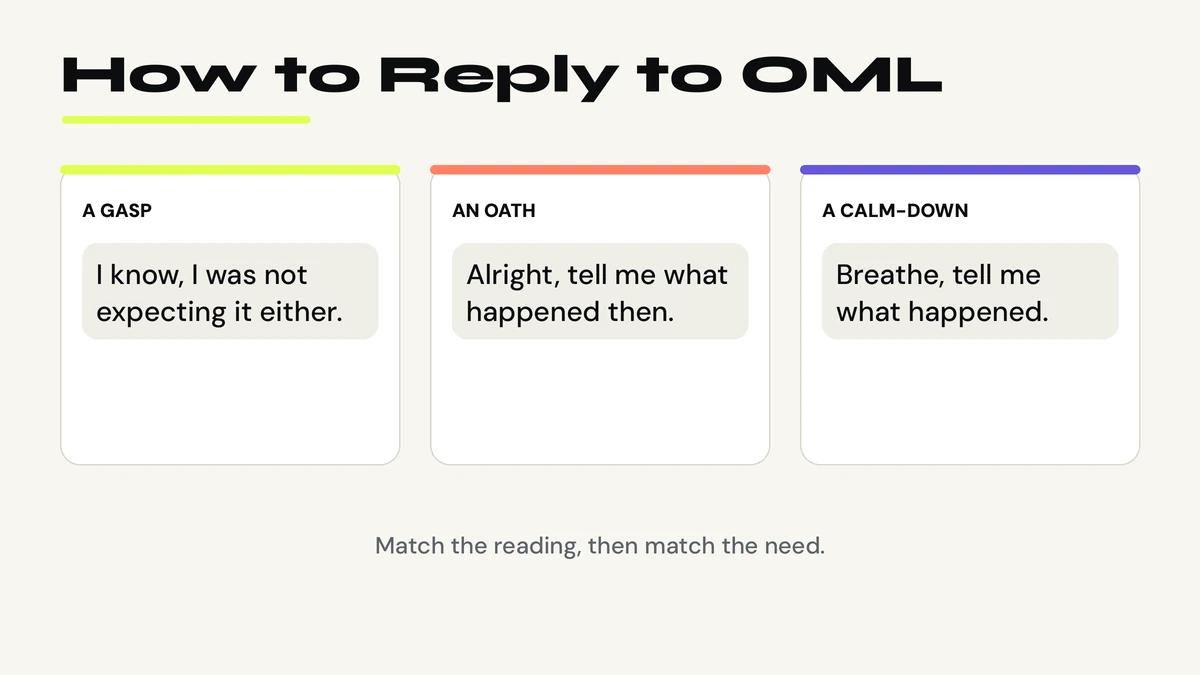
Golden rule: answer the reading the test found, not the letters. A reply bank keyed to the reading:
- Shocked gasp — match the news, not the gasp: “I know, I was not expecting it either” or “Right? I had the same reaction.” The gasp was about the news; the news is what the reply should be about. Do not ask “what does oml mean” when somebody is still processing.
- Delighted shock — celebrate with them: “I am so happy for you!” The gasp was a cheer, and a cheer is the whole reply. A plan or a question about the good news is the natural second sentence.
- Annoyed disbelief — acknowledge the feeling: “Ugh, what happened now?” The sender is frustrated at a situation, and naming the situation is kinder than matching the frustration. If the annoyance was aimed at you, one plain question — “Did I do something?” — works better than a longer jab.
- Panicked “not now” — slow it down: “Breathe, tell me what happened.” The sender is overwhelmed, and the reply should be the calmest message in the thread. And if the panic is real, not performed, our DW guide covers the do-not-worry reply in full, because a panicked oml is usually asking for reassurance without saying so.
- Playful drama — match the energy: “And I would do it again.” The sender is performing the shock, and a matching laugh is the reply the performance was built for. Do not explain the joke; join it.
- Serious oath — answer the claim: “Alright, tell me what happened then.” The oath was about a denial or a claim, and the claim is what needs an answer. Believe it, question it, or ask for the story — but never answer a promise with a laugh.
Frequently Asked Questions
What does OML mean in a text message?
OML means “oh my lord” in a text message — a fast, emotional reaction to shocking, funny, embarrassing, or overwhelming news. It can also mean “on my life” when it sits at the end of a denial or a claim, swearing the words are true. Run the Reaction-or-Oath Test before you decide which job you just got.
What does OML stand for?
It most often stands for “oh my lord.” In some conversations it can also mean “on my life,” a promise or a way to stress that someone is telling the truth. In music talk it can mean “One More Light,” the Linkin Park album and song. Wiktionary lists only “oh my lord” as the dictionary sense.
What does OML mean on Snapchat?
On Snapchat, OML usually keeps the same reaction meaning it has in texting — surprise, excitement, or annoyance at a photo, a story, or a message. The disappearing format means you cannot re-read it, so judge from memory whether it rode with a denial (an oath) or with news (a gasp).
How do I know if it means “on my life”?
If the sentence is a defence like “I did not do it, oml,” it means “on my life.” If it is a reaction like “OML, that is crazy,” it means “oh my lord.” The position is the tell: an oath sits at the end, after the claim it swears to; a reaction sits at the start, before the news it answers.
Is OML rude?
Not by itself. Most of the time OML is not rude — it is a gasp, and the “on my life” reading is never rude, because it only swears honesty. It becomes rude only when the sentence around it sounds dismissive or impatient, like “OML, stop talking.” The letters are not the problem; the order is.
Is OML the same as OMG?
Not exactly. They are close — both are gasps at surprising news — but OMG is more common and more instantly familiar, while OML can feel slightly more dramatic or personal. OML also grew up as a polite alternative to OMG for people who did not want to say God’s name, so the two carry different histories even when they do the same job.
What does OML mean in a song or music post?
In music contexts, OML can refer to “One More Light,” the Linkin Park album and song from 2017. If the topic is Linkin Park, playlists, albums, or songs, the music reading is the one to take; in any other conversation, OML is a reaction or an oath, not a record title.
Does lowercase oml mean something different from OML?
No. Wiktionary lists lowercase oml as an alternative letter-case form of the same word, with no second sense. Capitalization changes volume, not meaning: capital OML reads a touch louder and can feel more dramatic, lowercase oml reads softer, faster, and more relaxed, but both mean “oh my lord.” What changes the reading is the sentence job, the position, and the topic — never the case alone.
The Takeaway
OML means “oh my lord”: a fast reaction to news that is too much for a full sentence. The gasp never changes; the feeling does — shocked, delighted, annoyed, embarrassed, panicked, playful, or sworn. When an OML lands, run the Reaction-or-Oath Test: check the sentence job, check the position, check the topic. And when you send one, remember the only rule that matters: a gasp at the start of a sentence is a gift, and an oath at the end of one is a promise — so if you mean it as a reaction, put it first and prove it with a follow-up sentence, and if you mean it as a promise, put it last and mean it, because three letters are the fastest gasp in the language, and the fastest gasp deserves the clearest one.