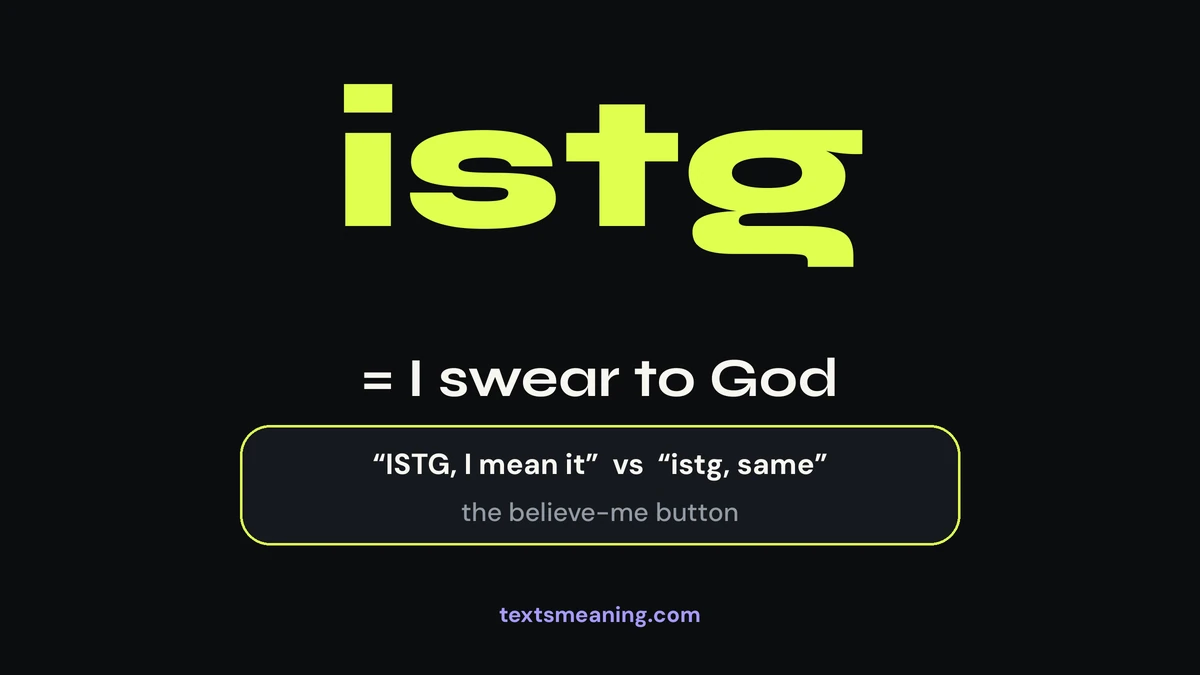
What does istg mean in text? ISTG means “I swear to God” — four letters that ask you to believe the sentence they sit in. Most of the time, though, nobody is swearing anything at all, and this guide to istg meaning in text teaches you to name the job behind the oath.
This guide covers the one dictionary-reported expansion, the ISTG Believe-Me Test, a seven-job tone list, istg on TikTok, Snapchat, Instagram, and in texts, senders, misreads, graded claims, cousins, history, and a reply bank keyed to the job you just named.
What “ISTG” Means in Text
“ISTG” means “I swear to God.” It is an initialism, built from the first letters of the phrase, and it works as an underline for a sentence rather than as the sentence itself: it can open one (“ISTG I locked the door”), close one (“Please forgive me, I will never do it again, istg”), sit in the middle (“You know who just walked by me istg I am freaking out”), or stand alone as a whole reply (“ISTG.”). Unlike the affection terms in this series, istg says nothing about how the sender feels about you. It says how seriously you should take what follows.
The dictionary record is reported, not first-hand, and this guide says so plainly. No Wiktionary ISTG entry surfaced in search for this article, so no Wiktionary attestation is claimed. What two independent competitors report is Dictionary.com’s informal entry: ISTG is an acronym for “I swear to God” used to convey extreme seriousness, exasperation, or surprise, usually outside a serious religious context — and one of those competitors dates that public entry to April 27, 2018. YourDictionary, read in full for this article, agrees in dictionary style: ISTG is an initialism used online or in texting, usable in upper or lower case with the same effect, and even though it uses the word “God,” it does not have a religious meaning in ordinary use. Every competitor guide read for this article agrees on the same expansion, and no competing texting expansion with any dictionary attestation was found.
That agreement is exactly what makes istg tricky. When the meaning is certain, the puzzle moves somewhere else: not what the letters stand for, but what the sender is doing with them this time. A friend defending a story, a coworker venting about a printer, and a stranger reacting to a video are all writing the same four letters, and none of them is swearing the same kind of oath. The rest of this guide is about telling those apart — because answering a joke like a warning, or a warning like a joke, is where istg actually goes wrong.
The ISTG Believe-Me Test
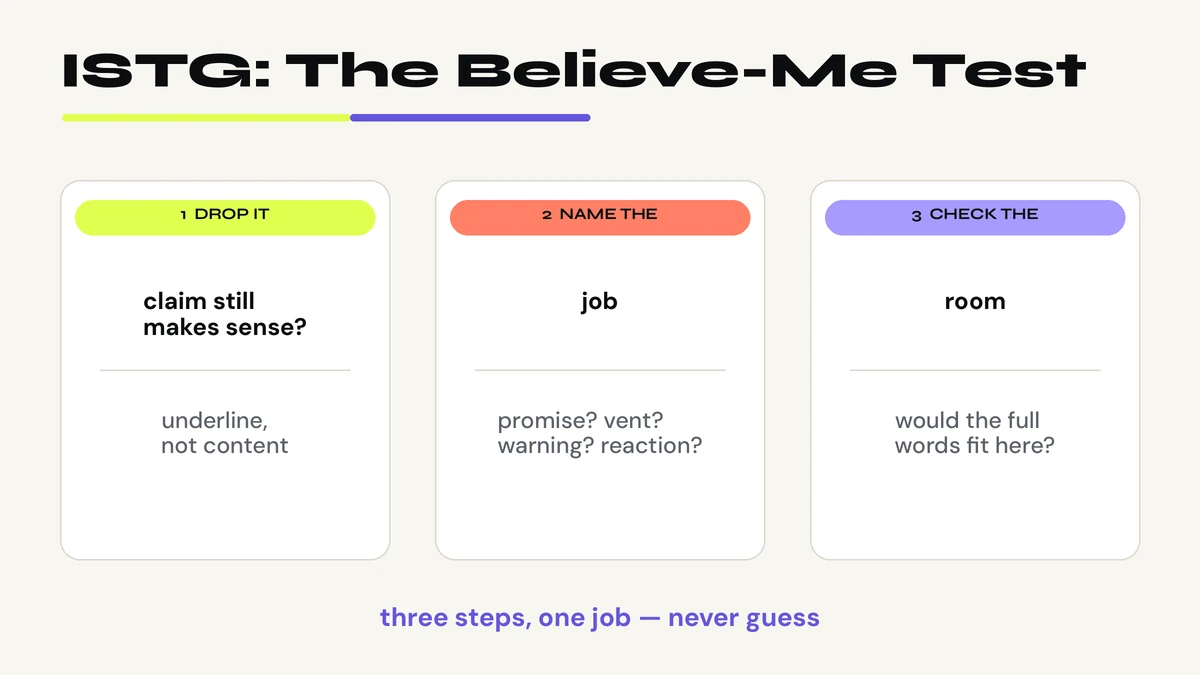
Before you answer an istg — or send one — run three steps. They take about five seconds, and they beat every shortcut the competitors offer, because the competitors all say “context matters” without giving you a procedure for reading it:
- Step 1 — Drop it. Delete ISTG from the sentence and read what is left. If the claim still makes sense — “this printer hates me” without the istg — then ISTG was an underline, not content: it added force, not information. If the sentence collapses without it, the oath was doing structural work, which usually means a bare “ISTG.” standing alone as a whole reply. Most istgs you meet will pass the drop test, and that is the point: an underline should never be mistaken for the message.
- Step 2 — Name the job. What is the sender asking you to believe, or to feel? A promise (“istg I locked the door”) asks for belief in a fact. A vent (“istg if the bus is late again”) asks for sympathy with a feeling. A reaction (“ISTG I just saw a fox on the subway”) asks you to share disbelief. A warning (“istg if you spoil the ending”) asks you to stop. Until you can name the job in one of those words, you have not read the message yet.
- Step 3 — Check the room. Would the sender say the full words to this person, in this place? If “I swear to God” would sound wrong — to a boss, in a formal message, to someone whose faith makes casual oaths unwelcome — then the abbreviation is wrong too, because abbreviation does not launder meaning. Four letters do not make an oath polite; they only make it shorter.
Worked trio. “istg I locked the door, I remember doing it” — drop it and the claim survives (underline); job: promise; room: friend, fine. “ISTG if the train is late again…” — drop it and a complaint survives (underline); job: vent, trailing off; room: friends, fine. “ISTG, that was the funniest thing anyone has said all week” — drop it and praise survives (underline); job: emphatic agreement; room: public comment, fine. Three underlines, three jobs, one test.
“ISTG” in Real Chats
Illustrative examples written for this guide, not real transcripts:
- The sincere promise. “istg I locked the door, I remember doing it” — the sender is being doubted and answers with an oath. Believe the fact, or ask for the detail.
- The frustrated vent. “istg if the bus is late again” — a sigh compressed into letters, usually followed by a complaint. Sympathize with the feeling, not the letters.
- The surprised reaction. “ISTG I just saw a fox on the subway platform” — vouching for an unbelievable-sounding fact. The oath is evidence: I would not make this up.
- The playful exaggeration. “ISTG, the cat has been staring at the wall for ten minutes” — the situation is absurd, so the oath is a joke. Laugh, do not investigate.
- The emphatic agreement. “ISTG same, that movie was awful” — agreement with a sincerity layer on top. The sender is not just agreeing; they are co-signing hard.
- The soft warning. “istg if you spoil the ending” — a mock threat among friends. Acknowledge it lightly; do not answer a joke warning with a real apology.
- The exhausted overload. “ISTG I cannot do this one more time” — emotional exhaustion, not anger at a person. Slow down and offer help, not debate.
The ISTG Tone List
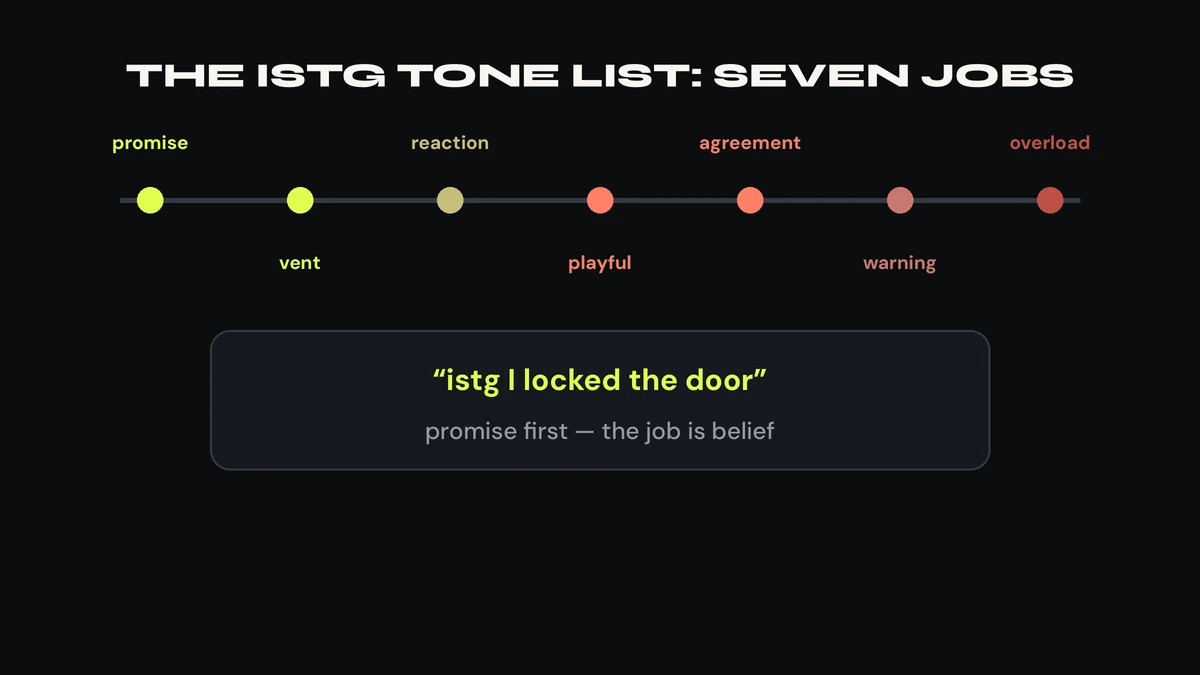
ISTG’s meaning stays “I swear to God”; its job slides. Seven jobs:
- Sincere promise: “istg I locked the door, I remember doing it” — the sender is being doubted and answers with an oath. The job is belief.
- Frustrated vent: “istg if the bus is late again” — a sigh compressed into letters. The job is sympathy, and the complaint that follows is the real message.
- Surprised reaction: “ISTG I just saw a fox on the subway platform” — vouching for something unbelievable. The job is shared disbelief.
- Playful exaggeration: “ISTG, the cat has been staring at the wall for ten minutes” — the absurdity is the tell. The job is a laugh.
- Emphatic agreement: “ISTG same, that movie was awful” — agreement, turned up. The job is a co-sign with feeling.
- Soft warning: “istg if you spoil the ending” — a mock threat among friends. The job is a boundary, drawn lightly.
- Exhausted overload: “ISTG I cannot do this one more time” — the sender is out of patience, not out for a fight. The job is a flare, not a weapon.
What moves a reading between these jobs is never the letters alone: it is the sentence around them, the punctuation (capitals raise the volume, lowercase relaxes it), the emoji (a laughing face turns a vent into a joke), and the relationship. The same “istg” that is a throwaway joke on Tuesday can be a real warning on the night before a finale — and the test, not the spelling, tells you which Tuesday you are on.
“ISTG” on TikTok
On TikTok, istg is a comment-section reaction more than a private message: “ISTG, every family has one person exactly like this” under a relatable video, “ISTG, the ending caught me completely off guard” under a twist, or a creator captioning a rant with a bare “istg.” The public stage suits the reaction and emphatic-agreement jobs best — a comment thread is an audience, not a courtroom, and nobody there is being asked to swear to anything. A TikTok istg usually means something close to “seriously,” “I cannot believe this,” or “I completely relate.”
The trap on TikTok is the reverse of the private-chat trap: taking a public istg too seriously. A creator who writes “istg” under their own video is performing emphasis for a crowd, not making you a promise, and a commenter who writes “istg same” is agreeing in public, not confessing in private. If an istg arrives in a TikTok DM, though, run the test as usual — a DM is private again, and the job rules return with it.
“ISTG” on Snapchat
On Snapchat, istg fits the fast, disappearing caption: “ISTG, this weather changed three times today” over a photo of rain, “ISTG why does my alarm hate me?” on a morning snap, or a story reply carrying the frustration for a few seconds before it vanishes. The disappearing format suits the vent and playful jobs — emphasis that lands lightly and is gone. But disappearance also removes your evidence: if an istg felt like a warning, you cannot re-read it, so judge from memory what rode with it — an emoji, a follow-up, or nothing at all.
Snapchat is also where the photo does half the work. A picture of a disastrous meal plus “ISTG” needs no explanation: the image names the complaint, and the letters only underline it. That is the Drop-It step working in real life — remove the istg and the snap still says everything, which is how you know the job was emphasis, not information.
“ISTG” on Instagram
On Instagram, istg shows up in captions, comments, story replies, and DMs, and the stage decides the job the way it does for every emphasis term. Captions lean public and performative: “ISTG this is the funniest thing I have seen all week” under a video is a reaction for an audience. Comments lean agreement: “ISTG same” under a relatable post is a co-sign the whole thread can join. DMs carry the full range, exactly like texts — a friend’s sincere promise and a match’s soft warning live in the same inbox, and only the test tells them apart.
Instagram is also where istg meets its closest letter-trap. A bio or cross-post that says “follow my IG” is pointing at the app, not swearing an oath — our IG guide covers that pointer in full, and confusing the two is the one Instagram-specific misread worth naming: “IG” inside “ISTG” is not the app, and “ISTG” is not a longer way of writing Instagram. The extra letters change everything — read the whole string, never just the familiar part.
“ISTG” in Text Messages
Plain texts are istg’s home ground, and the place its companion phrases are easiest to see. It pairs with the side-note companion BTW — “istg, btw, did you see the ending?” stacks an oath and an afterthought in one breath — and it stacks with itself: doubling (“ISTG on god he said that out loud”) layers one emphasis on top of another for extra conviction, the way “fr fr” doubles sincerity. Stacking is not a new word; it is the same underline drawn twice.
Texts are also istg’s work limit, stated plainly: never use istg in a professional message. A client, a manager, or a first contact deserves “I promise” or “honestly” spelled out, not four letters that presume an intimacy and a casualness you do not have. The same rule covers formal writing and any serious topic: emphasis deserves complete words when the moment is serious, and istg is, by design, a shortcut.
Who Is Sending It: How “ISTG” Lands by Sender
No source documents a different meaning of istg per sender — the expansion stays fixed; what changes is the job you should expect, and therefore what you owe back:
- Friend: the default. A friend’s istg is a promise, a vent, or a joke at face value; name the job and answer that, not the oath.
- Crush: overread territory. A crush’s istg feels bigger than it is — usually emphasis, not a vow about you. Answer the sentence, not the swear.
- Partner: pattern rules. A partner’s istg is usually routine emphasis; judge the pattern across days, not one message — but a sudden run of istg warnings after a calm stretch is a conversation worth having.
- Parent: usually literal and plain. A parent who writes istg has learned the term from you and means the emphasis plainly; do not read a parent’s istg as a threat unless the sentence around it is one.
- Coworker or boss: context decides. In a friendly team chat a colleague’s istg about a printer is a vent; in any formal thread it is out of place, and never send one upward to a manager or client.
- Group chat: the vent habitat at scale. A group’s “istg this meeting could have been an email” vents for everyone; answer briefly in the group, and do not single one sender out for a private reading of a public vent.
- Stranger or creator: the applause habitat. A stranger’s istg under your post, or a creator’s istg in a caption, is a public reaction, not a promise to you personally. A thank-you or a laugh is enough; never answer in kind with your own oath.
When “ISTG” Is Not Just Emphasis
Four misfires, graded. First, the anger assumption: treating every istg as furious. A laughing emoji plus an absurd situation makes it playful, and a sincere promise makes it warm — answering either like anger starts a fight nobody was having. Second, the literal-oath misread: treating a bleached intensifier as a solemn vow. Most users are not invoking God; they are marking intensity, the way nobody typing LOL is literally laughing out loud. If you hold someone to an istg as if it were a courtroom promise, you are enforcing a contract nobody signed.
Third, the warning misfire in both directions: answering a joke warning (“istg if you spoil the ending”) with a real apology, or answering a real warning with a joke. The Believe-Me Test fixes both, because Step 2 names the job before Step 3 checks the room. Fourth, the faith misfire: using istg where it lands wrong. Because the letters abbreviate “I swear to God,” some readers — across Christian, Jewish, and Muslim traditions, and among people who simply prefer care around God’s name — find casual oaths irreverent, and that is a fair view, documented by every full competitor. The fix is free and it is a swap: “honestly,” “I promise,” or “I’m serious” carries the same force with none of the risk. If someone tells you istg bothers them, simply stop — switching words is easy, and it shows respect.
On appropriateness: istg is not a curse word and not vulgar in any reading; its risk is social and relational, not moral — heat where calm was owed, or a casual oath where reverence was expected. Keep it out of formal, professional, and first-impression messages, out of condolences and serious topics, and out of any first message to someone you do not know well. And one boundary worth stating plainly: never use istg to dress up a real threat. A mock threat among friends (“istg if you eat my leftovers”) is a joke; a real threat with istg stapled to it is still a real threat, and the abbreviation makes it worse, not lighter.
Checked Claims: Expansions That Do Not Hold Up
- “ISTG means Instagram” — rejected as a texting meaning. Instagram is abbreviated Insta or IG; the extra “ST” changes everything, and every full competitor agrees. If a message is about a profile, the word is IG, not ISTG.
- “ISTG means ‘I stay on the grind’ / ‘I stan this group’ / ‘I support the girls’” — rejected as working texting meanings. They appear only on abbreviation-list pages, with no dictionary attestation and no chat example in any source read; list pages collect letter-matches, not usage.
- “ISTG is a literal religious oath every time” — rejected. Dictionary.com, as reported by two competitors, says it is usually used outside a serious religious context, and the bleaching account — most users marking intensity, not invoking God — is the standard linguistic description.
- “ISTG is a swear word” — rejected. It is not a curse word; it is emphasis that happens to invoke God. Some readers find it irreverent, which is an audience question with a swap-out answer, not a profanity classification.
- “ISTG means something different on each platform” — rejected. No source documents a platform-specific meaning; TikTok comments, Snapchat captions, and texts stage the same emphasis differently.
- “ISTG is only for Gen Z or teens” — rejected. Early-2000s AIM and SMS origin predates Gen Z texting, and adults use it in casual chat; a 30-year-old colleague’s istg may read borrowed, but it is still the same word.
- “ISTG always means anger” — rejected. Sincerity, surprise, excitement, humor, and agreement readings are all documented, and a laughing emoji plus an absurd situation makes it playful, not angry.
- “ISTG works in formal writing” — rejected. Every competitor confines it to casual chat; formal contexts want “I promise” or “honestly” spelled out.
What SURVIVES: “I swear to God” (dictionary-reported via Dictionary.com through two independent competitors, plus YourDictionary read in full), with the seven jobs above as uses of the same emphasis — not different meanings. No competitor percentages are repeated here as fact, and the 2007-versus-2008 Urban Dictionary dating discrepancy is reported, not resolved.
“ISTG” vs Its Closest Cousins
ISTG belongs to the emphasis family — words that swear something is true or felt strongly, not words that report a feeling about a person. Its closest cousins split by what they certify:
- FR (“for real”): the softer twin. Our FR guide covers a sincerity marker that vouches for a claim or agrees with one; ISTG swears by it. FR certifies, ISTG swears — same courtroom, louder oath.
- IKR (“I know, right?”): the echo cousin. Our IKR guide agrees with a feeling someone else already stated; ISTG defends a claim of your own. IKR needs a prior line to echo; ISTG needs only a claim to swear by.
- IDC (“I don’t care”): the opposite cousin. Our IDC guide reports indifference where ISTG reports intensity: ISTG says this matters enough to swear by, IDC says it does not matter at all. Same volume, opposite direction.
- ILY (“I love you”): the feeling cousin. Our ILY guide says how the sender feels about someone; ISTG says how seriously the sender means a claim. ILY is a feeling in three letters; ISTG is an oath in four. Mixing them up turns a promise into a confession.
- ONG (“on God”): the agreement twin. ONG usually agrees with a friend’s statement, while ISTG defends your own — you say ISTG when you talk about yourself, and ONG when you agree with a friend.
- STG (“swear to God”): the shorter twin. Same oath minus the “I,” more casual and more often a simple agreement check; ISTG, with the pronoun, sounds like a direct, individual pledge.
And one name-only neighbor worth fencing: OMG (“oh my God”) reacts with surprise where ISTG swears with emphasis — OMG is a reaction, ISTG is a promise, and the two are related the way a gasp is related to a vow.
Where “ISTG” Came From
The phrase “I swear to God” is centuries-old ordinary English; YourDictionary traces it to the courtroom oath, possibly since the 13th century, in which a witness swore by Almighty God to tell the truth, the whole truth, and nothing but the truth. The abbreviation belongs to the early-2000s AIM, Yahoo Messenger, and SMS era, when character limits and keypad typing rewarded four-letter feelings, and it rode the same character-saving wave as LOL, BRB, AFK, and OMG. One competitor reports the first visible Urban Dictionary entry dated January 3, 2008 (“I swear to God. Promising”); another reports 2007. Both are user-generated attestation, not a coinage claim, and no inventor is named by any source — the discrepancy is stated here rather than smoothed over.
Usage stayed steady through the Facebook status era, grew on Snapchat and WhatsApp in the late 2010s, and became standard Gen Z vocabulary on TikTok around 2020 to 2021, by which point Dictionary.com had already noticed it publicly (April 27, 2018, per one competitor). Like most texting shorthand, istg was born from a constraint — saying something emphatic in very few keystrokes — and survived the constraint because the emphasis turned out to be a feature: sometimes you want the force of an oath without the weight of a courtroom. Linguists call that drift semantic bleaching: the literal meaning fades while the force remains, the way LOL no longer means literal laughter. ISTG today is mostly bleach and force — which is exactly why the Believe-Me Test starts by dropping it.
How to Reply When Someone Sends “ISTG”
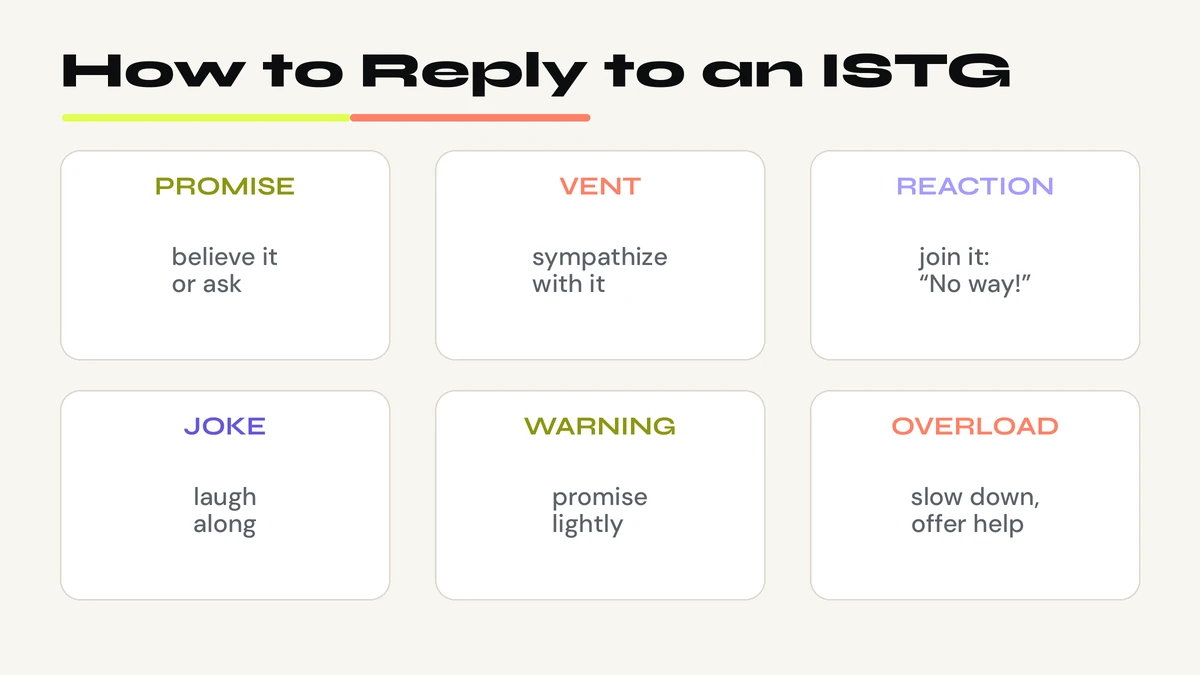
One rule, then six replies: answer the job the Believe-Me Test named, not the oath. An oath answered with an oath escalates; a job answered with its match resolves:
- Sincere promise — believe it or ask: “Okay, I believe you” or “Wait, really? Tell me more.” A promise wants belief, and a question is belief with curiosity attached.
- Frustrated vent — sympathize: “That sounds annoying, what happened?” Address the problem, not the abbreviation. A vent answered with a lecture about language doubles the frustration.
- Surprised reaction — join it: “No way!” or a laughing emoji. A reaction wants company, not fact-checking.
- Playful exaggeration — laugh along: a laughing emoji or a matching joke. A joke answered seriously is the only wrong answer here.
- Soft warning — acknowledge lightly: “Okay okay, no spoilers, I promise.” A joke warning wants a light promise, not a real apology — and a real warning wants a real promise, not a joke.
- Exhausted overload — slow down: “Hey, take your time — what can I do?” An overload flare wants help, not debate, and never a second istg on top of it.
Weak versus strong. Weak: a bare “istg” back to a loaded message. Strong: “I hear you — tell me what happened.” Small change, big difference. Golden rule: when the job is unclear, read the previous messages before assuming anger — most istg misreads are anger assumed where the job was play or exhaustion. You can also hand the chat forward with HMU — “istg, hmu when you are free” swears the feeling and opens the door for the longer conversation the abbreviation could not carry.
Frequently Asked Questions
What does “ISTG” mean in a text message?
ISTG means “I swear to God” in a text message. It is used to add emphasis — to swear that something is true, to vent frustration, to react with surprise, or to joke with exaggeration — and its job depends on the sentence around it. Run the Believe-Me Test above before you decide which job you just received.
Is istg a bad word?
No, istg is not a curse word. It is emphasis that happens to invoke God, and most readers treat it as casual slang. Some readers do find casual oaths irreverent, so if you do not know your audience, swap in “honestly” or “I promise” instead.
Does istg mean Instagram?
No. Instagram is abbreviated Insta or IG. ISTG means “I swear to God” — the extra letters change everything, and reading only the familiar “IG” inside the string is the most common istg misread there is.
Is istg the same as OMG?
They are related, but they do different jobs. OMG (“oh my God”) reacts with surprise; ISTG swears with emphasis. OMG is a gasp, ISTG is a vow — one reacts to news, the other certifies a claim.
What is the difference between istg and FR?
FR (“for real”) vouches for a claim or agrees with one; ISTG swears by it. FR is the softer twin — a sincerity stamp — while ISTG is the louder oath. In a sentence, FR certifies and ISTG swears.
Can I use istg at work?
It is better to avoid it in professional messages. Writing out “I promise” or “I’m serious” is clearer, suits every colleague, and carries none of the faith or casualness risk. In a friendly team chat about a printer, it is fine; in a client message, it is not.
What should I reply when someone sends istg?
Answer the job, not the oath: believe a promise or ask for the detail, sympathize with a vent, join a reaction, laugh at a joke, acknowledge a warning lightly, and slow down for an overload flare. The reply bank above has one for each job.
Does lowercase istg mean something different from ISTG?
No, the meaning is the same; only the volume changes. Lowercase istg reads casual and relaxed, all-caps ISTG reads louder and more emphatic, and a bare “ISTG.” with a period reads like a full stop. Case is volume, not a new definition.
The Takeaway
Four letters, one phrase, seven jobs. ISTG means “I swear to God” — and whether that is a promise, a vent, a reaction, a joke, an agreement, a warning, or a flare is decided by the Believe-Me Test: drop it, name the job, check the room. Send it when the sentence genuinely needs emphasis, swap it out when the room would rather hear “I promise,” and answer the job you actually received.