What does irl mean in text? IRL means “in real life” — the physical world outside the screen, as opposed to what happens online. This guide to irl meaning in text teaches you to read which side of the screen it is pointing at.
This guide covers the one dictionary-supported expansion, the IRL Screen Test, five jobs IRL does in a sentence, a tone list, irl on TikTok, Snapchat, Instagram, and in texts, senders, the “me IRL” meme and IRL streams, graded claims, cousins, history, a meetup-safety checklist, and replies keyed to the job you just found.
What “IRL” Means in Text
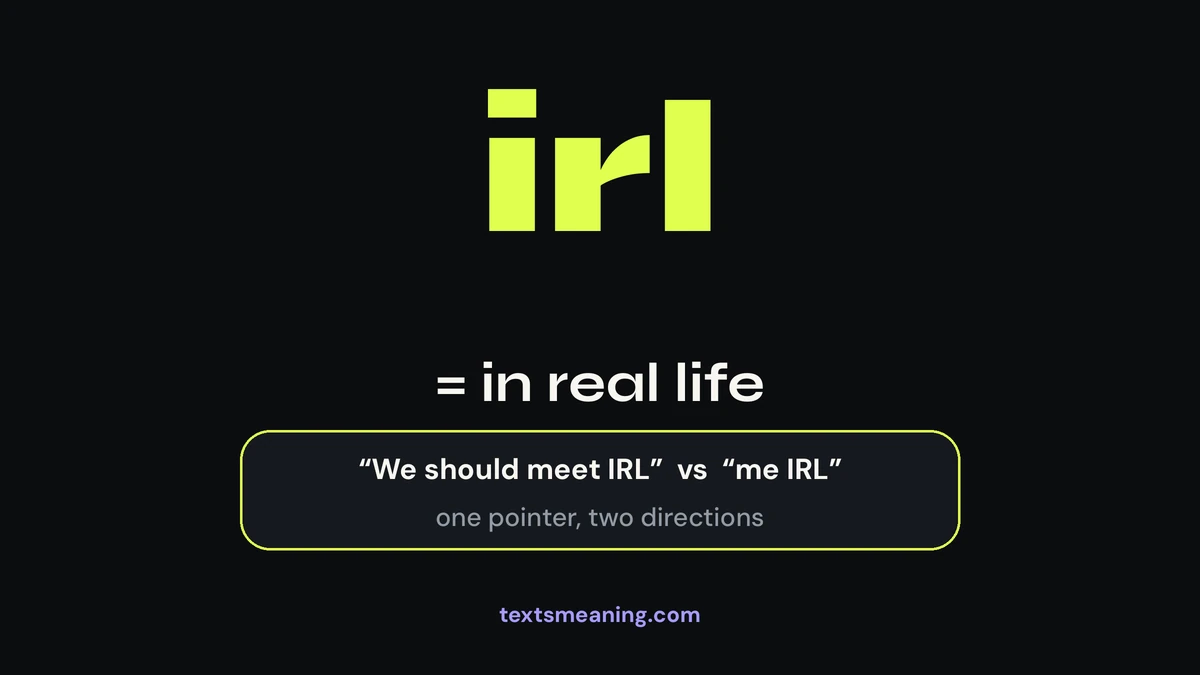
“IRL” means “in real life.” It is an initialism, pronounced letter by letter (“eye-ar-ell”, never “earl”), and it works as a pointer: it tells you that the person, place, event, or version of someone being talked about belongs to the physical world, not to the internet. “We finally met IRL” means the meeting happened face to face. “She is funnier IRL” means the in-person version beats the online impression. “My IRL friends” means the friends you know outside the internet, as opposed to the ones you only know through a screen.
The dictionary record is short and consistent. Wiktionary lists IRL under “real life” as the abbreviation for the phrase, with the relevant sense given as life outside of the Internet; it also notes, honestly, that the sense is sometimes discouraged because it can imply that internet interactions are less “real” than offline ones — a nuance this guide keeps, in the section on what IRL does not claim. Merriam-Webster defines the full phrase as “in a real situation: in actual existence,” with current examples showing people meeting in real life and deciding whether someone is a longtime friend in real life. Every competitor guide read for this article agrees on the same expansion, and no competing texting expansion with any dictionary attestation was found.
That agreement is exactly what makes irl tricky in a different way from the last article. ILY had one meaning with many weights; IRL has one meaning with many directions. The letters always point at the physical world, but the sentence can use that pointer to arrange a meetup, compare two versions of a person, report on something seen in person, joke about itself, or label a whole event. The rest of this guide is about telling those jobs apart — because answering a meetup invitation like a meme, or a meme like a meetup invitation, is where irl actually goes wrong.
The IRL Screen Test
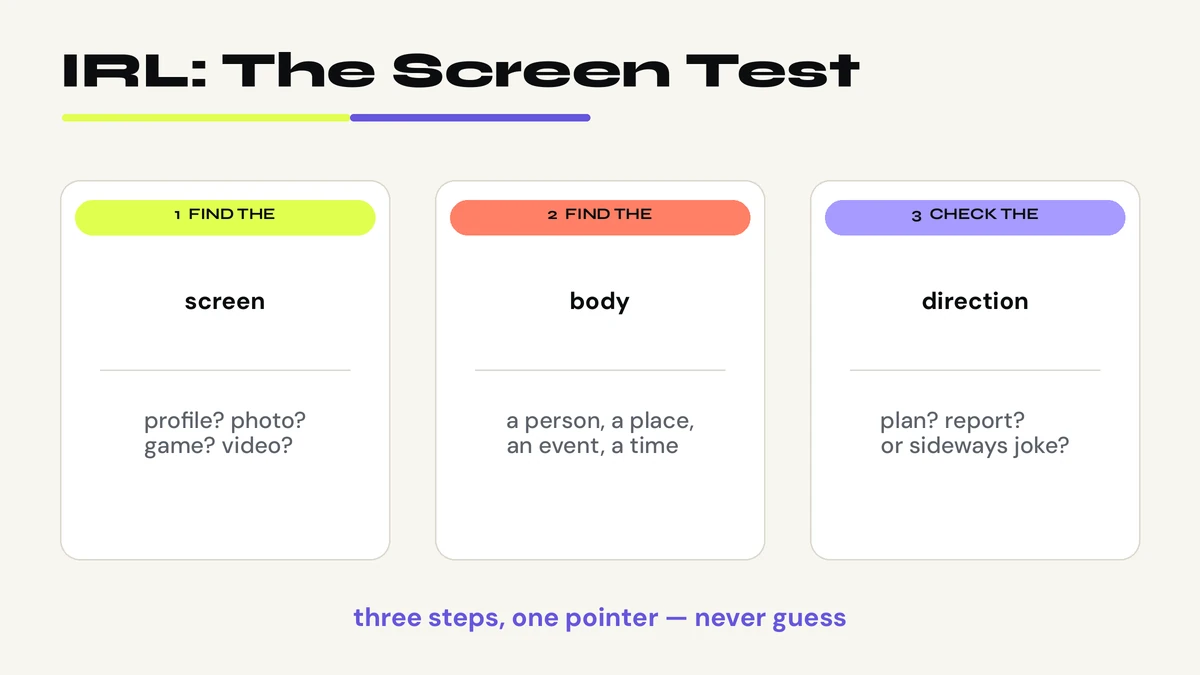
Before you answer an irl — or send one — run three steps. They take about five seconds, and they beat every shortcut the competitors offer, because the competitors all say “context matters” without giving you a procedure for reading it:
- Step 1 — Find the screen. What online thing is being contrasted? A profile, a photo, a game, a chat, a video, a username. If you cannot name the online side, you have not found the contrast yet — and most irl misreads start here, with the reader assuming a screen that was never in the sentence.
- Step 2 — Find the body. What physical thing is irl pointing at? A person you can meet, a place you can visit, an event you can attend, a voice you can hear in a room. IRL always lands on something with a body, a place, or a time — if it lands on nothing physical, you are probably reading the meme job, not the meetup job (see the “me IRL” section).
- Step 3 — Check the direction. Which way is the arrow pointing? Online toward offline (“we should meet IRL” — a plan), offline toward online (“met her IRL, now we text every day” — a report), or sideways into a joke (“me IRL” under a picture of a cat asleep on a keyboard — a self-portrait)? The direction decides the reply: plans get answers, reports get reactions, jokes get laughter.
Worked trio. “We have talked for months, we should meet IRL on Saturday” — screen: months of chatting; body: a Saturday meeting; direction: online toward offline, a plan — answer the plan. “The jacket looked ordinary in the photos, but the fabric is beautiful IRL” — screen: product photos; body: fabric in a shop; direction: offline toward online, a report — answer the report. “me IRL” under a video of someone tripping over their own feet — screen: the video itself; body: the sender, jokingly; direction: sideways — laugh, do not ask when they are free to meet.
“IRL” in Real Chats
Illustrative examples written for this guide, not real transcripts:
- The meetup plan. “We met in a forum and became IRL friends later.” — online toward offline, a friendship that crossed the screen.
- The comparison. “She seems quiet online, but she is very funny IRL.” — two versions of one person, and the physical one wins.
- The in-person report. “That restaurant looks amazing in the videos, but it is even better IRL.” — the screen promised; the visit delivered.
- The identity note. “I am a teacher IRL.” — the classic early-internet use: who you are when the username comes off.
- The event label. “The artist is hosting an IRL drawing workshop next month.” — a physical event, as opposed to an online class.
- The meme self-portrait. “me IRL” under a photo of a blanket burrito on a couch — not a plan and not a report, a joke about the sender.
- The gentle correction. “He seems lovely on screen, but he is a horrible person IRL.” — the comparison doing honest, uncomfortable work.
The IRL Tone List
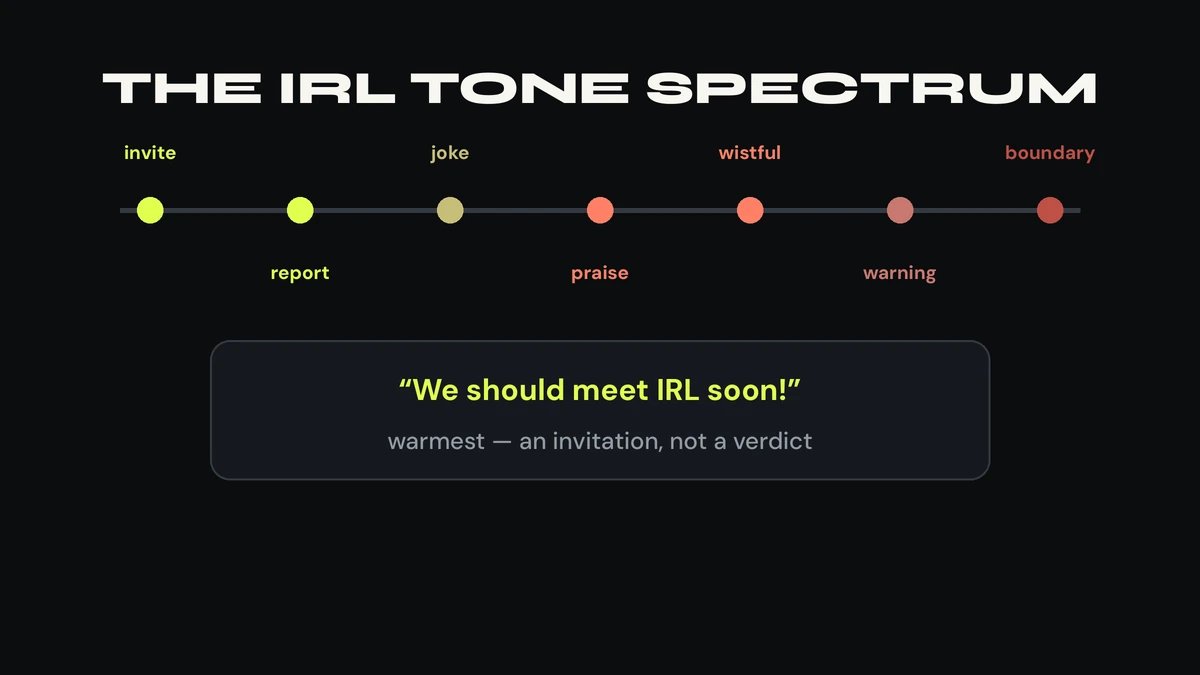
IRL itself is neutral — it names a side of the screen, not an attitude. The tone comes from the job and the direction. Seven readings, lightest to heaviest:
- Warm invitation: “We should meet IRL soon!” — the friendliest job, a door opening.
- Casual report: “The jacket is beautiful IRL.” — plain information, no feeling attached.
- Playful joke: “My phone battery is always at 5% IRL.” — the everyday-experience gag the competitors all quote, because it works.
- Affectionate comparison: “You are even kinder IRL.” — the comparison as a compliment.
- Wistful distance: “I wish we lived closer IRL.” — the screen named as a barrier, not just a medium.
- Blunt correction: “He is horrible IRL.” — the comparison as a warning, and the one reading where the tone is the message.
- Defensive boundary: “That is not my IRL life.” — drawing a line between a persona and a person, usually after an overstep.
What moves a reading up or down this list is never the letters alone: it is the direction (step 3), the relationship, and whether the physical side is being praised, reported, or used as a warning. The same “IRL” that is a warm invitation on Saturday can be a blunt correction on Sunday — and the test, not the spelling, tells you which day you are on.
“IRL” on TikTok
On TikTok, irl does two jobs at once, and the feed is the reason. First, the comparison job: “She is funnier IRL” under a creator clip, or “the concert hit different IRL” under concert footage — the video is the screen, the visit is the body. Second, the meme job: “me IRL” captions, where the video is the joke and the sender is the punchline. TikTok is also where irl meets its feed cousin: a video you found because an algorithm showed it to you lives on a feed, and our FYP guide covers that feed — the FYP shows you the video, irl names the world outside it. Confusing the two is easy because both arrive on the same screen; the test separates them, because only irl points at a body.
The trap on TikTok is the reverse of the private-chat trap: taking a public comparison too personally. A creator who writes “IRL version” in a caption is staging a contrast for an audience, not confessing something about you, and a commenter who writes “me IRL” under a stranger's video is joking about themselves, not inviting you anywhere. If an irl arrives in a TikTok DM as a meetup plan, though, run the test as usual — a DM is private again, and the safety rules in the reply section return with it.
“IRL” on Snapchat
On Snapchat, irl fits the fast, disappearing DM: “we should hang out IRL this weekend” as a chat reply, or “you are so much funnier IRL” on a streak snap. The disappearing format suits the warm-invitation and playful readings — plans made lightly and gone. But disappearance also removes your evidence: if an irl felt like a boundary (“that is not my IRL life”), you cannot re-read it, so judge from memory what rode with it — a plan, a joke, or a warning.
Snapchat is also where the crush ambiguity lives most vividly, for a different reason than the last article's. A crush's “we should meet IRL” on Snapchat can read as a date, a hangout, or a joke, and the format gives you no second look to decide. The test still works from memory: what was the screen (weeks of snapping?), what body is being proposed (coffee? a group hangout?), and which direction (online toward offline)? If you cannot answer all three, a warm, specific reply is safer than a vague yes — “Sounds fun — what did you have in mind?” costs nothing and names the plan.
“IRL” on Instagram
On Instagram, irl shows up in captions, comments, story replies, and DMs, and the stage decides the job the way it does for every screen-word. Captions lean comparative: “Even better IRL” under a travel photo is a report to an audience, closer to a review than a whisper. Comments lean playful: “me IRL” under a post is a self-portrait with a laugh attached. DMs carry the full range, exactly like texts — a friend's meetup plan and a match's first “we should meet IRL” live in the same inbox, and only the test tells them apart.
Instagram is also where irl meets its closest platform cousin. A bio or cross-post that says “follow my IG” is pointing at the app, not at the physical world — our IG guide covers that pointer in full, and confusing the two is the one Instagram-specific misread worth naming: “IG” in capitals as a pointer is a noun for an app, while “irl” as a message is a pointer to a world. Same alphabet, different jobs.
“IRL” in Text Messages
Plain texts are irl's home ground, and the place its companion phrases are easiest to see. It pairs with the private-channel companion DM — “we talked in the DMs for months, now let's meet IRL” moves a conversation from a channel to a place in one breath — and with the side-note companion BTW — “btw, have you ever met him IRL?” tucks the screen question inside an afterthought, which is why the two so often travel together.
Texts are also irl's work limit, stated plainly: never use irl where the reader cannot see the screen. In a work email, a formal message, or a note to someone who does not live online, “irl” reads as jargon, because the contrast it points at — online versus offline — is not shared ground. Spell it out instead: “in person” works in every room, and “face to face” works in the ones where a meeting is actually being proposed. The same rule covers serious topics: a condolence, a medical conversation, or a job offer deserves complete sentences, not a pointer that assumes the reader knows which screen you mean.
Who Is Sending It: How “IRL” Lands by Sender
No source documents a different meaning of irl per sender — the expansion stays fixed; what changes is the job, and therefore what you owe back:
- Friend: the default. A friend's “we should meet IRL” is a plan at face value; answer the plan, not the letters.
- Crush: overread territory. A crush's first “meet IRL?” feels bigger than it is — usually a hangout proposal, not a confession and not a joke. Answer with a specific question, and if you feel the same, name a public place.
- Partner: pattern rules. A partner's irl is usually a comparison (“you are funnier IRL”) or a shared plan; judge the pattern across days, not one message.
- Online-only friend: the crossing habitat. An online friend's “we should meet IRL” is the biggest job irl ever does — it proposes moving a whole relationship across the screen. Read the safety checklist in the reply section before you answer.
- Creator or stranger: the public habitat. A creator's “IRL event” is an announcement, and a stranger's “me IRL” is a joke; neither is a personal invitation. A thank-you or a laugh is enough; never answer in kind with personal details.
- Parent: the translation habitat. A parent who writes “IRL” usually means the plain phrase — “see you in real life, not on the phone” — and may not know the meme job at all, so do not read a parent's “me IRL” joke as a plan.
- Coworker or boss: context decides. In a friendly team chat a colleague's “let's discuss this IRL” means in person, and it is fine; in any formal thread, spell it out instead, and never send irl upward to a client.
When “IRL” Is Not Just a Place
Three uses that break the simple “physical world” picture, each graded. First, “me IRL”: a meme construction, not a location. It pairs the phrase with an image, video, or statement that the poster believes represents their own real-life state — often self-deprecating, often absurd — and it became a whole humor format, including a very large subreddit whose posts are titled with that phrase alone. The letters still stand for “in real life,” but the job is self-portraiture, and answering it as a meetup plan is a category error.
Second, IRL streams and IRL events: the label has escaped the sentence and become a category. An IRL stream is a broadcast where a creator takes the camera outside and streams daily life, travel, cooking, or a walk around a city, rather than sitting indoors playing a game; an IRL event is a physical gathering announced to an online community. Here irl modifies a noun the way an adjective would (“IRL friend,” “IRL bestie,” “my IRL self”), and the grammar matters: the noun tells you what is physical, and irl tells you it is not the online version.
Third, the philosophical edge, stated plainly because the competitors skip it: irl does not claim that online life is unreal. Wiktionary itself flags that the “life outside the Internet” sense is sometimes discouraged for implying exactly that, and ordinary usage agrees — “my online friends are important to me, even if I haven't met them IRL” distinguishes where a relationship exists, it does not dismiss the relationship. If someone uses irl to say your online friendships do not count, they are misusing the pointer, not using it.
On appropriateness: irl is not rude and not vulgar in any reading; its risk is social, not moral — a meetup proposed too soon, a comparison that lands as a warning, or jargon used where the screen is not shared ground. Keep it out of formal, professional, and first-impression messages, out of condolences and serious topics, and out of any first message to someone you do not know well. And one boundary worth stating plainly: a meetup invitation from an adult stranger to a child or teenager should never be answered with a plan — if your child receives a “meet IRL” message from someone you do not know, ask calmly who it came from, the way you would for any unexpected message.
Checked Claims: Expansions That Do Not Hold Up
- “IRL means ‘Ireland’ in texts” — fenced, not rejected outright. IRL is a genuine country-code-style abbreviation for Ireland in transport, registration, and database contexts, and secondary sources record it there; but in an ordinary text or chat it is not the reading, and no dictionary attests it as a texting meaning. If irl appears in a sports headline, a database, or an international-registration context, check the surrounding text first.
- “IRL means ‘in the right lane’ / ‘inverse reinforcement learning’ / other technical expansions” — fenced as domain homonyms. Abbreviation lists record dozens of these (Indy Racing League, industrial research, and more); they are real initialisms in their own fields and zero relevance to English texting. Noted here so nobody mistakes them for texting meanings, nothing more.
- “IRL is pronounced ‘earl’” — rejected. IRL is an initialism, spoken letter by letter; dictionaries give the pronunciation as eye-ar-ell, and no source attests a word-like pronunciation.
- “IRL means something different on each platform” — rejected. No source documents a platform-specific meaning; TikTok captions, Snapchat DMs, and texts stage the same pointer differently.
- “IRL always means offline, and offline always means IRL” — rejected as an equivalence. IRL identifies the physical-world side of a contrast; offline can also mean a device or service disconnected from a network (“the printer is offline”). If the important detail is a face-to-face meeting, use irl or in person; if it is network connectivity, use offline.
- “IRL must always be uppercase” — rejected as a rule. Uppercase is the dictionary form, but lowercase “irl” is common in casual messages and carries the same meaning; capitalization is a style choice, not a meaning change.
- “IRL means online life is not real” — rejected. Ordinary usage distinguishes where something happens, not whether it counts; see the philosophical edge above.
- “IRL is only for Gen Z” — rejected. IRL predates Gen Z texting by decades — 1990s chatrooms, and a dictionary listing reported for the year 2000 — and major dictionaries list it as established vocabulary used across ages.
What SURVIVES: “in real life” (dictionary-supported, Wiktionary plus Merriam-Webster, plus unanimous competitor agreement), with the five jobs above — meetup plan, comparison, in-person report, identity note, and meme self-portrait — as uses of the same pointer, not different meanings. No competitor percentages are repeated here as fact, and the year-2000 dictionary-listing claim is reported as secondary-source reporting, not verified in the dictionary itself.
“IRL” vs Its Closest Cousins
IRL belongs to the screen-family — words that sort the online world from the physical one. Its closest cousins:
- Online: the opposite pole. Online names the internet side of the contrast; irl names the physical side. Neither means anything alone — each needs the other to point at.
- Offline: the near-synonym with a second job. Offline can mean the physical world, but it can also mean disconnected from a network; irl never means a disconnected printer.
- In person / face to face: the formal replacements. They carry the same meeting meaning without the slang, and they work in rooms where irl would read as jargon.
- RL (“real life”): the shorter twin, mostly in gaming communities. Same pointer, fewer letters, narrower circulation.
- AFK (“away from keyboard”): the absence cousin. Our AFK guide covers it: AFK says someone has stepped away from the screen, while irl says where real life is happening. One is a status, the other is a place.
- Meatspace: the playful synonym Wiktionary lists beside real life — the physical world, named as a joke about bodies versus screens. Understandable, rarely used, and never the default.
Where “IRL” Came From
IRL belongs to the older generation of internet abbreviations, and that age is the point. It grew up in 1990s chatrooms, forums, Usenet boards, and multi-user dungeons, where people who talked to each other daily under usernames needed a quick way to say “outside the internet.” Because early online talk was mostly anonymous, the phrase did real work: an online friend asking what you did for a living would get “a dentist IRL” — the username off, the person on. That is the strongly supported origin, agreed across the competitors and the dictionary record.
Then the line moved. With social networks in the 2000s, people began using their real names and faces online, and irl stopped meaning only “my secret offline life” and started meaning “the version of me you can meet.” Meeting a longtime guildmate at a convention, comparing a celebrity's on-screen persona with who they are on the street, or labeling a stream that leaves the house — all of these are the same pointer, pointed at a world where online and offline now overlap instead of standing apart. Secondary explainers report a dictionary listing in the year 2000; that date is repeated here as their report, not as a verified dictionary entry, because the dictionary itself was not consulted for its first-listing date.
The meme job came last and changed the least: “me IRL” kept the same letters and turned the pointer inward, from a place you could visit to a joke about yourself. That is why irl has survived while hundreds of its 1990s siblings vanished — the distinction it names, between a screen and a body, has only gotten more useful as screens have gotten closer.
How to Reply When Someone Sends “IRL”
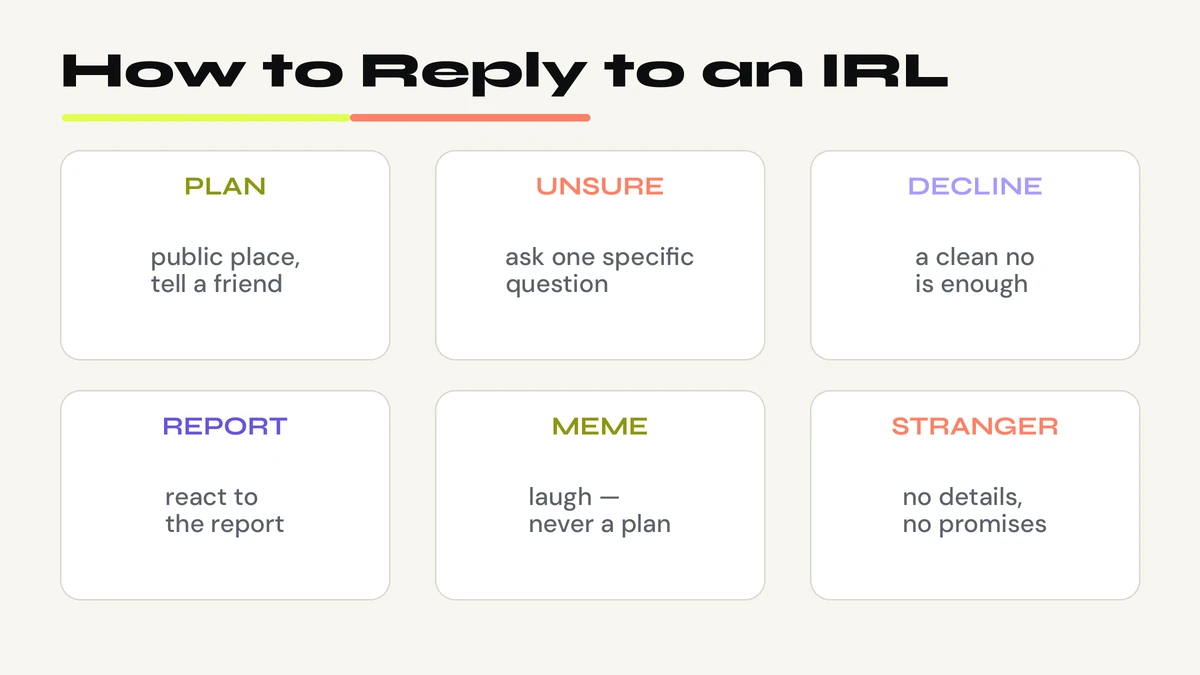
Match the direction the Screen Test found, not the letters. And if the direction is a meetup plan from someone you only know online, read the safety checklist first — it is the one reply in this guide where getting it wrong has consequences beyond awkwardness:
- Meetup plan, and you want to go: answer the plan with a place and a time — “Yes! Coffee on Saturday?” — and keep it public for a first meeting. Meet in a public place, tell a friend where you are going and when you expect to be back, keep your phone charged, and arrange your own way home. A first IRL meeting is a plan, not a promise, and any of those steps can be added without making it awkward.
- Meetup plan, and you are unsure: ask one specific question — “Sounds fun — what did you have in mind?” A vague yes to a vague plan is how people end up somewhere they did not agree to.
- Meetup plan, and you do not want to go: “Thanks, not this time” is a complete answer. You owe no reason and no alternative, and a plan you decline is not a friendship you declined.
- Comparison: answer the comparison, not the letters — “Ha, I am much quieter in person, honestly” or “The photos really do not do it justice.”
- In-person report: react to the report — “That makes me want to visit!” If they say a place is better IRL, they are recommending it.
- Meme self-portrait: laugh, or send one back. Never answer “me IRL” with a meetup plan; the joke is the whole message, and the HMU you might send to arrange a real meeting belongs in a different message, on a different day.
What never works: replying to a meetup plan as if it were a joke, replying to a joke as if it were a plan, or answering a stranger's “meet IRL” with personal details. Answer the plan, the report, or the joke — whichever irl showed up — and when the direction is a first meeting with someone you only know online, let the safety checklist answer first.
Frequently Asked Questions
What does “IRL” mean in a text message?
“In real life.” In a text, it normally distinguishes an in-person person, meeting, event, or version of someone from one that exists online or in a game.
What does “me IRL” mean?
It is a meme phrase, usually paired with an image or video that humorously represents the poster: “this is me in real life.” It is a self-portrait joke, not a meetup invitation.
Is IRL the same as offline?
Closely related, but not always interchangeable. IRL means “in real life” and points at the physical world; offline can also mean a device or service disconnected from a network.
Should IRL be written in capital letters?
Uppercase is the dictionary form, but lowercase “irl” is also widely understood in informal messages. Both forms carry the same meaning.
Is IRL the same as “in person”?
Usually, yes. “In person” is the clearer and more formal alternative, while IRL is an informal internet abbreviation that assumes the reader knows the online side of the contrast.
Does IRL mean online life is not real?
Not in ordinary usage. It distinguishes where something happens — online or in the physical world — not whether it counts. Online friendships, work, and experiences are real; irl just says where the in-person version lives.
What is an IRL stream?
A broadcast where a creator takes the camera outside and streams daily life, travel, cooking, or a walk around a city, rather than sitting indoors playing a game. The label marks the stream as physical-world content.
Is it safe to meet someone IRL after talking online?
It can be, with the checklist in the reply section: meet in a public place, tell a friend where you are going, keep your phone charged, and arrange your own way home. If anything feels off, decline or postpone — a real plan survives a postponement.
The Takeaway
IRL is a three-letter pointer: “in real life,” the physical world outside the screen. It has survived since the 1990s because the contrast it names has never gone away — screens have only gotten closer, and the question of which side of one you are on has only gotten more useful. Before you answer one, run the Screen Test: find the screen, find the body, check the direction. Plans get answers, reports get reactions, jokes get laughter — and a first meeting with someone you only know online gets the safety checklist first. That is the whole skill, and it fits in five seconds.