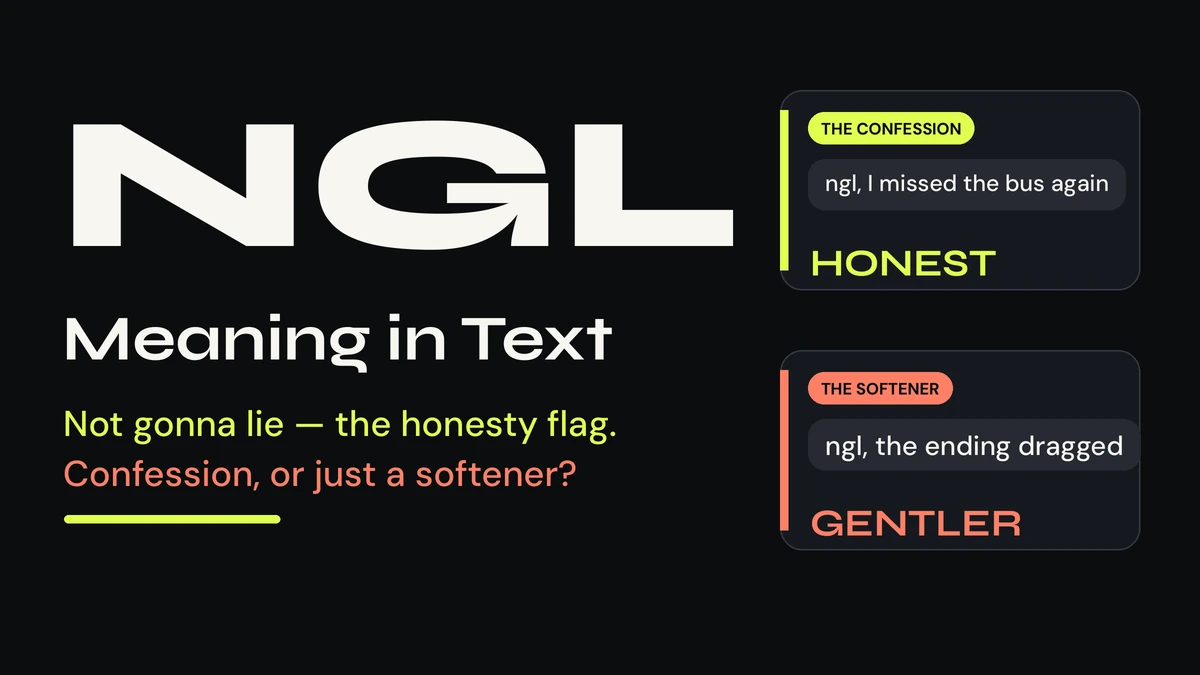
What does ngl mean in text? NGL stands for “not gonna lie,” and it works like a small flag planted in front of an honest opinion or a small confession. This guide to ngl meaning in text gives you the NGL Honesty Test, so you can tell in seconds whether the ngl you just saw was a real admission, a softened criticism, or a joke wearing honesty as a costume.
This guide covers the dictionary record, the three-check test, seven tones, NGL on TikTok, Snapchat, Instagram, and in texts, how it lands by sender, when it crosses a line at work, school, and home, graded claims, cousins, a dated history from spoken phrase to dictionary entry to a court-settled app, and a reply bank keyed to the reading you just identified.
What “NGL” Means in Text
NGL is an initialism, and the letters spell themselves out: N for not, G for gonna, L for lie. “Gonna” is simply the spoken form of “going to,” so the full phrase is “not gonna lie,” sometimes written out as “I’m not gonna lie.” You will see it as ngl, NGL, or Ngl; the meaning is the same, and lowercase is the most common in casual chats, because the whole point of the letters is speed. It almost always comes before a full sentence, because its job is to introduce what follows, not to stand alone.
The dictionary record is unusually complete for a slang term, and this guide leans on all three of its pillars. Wiktionary, read directly for this article, lists NGL as an initialism of “(I’m) not gonna lie” in internet slang and text messaging, meaning to tell the truth, with the example “NGL, I actually enjoyed the movie.” Merriam-Webster added ngl to the dictionary on 2023-09-27 as an informal abbreviation meaning “not gonna lie; not going to lie,” a date this guide takes from the publisher’s own announcement rather than a second-hand list. Cambridge Dictionary lists “not gonna lie” as informal, with the abbreviation ngl, and its own NGL entry adds the use that matters most in real chats: it appears when someone is admitting something embarrassing, or when they are trying to make a criticism or complaint less likely to offend someone. Dictionary.com defines it the same way, as an informal abbreviation used mostly in online messages when someone is admitting or confessing something, as reported by the main competitor read for this article, because the dictionary’s own NGL page could not be opened directly.
The flag does two jobs at once, and both matter. First, it signals honesty: what follows is the sender’s real take, not the polite version. Second, it softens the landing: “The new update is worse” sounds harsher than “ngl, the new update is worse,” because the sender is owning the opinion instead of stating it as a fact. And here is the twist this whole guide turns on: announcing honesty is not the same as being honest. A flag can be waved over a joke, an exaggeration, or a piece of sarcasm, and the test below is how you tell which one you just got.
The NGL Honesty Test

Before you answer an ngl — or send one — run three checks. They take about five seconds, and they beat every shortcut the competitors offer, because the competitors all say “it is a confession” without giving you a procedure for reading which kind of confession it is:
- Check 1 — The Placement Check. Where does NGL sit in the sentence? At the start it sets up an opinion: “ngl, I thought you would hate it.” At the end it adds weight to something just said: “that was actually really good, ngl.” In the middle it is an aside, a quick aside that barely changes the sentence. Placement is the fastest single clue, because the sender puts the flag where the honesty starts.
- Check 2 — The Payload Check. What is being carried after the flag? A feeling (“ngl, I am nervous about tomorrow”) is a confession. A compliment (“ngl, that is really good”) is praise made to sound sincere. A criticism (“ngl, I do not love the new layout”) is a complaint with the edges sanded down. A guilty pleasure (“ngl, I watched the whole series in a weekend”) is a small admission of something fun. Name the payload first, and half the readings disappear.
- Check 3 — The Proof Check. Does the rest of the message back the flag up? A real confession comes with a detail only an honest person would volunteer: a mistake named, a feeling admitted, a reason given. A joke gives itself away with a laugh, an emoji, or a claim nobody could believe. If the sentence after the flag contradicts the flag — praise that reads like an insult, honesty that reads like a setup — trust the sentence, not the flag. The flag promises; the proof delivers.
Worked trio. “Ngl, I am nervous about tomorrow”: placement at the start, payload a feeling, proof a real worry with no punchline. A warm confession, and the test says answer it kindly. “Ngl, that pizza was mid”: placement at the start, payload a blunt opinion, proof a judgment with nothing behind it but taste. Honest, a little sharp, and the test says take it as an opinion, not an attack. “That haircut is a choice, ngl”: placement at the end, payload a criticism dressed as a joke, proof a laugh that tells you the sender knows exactly what they did. A teasing jab wearing the honesty flag — and the reply it deserves is completely different from the first two. Three messages, one flag, three readings — and the test, not the spelling, sorted them.
“NGL” in Real Chats
Illustrative examples written for this guide, not real transcripts:
- The nervous confession. “Ngl, I am nervous about tomorrow”: a feeling admitted before it is asked about. The flag is the courage; the sentence is the confession.
- The surprised compliment. “Ngl, that is really good”: praise that lands harder because the sender flagged it as honest. The surprise is the point — they did not expect to like it.
- The gentle disagreement. “Ngl, I do not love the new layout”: a criticism with the edges sanded down. The flag says “I am being real with you,” so the criticism reads as a view, not a verdict.
- The small mistake. “Ngl, I have forgotten how to do this”: a small admission that asks for help without making a drama of it. The flag turns a failure into a request.
- The guilty pleasure. “Ngl, I watched the whole series in a weekend”: a fun admission, slightly embarrassed and proud at the same time. Nobody is harmed; the flag just makes it feel shared.
- The end-of-sentence weight. “I cried at that advert, ngl”: the feeling comes first and the flag lands last, like a shrug that says “yes, really.” Placement at the end adds weight instead of setting a scene.
- The stacked flag. “Ngl, tbh, I think she is right”: two honesty flags stacked in front of one opinion. The sender is being extra honest, or at least wants you to believe they are — and the Proof Check is the only way to tell which.
The NGL Tone List
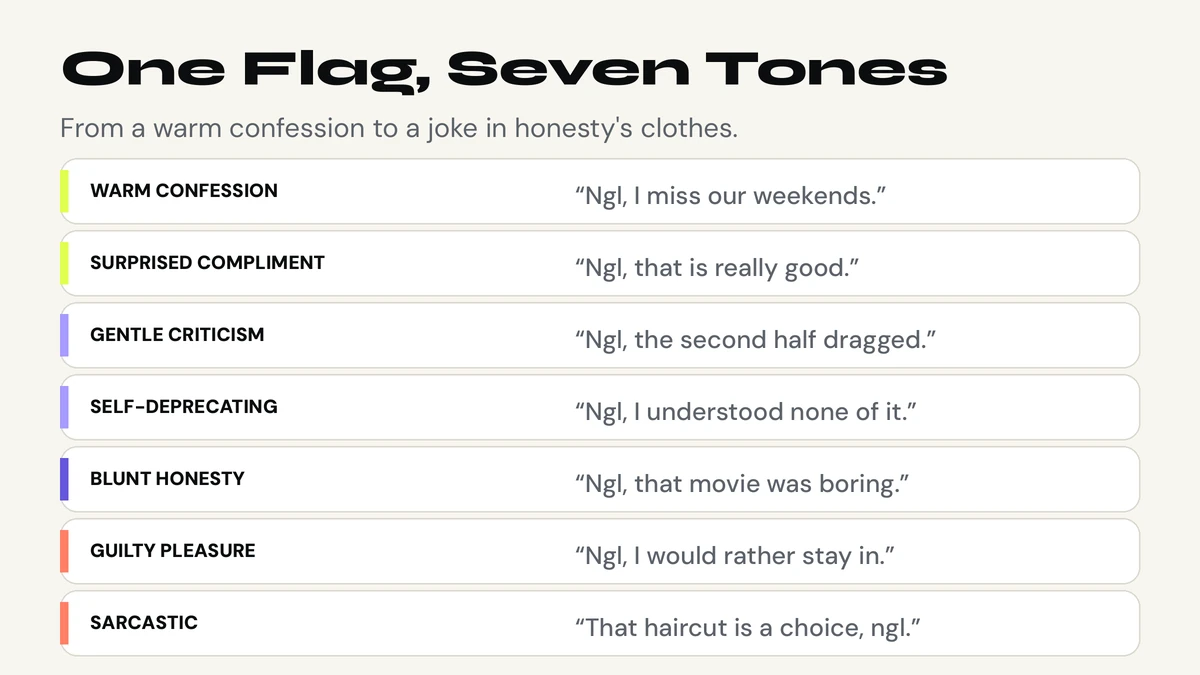
NGL’s flag never changes; its feeling slides across seven readings, warmest to sharpest. The first four are safe to send anywhere casual; the last one is safe only when everyone in the room knows it is a joke:
- Warm confession: “Ngl, I miss when we used to hang out every weekend” — a real feeling, offered openly. The flag is the trust; the sentence is the gift.
- Surprised compliment: “Ngl, that cake looks better than anything I have made” — praise the sender did not expect to give. The surprise makes it believable.
- Gentle criticism: “Ngl, the second half dragged for me” — a complaint softened by the flag, exactly the use Cambridge Dictionary describes. Honest, and built to be heard.
- Self-deprecating admission: “Ngl, I did not understand a word of that lecture” — the sender loses a little on purpose, and the flag keeps it light. A joke aimed inward.
- Blunt honesty: “Ngl, that movie was boring” — no softening, just a straight opinion. The flag does not cushion this one; it certifies it.
- Guilty pleasure: “Ngl, I would rather stay in tonight” — a small, slightly embarrassing preference, admitted with a smile. The flag makes the admission feel shared instead of judged.
- Sarcastic or ironic: “Ngl, that haircut is a choice” — the flag waved over a sentence that means the opposite of praise. The proof gives it away: a laugh, a joke, a claim nobody believes. This is the only tone where the flag itself is not telling the truth.
What moves a reading between these tones is never the letters alone: it is the placement (start, middle, or end), the payload (feeling, compliment, criticism, or confession), and the proof (a detail that backs the flag up, or a laugh that gives the game away). The same “ngl” that is a warm confession about missing a friend on Saturday can be a sarcastic jab about a haircut on Monday — and the test, not the spelling, tells you which day you are on.
“NGL” on TikTok
On TikTok, NGL lives in comments and captions, and the comment thread is its natural habitat: a creator posts a video, and the comments fill with “ngl, this made me cry” or “ngl, I did not expect to like this.” The public stage suits the surprised-compliment and gentle-criticism readings best, because a comment thread is an audience, not a private conversation — nobody there is owed a confession, and the flag lands precisely because everyone in the thread knows the feeling of having a real opinion about something they just watched.
TikTok is also where NGL meets its closest platform trap: the story link that is not the slang at all. A creator’s bio or story may carry a link that says something like “send me anonymous messages,” and that link usually belongs to the anonymous question app that borrowed the letters — an app literally called NGL. The slang in a comment and the app in a bio share three letters and nothing else, and the checked-claims section below untangles them, because mistaking one for the other is the most common NGL misread on the platform.
“NGL” on Snapchat
On Snapchat, NGL fits the fast, private, disappearing DM: “ngl, I am exhausted, can we do this tomorrow?” as a streak-snap caption between close friends, or a bare “ngl, I missed the bus again” on a story reply. The disappearing format suits the warm-confession readings — an admission that lands lightly and is gone. But disappearance also removes your evidence: if an NGL felt like a criticism, you cannot re-read it, so judge from memory what rode with it — a feeling, a laugh, or nothing at all.
Snapchat is also where the photo does half the work. A snap of a messy room plus “ngl” needs no explanation: the image names the confession, and the letters only say the sender is being real about it. That is the Payload Check working in real life — remove the NGL and the snap still shows the mess, which is how you know the job was admission, not information. And the same story-link warning applies here: a link promising anonymous messages is the app, not the slang.
“NGL” on Instagram
On Instagram, NGL shows up in comments, captions, story replies, and DMs, and the stage decides the tone the way it does for every honesty flag. Comments lean public and warm: “ngl, I am proud of this one” under a friend’s photo is praise the whole thread can join. Captions lean confessional: “ngl, I did not think this would work” under a finished project is a small admission dressed as a caption. DMs carry the full range, exactly like texts — a friend’s warm confession and a stranger’s blunt opinion live in the same inbox, and only the test tells them apart.
Instagram is also where the app confusion is at its worst, because the anonymous question app was built for Instagram stories: a creator puts a personal link on a story, followers tap it, type a message, and the creator receives it without a name. If you see the letters NGL as a link, a button, or a story sticker, you are looking at the app, not the slang — and the app’s history is worth knowing before you tap it, because in July 2024 the Federal Trade Commission and the Los Angeles District Attorney took action against its maker over fake messages and paid subscriptions, as the checked-claims section explains. The slang is free, the app was not, and the letters do not tell you which one you are looking at — the place they appear does.
“NGL” in Text Messages
Plain texts are NGL’s home ground, and the one-to-one setting makes the distinction sharpest. A warm text wants a witness: “Ngl, I miss summer already.” A blunt text wants a decision from you: is this an honest opinion from a friend, or a criticism the sender is hiding behind a flag? The reply each one deserves is completely different, which is why the Proof Check comes before the reply — answering a warm confession with suspicion, or a blunt opinion with a thank-you, is the classic NGL misfire.
Texts are also where an NGL confession turns into a longer conversation, and the conversation usually moves somewhere private. A friend who writes “ngl, I am nervous about tomorrow” and means it as a confession often follows up with the whole story — and that story belongs in a private thread, not a group chat. Our DM guide covers that move in full, because the channel changes what the next message can say. And texts are NGL’s work limit in miniature: never send NGL in a professional message. A client, a manager, or a first contact deserves plain language, not three letters that presume an intimacy and a casualness you do not have.
Who Is Sending It: How “NGL” Lands by Sender
No source documents a different meaning of NGL per sender — the flag stays fixed; what changes is which reading you should expect, and therefore what you owe back:
- Friend: the default. A friend’s NGL is a warm confession or an honest opinion at face value; run the test and answer that, not the letters.
- Crush: overread territory. A crush’s NGL feels bigger than it is — usually “I notice you,” not a declaration about you. An NGL that softens a feelings admission is common here, and our ILY guide covers the direct declaration itself, because a confession that hides behind a flag is not the same as saying the words plainly. Answer the opinion, not a romance you invented.
- Partner: pattern rules. A partner’s NGL is usually routine honesty; judge the pattern across days, not one message — but a sudden run of blunt NGLs after warm ones is worth one plain question, not a fight.
- Parent: usually literal and plain. A parent who writes NGL has usually learned it from you and means the honesty plainly; do not read a parent’s NGL as sarcasm unless the sentence around it gives the game away with a laugh.
- Coworker or boss: context decides. In a friendly team chat a colleague’s NGL about a lunch spot is a joke; in any formal thread it is out of place, and never send one upward to a manager or client — and never one that carries a criticism of someone’s work.
- Group chat: both habitats at scale. A group’s “ngl, that was the best night” cheers for everyone; a group’s single “ngl, that was rough” after your news still stings, but answer briefly in the group either way, and do not single one sender out for a private reading of a public opinion.
- Stranger or creator: the applause habitat. A stranger’s NGL under your post, or a creator’s NGL in a caption, is a public reaction, not a verdict on you personally. A thank-you or a matching laugh is enough; never answer a public reaction with a private confession about how you feel.
When “NGL” Is Too Much: Work, School, and Family
This section is mandatory for NGL in a way it is not for most terms in this series, because NGL’s risk is not vulgarity — the word is clean — but false intimacy: it borrows the sound of a confidence, and a confidence in the wrong room reads as unprofessional or presumptuous. Four rooms, four rules. At work: never send NGL in a professional message, a client thread, or a formal channel. A lunch opinion among close peers in a casual chat is one thing; the same letters carrying a criticism of a colleague’s work read as a judgment wrapped in a flag, and a judgment at work is a problem, not a joke. If the room would want an honest opinion, give one in full sentences, with no flag at all.
At school: the same rule, with a younger audience, and a warmer edge. Parents often notice NGL in messages between teenagers, usually around feelings, crushes, or school, and the main competitor read for this article treats it as a sign of trust, because it means a young person is willing to be candid with a friend — a good cue to keep the lines of conversation open, not a reason to snoop. Teachers, school groups, and class chats are not NGL rooms, and essays and assignments never are: a teacher who reads “ngl” in homework reads a student who did not take the work seriously, whatever the opinion underneath was. The clean swap is a full sentence: “To be honest, I found the second half hard to follow.” In family chats, read the room person by person: a sibling group may love the flag, a grandparent group may not know the letters, and a parent who dislikes casual shortcuts will dislike the abbreviation exactly as much as the phrase, once they learn what it stands for. Abbreviation is not permission.
The general rule covers every room at once: if someone tells you NGL bothers them, simply stop. Switching words is easy, and it shows respect. The swap menu is free and it loses nothing: “to be honest” for a plain opinion, “I will be straight with you” for a confession, “in my opinion” for a judgment. And one boundary worth stating plainly: NGL does not license cruelty. An honesty flag on a cruel sentence is still a cruel sentence, because the flag promises honesty and cruelty is not honesty — and never use it to dress up meanness as truth. A confession that hurts someone on purpose is not candor; it is a jab wearing a flag’s clothes, and the Proof Check catches it, because a message that proves nothing except a desire to sting was never honest at all.
Checked Claims: Expansions That Do Not Hold Up
Three letters attract folklore, and a flag that promises honesty attracts more than most. Each claim below was graded against the dictionaries read in full and the competitors read in full; nothing is repeated here as fact on a single blog’s say-so:
- “NGL means ‘never gonna lie’” — rejected. No dictionary supports it: Wiktionary, Merriam-Webster, and Cambridge Dictionary all give “not gonna lie,” and none mentions “never.” A word that sounds close is not the expansion.
- “NGL guarantees the sender is telling the truth” — rejected. NGL signals honesty; it does not certify it. The flag can sit in front of a joke, an exaggeration, or a sarcastic jab, and one competitor notes directly that it does not always mean total honesty. Trust the proof in the rest of the message, not the flag.
- “NGL is rude” — rejected as a blanket claim. The phrase itself is friendly and casual; what follows can be blunt, and Cambridge Dictionary says the flag is used to make a criticism less likely to offend, not more. A rude sentence after NGL is rude because of the sentence, not because of the letters.
- “NGL and TBH mean exactly the same thing” — rejected as an exact claim. They overlap heavily and most people use them almost interchangeably, but the lean is real: NGL tends to sound like a confession, while TBH is a more general flag that a candid opinion is coming. Close cousins, not twins.
- “TikTok invented NGL, or the NGL app invented it” — rejected. The spoken phrase predates both: one competitor traces it to print in the 1980s, and the acronym was already a standalone dictionary entry in January 2009, years before the app launched in 2022. TikTok spread the flag; the app borrowed it; neither invented it.
- “NGL means natural gas liquids in texts” — fenced, not a texting meaning. NGL genuinely stands for natural gas liquids in the energy industry, and Wiktionary lists that sense first — but that expansion lives in fuel reports and business writing, not in chats. If the sentence is about fuel, it is the energy meaning; if it is a friend’s text, it is not gonna lie.
- “The NGL app really is anonymous, and paying reveals who sent your messages” — rejected. In July 2024 the Federal Trade Commission and the Los Angeles District Attorney took action against the app’s maker, saying it sent fake messages that looked like they came from real people and pushed users to pay for a subscription by falsely claiming it would reveal who sent their messages. Under the settlement the maker agreed to pay 4.5 million dollars for consumer refunds plus a 500,000 dollar civil penalty, and was banned from offering anonymous messaging to anyone under 18. A link that promises anonymity is selling a product, not a fact.
- “60 percent of teens use abbreviations like NGL routinely” — not repeated. One competitor cites a late-2022 survey figure for this claim, with no checkable method and no link to the survey itself. A single unsourced percentage is not evidence, and this guide does not repeat it as a fact.
What SURVIVES: NGL means not gonna lie, an initialism of “(I’m) not gonna lie,” with the seven tones above as feelings of the same flag — not different meanings; Merriam-Webster added ngl on 2023-09-27; Cambridge Dictionary records the softening use, admitting something embarrassing or toning down a complaint; the anonymous question app is a real product that borrowed the letters, launched in 2022, and settled with the Federal Trade Commission in July 2024. A dictionary entry is a usage record, not a permission slip: the word stays informal slang, and this guide treats it that way.
“NGL” vs Its Closest Cousins
NGL belongs to the honesty family — words that frame what follows as a real opinion. Its closest cousins split by what they frame:
- FR (co-sign cousin). Our FR guide covers the sincerity stamp that certifies a claim. A comment that reads “ngl, fr, that was good” stacks the two flags: NGL promises the honesty, FR swears it is true. One opens the confession, the other locks it in.
- IKR (agreement cousin). Our IKR guide covers the echo that agrees with a feeling. A reply of “ikr, ngl, same” agrees with the confession; NGL makes it. One shares the honesty, the other delivers it.
- IMO (opinion cousin). Our IMO guide covers the marker that a statement is just a view. NGL frames an opinion as honest; IMO frames it as only a view. One certifies the feeling, the other limits the claim.
- TBH (confession cousin). The closest of all: to be honest. TBH is the more neutral flag, NGL the more confessional one, and most people use them almost interchangeably. When the message is a small admission, NGL fits better; when it is a plain candid opinion, TBH does the same job with less drama.
- “Lowkey” (quiet cousin). The soft alternative: quietly, secretly, without making a scene. “Lowkey obsessed with this song” admits a feeling at low volume; “ngl, I am obsessed with this song” admits it out loud. One whispers the confession, the other announces it.
- “Honestly” (plain-English cousin). The clean alternative that works anywhere: “Honestly, I did not expect to like it.” It does NGL’s whole job in full words, with no slang at all — and in any room where the letters would look out of place, it is the right word to reach for.
Where “NGL” Came From
The trail starts with a spoken phrase, not a keyboard. “Not gonna lie” is ordinary spoken English, the way people have introduced an honest opinion out loud for decades; one competitor traces the phrase to print in the 1980s, and this guide grades that as a single-source claim, not a settled date. The acronym grew out of early internet and texting culture, where short phrases were squeezed into three letters to type faster, and the letters spread with social media in the late 2000s and early 2010s as the spoken preface moved onto YouTube and early Twitter.
The paper trail sharpens from there. A standalone dictionary entry for the acronym arrived in January 2009, as reported by two competitors — a date this guide treats as competitor-reported, because the entry itself was not read directly. Merriam-Webster made it official on 2023-09-27, adding ngl among 690 new words with the definition “not gonna lie; not going to lie.” The letters then took a second life as a product: the anonymous question app called NGL launched in 2022, put its link on Instagram stories, and in July 2024 settled with the Federal Trade Commission over fake messages and paid subscriptions. No inventor is claimed, because there is none: the phrase was spoken by everyone, shortened by the internet, and adopted by a dictionary and an app in turn — and its history is a dated spine, 1980s, 2009, 2023, 2024, not a single birth year.
How to Reply When Someone Sends “NGL”
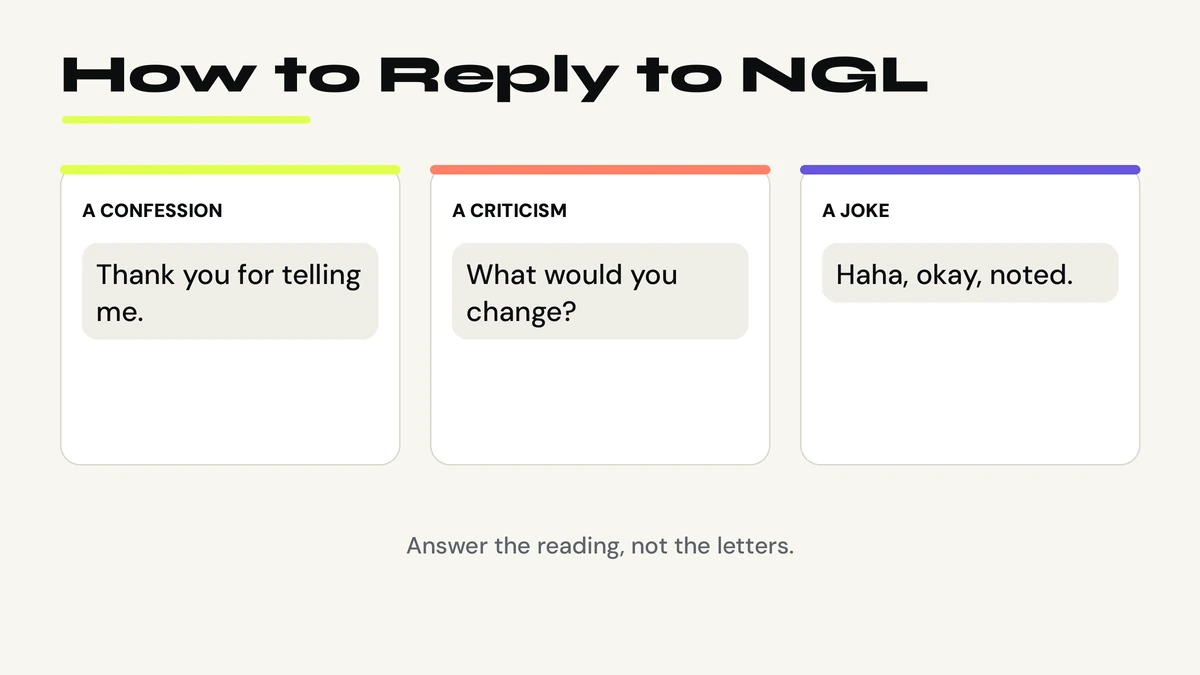
Golden rule: answer the reading the test found, not the letters. A reply bank keyed to the reading:
- Warm confession — answer kindly: “Thank you for telling me” or “Same here, honestly.” A confession is a gift of trust; answer the trust first and the topic second.
- Surprised compliment — accept it: “Thank you, that means a lot” or “Haha, I did not expect that either.” Admiration answered with warmth keeps the thread warm.
- Gentle criticism — ask one question: “What would you change?” keeps the conversation open. A softened criticism is an invitation to improve, not a verdict to defend against.
- Blunt opinion — match the energy, or let it go: “Fair enough” matches the honesty without starting a debate; silence ends it. Never answer a blunt opinion with a longer blunt opinion unless the friendship runs on that.
- Sarcastic jab — laugh, or name it: “Haha, okay, noted” matches the joke; “That one stung a little, honestly” names it without a fight. You owe no defense of a haircut, a playlist, or a photo.
- You want the detail — ask for it plainly: A confession that hides the story is an opening, not just a flag — our FYI guide covers the follow-up fact in full, because “tell me more” turns a flag into a conversation, and conversations beat flags every time.
Frequently Asked Questions
What does NGL mean in a text message?
NGL means not gonna lie. In a text it introduces an honest admission, opinion, or confession, good or bad — “ngl, I am nervous about tomorrow” is a feeling, “ngl, that was really good” is praise. Run the Honesty Test before you decide which one you just got.
What does “ngl tbh” mean?
It stacks two honesty flags: “not gonna lie, to be honest.” It just means the person is being extra honest about what follows, or wants you to believe they are. The two phrases overlap heavily; stacking them adds emphasis, not a new meaning.
What does NGL mean on TikTok?
On TikTok, NGL usually means not gonna lie in comments or captions, most often before an honest opinion: “ngl, this made me cry.” The public stage suits the surprised-compliment and gentle-criticism readings best. A link or sticker that says NGL is usually the anonymous question app, not the slang.
What does NGL mean on Instagram?
On Instagram, NGL usually means not gonna lie in comments, captions, story replies, and DMs. Comments lean public and warm, captions lean confessional, and DMs carry the full range exactly like texts. A story link that says NGL belongs to the anonymous question app, which settled with the Federal Trade Commission in July 2024.
Is NGL rude?
No. NGL itself is neutral and friendly. It can come before criticism, but it usually makes the criticism sound softer, because you are presenting it as your honest opinion — which is exactly the use Cambridge Dictionary records. A rude sentence after NGL is rude because of the sentence, not the letters.
Can I use NGL at work or school?
Generally, no. NGL belongs in casual digital conversations. In work messages, formal chats, or school messages it can sound unprofessional, and in essays or assignments it reads as if the work was not taken seriously. In a casual peer chat about lunch or a film, it is fine; anywhere formal, spell it out instead.
What should I reply when someone says “ngl”?
Answer the reading the test found. A warm confession gets kindness (“Thank you for telling me”); a compliment gets acceptance; a gentle criticism gets one question (“What would you change?”); a blunt opinion gets “Fair enough” or silence; a sarcastic jab gets a laugh or a boundary. The full reply bank is in the section above.
Does lowercase ngl mean something different from NGL?
No. Capitalization changes volume, not meaning: capital NGL reads a touch louder, lowercase ngl reads softer and faster, and both mean not gonna lie. What changes the reading is the placement, the payload, and the proof — never the case alone.
The Takeaway
NGL means not gonna lie: three letters planted in front of an honest opinion or a small confession, to signal that what follows is real and to soften the landing. The flag never changes; the feeling does — warm confession, surprised praise, gentle criticism, blunt opinion, or a joke in honesty’s clothes. When an NGL lands, run the Honesty Test: check the placement, check the payload, check the proof. And when you send one, remember the only rule that matters: a flag promises honesty, so make sure the sentence after it keeps the promise — because the letters are now in the dictionary, on the app store, and in a regulator’s settlement file, and the whole internet is watching how they get used.