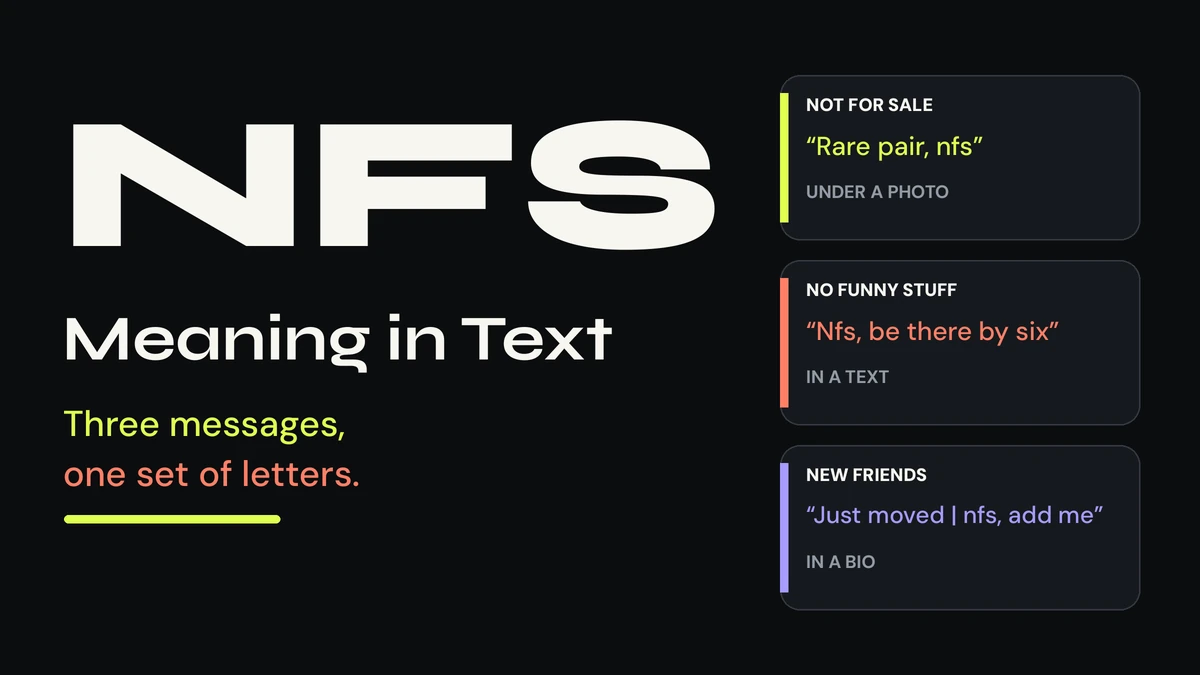
What does nfs mean in text? In a text message, NFS usually means “no funny stuff” — “I’m serious, no jokes, no tricks.” But the same three letters can also mean “not for sale” under a photo, or “new friends” in a bio. This guide to nfs meaning in text gives you the NFS Boundary Test, so you can tell in seconds which of the three messages you just received.
Most guides list the meanings and stop. This one does the harder job: the three-check test, seven tones, NFS on TikTok, Snapchat, Instagram, and in plain texts, how it lands depending on who sends it, when it crosses a line at work, school, and home, graded claims, cousins, a dated history from a 1980 Stephen King story to today’s search charts, and a reply bank keyed to the reading you just identified.
What “NFS” Means in Text
NFS is an initialism, not a word — three letters doing three different jobs, and the job changes with the room. In a text or a DM it usually means “no funny stuff”: the sender is drawing a line and asking you to be serious. Under a photo of sneakers, a car, a painting, or a collectible it usually means “not for sale”: the owner is showing something off and heading off the offers before they start. In a bio, a story, or an add request it usually means “new friends”: the person is open to meeting people. Three messages, one set of letters — and the sentence around the letters, not the letters themselves, tells you which one you got.
The dictionary record is the first honest surprise in this guide, and it is worth stating plainly. Wiktionary, read directly for this article, lists NFS as an initialism of “not for sale” — with a 1980 citation from Stephen King’s The Mist, where an “NFS card” sits tucked into a picture frame — plus two homonyms, Network File System in computing and Need for Speed in gaming. It records no chat sense at all. Dictionary.com, also read directly, lists only “not for sale” in American English and National Fire Service in British English. A search for a Merriam-Webster NFS entry turned up no dedicated entry. So the established dictionaries cover the oldest sense and the two homonyms, and none of them records “no funny stuff” or “new friends” — the chat senses live in usage guides and crowd-sourced references, and this guide grades them as attestation, not dictionary proof. One more fact belongs here, stated once and plainly: a ruder last word is common in the wild — the blunt version reads “no funny shit” — and the clean expansion means exactly the same thing. Everywhere else in this guide you will see the clean form, or the asterisked form where the ruder spelling is the point.
SlangDex, the best-structured competitor and the main competitor for this article, puts it the same way: NFS is three different messages wearing the same letters, and where you see it tells you which one you have got. It also notes that NFS works a little like FR — our FR guide covers that sincerity stamp in full — but where FR vouches that something is true, NFS asks the other person not to joke or play games. The difference matters: FR certifies a claim, NFS sets a rule for the conversation. And the three senses are not the whole story. Three secondary senses circulate widely enough to learn: “not for sure” (uncertainty about plans), “not feeling social” (a soft no to an invitation), and “not for sharing” (a privacy boundary on photos and personal details). Two more expansions are real words with real jobs that are not slang at all: Need for Speed, the racing game series, and Network File System, the computing protocol. Both get fenced in their own section below, because mistaking a game night or a server error for a texting boundary is the classic NFS misfire. Hold it all together by what each sense asks of you. “No funny stuff” asks for seriousness: take the promise, the money, or the meeting at face value. “Not for sale” asks you not to buy: admire the item, do not make an offer. “New friends” asks you to add: the person wants to talk, and the ball is in your court. “Not for sure” asks for patience: nothing is decided yet. “Not feeling social” asks for space: tonight is a quiet one. “Not for sharing” asks for trust: keep what you were sent where it was sent. Learn the ask, and the letters stop looking chaotic — they are six different requests that happen to share a shape.
The NFS Boundary Test
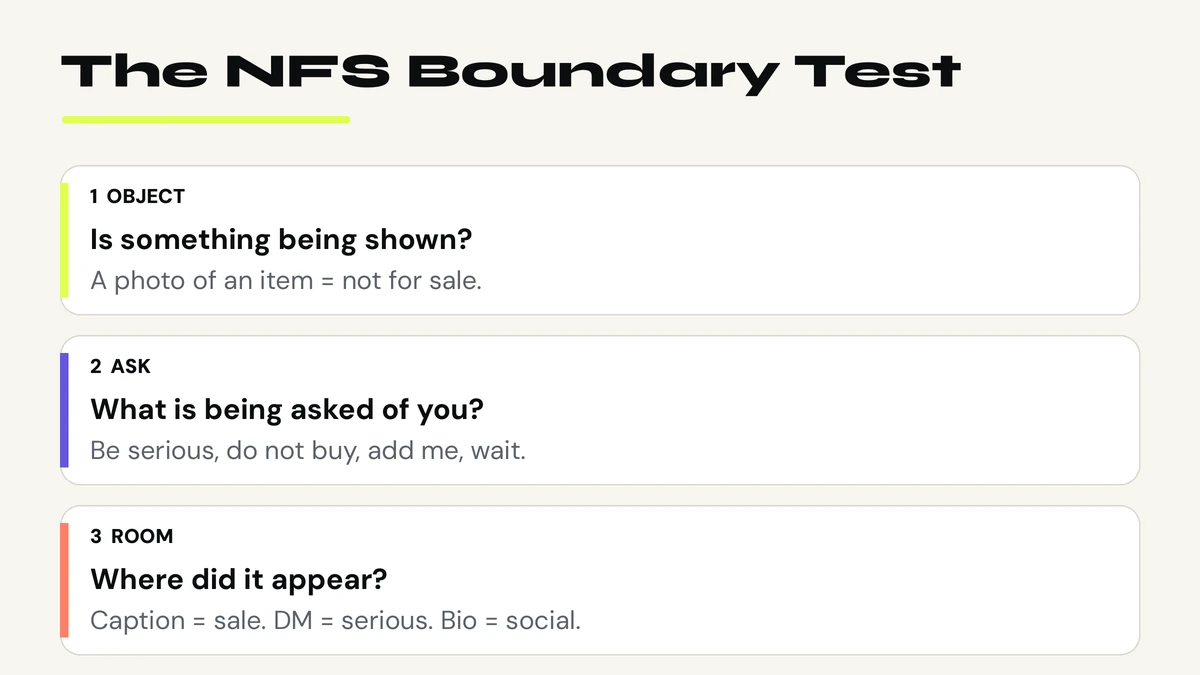
Before you answer an NFS — or send one — run three checks. They take about five seconds, and they beat every shortcut the competitors offer, because the competitors all list the meanings and leave you to guess which one applies. The test does not guess: it reads the evidence around the letters.
- Check 1 — The Object Check. Is something being shown? A photo of sneakers, a car, a painting, a rare pair, or a restored camera with NFS beside it means “not for sale” — the object is the whole message, and the letters only say what you cannot do with it. No object, no sale reading. If there is nothing to buy, “not for sale” has nothing to attach to, and it drops out of the running first.
- Check 2 — The Ask Check. Is someone being asked to do something? A promise, money, a meeting time, a secret, a plan — “nfs, be there by six” asks for seriousness; “chat’s fine but nfs” asks for silence about what was shared; “nfs if I can make it” asks for patience. The ask names the sense, because each NFS sense is a different request: be serious, do not buy, add me, wait, give me space, keep this private. Name the request and half the readings disappear.
- Check 3 — The Room Check. Where did it appear? A caption, a listing, or a marketplace post means “not for sale.” A DM or a plain text means “no funny stuff” unless a stranger sent it. A bio, a story, or an add request means “new friends.” A game lobby, a Discord server, or a group chat about racing means Need for Speed. A server log, a mount command, or a storage ticket means Network File System. The room is the fastest single clue, because the sender chose the room on purpose — and a caption and a DM are different rooms even when they hold the same letters.
Worked trio. “Finally got the pair I wanted, nfs so don’t even ask in my dms”: object a pair of sneakers, ask stop asking, room a caption. Not for sale, no ambiguity. “Nfs, I need you on time tomorrow”: no object, ask be serious about a time, room a DM. No funny stuff, and the sender is not selling anything. “Just moved to Austin | nfs, add me”: no object, ask add me, room a bio. New friends — and note what the test just did: the same three letters, three different messages, sorted by evidence in seconds. When the checks disagree or the context is empty, ask plainly — “nfs as in not for sale?” — because a wrong guess about a boundary is worse than one honest question.
“NFS” in Real Chats
Illustrative examples written for this guide, not real transcripts:
- The serious promise. “Nfs, I need you on time tomorrow”: the sender is setting the terms before the meeting, not after it. The letters say the promise matters and the jokes can wait.
- The collector’s caption. “Finally got the pair I wanted, nfs so don’t even ask in my dms”: pride plus a pre-emptive no. The photo is the evidence, and the letters are the fence around it.
- The new-in-town bio. “Just moved to Austin | nfs, add me”: an open door in nine words. The bio is the room, and the room makes “new friends” the only reading that fits.
- The uncertain plan. “Nfs if I can make it, I’ll let you know”: a maybe with manners. The sender is not refusing — they are refusing to promise what they cannot keep.
- The quiet night. “Sorry, nfs tonight — need a quiet one”: a decline that needs no excuse. The apology softens it; the letters carry the boundary.
- The privacy line. “Chat’s fine but nfs”: talk all you want, share nothing. The trust is conditional, and the condition is the whole message.
- The game invite. “Anyone on nfs later?”: not slang at all — a racing game night. The room (a gaming chat, a console, a Friday night) does all the work, and the Boundary Test catches it on the Room Check alone.
The NFS Tone List
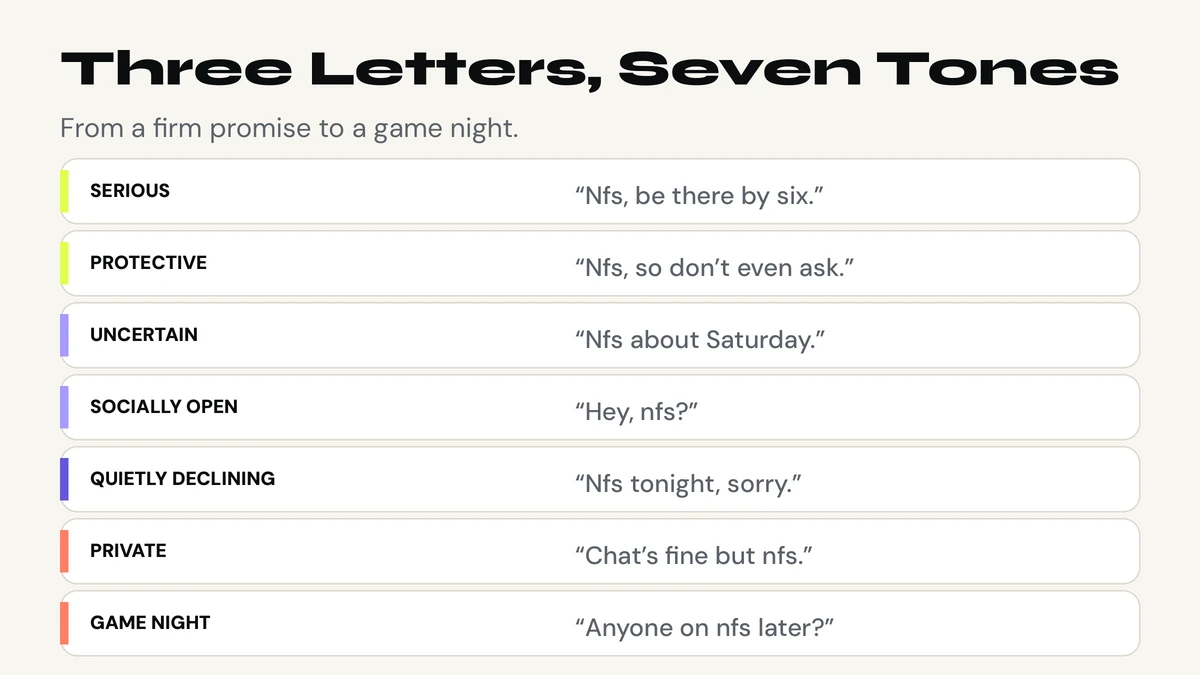
NFS never changes its letters; its feeling slides across seven readings, lightest to firmest. The first three are easy to send; the last two are boundaries that deserve respect when you receive them:
- Serious and straight: “Nfs, be there by six” — a boundary set plainly, with no decoration. The sender wants the promise kept, not a performance of keeping it.
- Protective: “Nfs so don’t even ask” — guarding something valued. The pride is real, and so is the fence; the letters keep the admirers at a friendly distance.
- Uncertain: “Nfs about Saturday” — a soft maybe. The sender is honest about not knowing, which is kinder than a promise they will break.
- Socially open: “Hey, nfs?” — an invitation from a stranger. Warm on the surface, and worth one careful look before you answer, because strangers open with invitations for many reasons.
- Quietly declining: “Nfs tonight sorry” — a gentle no. The apology is the warmth; the letters are the door closing softly instead of slamming.
- Private and trusting: “Chat’s fine but nfs” — trust with a condition attached. The sender is sharing and setting the rule in the same breath.
- Playful, or not slang at all: “Anyone on nfs later?” — a game night, no boundary in sight. The lightest reading in the list, and the one that proves the letters alone never decide anything.
What moves a reading between these tones is never the letters alone: it is the ask (be serious, do not buy, add me, wait, give me space, keep this private) and the room (caption, DM, bio, game lobby). The same “nfs” that is a firm promise on Tuesday can be a soft maybe on Friday — and the test, not the spelling, tells you which day you are on.
“NFS” on TikTok
On TikTok, NFS lives in captions and comments, and the caption is its natural habitat for the sale sense: a creator posts sneakers, a restored car, a piece of art, or a collection, adds “nfs” to the caption, and the comments understand — admire it, do not make an offer. The public stage suits “not for sale” best, because a caption is a broadcast, and a broadcast is the fastest way to answer a hundred would-be buyers at once. Comments lean the other way: a serious thread about plans, money, or a promise can carry “nfs” as “no funny stuff,” and a creator’s bio can carry it as “new friends.”
The honest limit matters here, and this guide states it where the competitors do not: no reputable source documents which NFS sense lives on which app. SlangDex says so directly — “no reputable source documents which sense is used on which app, though, so read the context” — and EasyPuns’ platform claims rest on its own reading of posts, not on a documented source. So this guide reports the lean (captions lean sale, DMs lean serious, bios lean social) as a lean, not a rule. If a TikTok DM arrives and the room does not settle it, run the test as usual — a DM is private again, and “no funny stuff” returns with it.
“NFS” on Snapchat
On Snapchat, NFS is at its most ambiguous, because two senses compete in the same small space. In a chat it is most often “no funny stuff”: a fast, private, disappearing DM — “nfs, be honest with me” — where the sender wants a serious answer and the disappearing format means the promise lives only in memory. In a bio, a story, or an add request it is most often “new friends”: someone who just added you, opening with “nfs?” and hoping you want to talk. The difference is usually obvious from who sent it. A close friend means “I’m serious.” A stranger who just appeared in your chat list means “want to talk?”
Snapchat is also where the privacy sense does its hardest work. A snap or a chat that carries “nfs” as “not for sharing” is a request about screenshots and forwards — and disappearance removes your evidence, so you cannot re-read the boundary later. Treat it as real the first time: if someone sends you something private and marks it not for sharing, the rule stands even after the message is gone. And the stranger side of Snapchat deserves one plain warning: a “nfs?” from someone you cannot verify is an invitation, not an obligation. You do not owe a reply, a photo, or a school name to a stranger who opened with three letters.
“NFS” on Instagram
On Instagram, NFS is almost always “not for sale” under a post — and the platform is built for exactly that reading. Instagram is visual and full of desirable objects, so the buy-it question comes up constantly, and collectors, sneakerheads, artists, restorers, and car owners add NFS to captions purely to stop the flood of enquiries. The caption does the work before anyone has to ask, which is why the sale sense dominates here more than anywhere else. In a bio the letters flip to “new friends,” and in DMs the full range appears, exactly like texts — a friend’s serious “nfs” and a stranger’s social “nfs?” live in the same inbox, and only the test tells them apart.
Instagram is also where NFS meets its most persistent piece of folklore: the claim that it means “no filter selfie” on an unedited photo. That reading is graded in the Checked Claims section below, and the short version is that it was a mid-2010s hashtag habit, not a live texting meaning — nobody decoding a DM today should read it that way. The platform trap to avoid is the opposite one: reading a seller’s caption as a personal message. A stranger’s “nfs” under their own post is a label on an object, not a message to you, and answering it with an offer, a plea, or a life story embarrasses both sides. A compliment, or silence, ends it cleanly; the caption was never asking for more.
“NFS” in Text Messages
Plain texts are NFS’s home ground for the serious sense, and the one-to-one setting makes the distinction sharpest. A serious text wants a straight answer: “Nfs, I need you on time tomorrow” leaves no room for a joke, and the reply it deserves is a straight yes or a straight no. An uncertain text wants patience: “nfs if I can make it” is a maybe, and the reply it deserves is “no rush, let me know.” A quiet text wants space: “nfs tonight sorry” is a decline, and the reply it deserves is acceptance, not a counter-offer. The reply each one deserves is completely different, which is why the Ask Check comes before the reply — answering a serious text with a joke, or a quiet text with pressure, is the classic NFS misfire.
Texts are also where NFS pairs with other shorthand most naturally. A seller who writes “nfs but DM me” is doing two jobs at once — the caption says not for sale, the DM invitation says the conversation can still happen — and our DM guide covers that move in full, because the channel changes what the next message can say. And texts are NFS’s work limit in miniature: never send NFS in a professional message. A client, a manager, or a first contact deserves plain language, not three letters that could mean a sale, a boundary, a game, or a server protocol — and never the ruder spelling, which has no place in any work or school message at all.
Who Is Sending It: How “NFS” Lands by Sender
No source documents a different meaning of NFS per sender — the letters stay fixed; what changes is which reading you should expect, and therefore what you owe back:
- Friend: the default. A friend’s NFS is the reading the room already suggests — serious in a DM, sale under a photo, social in a bio — and you can take it at face value. Run the test and answer that, not the letters.
- Crush: overread territory. A crush’s “nfs” feels bigger than it is — usually “I’m serious about this plan,” not a confession about you, and almost never “new friends” from someone who already knows you. Answer the ask, not a romance you invented.
- Partner: pattern rules. A partner’s “nfs” is usually routine — a serious note before plans, a quiet night, a privacy line — and you should judge the pattern across days, not one message. But a sudden run of serious NFS messages after warm ones is worth one plain question, not a fight.
- Parent: usually literal and plain. A parent who writes NFS has usually learned it from you and means the sense the room suggests — most often “not for sale” under a photo of something they own, or “no funny stuff” before a family plan. Do not read a parent’s NFS as a hidden message unless the sentence around it says so.
- Coworker or boss: context decides, and the context usually says no. In a friendly team chat a colleague’s NFS about a game night is a joke; in any formal thread it is out of place, and never send one upward to a manager or client — three letters that could mean a sale, a boundary, or a server error are the opposite of clear communication.
- Group chat: both habitats at scale. A group’s “nfs tonight” is a soft no to the plan the group just made — and our GNG guide covers the invite it answers, because a group-night plan and a quiet-night decline are two halves of the same conversation. Answer briefly in the group either way, and do not single one sender out for a private reading of a public decline.
- Stranger or creator: the caution habitat. A stranger’s “nfs?” is an invitation to talk, and a creator’s “nfs” under a post is a label on an object — one asks something of you, the other asks nothing at all. A thank-you or a matching laugh is enough for the label; the invitation gets a reply only if you want to talk, and never with personal details you cannot take back.
When “NFS” Is Too Much: Work, School, and Family
This section is mandatory for NFS in a way it is not for most terms in this series, because NFS’s risk is not one meaning but two: the serious sense can sound like an accusation, and the social sense can open a door to a stranger. Four rooms, four rules. At work: never send NFS in a professional message, a client thread, or a formal channel. Even the “not for sale” meaning — which sounds businesslike — risks being read as Network File System by anyone technical, or simply not understood at all, and the serious sense reads as distrust: “no funny stuff” to a colleague says “I expect you to mess around,” which is not a message to send upward or outward. If the room would want clarity, spell the words out.
At school: the same rule, with a younger audience, and a sharper edge on the stranger side. A “nfs?” from someone a student does not know is the standard opener on friend-finding apps and in add requests, and it is usually harmless — but it is also the standard opener used by spam accounts and, occasionally, by people misrepresenting who they are. Never share a school, an address, or photos with someone you cannot verify, and if you are a parent reading this, that is the conversation worth having about friend-finding apps generally. Teachers, school groups, and class chats are not NFS rooms, and the ruder spelling (“no funny sh*t”) never belongs in a school message at all. In family chats, read the room person by person: a sibling group may love the shorthand, a grandparent group may not know the letters, and a parent who dislikes being told “no funny stuff” will dislike the abbreviation exactly as much as the sentence, once they learn what it stands for. Abbreviation is not permission.
The general rule covers every room at once: if someone tells you NFS bothers them, simply stop. Switching words is easy, and it shows respect. The swap menu is free and it loses nothing: “just showing it off, not selling” for the sale sense, “I’m serious about this” for the serious sense, “I’d love to meet new people” for the social sense, “I need a quiet night” for the declining sense. And one boundary worth stating plainly: never use the serious sense as a weapon. “No funny stuff” said to someone who has done nothing wrong is an accusation wearing a boundary’s clothes — and the Ask Check catches it, because a boundary with no ask behind it is not a boundary at all. Our DND guide covers the firmer version of the same boundary — “do not disturb” — for the nights when a soft “not feeling social” is not enough, and the difference between the two is worth learning: NFS asks for space tonight, DND asks for silence until you say otherwise.
Checked Claims: Expansions That Do Not Hold Up
Three letters attract folklore, and an initialism with this many jobs attracts more than most. Each claim below was graded against the dictionaries read in full and the competitors read in full; nothing is repeated here as fact on a single blog’s say-so:
- “NFS always means not for sale” — rejected as a full account. “Not for sale” is the oldest sense and the dictionary sense, but in a text or a DM the usual reading is “no funny stuff,” and in a bio it is “new friends.” Reducing the letters to the sale sense deletes the two senses people actually meet in chats.
- “Snapchat NFS always means no funny stuff” — rejected. Snapchat is the platform where NFS is most ambiguous, because the serious sense and the social sense compete there — a close friend means “I’m serious,” a stranger who just added you means “want to talk?” SlangDex states the limit directly: no reputable source documents which sense is used on which app. A platform rule with no source behind it is a guess, not a fact.
- “NFS means not for screenshots” — weak, unproven. This expansion appears on glossary lists and in EasyPuns’ table, but no dictionary records it, no competitor gives a worked example of it in a real message, and the privacy job it describes is already covered by the better-attested “not for sharing.” Treat it as an unproven claim, not a meaning to rely on — and if a message clearly asks you not to screenshot, respect the request itself, whatever the letters meant.
- “NFS means no filter selfie” — rejected as a live chat sense. EasyPuns reports it as an occasional Instagram use, and its root is real: “No Filter Sunday” was a mid-2010s Instagram hashtag habit for unedited photos. But a hashtag trend from a decade ago is not a current texting meaning, no dictionary records it, and no competitor shows it in a DM or a chat. Fence it as history, not as a reading to use today.
- “NFS means Need for Speed in texts” — fenced, not slang. Need for Speed is a real racing game series, first released in 1994 and still going, and in a gaming chat, a Discord server, or a group chat about racing, “anyone on nfs later?” is an invitation to play. But the game title is not a texting meaning: the moment the room stops being about games, the reading stops being about the game. Same letters, different job — the Room Check is the whole distinction.
- “NFS means Network File System in texts” — fenced, not slang. Network File System is a real computing protocol, developed by Sun Microsystems in the 1980s, that lets a computer access files stored on another machine across a network. It is the meaning most slang guides skip entirely, and it matters — because plenty of people search “NFS meaning” after seeing it in a server error, a setup guide, or a work ticket, not after seeing it on Snapchat. If NFS appears near words like server, mount, share, storage, Linux, or a file path, it is the protocol, not slang. Nobody puts “not for sale” in a system log.
- “NFS is the same as NSFW” — rejected. The letters look alike, and both turn up around content online, but NSFW — “not safe for work” — is a warning that something is explicit, while NFS carries no such warning at all. One flags content, the other sets a boundary or a sale or a social rule. Confusing them is how a harmless caption gets read as a warning, or a real warning gets missed.
- “Not feeling social is the main meaning” — rejected as main. “Not feeling social” is a real secondary sense — a gentle way to decline plans without a long explanation — but it is attested only in glossary lists, never in a dictionary, and every competitor that ranks the senses puts “not for sale” and “no funny stuff” first. A minor sense is still a sense; promoting it to the main one misleads the reader about what they will actually meet.
What SURVIVES: “no funny stuff” in texts and DMs, “not for sale” under photos and listings, and “new friends” in bios and add requests as the three live chat senses; “not for sure,” “not feeling social,” and “not for sharing” as secondary senses with glossary-level attestation; Need for Speed and Network File System as real homonyms that are not slang; and the oldest fact of all, “not for sale” in print by 1980. Everything else failed evidence or was fenced to its own room.
“NFS” vs Its Closest Cousins
NFS belongs to the boundary family — the words that draw a line without starting an argument. Its closest cousins split by which line they draw:
- FS (for sale) — the mirror opposite. Our FS guide covers the two-letter yes that becomes a listing: “FS: gaming monitor, $120” invites offers, and NFS refuses them. Same marketplace, opposite jobs — one opens the bidding, the other closes it before it starts.
- OBO (or best offer) — the negotiating cousin. Where NFS shuts the sale down, OBO invites it: “or best offer” means the price is a starting point, not a wall. The two never appear together honestly — a post cannot be both not for sale and open to offers.
- ISO (in search of) — the buyer’s cousin. The marketplace term for wanting to buy, not sell. An ISO post is a person looking for an item; an NFS post is a person showing one off. Same marketplace, opposite sides of the table.
- “No cap” — the sincerity cousin. “No cap” vouches that something is true; NFS asks the other person to be serious. One certifies a claim, the other sets a rule for the conversation — close enough to confuse, different enough to matter.
- NFT (non-fungible token) — the lookalike cousin. The letters look similar and both turn up around valuable items online, but a non-fungible token is a digital asset record — nothing to do with declining a sale. The one genuinely worth separating, because the confusion is visual, not logical.
- NSFW (not safe for work) — the false twin. Similar letters, different job: NSFW warns that content is explicit, NFS sets a boundary, a sale rule, or a social rule. The Checked Claims section above grades this confusion as rejected — but it is common enough to name twice.
Where “NFS” Came From
The trail splits in two, because NFS has two different ages. The old half is “not for sale,” a shop and gallery label from long before texting — and it is the only chat sense with a dated first sighting. Wiktionary cites it in print by 1980, when a Stephen King story, The Mist, put an “NFS card” on a picture frame while a buyer kept raising his offer from six hundred dollars to four thousand. The label solved a real problem then, exactly as it does now: how to show something beautiful without selling it. The computing homonym is nearly as old — Network File System was developed by Sun Microsystems in the 1980s — and the gaming homonym followed in 1994, when Electronic Arts released the first Need for Speed.
The young half has no traceable birthday at all. The two chat senses — “no funny stuff” and “new friends” — have no documented coiner, no first year, and no first platform, and no dictionary records them; SlangDex says so directly, and this guide does not invent what the record does not contain. What is documented is the confusion, and the search numbers that measure it: in early 2025, a list of the text abbreviations Americans searched most ranked NFS (as “new friends”) ninth, with 75,000 searches in nine weeks, and a 2026 analysis of the most searched texting acronyms in America ranked it ninth again, at 77,900 searches a month. Both lists come from the same data vendor, so they are one signal, not two — a fact SlangDex flags and this guide repeats, because a number quoted twice is still one number. The letters spread because the jobs multiplied: one shorthand, three messages, and a confusion worth a whole guide.
How to Reply When Someone Sends “NFS”
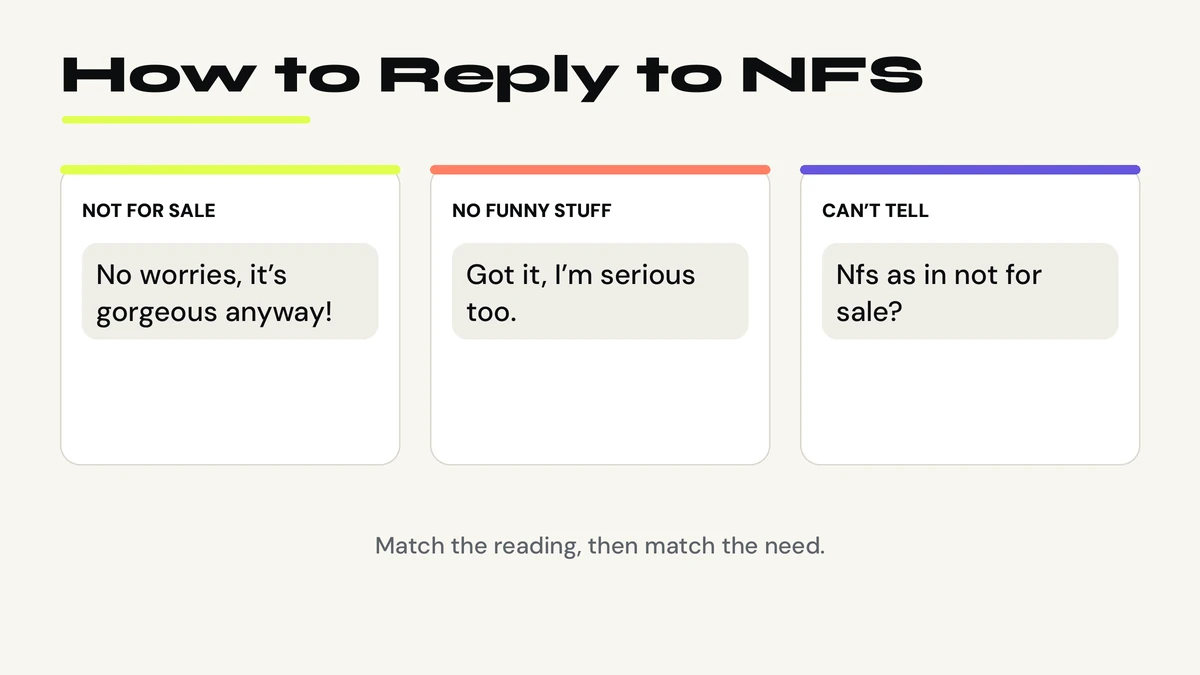
Golden rule: answer the reading the test found, not the letters. A reply bank keyed to the reading:
- Not for sale — accept it gracefully: “No worries, it’s gorgeous anyway!” The seller showed you something they love; a compliment costs nothing and a haggle costs the conversation.
- No funny stuff — show you are serious too: “Got it, I’m serious too — I’ll be there at six.” A boundary answered with a straight promise is a boundary respected, and the conversation moves on.
- New friends — answer the invite, or do not: “Hey! Just moved here too, what’s good around here?” if you want to talk — or nothing at all if you do not. An invitation is not an obligation, and a stranger gets no personal details either way.
- Not for sure — hold the door open: “No rush, let me know when you can.” If the maybe is about arrival rather than attendance, give a real time instead of a maybe — our ETA guide covers the honest way to give one, because “soon” is not a time and a fictional number is worse than no number.
- Not feeling social — accept it: “No worries, another day.” A quiet night is not a rejection, and the right response is simply to accept it and check in another day.
- You cannot tell — ask plainly: “Wait, nfs as in not for sale?” The honest reply when you cannot tell is a question, not a guess. People who use one sense are often surprised the others exist, and nobody has ever been offended by being asked what they meant.
Frequently Asked Questions
What does NFS mean in a text message?
Usually “no funny stuff”: “I’m serious, don’t joke or mess around.” Under a photo or a listing it means “not for sale,” and in a bio it means “new friends.” Run the Boundary Test — object, ask, room — before you decide which one you just got.
What does NFS mean on Snapchat?
It depends where it appears. In a bio or a story it usually reads as “new friends,” an invitation to add. In a chat it is more likely “no funny stuff,” a request to be serious. Snapchat is the most ambiguous platform for NFS, because both senses compete there — so the sender matters: a close friend means “I’m serious,” a stranger who just added you means “want to talk?”
What does NFS mean on Instagram?
Under a post of sneakers, a car, or art, “not for sale”: the owner is showing it, not selling it. In a bio it can mean “new friends.” Instagram is the sale sense’s home ground, because the platform is visual and the buy-it question comes up constantly — collectors add NFS to captions purely to stop the flood of enquiries.
What does NFS mean on TikTok?
In captions it usually means “not for sale,” on a post showing off an item. In comments and DMs it can mean “no funny stuff,” and in a bio it can mean “new friends.” No reputable source documents a platform-specific meaning for NFS, so this guide reports the lean, not a rule — read the context, not the app.
Is NFS rude?
No. Every common meaning is neutral or protective — declining a sale, asking for honesty, requesting privacy, or stepping back socially. It sets a boundary politely, which is exactly why it is so widely used. It only stings when the serious sense lands as an accusation — “no funny stuff” to someone who has done nothing wrong — or when the ruder spelling shows up where it does not belong.
Can I use NFS at work or school?
Generally, no. NFS belongs in casual digital conversations. In work messages, formal chats, or school messages it can sound unprofessional — and the sale sense risks being read as Network File System by anyone technical. In a casual peer chat about a game or a gadget it is fine; anywhere formal, spell the words out instead. The ruder spelling never belongs in a work or school message at all.
What should I reply when someone sends NFS?
Match the meaning. If it is “not for sale,” a simple “no worries, it’s lovely anyway” works. If it is “no funny stuff,” show you are serious too. If it is “new friends,” answer the invite or ignore it — never with personal details. If you genuinely cannot tell, asking “nfs as in not for sale?” is completely normal. The full reply bank is in the section above.
Does lowercase nfs mean something different from NFS?
No. Capitalization changes volume, not meaning: capital NFS reads a touch louder, lowercase nfs reads softer and faster, but both mean the same three things. What changes the reading is the object, the ask, and the room — never the case alone.
The Takeaway
NFS means three things, and the room decides which one: “no funny stuff” in a text, “not for sale” under a photo, “new friends” in a bio — with “not for sure,” “not feeling social,” and “not for sharing” riding along as secondary senses, and a racing game and a server protocol fenced off in their own rooms. When the letters land, run the Boundary Test: check the object, check the ask, check the room. And when you send them, remember the only rule that matters: a boundary is a request, not a verdict — so if you mean it seriously, say what you need, and if you mean it kindly, prove it with a follow-up sentence, because three little letters are doing the work of six different messages, and the person reading them deserves to know which one you sent.