What does jk mean in text? JK means “just kidding” — two letters that tell you the line before them was not meant literally. That sounds simple, and the letters are simple, but the timing is not: a jk that arrives in the same breath as the joke is a joke, and this guide to jk meaning in text teaches you to judge the line before the tag and the clock behind it.
This guide covers the one dictionary-attested expansion, the JK Rewind Test, a seven-job tone list, jk on TikTok, Snapchat, Instagram, and in texts, senders, the backpedal problem, graded claims, cousins, history, and a reply bank keyed to the job and the clock you just found.
What “JK” Means in Text
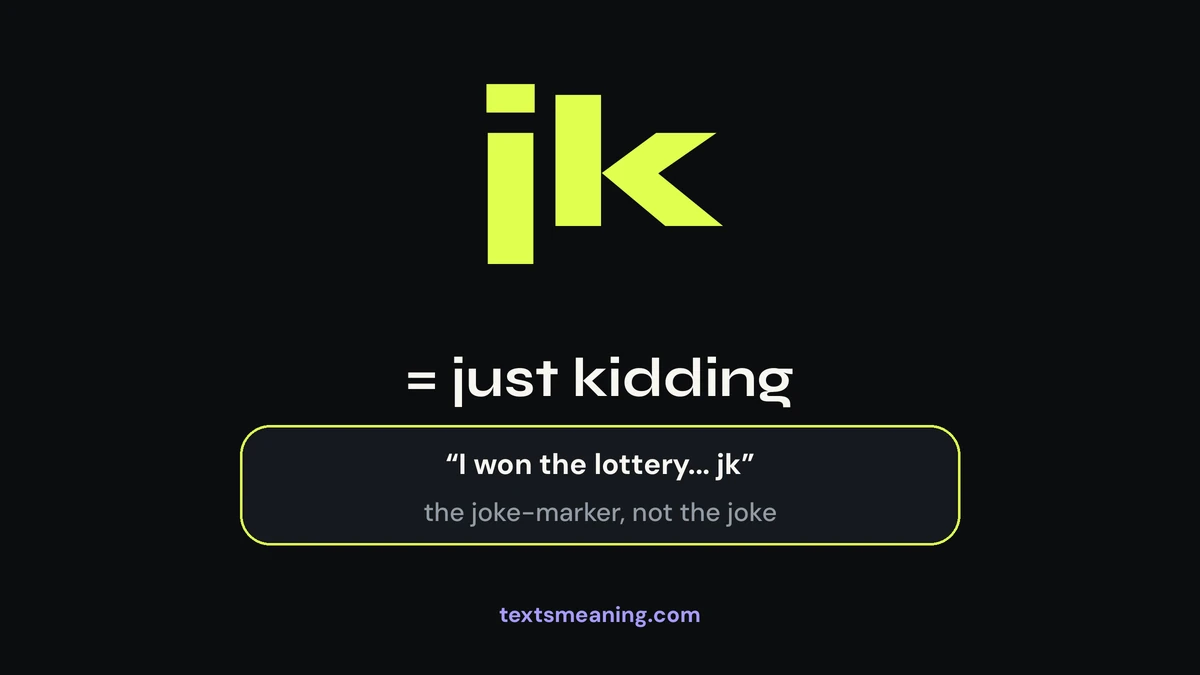
“JK” means “just kidding.” It is an initialism, built from the first letters of the phrase, and it works as a label you stick on the line before it: “I won the lottery… jk, I wish” does not report a win, it stages one and then releases it. The jk is not the message. The line before it is the message, and the jk only tells you how to take it. Older spellings — j/k with a slash, J.K. with periods — are the same term in older clothes, and lowercase jk is now the default in casual text.
The dictionary record is short and clean. Wiktionary, read directly for this article, lists JK in Internet slang and text messaging as an initialism of “just kidding,” with alternative forms jk and j/k. Every competitor guide read for this article agrees on the same expansion, and no competing texting expansion with any dictionary attestation was found. That agreement is exactly what makes jk tricky in a different way from most slang: when the meaning is certain, the puzzle moves somewhere else — not what the letters stand for, but whether the line they label was ever a joke, and whether the label arrived in time.
Two boundaries before the test. First, jk is a marker, not a mood: it does not say the sender is happy, sad, or angry, only that the line before it should not be taken literally. Second, jk never changes the line it follows into something else — it only claims the line was a joke. Whether that claim is true is a separate question, and it is the question this guide exists to answer, because a jk after a line that was meant is not a joke. It is a negotiation.
The JK Rewind Test
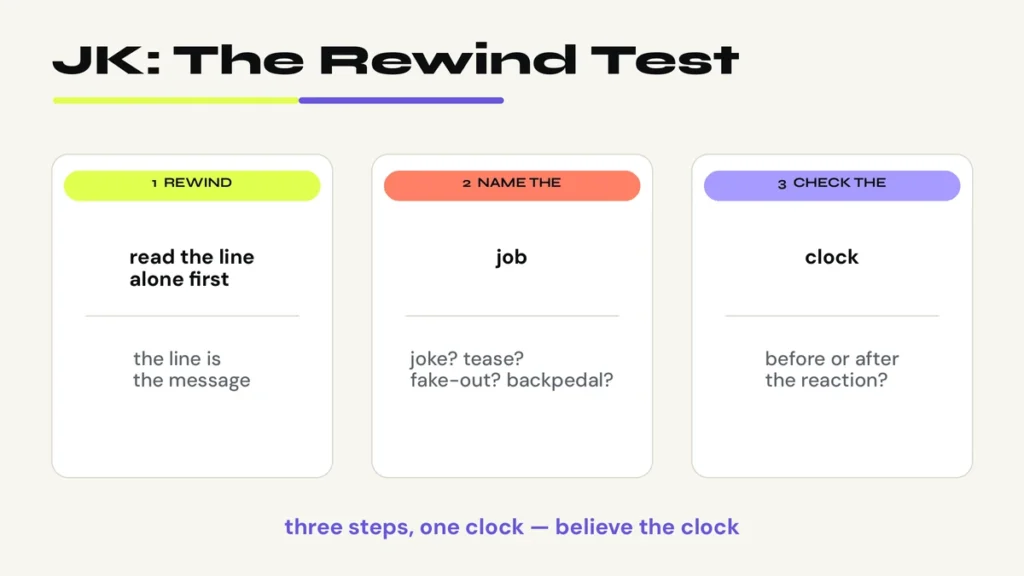
Before you answer a jk — or send one — run three steps. They take about five seconds, and they beat every shortcut the competitors offer, because the competitors all say “context matters” without giving you a procedure for reading it:
- Step 1 — Rewind. Cover the jk and read the line before it on its own. If the jk had never arrived, would this line be a joke, a tease, an insult, a confession, or a claim? The line is the message; the jk only labels it. A line that is absurd on its face (“I won the lottery” from someone who did not buy a ticket) was already a joke before the jk arrived. A line that is plausible and pointed (“I never liked your cooking”) was not.
- Step 2 — Name the job. What is the jk doing to that line? A joke flag confirms an obvious joke. A tease softener pulls a poke back before it stings. A fake-out defuser releases a staged shock. A sarcasm marker signs a reversal, where the line means its opposite. A flirt test keeps a risky line deniable. A backpedal tries to retract a line that was meant. Until you can name the job in one of those words, you have not read the message yet.
- Step 3 — Check the clock. When did the jk arrive relative to the reaction? Before any reaction (preemptive, usually honest: “jk, I am not actually mad” posted with the line). In the same message (standard, the normal case: the joke and its label travel together). Or after the other person already reacted (late, the backpedal zone: the jk is now negotiating, not labeling, and the reaction it is answering matters more than the joke it claims). Believe the clock more than the tag.
Worked trio. “I ate all your fries… jk, they are still in the bag” — rewind: a theft claim; job: fake-out defuser; clock: same message, honest joke. “You are the worst singer ever… jk” sent after the friend replied “wow, rude” — rewind: an insult; job: tease softener attempted; clock: late, so the apology inside the jk matters more than the joke claim. “jk, I am not actually quitting” posted hours after a resignation caption — rewind: a resignation claim; job: backpedal; clock: late, so readers are entitled to doubt it. Three tags, three clocks, one test.
“JK” in Real Chats
Illustrative examples written for this guide, not real transcripts:
- The lottery fake-out. “I won the lottery… jk, I wish.” — absurd on its face, jk confirms it. The joke was already visible before the tag.
- The fridge fake-out. “I ate all your leftovers… jk, they are still in the fridge.” — a staged shock, released on purpose. The release is the punchline.
- The dance tease. “You are terrible at dancing… jk, you are getting better.” — a poke pulled back before it stings, with a compliment doing the repair.
- The Monday sarcasm. “I love Mondays… jk.” — the line means its opposite and jk signs the reversal. Answer the real meaning, not the literal words.
- The quitting caption. “I am quitting TikTok… jk.” — a dramatic claim staged for an audience, then defused. The drama was the content; the jk was the wink.
- The outfit damage control. “That outfit is a choice… jk, it looks great.” — the line stung first, the jk tries to soften it second. The softening is only half the repair.
- The late backpedal. “I never liked your cooking, jk” after an upset reply — the jk arrived after the reaction, so it is negotiating, not labeling. Read it as doubt, not as a joke.
The JK Tone List
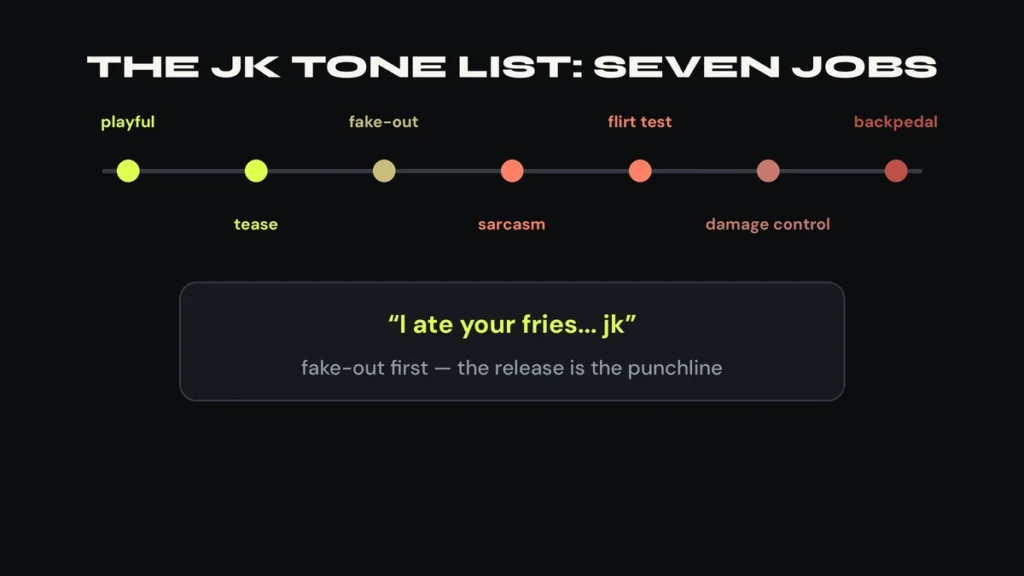
JK’s meaning never changes; its job slides across seven readings, lightest to heaviest:
- Playful joke: “I won the lottery… jk, I wish.” The default. An absurd line, confirmed as a joke.
- Friendly tease: “You are terrible at dancing… jk, you are getting better.” A poke with a pull-back built in.
- Fake-out: “I ate all your leftovers… jk, they are still in the fridge.” A shock staged and released on purpose.
- Sarcasm marker: “I love Mondays… jk.” The line means its opposite; the jk signs the reversal.
- Flirt test: “I do not like you at all… jk, mostly.” A risky line kept deniable. The jk is doing social work, not joke work.
- Damage control: “That outfit is a choice… jk, it looks great.” The line stung, the jk tries to soften it. The softening is real but incomplete.
- Backpedal: “I never liked your cooking, jk” after pushback. The line was meant, the jk arrived late, and the jk is negotiating. Do not file this under “joke.”
What moves a reading up or down this list is never the letters alone: it is the line before the jk (step 1), the job (step 2), and the clock (step 3), plus the emoji riding with it and the relationship behind it. A laughing emoji pulls any jk toward playful; no emoji, after a pointed line, pulls it toward damage control. The same “jk” that is a joke on Tuesday can be a backpedal on Friday — and the test, not the spelling, tells you which day you are on.
“JK” on TikTok
On TikTok, jk is a caption and comment-section device more than a private message: “I am quitting TikTok… jk” under a video, “I am moving to Antarctica for winter… jk” as a caption, or a commenter defusing their own hot take before the replies arrive. The public stage suits the fake-out and playful-joke readings best — a caption is an audience, and a staged shock with a built-in release plays well there. The trap on TikTok is the reverse of the private-chat trap: taking a public jk too personally. A creator who captions a dramatic claim with jk is performing a joke for a crowd, not confessing something about you, and a commenter who writes jk under a stranger’s video is joking about themselves, not inviting you anywhere.
TikTok is also where jk meets its closest caption cousin. A caption that says “me IRL” under a video is a self-portrait joke about the sender’s real life, not a retracted claim — our me IRL guide covers that portrait in full, and confusing the two is the one TikTok-specific misread worth naming: “me IRL” shows you the sender, while jk unsays a line. Same caption box, different jobs. If a jk arrives in a TikTok DM, though, run the test as usual — a DM is private again, and the clock rules return with it.
“JK” on Snapchat
On Snapchat, jk fits the fast, disappearing DM and the overlay caption: “You are the worst roommate ever jk” on a streak snap, or “I was about to block you for that take jk” as a story reply. The disappearing format suits the tease and fake-out readings — a poke that lands lightly and is gone. But disappearance also removes your evidence: if a jk felt like damage control, you cannot re-read the line it followed, so judge from memory what rode with it — a laughing emoji, a follow-up compliment, or nothing at all. And because streak culture rewards speed, Snapchat is where the barest jk lives: a lone “jk” on a streak snap is usually a tease softener, not a verdict on you.
Snapchat is also where the clock matters most, because the format gives you no second look. A friend’s jk on Snapchat is usually a joke you already understand from history; a new match’s jk, with no history and a pointed line before it, deserves all three steps before any reply. If you cannot answer step 3 from memory — did the jk arrive with the line, or after your reaction? — a warm, plain reply is safer than laughing at a joke nobody told.
“JK” on Instagram
On Instagram, jk shows up in captions, comments, story replies, and DMs, and the stage decides the job the way it does for every joke-marker. Captions lean performative: “I do not like pizza… jk, want some?” under a photo is a staged reversal posted for an audience, closer to a bit than a whisper. Comments lean teasing: “You failed the test? jk, you did fine” under a post is a poke with a pull-back attached. DMs carry the full range, exactly like texts — a friend’s fake-out and a match’s flirt test live in the same inbox, and only the test tells them apart.
Instagram is also where jk meets its letter-trap. A bio that says “JK” as initials — a name, a creator handle, a fandom tag — is not a joke-marker at all, and the namesake note in the checked-claims section fences those off. Read the whole string and the room around it: “jk” at the end of a sentence is a tag; “JK” standing alone as a name is a person. Same letters, different jobs.
“JK” in Text Messages
Plain texts are jk’s home ground, and the place its companion phrases are easiest to see. It pairs with the side-note companion BTW — “jk, btw, did you see the new episode?” stacks a joke-marker and an afterthought in one breath — and it travels with laughter markers that do different work: “jk lol” combines a joke claim with a laughter reaction, which is why the two so often travel together without meaning the same thing. Texts are also where the fake-out is cleanest, because there is no photo or video doing half the work: the line alone has to stage the shock, and the jk alone has to release it.
Texts are also jk’s work limit, stated plainly: never use jk in a professional message, a formal note, or any message where the reader cannot afford to misread you. A client, a manager, or a first contact deserves the full sentence, not two letters that presume the reader will enjoy your joke. The same rule covers serious topics: a condolence, an apology, or a real disagreement deserves complete sentences, not a tag that lets you take a line back. If the line matters, spell it out; if it does not matter, you probably did not need the jk either.
Who Is Sending It: How “JK” Lands by Sender
No source documents a different meaning of jk per sender — the expansion stays fixed; what changes is how much the joke can carry, and how much a backpedal can sting. One framing is rejected outright here: a competitor organizes sender sections by gender (“from a guy,” “from a girl”) while admitting the tone is the same. Gender does not decide a jk’s job. Relationship and stakes do, so this guide uses those instead:
- Friend: the default. A friend’s jk is a joke or a tease at face value; laugh or play along, and do not overread it.
- Crush: overread territory. A crush’s jk after a risky line is usually a flirt test, not a confession and not a rejection. Answer the risk at the level you are comfortable with, and if you want honesty, ask a direct question instead of mining the tag.
- Partner: pattern rules. A partner’s jk is usually a running joke; judge the pattern across days, not one message — but a sudden run of late jks after disagreements is a conversation worth having, because the clock, not the letters, changed.
- Parent: usually literal and plain. A parent who writes jk has usually learned it from you and means the joke plainly; do not read a parent’s jk as a backpedal unless the line before it was pointed.
- Coworker or boss: context decides. In a friendly team chat a colleague’s jk about lunch is a joke; in any formal thread it is out of place, and never send one upward to a manager or client.
- Group chat: the fake-out habitat. A group’s “I ate all the cake… jk” plays to the whole room; answer briefly in the group, and do not single one sender out for a private reading of a public joke.
- Stranger or creator: the performance habitat. A stranger’s jk under your post, or a creator’s jk in a caption, is a joke for an audience, not a message to you personally. A laugh or a scroll-past is enough; never answer in kind with personal details.
When “JK” Is Not Just a Joke
Four misfires, graded. First, the eraser trap: treating a late jk as if it deleted the line before it. It did not. A reaction that already happened — hurt, offense, a changed plan — is not undone by two letters, and pretending otherwise teaches the sender that any line can be taken back for free. Second, the joke-assumption trap: treating every jk as a real joke. A winkless jk after a pointed line about someone’s work, appearance, or cooking is not a joke that failed — it may be damage control that succeeded, and laughing at it tells the sender the room accepts it.
Third, the flirt-test trap: reading a deniable line as a confession, or dismissing a real feeling because it wore a jk. A jk keeps a line deniable by design, so neither the confession reading nor the dismissal reading is safe — ask, in plain words, if it matters. Fourth, the apology trap: accepting a jk as a full apology. A jk retracts a label (“I was not serious”); an apology owns an effect (“I am sorry that stung”). Those are different sentences, and only the second one repairs anything.
On appropriateness: jk is not rude and not vulgar in any reading; its risk is social, not moral — a joke where a real answer was owed, or a retraction where an apology was owed. Keep it out of formal, professional, and first-impression messages, out of condolences and serious topics, and out of any first message to someone you do not know well. And one boundary worth stating plainly: never use jk to dress up a real insult as a joke and then blame the reader for not getting it. If the line needed a jk to be safe, the line was the problem, not the reader.
Checked Claims: Expansions That Do Not Hold Up
- “JK means joking” — rejected as the expansion. The attested phrase is “just kidding”; “joking” is a near synonym, not what the letters stand for. Use it as a paraphrase, never as the expansion.
- “JK means something different on each platform” — rejected. The meaning never changes per platform; what changes is which job a platform stages most often — TikTok stages public fake-outs, Snapchat stages private teases.
- “JK is dead / nobody uses it anymore” — rejected. A competitor updated in November 2026 describes it as still active and highly used, and every competitor treats it as current. What changed is its status — classic shorthand, not trendy slang — not its survival.
- “JK means J.K. Rowling, a K-pop star, or a celebrity” — rejected as texting meanings. Those are namesakes sharing initials, not senses of the term. The same firewall covers Wiktionary’s non-texting senses: Jakarta, Jammu and Kashmir, Canadian junior kindergarten, and the Japanese fandom sense meaning a high-school girl. Genuine senses of the letters, zero relevance to English texting — noted here so nobody mistakes them for texting meanings, nothing more.
- “Uppercase JK and lowercase jk mean different things” — rejected. Wiktionary lists them as alternative forms of one entry; case changes volume and casualness, not meaning.
- “A jk after any serious statement turns it into a joke” — rejected as a blanket rule. A late jk after a reaction has already landed is a backpedal, not an eraser, and the clock step exists to catch exactly this.
- “JK is rude” — rejected as a blanket claim. The letters are neutral; rudeness lives in the line jk was attached to, or in using jk to retract something meant.
- “A guy’s jk and a girl’s jk mean different things” — rejected. The competitor that organizes senders by gender admits the tone is the same; relationship and stakes decide the reading, not gender.
What SURVIVES: “just kidding” (dictionary-attested, Wiktionary read directly, plus mainstream consensus), with the seven tone readings above as jobs of the same marker — not different meanings. Two competitor habits are flagged and not repeated: unattributed expert quotes (a linguist and a psychologist quoted with no source) and unmethoded usage stats (an “aura” score with no method). Nothing is claimed about a dictionary entry that was not read directly.
“JK” vs Its Closest Cousins
JK belongs to the tone-marker family — short signals that tell you how to take the sentence around them. They are not synonyms, and mixing them up is where misreads happen:
JK vs LOL: the distinction the main competitor gets right and this guide keeps. JK marks intent (“that line was a joke”); LOL marks reaction (“that was funny”). “I ate your fries… jk” means you did not eat them; “I ate your fries” plus a laugh means you did, and someone finds it funny. One cancels a claim, the other applauds one.
JK vs IMAO: our IMAO guide covers the opinion with a wink. IMAO jokes about confidence (“in my arrogant opinion”); JK jokes about a claim. IMAO says “take my swagger as a joke”; JK says “take my line as a joke.” Different halves of the sentence, same wink.
JK vs IKR: our IKR guide covers the agreement echo. IKR agrees with a feeling someone else stated; JK cancels a claim the sender just made. IKR looks backward at someone else’s line; JK looks backward at your own.
JK vs BRB: our BRB guide covers the pause. BRB pauses a conversation with a promise to return; JK cancels a line inside a conversation that continues. One stops the chat, the other edits it.
JK vs ISTG: our ISTG guide covers the oath. ISTG swears a claim (“believe this”); JK unsays one (“do not believe that”). They are mirror images: one adds force to a line, the other removes the line’s force. A sender who writes both is usually doing emphasis theater, not making two claims.
Where “JK” Came From
The phrase “just kidding” is ordinary English, older than the abbreviation by far; the abbreviation belongs to the late-1990s chat-room and forum era, when typing speed and character limits rewarded two-letter tone markers, and it carried into 2000s instant messaging and then SMS. One competitor reports the first Urban Dictionary definition dating to 2001 (“Acronym. Just kidding.”) — user-generated attestation, not a coinage claim, and no inventor or first-use date is claimed for the abbreviation itself.
JK survived every platform migration — chat rooms, SMS, social feeds, captions, gaming chats — because it solves a permanent problem (tone in text) rather than riding a trend. That longevity is itself the contrast with trend-driven slang: jk did not need to stay cool to stay useful, and the newest competitor update (November 2026) calls it classic internet shorthand, recognizable without being trendy. Two letters, thirty years of tone problems, one job that never changed.
How to Reply When Someone Sends “JK”
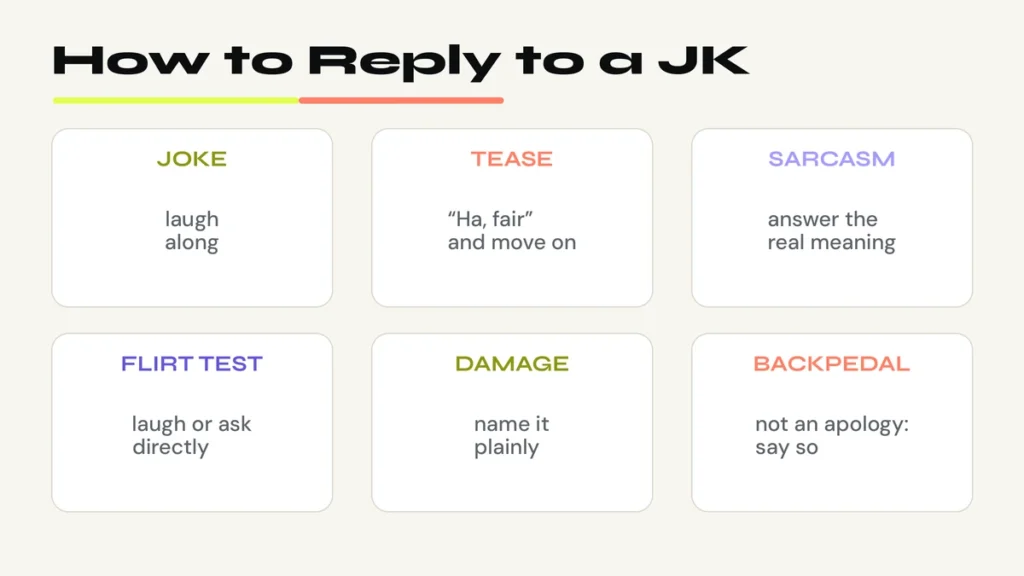
Answer the line the Rewind Test exposed, not the tag. The reply bank, keyed to the job and the clock:
- Joke flag or fake-out → laugh or play along: “You got me” / “I almost believed that.”
- Tease softener → accept it lightly if it was light: “Ha, fair.” Do not perform hurt for a joke.
- Sarcasm marker → answer the real meaning, not the literal words.
- Flirt test → answer the risk at the level you are comfortable with. A laugh keeps it light; a direct question (“Wait, were you serious?”) forces the honesty the jk avoided.
- Damage control or backpedal → name what happened plainly: “That one actually stung a bit.” A jk retracts a label; it does not apologize, so do not accept it as one.
What you never owe anyone: a laugh at a joke that stung, an apology for a line you did not write, or a jk of your own as the whole answer to a serious line. And never demand a jk from someone — if a line needed one and did not get one, say so in plain words: “Were you joking just now?” costs nothing and settles the clock question at once.
Frequently Asked Questions
What does jk mean in text?
JK means “just kidding” in texting. It signals that the line before it was meant as a joke and not to be taken literally, and the JK Rewind Test above shows you how to judge whether that signal is honest.
Is jk the same as joking?
No, not as an expansion. JK stands for “just kidding”; “joking” is a near synonym you can use as a paraphrase, but it is not what the letters stand for. The distinction matters because paraphrases drift and expansions do not.
Where should jk go in a sentence?
Usually at the end, right after the line it labels: “I ate all your fries… jk.” A leading jk (“jk, I am not actually mad”) works as a preemptive flag, and a mid-sentence jk usually confuses readers, because the line it labels is not finished yet.
Does a jk after a hurtful message make it okay?
No. A jk retracts a label (“I was not serious”); it does not apologize or undo a reaction that already happened. If a line stung, the repair is a plain sentence — “I am sorry that stung” — not two more letters.
Can I use jk at work?
In a friendly team chat, a light jk about lunch or a deadline joke is usually fine. In formal email, with a client, or with senior leadership, no — spell the sentence out. A joke that needs a tag to be safe is a joke that does not belong in a work thread.
What is the difference between jk and lol?
JK marks intent and LOL marks reaction. JK says “that line was a joke”; LOL says “that was funny.” “I ate your fries… jk” means you did not eat them; “I ate your fries” plus a laugh means you did.
Does jk mean something different on TikTok?
No. The meaning never changes per platform; what changes is which job a platform stages most often. TikTok stages public fake-outs in captions, Snapchat stages private teases in DMs, and texts carry the full range.
How do I reply when someone sends jk?
Answer the line, not the tag: laugh at a real joke, play along with a fake-out, answer the real meaning behind sarcasm, and name it plainly when a late jk was damage control rather than a joke. The reply bank above has a line for each job.
The Takeaway
Two letters, one rule. JK means “just kidding” — a label on the line before it, not a message of its own. Run the Rewind Test on every jk you receive: rewind the line, name the job, check the clock. Believe the line before the tag, and believe the clock more than the tag, and you will never again mistake a backpedal for a joke — or a joke for an insult.