What does iykyk mean in text? IYKYK means “if you know, you know” — five letters that point at a joke, a memory, or a reference without explaining it. If you are in on it, you smile instantly. If you are not, the letters are the whole joke, and you are standing outside it. This guide to iykyk meaning in text teaches you to tell which side of that door you are on, and what to do from there.
This guide covers the one dictionary-supported expansion, the IYKYK Inside-Joke Test, a seven-reading tone list, iykyk on TikTok, Snapchat, Instagram, and in texts, senders, the exclusivity question nobody else answers honestly, graded claims, cousins, history, and a reply bank keyed to the door you are standing at.
What “IYKYK” Means in Text
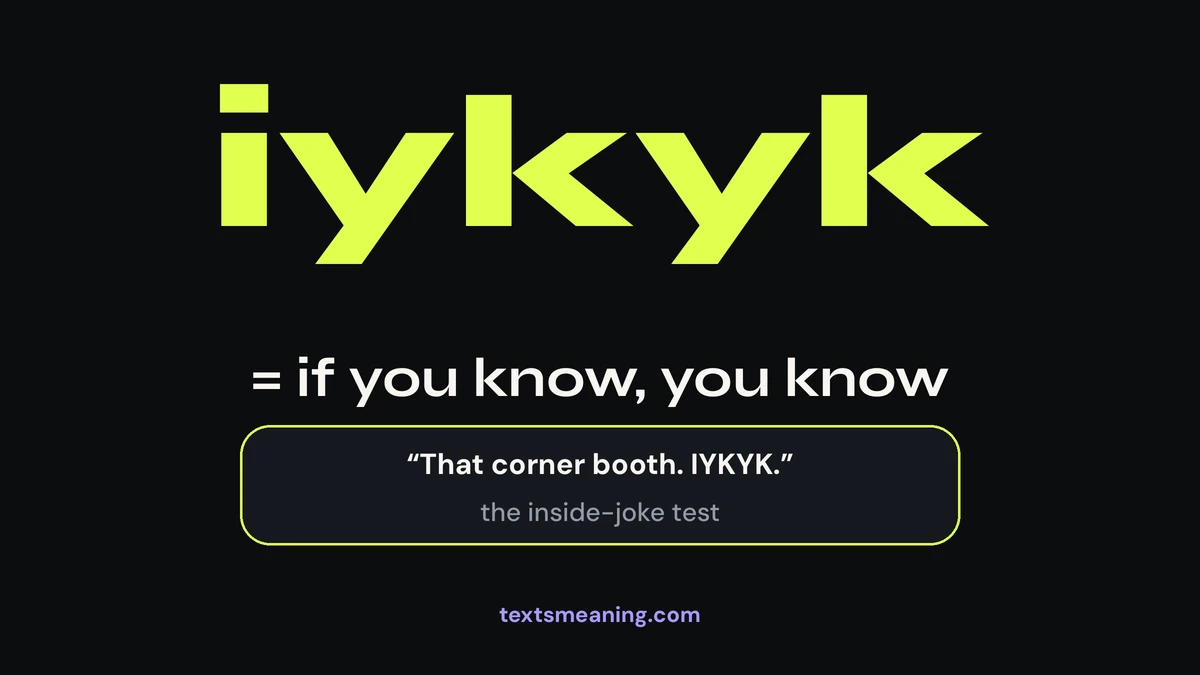
“IYKYK” means “if you know, you know.” It is an initialism, built from the first letters of the phrase, and it works as a pointer, not as a piece of information: it tells the reader that something worth knowing sits behind the message, and that the sender is not going to spell it out. It usually sits after the reference it points at (“That corner booth. IYKYK.”), it can stand alone as a whole reply when someone else has already made the reference, and as a hashtag (#iykyk) it turns the pointer into a label other people can search for. It is often read out as the full phrase, letter by letter or all at once, and the meaning does not change either way.
The dictionary record is short and consistent, and this guide states its limits plainly. Wiktionary lists IYKYK as an informal, humorous initialism of “if you know, you know,” with a 2023 Atlantic citation showing it in ordinary prose, and it lists ifykyk as a variant form of the same entry. Merriam-Webster lists IYKYK in its slang dictionary as “if you know, you know” — a list attestation, not a full dictionary entry, and this guide does not dress it up as more than that. Dictionary.com, read in full for this article, gives the same expansion as an informal word summary (it says so itself: this is not a formal definition), used after a statement or a piece of content to mark an inside joke or a reference only a select group understands, usually without any further explanation.
That agreement is exactly what makes iykyk tricky, and it is a different kind of tricky from the last article. ISTG had one meaning with many jobs; IYKYK has one meaning with many doors. The letters never change, but the reader’s position changes everything: the same five letters can be a warm welcome, a teasing hint, or a door quietly closing in your face, and the letters alone never tell you which one you just got. Most of the time, the reference does the real work. A photo of a broken chair, a street name, a song lyric, a night nobody wrote down — iykyk only points. If the reference means nothing to you, the pointer points at nothing, and that emptiness is itself information: the message was not built for you. Most iykyk moments point at something that happened in real life, not on a screen — a place, a night, a person — and our IRL guide covers that other side of the screen in full.
One more distinction before the test: iykyk is not a question, and it is not a secret. It does not ask whether you know; it states that some people already do. And it does not mean the reference is hidden or forbidden — often it is perfectly public, just specific. A whole city can know a restaurant, a whole fandom can know an episode, and iykyk still works, because “knowing” here means recognizing, not being told. If you had to be told, you were not in the circle yet. That is the whole mechanism, and the test below reads it in three steps.
The IYKYK Inside-Joke Test
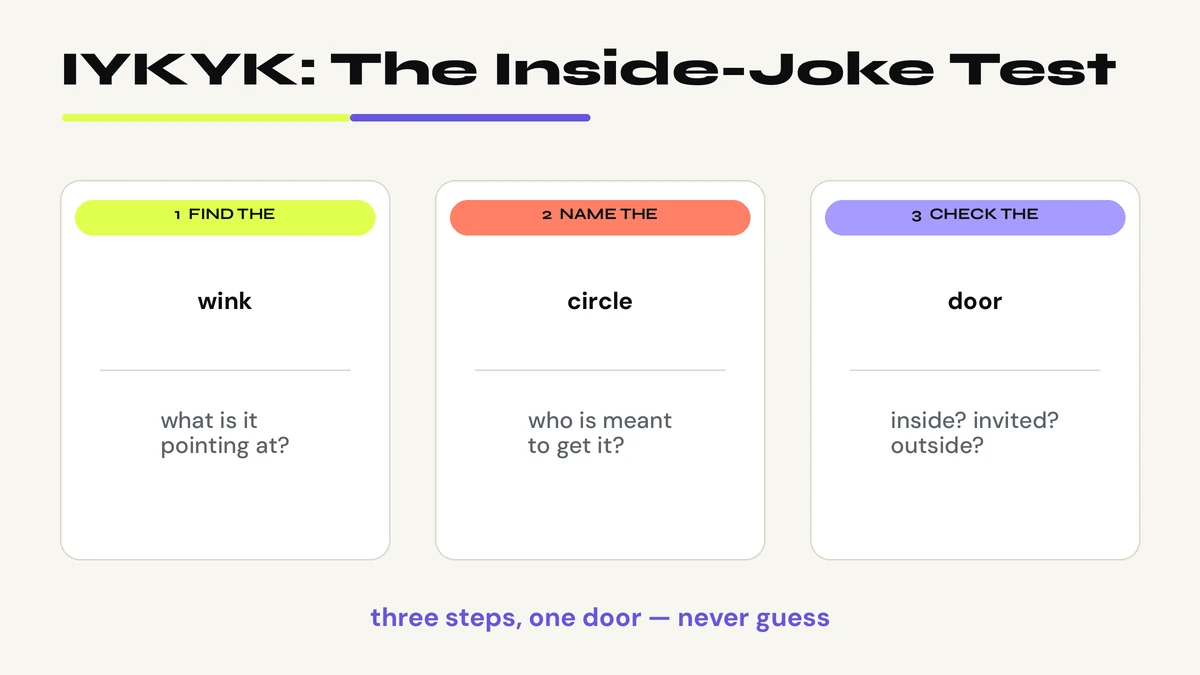
Before you answer an iykyk — or send one — run three steps. They take about five seconds, and they beat every shortcut the competitors offer, because the competitors all say “context matters” without giving you a procedure for reading it. The test does not ask what the letters mean. It asks where you are standing.
- Step 1 — Find the wink. What is the reference pointing at? A photo, a place, a line, a night, a song, a person. Point at it, even silently. If you cannot point at anything — no photo, no place, no story, just the letters floating alone — then there is no joke yet, only a bluff. A wink with nothing behind it is the first thing the test catches, and it is the most common way iykyk is misused.
- Step 2 — Name the circle. Who is meant to get it? A friend group, a fandom, a neighborhood, everyone who watched one show, everyone who survived one school. Name the circle as specifically as you can. “People who were there” is a start; “our table at lunch in tenth grade” is an answer. The narrower the circle, the warmer the joke feels to insiders — and the colder it feels to everyone else, which is why step 3 exists.
- Step 3 — Check the door. Are you inside, invited, or outside? Inside: you recognize the reference, and the message is a nod to you. Invited: the sender wants you to ask, to learn, or to laugh along and join the circle — the wink is an opening, not a wall. Outside: the message was built for a circle you are not in, and no reply is owed. The door decides the reply, and guessing at the door is where nearly every iykyk misread starts.
Worked quartet. “That corner booth. IYKYK.” under a photo your whole friend group recognizes — wink: the booth; circle: your group; door: inside — laugh, add a detail. A crush texts “Remember that night? IYKYK” after a first date — wink: the date; circle: the two of you; door: invited — the hint is an opening, answer the memory, not the letters. A stranger captions a city in-joke “IYKYK” and you have never been there — wink: a local reference; circle: locals; door: outside — scroll on, nothing is owed. A creator posts “Something big is coming. IYKYK.” with no reference at all — step 1 fails, there is no wink to find, and the letters are a bluff: hype wearing an inside joke’s clothes. Four doors, one test, no guessing.
“IYKYK” in Real Chats
Illustrative examples written for this guide, not real transcripts:
- The old place. “That corner booth. IYKYK.” — the booth is the whole story, and everyone who sat there knows which story.
- The shared night. “Last summer, that roof. IYKYK.” — a date, a place, and nothing else. Outsiders see a roof; insiders hear a night.
- The fandom nod. “That episode. IYKYK.” — no title, no season, no explanation. The circle is everyone who watched it, and the test is whether you flinch.
- The family joke. “Mom’s burnt toast, IYKYK.” — the warmest circle there is, because the reference is a kitchen, not a secret.
- The group-chat callback. A photo of a broken chair, captioned only “IYKYK.” — the photo is the wink, the group is the circle, and the caption is the nod.
- The public caption. “Same street, ten years later. IYKYK.” — a caption for an audience, not a whisper: anyone who knows the street is invited in.
- The reply-only iykyk. Someone posts a vague reference; a friend replies with a bare “iykyk.” — not a new joke, but a claim: I got it, I was there too.
- The bluff. “Something big is coming. IYKYK.” — no reference, no circle, no wink. Step 1 fails. Do not fake recognition for a message that gave you nothing to recognize.
The IYKYK Tone List
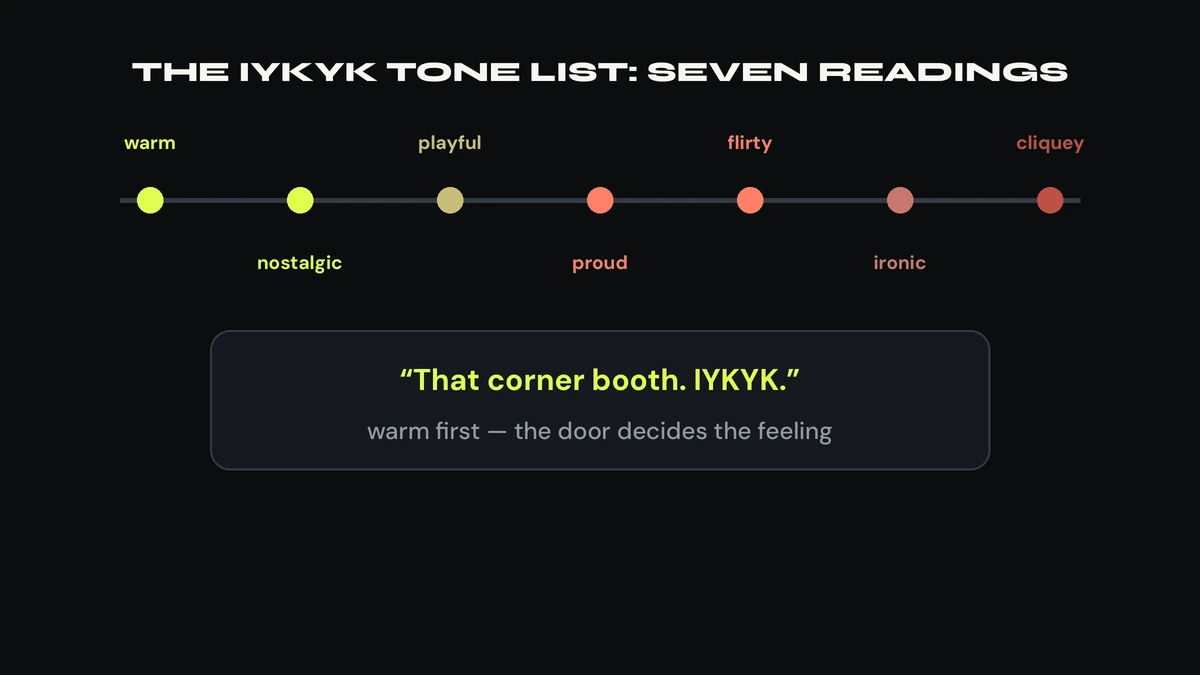
IYKYK’s meaning stays “if you know, you know”; its feeling slides. Seven readings, warmest to riskiest:
- Warm inclusion: “That corner booth. IYKYK.” among friends — a hug in five letters. The circle is open to everyone reading, because everyone reading was there.
- Nostalgic: “Same street, ten years later. IYKYK.” — the joke is really a memory, and the letters are just the frame around it.
- Playful tease: “You already know. IYKYK.” with a laughing emoji — the tease is the point, and the emoji is what keeps it kind.
- Proud badge: “Local kids get it. IYKYK.” — fandom pride, city pride, team pride. The circle is big, and the badge is meant to be seen.
- Flirty hint: “Remember that night? IYKYK.” from a crush — a private memory offered as a door, not a confession. Answer the memory, not the hint.
- Sarcastic or ironic: “Oh sure, Mondays. IYKYK.” — the “inside joke” is something everyone knows, and the joke is pretending it is exclusive.
- Cliquey exclusion: “IYKYK” posted where half the group cannot know — the same letters, aimed. The circle is the weapon here, not the joke, and the section on exclusivity below says what to do about it.
What moves a reading up or down this list is never the letters alone: it is the reference (step 1), the circle (step 2), and the audience. A caption for followers is a badge; the same letters in a three-person chat where one person was not there is a wall. Caps add a little volume, lowercase relaxes it, and an emoji can rescue a tease or sink it — but the door, not the decoration, decides the feeling.
“IYKYK” on TikTok
On TikTok, iykyk is a comment-section signal and a caption badge more than a private message: “IYKYK” under a relatable video claims shared experience with the whole comment thread at once, and a creator captioning a niche reference with #iykyk is sorting an audience — insiders comment, outsiders scroll. The public stage suits the proud-badge and nostalgic readings best, because a comment thread is an audience, not a living room, and nobody there is owed an explanation.
The trap on TikTok is the bluff, in public. Commenting “iykyk” on a video whose reference you did not get marks you as someone performing membership, in front of everyone, and the thread usually knows. If an iykyk arrives in a TikTok DM, though, run the test as usual — a DM is private again, and the door rules return with it: a private iykyk is a hint or a callback, not a badge.
“IYKYK” on Snapchat
On Snapchat, iykyk fits the fast, disappearing story reply: “IYKYK” over a photo of a place only two people know, or a streak snap carrying a callback for a few seconds before it vanishes. The disappearing format suits the warm and playful readings — a nod that lands lightly and is gone. But disappearance also removes your evidence: if an iykyk felt cliquey, you cannot re-read it, so judge from memory what rode with it — a photo, an emoji, or nothing at all.
Snapchat is also where the photo does half the work, which is why step 1 matters most here. A picture of a familiar street plus “IYKYK” needs no explanation: the image names the reference, and the letters only nod at it. A bare “iykyk” with no image and no context, on the other hand, is a wink with nothing behind it — and on a disappearing app, a bluff is even cheaper, because it vanishes before anyone can ask what it meant.
“IYKYK” on Instagram
On Instagram, iykyk shows up in captions, comments, story replies, and DMs, and the stage decides the door the way it does for every pointer word. Captions lean public and badge-like: “That place. IYKYK.” under a travel photo is a signal to an audience, closer to a flag than a whisper. Comments lean communal: “iykyk” under a relatable post is a claim of membership the whole thread can join. DMs carry the full range, exactly like texts — a friend’s callback and a crush’s hint live in the same inbox, and only the test tells them apart.
Instagram is also where the hashtag does separate work from the word. As a caption, iykyk nods at a circle; as #iykyk, it also files the post under a label strangers can browse, which is a stranger door than any private joke: people who have never met you can find the post by the tag and claim the circle anyway. And when an iykyk arrives in an Instagram DM, remember what channel you are on — our DM guide covers the private inbox in full, and the difference matters: a public caption performs for a crowd, a DM whispers to one person, and the same five letters mean a different door in each place.
“IYKYK” in Text Messages
Plain texts are iykyk’s home ground for private callbacks, and the place its companion phrases are easiest to see. It pairs with the side-note companion BTW — “iykyk, btw, did you see the new place on our street?” stacks a nod and an afterthought in one breath, and our BTW guide covers the second half — and it stacks with itself in group chats, where one iykyk from a friend pulls a second “iykyk” from another friend, and the thread becomes a roll call of the circle.
Texts are also iykyk’s work limit, stated plainly: never use iykyk where everyone must understand. Instructions, safety information, a serious announcement, or a group chat where half the members were not there all deserve complete sentences, not a pointer that assumes shared ground. The same rule covers formal writing and any first message to someone you do not know well: if the reader cannot possibly be in the circle yet, iykyk does not invite them in — it tells them they are out.
Who Is Sending It: How “IYKYK” Lands by Sender
No source documents a different meaning of iykyk per sender — the expansion stays fixed; what changes is the door, and therefore what you owe back:
- Friend: the default. A friend’s iykyk is a callback at face value; name the reference and answer that, not the letters.
- Crush: hint territory. A crush’s iykyk feels bigger than it is — usually a private memory offered as a door, not a confession. Answer the memory warmly, and do not mine a hint for devotion the way a confession would demand. The contrast helps: our ILY guide covers letters that say a feeling outright, while iykyk only points at a shared moment.
- Partner: pattern rules. A partner’s iykyk is usually shared-history shorthand; judge the pattern across days, not one message — but a sudden run of iykyk hints about things you were never part of is a conversation worth having, not a joke to laugh off.
- Parent: usually literal and plain. A parent who writes iykyk has learned the term from you and means the callback plainly; do not read a parent’s iykyk as exclusion unless the reference is plainly aimed at someone.
- Group chat: the circle test at scale. A group’s “IYKYK” nods at the members who were there; answer briefly in the group, and do not single one sender out for a private reading of a public nod — or for a private complaint about being left out.
- Creator or stranger: the badge habitat. A creator’s iykyk in a caption, or a stranger’s iykyk under your post, is audience-building, not a personal message. A laugh or a like is enough; never answer in kind with a private memory of your own.
- Coworker: context decides. In a friendly team chat a colleague’s iykyk about a shared workday is a joke; in any formal thread it is out of place, and never send one upward to a manager or client about something they cannot know.
When “IYKYK” Is Not Just Playful
Four misfires, graded. First, the mixed-group wall: posting iykyk in a chat where half the members cannot know the reference, then acting surprised that someone feels left out. The letters did exactly what they were built to do — they drew a circle — and the sender chose who stood outside it. Second, the gossip shield: using iykyk to talk about someone who is present in the thread, in code. That is not an inside joke; it is exclusion with a punchline, and the fix is not a better abbreviation, it is not posting it.
Third, the bluff habit: iykyk with nothing behind it, used so often that the sender’s winks stop meaning anything. A circle that never names a reference is not a circle; it is a costume, and readers learn fast. Fourth, the forced-membership misread: answering a bluff or a badge with a fake “iykyk” of your own, claiming a circle you are not in. Nobody owes a performance of belonging, and a faked nod is found out the moment the conversation asks for a detail.
On appropriateness: iykyk is not rude and not vulgar in any reading; its risk is social, not moral — a wall where a bridge was owed, or a joke where clarity was owed. Keep it out of formal, professional, and first-impression messages, out of instructions and serious announcements, and out of any message where being understood matters more than being recognized. And one fix worth stating plainly, because no competitor states it: the bridge line. If you must post a callback in a mixed group, add one line for outsiders — “long story, ask me later” — and the wall becomes a door. It costs eight words, and it is the difference between playful gatekeeping and deliberate exclusion.
Checked Claims: Expansions That Do Not Hold Up
- “IYKYK means ‘I think you know’” — rejected. No dictionary attests it; the attested phrase is “if you know, you know,” and swapping “if” for “I think” turns a statement about a circle into a guess about one person.
- “IYKYK is a question” — rejected. It is always a statement confirming that some people already know. A question mark after it (“iykyk?”) is a reply asking whether the other person got the reference — a question about the joke, not a question inside the letters.
- “IYKYK means something different on each platform” — rejected. No source documents a platform-specific meaning; TikTok comments, Snapchat captions, Instagram hashtags, and texts stage the same pointer differently.
- “IYKYK is only for Gen Z or teens” — rejected. The earliest documented use cited by Dictionary.com dates to 2009, before Gen Z texting dominated, and fandoms, friend groups, and local communities of every age use the same pointer today.
- “IYKYK started on TikTok” — rejected. The 2009 attestation predates TikTok by years; Dictionary.com dates the growth to the mid-2010s, on social media broadly, not on one app.
- “IFYKYK is a different word” — rejected. Wiktionary lists ifykyk as a variant form of the same entry, not a second meaning — the extra letters are a spelling variant, not a new joke.
- “Lowercase iykyk means something different from IYKYK” — rejected. The lowercase form is the casual spelling of the same pointer; caps add volume, not a new definition.
- “IYKYK is rude by itself” — rejected. Exclusion is a use, not the meaning: the same letters build a warm circle among friends and a wall in a mixed group, and the test, not the spelling, tells you which one you are looking at.
What SURVIVES: “if you know, you know” (Wiktionary initialism, Merriam-Webster slang-list attestation, and Dictionary.com informal summary, all read directly), with the seven tone readings above as feelings of the same pointer — not different meanings. No competitor percentages are repeated here as fact, and nothing is claimed about a dictionary entry that was not read directly.
“IYKYK” vs Its Closest Cousins
IYKYK belongs to the shared-knowledge family — words that sort readers into those who get it and those who do not. Its closest cousins split by what they sort:
- FR (“for real”): the sincerity cousin. Our FR guide covers a marker that vouches for a claim or agrees with one; IYKYK vouches for a reference. FR certifies truth, IYKYK certifies shared knowledge — same confidence, different object.
- IKR (“I know, right?”): the echo cousin. Our IKR guide agrees with a feeling someone else already stated; IYKYK points at a reference nobody stated fully. IKR needs a prior line to echo; IYKYK needs only a circle to nod at.
- “You had to be there”: the spoken ancestor. The older phrase says the same thing in full sentences — the experience cannot be explained to outsiders — and IYKYK is its compact internet form, built for captions and comments.
- IYKWIM (“if you know what I mean”): the nudge cousin, discussed by name only. It hints at a shared understanding of a suggestion or an innuendo, where IYKYK points at a shared memory or reference. One nudges, the other nods.
- YKYK (“you know, you know”): the shorter cousin, discussed by name only. It drops the “if” and reads more like a check-in — you know what I mean? — where IYKYK states the circle as a fact.
- “Those who know, know”: the proverb cousin. The older saying is the idea IYKYK compressed: knowledge as membership, stated without explanation, and left there.
And one name-only neighbor worth fencing: an inside joke itself is not IYKYK. An inside joke is the thing being pointed at; IYKYK is the finger. Confusing them is why the bluff works — a sender who posts only the finger, with no joke behind it, is counting on you not to check step 1.
Where “IYKYK” Came From
The phrase “if you know, you know” is ordinary English, older than the abbreviation by a long way, and it belongs to the same family as “those who know, know” and “you had to be there”: sayings that treat shared experience as something that cannot be transferred by explanation. The abbreviation is the internet’s compression of that idea, and its dating is reported here as a conflict, not smoothed over. Dictionary.com, read in full, cites use on social media since at least 2009 — a post dated August 13, 2009 — with use growing in the mid-2010s. Other guides date the mainstream spread later, to around 2016 on Twitter and Instagram, or to the meme and short-video wave around 2019–2020. Those dates do not contradict each other if they are read as different milestones: 2009 is the earliest documented use, the mid-2010s is the growth, and the late 2010s is the mainstream moment. No inventor or single coinage date is claimed, because no source documents one.
What the sources do agree on is the mechanism of the spread: memes, fandom communities, and short-form video gave the pointer a stage where a vague photo plus five letters could do the work of a whole story, and the hashtag form let strangers sort themselves into circles without ever meeting. That is why iykyk survived where other abbreviations faded: it does not save typing so much as it saves explaining, and explaining is exactly what an inside joke refuses to do. The hashtag did the rest — #iykyk turned a private nod into a public label, and a public label into a searchable community.
How to Reply When Someone Sends “IYKYK”
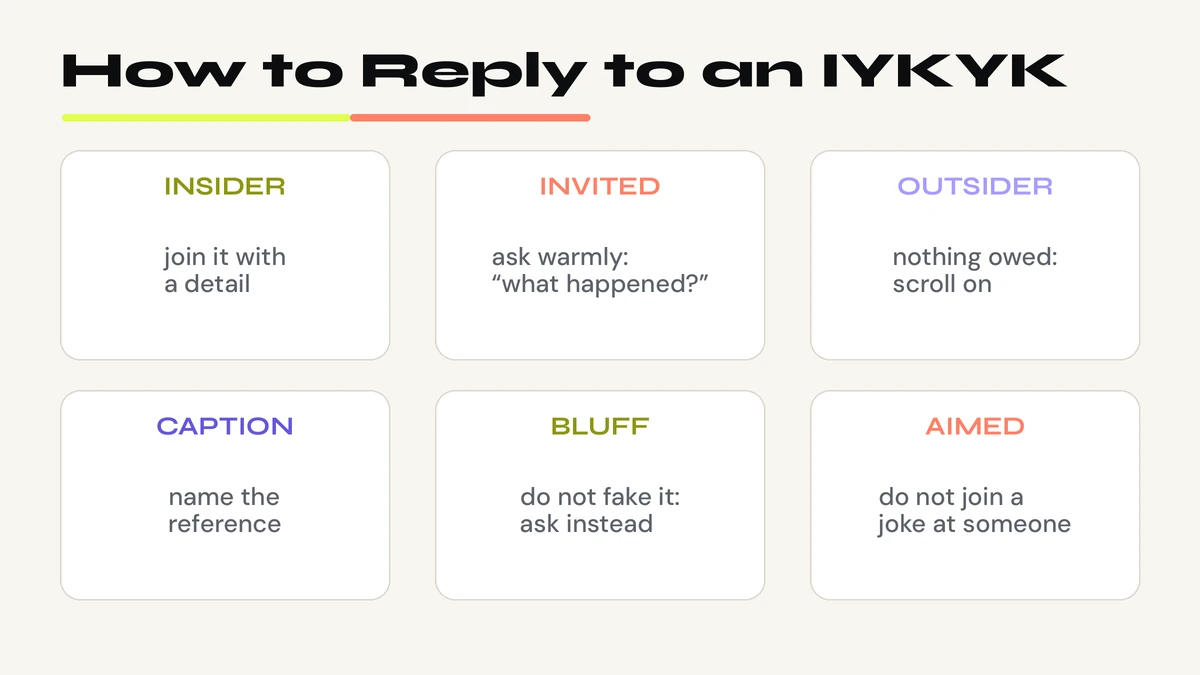
Match the door, not the letters. Six replies, keyed to the position the test found:
- Inside — join it with a detail: “That booth! I still think about that night.” A detail proves membership better than a bare “iykyk” ever could.
- Invited — ask warmly: “Okay, I need the story — what happened?” An invitation deserves an acceptance, not a performance of knowledge you do not have.
- Outside — nothing is owed: scroll on, laugh if it is funny anyway, or ask only if you actually want in. Silence is a complete reply to a message built for someone else.
- Public caption, and you get it — comment the detail, not just the letters: a comment that names the reference joins the circle; a bare “iykyk” only claims it.
- Bluff — do not fake it: if step 1 found no reference, do not reply with recognition you do not feel. A question (“What is the reference?”) is honest; a faked nod is found out by the first follow-up.
- Aimed at someone present — do not join it: if the joke’s circle is drawn around a person in the thread, laughing along makes you part of the wall. Change the subject, or say so plainly.
What never works: answering an invited hint with a cold “I don’t get it” and nothing else, answering a wall with a begging question, or answering a bluff with a bluff. The golden rule: the door decides the reply, and the test finds the door. If you cannot find the door, you have not read the message yet — and a warm question costs nothing.
Frequently Asked Questions
What does IYKYK mean in a text message?
“If you know, you know.” In a text it points at an inside joke, a shared memory, or a reference the sender expects you to recognize without an explanation. If you recognize it, you are in the circle; if you do not, the message was built for someone who does.
Is IYKYK a question?
No. It is a statement that some people already know. A question mark after it, as in “iykyk?”, turns the reply into a question about whether you got the reference — but the letters themselves never ask anything.
What is the difference between IYKYK and YKYK?
YKYK, short for “you know, you know,” is a shorter cousin that reads more like a check-in — you know what I mean? — where IYKYK states the circle as a fact. They are close, but they are not the same word, and the dropped “if” is the difference.
Can IYKYK be rude or exclusive?
By itself, no — it is not a rude word. But it can be used to exclude: posting it where half the group cannot know the reference draws a circle with people outside it. The bridge line fixes most of it: add “long story, ask me later” and the wall becomes a door.
Does IYKYK mean something different on TikTok, Snapchat, and Instagram?
No. The meaning never changes per platform; what changes is the stage. TikTok stages it as a public badge, Snapchat keeps it as a private disappearing nod, Instagram uses it as both a caption and a searchable hashtag, and texts carry the private callback. Same pointer, different doors.
How do you pronounce IYKYK?
Say the individual letters: I-Y-K-Y-K. Many people also say the full phrase, “if you know, you know,” and both are understood. There is no single spoken form the dictionaries insist on.
What do you reply if you do not get the reference?
Nothing is owed, and a warm question costs nothing: “Okay, I need the story — what happened?” works when the door is invited, and silence works when it is not. What does not work is faking recognition — a follow-up question will find it out.
Is IYKYK only for Gen Z?
No. The earliest documented use cited by Dictionary.com dates to 2009, and fandoms, friend groups, and local communities of every age use the same pointer today. It is most visible in Gen Z chats, but it is not owned by them.
The Takeaway
IYKYK is a five-letter pointer — “if you know, you know” — that sorts readers into those who recognize a reference and those who do not, without explaining the reference to anyone. When the letters arrive, run the Inside-Joke Test: find the wink, name the circle, check the door. And when you send one, remember the only rule that matters: a wink needs something behind it, and a circle needs a door. If the reference is real and the door is open, iykyk is the warmest shortcut in texting. If either one is missing, it is a bluff or a wall — and now you know which one you are looking at.